Background of the Study
Internationalization is fast changing the educational landscape of many countries in the world. The enor- mous developments in Information Technology have made substantial effect in education. The geographical distance between students and teachers in different countries is becoming narrower each day. Through the internet, students can easily connect themselves to different people, experts, and information from different parts of the world. As a result, many curricular and instructional innovations were introduced in all levels of education. Internationalization of education is fast becoming the focus of schools, colleges, and universities across the globe. According to Diokno( )interna- tionalization exposes faculty and students to new learning opportunities and environments and enables them to understand different cultures. As consequence, it is a crucial task for teacher education institutions to develop global teachers.
The idea of developing global teachers is real.
Global teachers are not only those who possess high level of Technology and Pedagogical Content Knowledge
(TPCK); they understand the multicultural nature of every classroom and possess good communication skills.
They can communicate their ideas to different types of learners and they plan instruction that engage the learners into deeper and meaningful learning process.
They understand that each classroom is filled with students coming from different places bringing with them their culture, prior knowledge, experiences, needs, aspirations, and their language(Pawilen, ).
Yanagisawa( )reiterated the need to develop students who have global perspectives and to foster human resources which can be active anywhere in the world. In the field of teacher education, responding to
this challenge requires academics to develop students with necessary skills and knowledge needed by the society and to prepare global teachers who posses high level of intercultural competence. Bennett ( ) defined intercultural competence as the ability to interpret intentional communications(language, signs, gestures), some unconscious clues(e. g. body language), and customs in cultural styles different from oneʼs own.
The emphasis of intercultural competence is empathy and communication.
The English language is still the worldʼs interna- tional language and it is continuously gaining prominence in countries where English is not their first language, like Japan. Many people across the globe use English when they go to different countries ; it is the dominant language used in the academe, tourism, politics, busi- ness, and in many fields aside from their national and local language. Thus developing the language competence and confidence of teachers in using English as a medium of instruction is necessary for developing global teachers(Pawilen, Sumida, & Calingasan, ).
Responding to the urgent need for the teacher education to develop English ability for teaching purpose, the authors and their colleagues planned and imple- mented a course meeting the demand. In developing Japanese student teachersʼ ability to plan lessons in English, effective and constant mentoring is important
(Hiwatig, et al., ). According to Goodwin( ) verbal and cognitive ability of teachers is important.
Given that teachers spend most of the day thinking on their feet and communicating with students, itʼs not surprising that teachersʼ verbal and cognitive abilities are strongly tied to their success in the classroom. It is important to understand that language is at the heart of culture and cognition(Bennett, ).
The Faculty of Education at Ehime University
Evaluation of an English Course on Designing Effective Instruction at Ehime University
Greg Tabios P
AWILEN1), Eiji T
OMIDA2)1)University of the Philippines, Diliman 2)Ehime University
developed a course that will facilitate the development of studentsʼ ability to plan and implement effective lessons using English as a medium of instruction. The faculty members who have contributed to the international exchanges started to discuss on the designing the course : Takenaga Yuji, Ikeno Osamu, Sumida Manabu, and the second author of the present paper. The course is innovative and action-oriented where each student develops the confidence of using English for teaching through different lectures, workshops, discussions, and teaching demonstrations. The course is offered to university students who have been interested in learning how to use English as a medium of instruction and plan to engage in teaching jobs.
The objective of the course is to meet the demand for school personnel to acquire the skills to teach various subjects using English as a medium of instruction. This course is different from the existing courses taught in English or from the existing English Language classes.
It is basically designed as a course on English for Teachers; it offers practical and useful lessons on how to use English as a medium of instruction effectively by analyzing how teachers use English in performing their different roles inside the classroom such as understanding the learners, planning instruction, and classroom management.
The offering of the course is very timely ; Japan is at the dawn of implementing its English Education program in the public school system. The course could provide learning experience for students to be trained on how to teach English to Japanese students and to use the English language effectively as a medium of instruction. It is aligned with the universityʼs goal to enter the arena of internationalization and globalization of education.
The course comprised of two major parts. The first part was designed and implemented by Tamai Satomi, who runs Amic International Inc. She has a wealth of experience as an interpreter and an English language teacher. The second half was designed and imple- mented by the first author of the present paper.
In the first half of the course, students learned the type of mindset demanded by international society, including the concept of the world Englishes and ENL, ESL, and EFL. Instruction and drilling are carried to help students become accustomed to a dialogue-based interactive learning style. Actual overseas classroom sessions are utilized as course material to simultaneously
help students understand the foundations of classroom interactions while giving them experience with English- language classroom instruction. English is used as the primary language during class all through the course.
Each half of the course has hours which are counted as one credit. Enrolling first half of the course is requirement for the enrolment in the second half.
This paper focused only on the evaluation of the second part of the course which focused on designing instructional plans using English. The result of the evaluation will be useful in improving the content and delivery of the course and in developing an effective means for training Japanese students to develop competence and confidence in using English as a medium of instruction in various subjects.
The Framework for the Intensive Course on Designing Instructional Plans
Using English
In order to guide the instructor of the course, the Course Framework shown in Figure was developed.
The framework shows the contents, methods, and desired outcomes of the course. This is a great help for the instructor in preparing the input for the lectures and for planning activities for the students. In the development of the course, the instructor considers the fact that all students enrolled are not native English speakers thus they have limited vocabulary. It is the intention of the course to help students develop self- esteem and confidence in using English as a medium of instruction for various subjects.
The course aimed to develop the competence and confidence of students in using English as a medium of instruction and in preparing instructional plans using English. The course was done on two days session.
The content of the course focused on using English for preparing instructional plans. The contents of the course include the following :
. Knowing the learners−the student teachers were given the opportunity to discuss the importance of knowing the learning styles of the students and utilizing them in instruction. In this course, Howard Gardnerʼs theory of Multiple Intelligences
( )was used.
. Principles of effective instruction−this includes an analysis of the general principles for designing effective instruction by discussing the different
factors affecting instruction such as teachers, students, instructional media, learning environment, and evaluation tools specified in the model devel- oped by Ramsey & Howe( ).
. Writing instructional Objectives−the student teachers were exposed to the Bloomʼs Taxonomy of Educational Objectives( ). They discussed the different learning domains, and presented with a list of verbs to use in writing instructional objectives based on the works of Adriano( ).
. Selecting classroom-based teaching strategies−a list of different strategies was discussed. A demon- stration was also used to show to the student teachers how the strategies can be used in different subject areas.
. Preparing instructional plans−the student teachers were presented with the instructional planning model developed by Reiser & Dick( ). Using the model, the procedure in writing instructional plan was discussed. In this phase, the student teachers were also given examples of lesson plans for Social Studies, Mathematics, Science, and Eng- lish to analyze.
. Actual writing of lesson plans and teaching demonstration−the students were given three hours to prepare lesson plans using the model and to prepare for teaching demonstration.
The methods used in implementing the course included a combination of teacher-centered and learner- centered strategies. Series of lectures and discussions were done to help the students learn different theories and principles of teaching. Demonstrations or mod- elling, small-group discussions, individual reflections, simulated activities were also used to help the student
teachers see and understand the application of the strategies, principles, and theories in actual classroom situations.
These learner-centered strategies are necessary in order to help student teachers develop the confidence to share their ideas in English and to participate actively in class discussions. In order to better facilitate studentʼs learning and interaction, the instructor facilitated the course with sense of humor. Researchers, Ornstein &
Levine( ), have recommended that the use of humor by teachers can capture the interest of students and reduce tension.
It is the goal of this subject to contribute to the realization of the English Education program of the Japanese Ministry of Education ; given that Ehime University is one of the national universities that must respond to the needs of the country.
Consequently, it is important to examine the outcomes of the course by analyzing the skills and competence of the students in designing lesson plans for different subjects using English. The result of this study provides useful insights for improving the pedagogical skills of student teachers on using English as a medium of instruction.
Methodology
The study aimed to evaluate an intensive course on using English for developing Instructional Plans. The researchers used the participant observation method in this study. There are students who participated in the course. Out of , nine are females and four are males. Twelve of them are students of the Faculty of Education and the one is a student of the Faculty of Law Figure : Framework of the Course
and Letters.
The researchers served as instructors and facilitators for the workshops, and served as mentors for the students during the two days session. The primary sources of data derive from the result of the evaluation form conducted to the students at the end of the session.
The researchers also recorded studentsʼ questions and ideas during the lesson and analyzed the lesson plans prepared by the student teachers. Specifically, this study answered the following questions :
. What new ideas were learned by the students as a result of the course ?
. How did the students perform during the course ?
. What are the perceptions of the students about the course ?
. Based on the instructional plans that the student teachers prepared, how competent are the student teachers in designing instructional plans using English ?
. What problems are encountered in the imple- mentation of the course ?
Results and Discussion
The results of the study were clustered based on the four research questions mentioned in this paper.
1. What new ideas were learned by the students as a result of the course ?
The responses of the student teachers showed that they have learned a lot from the course. The following were mentioned by the students :
I learned many teaching strategies for different subjects. (Student A & B)
I learned how to write lesson plans in English for the first time. It was a useful skill for me. (Student C)
It is necessary to use appropriate visual aids and be able to explain them during the lesson. (Student D)
I learned the difference in the way Japanese prepare lesson plans from other countries. (Student E, F, &
G)
I learned that instructional objectives should be S. M.
A. R. T.−specific, measurable, attainable, realistic, and time bounded. (Student H)
I learned that there is a proper procedure followed in teaching and learning. In this class I learned a new model that was developed by Reiser & Dick.
(Student I)
I learned the different parts of a lesson plan and that it is important to create a good atmosphere in the classroom. (Student J)
I learned many techniques in teaching. I also enjoyed the activities and the tongue twisters. (Student K)
It is important to do practice and feedback when teaching the students. I learned also that memorization is not learning. We should ask why and how questions to the students. (Student L)
Those responses of the students showed that they learn how to effectively develop a lesson plan, select different teaching strategies and techniques, and some principles of effective instruction. The students also mentioned that they learned how to use English in teaching various subjects. According to the responses of the students, these are new ideas for them ; probably because all are still in their second year in education course. One of the students, student D, in fact is not from the Faculty of Education.
Tsubota Yasushi, a researcher working at Kyoto University, participated in the course as an observer.
In the personal correspondence with him, he noted some observations on the classes. The present study incorporated his findings for broader data collection. He also identified the following ideas learned by the students(Tsubota, ):
The importance of conducting review before the start of the class. The professional observer noted this to be an excellent idea in helping the students understands prerequisite skills and background information that they need to learn in every topic.
The use of constructivist teaching strategies such as collaborative activities, modelling or demonstra- tion activities, and using real-life examples in class.
The A to Z teaching strategies that they can use in teaching different subjects. They are taught that teaching is like a magic if the teachers have a good repertoire of effective teaching strategies.
They are challenged to try these approaches and strategies in their own teaching.
The art of making a learner-friendly atmosphere in the classroom. This is done by developing good rapport with the students and responding to the studentsʼ needs and concerns. In this class, this was done by telling the students that it is normal to feel nervous and commit mistakes in
the class but there are ways to overcome them.
Building studentsʼ confidence is very important in engaging the students in meaningful learning.
Based on the result, the researcher would like to recommend the inclusion of foreign ideas in education in the pre-service teacher education curriculum so that the students can compare them with Japanese educational theories and practices. The pre-service teacher education programs should include cross-cultural discussions on different educational ideas and educational systems of other countries in order to develop their cultural literacy and appreciate the educational activities and ideas of various cultures.
2. How did the students perform during the course ?
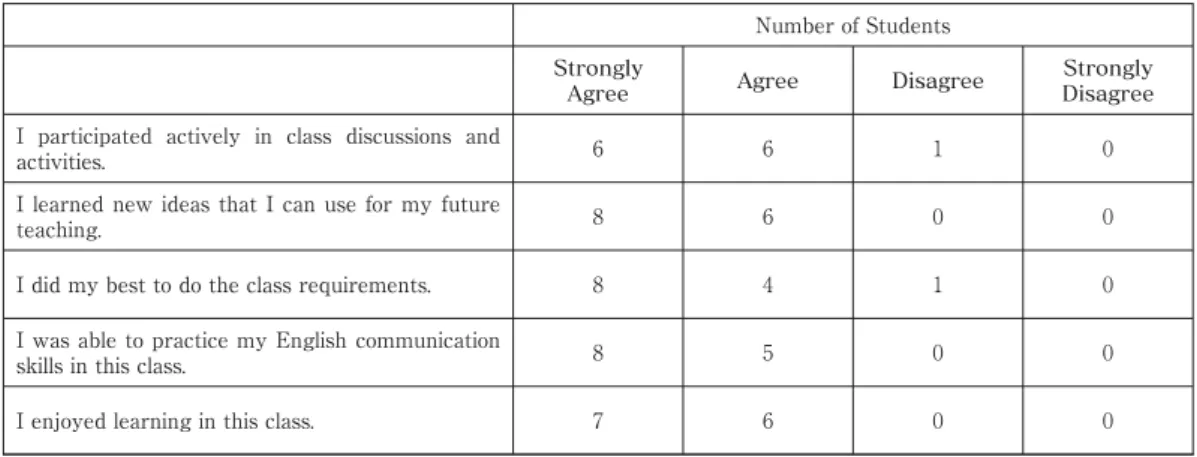
The result of the studentsʼ responses as shown in Table showed that almost all of the students except one did their best to perform in the class. They participated actively in class discussions and activities, they learned new ideas that are useful for their future plan to teach, they were able to practice their English communication skills, and they enjoyed a lot in the class.
Some useful comments of the students about their performance are the following :
I was motivated to learn more. (Student A)
I appreciated the lecture. There are a lot of things I do not know but I was able to learn much and practice my English in this class. (Student C)
The content of the class were steady. I wanted to follow that. (Student E)
I enjoyed the teaching demonstrations. They were very interesting. (Student M)
I enjoyed the class. Watching other group’s presentation motivates me to try my best. I enjoyed
the class for two days. (Student G)
The result of the studentsʼ evaluation of their performance and the narrative comments given by the students showed that the course somehow has engaged them to perform in the class. It was also observed during the course that the students actively participated in the class teaching demonstration, small group discussions, and during the lecture. The students submitted the requirements on time and do their task as scheduled.
The result shows that the students gained more confidence in participating in various class activities.
They find the class interesting and useful. The size of the class is contributory to the active involvement of the students. There are only around students so it was easy to manage. The strategy Think-Pair-Share was effective in involving the students in big-group or small- group discussions.
The seating arrangement of the students is also one of the contributors of effective instruction. The classroom seating arrangement was organized in a U- shaped so that the instructor can maintain eye-contact with the students and monitor their activities. The U- shaped seating arrangement also made possible for the class instructor to ask all students to answer questions and share their ideas.
Based on the observerʼs note, the students were very active in the class. The activities were able to motivate the students to participate in all class activities and share their thoughts during the small-group and big- group discussions. The class is not a typical one.
Speaking in English became natural as all students share ideas, give answers to all questions, and share expe- riences to the class. Nobody is exempted in all class activities.
Number of Students Strongly
Agree Agree Disagree Strongly
Disagree I participated actively in class discussions and
activities.
I learned new ideas that I can use for my future teaching.
I did my best to do the class requirements.
I was able to practice my English communication skills in this class.
I enjoyed learning in this class.
Table : Studentsʼ Evaluation of their Performance in the Class
The observer gave the following comments re- garding performance of the students in the class :
I am really impressed with the high performance of their demonstration with such a little preparation time. They speak English very well and are very eager to cooperate with each other. I recognize that the group presentation is also a good way of practicing speaking English. It’s worth trying it in my class, too.
According to Tsubota( ), time constraint is one major factor that should be considered. This class can be offered in a longer period so that students will have time to reflect and internalize the different ideas learned and so that they can also prepare for their teaching demonstration.
The success of the class leads the professional observer to think that the class can be required for students to take as an elective course. The course can be very useful for students especially those who are majoring in English Education.
3. What are the perceptions of the students about the course ?
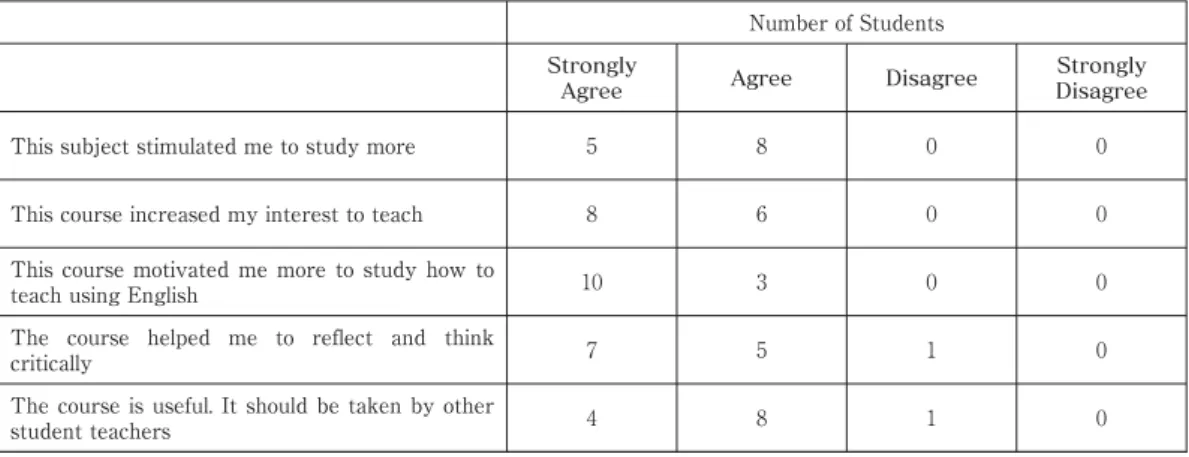
The result of the studentsʼ evaluation in Table shows that almost all the students except for one student felt that the course was very useful to them.
During the class discussions, the students always mentioned that they aremotivated to become teachers and they are challenged to develop strong passion to teach.
The narrative comments from the students also confirmed this. Some of the students gave the following comments about the course :
This course helped me to think of effective ways to design effective instruction. (Student A)
I developed self confidence in using English for
teaching soon. I learned the importance of positive facial expression in class. (Student C)
I am challenged to do my best and want Dr. Pawilen to watch it someday, soon. (Student E)
I want to exert more effort in communicating to people using English and develop passion to read and write using English. (Student F)
This result confirmed that the course was able to fulfil or attain its objectives to engage the students into meaningful learning that will encourage them to develop skills and ability to use English in teaching various subjects. The course successfully planted the seed for developing teachers that can help implement English Education program in Japan. The course was also able to encourage them to be an effective teacher soon when they finished their degree.
4. Based on the instructional plans that the student teachers prepared, how competent are the student teachers in designing instructional plans using English ?
The students were given minutes to write a lesson plan in English. The students were given the freedom to choose the subject they want. The result of the workshop and analysis of the lesson plans developed by the students show that they were able to develop skills and competence in writing lesson plans using English. The analysis of their lesson plans show that they were able to :
Develop clear understanding of how to write instructional objectives considering the principles of SMART objectives and following the Bloomʼs Taxonomy of Educational Objectives.
Incorporate the teaching strategies and tech- niques learned during the class in the instructional
Number of Students Strongly
Agree Agree Disagree Strongly
Disagree
This subject stimulated me to study more
This course increased my interest to teach This course motivated me more to study how to teach using English
The course helped me to reflect and think critically
The course is useful. It should be taken by other student teachers
Table : Studentsʼ Evaluation of the Course
plans that they prepared.
Follow the instructional planning model advocated by Reiser & Dick( )and use the format in developing their instructional plans.
Use English educational terms in the flow of their lesson plans.
Use English language effectively in the lesson plans they prepared. The lesson plans can be easily understood and followed by other teachers.
Apply principles of effective instruction in planning their lessons.
An Example of the lesson plan one of the students developed is found in the Appendix. An analysis of the lesson plans show that the Japanese students have immense potential in using English as a medium of instruction given the proper training and mentoring.
5. What are the problems encountered during the implementation of the course ?
The result of the evaluation also shows some problems encountered by the students during the delivery of the course. These are :
The students feel that the lectures are too long that they need to have breaks in between lectures. Thus this was addressed during the second day of the class.
Many education terms and English words are difficult to understand by the students. However, the use of electronic dictionary somehow helped solve this problem.
From the experienced and observation of the instructor, the result of the observation of how the students perform in class also reveals some important things that need to consider :
Some students are sleepy when they come to class. According to the students, they watched TV during the night that is why they are sleepy when they come to class in the morning.
One student has difficulty in speaking English.
Her English background is not enough to help her perform in the subject. The instructor needed to assist her during the class activities.
It was also observed that learning how to use English expressions in the classroom is not enough. The students should also develop cultural literacy. For example, one student asked what is the language spoken by the people in the Philippines. The instructor answered and
explained that in his country, there are many languages and English is his second language.
The student got hurt because she felt that the instructor made fun of her question. This particular student lacks the cultural literacy or knowledge that many countries in the world have many different languages.
Conclusion
The course was successful in attaining its goals.
The students were able to develop and improve their skills and competence in using English in designing instructional plans for different subjects. They also developed certain degree of confidence in expressing themselves in English. Based on the result of the evaluation, the students find the course interesting and learned many useful ideas that they can use in teaching.
This course was perfectly different from other English classes offered in the university or in other schools. The course was not a translation course where students just memorized English expressions and sentences. This course is not about learning different English expressions that can be used in the classroom.
This class involved the students in a learning environment where they can have opportunity to use English in a natural classroom setting. This type of course is very useful.
One exciting result of the evaluation is the realization that there is a bright future for using English language as a medium of instruction in Japanese schools.
The result shows that given the right training and proper mentoring, Japanese students can develop com- petence and confidence in using English as a medium of instruction. This course can be a model for developing English language competence for Japanese in-service and pre-service teachers.
The result of the evaluation also provided several points to consider in improving the delivery of the course :
. This can course can be offered as a required electives for all education students. The positive result confirms that it can help contribute to the preparation of teachers for the implementation of the English Education Program of Japan.
. The course can be offered in a regular semester so that more students can enrol and the pacing of the course can be improved. One week of
intensive training on using English for designing lesson plans is ideal if this course will be offered again on a summer term.
. Students from other colleges can be encouraged to enrol in this class should they have plans to teach in the future.
. The scheduling of the class activities per day can be more systematize to include breaks in between lectures as requested by the students.
. The last part which is demo-teaching can be done in the attached school of the university. English teachers can be invited to observe their demo- teaching.
. Understanding the classroom environment and introduction of different educational systems in various countries can be included in the course.
. As a prerequisite for this course, a subject on English grammar for teachers can be offered to prepare students who lack the necessary level of English background who would like to take the course.
. A module for the course can be developed for the students to use.
REFERENCES
Bloom, B. S.( ). Taxonomy of educational objectives handbook I : The cognitive domain. New York : David McKay Co Inc.
Diokno, M.( ). The promise of redemption : BESRA and the need for higher education Reform. A paper presented to the Education Forum of the University of the Philippines, Diliman.
Ehime University( ). Practical course on English expressions as a medium of instruction. A Syllabus Prepared for the Faculty of Education, Ehime University, Japan.
Hiwatig, A. D. F., Faustino, J. B., Sumida, M., Pawilen, G. T., Fujita, A., and Kumagai, T.( ). Mentoring Ehime University student teachers for practice teaching in the Philippines : A personal experience. Bulletin of the Faculty of Education, Ehime University, , − .
Gardner, H.( ). Multiple intelligences : New horizons.
Basic Books. New York.
Goodwin, B.( ). Good teachers may not fit the mold.
The effective educator, ( ), − .
Ornstein, A. and Levine, D.( ). Teacher behavior research : overview and outlook. Phi Delta Kappan, ,
− .
Pawilen, G. T., Sumida, M., and Calingasan, L.( ). Sharing a culture of excellence in teaching across borders : An evaluation of Ehime University student teachers
practice teaching in the Philippines. Bulletin of The Center for Educational Research, Ehime University Faculty of Education. , − .
Pawilen, G. T.( ). Developing curriculum standards for preschool teacher education. Doctoral dissertation sub- mitted to the College of Education, University of the Philippines, Diliman, Quezon city.
Ramsey, G. A. and Howe, R. W.( ). An Analysis of Research on Instructional Procedures in Secondary School Science, Part II Instructional Procedures. The Science Teacher. ( ), − .
Reiser, R. A. and Dick, W.( ). Instructional planning : A guide for teachers. Boston : Allyn and Bacon.
Tsubota, Y.( ). Personal correspondence with the authors of the present study.
Yanagisawa, Y.( ). Message from the President. In An introduction of Ehime University Japan. Ehime University.
Matsuyama City.
Acknowledgement
The present paper is based on teaching practice, which was funded by a presidential special aid in education Ehime Daigaku Kyoiku Jyujitsu Tokubetsu Shien Keihi in academic year at Ehime University.
Appendix Lesson Plan for Grade Social Studies
Objectives : in this lesson, the students should be able to : Survey Matsuyama actively
Share their knowledge, opinions and ideas Introduce our town, Matsuyama to foreigners
Instructional Materials : Books from School library + Internet
Subject Matter : Our town, Matsuyama
Learning Experiences A. Motivation
Ask the students : What do you know about Matsuyama ? Do you like Matsuyama ? Why ? Why not ? Inform them that they are going to survey Matsuyama on their town.
B. Informing the students of the Objectives of the Lesson
Inform the students that in this lesson, they should be able to : Survey Matsuyama actively
Share their knowledge, opinion, and ideas Introduce our town, Matsuyama to foreigners
C. Prerequisites
Go to the School library
Remind the student of the rules inside the School library Inform the students of what kind of books they will look into
Inform the students how to use the Internet right and some useful Websites.
Using various materials, the students research and write reports about Matsuyama
Ex. Population, famous food/places, special products, some great people from Matsuyama, some unique points
D. Information and Examples(Upon getting back to the class)
Ask the students to present their research report, opinions and ideas.
E. Practice and Feedback
Discuss the result of their research, opinions and ideas.
Ask the students what things they want to introduce to foreigners. Why ?
F. Summary
The students have attachment to Matsuyama more.
The students realize that there are a lot of good points in Matsuyama.
The students have their own opinions and ideas of Matsuyama.