On the Laws . of Realization
of Non-Ego
Yoshiharu Akishige
Modern psychology has treated the concept of Ego, hitherto regarded as so-mething special, as a mere gestalt defined by the field of consciousness like all other objects. This is a great achievement of the modern psychology.
Modern psychology has a great wealth of knowledge about the constancy of the world of perception, which includes the Ego, and has elucidated its laws. Accrding to these laws, the constancy of the objects of the external world depend on the so called reference system. It is impossible to determine the distance or the size of a point of light presented in a dark room where the reference system is lacking.
In many cases it even becomes impossible to suspend oneself and keep its position constant. An object in a homogeneous space loses its constancy and becomes a mere sensational quality defined by the stimulus ; it loses its pro-perties as an object.
An external object is not the only object of perception that has constancy. "I" that is surrounded by objects also possesses constancy . Although "I" of last year and "I" of today are dissimilar in contents, they are identical and are always "I" at whatever time. This is the constancy of "I" or the perso-nality. The constancy of an object and the constancy of "I" differ in that the latter has constancy as a subject in addition to ha ping constancy as an object. This is because unlike an object "I" is a subjective entity. From the subjective aspect, one who possesses a personality with least constancy is a schizophrenic, while one who has a personality with highest constancy is a person in medi-tation.
In this paper the author wishes to show that similarities exist between the laws that govern the constancy of a personality and those that govern the
On the Laws of Realization of Non-Ego (Y. Akishige) (2) constancy of an object by examining the important f actor that controls the subjective constancy.
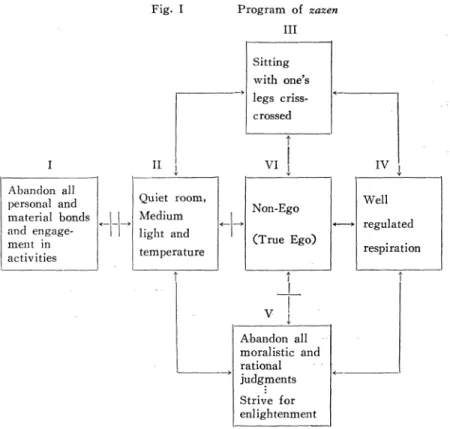
From ancient times, the order or rules for practicing zazen, in other words, the program of zazen, has remained almost unaltered. It can be diagramed as in Figure 1.
As indicated in I in Figure I, all bonds with the external world must first of all be abandoned. Then, all the activities currently engaged in must be given up. On these two conditions, any bond between the Ego and other phenomena will disappear.
II shows the conditions required for the room in which zazen is to be prac-ticed. First of all, it has to be a quiet room in which the temperature is kept
(3) On the Laws: of Realization of Non-Ego (Y. Akishige)
at- medium, warm in winter. ~ and cool in, summer. The lighting should also be of a medium degree, not too bright in the day time and not too dark, in the night time. The eyes must be half, opened without being in focus or blank. It is, therefore, a space where homogeneity of audition, vision and .temperature sensation is maintained.
. In :III the wavering of . the, body is very slight because of sitting with the .legs crisscrossed. The entire motor system is :in an extremely good equilibrium. In IV the oxygen consumption is low and the production of- carbon dioxide is also reduced because of the regulated respiration of zazen. As a result,- the fluid (internal environment) surrounding the cells of the body is in a good balance.
V indicates the most important state of mind in zazen. During zazen all moralistic and rational judgments are abandoned. All activities of reflection, thought and insight cease. =And, ultimately all contrivances are discarded. The most important thing is to have a mind devoid of all cravings. Even the desire to be enlightened and become a Buddha must be abandoned. The law of no requirement calls for an attitude free from all requirements.
If I and V are diagramed for the take of clarity, they become as in Table I.
In accordance with r the numerical order of the rows in Table I, if I. all bonds with the external world are relinquished, II. all current engagements are ter-minated, III. all moralistic and rational judgments are suspended, IV. all acti-vities of reflection, thought and insight cease, V. all conscious cravings are
On the Laws of Realization of Non-Ego (Y. Akishige) (4) abandoned and VI. even the desire to become a Buddha is given up , what re-mains is a state of inactivity. The control of the mind ;in zazen means to stop controlling the mind completely. Paradoxically, it is the non-control of ,the mind that is the control of the mind in zazen. This is also called the law of no contrivance. This law is essentially the same with the low of no requirement. The former is so called because of the emphasis on mainly the intellectual activities, while in the latter the emphasis is mainly on the emotional and volitional activities. The fulfillment of this law is supported by the law of faith believing that we are in enlightenment already and ourselves have no illusion and no error.
Depending on how the above conditions are satisfied, a person practicing zazen will enter various stages of meditation. Meditation is a state in which homogeneity of the mind and body can be constantly maintained. It is to be in a kind of dynamic equilibrium. Traditionally, meditation is classified into nine states which are showed in Table II. The trance-like states devoid of almost all notions and sensations, such as the meditations of stages IX, VIII, VII, are not considered proper meditations. The Fourth Meditation is considered most ideal. By entering a proper state of meditation, a person , loses an Ego full of mental upheavals and becomes non-Ego and eventually turns , into an Ego free of sufferings. It should be noted that 'there are two such types of non-Ego. One is non-Ego in 'the sense that the mind is homogeneous and per-ceptionless. Another is non-Ego in the sense that the self is liberated from all bondages and without an Ego-craving mind. The latter , is considered , the true non-Ego.
From the above discussion, it can be found that the laws that govern tho constancy of an object and the laws that govern the constancy of "I" are closely related.
Just as an object taken out of its framework stops being an object with certain properties and degenerates into a mere quality of sensation, so an Ego detached from its two systems of reference, internal and external, loses its properties and becomes non-Ego.
-494-(5) On the Laws of Realization of Non-Ego (Y. Akishige) Table II
On the Laws of Realization of Non-Ego (Y. Akishige) (6) But a state of homogeneous non-Ego with this kind of blank group of ideas { } is called stupefying meditation and is not the aim of zen. What zen strives for is a non-Ego with meditation and wisdom in good balance. As one attains a state of no requirement with zazen, the world changes its aspect and a new system of reference different from the old one arises. An Ego founded on such a system of reference is the true Ego with meditation and wisdom in equili-brium. The suffering Ego changes into an Ego free from torments. This trans-formation can be said to be a shedding of the mind and the body. True Ego that has cast away its old Ego does not become disturbed, deluded, upset, chan-ged or fallible. It is a personality with the highest constancy. To such a perso-nality opens up a world of no increase, decrease, filth or purity where values are preserved.