1
■Article■
The
Nagapancami
as
Described
in
the Puranas
and its Treatment
in the
Dharmanibandhas
●
Shingo Einoo
H. Kulke and D. Rothermund rightly points out that there has
been a great discrepancy between the indologists and the social
sci-entists in the studies of Indian culture [Kulke and Rothermund 1985:
XVI]. The indologists, they say, have been interested in the great
works of Indian literature and philosophy, and the social scientists
have investigated the caste system, village and tribal lives in
contem-porary society. The indologists used mainly sanskrit texts written
earlier than the eighth century A.D. as the source material for their
investigation, while the social scientists dealt with documents
origi-nating from the eighteenth century A.D. onward. The
contribu-tions made by M Marriott and M. N. Srinivas regarding the
theo-ries of " great and little tradition " and of " sanskritization "
respec-tively in the fifties were expected to fill the undesirable gap
be-tween indology and social science. This, however, resulted in the
永 ノ尾信 悟 Shingo Einoo, University of Tokyo, Sanskrit Philology.
Main Publications:
Die Caturmasya oder die altindischen Tertialopfer: Dargestellt nach den
Vor-schriften der Brahmanas und der Srautasutras= Monumenta Serindica 18. Tokyo:
Institute for the Study of Languages and Cultures of Asia and Africa, 1988. "
Changes in Hindu Ritual: With a Focus on the Morning Service ", in
Yasuhiko Nagano and Yasuke Ikari (eds.) From Vedic Altar to Village Shrine
(Senri Ethnological Studies 36), pp. 198-237, Osaka National Museum of
2 Journal of the Japanese Association for South Asian Studies, 6, 1994
elaboration of theories and research methods only in the field of social
sciences ; while the indologists remained mostly uninfluenced by the
discussions on the methodology of studies of Indian culture in the
last forty years [Kulke and Rothermund 1985 : XVII-XVIII].
Sanskrit texts are not the sole, but an important vehicle of great
tra-dition in India [Parasher 1991: 271], and lack of contributions to the
understanding of contemporary India by indologists who study these
texts pose serious problems for the non-sanskritists. Great tradition
appears to them as a black box, the inner structure of which is not
known and, therefore, sometimes seen as a catch-all container from
which they can get what they wish. So it is necessary for sanskritists
to present contributions which shed some light on not only the
his-torical development of some aspects of great tradition conveyed by
the sanskrit texts but also, if possible, to elucidate regional
distribu-tions of these aspects.
Annual festivals like the Navaratra, the Holi, and so on, are
cul-tural phenomena which we can observe in today's India and tradition
which we can trace in many sanskrit texts like the Puranas and the
Dharmanibandhas; these are texts assigned to the period between the
eighth and the eighteenth century, the period which has been
ne-glected by both the indologists and the social scientists. They,
there-fore, offer good examples for analysing the historical development
and regional distribution of certain cultural elements which make up
one of the important aspects of great tradition. In this paper I take
up the nagapancami or the snake worship which is usually held on
the fifth day of the lunar month in the rainy season as an example
for investigation. I attempt to show the great variety of the instances
of the neigapancami described in the Puranas and to make clear one
tendency in its transmission through the later Dharmanibandhas, a
tendency which can explain the regional characteristics of snake
worship in contemporary India.
The nagapancami, one of the vratas or religious rites and festivals
usually performed on a particular day of a particular month, is
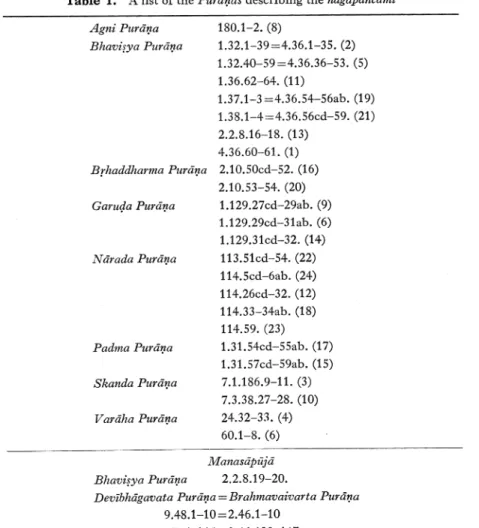
de-scribed in eight Puranas (see Table 1).1) I have drawn the material
The Nagapancami as Described in the Puninas and its Treatment 3
on the nagapancami from those places where the vratas are treated collectively with the exception of the Skanda Puriina. My coverage is naturally not exhaustive. It is highly possible that the number of passages referring to the nagapancami will increase if we examine
Table 1. A list of the Purdnas describing the nagapancami
* The number given in round brackets is the number which I have applied in the
4 Journal of the Japanese Association for South Asian Studies, 6, 1994
those places where the mahatmya or the glorification of a certain
sa-cred place such as Prabhasa is refered to as I have done regarding the
Skanda Puratna's seventh Khanda, the mahatmya of Prabhasa.
Table 1 indicates clearly that most of the Puranas contain more
than one description of the nagapancami.2) In what follows I have
collected the various instances of the description of the nagapancami
and paraphrased the relevant texts.
Among the various types of
nagapancami which I have come across in the Puranas there are some
whose date of performance is not specifically defined.
I have
there-fore begun with those varieties whose performance is stipulated for
the pancami day, though we do not know either in which month they
were performed or whether the performance took place in the bright
half or the dark half of the month.
Next, I treat examples of the
nagapancami performed on the pancami day of several months, and
then describe those nagaparkami whose celebration is assigned to the
fifth tithi of a particular month, beginning with the month of 8ravana.
1. Bhavisya Purana 4.36.60-61.
A mantra for protection from harm by snakes: 0171
kurukulle hurp
phat svaha.3) If people worship snakes with flowers on one
hundred pancami days, they will have no fear from snakes in their
houses.
2. Bhavisya Pureina 4.36.1-35=1.32.1-39.4)
(1) Dear to the nagas is the pancami day with its great festival
dedicated to the nagas.
(2) Vasuki, Taksaka, Kalika, Manibhadraka, Dhrtarastra,
Rai-vata, Karkotaka and Dhanamjaya5) grant people freedom
from danger.
(3) In the houses of those who bathe the nagas with milk on
the pancami day there will be no fear from snake-bite.
(4-27)
In these verses the well-known episode of the
sarpasat-tra performed by Janamejaya is related in order to account
for the necessity of bathing the snakes with milk on the
pancami day. 6
)
The Nagapancami as Described in the Puranas and its Treatment 5
day of joy.
(4-28cd) The householder performing the ritual should feed
a meal to the brahmins.
(4-29-30) A mantra is given here to be recited at the time of
sending away the brahmins after the meal, stating that all
the nagas living everywhere will be pleased.7)
(4-31-32ab) After having worshipped the nagas and the
brah-mins and sent them away, the householder takes dinner
with the members of his family.
(4-32cd-35cd) The result of the rite : After death, riding on
a celestial vehicle, surrounded by the Apsaras, the
house-holder goes to the city of the nagas and enjoys himself as
long as he wishes. In the next birth he becomes the king
of the world, etc.
3. Skanda Purcina 7.1.186.9-11.
(9) On the paticami day, the householder fasts and bathes in
Nagasthana.
(10-11) After having performed the s'raddha (ancestor worship)
and given the daksina (sacrificial fee) to the brahmins he
feeds them with milk-rice, regarding them as Sesanaga.
(10cd) Freed from all distress he goes to the world of Rudra.
4. Vardha Purana 24.32-33.
(32) It was on the pancami day that Brahma made contract with
the nagas. Therefore this day is favorable and carries
away all sins.
(33) On this day people avoid sour things, and bathe snakes
with milk. The snakes become friendly.
5. Bhavisya Purana 4.36.36-53=1.32.40-59.8)
(37) A man killed by snake bite goes to the nether world and
becomes a harmless snake.
(38-39) Krgia asks Yudhisthira what one should do when one's
relatives die from snake bite.
(40-51) For one year, every month on the pancami day in the
bright half month9) beginning from the month of
Bhad-6 Journal of the Japanese Association for South Asian Studies, 6, 1994
rapada, the householder worships one of the twelve nagas,10)
whose images are made of gold, silver, wood, or clay, with
flowers of the oleander, the lotus, and the jasmine, and
with sandal paste and oblations of food, and feeds the
brah-mins with ghee, milk-rice and modaka. After one year he
performs the Narayanabali11) and Vrsotsarga12) for the
dead person and holds a concluding feast, where the
brah-mins are also fed with a meal.
(52-53) Result: the dead person is delivered and there is no
fear from snakes.
6. Garuda Puriitta 1.129.29cd-31ab.
(30d-31a) On the pancami day in the bright fortnight of every
month, especially the month of Bhadrapada.
(29cd-30d) The householder worships Ananta, Vasuki, Sankha,
Padma, Kambala, Karkotaka, Dhrtardstra, 8ankhaka,
Kaliya, Taksaka, and Pingala.
(31b) He goes to heaven and obtains release.
7. Varaa Pureina 60.1-8.13)
(1) A householder who performs the santivrata (rite for
ap-peasement) always attains tranquillity.
(2a-c) For one year beginning from the palicami day in the
bright fortnight of the month of Karttika he does not eat
sour things.
(3ab) In the night he worships Hari lying on 8esa.
(3cd-5) The eight nagas are first worshipped at the various
parts of the body of Hari (angapuja), and are worshipped
individually afterwards.
(6ab) He bathes the nagas with milk, regarding them as Hari.
(6cd) He offers milk and sesame in the fire.
(7) After one year he feeds the brahmins a meal and gives
them golden images of nagas.
(8) He attains tranquillity, and is in no danger from snakes.
8. Agni Purana 180.1-2.
The Nagapancami as Described in the Purdnas and its Treatment 7
heaven, and final release.
(1cd-2d) On the pancami day in the bright half month of the
months of Asadha, 8ravarp, Agvina and Karttika, the
householder worships Vasuki, Taksaka,Ilya,
Mani-bhadraka, Airavata, Dhrtarastra, Karkotaka and
Dhan-arpjaya.
(2ef) They give safety, long life, knowledge, fame and wealth.
9. Garuda Purana 1.129.27cd-29ab.
(27cd-29a) On the pancami day in the bright fortnight of the
months of 8r-dvarja, Agvina, Bhadrapada, and Karttika, the
householder bathes Vasuki, Taksaka,liya,
Manibhadra,
Airdvata, Dhrtarastra, Karkotaka and Dhanamjaya with
ghee and other things.
(29b) They bestow long life and freedom from disease.
10. Skanda Puriina 7.3.38.27-28.
On the pancami day in the dark fortnight of the month of Sravana,
the householder bathes in the Nagahrada14) and performs the
s'reiddha,
in order to attain happiness.
11. Bhavisya Purana 1.36.62-64.15)
(62) On the pancami day in the bright fortnight of the month
of Sravana, the householder draws figures of snakes on
both sides of the door with cowdung.
(63) He worships them with curd, the sprouts of the durva, the
blades of the kusa, sandal paste, flowers and other oblations
and feeds the brahmins with a meal.
(64) There will be no fear from snakes.
12. Niirada Purana 114.26cd-32.
(26c-27c) On the pancami day in the bright fortnight of the
month of Sravarja, the householder draws figures of snakes
on both sides of the door with cowdung and worships them
with sandal paste and other things.
(27d-28) He further worships Indrani with gold, silver, curd,
rice, the kus'a, water, sandal paste, flowers, incense, lamps
and oblations of food.
8 Journal of the Japanese Association for South Asian Studies, 6, 1994
(29-30) He circumambulates the offerings from right to left,
prostrates himself before them, prays, and gives them to
the brahmins reciting a mantra.16)
(31) Kubera, the god of wealth, is pleased with the householder
and gives him gold, etc.
(32) After feeding the brahmins, the householder eats with his
wife and children and with his friends.
13. Bhavisya Purana 2.2.8.16-18.
(16) On the pancami day in the bright fortnight of the month
of Sravana, the householder bathes the nine nagas17) with
fragrant waters.
(18) On both sides of the door he draws figures of snakes with
cowdung and worships them with curd, milk, vermilion,
etc.
(17) The nagas provide safety for his house.
14. Garuda Purana 1.129.31cd-32.
(31cd-32d)
On the pancami day in the bright fortnight of the
month of Sravana, the householder draws figures of snakes
on both sides of the door and worships nagas like Ananta
and others with milk, ghee and food oblations.
(32e) The nagas give him freedom from danger.
(32) The rite is called dastoddhara pancami or the pancami for
the deliverance of one killed by snake-bite.
15. Padma Purana 1.31.57cd-59ab.18)
(57cd) The pancami of (Sravana)1-9) is a blessed day, averting all
evils.
(58cd-59ab)
On this day people avoid eating acrid or sour
things, and bathe the nagas with milk so the nagas become
friendly towards them.
16. Brhaddharma Purana 2.10.50cd-52.20)
(51ac, 52) On the pancami day in the bright fortnight of Sravana
month, people worship the nagas with water, curd, the
sprouts of the durva, the kusa, sandal paste and flowers,
and feed the brahmins with a meal.
The Nagapancami as Described in the Purdnas and its Treatment 9
(51d) There will be no fear from snakes.
17. Padma Purana 1.31.54cd-55ab.
On the pancami day in the month of Sravana if people
bathe in the Nagatirtha21) near Puskara, they will have
no-thing to fear from snakes.
18. Narada Purana 114.33-34ab.
On the pancami day in the dark fortnight of the month of
Bhadrapada, the householder pleases the nagas with milk,
with the result that he and his descendants for seven gen-
erations will have nothing to fear from snakes.
19. Bhavisya Purana 1.37.1-3:4.36.54-56ab.22)
(1-2) On the pancami day in the bright fortnight of the month
of Bhadrapada, the householder draws figures of snakes in
black and other colors and worships them with sandal
paste, flowers, ghee, bdellium and milk-rice.
(3) The nagas, like Taksaka and others, are pleased and there
will be no fear from snakes for seven generations.
20. Brhaddharma Purana 2.10.53-54.
(53) On the pancami day in the month of Bhadrapada, the
householder draws figures of snakes in black and other
colors and worships them with milk, milk-rice and
bdel-lium.
(54) The rite is called alikhyapancami or the pancami on which
figures of snakes are to be drawn (alikhya) and averts fear
from snakes.
21. Bhavisya Purana 4.36.56cd-59=1.38.1-4.23)
(56cd-59a) On the pancami day in the bright fortnight of the
month of Asvina, the householder makes figures of nagas
with kusa grass and worships them together with Indrani,
pouring on them ghee, water and milk and offering them
wheat, milk and boiled food.
(59b-f) The nagas like Sesa, and others are pleased. The
per-former obtains tranquillity in this life and after death he
goes to the tranquil realm and lives there in enjoyment
10 Journal of the Japanese Association for South Asian Studies, 6, 1994
forever.
22. Narada Pureina 113.51cd-54.
(51cd) The pancami day in the bright fortnight of the month of
Karttika is the day of the nagavrata.
(52ac) In the morning the householder declares his intention to
perform the vrata, drinks pure water with which the horns
of a cow have been washed24) and takes a bath.
(52c-53ac) At midday he invokes Sankha, Pala, Sea and others
and worships them and pours milk on them.
(54cd) The result: the poisons of snakes disappear and snakes
do not bite.
23. Närada Puriina 114.59.
(59ab) On the pancami day in the bright fortnight of the month
of Margagirsa people worship the nagas.
(59cd) Fear of the nagas disappears and the householder
re-joices with his relatives.
24. Narada Purana 114.5cd-6ab.
(5c-6a) On the pancami day in the month of Vaigakha, the
householder worships Sesa and all the nagas.
(6b) He obtains the results he wishes.
As a final example of the collected instances of the nagapancami I
refer to a short description of the worship of snake goddess Manasa251
in the Bhavisya Purana 2.2.8.19-20, which states :26)
(19ab) On the pancami day after Visnu fell asleep,27) that is,
on the pancami day in the dark fortnight of the month of
Asadha, the householder worships the goddess Manasa
sit-ting on a branch of the snuhi tree.
(20ac) He collects the leaves of the picumanda tree in the
court-yard of his house.
(20cd) Fear from snakes disappears.
The fifth example given above describes a rite called
dastoddharana-pancami or neigadastoddharanadastoddharana-pancami,
the pancami rite performed
for the deliverance of those killed by snake-bite. It was performed
twelve times a year, on the pancami day in the bright fortnight of
The Nagapancami as Described in the Puranas and its Treatment 11
every month, beginning with Bhadrapada. It is worth mentioning
that this dagoddharanpancami, particularly that described in the
Bha-visya Purana 4.36.36-53, is closely related to the nagabali prescribed
in the .Asvaltiyana Grhyaparista 3.16, which includes also the
per-formance of the Narayanabail and Vrsotsarga at the end of the
an-nual ritual course [Winternitz 1888: 26128)]. Snake worship did
in-deed occur during the Vedic period, notably the sarpabali, which is
found in some Grhyasutras and was discussed at great length by M.
Winternitz in his article " Der Sarpabali " [Winternitz 1888, Taka-
hashi 197829)]. Nevertheless we need not presume a direct
relation-ship between the sarpabali of the Grhyasutras and the nagapaticami of
the Puranas. Incidentally, the nagabali in question is found not in
the Grhyasutras but in the Grhyaparisista, the supplementary text of
the Agvaldyana school. The Grhyaparisistas are texts which are
primers of religious rites and customs unknown in the earlier Vedic
texts but which became integral to later Hindu rituals [Einoo 1993 :
229-231, 235-236]. The fact, therefore, that the
dastoddharanapan-cami had its precedent in a parisista text of the Grhyasutras serves
also to indicate the closeness of the Grhyaparisistas to later Hindu
rituals.
The date of performance of examples 8 and 9 extends over four
different months. However, the date of performance of fifteen types
of nagapancami (nos. 10-24) were clearly determined as the usual
an-nual vrata. Of those fifteen, eight (10-17) fall in the month of
Sra-vana and three more examples (18-20) are performed in the month
of Bhadrapada, another month in the rainy season like Sravana.
Thus eleven examples of the nagapaficami are performed in the rainy
season, more than seventy percent of the fifteen varieties which are
performed on a definite day in a particular month. From this we
can safely say that from the time of the Puranas the nagapancami has
been mainly a rite performed in the rainy season. This was the case
also for the sarpabali of the Vedic Grhyasutras [Winternitz 1888:
261].
12 Journal of the Japanese Association for South Asian Studies, 6, 1994
total number of 24, 20 types are described in less than five verses,
mostly only two or three verses.
Even so, every description contains
information about the result a performer could expect from the
na-gapancami.
In six examples (nos. 2, 3, 6, 10, 12, and 24) we find
results which are no doubt common with other annual vratas, such
as reaching the heavenly world, deliverance from worldly misery, and
the attainment of wealth and happiness.
However, more than 70
percent state, using a variety of expressions, the one particular result
that the performer and members of his family would no longer suffer
from snake bite.
Two more or less characteristic features of the nagapaficang are the
use of milk and the painting of pictures of snakes.
Milk is used in
nine cases (nos. 2, 4, 6, 13, 14, 17, 19, 20, and 21). Here I do not
mean milk products like ghee, curd or milk-rice, which are commonly
used in other rites and festivals as offerings.
Moreover, the use of
raw milk as oblation seems to have been very rare at least in Vedic
ritual.30) Of particular interest among these eight cases are nos. 2,
4, 6, 14, and 21, because here milk is used to bathe the snakes,
pos-sibly living snakes.
In the case of no. 13 the nagas are bathed not
with milk but with fragrant waters.
The drawing of pictures of
snakes is of two kinds.
Nos. 12, 13 and certainly 14 say that people
draw pictures of the nagas on both sides of the door with cowdung.
The other type, recorded in nos. 19 and 20, say merely that the
nagas are drawn in black and other colors.
Summing up my survey of the descriptions of the nagapancami in
the Puranas, I would define the nagapancami as a rite of snake
wor-ship performed mainly in the rainy season to avert danger from
snakes, a particular hazard at that time of the year.
In this sense,
the nagapancami is a successor of the Vedic sarpabali.
The most
remarkable characteristic of the nagapancami which discriminates it
from the Vedic sarpabali is, as the name itself indicates, that the date
of performance is confined mainly to the paficami, the fifth lunar day
of the half-month of the Hindu calendar.31)
The Nagapancami as Described in the Puranas and its Treatment 13
number of Dharmanibandhas, certainly beyond my count. For this
study I consulted fourteen texts: the Krtyakalpataru, Kalaviveka,
Caturvargacintamani, Samayapradipa, Krtyaratnakara, Varsakriyet-
kaumudi, Tithitattva, Krtyattva, Nirnayasindhu, Samayamayukha,
Jayasimhakalpadruma, Vratardja, Purusarthacintamani and Varsakrt-
yadipaka. These are listed in Table 2, where the Dharmanibandhas
have been arranged according to the order in which P. V. Kane
ex-plored them in his History of Dharmaiastra, vol. I, part II. First I
give the title of each Dharmanibandha. The number in round
brack-ets is the number that Kane gave to the individual Dharmanibandha
in his above-mentioned work. Then follows the name of the author
and information concerning the place and period he was active. In
the square brackets I indicate on which page Kane discussed the
problem of the date of the respective author.
I have divided the Dharmanibandhas into two groups, the first
group ending with the fifth of the listed texts, the Krtyaratnakara,
which Kane suggested was composed in the first quarter of the 14th
century. He placed Govindananda, the author of the
Varsakriyakau-mudi, the sixth text ;n Table 2, with which the second group begins,
between 1500 and 1540. Between the two groups of the Dharmani-
bandhas there is then a difference of about two centuries, enough
time to bring about a difference in attitude about the composition of
the texts. I call the first group the early Dharmanibandhas and the
second one the later Dharmanibandhas.
From the survey of the treatment of the nagapancami in the
Dhar-manibandhas, we can say that the early Dharmanibandhas reproduced
materials directly from the Puranas in almost the same form that each
rite is described there. In the later Dharmanibandhas we notice two
different methods. First, later texts, from the ninth in the list, the
Nirnayasindhu onwards, do not take material concerning the
nagapan-cami directly from the Pureinas, but rather quote from the early
Dhar-manibandhas, in most cases Hemddri's Caturvargacintamani (to the
best of my knowledge). Second, some of the later Dharmanibandhas,
namely the sixth, the Varsakriyakaumudi, the seventh, the Tithitattva,
14 Journal of the Japanese Association for South Asian Studies, 6, 1994
the eighth, the Krtyatattva,
the eleventh, the Jayasimhakalpadruma,
and the twelfth, the Vrataraja, quote, regarding one particular type
of nagapancami, various passages from different parts of one Purana
or an early Dharmanibandha, or from various Pura-vas, and insert new
The Nagapancami as Described in the Puranas and its Treatment 15
sentences which cannot be traced in any of the Puranas, and
ulti-mately combine them into a new prescription for the rite.
Let us examine this method in light of an instance in the Vrataraja
where the nagapancamivrata is described (see Table 3). Its basis is
the nagapancamivrata recorded in Hemadri's Caturvargacinteimani
(Vratakhancla, p. 565, l. 15-p. 566, l. 15.32)) According to Hemadri
(p. 565, 1. 16) it is performed on the pancami of the bright fortnight
in the month of Bhadrapada. Instead of this line the Vrataraja
quotes another passage by Hemadri, p. 564, ll. 15-16, corresponding
to the Bhavisya Purana 1.36.62, which states that on the pacami of
the bright half month of Sravarja, figures of nagas are drawn on both
sides of the door with cowdung. (See Example 10 above.) This
reveals that the original date of Elemddri's nagapancamivrata has been
Table 3. The nagapancami described in the Vrataraja*
* I have used the text quoted by R. S. Vishvanath Narayan Mandlik in his article
"
Serpent Worship in Western India " [Mandlik 1867-1870: 174]. For the
translation of this passage see Mandlik 1867-1870: 174-175 and Vogel 1926: 276.
16 Journal of the Japanese Association for South Asian Studies, 6, 1994
changed from Bhadrapada to Srdvaria. Then follows the
prescrip-tion of the nagapancamivrata according to the Caturvargacintamani
(pp. 565-566.) However, in the middle of the prescription the
Vra-taraja inserts three new sentences which I translate in Table 3. As
far as I know, these passages have not been traced in any of the
Pureinas I consulted, and perhaps represent local customs. In this
way the Vrataraja creates a new standard for the rite which was and
has been current in the Konkan district, according to V. N. Mandlik
[Mandlik 1867-1870: 176], making it appear as if the authority
is-sued from the Puranas themselves.
The manasapuja worship of snake goddess Manasa, is very popular
in Bengal and surrounding areas. In the Purdnas it is described, for
example, very briefly in the Bhavisya Purdna 2.2.8.19-20, as I have
The Nagapancami as Described in the Puranas and its Treatment
17
Table 5. The manasapuja described in the Tithitattva of Raghunandana
*
This is the translation of P. K. Maity. [Maity 1966: 212] I could not find
this dhyana in the Padma Purana. The dhyana of Manasa in the Devibhagavata
Purana 9.48.2-3 is different .
**
I could not find the same enumeration of eight nagas in the Puranas . Ra-ghunandana repeats this enumeration in his Krtyatattva 437, 12-14. For the enumeration of the eight nagas, see note 5 .
*** Here thirteen, not twelve, migas are enumerated
. This enumeration appears also in Raghunandana's Krtyatattva 437, 14-16. For the enumeration of the twelve nagas, see note 10.
18 Journal of the Japanese Association for South Asian Studies, 6, 1994
noted above (p. 10). Using this brief description as our base, we
can see how an elaborate ritual for the manasapuja was constructed,
bolstered by Puranic authority, in Govinananda's Varsakriyakau-
mudi and Raghunandana's Tithitattva (see Table 4 and 5), two very
renowned Bengali Dharmanibandhas.
Various parts of India have their own local habits and customs, not
recorded in the Puranas. The three examples mentioned above
(Tables 3, 4, and 5) show clearly how later Dharmanibandhas, of
mostly regional character, tried to extend Puranic authority to their
respective local cultures.
Let us now turn to Table 6. This contains a list of the types of
nagapancami which are described in the Puranas and quoted in the
Dharmanibandhas. When we compare Table 6 with instances of the
nagapancami paraphrased above, we find that the 24 varieties of
na-gapancami there have been reduced to 9 in Table 6. Further, only
four of the original eight Puranas are quoted in the Dharmanibandhas,
the Bhavisya, Garuda, Padma, and Varaha Puranas. This suggests
that the nagapancami was losing its diversity, with the result that only
two types of naapancami are constantly treated in the
Dharmaniban-dhas, the types described in examples 11 and 19. It also suggests that
the nagapaficami is celebrated on the fifth day of the bright fortnight
in either Srdvarp. or Bhadrapada and on those days figures of snakes
are drawn on the wall with cowdung or in black. This summary
corresponds very well to the situation in Northern India which J.
Vogel depicts in his book Indian Serpent-lore or the Nagas in Hindu
Legend and Art (pp. 275-280; see also Winternitz 1888: 42-43).
What I have described is a case study for clarifying the historical
development and the regional characteristics of certain annual
festi-vals using the relevant sanskrit sources. The nagapancami itself is
simple and its description in various texts is brief, making it possible
to trace the development of its treatment in the texts of various
peri-ods. The nagapancami is described in eight Puranas in various
forms, perhaps dating from the last quarter of the first millenium.
The compilers of the Puranas were, I think, aware of the existence of
The Nagapancami as Described in the Puranas and its Treatment 19 (2) Bhavisya Purana 1.32.1-39 = 4.36.1-35. Krtyakalpataru, Vratakanda 87.8-90.9 Kalaviveka 413.2-4, 15-18 Caturvargacintdmani, Vratakhanda I 557.12-560.17 Samayapradipa 129.4-8 Krtyaratnakara 272.19-273.2 (5) Bhavisya Purana 1.32.40-59 =4.36.36-53. Krtyakalpataru, Vratakanda 90.11-93.17 Caturvargacintamani, Vratakhanda I 560.19-563.1; 565.16-566.15 Krtyaratnakara 273.5-275.13 (11) Bhavisya Purdna 1.36.62-64. Krtyakalpataru, Vratakcinda 94.3-8 Kalaviveka 413.5-10 Caturvargacintamani, Vratakhanda I 564.15-16; 564.20-565.1 Samayapradipa 128.3-7 Nirnayasindhu 87.7-10 Samayamayukha 41.12-17 Jayasimhakalpadruma 225.13-16; cf. 225.20-26 Purusarthacintamani 124.7-12 Varsakrtyadipaka 168.24-169.3
(19) Bhavisya Purdna 1.37.1-3 =4.36.54-56ab.
Krtyakalpataru, Vratakanda 94.12-95.3 Kalaviveka 413.11-14; 414.1 Caturvargacintamani, Vratakhanda I 563.3-9; 564.17-19; 567.4-10; cf. 565.2-7 Samayapradipa 128.9-13 Krtyaratnaikara 272.2-8 V arsakriyakaumudi 318.11-16 Krtyatattva 442.3-8 Jayasimhakalpadruma 225.27-226.5 Purusarthacintdmani 124.13-17 cf. Varsakrtyadipaka 169.5-11 (21) Bhavisya Purana 1.38.1-4=4.36.56cd-59. Krtyakalpataru, Vratakanda 95.6-14 Caturvargacintamani, Vratakhanda I 563.10-19 cf. Jayasimphakalpadruma 233.7-15
Table 6. A list of the types of the nagapalicami which are described in the Puranas and are quoted by the Dharmanibandhas
20 Journal of the Japanese Association for South Asian Studies, 6, 1994
various types of nagapancami and some of them collected several
varieties of the festival.
In this sense the authors of the early
Dharmanibandhas exhibit the same attitudes in their recording of
the nagapancami, the only difference being that the authors of the
Dharmanibandhas mention some Puranas as the sources of their
in-formation.
The later Dharmanibandhas are, on the other hand, of more regional
character, and one of their important concerns seems to be to record
local customs, dressing them up with Puranic authority.
These local
customs belonged to the places where the authors of the
Dharmani-bandhas were living, as in the case of the Var.yakriyakumudi and the
Tithi- and Krtyatattva,
or to the dwelling places of the royal patrons
of the brahmin pundits living mainly in Benares who were the
com-posers of the particular Dharmanibandha, as in the case of the
Jaya-simhakalpadruma and the Vrataraja.
In the course of time, the great
variety of nagapanceami were lost, and only two types have been
con-stantly transmitted through the Dharmanibandhas.
It is they which
have become the standard for the nagapancami now observed mainly
in Northern India.
What I have said about the nagapancami can be applied also to the
historical development of the other annual vratas.
It is well-known
The Nagapancami as Described in the Puranas and its Treatment 21
understand their position in present day India it is essential to survey
their treatment in the Dharmanibandhas. Further studies of this kind
would reveal more clearly various aspects of problems concerning the
annual vratas in India.
Notes
1) There are very few studies on the nagapancami based on material from the
Puranas. Kane describes this annual festival in his History of Dharmasastra,
Vol. 5, Part 1 (pp. 124-126) but mentions only the Bhavisya Purana [Kane
1974: 124]. Vogel treats the nagapancami in his Indian Serpent-Lore (pp.
275-280) but mentions the Puranas only in a footnote: "The rites to be
observed at the Naga-panchami are also described in Puranic literature, e.g.
in the Bhavisyat-purana." (footnote 1, p. 276.) One of the purposes of this article is therefore to collect together material on the nagapancami from the Puranas and to show the varieties of this festival described in Purapic litera-ture.
2) The Bhavisya Puriina has corresponding descriptions of the nagapancami in
the first Brahmaparvan and the fourth Uttaraparvan. The description in the
Brahmaparvan is interrupted by the intervening chapters 33-36. The
con-tents of these chapters are as follows: (33) forms, colours, characteristics and
teeth of snakes; (34) snake-bite and medical treatment; (35) effects of snake
poisons, medicinal herbs and other remedies; (36) characteristics, forms,
col-ours and poison of snakes [Hohenberger 1967: 111]. The Agni Purana
con-tains similar information about snakes: chapter 294 (Mgalaksanani) gives
in-formation about snakes, chapters 295-298 teach magical cures for snake-bite using mantras, and chapters 297 and 298 also discuss medicinal herbs [Padoux 1978: 63].
3) A textual footnote (5) to this verse contains another mantra: om vaca kulle hum
phat svaha//. A similar mantra is given in a corresponding passage in the
Bhavisya Purana 1.38.5: on kurukulle phat svaha// Hemadri's
Caturvar-gacintamani, Vratakhanda, Part 1, p. 565, l, 10 gives another reading: om kuku-lam hum phat svaha// I. Hemadri here refers to the Skanda Purana, Prabha-sakhanda, not to the Bhavisya Punina, but I was unable to find any passage in that source where this mantra is mentioned.
4) Kane gives a List of Vratas in his History of Dharmaaastra, Vol. 5 (pp.
251-462). Here this festival is referred to as Anandapancami (p. 270).
5) Here eight nagas are mentioned. The Agni Purana 180.2 and the Garuda
Purana 1.129.28 give a similar enumeration of eight nagas with a slight
22 Journal of the Japanese Association for South Asian Studies,6,1994
Karkotaka, and Dhanamjaya. In the Bhavisya Purana 1.32.2 Kaliya is
re-placed by Kalika. There is another enumeration of eight nagas in the
Bha-visya Purana (1.34.22-24ab) of Ananta, Vasuki, Taksaka, Karkota, Padma,
Mahapadma, Kulika, and gankhapala. A similar enumeration is found also
in the Padma Purana (1.31.13-14) of Ananta, Vasuki, Taksaka, Karkotaka,
Padma, Mahapadma, Sankha, and Kulika and in the Varaha Purana
(60.3cd-5ab) of Ananta, Vasuki, Taksaka, Karkotaka, Padma, Mahapadma, Sankhapala
and Kutila. The Agni Purana (294.2-3) gives Sesa, Vasuki, Taksa, Karkata,
Abja (=Padma), Mahambuja (=Mahapadma), Sankhapala and Kulika and
classifies them into the four varnas (Sesa and Vasuki being brahmins, etc.). For the enumeration of twelve nagas, see note 10.
6) This episode is briefly retold by Kane [Kane 1974: 125]. It is related in
great detail in the Mahabhdrata 1.36-53. For an analysis of this episode as
the frame story of the whole Mandbhdrata, see Minkowski 1989. The story
of the sarpasattra performed by Janamejaya is also used in some Puranic texts
as an introductory episode, e.g. Devibhagavata Purana 9.48.100-115 in the
explanation of the Manasapuja and the Skanda Purana 7.3.37.1-28 in the
mdhdtmya of Nagahrada in the Arbuda mountain. The Varaha Purana
24.4-31 gives a story relating how on the pancami Brahma made contract with the nagas and allowed them to bite only those who did not take certain precautions against snake-bite.
7) Bhavisya Purana 4.36.29-30 nagah priyantam ye ke cit prthivitale / himdcale
ye vasanti ye 'ntarikse divisthitah / ye nadisu mahandga ye sarahsv abhigdminah / ye vapisu taddgesu tesu sarvesu vai namah // " May nagas be pleased, those who are on the surface of the earth; those who live in the Himalaya moun-tain, who are in the atmosphere, standing in the sky; those great nagas in the rivers, those who come to the ponds ; those who are in the water reservoirs,
in the tanks; obeisance to them all." See also the Bhavisya Purana 1.32.
33cd-34, where this appears with a slight difference: nagah priyantdm ye ke cit prthivitale I ye ca helimaricisthei ye 'ntare divi sarpsthitah / ye nadisit naga ye sarasv atigdminah / ye ca vapitaddgesu tesu sarvesu vai namah II. This
mantra is reminiscent of the Vedic mantra originally used in the Agnicayana
and applied also to the Sarpabali [Winternitz 1888: 51, 250f.]. Taittiriya
Samhita 4.2.8.3 reads as follows: namo astu sarpebhyo ye ke ca prthivim anu / ye antdrike ye divi tebhyah sarpebhyo ndmah // ye' do rocane divo ye va suryasya rasmisu / yesdm apsit sddah krtdirt tebhyah sarpebhyo ndmah // y-eft isavo yatud-handndirt ye va vdnaspdtirhr dnu / ye vdvatesu ierate tebhyah sarpebhyo ndmah II " Homage to the serpents which are on the earth, the serpents in the atmos-phere, in the sky, to those serpents homage. Those that are there in the vault of the sky, or those who are in the rays of the sun, those whose seat is made
The Nagapancami as Described in the Puranas and its Treatment 23
in the waters, to those serpents honour. Those that are the missiles of
sor-cerers, or those that are among the trees, or those that lie in the wells, to
those serpents honour." [Keith 1914: 321.] For other occurences of this
mantra, see M. Bloomfied, Vedic Concordance, p. 535, s.v. namo astu sarpeb-hyalz.
8) Kane names this rite dagoddharana-pancami or nagadastoddharana-pancami
[Kane 1974: 312]. For the relation with the nagabali prescribed in the
Ai-valaiyana Grhyaparisista 3.16, see below, p. 11.
9) Bhavisya Purana 1.32.45b stipulates the krsnapaksa or the dark half-month while a footnote gives a different reading: suklapakse " in the bright
half-month". The Dharmanibandhas which quote this support the opinion that
the festival occurred in the bright half-month. See Caturvargacintamani ,
Vratakhanda I, p. 561, 1. 10 and p. 565, 1. 16;Krtyakalpataru, Vratakanda,
p. 91, 1. 6, and Krtyaratnakara, p. 273, 1. 13.
10) Ananta, Vasuki, Sesa, Padma, Kambala, Taksaka, Asvatara, Dhrtarastra ,
gankhapdla, Kaliya, Taksaka, and Pingala in the Bhavisya Pureina 4.36.48-49. In the Bhavisya Pureina 1.32.50-51 the first Taksaka is replaced by Kar-kotaka, which seems a better reading, and Sankha is named in place of Sep.
The Asvalayana Grhyaparisista 3.16 [173.19-21] enumerates twelve nagas in
its prescription of the Nagabali: Ananta, Vasuki, gesa, Padma , Kambala,
Karkotaka, Asvatara, Dhrtardstra, Sailkhapala, Kaliya, Taksaka and Kapila .
Slightly different enumerations of the twelve nagas are found in other Purcinas . For example, the Lingo Puraina 1.55.27d-29c gives Vasuki, Kamkarnkara ,
Tak-saka, Elapatra, Sankhapala, Airavata, Dhanamjaya, Mandpadma, Karkotaka,
Kambala, and Agvatara, the Skanda Purana 7.4.17.41cd-43ab gives Ananta,
Vasuki, Taksaka, Padma, Sankha, Kambalaka, Asvatara, Muktaka, Kaliya,
Janaka, Apardjita and Karkotaka, and the Garuda Purcina 1.129.29cd-30 gives Ananta, Vasuki, Sankha, Padma, Kambala, Karkotaka, Dhrtardstra, Sankhaka ,
Kaliya, Taksaka and Pingala.
11) The Ndrayarjabali is prescribed for a person killed by a snake [Krick 1977:
74]. The Padma Purana 6.181.2-12ab relates the interesting episode of a man
called Sankukarna from Pataliputra who died from snake-bite . His dead body
was placed on the trunk of a tree and his sons performed the Narayanabali for
him. gankukarna became a snake, appeared in a dream to his sons , and told
them where to find hidden treasure.
12) Takahashi describes the Vrsotsarga in detail and, referring to Stenzler 1878 (94-96), suggests, perhaps rightly, that the employment of the vrsotsarga in
obsequial rites began with the Visnu Smrti 86.19-20. [Takahashi 1982:
53-54]. Besides the Bodhayana Grhyasesasutra 3.16 which Takahashi noted, see
24 Journal of the Japanese Association for South Asian Studies, 6, 1994
3.18 where the use of this rite in connection with ancestor worship is indicated.
13) Kane calls this santivrata (2) [Kane 1974: 424].
14) In his History of Dharmaidstra, Vol. IV, Kane discusses sacred places in great
detail but does not mention Nagahrada, which was a sacred place on Mount Abu in Rajasthan praised in the Skanda Purana 6.31, and 7.3.37.
15) Kane lists this under the name of sarpavisapaha-pancami [Kane 1974: 442].
16) Narada Purana 1.114.30 yad idam svarnaraupyadi dravyam vai vipraseitkrtam/
tad anantaphalam bhuyan mama janmani-janmani // "When such gifts as gold,
silver and so on are accepted by the brahmins, may they yield me boundless fruits in every birth."
17) The text only says snapayen nava nagams ca "and he bathes nine nagas" and
does not mention their names. An enumeration of nine nagas is found in a
nagastotra recorded by Mandlik in his article on serpent-worship [Mandlik
1867-1870: 185] : anantam vasukim sesam padmanabham, ca kambalam /sank-hapalam dhrtarastram taksakam kaliyam tatha // In this mantra nine nagas are
named in the accusative. However, I am not sure whether these are the nine
nagas intended in the Bhavisya Purana. The Varaha Purana 24.6-7ab seems
to be another instance where nine nagas are enumerated: anantam vasukim
caiva kambalam ca mahabalam / karkotakam ca rajendra padmam canyam
sarisr-pam /6/ mahapadmam tatha sankham kulikam caparajitam / See also Padma
Purana 1.31.13-14ab. We find here Ananta, Vasuki, Kambala, Karkotaka,
Padma, Mahapadma, Sankha, Kulika and Aparajita. The last term aparajita
can be taken as an adjective meaning invincible, but we have already met
Aparajita in the Skanda Purana 7.4.17.41cd-43ab in the enumeration of twelve
nagas (see note 10 above.)
18) This festival is called nagamaitripalicami by Kane, who mentions as its source
the Padma Purana 5.26.56-57. I could not, however, find any description
of the festival at that place [Kane 1974: 331].
19) The description of this festival is contained in the malhatmya of Nagatirtha
near Puskara in Rajasthan. The Padma Purana 1.31.54cd-55ab, the section
preceding the description of the festival in question (see example 17 follow-ing), recommends bathing at this sacred place on the pancami in the month of gravana. Verse 57c reads pancami sa tithir dhanya" the fifth tithi is blessed." " The fifth tithi" can be interpreted in this context as the pancami in the month of grdvana.
20) The text itself in verse 50c calls this festival nagavrata.
21) See Kane 1973: 783. The mdhatmya of Nagatirtha is given in several places
in the Skanda Purana: 6.114, 6.183, 7.3.5, and 7.4.16.4, and in the Padma
Purana 1.31.47-59ab.
The Nagapancami as Described in the Puranas and its Treatment 25
[Kane 1974: 272] or under the name of santipancami [Kane 1974: 423]. 23) This festival is also called santipancami [Kane 1974: 423].
24) This is the translation of dhenusrngajala which I adopted from Hazra
, who used it for gosrngoda in the Matsya Purdna 56.6b [Hazra 1940: 241]. In the Matsya Purdna 242.29a there is an expression ambhasd•cgavam srngasrutena " with water flowing from the horns of cows " [Kane 1977: 777] which can serve as a paraphrase for dhenusritgajala and goirngoda. The Vedic use of the horn of a cow is a little different. In the Samavidheina Brahmana a king is annointed by means of horns of living cows (jivantinam gavam srngakosair abhisincet), and the Paraskara Grhyasfitra 3.7.2 and the Hiranyakesi Grhyasutra 1.4.14.2 teach how to prevent a servant from running away by having the master discharge his urine into the horn of a living animal (jivairnge), and sprinkle the urine round the sleeping servant [Gonda 1980: 106]. According to the Jaiminiya Grhyasutra 2.5 [30.18-19] " bones of a cremated body are sprinkled with a mixture of milk and water by means of the horn of a cow (gosringena) or a goat " [Gonda 1980: 183]. I feel, however, that the word srngodaka which occurs in the Bodhayana Grhyasesasutra 1.23.14 and the Asvalayana Grhyaparusista
4.5 [177, 9] means the " water flowing from the horns of cows " as in the Puranas, and this water is praised in the Visnu Smrti 23.59cd srngodakam gavdm punyam sarvarghavinisudanam " Drops of water falling from the horns
of a cow are productive of religious merit, and have the power to expiate all sins " [ Jolly 1880 : 105]. See further e.g. Agni Purana 178.15c, 17a, 184.5b; Bhavisya Purana 4.21.31d, 25.25c, 26.26d, 27.16a; Narada Purana 1.113.52. 25) P. K. Maity made a very detailed survey of the manasapuja in Bengal, Tripura,
Bihar, Assam and Orissa [Maity 1966: 241-298]. See also Bhattacharyya 1977: 148-169 and Smith 1980: 22-24.
26) Bhavisya Purana 2.2.8.19-20 supte jancadane krmapancamyam bhavananagane/ pujayen manasadevim vdmam snuhiti samsrayam /19/ picumandasya patrani sthapayed bhavanodare / pujayitva naro devim na sarpabhayam apnuyat /20/ The Kalaviveka p. 414, H. 2-5 quotes the text with slight differences : instead of krsnapancamyam it reads deve pancamyam and 19d reads snuhivitapasams-thitam. In the paraphrase of verse 19d I follow the reading of the Kalaviveka.
Kane quotes the Tithitattva pp. 33-34 which contains the Bhavisya Purana 2.2.8.19-20ab, but does not say that it is from this Purcina [Kane 1974 : 125]. 27) Visnu is supposed to fall asleep on the eleventh day in the bright fortnight of
the month of Asadha. See e.g. Kane 1974: 109.
28) Anantadeva's Samskdrakaustubha treats the nagabali [Kane 1975 : 954]. 29) There are also several other rites to ward off fear from snakes: e.g. the Gobhila
Grhyasatra 4.9.15 and the Khddira Grhyasatra 4.4.1 prescribe the recitation of a mantra (Mantrabreihmana 2.6.18) for a man bitten by a poisonous snake; the
26 Journal of the Japanese Association for South Asian Studies, 6, 1994
Rgvidhana 4.119cd teaches the recitation of RV 10.189, the Hiranyakesi
Grhyasesasutra 1.5.3 [51, 18-53, 12] prescribes the sarpasanti or a rite of
ap-peasement of snakes, and the Arthasastra 4.3.35-39 gives measures to be
taken against snakes.
30) In his Vedic Ritual, Gonda discusses at length sacrificial substances in chapter
eight [Gonda 1980: 176-192]. The very fact that he has no paragraph on raw
milk in this chapter is an indication of how uncommon its usage was as an oblation.
31) The pancami is not the only day of snake worship. According to Kane [Kane
1974: 331] the Purusarthacintamani p. 95 (p. 120, ll. 2-3 in the Ananda
Asrama Sanskrit Series edition) prescribes the nagacaturthi performed on the caturthi, the fourth day, in the bright fortnight of the month of Karttika.
However the Caturvargacintamani, Vratakhatnda, I, p. 530, 11. 6-15 teaches
also two ndgavratas which are performed on this day allegedly according to
the Kurma Purana and the Skanda Purana. See also Mandlik 1867-1870:
178 and Winternitz 1888: 259. Mr. K. Nagata, a student of Tokai University, has pointed out to me that the Census of India, 1961, vol. II, part VI (no. 23, p. 39; no. 32, p. 96; no. 33, p. 54; no. 35, p. 69; no. 43, p. 57) reports a
festival called Nagulachavithi which is performed on the fourth day in the
bright fortnight of the month of Karttika in Andhra Pradesh, and that the Census of India, 1961, vol. II, part VI (no. 3, p. 52; no. 4, p. 45; no. 6, p. 48-49; no. 7, p. 117; no. 11, p. 39-40; no. 13, p. 44; no. 16, p. 61; no. 38,
p. 88) reports the Nagulachavithi being performed as well on the fourth day
in the bright half-month of Sravana in Andhra Pradesh.
32) The Caturvargacinteimani, Vratakhanda, 565, 15-566, 15 corresponds to the
Bhavisya Purtina 1.32.45-52., a passage which prescribes the main ritual acts
of the dastoddharanapancami paraphrased above as the fourth example.
Hemadri ascribes it to the Prabheisakhanda of the Skanda Purana, but I could
not find the corresponding text in the Prabheisakhancla of the Nag Publishers
edition. References
Bhattacharyya, A. 1977 The Sun and the Serpent Lore of Bengal. Calcutta, Firma
KLM.
Einoo, Shingo 1993 " Changes in Hindu Ritual: With a Focus on the Morning
Service ", in Yasuhiko Nagano and Yasuke Ikari (eds.) From Vedic Altar to Village Shrine (Senri Ethnological Studies 36), Osaka: National Museum of Ethnology, pp. 198-237.
Gonda, J. 1980 Vedic Ritual. The Non-Solemn Rites. Leiden-Koln, E. J. Brill.
The Nagapancami as Described in the Puranas and its Treatment 27
Dacca (Reprint 1975, Dehli, Motilal Banarsidass).
Hohenberger, A. 1967 Das Bhavisyapurava. 2nd ed. Wiesbaden, Otto
Harras-sowitz.
Jolly, J. 1880 The Institutes of Vishnu. Sacred Books of the East, Vol. VII.
London, Clarendon Press (Reprint 1965 Delhi , Motilal Banarsidass).
Kane, P. V. 1973 History of Dharmasastra (Ancient and Medieval Religious and
Civil Law) Vol. IV. Second edition. Poona, Bhandarkar Oriental Research
Institute.
Kane, P. V. 1974 History of Dharmasastra (Ancient and Medieval Religious and
Civil Law) Vol. V, Part I. Second edition. Poona, Bhandarkar Oriental
Re-search Institute.
Kane, P. V. 1975 History of Dharmaiastra (Ancient and Medieval Religious and
Civil Law) Vol. I, Part II. Revised and enlarged edition. Poona, Bhandarkar
Oriental Research Institute.
Kane, P. V. 1977 History of Dharmasaistra (Ancient and Medieval Religious and
Civil Law) Vol. V, Part II. Second Edition. Poona, Bhandarker Oriental
Re-search Institute.
Keith, A. B. 1914 The Veda of the Black Yajus School entitled Taittiriya Sanhita,
2 Vols. Harvard Oriental Series 18,19. Cambridge, Mass., Harvard University
Press (Reprint 1967, Delhi, Motilal Banarsidass).
Krick, Hertha. 1977 " Narayanabali und Opfertod ", Wiener Zeitschrift fur die
Kunde Sudasiens und Archiv fur Indische Philosophie 21, pp. 71-142.
Kulke H. and D. Rothermund 1985 " Region, Regionale Tradition und
Regional-ismus in Sudasien: Versuch einer Einfuhrung in die Thematik ." in H. Kulke
and D. Rothermund (eds.) Regionale Tradition in Siidasien (Beitrage zur
Sud-asienforschung, Stidasien-Institut, Universitat Heidelberg 104), pp. IX-XXIV.
Maity, P. K. 1966 Historical Studies in the Cult of the Goddess Manasa : A
Socio-Cultural Study. Calcutta, Punthi Pustak.
Mandlik, Rao Saheb V. N. 1867-1870 " Serpent Worship in Western India. The
Nagapanchami Holiday as it is now observed; Serpent Worship, the Nagas and
Sarpas ", Journal of the Bombay Branch of the Royal Asiatic Society 9, pp. 169-200.
Minkowski, C. Z. 1989 " Janamejaya's Sattra andRitual Structure ", Journal of the American Oriental Society 109, pp. 401-420.
Padoux, A. 1978 " On Mantras and Mantric Practices in the Agni-Purana ",
Purana 20, pp. 57-65.
Parasher, A. 1991 Mlecchas in Early India: A Study in Attitudes towards
Out-siders upto AD 600. New Delhi, Munshiram Manoharlal Publishers .
Stenzler, A. F. 1878 Indische Hausregeln. Sanskrit und Deutsch II. Pdraskara.
28 Journal of the Japanese Association for South Asian Studies, 6, 1994
Gesellschaft. Vi. Band. No. 4. Leipzig, F. A. Brockhaus.
Smith, W. L. 1980 The One-Eyed Goddess: A Study of theManasd Mangal.
Stockholm, Almqvist & Wiksell International.
Takahashi, Akira 1978 "Sravana, Gurihiya saishiki kenkyu (I) " (Sravana-Stu-dies on Grhya Rituals [I]), Journal of Indian and Buddhist Stu(Sravana-Stu-dies 27-1, pp. 87-89.
Takahashi, Akira 1982 " Vrsotsarga, Gurihiya saishiki kenkyu (IV) " ("
Vrsots-arga-Studies on Grhya Rituals [IV] "), Journal of Indian and Buddhist Studies
31-1, pp. 51-54.
Vogel, J. Ph. 1926 Indian Serpent-lore or the Ndgas in Hindu Legend and Art. London (Reprint 1972, Varanasi, Delhi, Indological Book House).
Winternitz, Moriz. 1888 " Der Sarpabali, ein altindischer Schlangenkult ", Mit-teilungen der Anthropologischen Gesellschaft in Wien 18, pp. 25-52 and 250-264,
in Horst Brinkhaus (ed.) Kleine Schriften, Teil 1. pp. 5-47. Stuttgart, Franz
Steiner.
The Dharmanibandhas
Caturvargacintdmavi of Hemadri, Vol. II. Vratakhanda, Part I. Ed. by Sri Bharata
Chandra Siromani. Calcutta: Asiatic Society, 1978 (Reprint Varanasi:
Chau-khambha Sanskrit Samsthan, 1985. Kashi Sanskrit Series, No. 235).
Jayasimhakalpadruma of Ratnakara of Sandilyagotra, son of Pandit Svrideva Bhatta
Ed. by Pandit Harinarayana Sharma. Kalyan: Lakshmivenkateshvar Press,
1925.
The Kalaviveka. A Part of Dharmaratna. A Treatise on Hindu Law and Rituals
by Jimuta Vahana. Ed. by Pandita Pramathanatha Tarkabhusana. Bibliotheca
Indica. Calcutta: The Asiatic Society of Bengal, 1905.
Krtyakalpataru of Bhatta Laksmidhara. Vol. VI. Vratakancla. Ed. by K. V.
Rangas-wami Aiyangar. Gaekward's Oriental Series, No. 123. Baroda: Oriental
Insti-tute 1953.
Krtyaratnakara. A Treatise on Smrti by Chancleivara Thakkura. Ed. by Pandit
Kamalkrishna Smrititirtha. Bibliotheca Indica. Calcutta: The Asiatic Society of
Bengal, 1921.
Krtyatattva, see Smrtitattva.
Nirvayasindhu of Sri Kamaldkarabhatta. Ed. by Narayana Rama Acarya
Kavyatir-tha. Bombay: Nirnayasagar Press, 1949.
Purusdrthacintdmani of Vistnubhatta. Ed. by Hari Narayana Apte. Ananda Agrama
Sanskrit Series 55. Varanasi: Ananda Agrama Press, 1907.
Samaya Mayukha by Nilakanth Bhatta. Ed. by Mahadeva Gangadhar Bakre and
Vyankatesha Ramachandra Lele. Printed and published by Manilal Itcharam
The Nagapancami as Described in the Puranas and its Treatment 29
Samayapradipa of Sridatta Upadhyaya. Ed. by Prof. Asoke Chatterjee Sastri.
Bibliotheca Indica 296. Calcutta: The Asiatic Society, 1971.
Smrtitattva of Mandmahopadhydya Sri Raghunandanabhattacairyya. Ed. by Sri
Jivananda Vidyasagar. Calcutta 1895. Tithitattva, see Smritattva.
Varsakrtyadipaka. A Treatise on the Hindu Rites during the Year with the decision
of time and the performance of fasts and their completion of M. M. Nityananda
Pant Parvatiya completed by Pt. Gopal Shastri Nena. The Kashi Sanskrit Series
96. Varanasi: The Chowkhanba Sanskrit Series Office 1967.
Varsa Kriya Kaumudi by Govindananda Kavikavkandcdryya. Ed. by Pandita
Ka-mala Krstja Smrtibuasana. Bibliotheca Indica. Calcutta: The Asiatic Society
of Bengal, 1902.