
九州大学学術情報リポジトリ
Kyushu University Institutional Repository
Studies on Catalysis of Metallic Species during CO2 Gasification of Lignite Char
ヌルルフダ, ハリム
http://hdl.handle.net/2324/4060199
出版情報:九州大学, 2019, 博士(工学), 課程博士 バージョン:
権利関係:
Studies on Catalysis of Metallic Species during CO
2Gasification of Lignite Char
by
Nurulhuda Halim
Department of Applied Sciences for Electronics and Materials Interdisciplinary Graduate School of Engineering Sciences
Kyushu University
2020
ACKNOWLEDGEMENTS
In the name of Allah, the beneficent and the merciful.
This doctoral thesis would not be completed without the supports, contributions, and helps from many people who are gratefully acknowledged here.
First of all, I would like to express my sincere gratitude to my supervisor and my mentor, Prof.
Jun-ichiro Hayashi, for his patience, motivation and also insightful discussion during my PhD journey. I am grateful for his guidance in helping me to develop my research skills.
I would also like to express my sincere appreciation and thank to the committee member, Prof.
Hisahiro Einaga and Associate Prof. Shinji Kudo, for their valuable comments and suggestions, and also fruitful discussion during my study.
My sincere gratitude is also given to Prof. Koyo Norinaga, Associate Prof. Xianpeng Gao, Assistant Prof. Shusako Asano, and Dr. U.P.M., Ashik for their support on my research. They have provided a lot of technical suggestions, personal motivations, and emotional supports.
Special thanks for all of the member of Hayashi-Kudo laboratory, especially Mrs. Naoko Sudo, Ms. Yasuyo Hachiyama, Ms. Asuka Mori, Mr. Kentaro Shima, Mrs. Zayda F. Zahara, Mr.
Huang Xin, Mrs. Ni’mah Ayu L., Mr. Aditya Wibawa, Ms. Phatchada Santawaja, Mr. Tianlong Liu and Mr. Akira Tajima for their kind help and smile in the laboratory.
I would like to thank to Ministry of Education, Culture, Sport, Science, and Technology (MEXT), Japan and General Foundation Seisankagaku Kenkyushoureikai for the financial support of my PhD study. I would also like to express my gratitude for Kyushu University for Intellectual Exchange and Innovation (IEI) Program.
I am also grateful to all my seniors and colleagues at the Department of Metallurgical Engineering, ITB, and also Dr. Miftahul Huda for supporting my PhD study.
Saving the best for last, I would like to appreciate my parents, Mr. Djaja Rahmat and Mrs. Diah Rodhiyati, and my brothers, Rais and Ilham, for their continuous support and prayer. I am also extremely grateful and appreciate all the sacrifices of my beloved wife, Nisa, and kids, Arisha and Ibrahim, for always supporting me in good and hard times, for always waiting for me in muggy or frosty night, and for always becoming energy for me to finish this intensive training.
CONTENTS
CHAPTER 1 ... 1
GENERAL INTRODUCTION ... 1
1.1 Background ... 1
1.2 Thermochemical Conversion of Coal ... 2
1.2.1 Pyrolysis ... 2
1.2.2 Gasification ... 3
1.3 Roles of Metallic Species during Char Gasification ... 3
1.3.1 Alkali metals ... 4
1.3.2 Alkaline earth metals ... 4
1.3.3 Transition metals ... 5
1.4 Kinetic Analysis of Char Gasification ... 5
1.4.1 Volumetric model ... 6
1.4.2 Shrinking core model ... 6
1.4.3 Random pore model ... 7
1.4.4 Parallel reaction model ... 7
1.5 Objective of This Study ... 9
1.6 Outline of This Study ... 10
1.7 References ... 14
CHAPTER 2 ... 17
QUANTITATIVE DESCRIPTION OF CATALYSIS OF INHERENT METALLIC SPECIES IN LIGNITE CHARS DURING CO2 GASIFICATION... 17
2.1 Introduction ... 17
2.2 Experimental ... 18
2.2.1 Lignite samples and sequential washing ... 18
2.2.2 Quantification of metallic species ... 19
2.2.3 Pyrolysis and gasification ... 19
2.2.4 X-ray diffractometry ... 20
2.2.5 Kinetic analysis ... 20
2.3 Results and Discussion ... 21
2.3.1 Occurrence of inherent metallic species ... 21
2.3.2 Overview of characteristics of char gasification ... 23
2.3.3 Definition of rate of non-catalytic gasification ... 24
2.3.4 Results of kinetic analysis ... 25
2.3.5 Further analysis of ICA-2 ... 27
2.3.6 Analysis of ICD-2 ... 29
2.3.7 Further discussion on the effect of composition of metallic species on catalyst deactivation ... 30
2.4 Conclusion ... 31
2.5 References ... 46
CHAPTER 3 ... 49
KINETICS AND MECHANISM OF THE INTERACTIONS BETWEEN CA AND MG/K DURING CO2 GASIFICATION OF LIGNITE CHAR ... 49
3.1 Introduction ... 49
3.2 Experimental ... 50
3.2.1 Sample preparation ... 50
3.2.2 Pyrolysis and CO2 gasification in TGA ... 51
3.2.3 Quantification of metallic species ... 51
3.2.4 Kinetic modeling ... 52
3.3 Results and Discussion ... 53
3.3.1 Examination of kinetics of non-catalytic gasification ... 53
3.3.2 Gasification of char from Ca-loaded lignite ... 54
3.3.3 Overall effects of Mg or K on the kinetics of Ca-catalyzed gasification... 54
3.3.4 Relationship between catalytic activity and composition of metallic species ... 56
3.3.5 Discussion on catalysis of inherent and extraneous metallic species in lignite char ... ... 58
3.4 Conclusion ... 60
3.5 References ... 73
CHAPTER 4 ... 75
CHANGE IN CATALYTIC ACTIVITY OF POTASSIUM DURING CO2 GASIFICATION OF CHAR ... 75
4.1 Introduction ... 75
4.2 Experimental ... 76
4.2.1 Sample preparation and analysis ... 76
4.2.2 Pyrolysis and CO2 gasification ... 77
4.2.3 Measurement of char surface area ... 78
4.2.4 Equations for analysis of gasification kinetics and catalytic activity ... 79
4.3 Results and Discussion ... 80
4.3.1 Yield and K content of char ... 80
4.3.2 Gasification of chars from B0 and K-loaded lignites ... 81
4.3.3 Volatilization of K during gasification ... 81
4.3.4 Determination of the rate of catalytic gasification ... 82
4.3.5 Activity of K catalyst and its change along char conversion ... 83
4.3.6 Relationship between activity of K catalyst and its concentration in gasifying char .. ... 84
4.3.7 Change in the intrinsic reactivity of char ... 84
4.3.8 Discussion on mechanism of promotion of catalytic activity of K along char conversion ... 86
4.4 Conclusion ... 87
4.5 References ... 96
CHAPTER 5 ... 99
GENERAL CONCLUSION ... 99
APPENDIX ... 101
APPENDIX 1 ... 102
APPENDIX 2 ... 103
APPENDIX 3 ... 104
APPENDIX 4 ... 105
APPENDIX 5 ... 106
APPENDIX 6 ... 107
APPENDIX 7 ... 108
APPENDIX 8 ... 109
APPENDIX 9 ... 110
APPENDIX 10 ... 111
APPENDIX 11 ... 112
APPENDIX 12 ... 113
APPENDIX 13 ... 114 APPENDIX 14 ... 115 APPENDIX 15 ... 116
NOMENCLATURE
αcg = Contribution rate of catalytic gasification to overall gasification [%]
β = Rate of volatilization of K species from gasifying char at t [-]
Ccat = Concentration of K catalyst in gasifying char at t [mol-K/kg-daf-char]
CCn = Concentration of catalyst Cn [–]
CC1prec = Concentration of precursor of catalyst C1 [–]
ICA-1 = Initial catalytic activity at the beginning of gasification [min-1] ICA-2 = Potential catalytic activity at the beginning of gasification [min-1] ICD-1 = Initial rate of catalyst deactivation [min-1]
ICD-2 = Overall rate of catalyst deactivation [min-1]
k’C = The rate of catalytic gasification per amount of catalyst [min-1]
k'cat = The rate of catalytic gasification per amount of K catalyst in gasifying char [kg- daf-char/(min∙mol-K)]
kcat = Rate constant for catalytic gasification [min-1]
kCn = Rate of catalytic gasification defined by k’C.mCn [min-1] kC1prec = Rate constant for transformation of C1 precursor to C1 [min-1] kloss-n = Rate constant for loss of Cn [min-1]
knc = Rate constant for non-catalytic gasification [min-1] mcat = Amount of K catalyst [mol-K]
m’cat = Amount of K catalyst per initial mass of char at t [mol-K/kg-daf-char]
mCn = Amount of catalyst Cn [–]
mC1prec = Amount of precursor of catalyst C1 [–]
mchar = The mass of char at t [kg-daf-basis]
t = Time from the initiation of gasification [min]
T = Gasification temperature [°C]
X = Mass-based conversion of char by gasification [–]
Chapter 1 General Introduction
1.1 Background
At present, more than 85% of the world’s primary energy demand is provided by fossil fuels such as coal, oil, and natural gas. [1,2] This shows today’s challenges regarding energy supply security and environmental conservation. In order to do transition to a long-term sustainable energy mix in the future, it is inevitable to implement more environmental-benign utilization methods of conventional fuels until renewable resources are capable of meeting our energy needs. Therefore, any improvement in the conversion efficiency of carbon resources, even if it is small, has a significant impact on resource reserve and CO2 reduction.
Some studies reported that coal has the highest reserves-to-production ratio (R/P) among the conventional carbon resources, which means that coal reserves can contribute longer for supplying energy for us. [1,2] In 2018, more than 7.7 billion tons of coal had been produced to fulfill 22% of the world’s energy consumption. [1,2] This was not only because of the competitive price of coal but also the availability of coal reserves/resources in almost every country worldwide, enabling energy access for the whole world. Despite those benefits, coal seems to have been marked out as an undesirable fuel in recent years. One of the reasons is that the major current consumption way for coal is combustion, by which power and steam are generated. The conventional combustion technology burns coal with air/oxygen by following Equation 1, at high operating temperatures (1300–1700°C) that causes a substantial loss of chemical energy and high CO2 emission. [3,4] This situation is getting worse when inferior coal, i.e., lignite, is used. In this context, it is therefore essential to develop a technology aiming to make coal conversion more efficient and less polluting.
C(s) + O2(g) = CO2(g) ΔH298 = –394 KJ/mol (1)
Gasification has been studied for centuries yet has returned drawing attention in academic and industrial fields in recent decades due to its potential to reduce carbon emission. Figure 1.1 shows the concept of a polygeneration gasification system with the flexibility of using multiple feedstocks and generating multiple products. [4,5] Steam/CO2 gasification, which employs endothermic reactions (see Equations 2 and 3) and low-operating-temperatures (<
1000°C), is recognized as a promising conversion technology that can be used to minimize greenhouse gas (GHG) emissions from continued fossil fuel usage. [4,6,7] This technology, coupled with solid oxide fuel cell (SOFC) as a heat provider, becomes an excellent option for realizing carbon-neutral co-production process, in which CO2 is recycled into the system.
[4,8,9] Moreover, the use of CO2 instead of steam as a gasifying agent reduces heat consumption (see Equation 4) and thus improves the overall thermal efficiency.
C(s) + CO2(g) = 2 CO(g) ΔH298 = +172 KJ/mol (2) C(s) + H2O(g) = CO(g) + H2(g) ΔH298 = +131 KJ/mol (3) H2O(l) = H2O(g) ΔHvap,373 = +41 KJ/mol (4)
The usage of lignite as feedstock adds another advantage, an abundance of inherent catalyst species that bond to carboxyl groups. These species are capable to enhance the rate of char gasification, which commonly controls the overall rate of the lignite-to-syngas conversion.
However, it is not an easy task to describe the kinetics and reveal the mechanism of CO2
gasification of lignite char. Many factors influence the kinetics of char gasification such as char properties, metallic species content, and operating conditions i.e., temperature and pressure.
Therefore, it was thus necessary to comprehensively understand the complex properties of organic and inorganic matrices of lignite, and also the interaction between them in order to design and optimization of a gasifier. Here, some related aspects are discussed to understand the nature of CO2 gasification of lignite char.
1.2 Thermochemical Conversion of Coal
There are several methods to convert coal into energy and chemicals by applying heat and controlling reactant gas. In this study, the main focus is given to pyrolysis and gasification.
1.2.1 Pyrolysis
Pyrolysis, also known as devolatilization, is the first stage (after drying) of thermochemical process for coal conversion, and it is performed by heating solid fuel at 300–
600°C in the absence of oxygen. [10,11] During the heating, solid and gaseous products, i.e., char and volatiles, respectively, are formed in proportions that largely depend on the nature of carbon material used and the operating parameters such as heating rate, holding temperature, and gas atmosphere. The volatiles consists mainly of low molecular weight gases (CO, CO2, H2), light hydrocarbon gases (C1–C5), and tar, which is organic compounds having > 6 carbon atoms per molecule. The char then can be directly used as fuels or further processed into syngas
via gasification, while the volatile is normally reformed to produce some functional chemicals.
The presence of alkali and alkaline earth metallic (AAEM) species inhibits the release of the larger aromatic ring systems during the pyrolysis, and thus increases the yield of char. [11–13]
However, a portion of these species underwent volatilization, leaving the char matrix and thus reducing the effective amount of catalyst for gasification. [13,14]
1.2.2 Gasification
Gasification is a process by which carbonaceous solid fuel such as lignite and biomass is heated with a limited amount of oxygen in the form of air, pure O2, steam or CO2 to form syngas (mainly H2, CO, and CH4) that can be used for co-production of power, fuels, and chemicals. [15–19]. The syngas, which its composition is mainly influenced by the temperature and gasifying agent, later undergoes further downstream processing, including gas cleaning before converted into a final product. [20] In the case that CO2 is used as a gasifying agent, it can be more cost-effective than conventional carbon capture technologies. [7] Thus, the Boudouard reaction in Equation 2 might be an attractive option not only for CO2 sequestration but also for its utilization.
The application of current gasification technology such as integrated coal gasification combined cycle (IGCC) or even Advanced-IGCC (A-IGCC) is generally considered as the most proper way to utilize low-rank coal for power production. [3] A-IGCC is promising a high net thermal efficiency by applying the recuperation of heat and reduction of oxygen production energy. [3] In A-IGCC, the required heat for the endothermic reactions, i.e., those in Equations 2 and 3, in the coal gasifier are supplied from gas turbine exhaust. In other words, thermal energy in the exhaust is converted to chemical energy. This promotes autothermal gasification that is supported by additional steam instead of gasification by partial oxidation alone, enabling reduction in exergy loss. The presence of catalyst species can further reduce the activation energy of the process and thus improve the thermal efficiency.
1.3 Roles of Metallic Species during Char Gasification
It is well renowned that inherent as well as externally loaded alkali and alkaline earth metals (AAEM) and transition metals influence the reactivity of char, especially those produced from low-rank coal. The following sections describe the catalysis and behavior of those metallic species during char gasification.
1.3.1 Alkali metals
Kapteijn et al. [21] observed the catalytic activity of alkali metals during CO2
gasification of carbon, and it increases with the atomic weight from lithium (Li) to cesium (Cs).
Considers a trade-off between activity and relative abundance in coal (or cost for its addition), the compounds of sodium (Na) and potassium (K) have been regarded as promising catalysts for industrial application, and thus studied extensively. The water-soluble forms of Na such as NaCl, NaOH, and Na2CO3 are widely used as the catalyst for gasification, while K2CO3 and KOH are the most commonly-used K precursors. [22] Figure 1.2 shows a typical example of the change in the rate of gasification, dX/dt, along char conversion, X, for Na and K-catalyzed gasification of carbon. [23] The dX/dt of these chars changed via a maximum in the course of gasification, suggesting either of the presence of optimum sizes of clusters/particles of alkali catalyst or the change in quality/activity of the catalyst. [24,25] Alkali metals have a propensity to be well dispersed in carbon matrix of char at an atomic scale at a lower concentration but to form more active nanoparticles/clusters as the concentration increases. [25] However, there have been no or, if any, very few trials to describe experimentally the catalytic mechanism of alkali metals and explain clearly the trend mentioned above.
One drawback of applying alkali metals-catalyzed gasification is the volatility of these species from pyrolyzing and gasifying char. [13,14,26,27] For example, the melting temperatures for Na2CO3 and K2CO3 are ~850 and ~890°C, respectively, which are in the range of typical temperature for gasification. These species also react with aluminosilicate minerals, losing its original activity during gasification. [28,29] It is thus important to remove mineral matters before analyzing the catalysis of alkali metal species during the gasification.
1.3.2 Alkaline earth metals
Although the activities of alkaline earth metallic species are not as high as those of alkali species, [30,31] its abundance in many coal samples [32,33] and its resistance to vaporization [13,34] sometimes made these species become the major catalyst for char gasification. As with alkali metals, the catalytic activity of alkaline-earth metals increases with increasing atomic weight. The carbonate of calcium (Ca) was found to be less active than those of barium (Ba) and strontium (Sr), while that of magnesium (Mg) had only slight effect on the kinetics. [35]
Despite the higher activity of Sr and Ba, only a few studies using them as gasification catalysts, likely due to the higher natural abundance of Ca in coal. Many studies found that the catalytic activities of doped calcium species such as CaCO3 and CaO depend on its dispersion in char matrix, [36,37], and therefore, an ion-exchange method is commonly applied to load these
types of catalysts. [5,38] As reported previously, the activity of Ca increased linearly with Ca content up to a loading saturation level (LSL). [36,39] Even though the rate of Ca-catalyzed gasification is initially high, but it slowly decreases with the progress of char conversion due to deactivation via sintering/agglomeration (see Figure 1.2). Recent studies also reported that the gasification of char from the coal that doped with a combination of alkali and alkaline earth metal catalyst species performs better than that from metal-loaded coal due to synergistic effects of these catalysts. [40–43]
1.3.3 Transition metals
Gasification is typically conducted under the catalysis of AAEM species, but some transition metals such as iron (Fe), cobalt (Co), and nickel (Ni) also showed promising performances. [44,45] These species are sometimes found naturally in coal or obtained inexpensively as a waste catalyst from a number of chemical processes such as Fischer-Tropsch synthesis. Figueiredo et al. [46] investigated the CO2 reactivities of various activated carbons that were impregnated with Ni, Co, and Fe. They found that Ni and Co were better catalysts than iron, but in all cases, high conversions could not be achieved due to catalyst deactivation.
The activities of Ni and Fe species are more sensitive to the initial surface area than those of alkali species, but these catalysts do not deactivate with aluminosilicates as alkali catalyst species do. However, previous studies showed that the activities of the heavy metal species during the steam gasification are lower than those of AAEM species. [47–49] This suggested that the heavy metals might be better to be used as catalyst in downstream processes such as tar reforming. [50]
1.4 Kinetic Analysis of Char Gasification
The development of kinetic models to describe the profiles of char conversion, which is the rate-determining step in coal gasification, is essentially important for enhancing the performance of a gasifier. However, proposing a universal model that can be applied for different coal types and various operation conditions remains a challenging subject due to the problematic complexity of char gasification reactions. Many previous researchers applied Langmuir-Hinshelwood (L-H) mechanism to explain the effects of temperature and total/partial pressure in reactor on the char reactivity, [51–53] while others made theoretical models based on the geometry of char particles and its change during the gasification such as random pore model (RPM), shrinking core model (SCM), and volumetric model (VM). On the
other hand, several authors proposed parallel reaction model (PRM) to describe the dynamic change in catalytic char gasification by considering not only the inherent char reactivity but also the composition of metallic species in coal/char.
1.4.1 Volumetric model
Volumetric model (VM) assumes that the reaction between the gasifying agents and the char particles takes place at all active sites, which uniformly distributed in the non-porous part and on the pore surface of char particles. The overall rate of gasification is assumed steady in the course of gasification. The rate follows first-order kinetics, and it is given by:
𝑑𝑑𝑑𝑑
𝑑𝑑𝑑𝑑 = 𝑘𝑘VM(1− 𝑋𝑋) (5)
Different previous studies successfully applied this first-order kinetics to explain the gasification of chars from acid-washed biomass/lignites. [24,32,54] This model, however, has a difficulty to explain a maximum dX/dt, which usually occurs for the non-catalytic gasification of chars originated from coal ranked higher than or equivalent to sub-bituminous, [55–57] and that for the gasification of lignite char, in which contains an abundance of metallic species.
[32,58,59]
1.4.2 Shrinking core model
In contrast to the VM, the shrinking core model (SCM) considers that the gasifying agents only react either on the surface of char particles or within the pores close to the outer particle surface. The SCM assumes that a char particle is an aggregation of smaller grains, each of which is in a uniform size. The reaction proceeds from the grain surface to the interface of the shrinking char, unreacted core through a layer of ash and/or catalyst, and moves toward the center of the char particle. The general equation of SCM is expressed as follows:
𝑑𝑑𝑑𝑑
𝑑𝑑𝑑𝑑 = 𝑘𝑘SCM(1− 𝑋𝑋)𝑛𝑛 (6)
kSCM is the reaction rate constant, which related to the initial char properties (surface area and porosity), while n is the shape factor. By assuming the grain shape is a sphere, the exponent n in Equation 6 has the value of 2/3. The SCM enables to predict the rate of gasification of char from sub-bituminous coal that shown decreasing in the char reactivity with the progress of its conversion. [60] However, the main assumption of SCM, the dependency of the kinetics of char conversion on the surface area of char, is not valid for the non-catalytic gasification of chars from lignite/biomass. Kudo et al. [58] investigated the steam gasification of acid-washed chars from various types of biomass and lignite. They confirmed that the specific surface area
of chars increased with the conversion, while the specific rates of reaction were steady during the gasification.
1.4.3 Random pore model
Random pore model (RPM) is one of the most widely used structural models to fit the kinetic profiles of char gasification. [61,62] The model is developed for a gas-solid reaction by assuming that the internal surfaces of porous char particles serve as the reaction interfaces. [61]
All pores are assumed in a cylindrical shape, and it grows and coalesces as the conversion proceeds. The rate of char conversion is expressed as:
𝑑𝑑𝑑𝑑
𝑑𝑑𝑑𝑑 = 𝑘𝑘RPM(1− 𝑋𝑋)�1− 𝜓𝜓 ln(1− 𝑋𝑋) (7)
𝜓𝜓 = 4𝜋𝜋𝜋𝜋(1−𝜀𝜀)
𝑆𝑆2 (8)
where kRPM is the reaction rate constant and ψ is the structural parameter, obtained from the morphology of coal particle (L; pore length, S; specific pore surface area, ε; solid porosity) or that from the reaction rate measurements. [63,64] The advantage of RPM over VM and SCM is the ability to predict the rate of char gasification with the maximal dX/dt in the range of char conversion, X, of 0–0.393. [23,62] However, the RPM failed to fit the reactivity profiles of lignite/biomass chars or alkali metals catalyzed chars, in which appears a maximum reactivity in high conversion range. [23,65–67] Zhang et al. [65] modified the RPM by introducing two empirical parameters to describe specific catalytic effects of K and Ca on the CO2 gasification of coal char. The modified RPM was found to be capable of describing the measured kinetics well over the entire range of X. They also found that both empirical parameters have a good correlation with the contents of metallic species in char. This strongly suggested that the kinetics models should be developed not only by considering the geometry or property of char, but also by the catalysis of metallic species.
1.4.4 Parallel reaction model
The concept of simultaneous reactions of char with gasifying agents in the absence and presence of catalyst, which is hereafter termed non-catalytic gasification and catalytic gasification, respectively, has been known for long. [47,68] However, the first attempt to generalize the mathematical expression of the parallel reaction model (PRM) was conducted by Bayarsaikhan et al. [69] They investigated the steam gasification of nascent char from rapid or slow pyrolysis of a Victorian brown coal at 800–900°C in a fixed-bed reactor. They found that the rate of the gasification of char from the raw coal at X > 0.8 was similar to that from the
acid-washed coal, which follows first-order kinetics. The rate of non-catalytic gasification was defined as:
𝑑𝑑𝑑𝑑
𝑑𝑑𝑑𝑑 = 𝑘𝑘nc(1− 𝑋𝑋) (9)
knc is the rate constant of the non-catalytic gasification and it was barely influenced by operating parameters such as total pressure in the reactor, heating rate for the pyrolysis, and even period of isothermal heating before the gasification. Recent studies confirmed the applicability of Equation 9 to describe the kinetics of gasification of chars from acid-washed lignite/biomass and also reported that knc is only slightly affected by the coal/biomass type.
[32,58,70]
Bayarsaikhan et al. [69] also found that the difference in the kinetics of char from raw coal and that from acid-washed coal is mainly due to the catalysis of inherent AAEM species.
They then proposed some equations to describe the kinetics of catalytic gasification. As confirmed in previous studies, AAEM species are highly dispersed in/on the carbonaceous matrix of the raw char. [71–73] It was thus reasonable to assume that the rate of the catalytic gasification is a function of the amount of the active AAEM species, while independent of the amount of char. In other words, the rate of the catalytic gasification obeys zeroth-order with respect to the unconverted fraction of char.
𝑑𝑑𝑑𝑑
𝑑𝑑𝑑𝑑 =𝑘𝑘cg (10)
kcg, which is the rate constant for catalytic gasification, is assumed to be proportional to the amount of active catalyst species, i.e., AAEM species, remaining in/on the gasifying char.
𝑘𝑘cg = 𝑘𝑘′cg𝐶𝐶cat (11)
where k’cg and Ccat are the rate constant for catalytic gasification per unit amount of active catalyst species and the amount of active catalyst species, respectively. The amount of the active catalyst decreases during the gasification due to deactivation. Sams et al. [29]
investigated the kinetics of catalyst loss during CO2 gasification of carbon. Their result showed that the significant fraction of the potassium catalyst was lost by vaporization. They defined the rate of vaporization obeying first-order expression. Then, Equation 10 is modified to
𝑘𝑘cg = 𝑘𝑘′cg𝐶𝐶cat = 𝑘𝑘′cg𝐶𝐶cat,0exp(−𝑘𝑘𝑙𝑙𝑙𝑙𝑙𝑙𝑙𝑙𝑡𝑡) = 𝑘𝑘′cg,0exp(−𝑘𝑘𝑙𝑙𝑙𝑙𝑙𝑙𝑙𝑙𝑡𝑡) (12)
Ccat,0 and kcg,0 are Ccat and kcg at t = 0, respectively, while kloss is overall rate constant for the loss of active catalyst species not only due to volatilization but also due to intraparticle deactivation. Equation 9 is combined with Equations 10–12 to give the total rate of the non- catalytic gasification and catalytic one.
𝑑𝑑𝑑𝑑
𝑑𝑑𝑑𝑑 = 𝑘𝑘nc(1− 𝑋𝑋) + 𝑘𝑘cg = 𝑘𝑘nc(1− 𝑋𝑋) + 𝑘𝑘′cg,0exp(−𝑘𝑘𝑙𝑙𝑙𝑙𝑙𝑙𝑙𝑙𝑡𝑡) (13)
Equation 13 represents the progress of non-catalytic and catalytic gasification in parallel.
This model successfully described the changes with time of char conversion during steam gasification of chars not only from Victorian brown coals but also that from Indonesian sub- bituminous coals, under various operating conditions. [69,74] Kajita, et al. [24] then studied the steam gasification of biochars and applied Equation 13 to analyze its kinetics. They confirmed that the non-catalytic and K-catalyzed gasification occurred in parallel, and the kinetics of each type of gasification was quantitatively described based on the L-H mechanism.
A further study, conducted by Kim et al. [5], revealed the dependency of the rate of Ca- catalyzed gasification on the concentration of Ca in lignite char (CCa). They investigated the kinetics of steam gasification of lignite char with different combinations of CCa, temperature, and partial pressures of H2 and steam. They described successfully the kinetics of 41 sets of gasification experiments by employing two types of Ca-catalysts with different features, in other words, modifying Equation 13. They then found the optimum initial CCa in the char to minimize the time required for 99% char conversion.
Moreover, recent studies on the CO2 gasification of lignite/biomass chars further enriching the application of the PRM. Byambajav et al. [32] and Zahara et al. [70] successfully describe the measured kinetics of gasification of chars from raw/acid-washed lignite and biomass, respectively, over a range of char conversion, 0−0.999, by employing the PRM, together with the presence of three to four types of catalysts having different activities and deactivation characteristics, and a type of precursor. They found that the catalysis of AAEM and Fe species is responsible for the overall catalytic activity. They also proposed the mechanism of catalyst deactivation by analyzing the metallic species composition in char.
1.5 Objective of This Study
The potential use of lignite to produce energy and chemicals is an important subject to explore. The conversion of lignite to syngas via gasification, in which steam/CO2 is employed as a gasifying agent, offers some advantages such as high thermal efficiency and low carbon emission. To further promote the efficiency of a gasifier, the reaction mechanism during the gasification need to be understood well, generally by applying a kinetic model, so that the rate of char conversion can be maintained optimally. However, the development of the conventional kinetic models is mostly based on the assumption that the change in char reactivity is only caused by that in char structure. These models described well the kinetics of gasification of
highly ordered carbonaceous materials but failed to explain changes in the char reactivity of lignite and biomass, which contain inherent catalyst species. Recent studies also found the correlations of the rate of catalytic gasification with the metallic species composition. It was thus suggested that the kinetics model should take into account not only the char properties but also the catalysis of metallic species. Thus, the application of the parallel reaction model, which assumed the progress in parallel of catalytic and non-catalytic gasification, seems to be more reasonable to describe quantitatively the kinetics of gasification of lignite char. It is also noted from the review that there have been no trials to explain the differences in catalytic behavior between inherent and extraneous metallic species during CO2 gasification of lignite char.
Moreover, while the use of composite catalysts from AAEM species becomes a popular subject recently, very few studies made a focal point to understand the interaction mechanism of these species. Therefore, the focuses of this thesis is to understand the kinetics and mechanism of CO2 gasification of lignite char under the catalysis of inherent metallic species (Chapter 2), and also that of extraneous (i.e., intentionally added) metallic species (Chapter 3) using the parallel kinetic model, striving for a quantitative description of the overall rate of gasification, as a function of char conversion (X) over the entire range of X. The initial catalytic activity and the rate of catalyst deactivation of these types of metallic species are also compared and discussed (Chapter 3). This thesis also aimed to explain the kinetics of the K-catalyzed CO2
gasification by proposing a new way to evaluate the catalytic activity of K and its change during the gasification (Chapter 4).
1.6 Outline of This Study
This thesis contains 5 chapters. Chapter 1 describes the current energy balance and relevant efforts to improve the conversion efficiency of fossil fuels. This chapter also comprehensively reviews the characteristics of alkali and alkaline earth metals (AAEM) and transitional metals that inherently abundance in lignite, making it a desirable feedstock for gasification. The features and basic assumptions of commonly used kinetic models are also discussed in order to find a proper model that able to describe the gasification of lignite char.
Chapter 2 discusses the results of the CO2 gasification of lignite chars at 900°C. The twenty chars, which having different contents/chemical types of inherent metallic species, were prepared by multistage washing of two-parent lignites and subsequent pyrolysis. The time- dependent changes in char conversion up to 0.999 for all the chars are quantitatively described by a kinetic model that assumed the progress of non-catalytic and catalytic gasification in
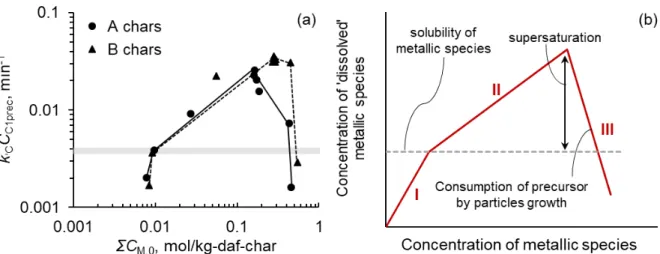
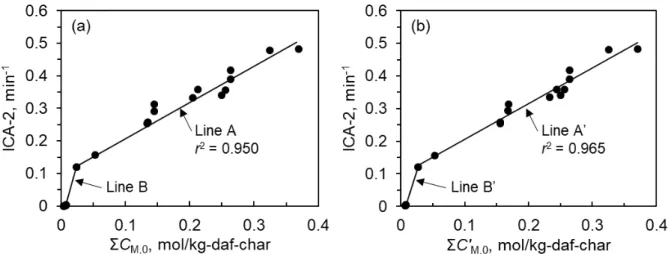
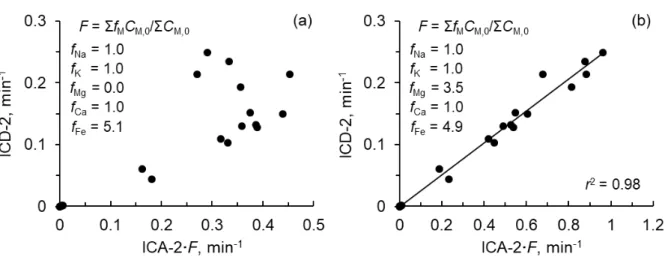
parallel, and employed multicatalytic species with different initial activities and deactivation kinetics. A single piecewise linear function, which followed a nucleation-growth mechanism of catalysts, showed the relationship between the total concentration of Na, K, Ca, and Fe and the initial total catalytic activity (ICA-2) for the chars. The overall rate of catalyst deactivation (ICD-2) was given by a single linear function of ICA-2 and a factor for the composition of metallic species. This function was also applicable to previously reported ICA-2/ICD-2 relationships for chars from lignite and biomass, showing fast deactivation of Fe catalyst and an important role of Mg in the promotion of catalyst deactivation.
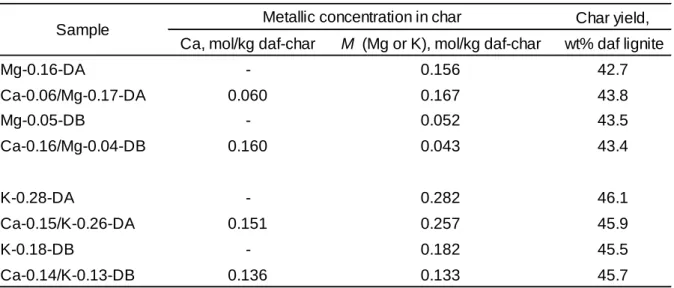
Chapter 3 discusses the results of the investigation on the interaction mechanisms of Ca with Mg or K during catalytic CO2 gasification of lignite char. Two demineralized lignites, prepared by multi-stage removal of inherent inorganic species, were loaded with varying amounts of Ca, Mg, and K, separately or jointly, by ion exchange, then pyrolyzed and subsequently gasified at 900°C. The measured kinetics of the gasification of chars with different contents of metallic species was described quantitatively over a range of char conversion, 0−0.999, by the model that employed the progress of non-catalytic gasification and catalytic gasification in parallel, together with the presence of multicatalytic components with different characteristics. For Ca-catalyzed gasification, its initial rate was correlated well and linearly with the Ca concentration in char (0.14– 1.33 wt%-daf-char). When bi-metal catalysts were used, the kinetic analysis revealed that the Mg/MgO deactivated a portion of the most active Ca catalyst prior to and during the gasification. In contrast, the K showed synergistic performances with Ca. Its overall catalytic activity was similar to Ca on an equal mol basis, but its deactivation rate was much lower. It was also found that the catalytic performance of the extraneous metallic species was lower than that of inherent metallic species.
Chapter 4 discussed the results of the investigation of the change in catalytic activity of K with the char conversion during CO2 gasification of lignite char at 800–900°C. Several physical and chemical properties of char that potentially influence the catalytic activity were examined. The char samples were prepared from an Indonesian lignite by a sequence of complete removal of inherent metallic species and mineral matter, K-loading by ion-exchange, and pyrolysis. The catalytic activity of K (k’cat) was defined as the rate of catalytic gasification (after elimination of the rate of non-catalytic gasification and that of K volatilization from total mass release rate from char) per amount of K retained by the gasifying char. k’cat increased by a factor of 5–20 with X over its range up to 0.98–0.99, depending on the initial K concentration in the char (mcat,0) ranging 0.16–1.4 wt%-daf. Such significant increase in k’cat was due to change in not the intrinsic reactivity of char but its porous nature, i.e., the size and volume of
pores that retained the K catalyst. At X < 0.4, the entire portion of K catalyst was confined in micropores (width < 2.0 nm) having relatively small k’cat, although it increased gradually. At X > 0.4, the gasification created greater mesopores (width > 2.0 nm), providing spaces for growth in the size of the K catalyst and allowing promotion of its activity. However, for low mcat,0, its major portion continued to stay in micropores with a limited increase in k’cat.
Chapter 5 provides a summary with general conclusions, perspectives, and recommendations based on the findings in preceding chapters.
Figure 1.1. Scheme of polygeneration gasification system coupled with SOFC. [4,9]
Figure 1.2. The rate of steam gasification of the original and AAEM-loaded activated carbon.
[23]
1.7 References
1. BP Economics. BP Statistical Review of World Energy, 68 (2019) [Retrieved from https://www.bp.com].
2. IEA, Key World Energy Statistics, (2018). [Retrieved from https://www.iea.org/]
3. M. Kawabata, O. Kurata, N. Iki, H. Furutani, A. Tsutsumi, Journal of Power Technologies, 92 (2012), 90–100.
4. J. Hayashi, S. Kudo, H.S. Kim, K. Norinaga, K. Matsuoka, S. Hosokai, Energy & Fuels, 28 (2014), 4–21.
5. H. Kim, S. Kudo, K. Tahara, Y. Hachiyama, H. Yang, K. Norinaga, J. Hayashi, Energy &
Fuels, 27 (2013), 6617–6631.
6. D. Fan, Z. Zhu, Y. Na, Q. Lu, Journal of Thermal Analysis and Calorimetry, 113 (2013), 599–607.
7. G. Skodras, G. Nenes, N. Zafeiriou, Applied Thermal Engineering, 74 (2015), 111–118.
8. J. Ahrenfeldt, T.P. Thomsen, U. Henriksen, L.R. Clausen, Applied Thermal Engineering.
50 (2013), 1407–1417.
9. V. Subotić, A. Baldinelli, L. Barelli, R. Scharler, G. Pongratz, C. Hochenauer, A. Anca- Couce, Applied Energy, 256 (2019).
10. R. Cypres, C. Soudan-moinet, Fuel, 59 (1988), 48–54.
11. C. Sathe, Y. Pang, C.Z. Li, Energy & Fuels, 13 (1999), 748–755.
12. J. Hayashi, H. Takahashi, S. Doi, H. Kumagai, T. Chiba, T. Yoshida, A. Tsutsumi, Energy
& Fuels, 14 (2000), 400–408.
13. C.Z. Li, C. Sathe, J.R. Kershaw, Y. Pang, Fuel, 79 (2000), 427–438.
14. D.M. Quyn, H. Wu, S.P. Bhattacharya, C.Z. Li, Fuel, 81 (2002), 151–158.
15. R.M. Navarro, M.A. Peña, J.L.G. Fierro, Chemical Reviews, 107 (2007), 3952–3991.
16. G.W. Huber, S. Iborra, A. Corma, Chemical Reviews, 106 (2006), 4044–4098.
17. A. Corma, Chemical Reviews, 114 (2014), 1545–1546.
18. Q. Yi, W. Li, J. Feng, K. Xie, Chemical Reviews, 44 (2015), 5409–5445.
19. H.C. Butterman, M.J. Castaldi, Environmental Science & Technology, 43 (2009), 9030–
9037.
20. C. Higman, S. Tam, Chemical Reviews, 114 (2014), 1673–1708.
21. F. Kapteijn, O. Peer, J. Moulijin, Fuel, 65 (1986), 1371–1376.
22. R.A. Arnold, J.M. Hill, Sustainable Energy Fuels, 3 (2019), 656–672.
23. Y. Zhang, M. Ashizawa, S. Kajitani, K. Miura, Fuel, 87 (2008), 475–481.
24. M. Kajita, T. Kimura, K. Norinaga, C.Z. Li, J. Hayashi, Energy & Fuels, 24 (2010), 108–
116
25. H. Yang, S. Kudo, K. Norinaga, J. Hayashi, Energy & Fuels, 30 (2016), 1616–162.
26. D.M. Quyn, H. Wu, C.Z. Li, Fuel, 81 (2002), 143–149.
27. C. Sathe, J. Hayashi, C.Z. Li, T. Chiba, Fuel, 82 (2003), 1491–1497.
28. K. Formella, P. Leonhardt, A. Sulimma, K.H. van Heek, H. Jüntgen, Fuel, 65 (1986), 1470–1472.
29. D.A. Sams, T. Talverdian, F. Shadman, Fuel, 64 (1985), 1208–1214.
30. L.R. Radovic, P.L. Walker, R.G. Jenkins, Fuel, 63 (1984), 1028–1030.
31. R.P.W.J. Struis, C. Von Scala, S. Stucki, R. Prins, Chemical Engineering Science, 57 (2002), 3593–3602.
32. E. Byambajav, Y. Hachiyama, S. Kudo, K. Norinaga, J. Hayashi, Energy & Fuels, 30 (2016), 1636–1646.
33. M. Perander, N. DeMartini, A. Brink, J. Kramb, O. Karlström, J. Hemming, A. Moilanen, J. Konttinen, M. Hupa, Fuel, 150 (2015), 464–472.
34. D.M. Quyn, J. Hayashi, C.Z. Li, Fuel Processing Technology, 86 (2005), 1241–1251.
35. D.W. McKee, Fuel, 59 (1980), 308–314.
36. C.S.M. de Lecea, M. Almela-Alarcón, A. Linares-Solano, Fuel, 69 (1990), 21–27.
37. Y. Ohtsuka, K. Asami, Energy & Fuels, 9 (1995), 1038–1042 38. Y. Ohtsuka, K. Asami, Energy & Fuels, 10 (1996), 431–435.
39. T. late T.D. Hengel, P.L. Walker, Fuel. 63 (1984), 1214–1220.
40. J. Wang, Y. Yao, J. Cao, M. Jiang, Fuel, 89 (2010), 310–317.
41. M.-Q. Jiang, R. Zhou, J. Hu, F.-C. Wang, J. Wang, Fuel, 99 (2012), 64–71.
42. L.X. Zhang, S. Kudo, N. Tsubouchi, J. Hayashi, Y. Ohtsuka, K. Norinaga, Fuel Processing Technology, 113 (2013), 1–7.
43. Y. Bai, P. Lv, F. Li, X. Song, W. Su, G. Yu, Energy Conversion Management, 184 (2019), 172–179.
44. H.S. Kim, S. Kudo, K. Norinaga, J.I. Hayashi, Energy & Fuels, 28 (2014), 5623–5631.
45. J.T. Gallagher, H. Harker, Carbon, 2 (1964), 163–173.
46. J.L. Figueiredo, J. Rivera-Utrilla, M.A. Ferro-Garcia, Carbon, 25 (1987), 703–708.
47. W.J. Lee, S.D. Kim, Fuel, 74 (1995), 1387–1393.
48. E.J. Hippo, R.G. Jenkins, P.L. Walker, Fuel, 58 (1979), 338–344.
49. A. Tomita, T. Takarada, Y. Tamai, Fuel, 62 (1983), 62–68.
50. V. Claude, C. Courson, M. Köhler, S. D. Lambert, Energy & Fuels, 31 (2017), 1050–1050.
51. J. Tanner, K.B. Kabir, M. Müller, S. Bhattacharya, Fuel, 154 (2015) 107–113.
52. C. Heinze, J. May, J. Peters, J. Ströhle, B. Epple, Fuel, 250 (2019), 285–291.
53. L. Liu, Y. Cao, Q. Liu, J. Yang, RSC Advances, 7 (2017), 2193–2201.
54. X. Shenqi, Z. Zhijie, X. Jie, Y. Guangsuo, W. Fuchen, Fuel, 90 (2011), 1723–1730.
55. R.H. Hurt, A.F. Sarofim, J.P. Longwell, Fuel, 70 (1991), 1079–1082.
56. J. Kopyscinski, R. Habibi, C.A. Mims, J.M. Hill, Energy & Fuels, 27 (2013), 4875–4883.
57. J. Kopyscinski, M. Rahman, R. Gupta, C.A. Mims, J.M. Hill, Fuel, 117 (2014), 1181–
1189.
58. S. Kudo, Y. Hachiyama, H.-S. Kim, K. Norinaga, J. Hayashi, Energy & Fuels, 28 (2014), 5902–5908.
59. J. Tang, X. Wu, J. Wang, Fuel, 141 (2015), 46–55.
60. F. Zhang, M. Fan, X. Huang, M.D. Argyle, B. Zhang, B. Towler, Y. Zhang, Fuel Processing Technology, 161 (2017), 145–154.
61. S.K. Bhatia, D.D. Perlmutter, AIChE Journal, 26 (1980), 379–386.
62. S. Kajitani, N. Suzuki, M. Ashizawa, S. Hara, Fuel, 85 (2006), 163–169.
63. A. Tremel, H. Spliethoff, Fuel, 107 (2013) 653–661.
64. K. Zubek, G. Czerski, S. Porada, Energy & Fuels, 32 (2018) 5684–5692.
65. Y. Zhang, S. Hara, S. Kajitani, M. Ashizawa, Fuel, 89 (2010), 152–157.
66. T. Liliedahl, K. Sjöström, Fuel, 76 (1997), 29–37.
67. K. Umeki, A. Moilanen, A. Gómez-Barea, J. Konttinen, Chemical Engineering Journal, 207–208 (2012), 616–624.
68. K. Miura, K. Hashimoto, P.L. Silveston, Fuel, 68 (1989), 1461–1475.
69. B. Bayarsaikhan, J. Hayashi, T. Shimada, C. Sathe, C.Z. Li, A. Tsutsumi, T. Chiba, Fuel, 84 (2005), 1612–1621.
70. Z.F. Zahara, S. Kudo, Daniyanto, U.P.M. Ashik, K. Norinaga, A. Budiman, J. Hayashi, Energy & Fuels, 32 (2018), 4255–4268.
71. D.P. Ye, J.B. Agnew, D.K. Zhang, Fuel, 77 (1998), 1209–1219.
72. B.B. Beamish, K.J. Shaw, K.A. Rodgers, J. Newman, Fuel Processing Technology, 53 (1998), 243–253.
73. J. Hayashi, H. Takahashi, M. Iwatsuki, K. Essaki, A. Tsutsumi, T. Chiba, Fuel, 79 (2000), 439–447.
74. T. Kitsuka, B. Bayarsaikhan, N. Sonoyama, S. Hosokai, C.Z. Li, K. Norinaga, J. Hayashi, Energy & Fuels, 21 (2007), 387–394.
Chapter 2
Quantitative Description of Catalysis of Inherent Metallic Species in Lignite Chars during CO
2Gasification
2.1 Introduction
Gasification of lignite is a platform for the production of power, fuels, and chemicals, or their co-production. [1,2] Its efficiency, in terms of chemical energy recovery, is maximized by maximizing the utilization of endothermic gasifying agents such as steam and CO2. [3–5]
The advantage of CO2 over steam is the omission of heat for vaporization, while the disadvantage is the lower reactivity. Inherent catalyst species with sufficient content neutralize the disadvantage. Many Indonesian lignites are rich in alkali and alkaline earth metallic species (Na and/or Ca) and also a transition metal (Fe), major portions of which are in the form of organically-bound cations. [6,7]
The quantitative description of the char gasification kinetics, which is the rate- determining step of the lignite-to-syngas conversion, is vital for the design and optimization of a gasifier. Previous studies have recently developed a kinetic model that assumes parallel progress of non-catalytic gasification and catalytic gasification of char, along with catalyst generation and deactivation. [8,9] This model has been applied successfully to describing the kinetics of steam and CO2 gasification over entire ranges of char conversion up to 0.999 or even higher for chars from various types of lignites or biomass. [8–10] It has been demonstrated that inherent Na, K, Ca, and Fe species play important catalytic roles, and moreover, strongly suggested that different catalytic species undergo deactivation at different rates while interacting with one another. On the other hand, participation of Mg species in catalysis and catalyst activation/deactivation has been left unknown. [9,10]
To better understand the catalysis of metallic species, it is effective to prepare a sufficient number of char samples that contain metallic species at various concentrations. There are three different approaches to achieve this purpose. One is to remove metallic species from original lignite by leaching with aqueous solutions of strong acids such as HCl and HF, and then dope fresh metallic species as catalyst precursor. [11–15] However, this approach may not well represent the original mode of occurrence of the target metallic species present inherently in
the original lignite. Another approach is to employ a wide range of original lignites with or without acid washing. [9,16,17] The third approach is to sequentially remove metallic species by washing with increasingly aggressive acids or ion-exchanging reagents, i.e., water, ammonium acetate (NH4OAc), HCl, and then HF. This approach is useful in chemical fractionation analysis. [18,19] Preparation of a variety of samples from a parent lignite ensures the intrinsic reactivities of resulting chars are fixed. More importantly, such sequentially washed lignite samples contain inherent metallic species with different concentrations and/or chemical types such as water-soluble, ion-exchangeable, acid-soluble and acid-insoluble. [20–
24]
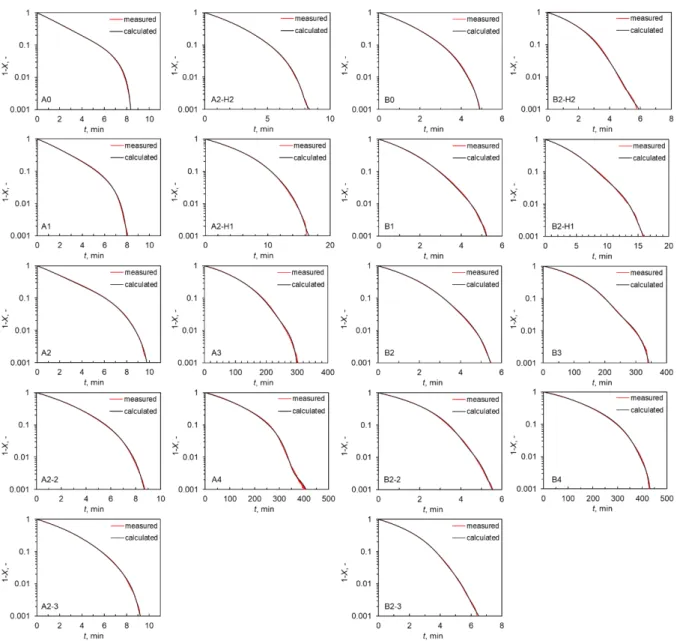
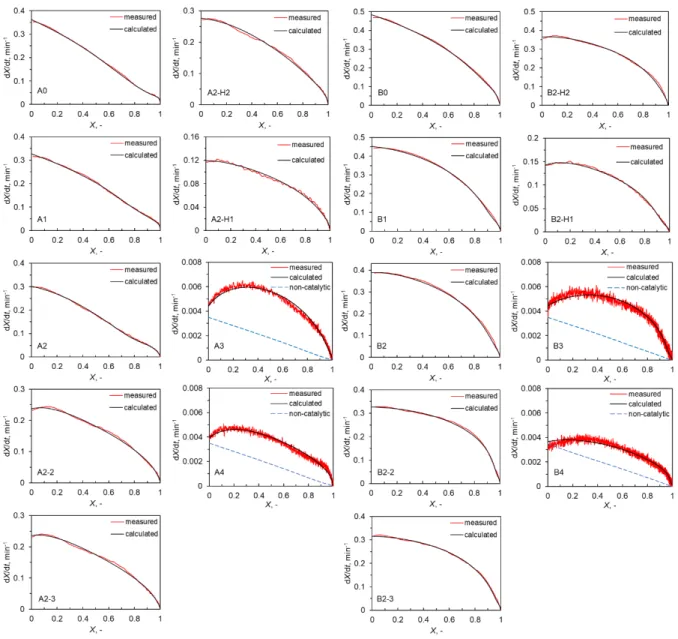
The present authors investigated CO2 gasification of chars from two series of original and sequentially washed Indonesian lignites that were prepared by removing the inherent metallic species sequentially with deionized water, NH4OAc, HCl, and HF at various concentrations. This study reports that the catalytic/non-catalytic parallel reaction model successfully describes the kinetics of gasification of 20 lignite chars over a wide range of concentrations/forms of metallic catalyst species. It is also reported that the initial activity and subsequent deactivation of catalyst can be described by functions of the composition of metallic species.
2.2 Experimental
2.2.1 Lignite samples and sequential washing
Two Indonesian lignites, A and B, were used as the starting samples. These were dried partially at room temperature, pulverized to particle sizes smaller than 106 μm, and then dried at 60°C under vacuum until the moisture content decreased to ca. 5 wt%. The samples were further pulverized by ball milling for 10 h in a pot mill. Zirconia balls (diameter: 9.5–10 mm) were used for the milling. It was confirmed that the ball milling reduced the particle sizes to <
10 μm (see Appendix 1). The finely pulverized lignites A and B, which are hereafter referred to as A0 and B0, respectively, were subjected to the sequential washing. Table 2.1 shows the properties of A and B.
A flow chart of the sequential washing is presented in Figure 2.1. Briefly, ca. 6 g of A0 or B0 was washed with 0.12 L of deionized water (resistivity ≥18.2 MΩ cm) in a plastic beaker.
The lignite/water slurry was heated at 65°C for 24 h while stirred continuously. The washed lignite was separated from the water by vacuum filtration and then washed with other 1–3 L of deionized water repeatedly until no chlorine ion was detected in the filtrate. A portion (ca. 1 g)
of the water-washed lignite (A1 or B1) was vacuum-dried at 60°C, while the other (ca. 5 g) was washed with 0.1 L of 1 M NH4OAc aq. A portion of the NH4OAc aq.-washed lignite (A2 or B2) was washed sequentially with 3M HCl aq. for recovering A3 or B3, with 3 M HF aq.
for A4 or B4, and then with 6 M HCl aq. for A5 or B5. A2 and B2 were also subjected to washing with 1 M NH4OAc aq. once or twice for preparing A2-2/B2-2 or A2-3/B2-3, respectively. Such repeated washing was performed to remove ion-exchanged metallic species.
A2 and B2 were also washed with 0.01 M HCl aq. or with 0.1 M HCl aq. for A2-H2/B2-H2 or A2-H1/B2-H1, respectively, to investigate the effect of pH of acidic solution on the removal of metallic species. For each washing, the ratios of solution volume to dry lignite mass were fixed at 20 ml/g, and the washing temperature and time were systematically at 65°C and 24 h, respectively. 10 samples were thus prepared from each lignite. Table 2.2 shows the ash contents of the samples.
2.2.2 Quantification of metallic species
The contents of K, Na, Mg, Ca, and Fe in the individual samples were measured referring to previous reports. [25–27] In brief, each sample was ashed carefully and completely by heating in the air with a rate, holding temperature and holding time of 1 °C/min, 620°C, and 60 min, respectively. The lignite mass subjected to the ashing was 37±4 and 370±40 mg for A0–A2/B0–B2 and the others, respectively. The resulting ash was digested in an equivolume mixture of 1 M HF and 1 M HNO3 at 60°C for 16 h. The acids and water were then evaporated at 120°C. The residue was dissolved in 4 mM aqueous solution of methanesulfonic acid, and analyzed by ion chromatography for K, Na, Mg, and Ca or by inductively coupled plasma- optical emission spectroscopy for Fe. Details of the analysis were reported elsewhere. [10]
2.2.3 Pyrolysis and gasification
Char samples were prepared from the individual lignite samples in a general way. [28,29]
The fixed bed of lignite (0.5–1 g) was set in a horizontal quartz tube reactor, heated in an atmospheric flow of N2 (purity; > 99.999 vol%, flow rate; 300 mL/min) at 30 °C/min to 600°C with a holding time of 15 min. The char from the pyrolysis was heated at a rate of 30 °C/min to 900°C and then gasified in a thermogravimetric analyzer (TGA; Hitachi Hi-Tech Science, model SII TGA/DTA 7200) with the total gas flow rate of 700 mL/min (50 vol% CO2/N2 flow).
Details of the procedure for the gasification were reported previously. [9,10] The initial mass of char was a critical factor for eliminating the effects of heat and mass transfer, and its effect on the kinetics of gasification was examined preliminarily. Results are reported in Appendix
2. In summary, it was necessary to choose the initial mass as small as 1 mg for the chars from A0–A2 and B0–B2, which underwent fast gasification. Since the reactivities of the chars from A3–A5 and B3–B5 are much lower, the initial mass of these chars was 1–2 mg in order to obtain a reasonable DTG curve. Reproducibility of the above gasification conditions, which had been confirmed previously for steam and CO2 gasification, [9,30] was successfully examined in the preliminary experiments.
2.2.4 X-ray diffractometry
Inorganic species in A0 and B0 chars with mass-based char conversions of 0%, 80%, and 100% were characterized by X-ray diffractometry (XRD). It was performed on a powder X- ray diffractometer (Rigaku, model TTRIII) applying Cu Kα radiation, a 50 kV tube voltage, a 300 mA tube current, and a scan rate of 0.5 °/min over a 2θ range of 15–65°. Specific compounds were identified by a general method, referring to International Centre for Diffraction Data. The char/ash samples were prepared by collecting the residue from several gasification experiments in TGA under the same condition.
2.2.5 Kinetic analysis
The kinetics of char gasification was analyzed by a model that has been developed by the present authors. [8-10] This model assumes progress of non-catalytic and catalytic gasification in parallel. The following equation describes the overall rate of gasification as a function of char conversion on the basis of the mass of carbonaceous portion, X.
𝑑𝑑𝑑𝑑
𝑑𝑑𝑑𝑑 =𝑘𝑘nc(1− 𝑋𝑋) +𝑘𝑘c (1)
knc and kc are the rate constants for the non-catalytic and catalytic gasification, respectively, which obey first-order and zeroth-order kinetics with respect to the unconverted fraction of char. [8,26,27,31–33] The model also assumes the followings.
• The initial activity and rate of deactivation of the catalyst(s) distribute over wide ranges that are described quantitatively in a discrete manner by lumping various catalysts into four types (Cn; n = 1 – 4). This number is necessary to describe the dX/dt vs X for all the chars and over the entire ranges of X as shown later. However, Cn does not represent any specific elements (i.e., K, Na, Ca, and Fe) individually.
• The presence of precursor (C1prec) that is transformed into C1.
The following equations, Equations 2–7, are details of Equation 1 and definitions of amounts (mCn) and concentrations of the catalysts (CCn) and C1 precursor (CC1prec). More details of the model and kinetic equations were reported elsewhere. [9,10]
𝑘𝑘c =∑ 𝑘𝑘𝑛𝑛 C𝑛𝑛 (2)
𝑘𝑘C𝑛𝑛 =𝑘𝑘′C𝑚𝑚C𝑛𝑛 (3)
At t = 0, kCn = kCn,0 = k'CmCn,0, where k’C is a rate of constant that defined to be common among C1–C4, and Σn mCn + mC1prec = Σn mCn,0 + mC1prec,0 = 1. The dynamic concentration of catalysts during char gasification is defined by:
𝑑𝑑𝑚𝑚C1,prec
𝑑𝑑𝑑𝑑 = −𝑘𝑘C1prec𝐶𝐶C1prec (4)
𝑑𝑑𝑚𝑚C1
𝑑𝑑𝑑𝑑 = 𝑘𝑘C1prec𝐶𝐶C1prec− 𝑘𝑘loss-1𝐶𝐶C1 (5)
𝑑𝑑𝑚𝑚C𝑛𝑛
𝑑𝑑𝑑𝑑 = − 𝑘𝑘loss-n𝐶𝐶C𝑛𝑛 (n = 2–4) (6)
𝐶𝐶C1prec = 𝑚𝑚1 − 𝑑𝑑C1prec and 𝐶𝐶C1 = 1 − 𝑑𝑑𝑚𝑚C1 (7)
From the above equations, the following parameters for the overall initial catalytic activity and the overall initial rate of catalyst deactivation are derived.
ICA-1 = ∑ 𝑘𝑘𝑛𝑛 C𝑛𝑛,0 = ∑ 𝑘𝑘′𝑛𝑛 C𝑛𝑛𝑚𝑚C𝑛𝑛,0 (8) ICA-2 =∑ 𝑘𝑘𝑛𝑛 C𝑛𝑛,0+𝑘𝑘′C𝑚𝑚C1prec,0 =𝑘𝑘′C (9)
ICD-1 = ∑ 𝑘𝑘𝑛𝑛 loss-n,0𝐶𝐶C𝑛𝑛,0 (10)
ICD-2 = 𝑘𝑘loss-1,0�𝐶𝐶C1,0+𝐶𝐶C1prec,0�+∑ 𝑘𝑘𝑛𝑛 loss-n,0𝐶𝐶C𝑛𝑛,0 (11)
ICA-1 represents the overall catalytic activity at t = 0, while ICA-2 involves the potential activity of C1. ICD-1 and ICD-2 are the overall rates of catalyst deactivation at t = 0, corresponding to ICA-1 and ICA-2, respectively. It is believed that the char contains various types of catalysts of that initial activity and deactivation kinetics distribute continuously over a wide range. The present kinetic model represents such continuous distribution by a discrete one. [9,10] Details of the method for optimizing the kinetic parameters were reported elsewhere.
[9,10]
2.3 Results and Discussion
2.3.1 Occurrence of inherent metallic species
Table 2.2 presents the ash contents of the lignite samples. The ash contents of the lignites A and B decrease in manners similar to each other. Taking the An series as an example, the difference between A0 and A1 and that between A1 and A2 were arisen from water-soluble salts and ion-exchangeable (organically bound) cations, respectively. It was suspected that the
organically-bound cations had not been exchanged by NH4+ ions completely. [34] A2 and B2 were then washed repeatedly with fresh 1 M NH4OAc aq. according to a report by Matsuoka et al. [34] However, the ash content was decreased only slightly by the second and third washings. The A2–A3 difference is normally attributed to metallic species in forms of oxides, carbonates, sulfates, and/or sulfides. [35–37] However, as mentioned later, it was suspected that a limited portion of the organically-bound cations was removed with 1 M NH4OAc aq.
even by the repeated washing. It was believed that the A3 and A4 difference was due to silica, alumina, and aluminosilicates that were insoluble in HCl aq. but soluble in HF aq. The ash content of A5 was very low but not zero. The washing with 6 M HCl aq. left trace amount of ash-forming species, which were probably encapsulated in the organic matrix and therefore inaccessible to the aqueous media. [20,36]
Figure 2.2 displays the cumulative concentrations of five metallic species (Na, K, Mg, Ca, and Fe) in the original lignites that were leached at different stages. The cumulative concentrations of all the five metallic species agree well with those in the original lignites as determined by a sequence of ashing, its dissolution in HNO3/HF aq. and ion-chromatography analysis. These data demonstrate that the sequential leaching and analysis were performed with sufficiently high accuracy.
Figure 2.2 also shows five important features that are reported below. First, both lignites contained very little amounts of Na and K. These consisted mainly of water- and NH4OAc- solubles, in other words, salts (chlorides), and organically-bound cations. Second, Mg and Ca were much more abundant than Na and K and also mostly in the form of either water-soluble salts, organically-bound cations or 3 M HCl aq.-soluble. It was believed that water-soluble Mg and Ca species originated from those dissolved in the inherent pore water. [37–39] Third, major portions of Ca species were NH4OAc aq.-insoluble but 3 M HCl aq.-soluble. Matsuoka et al.
reported that even repeated leaching with NH4OAc aq. could not remove Ca from lignite completely, while it removed a portion of Ca species in the form of minerals such as calcite.
[34] It was thus suspected that more or less amount of organically-bound Ca remained in A2 and B2. As reported in the above, A2 and B2 were washed with 1 M NH4OAc aq. repeatedly, but, additional leaching of Ca was insignificant (see Appendix 3). Then, A2 and B2 were washed with 0.01 M HCl aq. (pH ≈ 2) and 0.1 M HCl aq. (pH ≈ 1). The Ca-leaching ability of the 0.01 M HCl aq. was equivalent to that of the 1 M NH4OAc aq. (see Appendix 3). On the other hand, the washing with the 0.1 M HCl aq. removed a major portion (ca. 80%) of NH4OAc aq.-insoluble/3 M HCl aq.-soluble Ca (see Appendix 3). According to general knowledge, [35–
37] these results are explained by that substantial portions of Ca in the lignites A and B were
in chemical forms of oxides, carbonates, sulfates, and/or sulfides. These minerals normally exist as particulate matter with insignificant catalytic activity. It was, therefore, suggested that a major portion of the 0.01 M HCl aq.-insoluble/0.1 M HCl aq.-soluble Ca was organically- bound. As reported later, this suggestion was consistent with the significant differences in the catalytic activity between A2-H2 and A2-H1 chars and also B2-H2 and B2-H1 chars. Fourth, the lignites A and B were much different from each other regarding Fe content. The lignite A contained Fe with a content of 1,150 ppm-wt on a dry lignite basis, a major portion of which was NH4OAc aq.-insoluble but 3 M HCl aq.-soluble. On the other hand, the Fe content in the lignite B was negligibly small. Fifth, the sequential washing with 3 M HF aq. and 6 M HCl aq.
removed almost entire portions of metallic species from the lignites A and B, leaving trace amounts of Na, K, Mg, Ca and Fe at total concentrations of 99 and 96 ppm-wt, respectively.
As reported above, the sequential washing enabled to prepare a range of samples with various compositions of ‘remaining’ inherent metallic species. For expedience, A0–A2 and B0–B2 samples were classified into H group while the others into L group according to the metallic species concentration and the char reactivity with CO2, as shown later.
Figure 2.3 shows the char yields from the individual lignite samples on a dry-and-ash- free (daf) basis. The pyrolysis of the L-group lignites gave char yields systematically lower by 1–3 wt%-daf than those from the H-group lignites, which was more than the experimental error within ± 0.1 wt% daf that preliminary examined. [9] This trend was explained by the removal of organically-bound cations, which played a role of chemical cross-links and also a catalytic role of cross-linking during pyrolysis, causing the char yield increase. [8,40,41] It is also known that mineral particles have no significant catalytic effects on the char yield. This suggested that a substantial portion of the NH4OAc aq.-insoluble/3 M HCl aq.-soluble metallic species were organically-bound cations, although a main reason for ‘NH4OAc aq.-insoluble’ was unknown.
2.3.2 Overview of characteristics of char gasification
Figure 2.4 presents the relationship between the rate of gasification, dX/dt, and X. The initial dX/dt for the H-group chars and L-group chars are differing by 1–2 orders of magnitude reflecting that the chars from H-group lignites underwent faster gasification than that from L- group chars. It was thus clear that the inherent metallic species played catalytic roles in the gasification. In addition, the dX/dt for the A5 and B5 chars are lower than those for any other chars over the entire range of X. It was difficult to exactly determine the rate of non-catalytic gasification experimentally, because the removal of metallic species was nearly but not fully complete. It was, however, reasonable to approximate the rate by that for the gasification of
![Figure 1.1. Scheme of polygeneration gasification system coupled with SOFC. [4,9]](https://thumb-ap.123doks.com/thumbv2/123deta/9810275.1885895/22.892.121.779.118.401/figure-scheme-polygeneration-gasification-coupled-sofc.webp)


![Figure 3.2. Effect of Ca concentration in char, C Ca , on [(a1) and (b1)] 1–X vs t profiles, and [(a2) and (b2)] dX/dt vs X profiles for the gasification of chars from Ca-loaded DA and DB, respectively](https://thumb-ap.123doks.com/thumbv2/123deta/9810275.1885895/75.892.112.785.104.615/figure-effect-concentration-profiles-profiles-gasification-loaded-respectively.webp)
