九州大学学術情報リポジトリ
Kyushu University Institutional Repository
関係計算を用いたファジィ関係データベースの研究
モハッマド, デニ, アクバル
https://doi.org/10.15017/1866253
出版情報:Kyushu University, 2017, 博士(機能数理学), 課程博士 バージョン:
権利関係:
A Study on Fuzzy Relational Database Model using Relational Calculus
A Dissertation Submitted to the Graduate School of Mathematics in Fulfillment of the Requirement for the Degree of Doctor of Philosophy in
Functional Mathematics Kyushu University
By
Mohammad Deni Akbar
Supervisor: Professor Yoshihiro Mizoguchi
Graduate School of Mathematics Kyushu University
2017
Abstract
We introduce a formalization of a fuzzy relational database model using rela- tional calculus on the category of fuzzy relations. The fuzzy relational database is an extension of the relational database using a soft computing technique, fuzzy theory. We also introduce general formulas for the notion of database operations such as ’projection’, ’selection’, ’injection’ and ’natural join’ which can be used for both traditional and fuzzy database models. Using our relational formulas of relational calculus, we can denote its properties by simple and correct formulas.
Also, we can prove its properties formally using relational calculus. Further, we formalize an equivalence class of the fuzzy relational database. There are many applications of fuzzy relational database such as managing hyperlinks of web pages, customer relationship management, etc. Our motivation is developing formal verification tools for a software system using an equivalence class of fuzzy relational database.
Next, we show the soundness and the completeness of Armstrong’s inference rules of the Functional Dependency (Implication or Association rule) with re- spect to fuzzy relational databases. In 2009, Ishida et al. presented a relational formulation for Armstrong’s inference rules and implication in a Dedekind cate- gory. They showed a relation-algebraic proof of the soundness and completeness theorem for Armstrong’s inference rules in a Dedekind category. We follow their approach especially focusing on fuzzy relations using relational calculus. We in- troduce a formalization of a fuzzy equivalence relation, a fuzzy implication, and functional dependency. We prove theorems in our formalization of fuzzy con- cepts using relational calculus. We also show the logical comparison between a fuzzy implication dependency and a functional dependency.
Finally, we demonstrate the truck backer-upper control problem using our
formulation of the fuzzy relational database. Every fuzzy state, operation strate-
gies, and solving procedures are described by database tables and formulas of
relational calculus. We also show examples of computations of fuzzy relational
databases using our Mathematica implementation.
Acknowledgment
First, I would like to express my deepest gratitude to Professor Yoshihiro Mi- zoguchi, my supervisor as well as the academic advisor, for the patient guidance, encouragement and advice he has provided throughout my time as his student.
I have been extremely lucky to have a supervisor who cared so much about my work, and who responded to my questions and queries so promptly.
I am also grateful to Professor Yasuo Kawahara for his valuable suggestions and helpful comments to succeed this research.
I am express my gratitude to Professor Hitoshi Furusawa of Department of Mathematics of Kagoshima University for all of his valuable comments, sugges- tions, encouragement and his continues support. Since my thesis is the applica- tion of his theory in algebraic of fuzzy relations, his comments and corrections are very important in my research.
I am also express my gratitude to Professor Hidefumi Kawasaki of Depart- ment of Mathematics of Kyushu University for his kind support and all of com- ments during my studies in Kyushu University. Also, I would like to thanks for his kind help that give me chance to get experience internship in Toshiba.
My wholeheartedly gratitude goes to my parents and my family, especially to my mother and my wife who was the persons behind all the success in my life, providing me every support, and for all supplications to Allah for my success in PhD.
I would like thanks to all Mizoguchi’s lab member, Indonesian community, moslem community in Fukuoka, the officials of various academic and non- academic divisions of Kyushu University for their kind support during my studies.
Also, I would like to thanks to Interactive Media Laboratory members in Toshiba company for all the experience, kind help, and discussion during my internship in Toshiba.
Finally, I would like to thank The Ministry of Education, Culture, Sports,
Science and Technology (MEXT) Japan, for providing Super Global scholarship
to support funding during my studies.
Contents
1 Introduction 2
2 Basic Notions of Fuzzy Relational Calculus 5
2.1 Fuzzy Relation . . . . 5
2.2 Category . . . . 7
2.3 Fuzzy Power Set . . . . 11
3 Fuzzy Relational Operators Using Relational Calculus 12 3.1 Fuzzy Relational Database . . . . 12
3.2 Fuzzy Database Operations . . . . 14
3.2.1 Selection . . . . 14
3.2.2 Projection . . . . 15
3.2.3 Injection . . . . 16
3.2.4 Natural Join . . . . 18
4 Equivalence Relational Database and Its Operations 21 4.1 Similarity Domain and Fuzzy Relation . . . . 22
4.2 Equivalence Relational Database . . . . 24
4.2.1 Simple(non redundant) sets . . . . 27
4.3 Equivalence Relational Database Operations . . . . 36
4.3.1 Union . . . . 36
4.3.2 Intersection . . . . 38
4.3.3 Selection . . . . 40
4.3.4 Projection . . . . 41
4.3.5 Injection . . . . 42
4.3.6 Natural Join . . . . 42
5 Fuzzy Implication and Functional Dependency 45 5.1 Fuzzy Context . . . . 45
5.2 Armstrong’s Inference Rules . . . . 46
5.3 Fuzzy Functional Dependency . . . . 47
5.4 Fuzzy Implication . . . . 50
5.5 Soundness and Completeness . . . . 51
5.6 Comparison . . . . 52
6 Application: Fuzzy Process on Truck Backer-Upper 54
6.1 Formulation Using Our Fuzzy Relational Model . . . . 55
6.2 Fuzzy Rules . . . . 57
6.3 Fuzzy Algorithm . . . . 57
6.4 Result . . . . 59
7 Conclusion and Future Work 61
List of Figures 66
List of Tables 67
Chapter 1
Introduction
The relational database model was first introduced by Codd in 1970[Cod70].
One of the advantages of the relational model is soundness for data consistency.
A procedure of data processing is sometimes described by dynamic sequences of operations which may have ambiguities in its implementation. Since a procedure in the relational database model is defined by a static formula, we can avoid inconsistencies in their implementations.
Relational databases commonly contain attributes, tuples, database relation, database schema, and database operations. In this paper, we show properties of fuzzy relational databases using relational calculus.
Fuzzy database relation has been introduced by Raju and Majumdar in 1988[RM88], and fuzzy operations model was introduced by Umano and Fukami in 1994[UF94] and Nakata in 2000[Nak00]. Database operator is one of the im- portant aspects in relational database properties. Fuzzy relational database operators(’projection’, ’join’, and ’selection’) has been introduced by Umano in 1994[UF94]. In our work, we use relational calculus to compute database oper- ations. We use simpler and clearer formula to compute database operations.
The first concept of fuzzy relation has been invented by Zadeh in 1965[Zad65].
Kawahara, et al. developed an algebraic formalization of fuzzy relations using relational calculus[Kaw88, Kaw95, KM93, MK95a, MK95b]. Okuma, et al. in- troduced a relational database model using a theory of relational calculus on the Dedekind Category in 2000[OK00]. Since the Dedekind Category includes the category of fuzzy relations, we can formalize a fuzzy relational database model using relational calculus on the category of fuzzy relations.
In Chapter 2, we present basic terminologies and key results related to fuzzy relations and its operations, which will be used throughout this thesis.
In Chapter 3, we introduce a formalization of a fuzzy relational database
model using relational calculus on the category of fuzzy relations. We also
introduce general formulas for the notion of database operations such as ’pro-
jection’, ’selection’, ’injection’ and ’natural join’ which can be used for both
traditional and fuzzy database models. We prove several elementary properties
of database operations using relational calculus. We note that the same for- mulas of relational calculus can be used for a traditional non-fuzzy relational database model. So we can consider our fuzzy relational database theory us- ing intuition of the traditional database operations. There exist some trials of fuzzy relational database theory, but they are limited in specific topics such as fuzzy graph problem introduced by Kiss in 1991[Kis91] and Mordeson and Nair in 2001[MN01]. The advantage of our framework is showing several relational database operations uniformly using the theory of relational calculus.
In Chapter 4, one of our goals is to formalize an equivalence class of the fuzzy relational database. Using our relational formulas of relational calculus, we can denote its properties by simple and correct formulas. Also, we can prove its properties formally using relational calculus. There are many applications of fuzzy relational database such as managing hyperlinks of web pages, customer relationship management, etc. Our motivation is developing formal verifica- tion tools for a software system using an equivalence class of fuzzy relational database. We also extend the formalization database operations in previous chapter such as "projection", "selection", and "natural join" to equivalence class model. We prove several elementary properties of natural join operations using our formalization.
In Chapter 5, we show the proof of the soundness and completeness in Armstrong’s inference rules for the fuzzy functional dependency and fuzzy im- plication (association rule) with respect to fuzzy context table. Okuma and Kawahara introduced the notions of functional dependency and multivalued de- pendency using Dedekind category[OK00]. In 2009, Ishida et al. presented rela- tional formulations for Armstrong’s inference rules in a Schrőder category[IHK08].
Since Schrőder category is special for the boolean case then we considered mak- ing using Dedekind category to investigate the soundness and completeness in fuzzy context table. We investigate the approach introduced by Okuma, Kawa- hara and Ishida especially focusing on fuzzy relations using relational calculus.
In 1998, Duntsch and Gediga defined indiscernibility relation. We follow their approach to define the equivalence relation[DG98]. In 1997, Ganter and Wille in their textbook investigated formal concept analysis, they introduced some properties of dependency in the formal context such as implication, functional dependency, etc[GW97]. In this chapter, we try to redefine the implication and functional dependency using equivalence relation in relational calculus. The formalization can be used to analyze equivalence condition between functional dependency and implication. We prove theorems in our formalization of fuzzy concepts using relational calculus. We also show some logical comparison the- orems between a fuzzy implication and a functional dependency. Finally, we explain implemented operations in our fuzzy formal concept analysis using Math- ematica software. We show some examples in the application of data analysis.
Future work, includes constructing a theory of fuzzy relational database theory with computer verified formal proofs using relational calculus.
In Chapter 6, we apply our formulation to an example of the truck backer-
upper control problem using fuzzy logic introduced by Freeman in 1994[Fre94].
Every fuzzy states, procedures are described as database tables of the fuzzy rela- tional database theory. Problem-solving procedures are also described by static formulas of the relational calculus on the category of fuzzy relations. Since every property is described statically, the consistency of data can be proved formally.
We also implemented operations in the theory of fuzzy relational database us-
ing Mathematica Software. Using our Mathematica library, we demonstrate
computations in the truck backer-upper control problem.
Chapter 2
Basic Notions of Fuzzy Relational Calculus
There are many applications of fuzzy relations such as fuzzy modeling, fuzzy diagnosis, and fuzzy control. The applications of fuzzy relations can be used in many fields such as psychology, medicine, economics, and sociology. In this chapter, we define and discuss the notions of fuzzy relations. Beginning with a definition of fuzzy relations, we then talk about expressing fuzzy relations in relational calculus. Later we discuss the various properties of fuzzy relations and operations that can be performed with fuzzy relations.
In 1941, relational calculus has been introduced by Tarski[Tar41]. Then, many researchers continue about relational calculus such as Relational set theory by Kawahara[Kaw95], Relational Mathematics by Schmidt[Sch10], etc.
Next, there is much research that extends the relational calculus to the fuzzy relation. Using Dedekind category, they made some formalization of fuzzy relation, such as for cut off relation by Furusawa et al[FKW11], member basis value by Winter et al[WJ16].
In this chapter, we would like to introduce some properties and operations of fuzzy relations using relational calculus. The formalization is very basic and important because we will use the formalization to formalize in the next chapter.
2.1 Fuzzy Relation
In this section, we summarize basic notations for fuzzy relations. We denote the set {x ∈ IR|0 ≤ x ≤ 1} as [0,1]. The supremum and infimum of a family {x
λ}
λ∈Λof elements x
λ∈ [0, 1] is denoted by W
λ∈Λ
x
λand V
λ∈Λ
x
λ, respectively.
In particular, x ∨ x
0= max{x, x
0}, x ∧ x
0= min{x, x
0} for x, x
0∈ [0, 1]. For
two elements x, x
0∈ [0, 1], the relative pseudo-complement ⇒ of x relative to
x
0defined by x ⇒ x
0:= [x ≤ x
0] ∨ x
0, where [x ≤ x
0] :=
( 1 if x ≤ x
0, 0 otherwise . Lemma 2.1.1. Let x, y, z ∈ [0, 1].
x ≤ (y ⇒ z) if and only if x ∧ y ≤ z.
Proof. (→) x ≤ (y ⇒ z) ↔ x ≤ [y ≤ z] ∨ z
↔ (x ≤ [y ≤ z]) ∨ (x ≤ z)
→ (x = 0 ∨ (y ≤ z)) ∨ (x ≤ z)
→ (x ∧ y ≤ z).
(←) x ∧ y ≤ z ↔ x ≤ z ∨ y ≤ z
→ x ≤ z ∨ x ≤ [y ≤ z]
→ x ≤ [y ≤ z] ∨ z
↔ x ≤ (y ⇒ z).
Definition 2.1.1. A fuzzy relation α from a set A to another set B is a fuzzy subset of the Cartesian product A × B. i.e. α : A × B → [0, 1]. It is denoted by α : A + B. The composition α · β : A + C of α : A + B followed by β : B + C is a fuzzy relation defined by α · β(a, c) := W
b∈B
(α(a, b) ∧ β(b, c)).
The identity relation id
A: A + A is defined by id
A(a, b) :=
( 1 (a = b), 0 (a 6= b) . Definition 2.1.2. We define a category F Rel as follows:
An object X of F Rel is a set. For two objects X and Y , a morphism set F Rel(X, Y ) is a set of fuzzy relations from X to Y .
It is easy to check that F Rel is a category with a composition and an identity of relation.
Definition 2.1.3. Let X, Y be objects in F Rel. α, β morphism in F Rel(X, Y ), a ∈ X, and b ∈ Y . We define fuzzy operations #(invers), t(union), u(intersection), v(subset), ⇒(the relative pseudo-complement), and constants 0
AB(least), ∇
AB(greatest) in F Rel, as follows:
1. α
#(b, a) := α(a, b)
2. (α t β)(a, b) := α(a, b) ∨ β(a, b),
3. (α u β)(a, b) := α(a, b) ∧ β(a, b), 4. α(a, b) v β(a, b) iff α(a, b) ≤ β(a, b), 5. 0
AB(a, b) := 0, and
6. ∇
AB(a, b) := 1.
Example 2.1.1. Consider A = {a, b, c, d}, B = {2, 3, 4}, C = {x, y, z}. Let α
1: A + B, α
2: A + B, β : B + C be fuzzy relations such that we defined by α
1(a, 2) = 0.1, α
1(a, 4) = 0.4, α
1(c, 2) = 0.3, α
1(d, 3) = 0.5, α
2(a, 2) = 0.3, α
2(c, 2) = 0.2, β(2, y) = 0.5, β(4, y) = 0.2, β(3, z) = 0.6,and β(3, x) = 0.4.
The followings are examples of a union, an intersection and a composition relation:
• We have (α
1tα
2)(a, 2) = 0.3, (α
1tα
2)(a, 4) = 0.4, (α
1tα
2)(c, 2) = 0.3 for (α
1t α
2) : A + B.
• We have (α
1u α
2)(a, 2) = 0.1, (α
1u α
2)(c, 2) = 0.2 for (α
1u α
2) : A + B.
• We have (α
1· β)(a, y) = (α
1(a, 2) ∧ β(2, y)) ∨ (α
1(a, 3) ∧ β (3, y)) ∨ (α
1(a, 4) ∧ β(4, y)) = 0.1 ∨ 0 ∨ 0.2 = 0.2 for (α
1· β) : A + C.
Definition 2.1.4. Let α : X + Y, β : Y + Z be fuzzy relations for all x ∈ X, y ∈ Y and z ∈ Z . The residue composite α B β : X + Z is defined by:
(α B β)(x, z) = ^
y∈Y
(α(x, y) ⇒ β(y, z))
2.2 Category
Definition 2.2.1. [FK15] Dedekind Category D is a category satisfying the following axioms D1(Complete Distributive Lattice), D2(Converse), D3(Dedekind Formula), and D4(Residual Composition).
We denote a morphism α ∈ D(X, Y ) as α : X + Y .
D1. For all pairs of objects X and Y the hom-set D(X, Y ) consisting of all morphisms of X into Y is a complete distributive lattice. D(X,Y) = (D(X,Y), u, t, v, 0
XY, ∇
XY) with the least morphism 0
XYand the greatest morphism
∇
XY.
That is, if α, α
i∈ D(X, Y ) for an index set I, we have the followings:
(a) v is a partial order on D(X, Y ), (b) 0
XYv α v ∇
XY,
(c) t
i∈Iα
iv α iff α
iv α for all i ∈ I,
(d) α v u
i∈Iα
iiff α
iv α for all i ∈ I, and
(e) α u t
i∈Iα
i= t
i∈I(α u α
i).
D2. There is given a converse operation
#: D(X, Y ) → D(Y, X ). That is, for all morphisms α, α
0∈ D(X, Y ), β ∈ D(Y, Z), the following converse laws hold:
(a) (αβ)
#= β
#α
#, (b) (α
#)
#= α, and
(c) α v α
0, then α
#v α
0#.
D3. For all morphisms α ∈ D(X, Y ), β ∈ D(Y, Z) and γ ∈ D(X, Z), the Dedekind formula αβ u γ v α(β u α
#γ) holds.
D4. For all morphisms, we denote α ∈ D(X, Y ) as α : X + Y and β ∈ D(Y, Z) as β : Y + Z , the residual composite α B β : X + Z is a morphism such that γ v α B β if and only if α
#.γ v β for all morphisms γ : X + Z . Example 2.2.1. We consider a category Rel
ewhose objects are all nonempty set and in which a hom-set Rel
e(X, Y ) between objects X and Y is the set of all (binary) fuzzy relations on X if X = Y , and ∇
XY= 0
XY, otherwise. That is, a hom-set Rel
e(X, Y ) is singleton set when X and Y are distinct. Then it is easy to verify that the category Rel
eis Dedekind category. The conditions (D1) and (D2) are trivial, then (D3) and (D4) also hold as follows:
(a). If X = Y = Z, then (D3) and (D4) are clear from Proposition 2.2.1.1 and 2.2.1.2.
(b). If X = Y 6= Z , then β = 0
Y Z, and γ = 0
XZ.
So α · β u γ = α · 0
Y Zu 0
XZ= 0
XZholds. Since 0
XZv α · (β u α
#· γ ), then we have α · β u γ v α · (β u α
#· γ) (D3).
Since γ v α B β ↔ 0
XZv α B 0
Y Zand α
#· γ v β ↔ α
#· 0
XZv 0
Y Z, then we have γ v α B β and α
#· γ v β for any α, β, γ (D4).
(c). If X 6= Y then α = 0
XY.
So α · β u γ = 0
XY· β u γ = 0
XZholds. Since 0
XZv α · (β u α
#· γ ), then we have α · β u γ v α · (β u α
#· γ) (D3).
Since γ v α B β ↔ γ v 0
XYB β ↔ γ v ∇
XZand α
#· γ v β ↔ 0
Y X· γ v β ↔ 0
Y Zv β , then we have γ v α B β and α
#· γ v β for any α, β, γ (D4).
Proposition 2.2.1. Let α ∈ F Rel(X, Y ), β ∈ F Rel(Y, Z) and γ ∈ F Rel(X, Z ) be fuzzy relations.
1. αβ u γ v α(β u α
#γ),
2. γ v α B β if and only if α
#· γ v β, and
3. (0
XYB β) = ∇
XZ.
Proof. 1. Let x ∈ X and z ∈ Z.
(α · β u γ )(x, z) = (α · β )(x, y) ∧ γ(x, z)
= _
y∈Y
(α(x, y) ∧ β(y, z) ∧ γ (x, z))
= _
y∈Y
(α(x, y) ∧ β(y, z) ∧ α
#(y, x) ∧ γ (x, z)) v _
y∈Y
(α(x, y) ∧ β(y, z)) ∧ _
x0∈X
(α
#(y, x
0) ∧ γ (x
0, z))
= _
y∈Y
(α(x, y) ∧ β(y, z)) ∧ (α
#· γ)(y, z)
= _
y∈Y
(α(x, y) ∧ (β u α
#· γ )(y, z))
= α · (β u α
#· γ )(x, z) So we have α · β u γ v α · (β u α
#· γ).
2. Let y ∈ Y and z ∈ Z
α
#· γ(y, z) v β(y, z) ↔ ∀
y∀
z: α
#· γ(y, z) ≤ β(y, z )
↔ ∀
y∀
z: _
x∈X
(α
#(y, x) ∧ γ(x, z)) ≤ β(y, z)
↔ ∀
y∀
z∀
x: α
#(y, x) ∧ γ (x, z) ≤ β(y, z )
↔ ∀
y∀
z∀
x: γ (x, z) ∧ α
#(y, x) ≤ β(y, z ) By Lemma 2.1.1, we get:
↔ ∀
y∀
z∀
x: γ (x, z) v α
#(y, x) ⇒ β(y, z)
↔ ∀
x∀
z: γ(x, z) v ^
y∈Y
α(x, y) ⇒ β (y, z)
↔ ∀
x∀
z: γ(x, z) v (α B β)(x, z) So we have γ v α B β ↔ γ v α B β.
3. Let x ∈ X and z ∈ Z
(0
XYB β)(x, z) = ^
y∈Y
0
XY(x, y) B β(y, z)
= ^
y∈Y
[0
XY(x, y) ≤ β (y, z)] ∨ β(y, z)
= ^
y∈Y
1 ∨ (β(y, z )) = 1 = ∇
XZ(x, z)
So we have (0
XYB β) = ∇
XZ.
Proposition 2.2.2. [FK15]
Let α : A + B, β : A + B and β
λ: A + B (λ ∈ Λ) be fuzzy relations. Then we have Basic properties of Dedekind categories:
1. (α · 0
Y Z= 0
XZ) and (0
V X· α = 0
V Y).
2. If (α v α
0) and (β v β
0) then (α · β v α
0· β
0).
3. If (α v α
0) and (β v β
0) then (α
0B β v α B β
0).
4. α u (t
kα
k) = t
k(α u α
k).
5. α · (u
jβ
j) · γ v u
jα · β
j· γ, α · (t
jβ
j) · γ = t
jα · β
j· γ.
6. id
#X= id
X, 0
#XY= 0
Y X. ∇
#XY= ∇
Y X, 7. (u
kα
k)
#= u
kα
#k, (t
kα
k)
#= t
kα
#k. 8. (t
kα
k) B β = u
k(α
kB β).
9. α v α · α
#· α.
10. α · β u γ v (α u γ · β
#) · (β u α
#· γ).
11. [f · (β u β
0) · g
#= (f · β · g
#) u (f · β
0· g
#)], for all f : X → Y , and for all g : W → Z.
12. [f · (β ⇒ β
0) · g
#= (f · β · g
#) ⇒ (f · β
0· g
#)], for all f : X → Y , for all g : W → Z.
13. If f v g then f = g, for all f, g : X → Y . 14. If (u v id
X) then (u
#= u),
15. If (u v id
X) and (v v id
X) then (u · v = u u v), and
16. If (u v id
X) and (v v id
X) then (u B v) u id
X= (u ⇒ v) u id
X.
Lemma 2.2.1. Let f : A + B, α, β : B + C, and g : C + D be fuzzy relations.
If f f
#v id and g
#g v id then we have f · (α u β) · g = (f · α · g) u (f · β · g)
2.3 Fuzzy Power Set
The fuzzy power set ℘
f(Y ) of a set X is the set of all fuzzy relations π : I + Y , where I denotes a singleton set {∗}. A fuzzy relation π in ℘
f(Y ) is called a fuzzy relation into Y . We will identify a point y of Y with a (crisp) fuzzy relation y ˆ : I + Y such that y(∗, y ˆ
0) = 1 if y
0= y and y(∗, y ˆ
0) = 0 otherwise.
Let B : I + Y be a fuzzy relation and y ∈ Y . The restriction B
yof B on y is a fuzzy relation into Y such that
B
y(∗, y
0) =
( B(∗, y) y
0= y,
0 Otherwise
It is trivial that B = t
y∈YB
y.
A fuzzy relation B : I + Y is finite if B
y= 0
IYexcept for a finite number of y ∈ Y , or equivalently if there is a finite subset J ⊆ Y such that B = t
y∈JB
y.
Then we have fuzzy power set is equal to a morphism set F Rel(I, Y ),
℘
f(Y ) = F Rel(I, Y )
Chapter 3
Fuzzy Relational Operators Using Relational Calculus
One of the problem for relational database from Codd[Cod70] is computing the imprecise data. For example, there is a person making survey about ’height’ in the class. Ahmad forgot the "exact" value of his height. Since his tall is less than Adam’s height and more than Kotaro‘s height then he just write "tall".
Name Height
Adam 175
Eva 169
George 161 Kotaro 165 Ahmad Tall
Dimas 159
Siti 160
Using the relational database, we can not query the table, since the table should be in exact value and also the query should be in "exact" operation.
In fuzzy theory, we can deal with vagueness of data.
For example, we can define fuzziness of data.
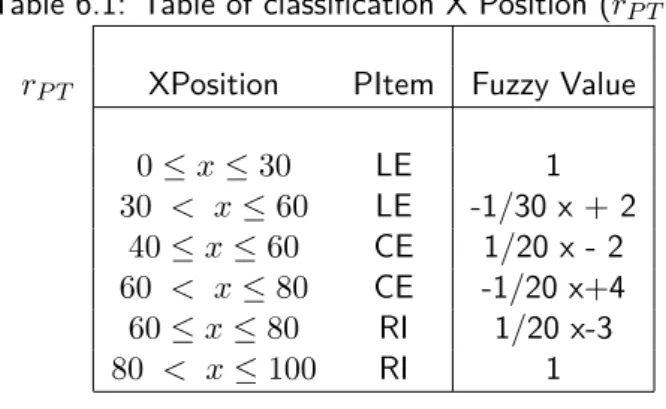
For example, we divided become 3 classification "short" from 0 to 155, "medium"
from 155 to 165, "tall" from 165 to 180. We also can make function to define the "degree" value of classification.
In this chapter, we introduce the notions of fuzzy relational database and also its operation/query process in relational calculus such as "selection", "pro- jection", "injection", and "natural join".
3.1 Fuzzy Relational Database
In this section, we review a formalization which is introduced by [OK00] and introduce new formalization of database operations.
Definition 3.1.1. Let A be a finite set of attributes. For any attribute a ∈ A, we define a set domain of attribute a with D
a. We denote the product set
Q
a∈X
D
aby D
Xfor finite subset X of A.
Definition 3.1.2. A database scheme R = A, {D
a}
a∈Ais a pair of an attribute set and a class of attribute domains. Letting a ∈ A and Y @ X v A, we denote a projection function from D
Xto D
aby ρ
Xa: Q
a∈X