Process
著者 Kanemura Tomoya
出版者 Institute of Comparative Economic Studies, Hosei University
journal or
publication title
Journal of International Economic Studies
volume 31
page range 37‑48
year 2017‑03
URL http://doi.org/10.15002/00013907
Tomoya Kanemura
The Die Industry of China and Its Development Process
Tomoya Kanemura
Faculty of Comprehensive Management, Matsumoto University Lecturer, Institute Of Comparative Economic Studies, Hosei University
1. Introduction
In 2009, China’s die industry overtook that of Japan in terms of production volume, taking the top position in the world, as was the case with other industrial products. Die industries in other countries could not but take cognizance of China’s overwhelming market size, competitiveness, and production and supply capacity. China now occupies the major role, at least in quantitative terms, in this foundational manufacturing industry.
Prior studies have shown the great diversity of China’s die industry in terms of price, quality, and the companies supporting it (Kanemura, 2013, 2015). Drawing on this research, I will provide an overview of China’s die industry and discuss the growth of companies which have business relationships with foreign users, keeping in mind the differences with Japan.
2. Prior studies and research subjects
One feature of dies as goods is that orders tend to cluster around the timing of a product’s model changes. This makes the stable management of die companies more difficult, because of repeated cycles of peaks and valleys depending on the demand from these products’ model changes. One can try to minimize fixed costs in order to rein in the burden of the slow periods as much as possible.
This gives rise to more small-sized companies.1 The industry thus features a division of labor among these firms during the busy periods, and a decentralization and absorption of the pain during the slow periods.
Although companies in the industry find it hard to expand their business, companies which expand or have expanded to some extent due to the size of the dies they produce, have aggressively engaged in the export market. Obtaining additional profits and increasing corporate value by capturing external demand through exports is the same as for other industrial products (Roberts and Tybout, 1997), as this facilitates business stability by easing fluctuations in orders from your own country by looking to demand overseas. In addition, if the company is based in a developed country, it can be a learning opportunity in terms of technology and the development of a virtuous cycle of contributing to a stable business by leading to further business expansion and enhanced technical skills. This kind of export model was seen in the development of the Japanese die industry (Murakoso, 1998), as was the case with Ogihara.
On the other hand, the die industry in South China is expanding its business into downstream mass production processes such as processed goods using dies, rather than through exports (Kanemura, 2014). In terms of the supply chain, whereas Japanese companies, focusing on exports,
1 Ministry of Economy, Trade and Industry shows that 88.5% of the Japanese die industry consists of small-sized companies with 20 employees or less.
Journal of International Economic Studies (2017), No.31, 37-48
ⓒ2017 The Institute of Comparative Economic Studies, Hosei University
follow a growth model premised on the “horizontal division of labor,” which is dedicated to the manufacture of dies, companies in China are expanding the scope of activities necessary to their value chain by supplying products, and this could be called a “vertical integration” type of growth model involving activities that can be the source of added value. This growth model in China applies to companies dealing with small plastic dies for light electrical appliances, OA, and car parts.
Can this also be applied to large press die companies such as Japan’s Ogihara, which achieved growth through exports?
If so, then why do we see growth via “vertical integration” in China’s die industry, when the driving force for industrial growth in China was what Maruyama called “vertical segmentation” or what we call the “horizontal division of labor”?2
In Section 3, we shall start by presenting an overview of China’s die industry, now the largest in the world, and discuss its diverse nature. In Sections 4 and 5, we address the topic of three Chinese-owned die companies that have taken part in that diversity, and review the research challenges alluded to earlier.
3. Overview of China’s die industry
Production volumes
As we mentioned, China’s die industry already holds the top position in the world by production volume with a total value of 124 billion RMB in 2011. This is a growth of approximately forty times over the last quarter of a century, from a level of three billion RMB in 1987 (Figure1). The production target in 2015 is 180 billion RMB, with a domestic self-supply ratio of 85% or above, with more than 40% in medium- to high-level dies.
Figure 1. Production volumes in China’s die industry & new models of passenger cars
Source: China Die & Mould Industry Association, “China Die & Mould Industry Yearbook”
2 Maruyama uses what he claims is the more suitable term “vertical segmentation” instead of “horizontal division of labor”
as the opposite of “vertical integration”, based on the fact that the term “horizontal division of labor” is already used in international trade theory to refer to the situation where countries conduct mutual trade in industrial products among themselves. His point is that it could be a source of confusion to use exactly the same word to refer to an entirely distinct phenomenon such as structural changes in the computer industry.
Tomoya Kanemura
Whether these figures will be reached will not be known until the 2016 statistics are published, but the latest numbers seem to point to something close. A country’s die production volume, if imports are excluded, is determined by the number of new product models launched in that country.
The amounts rise with more launches and fall with fewer. If one looks at the demand arising from the number of new models launched in China’s automobiles, which is the largest consuming industry and one with data available on the production volume of dies, even though this number fluctuates from year to year, one can seed that the trend in new models is a near match to die production volumes. In other words, a positive correlation can be seen between the two, and from this relationship we can surmise that the 2015 target of 180 billion RMB was met.
How much larger is this production amount compared to other countries? In 2011, the most recent year for which data is available and comparable for China and Japan, the second largest producer in the world, China’s production amount is roughly 1.3 times that of Japan. However, a simple comparison is not possible, since the source of the data for Japan is “Industrial Statistics (Industry Version),” which is an exhaustive survey, whereas the data for China comes from the
“China Die & Mold Industry Yearbook,” which covers only companies that are members of the industry’s association. Moreover, these surveys are from five years ago, and the gap has probably widened since then. Let us now compare China, Japan, the US, and Korea, the major automobile and die making countries in the world, using the number of automotive model launches. We see that whereas the other three countries are on a long-term downward trend, China is on an expansionary trend, albeit with repeated ups and downs. The gap is growing year by year; China had eight times more launches than Japan in 2014 with the other countries lagging even further behind (Figure 2).
Even deducting the imported portion, China is by far the largest producer in the world, with a global share believed to be in excess of 50%.
Figure 2. Production volumes in China’s die industry & new models of passenger cars
Source: Fourin,“Monthly Report on China Automotive Industry ”
Diversity in price & quality
We see from the above that China is without question the center of the world’s die market and production, accounting for a substantial share, but this industry is very diverse in nature. This
diversity lies in the broad range of qualities and prices for dies, as well as in the many forms taken by its supporting companies.
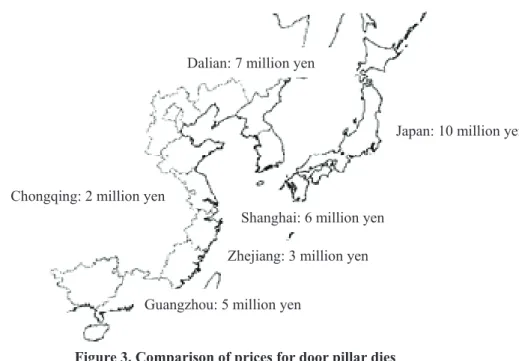
For example, there are huge differences in price depending on the region and company, even for dies for the same products and parts. Figure 3 shows the prices for door pillar dies. If the price in Japan is 10 million yen, in Dalian, with its many Japanese companies, the price will be 7 million yen, in Shanghai 6 million yen, and the most inexpensive region Chongqing will be 2 million yen, about 30% of the price in Shanghai.
Of course, there will also be differences in quality. What has the greatest effect on the difference in price is the cost of raw materials, which accounts for a larger percentage of manufacturing costs the larger the die. Costs can be reduced by sacrificing the durability and homogeneity of the material components or by using cheaper raw materials from China. Such materials are used in the 2 million yen dies. Conversely, using imported materials will increase durability and homogeneity but will increase the price, with tariffs bringing the cost close to that of dies manufactured overseas. The same applies to equipment. Dies can be made more cheaply by using old-style, fully depreciated Chinese-made equipment but at the cost of precision. Prices can be reduced to some extent by using Taiwan-made equipment, but this will make it hard to maintain precision in the long run, while also requiring the replacement of equipment after a few years. Using Japanese-made equipment will guarantee long-term precision but will raise the price. In Japan, Japanese-made equipment is used by all companies and plants, allowing the supply of nearly identical quality, whereas in China there are different grades of materials and equipment depending on the region. China also has wide regional differences in labor costs. The minimum wage in Shanghai is 2020 RMB, about twice that of Chongqing at 1250 RMB.3 These differences appear as a difference in prices.
Figure 3. Comparison of prices for door pillar dies
Source: Drawn from information gained from the author’s interviews
3 International Division of Risona Bank, “Asia News,” 1/4/2015.
Shanghai: 6 million yen Dalian: 7 million yen
Japan: 10 million yen
Zhejiang: 3 million yen Guangzhou: 5 million yen
Chongqing: 2 million yen
Tomoya Kanemura A market which brings diversity
The only reason that such differences arise in the price for dies for the same product or part is the difference in quality which the product or parts require. For example, there are top-class automobile models launched by foreign makers, and then there are automobile models that are hardly distinguishable from farm vehicles. Certainly, differences in grade may also be seen in Japan, but in China, such differences are large. With its high levels of income inequality, there exists a market which accepts these kinds of differences.
There are also many limited production models manufactured in China. Assuming the monthly production of limited production models to be less than 3000 units (or 36,000 units annually) out of a total of 395 models produced in 2013, 248 fall into this category. This is about 2.5 times more than the 98 models in Japan in the same year. This shows that the die market for limited production models is much larger.
Many of these limited production models are low-priced cars. One would normally think that limited production models would mostly be luxury cars, but in China low-priced cars account for 32.5% of the total. The fact that prices can be low in spite of a model having a limited production is intimately related to die costs. It is because die costs for low-priced, limited production models cannot be complemented by production volumes that the die costs have to be set at low levels. What is operative in this case is the need to reduce the raw materials costs, which account for a high percentage of the total manufacturing costs. Using Chinese materials allows a reduction of die costs.
Of course, using Chinese materials involves sacrificing die durability and homogeneity, as mentioned above, but that is not highly problematic in the case of limited production. In other words, the fact that the Chinese market features many low-priced, limited production cars, and that Chinese dies are low cost, albeit with quality problems, produces a situation that works well for everyone.
The diversity of the Chinese die industry was born from this kind of market diversity.
Diversity of companies comprising the die industry
The companies comprising the die industry were set up and capitalized in many different ways.
Conversely, one can take the view that the diversity of the companies involved helped bring about the production of a diversity in dies. Given the variety of alternatives for materials and equipment that we described, these companies make choices based on the business conditions they face and the markets they are addressing. The wide range of alternatives available gives more discretion to management in their efforts, for example, to find ways to manufacture products at a low price.
Chinese die companies, although they come in many different forms, can be categorized into three major categories by how they were set up and capitalized: state-owned, private, and foreign, with private companies falling into three additional categories and foreign companies into two. The first category, state-owned, refers to companies spun-off from the die divisions of state-owned companies with the state retaining a holding—we shall call these the state-owned-type. State- owned-type companies can be considered the starting point of China’s modern machine industry, and many are found in the northeast and interior regions. Private companies come in three types:
those which were originally public, either state-owned or owned by local governments, but with the capital now having been transferred to the private sector (transfer-type); newly founded companies (founded-type), which acquired technology from these companies; and companies who entered from other product or technological areas (entrant-type). Each type has its own particular location.
Transfer-type companies are common in Zhejiang and Jiangsu with their many township industries;
entrant-type companies are found in Shanghai where their huge customers are concentrated; and founded-type companies are in the three regions where their mother companies are clustered, while the die industry clusters in places like Guangzhou where many foreign die companies have moved.
These foreign-capital die companies made their appearance in the latter half of the 1990s to take orders from the foreign-capital users who started expanding into China then. At that time, Chinese die makers, whether state-owned-type or transfer-type, were not yet at a high enough level of technology to meet such demand, and there were hardly any founded-type companies. Foreign- owned die makers can be classified into Hong Kong-based and Taiwan-based companies run by ethnic Chinese (which we will call “greater China firms”), and other nationalities such as the Japanese and Korean firms. Of these, many of the greater Chinese firms set up operations and established their presence in southern China, the symbol of China’s economic reform. Some came into China with experience of dealing with foreign users from their headquarters, while large die makers appeared with business models that enabled the mass production of dies by using plentiful inexpensive labor and large amounts of equipment with support from the immense capital resources of the overseas Chinese (Kanemura, 2009).
Until around the middle of the first decade of the 21st century, these firms supplied dies of the quality required by foreign users, but in recent years, in the face of the higher requirements of foreign users, no enhancement of QCD competitiveness can be seen, and, with the sharp rise in labor costs, their business models are reaching their limit. Replacing them are the founded-type companies who developed competitiveness through business with these firms. They have been taking the place of the greater China firms in recent years and are serving as a vehicle for demand from foreign users. These firms strive for a smaller size and a multi-functional worker system, closely resembling Japanese die makers in industrial structure and production systems in this sense.
They are converging on a format that is suited to the characteristics of the die industry, as mentioned earlier (Kanemura, 2014).
At the same time, as described in the introduction, they are exhibiting a “vertically-integrated”
pattern of growth and expanding their areas of business into downstream mass-production processes, such as using dies to manufacture processed goods. The die business is thus in the process of converging on a practical form for the industry, taking a form that minimizes the industry’s problems and disadvantages. We can view this as a new type of growth model for the die “industry,”
which was invented in developing countries and is distinct from that of Japan. This model primarily deals in dies for light electronics and OA, particularly by focusing on plastic dies.
With regard to press dies, imports showed rapid expansion starting at the beginning of the century, when the foreign automotive industry started full-fledged production, but they lost steam around the middle of the decade (Figure 4). This is probably due to a pick-up in the local procurement of dies, which was handled by overseas Chinese firms bypassing foreign firms. Many of these firms were of the entrant-type, and they made up for any technology deficit with cutting- edge equipment, experienced engineers, including from Japan, and lessons from foreign firms via their dealings with them. Of course, this requires huge capital resources, and it is fascinating that many companies were in fact from Zhejiang, with has a vibrant private economy. Even then, the gap in design skills prevented them from making press dies that were easy to use and had high productivity. Their lack of a trial capability saddled them with problems such as the enormous amounts of time required for finishing and moving into production.
Tomoya Kanemura
Figure 4. Trends in the amount of die imports to China
Source: World Trade Atlas
Although unable to satisfy the requirements of foreign companies, the Japanese in particular, given the rising demand for dies, the industry was forced to compromise and be patient, but it progressed nevertheless in terms of procurement and utilization.
We shall see in the next section whether these firms, which correspond in Japanese terms to Ogihara, are taking “vertical integration” initiatives similar to those in the plastic die industry of southern China.
4. Case study of Chinese die companies
I will now present three Chinese companies. Note that these companies have all been featured and introduced in the author’s writings. We will therefore limit ourselves to only brief general overviews and focus on issues related to their business expansion into “vertical integration.”
Yesun (Shanghai) Mould Co., Ltd.4
This Company is a press die maker that was established in the Huangyan District of Taizhou City in Zhejiang Province, the hometown of the founder. It started with dies for small pressed parts related to light electronics, but moved into dies for automotive press components, first for Shanghai Volkswagen (VW) and then Shanghai GM, when it began production in 1999. It was established in the Shanghai suburbs in 2001 with sales of 250 million RMB and 250 employees.
Subsequently, in 2004, it took on new capital and changed its name, at the same time establishing a new plant in the Jiadiang District, where automotive and parts makers were clustered.
Initially, it worked on mid-sized dies for tier one use for automotive chassis, but in recent years, as tier one orders have shrunk, the focus has been on the finished automobile manufacturers that were its original target, such as Shanghai GM and Shanghai VW, which have advantages in terms of profitability and business performance. It now focuses on large-sized dies for the outer and inner panels of body components.
Production and sales expanded briskly with die production rising from 1200 dies to 1500 dies between 2010 and 2014, and an increase in the workforce from 470 (370 in the die division) to 650 (400). The production target for 2013 through 2015 was 1.5 billion RMB.
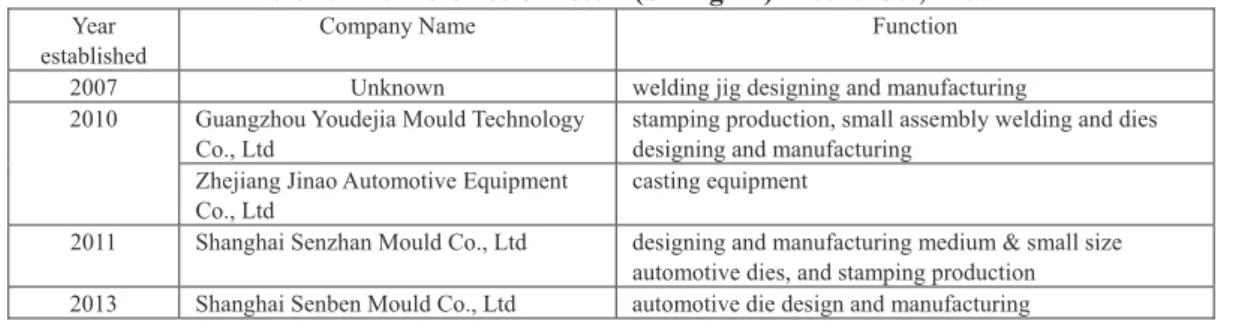
During this period, in addition to die businesses, the following companies were established: a
4 Interview date, 23/3/2015
jig company in Shanghai in 2007, a press company in 2010 in Guangzhou, where many Japanese firms are clustered, a casting company for die raw materials in Zhejiang in the same year, a company making small and medium dies and presses for cars between 250t and 500t in 2011, and a company preparing and supplying die finishing data in 2013.
Table 1. The factories of Yesun (Shanghai) Mould Co., Ltd.
Year
established Company Name Function
2007 Unknown welding jig designing and manufacturing
2010 Guangzhou Youdejia Mould Technology
Co., Ltd stamping production, small assembly welding and dies designing and manufacturing
Zhejiang Jinao Automotive Equipment
Co., Ltd casting equipment
2011 Shanghai Senzhan Mould Co., Ltd designing and manufacturing medium & small size automotive dies, and stamping production 2013 Shanghai Senben Mould Co., Ltd automotive die design and manufacturing Source: http://yesun.mouldfair.com/
Shanghai Qian Yuan Motor Body Die Co., Ltd5
This company originated as a press die maker in Botou City in Hebei Province. The company was created in 2000 with enough investment to receive business from foreign companies such as Shanghai VW and Shanghai GM.
The company was originally a die manufacturer, but orders for dies fluctuate wildly and margins are thin. It thus moved at an early stage into the press business, partially due to its improved chances of survival as a result.
The labor force grew from 240 to 350 between 2010 and 2014, and revenues doubled from 150 million RMB to 300 million RMB. At this point already about half of the revenues came from press components. Although one executive recently spun out into his own company, the press business avoided any large drop in revenues. The company is in the process of setting up a new plant in Nantong City in Jiangsu Province, where it will pursue further expansion of its press business.
Figure 5. Trends in Die Sales to China
Source: The company guide
5 Interview date, 24/3/2015
Tomoya Kanemura Yifeng-mould6
This Company has its roots in a plastic die maker founded in Taizhou City, the hometown of the founder, in Zhejiang Province, which is famous as the “birthplace of dies.” Subsequently, on the occasion of moving its base of operations to the Baoshan District of Shanghai, close to Shanghai VW, it withdrew from plastic dies and began fabricating press dies for foreign car parts. It also established die plants in Yantai City in Shandong Province and Guangdong City in Guangzhou Province, dividing work based on die types between tandem dies in Shanghai and progressive dies in Yantai (it is unknown what types of dies are produced in Guangdong).
The company then moved into the press business starting in 2009, setting up press plants in rapid succession in Nanjing (Jiangsu), Jiaxing (Zhejiang), and Ningbo City. Revenues currently stand at six billion RMB, of which 65% is from the press business, with the die business having shrunk to 25% (the remaining 10% is exports). In its current form, it might therefore be better described as a press component maker than a die company. It does not use dies made in-house. It performs press machining using dies supplied by the finished car manufacturers. The reason for focusing on press machining is the significant fluctuations in die orders. At present, it no longer works with tier one companies as it did until 2010. The reason is the company’s target of large-sized press components, meaning that it is focusing on the manufacturers of finished cars.
Note that in 2014 the company set up a casting plant in Xiangtan (Hunan), creating a structure that allows it to handle everything from die materials and die fabrication to press machining within the group.
Table 2.The factories of Yifeng-mould
Year
established Company Name Function
2000 Shanghai Yifeng Die Making Co.,Ltd Tools and Stamping Factory 2004 Yantai Yifeng Die Making Co.,Ltd Tools and Stamping Factory 2005 Shanghai Yifeng Automotive Die Manufacture Co.,Ltd Tools and Stamping Factory 2009 Nanjing Yifeng Body Manufacture Co.,Ltd Only Stamping Factory 2010 Jiaxing Yifeng Auto Parts Co.,Ltd Only Stamping Factory
Guangzhou Yifeng Die Manufacture Co.,Ltd Tools and Stamping Factory
2012 Ningbo Yifeng Auto Parts Co.,Ltd Only Stamping Factory
2014 Yangzhou Yifeng Auto Parts Co.,Ltd Auto Parts
Taizhou Qixiang AutoDie Manufacture Co.,Ltd Auto Die Manufacture Xiangtan Yifeng Casting Manufacture Co.,Ltd Casting Manufacture Xinagtan Yifeng Auto Parts Co.,Ltd Auto Parts Xinagtan Yifeng Die Manufacture Co.,Ltd Die Manufacture Source: The company guide
5. Conclusion
In all three of these case studies, the companies have moved into the downstream processes of pressing, like the companies in southern China, with companies Yesun (Shanghai) Mould and Yifeng-mould also moving upstream into the casting business to make die materials. They are truly exhibiting a “vertically-integrated” style of growth. The “vertically-integrated” business model is generally known for its advantages in reducing transaction costs and enabling the control and management of brand, quality, and delivery time (Roberts and Tybout, 1997), allowing companies to
6 Interview date, 24/3/2015
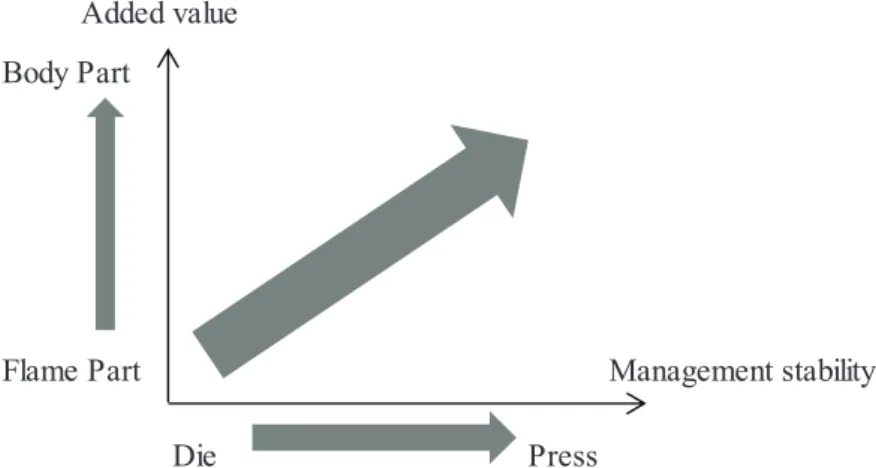
make “additional profits” and “increase corporate value” with, for instance, exports, while accomplishing the mission of die makers to mitigate fluctuations in orders by adding earlier and later production processes, thus leading to greater “management stability.” This approach is different from that of the Japanese die companies, which, while sticking to their core business, attempt to make “additional profits” and “increase corporate value” by finding overseas markets, and who compensate for order fluctuations in domestic markets (internal demand) by means of exports (external demand). It appears that while the Japanese companies strove to develop their die business by means of exports, the Chinese companies strove to grow into component companies by moving from dies into upstream and downstream processes (the horizontal scale in Figure 6).
With regard to components designed for machining, of the three companies, two have shifted from their previous mid-sized field of chassis components and dies handled by tier one companies – they no longer take such orders – to business from foreign brand manufacturers of finished cars which, in terms of components, means large-sized pressing of body panel components and dies (the vertical scale in Figure 6). This implies a shift to components with higher value added, and demonstrates the two aspects of the approach by China’s die companies, which involve not only business growth in a “vertically-integrated” fashion but also the bolstering of profitability and the strengthening of their brand (the bolt arrow in Figure 6).
Body Part
Flame Part Management stability
Die Press
Added value
Figure 6. Direction of the Development of Die companies in China
Source: Researcher’s original chart
Why does such a difference occur?
For Japanese die companies, exports to developing countries represent “learning opportunities” that contribute greatly to improving their in-house technology capabilities. This advantage could conceivably be lost with domestic business activities, a point which requires consideration if Chinese companies build “vertically-integrated” domestic businesses.
As is well known, almost all foreign users are now present in China. As we saw in the case studies, these companies transact with foreign users rather than Chinese ones. This means that they can enjoy “learning opportunities” from transacting domestically with foreign users without exporting. This is a business environment unique to China. In Japan, by contrast, where foreign users have not arrived, companies have no choice but to export in order to gain such “learning opportunities.”
In addition to the fact that foreign users are present in China, thus negating the need to seek the Body Part
y ti li b a t s t n e m e g a n a M tr
a P e m al F
Die Press
Added value
Tomoya Kanemura benefits of exporting, another major factor in not focusing on exports is the immense size of the market. The Chinese market for dies is enormous, as we have seen, and in any given year foreign customers account for about one third. By itself this market with foreign customers exceeds that of Japan. In addition, of the many die companies in China, only a limited number can deal with orders from foreign users, further eliminating any reason to proactively pursue exports, especially given the relatively low supply capacity vis-à-vis demand.
The third factor is the attempt to expand the size of the business in terms of the number of companies (offices), the scale of the workforce, and revenues, through “vertical integration”.
Chinese executives, more than the Japanese, attempt to publicize their business successes. In so doing, they can spread their company’s reputation and trust, as well as their fame. Company size and revenues are the easiest metrics to use for displaying such success.
A fourth aspect is the attitude of executives towards manufacturing. Nearly all Japanese die companies’ executives have an engineering background. They care about making dies, and are deeply cognizant of their importance and fascination. They approach the expansion of their company with enhanced engineering capabilities as the lever. Executives at Chinese companies, however, view manufacturing as nothing more than a tool for commerce, one in which they are not particularly interested. Thus, they will shift cavalierly from an existing business to one where they can make more money. They are not fixated on dies, therefore they expand their business upstream or downstream more quickly, with both less effort and a greater chance of success.
Chinese companies have succeeded in catching up by adopting a “vertical segmentation”
approach, or in our terminology a “horizontal division of labor,” even in industries whose characteristics are more suited to a “vertically-integrated” supply chain. Why, then, did the die industry choose this path of “vertical integration”? One answer to this question is that our earlier discussions were predicated on automobiles, electronics, computers, and semiconductors being mass-production industries. In other words, these are industries where size can be achieved even when dealing only in devices and components for a particular area. Deploying management resources in a more effective fashion and keeping the business focus narrow can enhance competitiveness and allow the pursuit of efficiencies based on economies of scale. In contrast, with dies it is hard to separate components and devices, and, even if it were possible, they are limited production items, which makes it impossible to achieve “economies of scale” in individual areas.
It is also the case that the pace of technological progress is slower than in the industrial sectors mentioned earlier. To this extent, there is no need to constantly allocate management resources for technology development only for dies. In other words, this makes it possible to allocate resources to neighboring areas.
Research subjects for the future
We have compared the expansion of Chinese firms through a model of expansion via “vertical integration” and the factors involved, with Japanese die firms which grew through exports. The Chinese firms are not growing only through “vertical integration”, but also through rapid growth in exports starting around 2010 after the financial crisis. During that period, as Japan’s exports shrank, it seemed on the surface that China was taking over from Japan as the major export player. Does this mean that Chinese-made dies are catching up with Japanese-made dies? Based on trends in export data, Baba argues that the demand/supply structure for dies in Asia is shifting from one previously centered on Japan to a multi-polar era. That does indeed highlight this phenomenon, but if this is the case, what sectors is each country targeting? In other words, we would like to examine where a country’s strengths lie and in what sectors with particular regard to the role that Chinese exports will play in the future.
References
Milgrom.P. and James Roberts. J. [1992] “Economics, Organization, Management” Prentice Hall, Inc.
Takashi Murakoso [1998] “The Process of Internationalization and Structural Changes within the Small and Medium-sized Capital Goods Industry – The Case of Japan’s Die and Mold Industry
-[Ⅰ].” Bulletin of the Faculty of Management, Fukuyama Heisei University, Vol.3, 163-186.
Tomoya Kanemura [2009] “The Factors Affecting the Scale of Mould Companies in China.”
Journal of the Japan Academy of Small Business Studies 28, Doyukan, 217-230.
Tomoya Kanemura [2013] “Preparatory Study in the Difference of Receiving Orders among Speciality Businesses, Subsidiary Businesses and Customers: A case study in dies & moulds for automobiles.” Institute of Comparative Economic Studies, Hosei University, Working Paper.
No.178.
Tomoya Kanemura [2014], “A Study in the Development of the Die-Mould Industry in the South China Area.” Journal of Osaka University of Economics, Vol.65 No.2 (No.341), 63-74.
Tomoya Kanemura [2015], “Diversity in the Chinese Die Industry. Case study in Dies for Automobiles.” Journal of The Japan Society for Technology of Plasticity, Vol.56 no.656, 9-13.
Tomoo Marukawa [2007] “The Industry of Modern China-Strength and Fragility of the Rising Chinese Company.” Chukoshinsho.
Toshiyuki Baba [2014] “Trends in the Demand and Supply Structure of the Asian Dies and Molds Market.” Journal of Osaka University of Economics, Vol.65 No.2 (No.341), 75-98.
Roberts, Mark J. and James R. Tybout [1997] “The Decision to Export in Colombia: An Empirical Model of Entry with Sunken Costs.” American Economic Review, 87(4): 545-564.