I. Introduction: Why Does Global Environmental Governance Fail?
Two competing perspectives are represented on the logo of the United Nations (UN) Conference on Sustainable Development (Rio+20). One is the official explanation by the UN that the icon shows the three pillars of sustainable development—social equity, economic growth, and environmental protection.
Another is the critical interpretation that the harmonious relationship between nature and humans was sundered by the teeth of a saw blade of economic growth. Those of the former view expected that social and environmental externalities would be internalized as sustained economic growth with the concept of a “green economy in the context of sustainable development and poverty alleviation.” Those of the second view were skeptical about the concept of a green economy, and criticized it as a cosmetic label for a “greedy economy”
or “green imperialism.” Despite their ideological differences, both share the perspective that we are faced with serious systemic challenges with hybrid crises: environmental, financial, development, energy, food, health, and humanitarian. Thus, many concerned stakeholders anticipated a fourth pillar that could have created a constitutional moment for transformative change at Rio+20. However, many felt that it resulted in a U-turn, rather than a renewal of political will. Why? I argue that this is because a fourth pillar of transformative change has not yet been articulated clearly.
The three main pillars of sustainable development have been formed and
* Professor of Politics and International Relations, International Christian University pp.101-122
Global Justice in the Anthropocene:
The Fourth Pillar Debate in Sustainable Development
Katsuhiko Mori
*reconfirmed in the forty years since the UN Conference on the Human Environment held in Stockholm in 1972. The Stockholm meeting stressed a combination of human and environmental aspects and addressed underdevelopment in developing countries. Yet, because few leaders from socialist and developing countries attended the conference, the developed countries’ main concern for the environmental pillar was highlighted. As a result, the institution produced by the Stockholm Conference was the UN Environment Programme (UNEP). In 1982, when the special session of the UNEP was held in Nairobi, the UN General Assembly adopted the World Charter for Nature. Ironically, the first UN organization headquartered in Africa focused on the environment, despite the fact that the main concern of the global south was development. At the 1992 UN Conference on Environment and Development (Rio Earth Summit), the economic (development) pillar was more visibly integrated into environmental governance, as exemplified by the establishment of the Global Environment Facility. The Rio Earth Summit also created the UN Commission on Sustainable Development (UNCSD) to ensure linkage between the environmental and development communities. At the 2002 World Summit on Sustainable Development in Johannesburg, the three pillars were reconfirmed and partnerships of multiple stakeholders were widely recognized as an effective framework for sustainable development governance.
Despite these incremental efforts, there is considerable evidence that global environmental governance has virtually failed. Scientists have identified that three of nine “planetary boundaries” —biodiversity loss, climate change, and nitrogen cycle—have already been overstepped beyond “a safe operating space for humanity” (Rockström, 2009). In response to this warning, UN Secretary- General Ban Ki-Moon introduced a short video clip entitled “Welcome to the Anthropocene” at the opening address of Rio+20. The Anthropocene is a newly proposed geologic chronological term, in which human activities are causing global environmental instability. According to the scientific community, science and technology can be the fourth pillar, which calls for scientific evidence-based policymaking and decision-making.
On the other hand, the Peoples’ Sustainability Manifesto and “Treaties”
converged through a consultative process among civil society organizations at a parallel event of Rio+20 stressed equity and Mother Earth while localizing economies. The fourth pillar of global civil society could be the global citizens’
movement or participation for a sustainable world. Furthermore, a hot topic for the business and industry group at Rio+20 was integrated reporting, which could be a fourth pillar integrating the triple bottom line. Some argue that the fourth pillar is peace and governance, and still others argue that it is education and culture. Different people have identified various fourth pillars, but it has not yet been established effectively.
I argue that the fourth pillar is governance or an institutional framework based on a global ethics. In elaborating this argument, the present paper will critically review two key bodies of literature on ethical and institutional frameworks for sustainable development. The former literature stream addresses ethical values and principles of justice. Rather than the “green economy,” one of the two conference themes, “sustainable development” was revived as the dominant concept in the outcome document, especially in the section on sustainable development goals (SDGs). It was agreed “to establish an inclusive and transparent intergovernmental process on sustainable development goals that is open to all stakeholders” (UNCSD, 2012; para. 248). The open working group for this purpose comprised 30 representatives nominated by Member States from the five UN regional groups is expected to submit its report to the 68th General Assembly. How SDGs can integrate the three pillars of sustainable development into a global ethics is the key question at both the philosophical and policy levels. In discussing this issue, I distinguish between four layers of justice —national, international, world, and global—linking them to the four ways by which agents can cause harm, through doing, allowing, enabling, and preventing.
“An institutional framework for sustainable development (IFSD),” the second theme of Rio+20, could also be the fourth pillar by embedding ethics into policy and institutions. A series of institutional frameworks established in
the past four decades have not always functioned effectively (De Oliveira, 2012). At Rio+20, the international community agreed to adopt a resolution for
“strengthening and upgrading UNEP” (para. 88) that would “define the formal and organizational aspect of the high-level forum” (para. 86) to be eventually replaced with the UNCSD at the 67th and 68th sessions of the General Assembly, respectively. These proposals are an intergovernmental arrangement at the multilateral level. It is important, however, to consider IFSD from a wider perspective. By the evolutionary nature of governance patterns, the literature on the four institutional responses to the tragedy of the commons will be discussed:
market-oriented environmentalism, regulatory environmentalism, plurilateral environmentalism, and new commons-based environmentalism. In conclusion, based on reconstructed ethical and institutional frameworks, some policy implications will be discussed for the key environmental issues of climate change, biodiversity, and nitrogen cycle.
II. How Can SDGs Reflect Global Justice in the Anthropocene?
1. The Ethical Pillar
The outcome document of Rio+20 states that SDGs “should address and incorporate in a balanced way all three dimensions of sustainable development and their interlinkages” (para. 246). This statement implies that SDGs could be the fourth pillar if common values were adequately reflected in them. How can SDGs balance and integrate the three pillars into a set of synergetic goals? How can SDGs be developed, when a universal value for planetary survival conflicts with the self-determination of nations in their development paths? Can SDGs be
“a global ethic in the singular” in the Anthropocene by replacing, complementing, or integrating “a global ethics in the plural” (Ignatieff, 2012)?
The process of setting SDGs poses these questions.
The tension between local and universal ethics in the international system parallels the relationship between individual and collective rights and responsibilities in the domestic context. According to Ife (2007), four traditions of individual and collective rights and responsibilities can be represented by a
two by two matrix (Table 1). Liberalism, which has been dominant in Western societies, emphasizes individual rights and individual responsibilities. Socialism seeks to establish collective responsibilities for individual human rights.
Confucianism assumes cultivation of individual responsibilities and mutuality in collective rights. Communitarianism conceptualizes both rights and responsibilities collectively.
Table 1: Rights and Responsibilities in the Local Context (Ife, 2007; p. 169)
Rights
Individual Collective Responsibilities/ Individual Liberal Confucian
Duties Collective Socialist Communitarian
The Westminster model of democracy at home cannot be applied directly to the system abroad, because the majority cannot always rule in the Versailles model of the UN system. However, Ife’s framework is useful to understand rights and responsibilities in search of a global ethic in the connected world of today. Therefore, I postulate four layers of ethics: national, international, world, and global (Table 2).
Table 2: Rights and Responsibilities in the Universal Context
Rights
Individual Collective Responsibilities/ Individual National International
Duties Collective World Global
For national ethics, the autonomy of the state from the international community as well as domestic society is assumed, and sovereignty is the ontology of the individual nation-state in terms of both rights and responsibilities. If this value is threatened, unilateral action against causes of harm is claimed to constitute corrective justice. As for international ethics, the central norm is reciprocity or balance in allowing harm. Autonomy of the state
preexists based on self-determination of a people as a group, and any harm it is allowed to cause to another nation-state will be compensated in a reciprocal manner. Economic liberalism assumes that increased efficiency through reciprocal exchange in the international market is good. To overcome the prisoner’s dilemma and secure mutual benefits, political liberal institutionalism seeks joint action to improve predictability by deliberative exchange of information and opinions in a plurilateral community. For world ethics, the collective entity preexists in a multilateral arrangement. Collective actions against enabling harm based on distributive justice are called for as key norms.
Individual states can enjoy equal sovereign rights in the world community. Like the world, the global community existed prior to state and nonstate actors as well as individuals. Unlike the world, however, global ethics requires human and state responsibilities for the ecological globe as norms respected by all cultures and societies (Küng and Schmidt, 1993). Global ethics stresses harm prevention (or cooperative security) for both intra- and intergenerational justice.
Although “there is no fixed exchange rate between the interests of locals and nonlocals” (Barry, 2012; p. 23), balanced means could be sought flexibly through dialogue by multiple stakeholders and public –private partnerships (PPP). In this sense, global ethics is constitutive justice. The substantive aspects of the four levels of ethics can be summarized in Table 3.
Table 3. Substantive Aspects of Four Levels of Ethics
National International World Global
Right Individual Collective Individual Collective
Responsibility Individual Individual Collective Collective
Harm Doing Allowing Enabling Preventing
Justice Corrective Reciprocal Distributive Constitutive
2. The Economic Pillar as International Ethics
The key chairs of Rio+20 were teamed with leaders from emerging economies such as Brazil, China, and Korea. These economies became a new
symbol of sustained economic growth. Gross domestic production (GDP), gross national production (GNP), and gross national income (GNI) are often used as indicators of the economic pillar for the purpose of international comparison.
GDP focuses on the territorial state, including production by foreign workers, whereas GNP pertains to the nation-state and includes production by nationals working abroad. GNI is quantitatively identical to GNP, but was conceptualized in terms of financial income by the UN Statistics Division at the beginning of this century. The right to development is widely recognized and these macroeconomic indicators will continue to be used as a component of SDGs, but planetary boundaries call for restrictions on unlimited growth or overdevelopment. The business-as-usual approach will no longer sustain economic growth, and therefore the green economy concept was suggested as a replacement for unlimited economic growth. Advocates for a green economy seek to “decouple” environmental harm from sustained economic growth.
Decoupling is believed to be possible by increasing efficiency. Improved efficiency is justified because it will maximize benefits for humans and societies.
As the Jevons paradox warns, however, technological progress and increased efficiency will result in increased consumption of natural resources and allow further harm to externality. The UNEP study (UNEP International Resource Panel, 2011) shows some empirical evidence for modest domestic decoupling in Germany and Japan, but it is accompanied by “exporting” resource-intense production abroad. It is important to monitor whether decoupling actually occurs either domestically or abroad. Moreover, because neo-Malthusians indicate the dilemma between overpopulation and increased food production, it is also necessary to monitor decoupling in light of population size. The UNEP study points out the relative success of decoupling in China, but absolute reduction of energy and resource consumption cannot be observed in developing countries with population pressure. These criticisms will lead to SDGs being set as complements to sustained economic growth.
The Natural Capital Declaration issued at Rio+20 by the financial sector stresses the importance of natural “assets” and ecosystem “services” to be
internalized in financial products and services. While allowing and enabling environmental harm associated with these concepts are criticized as commodification of nature, economic ethics based on self-interest assume that the responsibility to conserve the ecosystem is borne by individual people, companies, or states by placing financial value on components of ecosystems that had been ignored previously.
Economic growth has also been justified as an increased ability to pay for externalities for peoples and societies. For instance, Chinese Premier Wen Jiabao stated at Rio+20, “The more it develops, the more opportunities China will create and the more contribution it will make to the world.” This can be understood as a complementary use of capital accumulation in response to allowing and enabling harm to the social pillar. However, compensatory and punitive liabilities in a financial form are not a complete solution for externalities. This is because human and environmental damage may not always be redressed in a financial form.
In an attempt to transcend these intrinsic limitations, SDGs can be conceptualized as an integrated concept for the economic pillar. Like SDGs at the macroeconomic or international levels, a single integrated report on financial and nonfinancial (social, environmental, and governance) performance at the microeconomic level would embrace transparency so that individual companies and industries could integrate their triple bottom lines by improving dialogue and engagement with investors and other stakeholders (Eccles and Krzus, 2010).
These tools will be helpful in changing self-correcting processes of externalities, but the environmental disaster risks of even one company can be too large for individual agents to take full responsibility. The concept of economic growth itself has also been critically reconsidered.
Among other criticisms, the report on “prosperity without growth” (Jackson, 2009) in the UK and the philosophy of “degrowth” (Latouche, 2010) in France challenge the orthodox assumption of unlimited growth. The Organisation for Economic Co-operation and Development (OECD) underscores socioeconomic
“well-being” associated with both material and nonmaterial quality of life. These
reflective concepts will further reconstruct ethical dimensions of the economic pillar for possible integration with SDGs in the international context.
3. The Social Pillar as World Ethics
The concept of “gross national happiness” (GNH) adopted in Bhutan was a popular concept that goes beyond GDP/GNP/GNI among participants of Rio+20 side events. It should be noted that the four pillars of GNH are also defined as sustainable development (economic), cultural values (social), natural environment (environmental), and good governance. While there has been widespread increased attention to the cultural and spiritual dimensions of
“happiness”, the official Rio+20 outcome document used the phrase “physical, mental, human, social, and environmental well-being” rather than subjective
“happiness.” In either case, social pillar ethics stress outcome equality or equity, as an alternative to the economic ethics of individual liberty and self-help in distributing economic wealth and natural resources. It is assumed that a collective authority, normally a government, should take responsibility for supplying necessary goods and services sustainably. In the world community, where no world government exists, it has been argued that international a benign hegemon or multilateral regimes can be such a supplier.
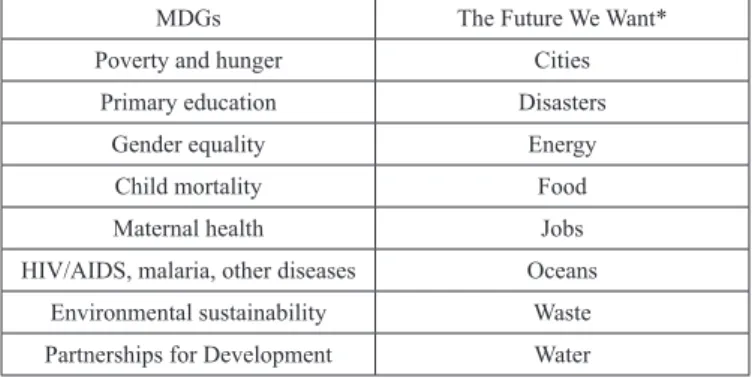
The individual–collective dimensions in the social pillar can be recognized in human and social development. In terms of world ethics, SDGs will probably follow a limited number of output-oriented frameworks of the Millennium Development Goals (MDGs), but are unlikely to be replaced with MDGs. As shown in Table 4, if the eight MDGs were replaced with eight SDG areas in a series of thematic areas and cross-sectoral issues, social and human dimensions will be reflected to a lesser extent. If the current MDGs were used as SDGs, the environmental pillar will be reflected to a lesser extent. The economic pillar will not be reflected adequately in these eight areas.
Table 4: Comparison of the Eight Areas of MDGs and the Future We Want
MDGs The Future We Want*
Poverty and hunger Cities
Primary education Disasters
Gender equality Energy
Child mortality Food
Maternal health Jobs
HIV/AIDS, malaria, other diseases Oceans Environmental sustainability Waste
Partnerships for Development Water
(*Source: http://futurewewant.org/solutions/)
Another possibility for the social pillar is the Human Development Index (HDI) developed by the UN Development Programme as a complementary approach to address income poverty (unemployment) and human poverty (such as lack of health and education), which allows and enables harm in the overlapping area of the economic and social pillars. HDI is a composite index of life expectancy at birth, education (adult literacy rate and the combined primary, secondary, and tertiary gross enrollment ratio), and income (GDP per capita in purchasing power parity terms) indicators. In a similar way, some MDGs set out simple guidelines for the human living environment, such as drinking water targets.
The Human Rights Council and human rights nongovernmental organizations (NGOs), such as Amnesty International and Human Rights Watch are in various ways monitoring the state status of liberal and social rights.
However, an integrated indicator of a rights-based approach, including the right to a safe environment and corporate social responsibility, is still less developed.
There are methodological difficulties in measuring human rights situations and progress, although it is not impossible to visualize them without some social dimensions, such as ethnicity, gender, generation, and physical challenges.
4. The Environmental Pillar as Global Ethics
The outcome document of Rio+20 for the first time officially included the concepts of “Mother Earth” and “the rights of nature” (para. 39). The former is
“a common expression in a number of countries and regions,” especially in a Universal Declaration of the Rights of Mother Earth submitted to Rio+20 for consideration by the Bolivian government. While Bolivian President Evo Morales is politically a socialist, his claim for Mother Earth originates in the land ethic of indigenous peoples and communities. Environmental justice associated with an ecologically based land ethic (Leopold, 1949) claims that nature has intrinsic value, and biotic communal justice is expected with convivial and healthy relationships between past, present and future generations and between human beings and nature. Corrective justice seeks restoration of resilient ecosystems, and distributive justice is applied between humans and other species as well as ecosystems. Universal responsibilities and obligations of human beings for nature are, in other words, the rights of nature. Although intergenerational justice is increasingly recognized as a moral obligation, and the World Charter for Nature adopted in 1982 includes the provision that “Each person has a duty to act in accordance with the present provisions of the present Charter,” further reform in international law will be needed to support for the rights of nature as a replacement for SDGs.
As complements, however, two indicators of the environmental pillar have been used for nonstate actors. One is the Happy Planet Index (HPI) developed at the New Economics Foundation and supported by civil society organizations such as the Friends of the Earth (FoE). As the name of the FoE suggests, the HPI links human/social development with the environmental pillar. It uses data on experienced well-being, life expectancy, and ecological footprint. Unlike deep ecology, it attempts to put both people and nature first. Another is the ecological footprint (EF), a measurement of the planet’s ecological carrying capacity, which is represented by the amount of biologically productive land and sea areas necessary to supply ecological services to a human population and to assimilate associated waste. In other words, the EF links the environmental and economic
pillars; natural capital is contrasted with the planet’s ecological services. The World Wide Fund for Nature’s Living Planet Report of 2012 warns “demand on natural resources has been doubled since 1966 and we are currently using the equivalent of 1.5 planets to support our activities” (WWF, 2012).
Ethics of preventing harm can be found in the Earth Charter, which states that to prevent harm is “the best method of environmental protection” and, when knowledge is limited, a precautionary approach is to be applied. However, indigenous people did not agree to the Earth Charter, and instead adopted the Indigenous Peoples’ Earth Charter at Rio 1992 and an alternative declaration at Rio+20. Contentious issues include traditional knowledge, group rights of indigenous peoples, and their inalienable rights to lands and territories. They reject the modern legal concept of terra nullius, and criticize green economies as the institutionalization of colonialism. One possible integrated indicator of SDGs from the environmental pillar perspective would be a combination of HDI and the EF. A goal is a higher HDI with a lower EF per person. Although no country falls in an ideal goal area, several Latin American countries, including Colombia, a proposer of SDGs, were closer to the target area in 2007 (Global Footprint Network, 2012).
III. How Can an Institutional Framework for Sustainable Development Reconstruct New Public Commons?
1. The Institutional Pillar
Ethics are a necessary but not sufficient condition for sustainability governance. How various stakeholders can effectively behave in integrating the three pillars remains the core question for the institutional framework debate.
The governance concept in political science is the equivalent of the public and common goods discourse in economics (Ostrom, 1990). In this context, Garrett Hardin’s classical explanation of environmental destruction as the tragedy of the commons (Hardin, 1968) should be reconsidered. As shown in Table 5, this classification is based on excludability and rivalry for consumption.
Table 5: Economic Explanation of Goods
Excludable Nonexcludable
Rivalrous Private Goods Common Goods
Nonrivalrous Club Goods Public Goods
To solve the dilemma of overexploitation of the commons, which are regarded as the property of no one (terra nullius, or res nullius), there exist at least four prototype solutions in economic terms: private goods, public goods, club goods, and new public commons. The first approach is market-oriented environmentalism. It prescribes the transformation of the commons into private property, as shown by the enclosure movement. By so doing, egoistic individuals are expected to use natural resources sustainably to pursue their own interests.
This will work only if incentives to use resources sustainably are internalized in human behavior, and if the necessary information is fully available. The second approach is regulatory environmentalism. This is accompanied by the transformation of the commons into a state or state-strengthening regulation of public goods. The effectiveness of this approach depends on the legitimacy and capability of the authority. The third approach is plurilateral environmentalism, which calls for the transformation of the commons into club goods. Natural resources are used exclusively by a group, whose members share them as nonrivalrous goods. When costs to negotiate for public goods are high, like- minded members may form a plurilateral institution for the sustainable use of resources. The fourth approach is to transform common property of nobody (res nullius) into commons for everybody (res communis), where the environment is expected to be shared and sustained through dialogue between multiple stakeholders and communications based on constitutive justice.
It is also important to examine the supply side of the equation, which parallels the responsibilities discourse. In a simple market with a horizontal division of labor, a private good for one consumer is supplied privately by a producer. When a good is supplied jointly by a few, joint responsibility is assumed. For public goods supplied collectively by many, collective
responsibility is undertaken. When commons are supplied naturally (or
“borrowed” from future generations) or by different types of agents, common but differentiated responsibilities are assumed.
Table 6. Institutional Aspects of Four Levels of Ethics
National International World Global
Demand Private goods Club goods Public goods Common
Supply Individual Joint Collective Cooperative
Action Unilateral Plurilateral Multilateral Heterarchical
2. Private Goods as Unilateralism
Market-oriented environmentalism is based on a microeconomics model at the discretion of individual private producers and consumers. In a similar way, unilateralism of individual nation-states is based on the macroeconomic model in anarchical international society. It is the movement towards enclosure of the commons by the nation-state. For instance, the Biodiversity Convention recognizes the sovereign rights of states over their natural resources. By so doing, egoistic individual nation-states are expected to conserve the environment. If not, environmental externalities will theoretically emerge as a result of market failure, although in practice this could be seen as a state failure.
Another proposed form of marketization of the environment in the international context is the trading regime. Many multilateral environmental agreements (MEAs) take the form of trading. Those include the Convention on International Trade in Endangered Species of Wild Fauna and Flora (trade in endangered species), the Basel Convention (hazardous waste trade), the Cartagena Protocol (trade in genetically modified organisms), and the Kyoto Protocol (emissions trading). Although trade in some items is regulated, the white-list approach is silent on or even encourages international trade in the environment unless otherwise regulated.
The authentic private sector in the market, such as multinational corporations, undertakes environmental conservation as a corporate social
responsibility (CSR). Some CSR initiatives, such as the UN Global Compact, encourage the business and industry community to pledge support for a precautionary approach to environmental challenges in order to promote greater environmental responsibility while developing and diffusing environmentally friendly technologies. The business and industry sectors also attempt to create shared values with the NGO sector.
These are voluntary initiatives, but an integrated reporting initiative, for instance, will require institutional reform within each company so that various institutions in charge of financial and CSR reporting are integrated or collaborate closely. Integrated reporting can be a requirement when an external institutional reform is made. For instance, integrated reports became a requirement for the companies listed in the Johannesburg Stock Exchange in South Africa. The International Integrated Reporting Council is seeking a globally accepted integrated reporting framework. Such attempts will induce and facilitate semivoluntary or voluntary internalization of integrated reporting practices by market players.
3. Public Goods as Multilateralism
A national government provides public goods, while a benign hegemonic state establishes international public goods. Regulatory multilateral environmental agreements are also provided by states. The UNEP is expected to be strengthened and upgraded as the environmental pillar and a counterweight organization to those of the economic pillar, such as the World Trade Organization (WTO). However, it is not yet certain whether it will be a UN or world or global environmental organization, an environment and development organization, or a sustainable development organization. The WTO Doha Development Agenda negotiations over the WTO–MEA relationship may also promote mutual support between environment and trade, although the WTO negotiations as a package deal were not successful.
When multilateral negotiations failed at the Johannesburg Summit, like- minded countries dissatisfied with the outcome created the International
Renewable Energy Agency (IRENA) outside the UN system. Korea’s initiative at Rio+20 in transforming the Global Green Economy Institute into an international organization has been supported by like-minded countries. These can be regarded as club goods, and yet plurilateral club institutions can be transformed into multilateral arrangements. Innovative multilateral financial mechanisms may also be constructed. The initiative began with a small club of like-minded countries proposing mechanisms such as a global carbon tax or solidarity duties for environmental and development purposes.
In contrast to internationalism, subnationalism and decentralization are also a possible direction for institutional reform. Many environmental problems are local rather than national or global. Sustainable cities gathered further momentum at Rio+20, as shown by the side event organized by the International Council for Local Environmental Initiatives: Local Governments for Sustainability. Many projects and programs were also committed to and implemented with Public-Private Partnerships (PPPs) at the local level. PPPs are collaborations between the public sector and the private business sector or private civil society organizations.
4. Heterarchical Governance of New Public Commons
Another institutional framework involves both state and nonstate actors in a heterarchical arrangement for new public commons. For instance, once popular debt-for-nature swaps were implemented among indebted local country governments, creditors, and NGOs. Environmental NGOs purchased debt obligations at discounted prices in exchange for the commitment of local indebted governments to conservation projects, such as establishment of sanctuaries. This can be regarded as the forerunner of new public commons.
There are also limitations. Criticisms of debt-for-nature swaps include the negative impact on local and indigenous communities. Establishing national parks without prior consent from landless local peasants and indigenous peoples could result in a negative impact on them. It is necessary for institutions to share decision-making and implementation.
Exclusive club goods for a selected number of elites are not new public goods. To facilitate an open, but small, group dialogue among stakeholders, World Café was established as an innovative approach to new public commons or new multilateralism. It is reported that the inputs from the science and technology community to Rio+20 were generated by World Café conversations (Kanie, 2012). A combination of small group discussions and a plenary session is not new. The innovative component of the World Café approach is “traveling”.
After small group rounds, each member of the group except the table host moves to a new table for another round of conversations. A table host welcomes and explains to the “travelers” what happened in the previous round. In this way, participants do not feel alienated, but are more comfortable about procedure and have a positive sense of contribution to substantive knowledge sharing and are not likely to oppose consensus making at the plenary session.
Modern legal reform may also be needed. The right to public access in Sweden and some other Scandinavian countries is a unique legal institution concerning right to roam. Provided nature and wildlife are not destroyed and landowners are not disturbed, people can access the countryside for walking, picnicking, kayaking, or other activities, even on private land. This is a demonstration that new public commons are possible. The common heritage of the humankind concept was first recognized for deep seabeds in the UN Convention on the Law of the Sea, but the human rights of past and future generations have yet to be institutionalized. The proposals submitted from a civil society, such as the creation of a High Commissioner for Future Generations and bicameralism in the UN system with a civil society forum, were not seriously examined at Rio+20.
IV. Conclusion
From an economic perspective, the social pillar is conceptualized as human resources or social capital, and the environmental pillar as natural resources or capital. In terms of the social pillar, the concerns address not only human health, but also economic and environmental health. In terms of the environmental
pillar, the natural environment is closely related to the human environment (physical environment) and economic environment. SDGs are operationalized as a combination of economic (such as GDP) and other indicators. The ethical pillar can conceptually integrate the values of these pillars.
For climate change mitigation and adaptation, ethics can be articulated as guiding principles for contribution and distribution in a series of financial mechanisms, including the most recently established Green Climate Fund.
Although technical details, such as historical responsibility and base year benchmarking, require further refinement, basic consolidation of ethics can be seen, for instance, in the proposal submitted by Mexico for a World Climate Change Fund (Mexico, 2008). The three pillars of economic growth, social inclusion, and environmental protection (the “polluter pays” principle) can be simply operationalized for all countries by the three indicators of GDP, population size, and greenhouse gas emissions, respectively. In the overlapping areas of the three pillars, efficiency can be operationalized as emissions divided by GDP, ability to pay as GDP per capita, and fairness as emissions per capita.
For biodiversity, the three pillars represent bioindustry, biosafety, and loss of biodiversity. The three main goals of the biodiversity conventions — conservation, sustainable use of components, and fair and equitable sharing of benefits—fall between the three pillars. The biosafety concept links biosphere and human safety, and is institutionalized as the Cartagena Protocol on Biosafety. However, from the perspective of bioindustry, the Cartagena Protocol to protect biodiversity from the risks posed by genetically modified organisms may conflict with the principle and institution of free trade. To bridge this ethical gap, the Nagoya –Kuala Lumpur Supplementary Protocol on Liability and Redress was adopted. For the goal of fair and equitable sharing of benefits arising from the utilization of genetic resources, the Nagoya Protocol on Access and Benefit Sharing of Genetic Resources (ABS) was adopted to link the economic and social pillars. To balance the environmental pillar, these benefits must also be used to prevent the loss of biodiversity.
For the nitrogen cycle, it is important to design an integrated ethical
framework on agriculture and other industries as the economic pillar, and on food and other life safety as the social pillar. Fertilizer, leguminous crops, and organic farming are some of the key issues overlapping between the three pillars. Nitrogen as well as phosphorus and potassium are the main elements in most packaged fertilizers to efficiently grow agricultural products. Overuse and abuse of fertilizers and imbalanced farm trade as well as fossil fuel combustions have altered significantly the natural nitrogen cycle both globally and locally.
Negative impacts of the changing nitrogen cycle include acid rain, air pollution, water degradation, and eutrophication. In search of a global ethic on the nitrogen cycle, a balance between the three pillars should be maintained, for instance, by scaling up organic farming of leguminous crops that can contribute to nitrogen fixation and plant nutrition.
Governance and institutional arrangements for the Green Climate Fund include not only governments, but also experts for technical advice, and stakeholder input and participation, including private sector and civil society organizations. An international ABS regime will be designed to take into account the four levels of justice: domestic regulations, international financial mechanisms for capacity-building, global multilateral benefit-sharing mechanisms, and traditional knowledge sharing in indigenous and local communities.
Global environmental governance requires rearticulation of ethics and institutional architecture innovation, by which agencies can increase and transform their actions for critical situations on a planetary scale. Organic farmers in Japan conceptualize land ownership in terms of three layers: “the surface land is my property; the middle land is the community’s property, and the deeper land is Heaven’s property.” This is somewhat similar to the Scandinavian approach to the rights to and responsibility for public access to private property. A combination of diverse values and institutions can constitute a global ethic. Hybrid responses are needed for hybrid crises. Integration in diversity is the power for sustainability. Concerted dispersion is the wisdom for resilience.
Acknowledgment
This work was supported by Grant-in-Aid for Scientific Research (C) No.
24530176.
References
Barry, Christian. (2012). Local Priorities, Universal Priorities, and Enabling Harm. Ethics &
International Affairs 26: 1, 21-26.
Eccles, Robert G. and Michael P. Krzus. (2010). One Report: Integrated Reporting for a Sustainable Strategy. New York, NY: John Wiley & Sons.
Global Footprint Network. (2012). Our Human Development Initiative.
http://www.footprintnetwork.org/pt/index.php/GFN/page/fighting_poverty_our_human_
development_initiative/
Hardin, Garrett. (1968). The Tragedy of the Commons. Science 162, 1243-8.
Ignatieff, Michael. (2012). Reimagining a Global Ethic. Ethics & International Affairs 26: 1, 7-19.
Ife, Jim. (2007). Human Rights and Peace. In Charles Webel and Johan Galtung (Eds.), Handbook of Peace and Conflict Studies (pp. 160–172). London: Routledge.
Jackson, Tim. (2009). Prosperity Without Growth: Economics for a Finite Planet. Abingdon, Oxon:
Earthscan.
Kanie, Norichika. (2012). Visioning Transformative Sustainable Development Governance. In Jose A. Puppim de Oliveira (Ed.), Green Economy and Good Governance for Sustainable Development (pp. 199–220). Tokyo: United Nations University Press.
Küng, Hans and Helmut Schmidt. (1993). A Global Ethic and Global Responsibilities. London:
SCM Press.
Latouche, Serge. (2010). Farewell to Growth. Cambridge, MA: Polity Press.
Leopold, Aldo. (1949). A Sand County Almanac. New York, NY: Oxford University Press.
Mexico. (2008). Submission by Mexico, 13 August 2008. Bonn, Germany: UNFCCC. FCCC/
AWGLCA/2008/MISC.2.
De Oliveira, Jose A. Puppim. (Ed.) (2012). Green Economy and Good Governance for Sustainable Development. Tokyo: United Nations University Press.
Ostrom, Elinor. (1990). Governing the Commons: The Evolution of Institutions for Collective Action. New York, NY: Cambridge University Press.
Rockström, Johan. et al. (2009). “A safe operating space for humanity.” Nature 461, 472–475.
United Nations Conference on Sustainable Development. (2012). The Future We Want. United Nations. A/CONF.216/L.1* (22 June 2012).
UNEP International Resource Panel. (2011). Decoupling Natural Resource Use and Environmental Impacts from Economic Growth. Nairobi: United Nations Environmental Program.
World Wide Fund for Nature. (2012). Living Planet Report 2012. Gland, Switzerland: WWF.
Global Justice in the Anthropocene:
The Fourth Pillar Debate in Sustainable Development
<Summary>
Katsuhiko Mori
The three main pillars of sustainable development—economic, social, and environmental—have been formed and reconfirmed in the 40 years since the 1972 UN Conference on Human Development. Many concerned people anticipated a fourth pillar that could have created a momentum for transformative change at the 2012 UN Conference on Sustainable Development (Rio+20). However, a fourth pillar has yet to be clearly articulated. I argue that the fourth pillar is governance, or an institutional framework based on global ethics in the Anthropocene, which is a newly proposed chronological term in geology that refers to the epoch in which human activities are causing global environmental instability. To facilitate the establishment of the fourth pillar, it is suggested that the currently negotiated Sustainable Development Goals should reflect global justice in the Anthropocene in a way that balances all three dimensions of sustainable development and their linkages. An institutional framework for sustainable development and global peace should also be reconstructed to facilitate the transformational integration of these pillars.