グローバルメディア倫理学
-メディアリテラシー教育への示唆-
Global Media Ethics:
Implications for Media Literacy Education
キング,アリアナ 1
KING, Ariana
● 国際基督教大学アーツ・サイエンス学科
Division of Arts and Sciences, International Christian University
グローバル,メディア,倫理学,メディアリテラシー,教育
global, media, ethics, media literacy, education
ABSTRACT
正確で倫理的なメディア環境の追求には,メディアリテラシーだけでは十分ではない。メディアリテ ラシーは現在のメディアの問題を明らかにする上では非常に重要だが,「メディア能力」の高い社会で あっても,非倫理的なメディアに立ち向かうメカニズムがなければ,その能力は制限される。この研究 の目標は,メディアリテラシーを学ぶ者に,メディアの倫理性を評価するメカニズムを提案することで ある。Time Warner,News Corp等のメディア会社の世界的な拡大と,それに伴う経済的・政治的権力の 集中化を考察すると,メディアに投影される意見の多様性の減少が認められる。メディアの右派と左派 の分極化や広告費への依存が高まった結果,メディア倫理は社会における重大な問題となりつつある。
マス・ニュース・メディアを中心とした,グローバルメディア倫理学の重要性について語り,グローバ ル・メディアの倫理コードを提案し,メディア倫理への違反行為を分析するフレームワークを紹介する。
In the ongoing pursuit of an environment of accurate and ethical media, media literacy alone is insufficient. Media literacy education is of paramount importance in bringing attention to the ethical conundrums facing today’s media. However, a media literate society is extremely limited without a mechanism to confront the “unethical” in the media. This study’s main purpose is to provide a mechanism for students of media literacy to evaluate media ethicality. Considering the global expansion of mass media corporations like Time Warner and News Corp, and the subsequent concentration of their financial and political power, there is a narrowing of the diversity of opinions being represented in the mass media.
研 究 論 文
RESEARCH ARTICLES
1. Introduction
1. 1 Current Media Literacy Education Media literacy is defined as a 21st century approach to education. It provides a framework to access, analyze, evaluate, create and participate with messages in a variety of forms - from print to video to the Internet. Media literacy builds an understanding of the role of media in society as well as essential skills of inquiry and self- expression necessary for citizens of democracy”
(Center for Media Literacy, 2014). There are various definitions of “media literacy” and “media literate,” but to simplify its purpose, media literacy education aims to enable individuals to both produce media and consume media with a critical mind.
Media literacy can be liberating; a critically aware “media literate” individual can make informed choices about their media consumption habits. However, there are also challenges in media literacy education. One challenge in particular:
when facing ethically ambiguous media, a critically aware individual must confront the question of whether to take action, and if so, how (Horn, 2010).
Media criticism is most often carried out by ombudsmen groups, and increasingly individuals are taking up independent watchdog efforts via
social media. However, these critics do not follow a universal framework explicating how to judge media. When media literate individuals are faced with a media message they believe to be damaging to society, or when news media cross an ethical line, simply recognizing that breach of ethics is rarely enough. The individual may want to take action against the media in question and make sure another such example does not reappear. In cases like these, a universal empirical media judging framework, particularly one that provides quantitative data would be of great value. Being able to empirically judge media leaves an individual with concrete evidence to present against offending media. With the Extended Potter Box for Analyzing Media Ethicality proposed in this paper, students of media literacy would be able to select specific news stories and juxtapose the practices of various news media with the ethical values that they preach.
While the field of media literacy is broad and encompasses many types of media, this study focuses on news media and the journalism ethics that in a democratic society, media are obliged to follow. Actualizing a media ethics analysis framework lends weight to the words of ombudsmen groups and scholars of media literacy.
With more objective evidence that can be Moreover, there is an observable polarization of right and left-wing media, and with fewer willing to pay for news services, the mass media is dependent on advertising revenue. As this study postulates, the current state of mass media is characterized by an inclination to appease media investors at the expense of media consumers. This tendency to prioritize financial and political self-interest above all else is the very definition of a media ethics conundrum. Yet, while media literacy education plays an important role in revealing the financial and political bias of the mass media, recognition of the “unethical” alone is not enough to enact change. Focusing specifically on mass news media, this paper asserts the importance of discourse concerning global media ethics. A code of global media ethics is proposed, as well as a framework for evaluating potential breaches of ethics in the media which can be applied in future media literacy education.
Through introducing a global media ethics code and a media ethics framework to the media literacy
curriculum, it is anticipated that media literacy students will be empowered to more actively enforce ethical
reporting of the mass media.
consistently generated by various parties, ideally these groups fighting to hold media accountable for their actions will be more likely to succeed in receiving a response from unethical media.
1. 2 Global Media Ethics
Media literacy education is characterized by its emphasis on thinking critically about current media practices. As the guidelines for current media practice, media ethics are very much related to media literacy; if media all functioned in an indisputably ethical way, media literacy education would have little reason to exist. However, media ethics are not always taught in media literacy education. Perhaps this is because the solidifying of a media ethics code with which analysis is based could mean systemizing the free critical thinking process, or maybe it is because the field of media ethics is too indeterminate to accept into media literacy literature.
The merit of incorporating media ethics into media literacy education however, transcends these inconveniences. An ethical foundation shared by all students of media literacy and media ethics would be a great contribution to two intertwined fields.
Furthermore, despite the current lack of a universally acknowledged media ethics code, there are values thought to be near-universal in journalism and media ethics; these values exist not just on a national level, but globally. “A dedication to report the truth” for example, is a value almost synonymous with journalism and media ethics.
Few ethics codes go without paying lip service to this word, “truth” and it could therefore be considered a universal value in media ethics (Christians, Rotzoll, & Fackler 1987). Ethics codes with many overlapping values have already been drafted by various different organizations. Thus, forming a universal global ethics code to be used by both media ethics and media literacy studies is not impossible. Moreover, while there are
numerous ways to look at media ethics and countless ethics rules that can be made, the creation of a global media ethics code narrows down that number of ethics points to just those that transcend borders: the bare minimum deemed necessary to ensure socially responsible journalism. Examples not covered by a global media ethics code provide space for critical thinking.
Because of the importance and influence of news media internationally, it has been argued that there is a global responsibility, if not a necessity to create a “global media ethics” (Ward, 2013). Mass media can discreetly be used as tools for those with power to spread propaganda. Native advertising for example, is a current and popular method of spreading a message, in which the consumer often does not realize they are looking at an advertisement. With the international consolidation of media from more than fifty firms in 1983 to nine transnational conglomerates by 2002, the strength of individual media conglomerates has greatly increased (Herman & Chomsky, 2002). Not only are media buy-outs continuing and strengthening the few corporations controlling the media oligopoly, but these corporations have spread themselves out as transnational conglomerates, gaining influence across the globe. This financial self-interest sets a great precedent for why a global media ethics code is necessary.
As for the question of how to preserve the rights
of media in countries with different cultural values
from those of the West, global media ethics
academic frontrunner Stephen J. Ward (2013)
emphasizes that the existence of universal values
across cultures does not mean that there can not be
cultural variation, nor that there has to be social
conformity. Applying global media ethics to media
literacy education means that students can first
analyze media based on a medium’s adherence to
global media ethics. Subsequently it also allows
students to think critically about whether the
cultural context of the medium clashes with the global values before declaring said medium
“unethical.”
Actualizing a universal global media ethics code does not mean that revision is impossible, nor that it would lack flexibility or exceptions. What it does provide is an important starting point in creating an empirical framework for analyzing media ethicality.
2. Methodology
The methodology followed in this study began with creating the framework for judging media ethicality by building upon prerequisite research in the field of media ethics, and concluded with the testing of the framework on a research question.
For the sake of furthering media literacy education, this study looked at media ethicality judged from the content of news media. Specifically, this study looked at the effect of self-interest (manifested in bias) on ethical decision-making in journalism.
2. 1 Review of Literature in Media Ethics Studies To create the framework for analyzing media ethicality, this study first identified a potential global media ethics code to serve as its foundation.
This media ethics code, titled the International Principles of Professional Ethics in Journalism, lists ten principles that journalists around the globe are encouraged to follow in their work. This code was selected for the reputation of the parties involved in its establishment, as it was drafted through the collaboration of multiple international and regional organizations of professional journalists, under the auspices of UNESCO in 1983. Due to the nature of the research, this study only focuses on the first three principles: 1.
People’s right to true information: the right of individuals to acquire objective reality by means and comprehensive information and to express
themselves freely, 2. The journalist’s decision to objective reality: that the journalist’s duty is to serve the people’s right to true and authentic information, and 3. The journalist’s social responsibility: the journalist is accountable not only to the party controlling the media, but also to the public and various social interests; he or she will act with ethical consciousness.
The Potter Box, a framework for judging the ethicality of individual decisions, often used in the field of media ethics, functioned as the main model for the framework. Providing detailed qualitative results, the Potter Box takes into account the definition: what the facts of an ethically questionable situation are, the values: what the decision-maker’s values are, the principles: the ethical philosophies applicable, and the loyalties:
who the decision-maker is loyal to (whose bias they are representing). What the Potter Box lacks is the ability to provide any quantitative results–a potential drawback in being able to conclusively prove or disprove media ethicality. Figure 1 shows a commonly cited representation of the original Potter Box.
Additionally, this study takes into account the research of Herman and Chomsky (2002) as well as
Who the decision-maker has loyalties or allegiances
to
Aesthetic, Professional, Logical, Moral,
Sociocultural All facts/issues arising in a
situation
DEFINITION LOYALTIES
VALUES PRINCIPLES
Ethical philosophies or modes of reasoning that may be applicable tofacts/situation Figure 1. The Potter Box.
Recasens, Danescu-Niculescu-Mizil, and Jurafsky (2013). Herman and Chomsky’s research studied the extent to which financial self-interest affects the decision-making of corporate media actors. This research culminated in the proposal of the
“propaganda model,” which lays out five filters through which the bias of media corporations enters the media. In one main qualitative and quantitative test Herman and Chomsky show that in news media reports involving a victim, victims branded “worthy” by the media were given more attention, and reports were written with language loaded with praise. Victims who were shown to be
“unworthy” for any reason, be it political or financial, were given minimal press attention (2002). The worthy/unworthy victim finding shows that the self-interest of the corporation may play a part in deciding what information a report will include or omit.
The research of Recasens et al. (2013) is a study in linguistics that proposes a model for detecting biased language, otherwise known as “loaded language.” Recasens et al. categorize linguistic biases into two discrete categories: framing bias:
praising or perspective-specific words (often a d j e c t i v e s ) , a n d e p i s t e m o l o g i c a l b i a s . Epistemological bias has four separate subtypes, but generally explains language which presupposes, entails, implies, or asserts another meaning. One example of epistemological bias is the word
“realize,” which presupposes that what follows is a definitive fact, i.e. the acceptable sentence, “I realized the sky was blue.” vs. the unacceptable, “I realized the sky was purple.” These studies by Recasens et al. and Herman and Chomsky provide empirical means of analyzing media by content and can be applied together with the Potter Box for more quantitative data on measuring unethical bias in media.
2. 2 Research Question
For the purpose of providing a media ethicality
judging framework for media literacy education, it
is necessary to test the framework on a sample
question. Facing journalism and media ethics are
many questions on privacy, freedom of speech, and
plagiarism, among others. However, what is
currently pressing for both media ethics and media
literacy students is confronting the dangerous
media bias which slips through the filters of the
propaganda model unnoticed. This study asked the
question of how ethical media are in cases when
reporting truthfully on a story conflicts with the
self-interest of the medium. To do this, this study
looked at the example of the 2011 News of the
World phone hacking scandal. In this case, News
Corp., one of the main transnational corporations
of the Western media oligopoly, was implicated in
an illegal and unethical breach of privacy of one of
its subsidiary news organizations, News of the
World. Although News of the World was closed
down as a result of the negative press from the
incident, News Corp. still owns a massive number
of subsidiary media outlets, including a leading US
network, Fox News. With no choice but to report
on the headline news, this study questions whether
subsidiary companies of News Corp., all owned by
Rupert Murdoch, reported independently of their
self-interest, or whether they let bias impinge on
accurate and ethical reporting. Media studied
included CNN, BBC, and The New York Times, in
contrast with the News Corp. owned Fox News and
Sky News. The Japan Times and Al Jazeera English
were also briefly viewed as sources that were not
immediate rivals of News Corp. and therefore least
likely to be affected by self interest. By answering
this question, this study looked to both discover the
effectiveness of the framework and its weak points,
and also draw some conclusions about the current
state of media ethics.
2.3 Conceptual Framework for Analyzing Media Ethicality
One important clarification for the framework proposed here, this study asserts that, as proclaimed in the first three principles in the International Principles of Professional Ethics in Journalism, the journalist (ethical decision-maker) reporting on a given news story has an ethical responsibility to provide true and objective information to society in spite of whatever loyalties or biases the journalist or media in control may have. However, due to the ubiquity of bias as found by numerous studies (Recasens et al., 2013; Park, Kang, Chung, & Song, 2009; Rivers & Mathews, 1988) this study proposes that bias in media only truly equates to unethical media when the medium’s bias is obstructing truthful and accurate reporting, and/or is being covered up.
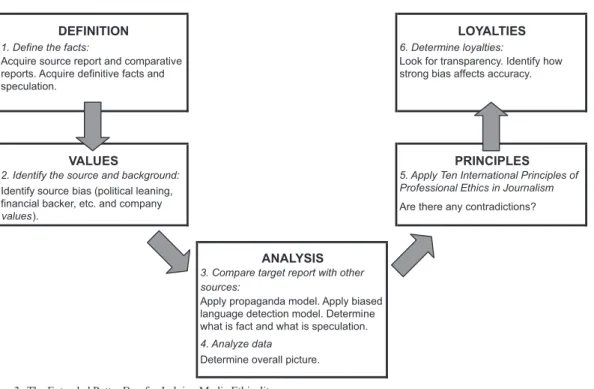
Expanding on the Potter Box and taking the concept of transparency into account, the Extended Potter Box for Judging Media Ethicality can be
outlined as follows.
1. Define the facts: acquire as much information about the report as possible.
What facts have been unanimously decided upon?
What areas of the story are simply speculation?
(Select source material carefully and intentionally, ex. reports on a certain date, or with a specific headline.)
2. Identify the source and the background of the sources.
What individual and/or group owns control of the source? Is the source commonly known as left/
right leaning? Specifically, what are the official values of the media outlet controlling the source?
Do these values overlap with the 10 Principles?
3. Compare the content of the target report with those from other sources.
Applying the propaganda model , find quantitative data. Are there more stories on this topic from one outlet than others? Are there specific facts omitted in one report, but included in many
Determine overall picture.
LOYALTIES
6. Determine loyalties:Look for transparency. Identify how strong bias affects accuracy.
PRINCIPLES
5. Apply Ten International Principles of Professional Ethics in Journalism Are there any contradictions?ANALYSIS
2. Identify the source and background:3. Compare target report with other Apply propaganda model. Apply biased language detection model. Determine what is fact and what is speculation.
4. Analyze data
DEFINITION
1. Define the facts:
Acquire source report and comparative reports. Acquire definitive facts and speculation.
VALUES
Identify source bias (political leaning, financial backer, etc. and company values).
sources:
Figure 2. The Extended Potter Box for Judging Media Ethicality.
others? Using the biased language detection model of Recasenset et al. (2013), do many words/phrases contain framing bias and/or epistemological bias?
4. Analyze the data found through comparison to determine the overall picture.
5. Apply the 10 International Principles of Professional Ethics in Journalism to the facts: focusing most specifically on the first three Principles, does the media report contradict any of these Principles?
6. Determine loyalties.
If any of the report contradicts any of their own declared values or the 10 Principles, or if there is a lack of transparency, the medium can be seen to be acting in their own interest, rather than accountably, and thus the media report can be considered unethical by this framework. A visual representation of this framework is available in Figure 2.
3. Findings
Applying the framework to the research question, this study found that in reports of the 2011 phone hacking scandal, self-interest did impact the reporting of news reports by media owned by the same corporation implicated in the scandal.
Following the first step of the framework, the study defined the facts of the case being studied. To summarize, News of the World was a popular tabloid in Britain owned by News Corp. After years of allegations of phone hacking, investigations concluded the allegations were true and the paper was implicated in hackings between 2004 and 2006. News of the World officially apologized and set up a compensation system, but generated new outrage when information that the paper had deleted the voice messages of missing teenager Milly Dowler causing her parents to believe she was still alive surfaced. It was at this time in July 2011 that James Murdoch, the son of News Corp.
CEO Rupert Murdoch, announced the closure of
News of the World. Those arrested since the scandal include previous News of the World editors Andy Coulson and Rebekah Brooks.
After also outlining the financial and political motives that would play a part in the reporting bias of the selected media, the propaganda model of Herman and Chomsky was applied. By utilizing Google search, it was possible to accumulate data on how many articles including specific key words were published. Plugging in the key phrases “news of the world” and “phone hacking” with a search range between 7/7/2011 and 7/8/2011 (the date that the closure of News of the World announced and the selected time period for this study) shows data which convincingly allude to Herman and Chomsky’s worthy/unworthy theory about mass media. Table 1 shows an organization of those results.
From Table 1 it is possible to see that media owned by News Corp. published far fewer reports on the topic than media directly rivaling them.
After aggregating articles from each of the selected media sources within the selected time period, the content was analyzed for “worthy” and
“unworthy” topics by breaking apart the key overlapping points of the articles.
Table 2 Displays a chart of the overlapping
Table 1
Number of articles published 7/7/11-7/8/11 about News of the World phone hacking.
Google Search Results of Articles Published July 7-8 2011 “news of the world” “phone hacking”
Fox News: foxnews.com 3
BBC: bbc.co.uk/news 51
CNN: cnn.com 24
NY Times: nytimes.com 18
Sky News: news.sky.com 2
The Japan Times: japantimes.co.jp 0
Al Jazeera English: aljazeera.com 4
content in the articles. Columns with “Yes” mean that the topic is both mentioned and some aspect of the topic being related to the hacking scandal and closure of News of the World is presented as fact in the article. “No” means either that the topic has not been mentioned in the article, or it is presented as untrue. “Maybe” means that the topic was mentioned, but was either not confirmed by the source, or was presented in a way which made the opinion of the article ambiguous. This yes/no chart shows which topics were deemed worthy or unworthy of being included in the articles.
Upon applying the linguistic bias detection model a few difficulties arose. Because the model was created initially for computer software to carry out analysis, attempting to look for framing and epistemological bias by eye proved to be difficult.
While some qualitative analysis was possible, noting certain loaded words (in the New York Times article specifically) such as “uproar,”
“outrage,” “suspicion and condemnation,” “ploy,”
and “demise,” no quantitative data were obtained.
Future research should look into acquiring the software intended for linguistic analysis.
Looking at the available data, it would appear
that the media in competition with News Corp.
were more likely to point fingers at who was to blame for the scandal and closure of the paper.
Media linked directly to News of the World through their ownership by News Corp. (along with British public media BBC) emphasize that Murdoch pulled out advertising for the last issue of the paper and emphasized his donation of profits to charity, while non-British news media CNN, The New York Times, and Al Jazeera English claim that advertisers were looking to distance themselves from News Corp.
media. Most notable however, was the lack of acknowledgement from either Fox or Sky News that News Corp. was in the midst of buying out the remaining 61% of pay-TV channel BskyB that it didn’t already own, despite that all other media disclosed that information.
Applying the International Principles of Professional Ethics in Journalism, the first two principles, people’s right to true information, and the journalist’s dedication to objective reality were followed through for the most part. However, the third principle, the journalist’s social responsibility:
that the journalist is accountable not only to the party controlling the media, but also to the public
Table 2
Overlapping topics in articles on the closure of News of the World.