Predictors of a Prolonged Operation Duration When Using General Anesthesia in a Teaching Hospital
Toshitaka Y AMANOKUCHI
1), 2), Tomoko N AKAGAWA
3), Ken Y AMAURA
4), Chikara Y OSHIMURA
1), Toshiki M AEDA
1), Masayoshi T SUJI
1),
Miki K AWAZOE
1), Atsushi S ATO
1), Hisatomi A RIMA
1)1)
Department of Preventive Medicine and Public Health, Faculty of Medicine, Fukuoka University
2)
Office of Institutional Research, Kyushu University
3)
Department of nursing, Fukuoka University Hospital
4)
Department of Anesthesiology, Faculty of Medicine, Fukuoka University
Abstract
Aim: To investigate the predictors of a prolonged operation duration when using general anesthesia in a teaching hospital.
Methods: From 2012 to 2013, a total of 11,942 operations were performed at Fukuoka University Hospital.
After the exclusion of operations without general anesthesia and those with planned operative duration <60 minutes or actual operative duration <30 minutes, a total of 10,623 operations were included in the present analysis. Predictors of a prolonged operation duration (defined as actual operation duration >30% of the planned duration) were assessed using logistic regression, hierarchical and mixed models with adjusting for random operator effects.
Results: The mean age of participants was 52.1 years, and 51.1% were female. The types of performed operations were cranial (5.5%) , thoracic (7.2%) , abdominal (9.9%) , thoracoscopic (3.9%) , laparoscopic (6.5%) , endoscopic (1.1%) , endovascular (2.0%) , eye (8.0%) , orthopedic (22.9%) , skin (6.1%) , obstetric (3.2%) , gynecologic (7.0%) , male genital (1.2%) , otorhinolaryngological (6.8%) , breast (1.6%) and others (7.1%) . There were 1649 cases (13.8%) with a prolonged operation duration. In the multivariable analysis, significant predictors of a prolonged operation duration were female gender (odds ratio [OR] 1.19, 95% confidence interval [95% CI] 1.01-1.30) , obesity (defined as a body mass index ≥25 kg/m
2; OR 1.19, 95% CI 1.05-1.36) , history of heart disease (OR 1.38, 95% CI 1.14-1.67) , laparoscopic surgery (OR 1.79 vs. abdominal surgery, 95% CI 1.34-2.38) , endoscopic surgery (OR 2.50 vs. abdominal surgery, 95% CI 1.24-5.07) , eye surgery (OR 2.31 vs. abdominal surgery, 95% CI 1.43-3.72) and intraoperative bleeding ≥200 mL (OR 2.95, 95% CI 2.51-3.46) . Conclusions: Female gender, obesity, a history of heart disease, several types of operation and increased intraoperative bleeding were associated with a prolonged operation duration.
Key words: prolonged operation duration, general anesthesia, predictors, observational study
Corresponding to: Prof. Hisatomi Arima, Department of Preventive Medicine and Public Health Faculty of Medicine, Fukuoka University, 7-45-1 Nanakuma, Jonan-ku, Fukuoka 814-0180 Japan
TEL: +81-92-801-1011(ext. 3315) E-mail: [email protected] Introduction
A prolonged operation duration has been shown to be associated with adverse events, such as a fever, anorexia and infection after operation.
1), 2)It may also increase the working hours of medical staff and result in a worse
financial situation at hospitals. Effective management of the operation room requires a strategy based on recognizing predictors of a prolonged operation duration.
A number of observational studies have suggested
that the skill of surgeons, characteristics of patients and
size of the hospital may predict a prolonged operation
duration.
3)-6)However, current evidence is mainly derived from Western populations, and it is unclear to what extent these findings apply to Japanese populations.
The aim of the present analysis was to investigate the predictors of a prolonged operation duration for various types of surgeries using a large-scale database from a teaching hospital in Japan.
Materials and Methods
Study design and participants
This is a cross-sectional study of patients who underwent surgery at Fukuoka University Hospital.
From January 2012 to December 2013, a total of 11,942 operations were performed in the hospital. After excluding operations without general anesthesia (n=508) and those with a planned operative duration <60 minutes (n=427)
or actual operative duration <30 minutes (n=384) , a total of 10,623 operations were included in the present analysis.
This study was approved by the Medical Ethics Review Board of the Fukuoka University (No 15-130) .
Predictors
We collected information on gender, age, body mass index (BMI) , type of surgeries (cranial, thoracic, abdominal, thoracoscopic, laparoscopic, endoscopic, endovascular, eye, orthopedic, skin, obstetric, gynecologic, male genital, otorhinolaryngological, breast or others; and emergency [operation not scheduled but required to be conducted as soon as possible] or elective) , and intraoperative bleeding volume from hospital electronic medical record database, including operation records. Histories of diabetes, hypertension, and heart disease were estimated from medical histories, medications and insurance names of disease listed in the hospital’s electronic medical record database.
Outcomes
The outcome was >30% prolongation of the scheduled operative duration, which was decided by the surgeon and listed on the application form of each operation.
Statistical analyses
Predictors of a prolonged operation duration were assessed using logistic regression, hierarchical and mixed models with adjusting for random operator effects. Effects of predictors are shown as odds ratio (ORs) with 95%
confidence intervals (95% CIs) . The SAS version 9.4 (SAS
Institute Inc., Cary, NC, USA) software program was used for the statistical analyses, and P <0.05 was considered statistically significant.
Results
The mean age of the participants was 52.1 years, and 51.1% were female. Types of performed operations were cranial (5.5%) , thoracic (7.2%) , abdominal (9.9%) , thoracoscopic (3.9%) , laparoscopic (6.5%) , endoscopic
(1.1%) , endovascular (2.0%) , eye (8.0%) , orthopedic
(22.9%) , skin (6.1%) , obstetric (3.2%) , gynecologic
(7.0%) , male genital (1.2%) , otorhinolaryngological
(6.8%) , breast (1.6%) and others (7.1%) (Table 1) . The scheduled and observed operative durations according to the type of surgery are shown in Table 2.
The average observed operative duration was longer than the average scheduled operative duration for thoracic surgery, laparoscopic surgery and endoscopic surgery
(Table 2) . Regarding emergency surgery, the average observed operative duration was longer than the average scheduled operative duration for laparoscopic surgery and gynecologic surgery.
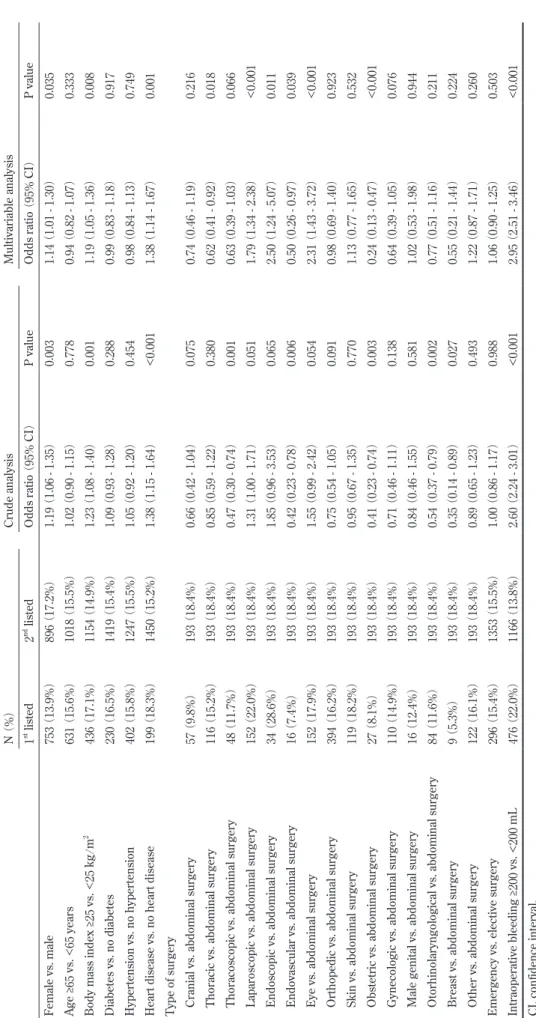
There were 1649 cases (13. 8%) with a prolonged operation duration. In the crude analysis, significant predictors of a prolonged operation duration were female gender (OR 1.19, 95% CI 1.06-1. 35) , obesity
(defined as BMI ≥25 kg/m
2; OR 1.23, 95% CI 1.08-1.40) , history of heart disease (OR 1.38, 95% CI 1.15-1.64) and intraoperative bleeding ≥200 mL (OR 2.60, 95% CI 2.24- 3.01) . Thoracoscopic surgery (OR 0.47, 95% CI 0.30- 0.74) , endovascular surgery (OR 0.42, 95% CI 0.23-0.78)
and obstetric surgery (OR 0.41, 95% CI 0.23-0.74) were associated with a reduced risk of a prolonged operation duration, while laparoscopic surgery (OR 1.31, 95% CI 1.00-1.71) , endoscopic surgery (OR 1.85, 95% CI 0.96- 3.53) and eye surgery (OR 1.55, 95% CI 0.99-2.42) were marginally associated with increased risks of prolongation
( Table 3) .
In the multivariate analysis, female gender (OR
1.14, 95% CI 1.01-1.30) , obesity (OR 1.19, 95% CI 1.05-
1.36) , history of heart disease (OR 1.38, 95% CI 1.14-
1.67) , laparoscopic surgery (OR 1.79, 95% CI 1.34-2.38) ,
endoscopic surgery (OR 2.50, 95% CI 1.24-5.07) , eye
surgery (OR 2.31, 95% CI 1.43-3.72) and intraoperative
bleeding ≥200 mL (OR 2.95, 95% CI 2.51-3.46) remained
statistically significant. Endovascular surgery (OR 0.50,
95% CI 0.26-0.97) and obstetric surgery (OR 0.24, 95% CI
0.13-0.47) were also significantly associated with reduced risks of prolongation (Table 3) .
Discussion
In the present analysis using a large - scale database from a teaching hospital in Japan, female gender, obesity, history of heart disease, several types of operation
(thoracoscopic, endoscopic and eye surgery) and increased intraoperative bleeding were significantly associated with a prolonged operation duration.
Obese patients have been shown to have increased risks of a prolonged operation duration in orthopedic or laparoscopic surgery.
7)-12)We confirmed the findings of the previous studies and demonstrated that obesity was clearly associated with a prolonged operation duration for various types of surgeries in a large-scale observational study of Japanese patients. Strategies to reduce the body weight before operation (e.g. a pre-operative weight
reduction program) may be useful for reducing the risk of prolongation.
In the present analysis, we investigated the effects of diabetes, hypertension and heart disease on a prolonged operation duration but did not collect information on histories of diseases in the lung, kidney or liver, or smoking habits, which is a limitation to this study. As a result, the history of heart disease was associated with increased risks of prolongation of the planned operative duration. Very few studies have investigated the association between a history of heart disease and a prolonged operation duration, but an observational study of 17, 412 operations (mean patient age 55 .8 years) conducted from 1993 to 2005 in a hospital in the Netherlands reported that a history of neither heart failure nor coronary artery disease was associated with an increased risk of prolongation.
9)Such conflicts in findings may be attributable to differences in hospital settings and characteristics of patients (e.g. ethnicity and age) . Table 1 Characteristics and clinical features of participants
Participants
Female 5424 (51.1%)
Age (years) 52.1±23.5
Body mass index (kg/m
2) 22.4±4.4
Diabetes 1397 (13 . 2%)
Hypertension 2552 (24.0%)
Heart disease 1086 (10.2%)
Type of surgery
Cranial surgery 581 (5.5%)
Thoracic surgery 762 (7 . 2%)
Abdominal surgery 1048 (9.9%)
Thoracoscopic surgery 411 (3.9%)
Laparoscopic surgery 692 (6.5%)
Endoscopic surgery 119 (1.1%)
Endovascular surgery 217 (2 . 0%)
Eye surgery 847 (8.0%)
Orthopedic surgery 2434 (22.9%)
Skin surgery 653 (6.1%)
Obstetric surgery 335 (3.2%)
Gynecologic surgery 739 (7.0%)
Male genital surgery 129 (1.2%)
Otorhinolaryngological surgery 727 (6.8%)
Breast surgery 171 (1.6%)
Other surgery 758 (7.1%)
Emergency surgery 1916 (18.0%)
Intraoperative bleeding (mL) 203.3±546.7
Values are the mean ± standard deviation for continuous variables and N (%) for categorical variables. Emergency surgery
was defined as operations that were not scheduled but were required to be conducted as soon as possible.
Table 2 The scheduled and observed operative duration according to type of surgery Scheduled operative
duration ( min ) Observed operative
duration ( min ) Difference (min)
Any surgery 172.1±127.8 162.4±138.1 -9.7±73.1
Elective (n=8707) 176.5±132.9 167.5±144.2 -9.0±74.4
Emergency (n=1916) 151.8±99.2 139.4±102.6 -12.4±67.2
Cranial surgery 248.3±146.1 223.2±147.8 -25.1±84.5
Elective (n=308) 284.7±154.3 258.1±154.0 -26.5±92.9
Emergency (n=273) 207.2±124.4 183.7±129.8 -23.6±73.9
Thoracic surgery 313.0±137.5 313.2±172.9 0.2±112.9
Elective (n=578) 323.7±128.9 335.2±173.2 11.4±113.5
Emergency (n=184) 279.4±157.2 244.1±152.9 -35.3±103.4
Abdominal surgery 225.5±181.5 214.0±191.0 -11.5±96.6
Elective (n=744) 259.6±202.9 244.1±215.1 -15.5±106.7
Emergency (n=304) 142.3±55.9 140.5±69.9 -1.8±64.6
Thoracoscopic surgery 161.8±65.6 144.3±88.0 -17.5±67.5
Elective (n=284) 189.2±58.1 165.2±86.8 -24.0±66.9
Emergency (n=127) 100.4±30.1 97.5±71.1 -2.9±66.8
Laparoscopic surgery 196.3±102.5 202.3±113.7 6.0±69.3
Elective (n=588) 209.5±104.3 213.9±116.0 4.5±71.6
Emergency (n=104) 121.7±43.5 136.5±70.1 14.8±53.6
Endoscopic surgery 169.4±56.5 177.6±88.7 8.2±76.3
Elective ( n =113) 167 . 0 ± 51 . 9 175 . 7 ± 88 . 7 8 . 7 ± 77 . 9
Emergency (n=6) 215.0±111.3 212.3±89.0 -2.7±38.6
Endovascular surgery 200.3±81.7 141.4±75.6 -58.9±78.0
Elective (n=154) 211.4±75.6 147.6±72.4 -63.7±74.9
Emergency (n=63) 173.3±89.9 126.3±81.6 -47.1±84.8
Eye surgery 88.5±30.3 85.2±44.0 -3.3±36.3
Elective (n=634) 83.4±27.4 79.8±41.5 -3.6±36.4
Emergency (n=213) 103.5±33.5 101.2±47.4 -2.3±36.1
Orthopedic surgery 112.5±52.8 109.2±60.2 -3.3±46.5
Elective (n=2273) 111.1±51.1 108.4±59.4 -2.8±46.1
Emergency (n=161) 131.5±69.8 120.9±69.6 -10.6±50.9
Skin surgery 199.4±204.2 192.6±223.1 -6.8±106.2
Elective (n=587) 206.2±212.7 198.9±230.7 -7.3±109.0
Emergency (n=66) 139.1±77.8 136.9±126.8 -2.2±76.9
Obstetric surgery 97.9±38.8 81.8±24.6 -16.1±42.3
Elective (n=117) 98.2±41.1 92.9±27.0 -5.3±39.3
Emergency (n=218) 97.8±37.6 75.9±21.0 -21.9±42.9
Gynecologic surgery 148.1±73.2 142.2±93.4 -5.9±57.1
Elective ( n =675) 149 . 6 ± 74 . 4 142 . 9 ± 94 . 9 -6 . 7 ± 56 . 1
Emergency (n=64) 132.7±57.8 134.9±77.1 2.2±67.1
Male genital surgery 160.9±102.1 131.7±80.7 -29.2±58.2
Elective (n=120) 164.3±104.7 134.9±81.7 -29.4±60.0
Emergency (n=9) 116.7±38.1 89.7±51.6 -27.0±23.6
Otorhinolaryngological surgery 176.3±110.2 152.6±110.6 -23.7±67.5
Elective (n=703) 177.0±111.1 153.5±111.5 -23.5±68.0
Emergency (n=24) 156.3±75.6 126.9±74.3 -29.4±51.6
Breast surgery 202.8±144.0 171.1±153.6 -31.7±54.2
Elective (n=170) 203.1±144.4 171.5±153.9 -31.6±54.3
Emergency (n=1) 150.0 110.0 -40.0
Other surgery 181.9±107.7 169.1±128.5 -12.8±69.5
Elective (n=659) 186.8±110.6 172.8±130.6 -13.9±70.2
Emergency (n=99) 149.7±78.7 144.2±111.3 -5.5±64.4
Values are the mean ± standard deviation.
Table 3 Predictors of a prolonged operation duration among 10623 participants N (%) Crude analysis Multivariable analysis 1
stlisted 2
ndlisted Odds ratio (95% CI ) P value Odds ratio (95% CI ) P value Female vs. male 753 (13 . 9%) 896 (17 . 2%) 1 . 19 (1 . 06 - 1 . 35) 0 . 003 1 . 14 (1 . 01 - 1 . 30) 0 . 035 Age ≥ 65 vs. <65 years 631 (15 . 6%) 1018 (15 . 5%) 1 . 02 (0 . 90 - 1 . 15) 0 . 778 0 . 94 (0 . 82 - 1 . 07) 0 . 333 Body mass index ≥ 25 vs. <25 kg / m
2436 (17 . 1%) 1154 (14 . 9%) 1 . 23 (1 . 08 - 1 . 40) 0 . 001 1 . 19 (1 . 05 - 1 . 36) 0 . 008 Diabetes vs. no diabetes 230 (16 . 5%) 1419 (15 . 4%) 1 . 09 (0 . 93 - 1 . 28) 0 . 288 0 . 99 (0 . 83 - 1 . 18) 0 . 917 Hypertension vs. no hypertension 402 (15 . 8%) 1247 (15 . 5%) 1 . 05 (0 . 92 - 1 . 20) 0 . 454 0 . 98 (0 . 84 - 1 . 13) 0 . 749 Heart disease vs. no heart disease 199 (18 . 3%) 1450 (15 . 2%) 1 . 38 (1 . 15 - 1 . 64) <0 . 001 1 . 38 (1 . 14 - 1 . 67) 0 . 001 Type of surgery Cranial vs. abdominal surgery 57 (9 . 8%) 193 (18 . 4%) 0 . 66 (0 . 42 - 1 . 04) 0 . 075 0 . 74 (0 . 46 - 1 . 19) 0 . 216 Thoracic vs. abdominal surgery 116 (15 . 2%) 193 (18 . 4%) 0 . 85 (0 . 59 - 1 . 22) 0 . 380 0 . 62 (0 . 41 - 0 . 92) 0 . 018 Thoracoscopic vs. abdominal surgery 48 (11 . 7%) 193 (18 . 4%) 0 . 47 (0 . 30 - 0 . 74) 0 . 001 0 . 63 (0 . 39 - 1 . 03) 0 . 066 Laparoscopic vs. abdominal surgery 152 (22 . 0%) 193 (18 . 4%) 1 . 31 (1 . 00 - 1 . 71) 0 . 051 1 . 79 (1 . 34 - 2 . 38) <0 . 001 Endoscopic vs. abdominal surgery 34 (28 . 6%) 193 (18 . 4%) 1 . 85 (0 . 96 - 3 . 53) 0 . 065 2 . 50 (1 . 24 - 5 . 07) 0 . 011 Endovascular vs. abdominal surgery 16 (7 . 4%) 193 (18 . 4%) 0 . 42 (0 . 23 - 0 . 78) 0 . 006 0 . 50 (0 . 26 - 0 . 97) 0 . 039 Eye vs. abdominal surgery 152 (17 . 9%) 193 (18 . 4%) 1 . 55 (0 . 99 - 2 . 42) 0 . 054 2 . 31 (1 . 43 - 3 . 72) <0 . 001 Orthopedic vs. abdominal surgery 394 (16 . 2%) 193 (18 . 4%) 0 . 75 (0 . 54 - 1 . 05) 0 . 091 0 . 98 (0 . 69 - 1 . 40) 0 . 923 Skin vs. abdominal surgery 119 (18 . 2%) 193 (18 . 4%) 0 . 95 (0 . 67 - 1 . 35) 0 . 770 1 . 13 (0 . 77 - 1 . 65) 0 . 532 Obstetric vs. abdominal surgery 27 (8 . 1%) 193 (18 . 4%) 0 . 41 (0 . 23 - 0 . 74) 0 . 003 0 . 24 (0 . 13 - 0 . 47) <0 . 001 Gynecologic vs. abdominal surgery 110 (14 . 9%) 193 (18 . 4%) 0 . 71 (0 . 46 - 1 . 11) 0 . 138 0 . 64 (0 . 39 - 1 . 05) 0 . 076 Male genital vs. abdominal surgery 16 (12 . 4%) 193 (18 . 4%) 0 . 84 (0 . 46 - 1 . 55) 0 . 581 1 . 02 (0 . 53 - 1 . 98) 0 . 944 Otorhinolaryngological vs. abdominal surgery 84 (11 . 6%) 193 (18 . 4%) 0 . 54 (0 . 37 - 0 . 79) 0 . 002 0 . 77 (0 . 51 - 1 . 16) 0 . 211 Breast vs. abdominal surgery 9 (5 . 3%) 193 (18 . 4%) 0 . 35 (0 . 14 - 0 . 89) 0 . 027 0 . 55 (0 . 21 - 1 . 44) 0 . 224 Other vs. abdominal surgery 122 (16 . 1%) 193 (18 . 4%) 0 . 89 (0 . 65 - 1 . 23) 0 . 493 1 . 22 (0 . 87 - 1 . 71) 0 . 260 Emergency vs. elective surgery 296 (15 . 4%) 1353 (15 . 5%) 1 . 00 (0 . 86 - 1 . 17) 0 . 988 1 . 06 (0 . 90 - 1 . 25) 0 . 503 Intraoperative bleeding ≥ 200 vs. <200 mL 476 (22 . 0%) 1166 (13 . 8%) 2 . 60 (2 . 24 - 3 . 01) <0 . 001 2 . 95 (2 . 51 - 3 . 46) <0 . 001 CI, confidence interval. 1
stlisted indicates female for gender, ≥ 65 years for age, body mass index ≥ 25 kg / m
2for obesity, diabetes, hypertension, heart disease, each type of surgery, emergency surgery and ≥ 200 mL for intraoperative bleeding ; and 2
ndlisted indicates male for gender, <65 years for age, body mass index <25 for obesity, no diabetes, no hypertension, no heart disease, abdominal surgery, elective surgery and <200 mL for intraoperative bleeding.
A number of studies have investigated the effects of gender on the operation duration. Some studies have reported increased risks of prolongation among female patients,
5), 13)while others reported opposite findings.
14), 15)In the present analysis, a female gender was associated with an increased risk of prolongation. Such conflicts in findings may be attributable to differences in the study design or characteristics of participants, surgeons and hospitals.
Limited evidence is available regarding the influence of the type of surgery on a prolonged operation duration. An observational study reported that the ratio of the actual vs.
planned operative duration was larger in neurosurgery, eye surgery and otorhinolaryngological surgery than general surgery.
17)However, the sample size of the study
(160 patients) was somewhat small, and findings of laparoscopic and endoscopic surgery were not reported.
The present analysis of 11,942 operations confirmed that eye surgery was associated with higher risks of a prolonged operation duration than abdominal surgery.
In contrast, cranial and otorhinolaryngological surgeries were not associated with a prolonged operation duration.
Further large-scale studies are required to establish the influence of the surgery type on the prolongation of the planned operative duration.
In the present analysis, increased intraoperative bleeding was a very strong risk factor of a prolonged operation duration. These findings are comparable with those from previous studies that reported clear associations between intraoperative bleeding and the prolongation of surgeries.
10), 16)In order to reduce the risk of a prolonged operation duration, it is important to minimize intraoperative bleeding.
To our knowledge, this is one of the largest studies to investigate predictors of a prolonged operation duration for various types of surgeries among Japanese.
One limitation is the possible selection bias due to the single-center design of this study. Another limitation is the lack of detailed information on the reasons for the prolongation. A third limitation is that this study was set in a teaching hospital. Because the operative duration in teaching hospitals has been shown to be longer than that in non - teaching hospitals
18), our findings may not be applicable to general hospitals. A fourth limitation is that the scheduled operative duration might have varied due to a lack of standardized procedures for deciding on the scheduled operative duration for each type of surgery.
In conclusion, female gender, obesity, a history of
heart disease, several types of operation and increased intraoperative bleeding were associated with a prolonged operation duration in a large-scale observational study in a teaching hospital in Japan. High-risk strategies focusing on these predictors (pre-operation weight reduction, reduction in intraoperative bleeding, recognition of high-risk patients beforehand) may aid in the effective management of the operation room in hospitals.
References
1) Rambachan A, Mioton L M, Saha S, Fine N, Kim:
The impact of surgical duration on plastic surgery outcomes, Eur. J Plast Surg, 36 (11): 707–714, 2013.
2) Willis-Owen CA, Konyves A,Martin DK: Factors affecting the incidence of infection in hip and knee replacement, J. Bone Joint Surg Br, 92-B (8): 1128-1133, 2010.
3) Strum DP, Sampson AR, May JH, Vargas LG: Surgeon and type of anesthesia predict variability in surgical procedure times, Anestheslology, 92(5):1454-1466, 2000 .
4) Patoir A, Payet C, Peix JL, Colin C, Pascal L, Kraimps JL, Maneguax F, Pattou F, Sebag F, Touzet S, Bourdy S, Lifante JC, Duclos A: Determinants of operative duration in thyroid surgery: a prospective multicenter study of 3454 thyroidectomies, PLoS One, 12: 1–11, 2017.
5) Wu A, Rinewalt DE, Lekowski RW, Urman RD: Use of historical surgical times to predict duration of primary aortic valve replacement, J Cardiothorac. Vasc. Anesth., 31: 810–815, 2017.
6) Girotto JA, Koltz PF, Drugas G: Optimizing your operating room: or, why large, traditional hospitals don’t work, Int J Surg, 8: 359–367, 2010.
7) Bradley BM, Griffiths SN, Stewart KJ, Higgins GA, Hockings M, David L: The effect of obesity and increasing age on operative duration and length of stay in primary hip and knee arthroplasty, J Arthroplasty; 29:
1906–1910, 2014.
8) Sato N, Yabuki K, Shibao K, Mori Y, Tamura T, Higure A, Yamaguchi K: Risk factors for a prolonged operative timbasee in a single-incision laparoscopic cholecystectomy, Int HPB Asso, 16 (2) , 177–182, 2014.
9) Eijkemans MJ, Houdenhoven M, Nguyen T, Boersma
E, Steyerberg EW, Kazemier G: Predicting the
unpredictable: a new prediction model for operating
room times using individual characteristics and the
surgeon’s estimate, Anesthesiology, 112: 41–49, 2010.
10) Ballantyne GH, Ewing D, Capella RF, Capella JF, Davis D, Schmidt HJ, Wasielewski A, Davies RJ: The learning curve measured by operating times for laparoscopic and open gastric bypass: roles of surgeon’s experience, institutional experience, body mass index and fellowship training, Obes Surg, 15: 172–182, 2005.
11) Kato JM, Iuamoto LR, Suguita FY, Essu FF, Meyer A, Andraus W : Impact of obesity and surgical skills in laparoscopic totally extraperitoneal hernioplasty, ABCD Arq Bras Cir Dig, 30: 169-172, 2017.
12) Schwartz ML, Drew RL, Chazin-Caldie M: Laparoscopic Roux-en-Y Gastric Bypass: Preoperative Determinants of A prolonged operation durations, Conversion to Open Gastric Bypasses, and Postoperative Complications, Obes Surg, 13: 734-738, 2003.
13) Subhas G, Gupta A, Bhullar J, Dubay L, Ferguson L, Goriel Y, Mittal, VK: Prolonged (longer than 3 hours)
laparoscopic cholecystectomy: Reasons and results. Am Surg, 77(8): 981–984, 2011.
14) Ambe PC, Kohler L: Is the Male Gender an Independent Risk Factor for Complication in Patients
Undergoing Laparoscopic Cholecystectomy for Acute Cholecystitis?, Int Surg, 100: 854-859, 2015.
15) Marty Z, Yasser B, Gunnar B, Derek Z, Tobias M, Alfred K: Impact of risk factors for a prolonged operation duration in laparoscopic cholecystectomy, Eur J Gastroenterol Hepatol, 24: 1033-1038, 2012.
16) Kobayashi K, Ando K, Ito K, Tsushima M, Morozumi M, Tanaka S, Machino M, Ota K, Ishiguro N, Imanaga S : Factors associated with extension of the scheduled time for spine surgery, Clin Neurol Neurosurg, 169:
128-132, 2018.
17) Gillespie BM, Chaboyer W, Fairweather: Factors that influence the expected length of operation: results of a prospective study, BMJ Qual Saf, 21, (1): 3-12, 2012.
18) Vinden C, Malthaner R, McGee R, McClure JA, Winick- Ng J, K Liu, M Math KL, Nash Dm, Welk B, Dubois L: Teaching surgery takes time: the impact of surgical education on time in the operating room, Can. J. Surg, 59(2): 87-92, 2016.
(平成 30.9.3 受付,平成 30.10.3 受理)
「The authors declere no conflict of interest.」