Creation of "Community" for Residents'
Activities in Hammersmith, London : Residents' Association Based on Information Network and Individual Choice(社会学科)
著者(英) Mugiko NISHIKAWA
journal or
publication title
The Journal of Konan University. Faculty of Letters
volume 160
page range 179‑197
year 2010‑03‑30
URL http://doi.org/10.14990/00000995
Introduction
The purpose of this study is to explore, based on a specific case study in London : 1) the trends of opera- tions and activities of residents’ organizations based on a place where people live and 2)the possibility of creating local community, in urban cities where diverse people gather and move with high anonymity among the resi- dents.
The primary target of this survey is the former Grove Ward1)in London Borough of Hammersmith and Fulham (hereafter LBHF)in inner London. Grove Ward was for- merly one of the poor wards in London2). From 1990s, high-income groups working in the inner city of London bought housing in this area, leading to a sharp rise of property prices, and consequently the majority of the residents are now from middle-class groups. In the last 20 years, this area has been transformed into a high- status residential area; however, low-rent houses owned by the local government and non-profit housing trusts are still scattered around. Hence, the old Grove Ward is an area with residents from different economic and social strata.
In this paper3) I discuss a membership residents’ or- ganization called the Brackenbury Residents Association (BRA), launched within the former Grove Ward in 1999.
It aims to create a hospitable environment and to nurture community spirit. BRA provides various kinds of infor- mation on the local community to members and local residents through newsletters and email and offers com- munity activities, including preventing crime, removing graffiti and greening streets. BRA has increased its
membership every year since 2000, and the number of members exceeded 440 as of July, 2009. On the other hand, some residents look on BRA as “activities to de- fend the interests of the middle class.” In this local com- munity, what characteristics does BRA, a relatively young organization, have in its organizational manage- ment? Further, which part of BRA’s activities attracts more residents or brings discomfort to some residents?
Section 1 outlines the overview of the studied com- munity4) and Section 2 explores the processes of field work in London, especially how the survey on BRA be- gan. Section 3 outlines the establishment, organization and operation of BRA. This section focuses on the fact that the organization named Brackenbury Residents As- sociation was named after the common name Brack- enbury, rather than the ward name Grove. Section 4 spe- cifically reviews the developments of various projects to reveal how BRA calls out to the residents in the process of bringing community identity to the residents. Section 5 analyzes the characteristics of BRA creating a commu- nity based on the “broken-windows theory” that empha- sizes the creation of a crime-preventive community. This section explores my assumption that the agility and foun- dation of BRA activities are based on its information net- work and individual choice and autonomy concerned with place, rather than on a sense of identification or coopera- tion with groups or community. This leads to the crea- tion of “local community” as a place for activities of cer- tain residents.
Creation of “Community” for Residents’ Activities in Hammersmith, London :
Residents’ Association Based on Information Network and Individual Choice
Mugiko Nishikawa
1. 1 London Borough of Hammersmith and Fulham : In- creasing Polarization
According to the 2001 census, the population of Lon- don Borough of Hammersmith and Fulham(LBHF)was 165,242 with 75,438 households. According to the esti- mate in 2004, the population increased to 176,800 and the population growth from 2001 to 2004 was 4.4%. Its population density is 100.73 per hectare, which is the fourth highest among boroughs of England and Wales. As for demographic composition by age groups, young adults (age 25 to 39) demonstrate a higher ratio of 37.6%5) than the England/Wales average. According to the 2001 census, the average household size was 2.16. The ratio of households with children as non-working dependents was as small as 17.91% (parents and children : 11.37%, single-parent and children : 6.54%) (LBHF, 2006a, pp.
917). Residents rapidly move in and out of this bor- ough; one out of five households have changed address within a year from 2000 to 2001, and according to the es- timate in 2004, about a half of LBHF households have moved into their current address within the last 5 years.
1 out of 3 residents of private rental housing moves in a year(LBHF, 2006b, p. 3).
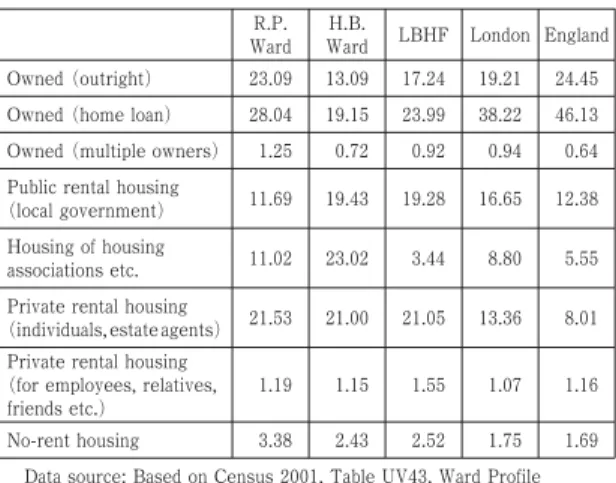
As for accommodation, according to the 2001 census, the percentage of house ownership in LBHF was 44.0%, while 19.2% lived in public rental housing, 13.5% in housing association rental housing and 23.4%in private rental housing(refer to Note 9 and Table 2). The aver- age property price in 2004 was£377,4066). In addition, according to 20032004 Housing Need Survey, the aver- age rent of private rental housing was£215 per week for single-bedroom housing and£457 per week for four- bedroom housing. On the other hand, the average rent for public rental housing and housing association rental housing within LBHF was as inexpensive as£71.20 and
£73.27 per week, respectively, as of April 2005(LBHF, 2006a, p. 43).
The percentage of population engaged in economic ac- tivities was slightly higher than the national average for both male and female according to the 2001 census
(75.3%for male and 64.3%for female). Also, 44.2%of population between ages 16 and 74 are either profes- sional or managerial workers, a high rate compared to national statistics (LBHF, 2005, p. 11). Polarization be- tween the poor and the rich advanced as indicated by the increase of high-income groups; according to data in Housing Need Survey 1998 and 2003, households with total annual income below £10,000 was 35% in 1998 and 36%in 2003, showing no drastic change. However, wealthy households with an annual income of over
£50,000 have doubled from 13%in 1998 to 21%in 2003 (p. 44)7)
1. 2 Former Grove Ward : Gentrification of “Residential Area for Working Class”
Due to the modification of LBHF in May 2002, Grove Ward was divided into two wards : Ravenscourt Park Ward and Hammersmith Broadway Ward8). Consequently Grove Ward no longer exists even in maps. However, in this paper the former Grove Ward is referred to as Grove Ward. It is located at the centre of LBHF and between Hammersmith, the centre of administrative and business activity, and Shepherds Bush, a northern commercial and residential district. Grove Ward is a quiet residential area with small houses dating from the Victorian era, many of them originally built for workers. Those dwellings are currently suited to single-person or small households in size. The area returns to its original wording as two of 45 Conservation Areas(Bradmore Area and Starch Green) in LBHF as of 2008.
In the neighbourhood of Grove Ward, there are a bus terminal, and stations for Underground lines(Piccadilly, District, Hammersmith and City, and Central). Thus the ward is very convenient for travel to London city centre and also to Heathrow International Airport. In the vicin- ity of Hammersmith Underground, there are several ma- jor supermarkets and a shopping mall for daily shopping convenience. While local state primary schools have en- joyed a good reputation in recent years, there are a few famous public or private schools. Therefore, the ward has favourable conditions for commuting to the inner city or schools, and daily shopping.
After the 1990s, high-income residents, with the abil- ity to purchase substantial houses, began moving into Grove Ward. What used to be pubs for workers turned 1. Overview of the Studied Community :
Gentrification of
“Residential Area for Working Class”
into fancy gastro pubs that also offer meals; new restau- rants, grocery stores with high-end and healthy food items, and various kinds of clinics opened up. The high- income groups are more likely to sell their houses as families grow(or diminish), often moving out to subur- ban areas. Housing purchased by non-profit housing trusts from the 1970s is still available with low rents9).
Some residents describe the transformation into high- income residents’ areas as “gentrification” (Nishikawa, 2006). The word “gentrification” describes the process of upward social mobility, in which the inhabitants are considered to have joined the upper classes, and it began to be used to express the phenomenon of middle-class movement into urban areas in US and European big cities in the 1970s.10)‘Gentrification’ is not a word used in everyday conversation among residents but as a jargon in newspapers, magazine articles and survey reports.
When I explained to those who I met in this survey that I was interested in transformation of local community es- pecially in gentrification, their responses fell into three main areas11) 1)not familiar with this word; 2)uncom- fortable in using this word to describe local community;
and 3) explaining the meaning of this word and using specific examples to describe what this word indicate.
Those who discussed “gentrification” [3)] are edu- cated, watch out for information from various media, and own properties or can afford to pay high rents to live in Grove Ward. They are classified into so-called middle, class among the residents; they are central players in gentrification. The Brackenbury Residents Association is a residents’ organization that attracts residents of such economic strata.
I stayed in Hammersmith for a year from September 2001 and then began to research society in urban cities when, as a resident, I used a community centre near my lodging called the Grove Neighbourhood Centre. From 2003 to 2009, I stayed in Hammersmith every August to take part in the Grove Neighbourhood Centre activ- ities12); I also interviewed people concerned with reside nts’ organizations in Grove Ward and nearby areas, and
archived and collected records of various activities13). What I realized during this research in London, with interviews, various resources and especially in relation- ship with the local community is that, though the word
‘community’ is frequently used, residents are neither recognizing each other nor sharing a sense of identifica- tion or attachment to certain wards or groups. In this situation where people do not appreciate what is called
“community” in their daily lives, the familiar word
“community” assumes an importance in ringing a bell with residents and organising themselves. With the key- word ‘community’, it turned my thoughts to the following questions: what type of community creation are the ur- ban residents seeking; and can this be satisfied through the residents’ organizations?
Since 2008, I have been continuing the survey in re- sponse to “Anthropological Study on ‘Community Strat- egy’ of Residents’ Organizations and Activities in an Ur- ban Area” (2008-2010, Grant-in-Aid for Scientific Re- search C). ‘Community strategy’ in this study refers not to principles and theories of government’s community policies or community development, but to a strategy chosen by those engaged in activities in the urban areas in order to sustain a residents’ organisation and to under- take specific activities amid various negotiating struggles between residents and public/private organisations. The survey aims to grasp the current conditions of the com- munity and the ideal local community that people seek from various perspectives through surveys14)on several residents’ organizations of different organizational forms and operation policies.
It was not until 2005 that I got in touch with members of the Brackenbury Residents Association(BRA). As de- scribed above, I started local research in 2001 when I took part in the activities of the Grove Neighbourhood Centre. In 1973, the Grove Neighbourhood Centre was established by residents who responded to the Ham- mersmith Community Development Project of a VCO (Voluntary and Community Organization) named the City Poverty Committee. This project was an attempt to establish a neighbourhood council in areas where there was weak community awareness and no existing reside nts’ organizations; to improve the living environment by residents acting together, while nurturing a sense of community(Nishikawa, 2006)15).
2. Toward the Survey on the Brackenbury Residents’ Association (BRA):
“Open-information People”
When I referred to BRA in interviews with residents who lived in Grove Ward before the start of gentrification (asking about changes in local activities), some inter- viewees criticised BRA as follows : “The middle class only know their own property prices,” “Brackenbury Vil- lage is only a name dreamed up by estate agents.” Even among those residents who have bought substantial houses or who can afford to pay high rents, their house- hold compositions, careers and circumstances are not uniform. Members of BRA are not all well off, and not all are middle-class16). Therefore, it is necessary to under- stand the activities of BRA to consider what such criti- cism represents. However, I was not able to fully esti- mate the sense of distance or boundary between new/old residents or different economic strata. This made me cautious in continuing the survey.
In August 2005, I asked one of my acquaintances who was a member of BRA to introduce me to BRA. A mem- ber of Management Committee in charge of member af- fairs(hereinafter ‘R’)immediately sent an email to me.
In my reply to R, I introduced myself, described the pro- gress of the survey in Grove Ward and my interest in gentrification and the BRA organization, and asked her to allow me to conduct a survey and give me any suitable documentation. In addition, I also included the address of Konan University’s Reference Website for Social Re- search, in which my English-version survey report (Nishikawa, 2006) was provided. In response to my email, R wrote me a generous reply with more than 20 attachment files. They were back issues of BRA’s news- letter and membership-related materials.
Soon after this, I received emails from unknown BRA members. Each of the emails contained a brief introduc- tion of the sender(e.g. name, occupation, age, address, phone number and marital status) and a message like
“I read your self introduction and reports. I think I can help your survey. Please feel free to contact me.” Even- tually, I received 7 emails and 1 phone call. At first, I could not understand the situation and felt confused. In fact, R had forwarded my email to about 200 BRA mem- bers who had registered their email addresses with BRA;
some of these members contacted me directly.
The emails from members clearly indicated how they could help my survey. “Go to new pubs, and you may well understand gentrification. Shall we meet and talk
about that in the most popular pub around?” “I am a xx- year-old xxx (profession) and moved to xxx in xxxx.
Now I am looking after my children. My kids are noisy, but if you don’t mind please come to visit me. I think I can tell you about my own experience of gentrification.”
“My favoured neighbour Mr.X is an old resident from a long time ago. You’d better interview him. His wife is also very open-hearted and cheerful.”
After some email exchanges, I met 6 women and 1 man aged between 30 and 70. I met one of them in well- reputed offering the best coffee around. Then we walked around the area and she talked about the historic buildings. With another one, I went to two pubs of differ- ent atmospheres and enjoyed a meal and drink. When I visited another one’s home, she showed me her kitchen, living room and quiet garden on a summer evening.
Though I was new to them, each of them told me about their lives, the local community and gentrification for 1 to 1.5 hours talking fluently and with considerable anima- tion. One of them showed me every corner of her house while talking about her life before moving to Grove Ward.
Encounters with BRA members were clearly different from encounters with people met through the Grove Neighbourhood Centre over the previous four years. In the Grove Neighbourhood Centre, the encounters were based on a face-to-face relationship. In most cases we got to know each other in the community centre and in other cases the Grove Neighbourhood Centre staff introduced each person. For the first meeting, I gained some infor- mation on the person in advance from the mediator.
However, communication with BRA members started through emails. Information came and went quickly among BRA’s management Committee, the members and the researcher(me), and plans were being arranged with several people whom I had not even met.
These voluntary proposals to cooperate with my sur- vey were also surprising. Before this time I had indeed obtained cooperation from many people of the local com- munity, but occasionally I felt people shunned surveys.
Even in interviews, I always hesitated to ask for personal information such as birth date, career, educational back- ground and family structure. However, BRA members voluntarily informed me who they were, invited me into their living areas and told me about the local community
along with the stories of their lives. Though each one of them had different household structures and occupations and their histories of moving to the Brackenbury area also differed, the impression they all gave me was that they were “open-information people.”
In 2006, I had a chance to meet people involved in the establishment of BRA. At that time, I myself became a member of BRA and received information from BRA by weekly email, even in Japan. Therefore, I have been able to acquire information on daily lives, other residents’ or- ganizations and administration, and police-related issues in the community under study. In 2007 and 2008, I was also given an opportunity to interview BRA’s manage- ment Committee and to participate in its events. In the following section, I will discuss BRA’s activities and their characteristics based on emails from BRA, the BRA’s website, back issues of its newsletter(hereinafter NL) from 2001 to 2008(available in the site)and the Annual General Meeting Minutes(hereinafter AGMM).
3. 1 Formation of Residents’ Organization of “Brack- enbury Village”
In 1999, a strong objection against a nightclub in Grove Ward was raised by local residents. They asserted that the night club corrupted public morals and its dark build- ing damaged the streetscape. At that time, some resi- dents, opposed to the night club, proposed forming a residents’ association. The minutes of the first meeting of Brackenbury Residents Association at the time of foundation states as follows :
“At a meeting local issues had been discussed and peo- ple suggested that this area needed a local residents’ as- sociation to promote the interests and the community as had the areas on either side, Brook Green and Ravens- court Park. Some months ago local people decided to try to set up such an organisation and had meetings with both the Brook Green Association and Ravenscourt Soci- ety to seek guidance and learn from their experience.
The people who had done this gradually evolved into a working committee and allocated responsibilities amongst themselves (6 members).... The guidelines they developed were that it should be non-political; have
the interests of the community as its priority; and be non bureaucratic and practically effective.” (BRA : AGMM, 1999)
The first meeting to form a new residents’ organiza- tion was held in the Grove Neighbourhood Centre at 8 p.m. on July 1st, 1999. The foundation members had pro- duced leaflets, announcing the formation of a residents’
association, and distributed these to 3600 households within the ward. More than 100 people gathered at the meeting (BRA : Rules 1999)17). The objectives of the new association adopted at the in augural meeting were follows,
● To seek improvements in local amenities, facilities and services for residents
● To preserve and enhance the character of the area
● To help foster a sense of community
● To serve as a forum for the exchange of views on local matters
(BRA : Rules, 1999)
The new organization’s name was discussed. As an al- ternative to Brackenbury Residents Association in the original plan, “it was proposed from the floor that the name should be changed to Grove Residents’ Associa- tion. Grove Ward was long-established and known whereas Brackenbury was not an entity. The alternative view was that Brackenbury was better known and had a friendly ring to it.” Eventually Brackenbury was adopted by a show of hands.(BRA : AGMM, 1999)
The name Brackenbury here is derived from Bracke- nbury Village. This name was first used by estate agents in the 1990s. Around the intersection of Brackenbury Road and Aldensley Road at the centre of Grove Ward, there are/were small stores (so-called corner shops) such as a butcher’s, a grocery and a general store and small branch post office. “Brackenbury Village” is the name derived from estate agents’ strategy to promote the local community’s image as a good old village com- plete with conveniences for residents’ lives within the crowded city. Old residents of Grove Ward are not famil- iar with this common name provided by agents. On the contrary, it is natural that those who bought their prop- erty in this ward from such estate agents could easily be- come attached to the name Brackenbury Village.
3. New Residents’ Organization of
“Brackenbury Village”: Debatable Name
The rules of BRA define the Brackenbury area as bounded by Glenthorne Road(south), Paddenswik Road and Dalling Road(west), Goldhwak Road(north) and Hammersmith & City Line(east). In short, the organiza- tion was formed as Brackenbury Village’s(not Grove’s) residents’ association though its area overlapped with Grove Ward at the time. This demonstrated that this residents association was a new type of residents’ organi- zation holding the line against existing ones in this area.
As a result, by including Brackenbury in the organiza- tion’s name, BRA has not been affected by later ward modifications and is familiar to residents recently moved into the area. Currently, the front page of the BRA’s website notes that “Brackenbury Village, as such, doesn’t actually exist but it is the name given to the area by the local estate agents. The central part of the district is based around Brackenbury Road in Hammersmith.”
In addition, as stated in the description of the prepara- tion process for establishment of the residents’ associa- tion, a number of other residents’ associations had al- ready been founded in neighbouring areas. Some BRA members had already got to know these residents’ or- ganizations or taken part in activities of such organiza- tions before moving into Grove Ward. The new BRA en- couraged all residents to join. In response to leaflets delivered to each household by the founding members, it was reported that “the response to the leaflet drop has been far better than expected; there were 140 members (later, as a result of further applications and people join- ing at door there were now more than 200 members)”
(BRA : AGMM, 1999).
3. 2 Organizational Management
The rules of BRA have been amended several times since 1999, but the primary purpose to promote creation of a hospitable environment for residents remains un- changed. As of December 2008, the admission guide in BRA’s website states that BRA is interested in the fol- lowing matters :
● Planning and licensing : we monitor applications and make representations as necessary. We take up cases of unauthorised developments, particu- larly within the Conservation Area, including al- terations to house fronts, wrongly placed satellite
dishes and tree felling. We encourage the Council to plant suitable trees.
● Rubbish : household and builders’ rubbish and street litter are a constant problem- the Committee works with the Council to improve rubbish collec- tion and street cleaning. We publicise the ways the Council can help residents with rubbish collection, their own and their neighbours’.
● Traffic and parking : although parking has been eased by controlled parking, and the Home Zone proposal have began to address the traffic and speeding problem, as supporters of the Home Zone scheme we continue to be concerned for road safety for pedestrians, cyclists and motorists in our area.
● Crime : we support the Neighbourhood Watch schemes and liaise with the Police to help crime prevention.
● Meeting : parties and talks are an important contri- bution to good neighbourliness. At the AGM mem- bers hear reports of our activities and can ask questions about the Association generally. We nor- mally invite a guest speaker to the AGM, often a person who has some responsibility for a matter of current concern to members.
The management Committee consists of 6 to 14 mem- bers elected at the AGM. The term is one year but re- election is not prohibited. The officers are chair and sec- retary selected by members of the management Com- mittee. The treasurer is elected by the AGM. As of September 2008, 12 members of the Management Com- mittee assume the following roles : Chairperson, Secre- tary, Treasurer, Tree Officer, Newsletter Editor, Social Organiser, Membership Secretary, Graffiti and Neigh- bourhood Watch Organiser, Neighbourhood Watch Or- ganiser, Law/Constitutional Adviser, Planning/Licensing Adviser, Committee Member
A Management Committee meeting is held once every six weeks/two months to conduct business, give reports, and plan future events. Committee members also liaise with local government, police department and compa- nies. Other than Management Committee members, BRA seeks representatives from each of 37 streets within the area, who work as mediators between the
committee and members/residents, distribute newslet- ters and encourage new membership. As of January 2009, there were 14 representatives from 13 streets (BRA : Website).
For admission into BRA, applicants must complete a short of form to include name, address and contact de- tails(interests and skills are also requested). The annual fee is£3 for ordinary members(standing order),£4 for cash or cheque,£2 for concessionary and £10 for local companies, schools and restaurants etc. BRA also ac- cepts donations. Members may lose their membership unless they pay the fee within about one month from the AGM in June or July; in practice, they are not removed from membership if payment is made within a year. If members move to other areas, members may keep their membership by way of exception; however, members of the BRA must basically be residents of the Brackenbury area.
As of July 2009, the number of members18)has reached to 445. Though member data by gender, occupation and household are not available, it is estimated that about 10%of residents of the Brackenbury area have member- ship of BRA(BRA : NL, January 2006). The percentage of email address registrants was increased from approxi- mately 50%in 2003 to almost 80%of all the members in 2008.
What are the benefits of membership? BRA’s pamphlet states as follows :
“As a member you will be better able to get across your ideas for improvements to the area and influence the decision-makers.” “As an association, we will be bet- ter able to put over your concerns and suggestions. The fact that we will have regular dealing with the Council and your Councillors means we will have that bit more clout.” “By supporting the Association you will be help- ing to preserve and improve the place where you live.”
“You will receive our newsletter giving up to date infor- mation on the work of the Association, things happening in the area and the Council’s plans. You can contribute to or help to produce the newsletter.” “If working for the community appeals to you, you can help with the work of the Association, depending on your interests and how much time you can spare.”
Being a member of BRA does not require any special obligation. How to use BRA depends on individual
choice. The basis for participation in BRA activities is en- tirely voluntary. Acting as a member of the management Committee in charge of various activities, or as a street representative, depends on each member’s voluntary will and action. Members can also choose either to attend or not to attend the AGM. Members do not have to follow the BRA management Committee’s declaration against a certain property development proposed for the area.
Rather, they can deliver contrary opinions to proposals from the management Committee of BRA or choose not to be involved in a certain issue. Members may apply to and participate in, any event such as BRA’s Christmas events, talks, historic tours within the local community, or in some cases just visit local places of interest.
BRA members include those concerned with, having experiences in or loving various areas such as law, fi- nance, mass media, audio-visual, architecture, gardening, estate agents, administration and medical treatment.
They can deliver information or opinions from different perspectives, provide knowledge, expertise and tech- niques, and develop measures or practical plans. What makes it possible to attract residents’ interests and util- ize members’ expertise is the information network be- tween BRA and its members, the local government, the police department, companies and other residents’ or- ganizations.
3. 3 Information Network
BRA delivers information through newsletters three times a year and 1 or 2 emails per week. The newsletter reports on BRA management Committee discussions and BRA activities, information/opinions from members and community news. The newsletter is two of folded A3 pages. Ruled lines and headlines are green and colour photographs are used taking into account the composi- tion and colour scheme. Various contents are simply and attractively organized so that the newsletter becomes easily viewable and understandable. BRA’s posters and other materials used for protests against development projects also clearly make points and have strong impact.
The newsletter is distributed to all households in Brackenbury area at least annually(but not in 2009 be- cause of the credit crunch). The printing and distribution of this newsletter are supported by estate agents.
Contents of articles include following : development
projects related to the local community (e.g. the third runway for Heathrow Airport affecting LBHF residents, redevelopment of Town Hall area and various issues re- lated to applications for development schemes within the Brackenbury area and nearby); protection of historic buildings and cultural assets within the BRA area(e.g.
preservation of the studio of Henry Moore[major Eng- lish sculptor, 18981986], and repairing a church con- structed in the 19thcentury); BRA activity reports(e.g.
removing graffiti in the area, greening streets, Neigh- bourhood Watch, BRA’s gatherings, events, guest speaker’s talk); daily life information (e.g. measures against rats and moths and introduction of anti-crime de- vices); cooperation with other organizations(e.g. intro- ducing new police officers to the area, other residents’
associations and meeting with residents’ organizations);
and introduction of useful websites.
While the newsletter represents public relations(ex- tended to non-members once a year), emails distributed from BRA to its members deliver on-going news related to residents’ daily lives. Occasionally, information sent from other organizations or groups to the BRA manage- ment Committee is forwarded to members via attach- ment files. Trends and public hearing information of development projects, residents’ meeting information, monthly newsletter of the police Neighbourhood Safer Team of each ward, event information from other resi- dents’ organizations, stores or theatres, inquiries about craftsmen for house repair/maintenance, house rents and so on from members, or wish-to-sell and wish-to-buy lists of electrical appliances, equipments and furniture etc. are also included. Information on incidents in the lo- cal community(e.g. theft, stabbing and drug dealing)is also distributed to draw attention to residents’ security.
Sharing, accumulation and updating of information re- lated to the local community among hundreds of resi- dents are the basis for creating the local community.
Information in emails from BRA is delivered rapidly to members regardless of where they live(either in Japan or Hammersmith). For example, in the latest BRA news- letter(winter 2009), my study on BRA was introduced, referring to this research paper. I sent the draft to the BRA management committee in an email on the 18thOc- tober 2009, to ask whether I could give it to the Journal of Konan University. Reading the draft, they gave me the
permission and asked me to send my photography for use in their newsletter. On 23rdNovember the newslet- ters in digital and in paper, were delivered to BRA mem- bers. In Japan I also got the newsletter in an email from BRA. The article titled ‘BRACENBURY UNVEILED’
focused attention on BRA’s actions against the “broken window syndrome”, referring to my research paper. Af- ter 6 hours, I got an email from my friends in Ham- mersmith, as follows. “Today, we found in the letter box the news letter of the Brackenbury Residents’ Associa- tion with a photo of you on the front page!”
Even though I am living in a rental unit in Osaka, Ja- pan, I receive more news on lives in Brackenbury than I do about local people and issues in Osaka. Therefore, I personally feel the Brackenbury area is more familiar to me. However, needless to say, the Brackenbury area is different from online communities. It exists as a physical space and residents of the area develop activities which aim to create a better local community on the ground.
This nurtures residents’ consciousness and attachment to the local community and creates an area which is dis- tinctive. As BRA offers a wide range of activities, in Sec- tion 4 I will introduce specific activities related closely to the creation of the local community.
The main purposes of the Brackenbury Residents As- sociation’s activities are to increase public security, to conserve the local community’s historic landscape and to promote its beautification.
Various events to learn the local community’s history, tours of the archive and local history centre of LBHF, talks, Village Walk(to walk around the local community with professional guides to learn its history) are held every year. They work as processes for BRA members to learn about the local community and to recognize and rediscover the Brackenbury area. In addition, develop- ment applications in and out of the area are strictly re- viewed in advance to check how they will affect the lives of the residents. Then, if necessary, either acting alone or with other residents’ organizations, BRA will launch a protest against the development.
BRA’s activities include not only learning its own his- 4. Various Projects of BRA and Creation of
“the Brackenbury Area”
tory but also lobbying local government. BRA also pro- poses and promotes various projects and conducts practi- cal activities to call out residents to be involved in the
“creation of the local community.” In this section I will introduce three projects : “Neighbourhood Watch” which is residents’ anti-crime activity street by street, “Graffiti Clean-Up Project” in the Brackenbury area and a “Tree Project” to plant trees in the area in cooperation with LBHF.
4. 1 “Neighbourhood Watch :” Anti-crime Activity and Neighbourhood Consciousness
“Neighbourhood Watch” is an activity re-launched when BRA was founded. The Police Constable(PC)in charge of Grove Ward also attended the first AGM in July 1999. The police officer stated that it was signifi- cantly effective for crime prevention to promote Neigh- bourhood Watch through the residents’ association as fol- lows : “PC spoke about Neighbourhood Watch. Experi- ence showed that Neighbourhood Watch was more effec- tive when it worked in conjunction with residents’
association.” “PC stressed that it was important to keep an eye on neighbours’ property and the police wanted people to tell them of anything suspiciousa two-way flow of information is vital. The police have a Community Consultant Group which meets monthly in Hammer- smith Town Hall.”(BRA : AGMM, 1999)
As I mentioned above, in the Brackenbury area there are 37 streets and one third has a street representative.
The representatives deliver newsletters, encourage new membership and feed back news to the management Committee. Brackenbury is not a particularly crime- infested part of London but it does suffer from problems such as burglary, car thief, mugging, stabbing, beggars, coercive sales and illegal drug dealing. Though crime is frequently recognized as one of the central issues of each street, the street representatives are only part of BRA’s information transmission system and they them- selves do not function as Neighbourhood Watch.
Neighbourhood Watch does not have representatives on each street,(although this is seen as ideal), but it functions as a general anti-crime measure by encourag- ing residents to be good neighbours. It creates an anti- crime environment by which neighbours look out for each other and pay attention to potentially criminal
events. When residents notice any suspicious event or problem, they are more likely to report it to the police.
A combination of residents’ anti-crime consciousness and systematic activities of the police based on the local com- munity produces an effect. In this area, it was not until 2005, when the Safer Neighbourhood Team(SNT)was deployed that the anticrime and regulation system of the police based on the local community was seriously devel- oped.
As mentioned in Section 1, in LBHF, wards of the bor- ough were modified in 2002 and the old Grove Ward was divided into two, and at the same time the local police ju- risdiction was also divided into Hammersmith Broadway Ward and Ravenscourt Park Ward. Characteristics of each ward are distinct and the focuses of police actions and staffing policies are not uniform. In June 12, 2003, a public meeting for Neighbourhood Watch was held in the Grove Neighbourhood Centre and Neighbourhood Watch groups of BRA, the GNC and police officers of two wards participated in this meeting. The police officers reported on the crime trend of the local community by using video and Q&A session was held with residents (BRA : NL, Summer 2003).
BRA invited the Inspector of the Metropolitan Police to the AGM in 2004(24thJune)and asked the Inspector about the new system of Community Policing and its team construction(BRA : AGMM, 2004). At the AGM in 2005 (21stJune), the Sergeant of Hammersmith Broad- way Ward explained that the “Safer Neighbourhood Team” (SNT) had just seriously started work in this area. Two New Police Constables(PCs)would be added to the team within six months in addition to the two cur- rent PCs. In addition, several Police Community Support Officers(PCSO)will be added and they will periodically patrol their service areas. Community issues such as graffiti, drug dealing and ruffians are the responsibility of PCSOs(BRA : AGMM, 2005)19).
As the community policing system gets organized, the BRA begins promote the Neighbourhood Watch program.
In 2005, the newly-opened BRA website indicated SNT composition and how to contact police officers, depend- ing on degrees of urgency and the nature of the crime.
Further, it becomes possible for BRA members to sub- mit information regarding crime or suspicious incidents to the police by logging onto the police website with
specified username and password.
On May 11, 2006, a meeting to promote Neighbour- hood Watch activities was held in the Grove Neighbour- hood Centre (NL. July 2006). Sergeants and borough councillors of both wards plus approximately 30 resi- dents participated. The sergeants introduced Neighbour- hood Watch and then emphasized that the main actors of Neighbourhood Watch should be residents rather than the police20). BRA implemented such plans in cooperation with the police. Further, to aid promotion, BRA down- loaded and printed out reference information materials from websites of the National Neighbourhood Watch As- sociation and the Home Office, and then provided this to residents interested in such activities.
The efforts of Neighbourhood Watch spread wider than the Brackenbury area. In 2007, Neighbourhood Watch meetings for LBHF overall, and each ward, were held, and BRA’s management Committee member in charge of Neighbourhood Watch attended(BRA : NL, June 2007).
From April 2008, the Safer Neighbourhood Team(SNT) of Hammersmith Broadway Ward emailed a monthly newsletter to Neighbourhood Watch coordinators and BRA, which is then forwarded to members as attachment files. The newsletter includes a detailed number of crimes in the area, trends of begging, drug dealing, break-in, theft, bicycle/car theft and bag-snatching,
Neighbourhood Watch and anticrime information.
The efforts of community policing and the BRA’ to en- courage Neighbourhood Watch in the Brackenbury area had an effect. The BRA newsletter distributed in October 2008 (BRA : NL, Winter 2008/09) indicated that ten Neighbourhood Watch schemes were launched and two more schemes were soon to be started in the Brack- enbury area. The BRA not only forwards newsletters from the SNT to its members but also reports incidents that occur in the Brackenbury area and the responses of residents and the police from time to time. In one case, an email from BRA to its members in August 2008 re- ported about a recent incident along with some other an- nouncements, as follows:
“Sgt W of the Hammersmith Broadway Safer Neigh- bourhood Team (SNT)has good news to report, and a pat on the back for Neighbourhood Watch. Yesterday, he wrote : ‘Two nights ago a vigilant resident noticed a male break into a property in XX Road. The witness immedi- ately contacted police who managed to detain the suspect inside the premises. As a result a male has been charged with burglary and is currently in prison awaiting trial.’”
The certification of gratitude from the police to the resi- dent of XX Road was attached to this email.
Next, the same email also contained bad news : “ Not such good news−and a reminder not to keep keys handy for burglars to use....Earlier this week, a resident’s front door was opened(by Yale keys being accessed through the letterbox). Car keys were found and the car stolen.
Please remind yourself and your family always to double- lock with a mortice-type lock- and keep all keys out of sight and out of reach.”
Further, the email continued : “The Sergeant of the SNT reminds us that “some very convincing people are going around door to door asking for money. These are con artists−some give mobile numbers and addresses too−and if they do not get an answer at the door they are also burglars. If residents do not give money to them they will go elsewhere and burglaries will fall too .... Ear- lier this summer we had a spate of young nicely dressed women asking passersbys in the street for money. Their stories were convincing and mostly involved running out of petrol and needing to get home. Variations included visiting mother/gas bill child/social worker, etc. The po- lice advise us not to give money to people in the street Poster of a meeting of Neighbourhood Watch, BRA
(NL. July 2006)
or calling at the door.”
In addition to information from the local police or gov- ernment, live information from BRA to its members is made closer to residents’ interests. The more infor- mation on security and crime is provided to residents, the more they become alert and pay attention to neigh- bours and the local community. When neighbouring resi- dents become more aware of each other and plan to leave their houses for long periods, they are more likely to in- form their neighbours and ask them to pay attention to any suspicious sounds during their absence. This also de- velops neighbourly ties. Though currently only a fraction of residents explicitly participate to Neighbourhood Watch schemes, the scheme draws residents’ broad at- tention to crime prevention, providing a chance for resi- dents to recognize their street neighbours.
4. 2 “Graffiti Clean Up Project :” Local Community’s Barrier
The “Graffiti Project” has cleaned up all graffiti21)from the Brackenbury area and helped to prevent new graffiti.
This raised the profile of BRA. Before BRA started the Graffiti Project, there was much graffiti on walls of houses and other buildings. Each graffiti always contains a tag, a sign of graffiti creator. “Essentially the Brack- enbury Residents Association started to get concerned over the level of graffiti in the area because we were told by the police that the graffiti was linked to crack cocaine dealing. Apparently, drug dealers use so-called “tags”
to mark an area as being safe to sell hard drugs in.”
(BRA : HP)
This project was initiated by the BRA management Committee member in charge of the graffiti issue in March 2004. The project set the graffiti cleaning day, mo- bilized volunteers, acquired approval of house owners and residents and applied paint to every wall with graffiti in the local community. The police initially helped paint out graffiti, and a local builder’s merchant donated paint.
BRA also liaised with the Council to ensure it sand- blasted paint off bare brick walls. The BRA newsletter is- sued in January 2005 called for residents’ participation with a heading “Graffiti Vigil” as follows :
“According to a report by Steve Gibbons of the London School of Economics, Published on 13thDecember 2004, graffiti is more damaging to house prices, than burglary.
A photographic database of all graffiti is kept and the council is compiling a list of possible suspects through the identification of individual ‘tags’. Fines have recently been increased to £2,500 for graffiti or fly-tipping. The council cannot attempt to remove graffiti without permis- sion from the property owner. This is because the high- pressure hoses used could cause slight damage. With the help of local residents, the consent of property owners has been obtained and the cleaning process carried out.
This cannot be done free of charge as a borough−wide service as it would cost the council £1.5 million each year. BRA has received grants of £250 from both the council and HSBC(bank), through their community pro- ject initiative, allowing us to cover the costs of materi- als.”(BRA : NL, January 2005)
During an interview in 2006, the BRA member in charge of the graffiti issue showed me a number of pho- tographs. All the graffiti found in the local community may be classified by creators identified by tags on the photographs. New tags may easily be recognized. How- ever, the purpose of this project is not to catch creators spraying graffiti. The project does not directly contact with graffiti creators, but the project members erase graffiti immediately after new graffiti is defiantly made.
In so doing, the project affirms its strong intolerance of any graffiti in this local community. Thus, from 2006, there has been little graffiti in the Brackenbury area22). By forming an invisible barrier to prevent graffiti, and presenting areas without graffiti as a result, the project actualized the Brackenbury area and existence of its res- idents’ organization.
4. 3 Tree Project : Fostering the Local Community In 2007, “the Tree Project” started. This project is an effort in cooperation with the local Council to green the Brackenbury area. Before the launch of this project, the BRA newsletter issued in January 2006 ran an article about LBHF tree activities and introduced comments from members under the heading of “Brackenbury Goes Green” on the front page. The article also reported on a survey on greening of London and its effect on human health, and introduced the tree-planting activities of a neighbouring resident’s association. The local Council also put out a call for tree managers among residents in- terested in nurturing trees and greening Brackenbury.
Each of them would be in charge of several trees and take responsibility for nurturing the trees (BRA : NL, January 2006).
In April, 2007, a Tree Walk sponsored by BRA was held. BRA members walked around to see the Brack- enbury area’s trees with the Council’s principal arbo- ricultural officer. The tree officer of BRA vividly reported the details of the event and called for the tree project in BRA’s newsletter of June 2007. Here are abstracts from the long article, as follows :
“On 21 April, 16 people met outside Buchanan’s at 10 am. During our two-hour stroll around the Brackenbury areas, we learnt that we have over 530 ‘public’ trees23) excluding those in gardens, etc....Each tree planted in our area costs the Council£175 to provide and install.
And it takes a further £48 for Council contractors to keep it watered during its first year. This pays for 8 lots of watering during the spring and summer, with the tree receiving 10 litres of water each time.
“The Brackenbury area currently has 16 trees that have been in situ for less than a year....And while trees sometimes have to be removed because they are coming to the end of their life, or due to ill health, the Council has a policy of replacing old with new whenever possible.
The not-so-good news is that, unsurprisingly, there is a very limited budget for tree planning, maintenance and watering−but that’s where we can help; and we’re al- ready starting to do so.
“Brackenbury residents have been offered the oppor- tunity to take on the watering of the new trees in our area, and the Council has pledged that the£48 that will be saved in each case will be ring-fenced and put towards tree planting in our area. So if we water our 16 new trees we’ll be paying for 4 new trees planting in the area. At the time of writing more than half our new trees have been adopted by residents, each of whom has pledged to water their charges until the end of the summer,
“A number of residents are very generously offering to pay for new trees to be planted in their streets at£175 per time. Anyone can suggest where further new trees might be planted....It’s a joy to be able to help ensure our beautiful trees survive and flourish; and I’m delighted so many of my Brackenbury neighbours feel the same. If you are interested in tree adaptation or sponsorship, or would like to suggest a tree- planting site, please contact
XXX at email”
The Tree Project gained the support of residents within one year and the BRA newsletter(Summer 2008) reported as follows : “Following the successful launch of the Brackenbury Tree Project in 2007, the fruits of our labours continue to blossom and grow. Over the last few months, 29 street trees have been planted across the Brackenbury area. While 13 of these were replacements for trees that the Council had had to remove for one rea- son on another, and which the Council therefore paid for as a matter of course, the remaining 16 are entirely due to the BRA activities.
“Ten of these trees have been sponsored by BRA members and local business. The remaining 6 trees were funded by last year’s watering activities and a small dona- tion from BRA. For every 4 trees BRA members watered last summer, we ‘earned’ another new tree for the area−and the Council offered the same opportunity this year. And so once again we have sought waters for our new trees. And once again, BRA members have re- sponded magnificently. 25 of our 29 new trees have been
‘adopted’ by members who have promised to water them through the summer months.”
The Tree Project has contributed to greening of the area by adopting and planting public trees with the coop- eration of residents24). Public trees become symbolic of BRA’s interaction between members and participants, and its connection with the local community. Tree plant- ing also nurtures residents’ consciousness and attach- ment to the Brackenbury area.
5. 1 Practice of “Broken Windows Theory”: Territorial Imperative and Sense of Ownership
Though originally not intended, activities offered by the Brackenbury Residents Association have nurtured a
“territorial imperative” and “sense of ownership” em- phasized by the “broken windows theory” to form an anti-crime community. The “broken windows theory”25) was published in Atlantic Monthly by G. Kelling and J.
Wilson in 1982 and exercised great influence over crime counter measures based on “crime opportunity theory”
which was conspicuous in the US and Europe in the 5. Community for Residents’ Activities : Information Network and Individual Choice
1980s. The crime opportunity theory is “a view to at- tempt to prevent crime by not giving crime opportu- nities”(Komiya, 2004, pp. 299301).
Komiya (2004) makes a brief overview of “broken windows theory and crime opportunity theory” in the translation supervisor’s postscript ofFixing Broken Win- dows(2004[1996], G. L. Kelling and C. M. Coles). As for location, Komiya refers to “territoriality” and “moni- toring” as factors to eliminate opportunities for crime26).
“Territoriality” clarifies regions beyond a criminal’s reach and consists of physical barriers and a mental terri- torial imperative (to prevent someone’s incursion).
“Monitoring” enables watchers to recognize the behav- iour of criminals and consists of physical elimination of blind spots and a mental sense of ownership. Criminals are likely to hesitate or give up a crime in monitored regions where there are strong physical and mental barriers and no objects obstructing views; therefore, in such areas criminals are closed out and the crime rate is lowered(Komiya, 2004, pp. 301302).
Komiya comments that “the broken windows theory”
places an emphasis on the mental aspects of territoriality and monitoring : the territorial imperative and a sense of ownership. In areas where broken windows are left un- tended, criminals assume that the residents are unlikely to call the police or restrain crimes and they will there- fore not be caught27). “The broken windows theory” as- serts the importance of the creation of mental barriers by residents monitoring the area and not easily tolerating criminals : furthermore, residents may establish an envi- ronment where disruptive behaviour are not allowed and criminals are closed out(Komiya, 2004, p.301). Further,
“as for who and how to address disruptive behaviour, ‘the broken windows theory’ emphasizes the necessity of partnership among the police, residents and concerned agencies with right solutions, rather than relentless measures of police against such behaviour.” (Komiya, 2005, p. 108)28)
“The Neighbourhood Watch” described above, as an example of BRA’s activities, is indeed an activity in which residents themselves primarily make efforts in crime prevention by monitoring and reporting incidents around the area while cooperating with the community policing. A territorial imperative and a sense of owner- ship discussed in this section are somehow invisible, but
the BRA’s Graffiti Project actualized their outcome and the local community’s barrier. This project has demon- strated residents’ intention to allow no graffiti in their area and to do this by eliminating all graffiti, by watching for its reappearance, and so keep the Brackenbury area clean of all graffiti. Additionally, “the Tree Project” in- creases public trees and contributes to greening of the Brackenbury area, and further, for those involved in the project, each public tree of the area works as a symbol of the relationship between their activities and the local community.
5. 2 Residents’ Organization Based on Individual Choice Komiya(2005), in his work, states that “Place” where residents’ territorial imperative and a sense of ownership have been increased by the adoption of the broken win- dow theory is worthy of being called a community. While the basic characteristics of community are thought to be
“regionality” and “sense of community”, and therefore a
“place” with weak residents’ territorial imperative and sense of ownership is merely an area, a “place” with strong residents’ territorial imperative and sense of own- ership deserves to be called a “community”. He explores a possibility of “revitalizing community with the broken windows theory”(p. 101).
Those involved in BRA’s activities have seen the Brackenbury area, which was originally a commercial name for estate agents’ convenience, being transformed into a local community (complete with a psychological barrier against antisocial behaviour) through members’
participation in various projects and their subsequent at- tachment to the area and sense of having been nurtured themselves. However, BRA’s activities are different from the “revitalization of community” proposed by Komiya. This residents’ association is an organization formed to address certain local community issues, not an engagement of the local community as a whole. BRA is especially interested in issues related to the built envi- ronment : local development applications, usually within the area or nearby, but also the Town Hall regeneration project ten minutes’ walk away. It concerns itself with vehicle speed limits and pub operation hours in the area, the preservation of cultural assets, Neighbourhood Watch, removing graffiti and planting trees. However, so- cial welfare and labour issues have never become main
subjects for BRA. For example, BRA’s concerns about is- sues related to crime and the adverse effects of develop- ment are rarely discussed in terms of solitary, old people or employment generation. BRA is a fairly typical resid ents’ association in its aims and purposes, and these do not included social programmes as such.
In addition, residents have different degrees of inter- est in issues dealt with by BRA and their sense of value is not uniform. Some residents think it is not acceptable that any recognizable, undesirable object is installed in the landscape(e.g. satellite antenna installed on street- facing housing). They feel regretful when cheap window cases or doors are fitted to houses of the Victorian age even if the houses are not theirs29). Brackenbury is largely covered by the Council’s conservation area status which supports the preservation of original features.
However, some residents do not understand why BRA so adheres to the elimination of graffiti and preservation of townscapes and they feel uncomfortable with the BRA’s way of doing this. Even for the Neighbourhood Watch project, some residents question its way of creat- ing a local community by monitoring the neighbourhood with crime prevention put first. They think that the first priority is rather daily lives with face-to-face relation- ships among neighbours and a local community system that allows people to communicate and interact with each other. The prerequisite condition of such criticism is that the basis of community is face-to-face relationships among residents helping and recognizing each other.
However, even among old residents, there are only a limited number of people who have established such rela- tionship. For those who moved into this area recently, it is even more difficult to build strong relationship with neighbours; for them it is still difficult to find common ground with neighbours, although having children at local school, and other common ties assists with integration.
BRA covers areas where isolated individuals live. By using the word “community” and utilizing information networks, pertaining to the local community, BRA gath- ered and provided detailed and latest information about issues proposed by BRA to residents, and acquired fur- ther information and opinions from residents. In so do- ing, BRA focused the interests of people, planned practi- cal projects with clear purposes and mobilized the resi- dents.
BRA attempted to develop a soft system in which each individual may participate in local community activities according to their interests and concerns. Participation of local residents or BRA members is not mandatory.
Brackenbury is the common medium connecting people with different interests and thoughts and is expressed by an ambiguous word ‘community.’ When individuals par- ticipate in activities geared towards an outcome, what was originally only a name of a place becomes a reality and local community for activities of residents’ organiza- tion was formed.
However, information does nothing unless it is up- dated and the local community may lose interest unless practices are embedded. In that sense, the BRA is not ro- bust as an organization since the policies and directions of its activities may vary depending upon current mem- bers.
5. 3 Possibility of Local Community
Why is BRA, a residents’ organization based on indi- vidual choice and initiative, occasionally regarded as an organization representing the interests of certain eco- nomic strata? Three factors may be tied to such a view.
The first one is information sharing and the gap gener- ated by the information network. The medium for the BRA’s activities is the rich information network about the local community. Information connects residents, draws out residents’ interests and mobilizes them. The consciousness generated by such information flow is, however, only a reality for those connected to the infor- mation network or experienced its activities. The more BRA’s activities are visible, the more people out of the information network are out of the loop; therefore, for those people “their (the BRA’s)” activities seem to be building up their own interests.
The second factor is the strong impression that its problem-solving, outcome-expressive activity style gives to outsiders. BRA not only gathers and concretizes infor- mation but also practically addresses each issue toward resolution and plans projects with clear purposes, methods and outcome. Each project is actually organized by a select few as it consists of only several core mem- bers and dozens of members. However, its actions im- press people or yield benefits towards the local commu- nity. Consequently, such actions are externally seen as
activities of BRA as a whole and tend to be regarded as an exercise of collective power of residents of the major- ity strata.
Third, there may be a certain view of “community”
behind a stereotypical criticism of BRA. This would be implied as follows, “While community depends upon the spirit of mutual support, people of wealth tend to priori- tize self-benefits. Therefore, it is indeed people without wealth who can build up a community in which members sincerely support each other.” The view that middle class and community are incompatible resides in some- where within the mind of people regarded as or claiming to be middle class.
Do these three factors cause a rift among residents or different residents’ organizations within the area called Brackenbury? I believe that the BRA’s activity style that reinforces information networks and clarifies issues and outcomes will be accepted by other residents’ organiza- tions, despite a certain sense of distance between resi- dents of different economic strata, or new and old resi- dents. Though there are a number of residents’ organi- zations within the studied community, many of them are given grants from the local government or private or- ganizations. Without an outcome preferred by outsiders, organizations therefore cannot acquire funds. Organiza- tions must first approve a result-based principle of mar- ket mechanism and then restructure their activities later by returning to the philosophy or policies of organiza- tions. Given that, organizations isolated from information cannot survive. I believe that different residents’ organi- zations will cooperate and form their own network while differentiating from each other. Then various overlapping local communities for residents’ activities will be estab- lished and opened to residents.
Many of those whom I met during the survey on BRA were first-generation middle class and worry about the changing society, as well as taking great pride in their lives so far. They long for old-time(or imaginary)local communities where street residents interact with, and relate to, each other. They are satisfied with BRA’s ac- tivities and feel attached to the area; however, they also feel that this is something different from true commu- nity. Though some people say that middle class conflicts with community, I think it may be the middle class which needs room in current urban places. “Brackenbury
Village” is not merely a name prepared by estate agents.
Those who use the name “Brackenbury Village” also want the essence of village or community within a city in their hearts. The word “community” may connect people regardless of their economic strata, even if it essentially means nothing.
In this paper I have primarily discussed the operations of a residents’ organization, BRA, and its activities in the place named Brackenbury. I intend, in the future, to study the development of residents’ organizations (in- cluding BRA)and their activities with a focus on coop- eration among multiple residents’ organizations both in and outside the area, private organizations, schools, com- panies, local government and the police operating in a wider area.
Notes
1) The ‘ward’ is an administrative unit within a Borough of London and an election district for selecting members of a representative Council (local government). Divi- sions are revised according to change of population com- position and/or policies. The number of wards in LBHF decreased from 23 to 16 in May 2002 and Grove Ward was divided and absorbed into two wards. Hence, now there exists no Grove Ward as a name or as an adminis- trative division; however in this paper the former Grove Ward is referred to as Grove Ward or the former Grove Ward.
2) “London’s Deprived Areas−A Comprehensive Ap- proach”(1973)reported that according to the 1971 Cen- sus, Grove Ward is one of the thirty-six poorest inner London wards which qualified for preferential treatment (Nishikawa 2004, p. 82).
3) This article is the revised version of the Nishikawa’s work(March 2009). After hearing comments on the pa- per from BRA’s members, I corrected and amended its contents and added new information. I would like to show my appreciation for BRA’s members who have kindly given me the opportunity to do interviews and to attend the events by BRA.
4) For overview of the studied community, refer to Nishikawa’s works(2006, 2008a).
5) Table 1. Demographic composition by age groups in 2004(based on LBHF, 2006a, p. 11)
6) According to 20032004 Housing Need Survey, while the average property price varied by 100%in England &
Age groups→ 04 510 1116 1724 2539 4049 5064 6574 75+
LBHF 5.9 5.8 5.1 11.3 37.6 12.6 11.8 5.2 4.7 Inner London 6.7 6.6 6.2 11.9 34.0 13.1 11.7 5.2 4.5 England 5.7 7.3 7.8 10.2 21.3 14.1 17.6 8.3 7.6 Data Source: Mid-Year Estimates, ONS