Risk factors of recurrent sickness absence due to depression: a two‑year cohort study among Japanese employees
学位名 博士(医学)
学位授与機関 獨協医科大学
学位授与年度 平成26年度 学位授与番号 32203甲第648号
URL http://id.nii.ac.jp/1199/00000067/
Risk Factors of Recurrent Sickness Absence due to Depression:
a Two-Year Cohort Study among Japanese Employees
M. Endo, T. Muto, Y. Haruyama, M. Yuhara, T. Sairenchi, R. Kato
M. Endo, T. Muto, Y. Haruyama, T. Sairenchi, R. Kato
Department of Public Health, Dokkyo Medical University School of Medicine, Mibu, Tochigi, Japan
M. Endo, M. Yuhara
Metropolitan Health Administration Center, Nippon Telegraph and Telephone East Corporation
5-9-22, Higashi-Gotanda, Shinagawa, Tokyo, 141-0022, Japan e-mail: [email protected]
Tel.: +81-3-5739-3372
Fax: +81-3-3448-5969
Abstract
Purpose: Depression has a high recurrence rate among employees. There have been few studies investigating risk factors for recurrent sickness absence due to depression after return to work (RTW). The objective of this study was to identify potential risk factors.
Methods: Subjects were 540 full-time employees at the biggest telecommunication company in Japan who returned to work from April 2002 to March 2008 after their first leave of absence due to depression. The Cox proportional hazard model was employed to find risk factors for recurrent sickness absence by analyzing variables including demographic, work-related and work
environmental factors.
Results: Of 540 study subjects, 200 employees (37.0%) experienced recurrent sickness absence due to depression after RTW within the follow-up period. Higher organizational job demand evaluated by the Brief Job Stress Questionnaire (BJSQ) was found to be a risk factor (OR 1.46, 95% CI 1.01-2.10) for recurrent sickness absence due to depression adjusted for confounding factors.
Conclusions: High organizational job demand (evaluated by BJSQ) is a risk factor for recurrent sickness absence due to depression after RTW.
Key Words depression, recurrent sickness absence, risk factors, brief job stress questionnaire, Cox
proportional hazard model
INTRODUCTION
In developed countries, depression is one of the major public health problems (Muto et al.
1999, Bijl et al. 1998, Kawakami 2007, Hensing et al. 2004). According to the World Health Organization, depression is expected to be one of the top two leading causes of disability-adjusted life years in 2020, with a lifetime prevalence of 15.4% and a yearly prevalence of 5.8% for depression (World Health Organization 2000). Depression is a mood disturbance characterized by a loss of interest or pleasure in normal everyday activities (Norder et al. 2012) and is associated with prolonged sickness absence and work disability (Lexis et al. 2012).
Sickness absence is defined as a financially compensated temporary medically certified absence due to any illness or injury (Norder et al. 2012). In the past few decades, there has been a marked increase in sickness absence rates due to depression among the working age population (Okumura et al.2011, Knudsen et al. 2012, Roelen et al. 2011). The management of depression in workers is an important component of the occupational health field, in that depression is a major contributor to reduced work performance, sickness absence, staff replacement costs and both social insurance and medical costs of long-term work disability (Okumura et al. 2011, Knudsen et al. 2012, Roelen et al. 2011, Takada et al. 2009). Sickness absence is not only affected by the personal characteristics of the patient, such as gender, marital status, and educational background, but also as a result of interaction with the work environment, such as job category, working hours, job demand, job control and the health care system (Vlasveld et al. 2008, Tsutsumi et al. 2007).
It is well known from previous studies that depression has a high recurrence rate (Simpson et al. 1997, Mueller et al. 1999, Maj et al. 1992, Pintor et al. 2004). Almost half of patients who recover from a first episode of depression have one or more additional episodes in their lifetime (Burcusa et al. 2007)
Inoccupational health, depression is known to be associated with recurrent sickness absence after return to work (RTW) (Endo et al. 2013, Arends et al. 2010) A Japanese study reported that almost half of RTW employees experienced recurrent sickness absence during the 8.5-year follow-up period (Endo et al. 2013). There has been great interest in the
development of strategies that might reduce the recurrence of depression (Burcusa et al. 2007).
However, we need to pay attention to the clear distinction between recurrence of depression and
recurrence of sickness absence due to depression. After RTW, some depressed employees may have
a relapse of sickness absence, while others continue to work (Norder et al. 2012).
To our knowledge, only a few studies have investigated risk factors for recurrent sickness absence due to depression after RTW (Koopmans et al. 2010, Arends et al. 2013, Virtanen et al.
2011). Koopmans et al. pointed out that work-related factors should be included to evaluate risk factors for recurrent sickness absence (Koopmans et al. 2008). With regard to work-related factors, Karasek’s job-demand control model (JDC model), which is the leading work stress model in occupational health psychology, is often used by researchers and practitioners to describe the psychosocial work environment. (De Jonge et al. 2010, Kondo et al. 2006, Shimomitsu et al. 2000, The Japan Ministry of Health, Labour and Welfare 2005, De Croon et al. 2002). High job stress evaluated by the JDC model as a psychological work characteristic has advanced effects not only on psychiatric problems but also on sickness absence (Ishizaki, 2006). In previous studies using the JDC model, there were reports that the psychosocial work environment can be significantly
associated with sickness absence (Ishizaki et al. 2006, Inoue et al. 2010, Roelen et al. 2007, Magee et al. 2011, Nielsen et al. 2006). Roelen et al. reported that psychological job demands were related to long-term absence (Roelen et al. 2007); however, to our knowledge, no study has investigated the association between the work environment using the JDC model and recurrent sickness absence due to depression. We thought that understanding and improving the psychosocial work environment could reduce sickness absence, as Magee et al. pointed out (Magee et al. 2011).
In Japan, a brief job stress questionnaire (BJSQ) developed by the Japan Ministry of Health, Labor and Welfare (JMHLW) based on the JDC model is often used to measure work environment characteristics. Inoue et al concluded that job control may be an important predictor of sickness absence among Japanese male employees (Inoue et al. 2010). BJSQ has proven to be a useful tool for mental health care at Japanese worksites (Kawakami et al. 2006).
Herein, we hypothesized that recurrent sickness absence due to depression might be associated with organizational job stress. The objective of this study was to find risk factors for recurrent sickness absence due to depression after RTW.
METHODS
Study design and participants
This was a longitudinal cohort study on the prognosis of RTW employees with depression.
Company A, to which participants of this study belonged, is one of the biggest telecommunication companies in Japan and is involved in various fields; regional, international telecommunication, big data and mobile services (installing and maintaining telephones, faxes, telegrams, internet systems, cell phones etc). The number of employee working for this company on a full-time basis from 2002 to 2010 was about 68,000. Employees’ turnover rate is quite low in this company.
As a rule, sickness absence due to depression in company A is accepted only with a psychiatrist's certificate stating that, "this employee needs to rest due to depression.” For RTW, firstly, sick employees submit a psychiatrist's certificate stating that, "this person can return to work" to the Human Resources Department of the company. Secondly, occupational physicians judge whether they can return to work medically, based on the occupational physician’s interview and the information from psychiatrists, and the company. If the company accepts the psychiatrist’s and the occupational physician’s documents that employees are ready to return to work, they can return to work. Similarly, recurrent sickness absence after RTW is also accepted only with a psychiatrist’s certificate. The data for this study were therefore collected based on psychiatrists' certificates. We also counted the episodes of recurrent sickness absence, even if an employee experienced recurrent sickness absence the day after the RTW day, based on the psychiatrist’s certificate. In that case, the participants could be on only 100% working or 100% sickness absence.
As the participants of this study, employees who were registered in the Health Data System and returned to work from April 1
st, 2002 to March 31
st, 2008 after their first sickness absence due to depression (F3; ICD-10, based on a psychiatrist’s certificate) were included. This criterion meant that this study population did not include employees who had had previous episodes of psychiatric disorder before April 1
st, 2002. Details of the design and the sickness absence and return to work system in company A have been described in a previous study (Endo et al. 2013). These participants were followed-up in the Health Data System from the RTW day until the day of recurrent sickness absence, until 730 days (2 years) had passed since the RTW day, until the end of follow-up
(September 30
th, 2010), or until censoring, whichever came first. The day of censoring was the day of resigning, the day of being transferred to another company, the day of maternity leave, or the day of sickness absence due to other diseases except depression certified by physicians, such as
malignancy, hernia, gastric ulcer and so on. That means that, by using the Health Data System, we had all corresponding information on employees who had been on sick leave for other reasons.
Sickness absence due to other reasons after RTW included 2 cases of low back pain, 2 cases of
tumor, and 1 case of heart disease.
The maximum follow-up time was 2 years. The reason why we chose to follow the
participants for 2 years was as follows: firstly, according to our previous study, many recurrences of sickness absence due to depression occurred within the 2 years after RTW, and the Kaplan Meier curve seemed to be stable after 2 years (Endo et al. 2013). Secondly, if the follow-up period was more than 3 years, it could be difficult to evaluate the organizational BJSQ score precisely because we need to take the employees’ transfer to the other departments into account. In this company, in general, the employees are supposed to return to work in the same department where they worked before the sickness absence, and few employees seemed to be transferred to other departments less than 2 years after RTW. As the study population, we used the data of 540 Japanese employees.
Variables
In this study, we included the following variables: age at RTW, sex, age at entering the company, duration of the first sickness absence, living with family, manager, job title,
organizational job demand and job control (evaluated by BJSQ). This information was extracted from the Health Data System. We did not use ‘tenure’ but ‘age at entering the company’ as variables.
Tenure equals ‘age at RTW’ minus ‘age at entering the company’. We thought that ‘tenure’ and ‘age at RTW’ should not be included in the multivariable analysis, as older RTW employees have longer tenure. We chose ‘age at entering the company’ as a variable, because we thought that employees who began to work at this company at younger age seemed to have higher adaptability after RTW.
Seven variables (age at RTW, sex, age at entering the company, duration of the first sickness absence, living alone, manager) were dichotomized based on their mean scores of the participants.
Job title was divided into four groups: office worker, sales worker, technician, researcher.
Organizational Job demand and Job control evaluated by BJSQ
In order to assess the psychological characteristics of the work environment into which the employees with depression returned to work, we used the organizational score of BJSQ. BJSQ is a simplified questionnaire for employees due to the relatively few question items. It is a 57-item multidimensional job stress questionnaire, composed of questions related to job stressors (17 items), stress response (29 items), social factors (9 items), and work and life satisfaction (2 items).
Reliability and validity of the BJSQ among Japanese employees has been established (Shimomitsu
et al. 2000, Kawakami et al. 1995). In this study, the organizational scores of 'psychological job demand' and 'job control' were calculated as the mean scores of these personal scores and divided by gender, according to BJSQ guidelines (Shimomitsu et al. 2000, The Japan Ministry of Health, Labour and Welfare 2005). The personal scores of 'psychological job demand' and 'job control' are calculated as follows (Shimomitsu et al. 2000, The Japan Ministry of Health, Labour and Welfare 2005); of the 57 items in BJSQ, the 3 following questions are used to calculate the personal 'psychological job demand': 'Q1: Do you have to work hard?';'Q2: Do you have to do a lot of work?';'Q3: Do you have difficulty completing your tasks within your schedule?'. The score is calculated for each item and response options are based on a 4-point Likert scale ranging from agree
= 4 points, somewhat agree = 3 points, somewhat disagree = 2 points, to disagree = 1 point. The personal psychological job demand is evaluated by summing the scores of 'Q1', 'Q2'and'Q3'.
Similarly, the 3 following questions are used to calculate personal 'job control': 'Q4: Can you work at your own pace?';'Q5: Can you decide the order and content of your work?';'Q6: Does your opinion affect your workplace?'. A personal decision latitude is evaluated by summing the scores of 'Q4','Q5'and'Q6'.
In this company BJSQ is conducted as an annual health checkup of mental health, and is used as important tool for evaluating and improving the psychological work environment. Every autumn (usually in November) it is mandatory for employees of this company to answer the BJSQ for mental health (response rate: more than 90% every year in almost all organizations). After
employees have completed the BJSQ, the occupational physicians make an "organizational stress figure" by using these organizational scores of job demand and job control, and present appropriate opinions to the manager of the organization.
We used the organizational scores of job demand and job control from 150 departments, such as the General Affairs and Personnel Department, IT Innovation Department, Corporate Strategy Planning Department, Accounts and Finance Department, Global Business Department, branches and so on, to which approximately 100-1000 employees belong. Employees with depression who returned to work within the follow-up period belonged to 109 departments. Based on the mean
"organizational job demand" or "organizational job control" scores of these 109 departments, the departments were dichotomized into two groups, "high/low job demand organization", "high/low job control organization".
Statistical method
The probability of recurrence after RTW was calculated by Kaplan-Meier survival analysis.
The person-days was calculated by the follow-up period. In order to investigate risk factors for recurrent sickness absence due to depression, hazard ratios (HRs) and their 95% confidence intervals (CIs) were calculated using the Cox proportional hazard model in IBM SPSS 19.0. The Cox model assumes that the hazard ratio remains constant over time. We virtually checked the Log minus log graphs to test this assumption and found no indication of such violation. We performed univariable analyses for all variables, and multivariable analyses including all variables. We built a prediction model using a stepwise backward selection model, and analyzed relationships among continuous variables. As the decision rules in the multivariable model, backward elimination was continued until only variables with a p-value<0.05 remained in the multivariable model. Data were analyzed using IBM SPSS ver.19.0 software for Windows. The study protocol was approved by the Medical Ethics Committee of Dokkyo Medical University.
RESULTS
Basic characteristics of the study population
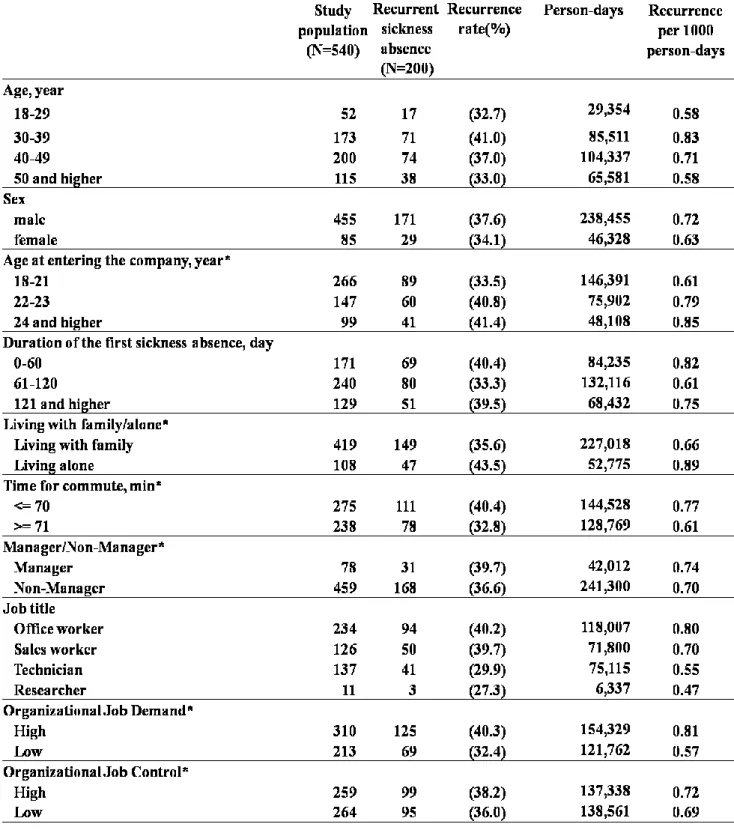
The basic characteristics of the participants are as follows (shown in Table 1): 540
participants were 455 (84.3%) men and 85 (15.7%) women, aged 41.7 ± 8.7 years
(mean ± SD). The age at entering the company was 21.1 ± 3.7 years. The duration of the first sickness absence due to depression was 94.6 ± 67.2 days. Commuting time was 70.2 ± 27.2 minutes. Organizational job demand score was 8.54 ± 0.57. Organizational job control score was 8.03 ± 0.26.
Recurrences per 1000 person-days presented in Table 1 were calculated by dividing the numbers of the employees with recurrent sickness absence with the each person-day in every stratification.
Risk factors of recurrent sickness absence due to depression
We collected the data of whether the study population had recurrent sickness absence due to
depression from the day of RTW within the 2-year follow-up period. Of 540 study subjects who
returned to work, 200 participants (37.0%) experienced recurrent sickness absence due to depression after RTW within the follow-up period. The cumulative recurrence rate for the total study population was 19.3% at 182 days after the day of RTW (about 6 months), 28.4% at 365 days (about 12 months), 34.0% at 547 days (about 18 months), and 37.9% at 730 days by Kaplan-Meier survival analysis. Before using Cox regression analysis, we confirmed that no variables correlated with each other (correlation coefficient <0.25) by checking all the correlation coefficients in the correlation matrix for all combinations.
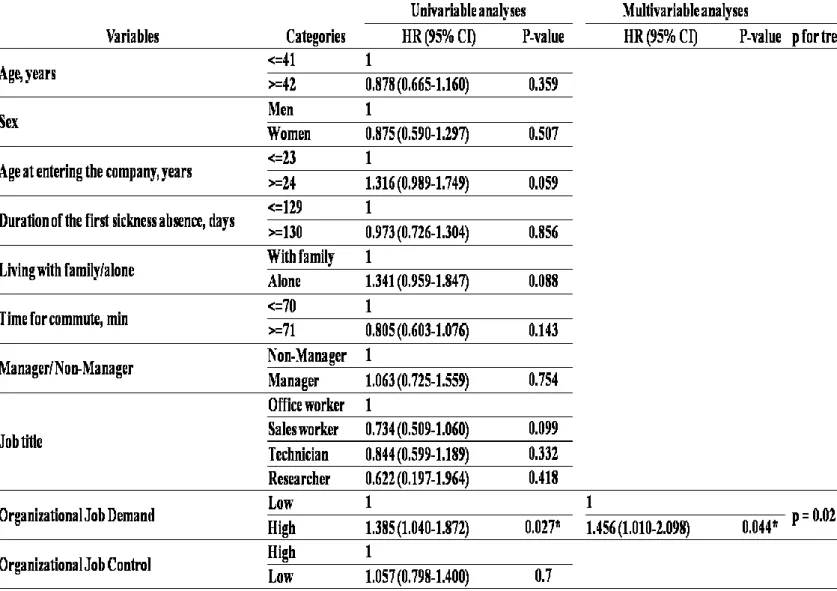
The univariable and multivariable analyses of factors for recurrent sickness absence are shown in Table 2. There were no statistically significant differences except for organizational job demand. Within the follow-up period, high job demand from the organizational score (BJSQ) was a risk factor (OR 1.46, 95% CI 1.01-2.10) for recurrent sickness absence due to depression after RTW.
By excluding irrelevant variables from the multivariable model with a stepwise, backward selection method, only organizational job demand, which went from a HR of 1.099 to 2.074, became
significant in the multivariable model. By analyzing relationships among continuous variables as presented ‘p for trend’ in Table 2, only organizational job demand was significant (p = 0.021) as a predictor of recurrent sickness absence.
DISCUSSION
Depression has been reported to have a high risk of recurrence (Burcusa S et al. 2007, Koopmans et al. 2011, Endo et al. 2013). To the best of our knowledge, this was the first study in Japan to clarify the predictors for recurrent sickness absence among employees who had returned to work from the first episode of depression.
Risk factors for recurrent sickness absence
Our study showed that employees who returned to work in an organization with a higher
psychological job demand had more risk for recurrent sickness absence. The result of our study is in
accordance with that of expert group consensus that psychological work demands are predictors of
recurrent sickness absence due to depression (Norder et al. 2012). Considering the previous studies
on the association between job demand and sickness absence, the above results seem reasonable:
Magee et al. reported that psychological demand may be a strong predictor of sickness absence (Magee et al. 2011), and DeSanto et al. reported that high job demand had a significant association with depression (DeSanto et al. 2010).
On the other hand, there were no statistically significant differences between job control evaluated by BJSQ and recurrent sickness absence due to depression in our study. This is compatible with a US study using the JDC model, in which job control was not strongly associated with depression (Lennaco et al. 2009). Lack of job control, however, was found to have the strongest impact on registered sickness absence in the Denmark occupational health study (Nielsen et al. 2006). Inoue et al. concluded that employees with high job control had a significantly lower hazard ratio for sickness absence due to depression than those with low job control (Inoue et al. 2010). These differences might have been caused by the characteristics of the population, such as job category, working hours, and the health care system.
So far, there is insufficient evidence on the association between other factors and recurrent sickness absence due to depression (Koopmans et al. 2010, Koopmans et al. 2011, Roelen et al.
2010). In our study regarding demographic factors such as age or sex, there were no statistically significant differences in recurrent sickness absence.
While Virtanen’s study showed that manual workers had a significantly higher risk of recurrent sickness absence than others, in this study ‘manager’, and ‘job title’ were not statistically significant predictors of recurrence (Virtanen et al. 2011). In Arends’ study, three main predictors of recurrent sickness absence were ‘company size >100 workers’, ‘conflicts with supervisors’, and
‘chronic diseases’. It’s very interesting to consider why Arends’ study did not find job demands to be significant, while our study found job demand to be a significant predictor for recurrent sickness absence. We thought the different results were due to the two reasons, ‘relevant variables included in the analysis’ and ‘difference in sampled population’. Our study did not include other relevant variables such as ‘conflicts with the supervisor’ as in Arends’ study. Our population ‘was not recruited by a cluster-randomized controlled trial’, ‘did not include employees diagnosed as F4’,
‘did not survey a variety of companies’, and ‘differed from Dutch company culture.
Strengths and Limitations
There are three strengths of this study. Firstly, the study included a rather large group of
participants (men). The number of subjects with recurrent sickness absence was more than 500, which was larger than in previous studies, which ranged from 71 to 431 subjects (Simpson et al.
1997, Mueller et al. 1999, Maj et al. 1992, Pintor et al. 2004, van Weel-Baumgarten et al. 1998, Eaton et al. 1997, Eaton et al. 2008), except the Dutch study (Koopmans et al. 2008). Secondly, we used objective measures of depression and sick leave. This study was based on sickness absence data medically certified by psychiatrists’ certificates, different from many studies based on self-reporting (Koopmans et al. 2010). The ICD-10 diagnosis of a single depressive episode
employed in our study was used in their daily clinical practice with sufficient precision (Bock et al.
2010), which was why we had higher validity and reliability to some extent. Thirdly, instead of personal ratings of job demand and job control, measures were based on mean scores from each department. This is likely to reduce the personal rating bias, but also reduces precision.