Eastern Middle Iranian Languages
著者(英) Yutaka Yoshida
journal or
publication title
Senri Ethnological Studies
volume 98
page range 123‑152
year 2018‑03‑16
URL http://doi.org/10.15021/00009008
123
Edited by K IKUSAWA Ritsuko and Lawrence A. R EID
8. The Family Tree Model and “Dead Dialects”:
Eastern Middle Iranian Languages
Yoshida Yutaka
Kyoto University
Translated by Kikusawa Ritsuko
National Museum of Ethnology, Japan The Graduate University for Advanced Studies, Japan
Abstract
Dixon (1997: 46) writes:
We have just a few scenarios with lengthy historical records—involving Greek, Indo- Aryan, Hebrew and Egyptian—and these extend 3,000 or at most 4,000 years, a small fraction of the 100,000 or so years that language is thought to have been around.
This list of language groups seems to represent a general view shared by linguists as to the availability of written texts. However, there are some languages that have not received the attention they deserve and the Iranian, or the Irano-Aryan sub-branch of the Indo-Iranian languages is one of them. Although they were always behind the more conspicuous Indo-Aryan group, languages belonging to this group have historical documentation covering no less than 3,000 years, and numerous different modern languages of this group are spoken in the vast area extending from Anatolia to China’s western border. Thus, the Iranian languages have a lot to offer for diachronic studies, no less than Italic or other Indo-Aryan branches. I will present selected topics from Iranian historical linguistics, in particular the Eastern Middle Iranian dialects of the Pre-Islamic period, and discuss how they relate to the tree model.
8.1. Introduction
This paper discusses issues related to the family tree model and the study of the history of languages from the perspective of philological studies of Middle Iranian languages.
When discussing the genetic relationships among languages, a family tree model is often used. However, drawing an accurate family tree for a group of languages requires accurate knowledge as to how the languages developed. Without such knowledge, a family tree could still be drawn but it wouldn’t correctly reflect how languages developed.
To illustrate this, I would like to talk about what a tree model would be like if the
development of yatsuhashi manufacturers was to be drawn. Yatsuhashi is a kind of
Japanese confectionary, one of the specialties of Kyoto. Today, there are yatsuhashi manufacturers carrying names such as, Yatsuhashi-Hompo, Honke-Yatsuhashi, or Yatsuhashi-Honten and so on. The Japanese words, hompo, honke, and honten all mean a
‘head shop’ or ‘originator’, and one interpretation of this situation would be that one of them is the real originator while the others who are claiming to be, in fact are not. If a family tree is to be drawn based on this interpretation, there would be a single line departing from the supposedly original manufacturer connecting to its successors. The others (which claim to be “real” but are not so) would not belong to the tree. Here, it should be noted that this interpretation comes from the presumption that there was only one original yatsuhashi manufacturer and the others all imitated it. However, a different tree could be drawn with a different interpretation.
For yatsuhashi to develop into the form we see today, each of these yatsuhashi manufacturers must have made some contributions, independently applying some modifications in pre-yatsuhashi stages. What we see as yatsuhashi today, probably is a sum of such accumulated modifications. In this sense, all the manufacturers can be regarded as the originator of each kind of yatsuhashi, which must have been unique at the stage when it was developed and put into the market. For instance, nama-yatsuhashi
‘raw yatsuhashi’ is very popular today but it did not exist until several decades ago.
Obviously, one of these “originators” innovated it, although it is not known who it was and when the innovation took place. With this fact, the assumption that a family tree could be drawn to reflect the development of yatsuhashi manufacturers turns out to be wrong, and the question arises as to how the facts can be identified and what kind of model would be appropriate to represent the identified facts.
The point presented in this paper is that historical linguists have to deal with the same kind of issues when drawing a family tree model representing the history of languages. Unless historical facts about the languages are identified, the history of languages cannot be adequately represented by a family tree. To show this point, the following points will be discussed.
1) How changes involving the development of the varieties attested in ancient texts of a language are determined. This includes how regional variations and their chronologically different stages are identified.
2) How innovations that are shared by a dialect of a language (but not others) and a neighboring language, are related to the application of the family tree model.
3) How useful basic vocabulary lists and other linguistic features are in identifying linguistic unity after divergence.
4) How the relative chronology of sound changes identifies the divergence of Eastern Iranian and Western Iranian.
8.2. Iranian Languages
Iranian languages belong to the Indo-Iranian branch of the Indo-European language
family. They are characterized by wide geographical distribution, relatively deep time
depth, and the cultural diversity of the speakers. The group includes Old Persian, which
goes back to the 6
thcentury BC and Avestan, a language used in the Avesta. The term Avesta refers to the primary collection of sacred texts of Zoroastrianism, which were originally orally passed down from generation to generation. A written system with unique characters was invented around the 6
thcentury, and the sacred texts started to be transcribed. The exact date when the Avestan language was spoken is not known, but it is considered to go back to an earlier date than Old Persian. In addition, there are six languages whose existence has been confirmed in documents. They are Middle Persian, Parthian, Bactrian, Sogdian, Choresmian, Khotanese, and Tumshuqese. These belong to
“Middle-Iranian,” which refers to the languages spoken during the period between the conquest by Alexander the Great in the fourth century BC through to the period when most of the Iranian-speaking world became Islamized. The present author’s research focus has primarily been on Sogdian and Bactrian. Map 8-1 shows the geographical distribution of the Iranian languages, and Map 8-2 shows areas where Sogdian and other major Iranian languages were spoken during the Achaemenid time.
As mentioned earlier, it is known that Old Persian was spoken about 2,500 years ago. If we go back to Proto-Indo-Iranian, from which all Iranian languages developed, we can trace further back, at least 3,500 years of history. Old Persian and the language of the Avesta share many characteristics with the Old Indian language or Sanskrit and it is not difficult to reconstruct the general form of Proto-Indo-Iranian. The oldest varieties of Old-Indian are considered to date earlier than 1,000 BC and Proto-Indo-Iranian, its parent language, obviously goes back beyond this date. Thus, both modern Indian and Iranian languages can be said to have at least 3,500 years of history.
Geographically, Iranian languages are spoken in a wide area. The official language of the Islamic Republic of Iran today is Persian, which has directly descended from Old Persian via Middle Persian. In addition, Iranian languages spread from Asia Minor to Central Asia. These include language isolates, such as Ossetic spoken in the Caucasus.
Ossetic is one of the unusual varieties of Iranian, with the speakers’ background being Christian while most Modern Iranian speakers are Muslim. The religious backgrounds of the speakers of Iranian languages are diverse. For example, in addition to Zoroastrianism, which is unique to Iranian people, Islam, Christianity, and Judaism were and still are followed. In addition, Buddhist texts in Sogdian and Khotanese have been found and thus it is known that there were also Iranian Buddhists in the eastern areas.
In the field of historical linguistics research on the Iranian languages has been so far rather “low-key”, hidden behind Indian languages, which are known for their abundance of written documents. However, I consider that the Iranian languages are ideal for historical linguistic research as well. This is because, in addition to the fact that their long-term linguistic changes are traceable through written records, the languages show a large geographical distribution, and the speakers’ cultures are very diverse.
Information about Iranian languages occasionally appears in historical
documentation, and based on such information, general changes are often traceable. For
example, in the Shiji (
史記), there is a quotation from Zhang Qian (
張騫), who is known
for his travel throughout the Iranian-speaking world in the 2
ndcentury BC during the
Western Han period. Zhang Qian states that:
Map 8-1 Geographical distribution of the modern Iranian languages (reproduced from Schmitt 1989)
Map 8-2 Areas where Sogdian and other majo r Iranian languages were spoken during the Achaemenid time (from Frye 1984: map 2)
PARSA
PAR Ɵ AVA
BĀ XTRIŠ
SUGUDA
HUV ĀRAZMIŠ
Although the states from Dayuan west to Anxie speak rather different languages, their customs are generally similar and their languages mutually intelligible. (Sima Qian tr. by Watson 1993: 245)
If we assume that the description in the statement is correct, the interpretation would be that, in the Iranian-speaking world at that time, languages had already diversified to the extent that they were recognized as “different”, nevertheless, they were still mutually intelligible.
Talking about “mutual intelligibility,” there is an interesting case which implies that Iranian languages were probably regarded as not so different from Indian languages. An Iranian form of the verb śavati ‘he goes’ is quoted in the Nirukta about 300 BC by its author Yāska, an Indian grammarian.
śavatir gati-karmā kambojeṣv eva bhāṣyate
‘the word śavati as a verb of motion is spoken only among the Kambojas.’ (Bailey 1971:
64)
The name Kamboja seems to refer to a place somewhere on the Iranian side of the border area between India and Iran, which is known as Afghanistan today. The form śavati cited in the Nirukta is an old form of šawad ‘he goes’, a word used in Modern Persian. Although it is not possible to pronounce on the mutual intelligibility between the Iranian and Indian languages spoken in this area based only on this fact, the wording gives an impression that this Indian grammarian recognized that Old Indian and Old Iranian were not completely different.
In the 7
thcentury, about eight hundred years after Zhang Qian’s visit to Iranian speaking areas, a Chinese pilgrim Xuanzang (
三藏法師玄奘) visited India via Sogdiana.
He states:
... the land is called Su-li (= Sogdiana), and the people are called by the same name. The literature (written characters) and the spoken language are likewise so called. (Beal 1906:
26)
A hundred years after Xuanzang’s visit, Hyecho (
慧超), a Buddhist monk from Silla in the Korean Peninsula, traveled through Central Asia. Regarding the languages spoken in the area, he comments that “The [Sogdian] languages are different from those of other countries” (Yang et al. 1984: 54). This could be interpreted as, by then, mutual intelligibility between the languages had been completely lost. Three hundred years later, there is another report about languages in Sogdiana after Islamization by Al-Muqaddasi.
According to his report, the languages had been replaced by Persian. He says that in
Bukhara, an oasis city on the Silk Road located in the west of Samarkand, the language
spoken there was also Persian. However, in its outskirts, it was not Persian that was
spoken but something similar to the one spoken in al-Sughd, the area located between
Samarkand and Bukhara. Al-Muqaddasi’s report in the 10
thcentury states:
The language of al-Sughd is unique to it and is approximated by the languages of the rural districts of Bukhārā, which are quite varied, but understood among them. (Collins 1994:
273)
Based on this, in the 10
thcentury, more and more Persian was used in city areas while in the countryside, varieties of Sogdian were still spoken.
Most of the languages in Sogdiana underwent further changes under the influence of several Turkic languages after Persianization. However, in the remotest areas, a unique descendant of Sogdian has survived to this day. In the Yaghnob gorge located deep in the mountains of Tajikistan, which itself is a mountain country, Yaghnobi is spoken. This language is known as a remote descendent of Sogdian and is sometimes referred to as
“Modern Sogdian.” Incidentally, the word Yaghnob etymologically means ‘glacier’ in Sogdian.
8.3. Linguistic Philology and the Family Tree Model
In this section, I will talk about the stemmas used in philological studies (3.1) and a specific case of the mechanism of micro-level language split that can be identified using text materials (3.2).
8.3.1 Manuscript Classification and Stemma
In philological studies, stemmas are used which resemble a linguistic phylogenic tree.
The present author once discovered that one text written in Sogdian script and belonging to the German Turfan Collection (Plate 8-1) in fact does not represent Sogdian but a Middle Chinese poem phonetically transcribed in Sogdian script. He could identify this Chinese text with a hymn popular among the Zen Buddhists of the 10
thcentury Dunhuang entitled Jingangwuliwen
金剛五禮文. He then collated thirteen Dunhuang Chinese manuscripts containing the hymn and produced a stemma (Figure 8-1) showing the interrelationship between them.
To draw a stemma like Figure 8-1 one must first produce a so-called “critical text”.
This is a hypothetical text that is considered to show what the text in different manuscripts could have ultimately originated from. Then, the text in each manuscript is compared to the critical text and matching and non-matching parts are identified. Based on the results, the texts are classified into groups and this classification is represented as a stemma.
Although the stemma appears to show the chronological development of the text,
this is not the case. It is a classification based on the similarities and differences that are
reflected in the stemma of the texts which are all from the same era, namely the tenth
century. In other words, what the stemma shows is a typological and not a historical
classification of the manuscripts. If a stemma was to be drawn showing the historical
relationships of the manuscripts, what we would need to know is facts about the
production or copying processes; namely, when, who and from which text each
manuscript was copied.
Plate 8-1 Fragment of a Buddhist Chinese text phonetically transcribed in Sogdian script (Mainz 160 + Mainz 627 after Yoshida 1994, p.360, Depositum der Berlin-Brandenburgischen Akademie er
Wissenschaften in der Staatsbibliothek zu Berlin — Preussischer Kulturbesitz Orientabteilung)
Plate 8-2 Dunhuang Chinese manuscript (The British Library, Or. 8210/S4173) containing the
Jingangwuliwen
金剛五禮文8.3.2 Identifying linguistic splits based on texts
The language name “Sogdian” means “language(s) spoken by people in Sogdiana.”
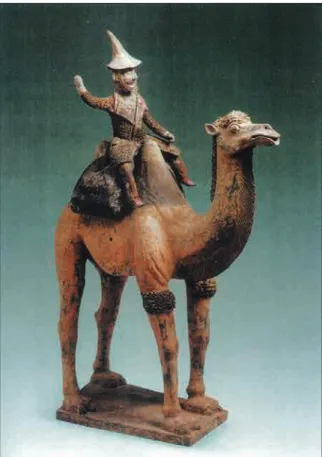
Despite the impression that the term may give, it should be noted that there was no such thing as “Standardized Sogdian.” This is because there never was a unified state covering the whole of Sogdiana (currently Uzbekistan and Tajikistan) prior to Islamization. The Sogdian people were international traders along the Silk Road, and were actively engaged in commercial activities in China and other foreign lands (Map 8-3, Plate 8-3).
Written texts in the Sogdian language differ from one another reflecting such a linguistic situation. In particular, the language of Christian Sogdian texts, written in Syriac script (Plates 8-4 and 8-5), varies considerably from text to text.
Here a question arises as to whether this heterogeneity and diversity reflect different developmental stages, or whether they are regional dialects, varieties that existed at the same time. It appears that both situations are found. There are phenomena which could be interpreted as either, such as difference in the number of case categories and the weakening and/or loss of articles. They could reflect either different developmental stages or the difference between innovative and conservative varieties from the same era.
However, as once demonstrated (Yoshida 1980), there are varieties that clearly reflect regional differences. Past progressive forms of the verb are one such example, based on which Christian Sogdian manuscripts can be readily classified into two groups. Details are explained below.
Two past progressive forms are shown in (1) from manuscript C5 (which is a translation of the New Testament), and in (2) from manuscript C2 (which is a collection of hagiographies and other miscellaneous texts) respectively. The forms wāβēk mātām̩t in the former and wāβāzam̩t in the latter both mean “they were speaking”. In (1), two verbs, namely wāβēk (the present participle of the verb wāβ “to speak”) and mātam̩t (the past
Figure 8-1 Stemma of the 13 Dunhuang Chinese manuscripts containing the Jingangwuliwen
金剛五禮文(Source: Yoshida 1994: 362)
form of the substantive verb) are combined to form a periphrastic expression. In (2), a single verb wāβāzam̩t is used which consists of wāβ, the suffix āz denoting the continuous past, and the 3
rdperson plural ending am ̩ t. The original forms in Syrian corresponding to these expressions are identical, a progressive past form of the verb:
’mryn hww ‘they were speaking.’
(1) ’t w’nw w’byq m’tnt mrtxmyt ət wānō wāβēk mātām̩t martaxmēt and thus saying were.3PL men
‘People were saying like that.’ (Manuscript C5, folio 72 verso 16) (2) c’nw myd w’b’znt
čānō mēδ wāβāzam̩t when thus were.saying.3PL
Map 8-3 The location of oasis cities in Sogdiana (de la Vaissière 2005: 15)
0 200km
‘When they were saying like that’ (Manuscript C2, folio 60 recto 31)
Both types of expression appear frequently, however, never simultaneously in a single text. Therefore, it is reasonable to assume that they developed independently from each other to eventually carry the same function, rather than showing different stages of a single process of development. There are many other differences found between the two manuscripts, most of which are readily explained as reflecting more conservative or innovative stages than the other. However, the differences found in past progressive expressions have to be interpreted as dialectal and not chronological.
Figure 8-2 is a stemma showing the relationship among the varieties of Christian Sogdian as attested in the four groups of manuscripts published before 1980. BST II represents the language of manuscript C2, while NT stands for that of C5. ML I-III and BST I share the periphrastic durative past with C5 and constitute one group against C2 (=
BST II). The languages of C5 and ML I=III differ from that of BST I in that the present participle ends in -ēsk in BST I against -ēk in C5 and ML I-III.
What is interesting about these two past progressive passive expressions is that the earlier embryonic form of each is found in those manuscripts that are older than these
Plate 8-3 Chinese statuette representing a Sogdian caravaneer (8
thcentury) (Qianling Museum 2008: 111)
Plate 8-4 Christian Sogdian manuscript, C5: n 153, recto (Depositum der Berlin-Brandenb ur gischen Akademie der W issenschaften in der Staatsbibliothek zu Berlin — Preussischer Kulturbesitz Orientabteilun g)
Plate 8-5
Christian Sogdian manuscript, C2: n 32, recto (Depositum der Berlin-Brandenb
ur gischen Akademie der W issenschaften in der Staatsbibliothek zu Berlin — Preussischer Kulturbesitz Orientabteilun g)
Christian Sogdian texts. For example, forms such as ptγwδyy wm’tym [patɣōδē wəmātēm]
‘we were covering (s.t.)’ with the past form of the substantive verb corresponding to (1), and ’skw’z [əskw-āz] ‘he stayed’ with the progressive past form with a formative āz corresponding to (2) appearing in manuscripts older than the Christian Sogdian texts can be identified as the predecessors of the two past progressive expressions discussed above.
The occurrence and the usage of these expressions were limited, for there were other forms for the past progressive that were widely used in these older texts. This means that in each of the two Christian Sogdian languages or dialects, one of the several earlier non-productive expressions was inherited to become productive. I consider that this is very convincing evidence to support the idea that there were at least two separate regional varieties in the Sogdian language spoken by Christian Sogdians. In my mind, this is a very good example of capturing a micro-level split of languages through philological research.
The above observations can be summarized as follows. In the proto-stage of a language, there may be alternating forms or expressions that are functionally equivalent.
Subsequently, one of them may be selected to be generalized and become productive while others disappear or remain as relics. This selection may take place for multiple features of a language and in different regional or social groups independently from one another. It is the sum of such selections that brings about language split, either into varieties or dialects, and ultimately to become different languages. To understand the mechanism of language change and the process of divergence, it is important to keep in mind that the parent language may have had different linguistic characteristics, any one of which could have subsequently developed to become the major feature in a daughter language. It is not possible to provide a general explanation as to why languages develop new forms from earlier functional equivalents. In order to know that, each case has to be examined in its own context considering the factors that must have influenced the change.
Stemmas that philologists deal with include also those of scripts and numeral signs.
Figure 8-2 Stemma showing the relationship among six Christian Sogdian texts (based on Yoshida 1980: 91) BST II (C2)
BST I MLI-III
NT(C5)
BST I:
BST II:
MLI-III:
NT:
Hansen 1941 Hansen 1955
Parts of a text in Müller-Lentz 1934
Sogdian translation of the New Testament in Müller 1912
However, space does not allow me to talk about them here.
8.4. Family Tree Models of Indo-European Languages
In this section, different types of models that are used to reflect the relationship among Indo-European languages are summarized and problems associated with them are discussed.
The very first tree model presenting the relationship of Indo-European languages was invented by August Schleicher, and has been reprinted in many text books (Figure 8-3). Problems associated with his tree have been pointed out since that time. First, Schleicher considered languages to be organisms just like biological creatures and thus regarded them as entities that evolved independently of speakers. No language, however, exists without its speakers and therefore there is an obvious problem in this assumption.
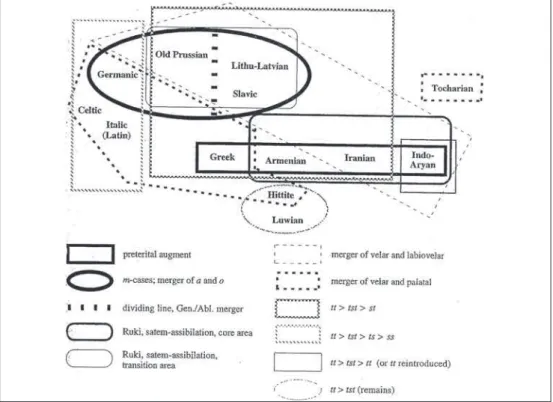
Second, his model, proposed before the era of the Neogrammarians, reflects the mid-nineteenth century unsophisticated view of Indo-European languages. Third, the significant fact that languages, even after they have split, influence each other through contact could not be adequately reflected. The third point triggered the proposal of an alternative model, namely the Wave model by Johannes Schmidt (1872). Regarding Indo- European languages, a diagram showing linguistic phenomena observed across different branches was subsequently proposed by Schrader (1907), see Figure 8-4. His diagram became commonly known among linguists after Leonard Bloomfield (1933) cited it, see (Figure 8-5). A revised version was published in Hock (1999) see (Figure 8-6).
Linguists have continued to use the family tree model to show relationships among the Indo-European languages. A family tree with about ten branches directly diverging from Proto-Indo-European is the commonly used diagram today (Figure 8-7), in which the interrelationship among the branches are not considered; most of the Indo-European family trees so far proposed are drawn reflecting the geographical distribution of the languages. Exceptions to this are the Indo-Iranian and Balto-Slavic languages.
Since the turn of the twentieth-first century, computational analyses of languages
have become more common, where methodologies developed in the study of genetics are
applied. Being somewhat reminiscent of Schleicher’s tree model, researchers in such
areas are seriously tackling the question as to how languages genetically evolve on a
large scale. Gray and Atkinson (2003, Figure 8-8) and Nakhleh et al. (2005, Figures
8-9a, b) are examples. The latter gives consideration to changes that were incurred by
contact. It should be pointed out, however, such computational analyses are still
dependent on manual selection by historical linguists depending on their basic knowledge,
such as sound changes, existence or non-existence of certain conjugational categories,
selection of lexical items, and their assessment of the relative importance of these for the
establishment of the relative chronology of branching. It should also be pointed out that
when considering contact relationship among groups of genetically related languages in
prehistory, the evidence is not exclusively linguistic but outside evidence is also taken
into consideration. In particular, information acquired through archaeological research
and excavated materials are referred to regarding peoples’ movements.
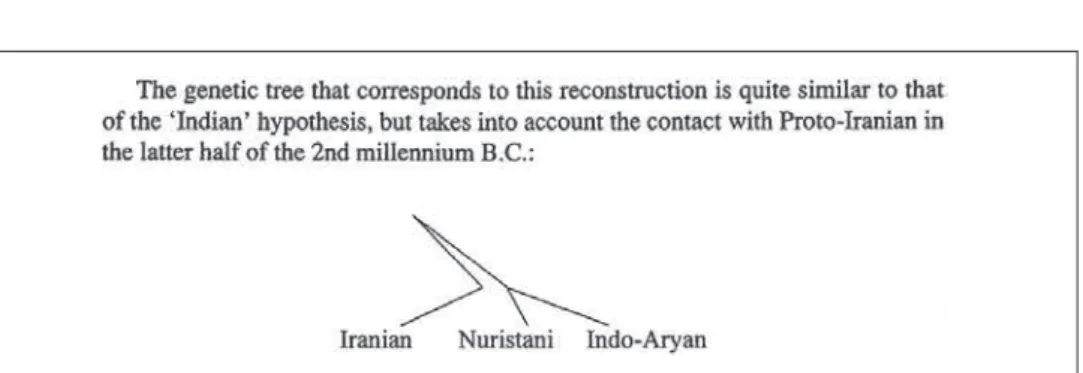
Genetic relationship among Indo-Iranian languages is considered to be relatively straightforward, though not without problems. There is a language called Nuristani, for example, whose affiliation is not clear. This language is spoken in the mountainous area of Afghanistan, and it is clearly an Indo-Iranian language. However, which sub-branch it belongs to has not been identified. The Proto-Indo-Iranian language is known to have split into two, namely Iranian and Indo-Aryan. Nuristani could belong to either of these, or otherwise could form a third branch. In the most recent examination of the position of Nuristani, Degener (2003: 112) states that the position of this language could not be identified solely based on linguistic comparison. Taking the results of archaeological research, she concludes that Nuristani belongs to the Indo-Aryan sub-branch, and that it split off at an early stage and was continuously exposed to Iranian languages of the other sub-branch. Degener’s claim is based on the locations of archaeological sites in which
Figure 8-3 Schleicher’s family tree model of the Indo-European languages (Schleicher 1861) after Clackson (2007: 11)
Germanic Lithuanian Slavic Celtic Latin Albanian Greek Iranian Indic Indo-European
parent
Figure 8-4 Schrader’s wave model (Schrader 1907: 65)
Figure 8-5 Wave model in Bloomfi eld 1933 based on Schrader (Bloomfi eld 1933: 316)
Figure 8-6 Hock’s revised wave model of the Indo-European languages (Hock 1999: 15)
the absence of graves specifically points to Proto-Iranian culture. Her tree diagrams showing the position of Nuristani (Figure 8-10) has a unique form, where influence through language contact is expressed by bent lines.
8.5. Sogdian and the Family Tree Model
In this section, issues related to the family tree model of Iranian languages, specifically those related to Sogdian, will be discussed.
Various family trees have been proposed hypothesizing the relationship among Iranian languages. Relatively recent ones are shown in Figure 8-11 and Figure 8-12, neither of which has been drawn by a specialist of this language group. Researchers of Iranian languages are not particularly keen in investigating the details of the genetic relationship among the languages, and it appears that they are content with the rough classification presented in these diagrams.
As can be seen in Figure 8-11, it is generally accepted that the Iranian languages are classified into two main groups, West Iranian and East Iranian, a subgrouping hypothesis supported by phonological innovations. (Figure 8-12 is unique and radically different from the generally accepted traditional view; the evidence for it as well as the basis for the exact dating of the time of branching elude the present author.) West Iranian is further classified into the North-West Iranian and South-West Iranian, again the subgrouping is supported by phonological innovations. East Iranian is sometimes classified into North and South also, however, this is based on the geographical distribution of languages rather than on linguistic innovations. Some linguistic examination concerning the relationship among these languages is presented below.
8.5.1 Sogdian and Yaghnobi
The focus of this subsection is the relationship between the Sogdian language documented in old manuscripts and Yaghnobi or Modern Sogdian. Figure 8-13 is an attempt by the present author to show the relationship among different stages of Iranian
Figure 8-7 Hock’s family tree model of the Indo-European languages (Hock 1999: 14)
Proto-Indo-European
Celtic Italic Germanic Greek Armenian Balto-Slavic Anatolian Indo-Iranian Tocharian
Latin Baltic Slavic Hittite Luwian Iranian Indo-Aryan
Latvian Lithuanian
Lithu-Latvian Old Prussian
Figure 8-8 A family tree model of the Indo-European languages proposed by Gray and Atkinson (2003:
435–439) after Clackson (2007: 11)
languages (Ancient, Middle, and Modern), including Sogdian and Yaghnobi. If we assume that Proto-Indo-Iranian broke into two or three branches about 3,500 years ago, the split into East Iranian and West Iranian would have occurred about 3,000 years ago, when the ancestors of Modern Persian and Yaghnobi seem to have diverged.
Yaghnobi and Sogdian “resemble” each other and the former is sometimes referred to as Modern Sogdian by those who study Iranian. To confirm the fact that the two languages are linguistically closer to each other than to Modern Persian, the basic vocabularies of Modern Persian, Sogdian and Yaghnobi are compared. The comparison is
Figure 8-9a, b A family tree model of Indo-European languages proposed by Nakhleh et al. (2005)
expected to show that Yaghnobi shares a larger number of similar lexical items with Sogdian than it does with Persian. First, Swadesh’s 100 wordlist was used. As expected, in some sets, all forms are cognate among the three languages (e.g., 3 in Table 8-1), in some other sets, the forms in the three languages have different sources (e.g., 13 in Table 8-1), and in the others, cognates are found in either two of the three languages (e.g., 20, 21, 28 in Table 8-1). The result of the comparison is that 64 apparent cognate sets are found between Sogdian and Yaghnobi, and 61 apparent cognate sets are found between Sogdian and Modern Persian. As mentioned earlier, Sogdian appears to be much more similar to Yaghnobi than it is to Modern Persian and this result is contrary to what one would expect. One would expect many more cognates between Sogdian and Yaghnobi than between Sogdian and Modern Persian.
The same examination was conducted using the Leipzig-Jakarta List, hereafter LJ List (Tadmor et al. 2010). The LJ List contains 100 words that are considered to be most resistant to borrowing. While the items in the Swadesh list were intuitively selected, the LJ List was compiled based on a statistical analysis of 1,500 words in 41 languages from across the world. Considering the fact that Yaghnobi has undergone intensive borrowing from Tajik (a variety of Modern Persian) and Uzbek spoken in surrounding areas, the LJ List appears to be more reliable for our purposes. The two lists of basic vocabulary differ from each other, and 38 words are not shared by the two sets. When one compares the 38 Sogdian words belonging to the Swadesh list with those of Yaghnobi, one finds 27 apparent cognates among them. In the case of the 38 items of the LJ list, only 19 (or 21 depending on how one counts) words turn out to be cognates. This result is astonishing again, because one would expect a “better performance” from the LJ list, based on modern technology and advanced linguistic knowledge.
This raises a serious question as to the liability of the JL List. Tadmor et al. (2010) classify 1,500 words in the 41 languages into the following five categories: i) Clearly borrowed; ii) Probably borrowed; iii) Perhaps borrowed; iv) Very little evidence for borrowing; v) No evidence for borrowing. However, the criteria as to how each form is classified into one of these may have to be reevaluated. For example, Japanese sekai (
世 界) ‘the world’ is classified as i), while its synonym yo “(this) world” is classified as v).
These are reasonable, for it is known that the former is known to have been borrowed from Chinese, while the latter is a word that originated in Japan. However, it seems
Figure 8-10 The position of Nuristani according to Degener (2003: 116)
Figure 8-11 A family tree showing the genetic relationship of Iranian languages (I) (Campbell and Poser
2008: 84–85)
Figure 8-12 A family tree showing the genetic relationship of Iranian languages (II) (Blažek 2007)
Figure 8-13 The family tree of Ancient, Middle, and Modern Iranian languages including Yaghnobi and New Persian (compiled by the author)
Note: The names of unattested languages are underlined, e.g., Proto-Iranian; languages attested in written texts are indicated by an asterisk (*), e.g., *Old Persian.
Old Iranian Middle Iranian Modern Iranian
*Tumshuqese
Old Saka *Khotanese
Old Choresmian *Choresmian
Yaghnobi
Old East Iranian Old Sogdian *Sogdian
Old Bactrian *Bactrian
*Avestan Proto-Iranian
South *Old Persian Middle Persian New Persian Old West Iranian North Old Parthian *Parthian