Research, Practice, and Reflection
journal or
publication title
The Journal of Kanda University of International Studies
number 30
page range 319‑344
year 2018‑03
URL http://id.nii.ac.jp/1092/00001484/
Conceptualizing Leadership Development:
Research, Practice, and Reflection
Kevin Knight
Abstract
Following Scollon (2001) and his mediated discourse analysis (MDA)-based nexus of
practice concept and Knight’s (2015a) research of the leadership conceptualization
process, this paper explores as a nexus of practice the creation of The Leadership
Connection Project website and the related creation and implementation of the
leadership development curriculum promoted on the website. The website and the
curriculum were created by Knight in his role as instructor/researcher at Kanda
University of International Studies (KUIS) in Chiba, Japan. The nexus analysis is
directed at providing historical and discourse analytical perspectives which are
continually relevant to the ongoing curriculum development and website creation. The
research approach illuminates how “leadership development” is conceptualized in the
leadership development curriculum on the website.
Conceptualizing Leadership Development: Research, Practice, and Reflection
Kevin Knight, Kanda University of International Studies
1.0 Introduction/Background
Jones and Norris (2005, p. 5) write about mediated discourse analysis (MDA) as a theoretical and methodological framework:
Mediated discourse analysis was developed as an alternative to approaches to discourse that see social action as secondary, and approaches to social analysis that see discourse as secondary (R. Scollon, [2001]). By not privileging discourse or social action but, rather, seeing discourse as one of many available tools with which people take action, either along with discourse or separate from it, MDA strives to preserve the complexity of the social situation. It provides a way of understanding how all of the objects and all of the language and all of the actions taken with these various mediational means intersect at a nexus of multiple social practices and the trajectories of multiple histories and storylines that reproduce social identities and social groups….The focus of mediated discourse analysis is not discourse per se, but the whole intersection of social practices of which discourse is a part. It explores, among other things, how, at that nexus, discourse becomes a tool for claims and imputations of social identity.
The nexus to which Norris and Jones refer above is defined by Scollon and Scollon
(2004, p. 159) as a nexus of practice, which is “the point at which historical trajectories
of people, places, discourses, ideas, and objects come together to enable some action
which in itself alters those historical trajectories in some way as those trajectories emanate from this moment of social action.”
A nexus of practice can be investigated with a nexus analysis. Scollon and Scollon (2007, p. 608) write how the researcher becomes a participant in the nexus of practice:
Nexus analysis takes human action rather than language or culture as its unit of analysis….A nexus analysis takes the constitution of human social groups and languages as a problem to be examined, shifting the focus away from groups toward action as the prime unit of analysis. This shift disrupts power relations between ethnographer as participant and observer and those observed who are now participants and observers in partnership.
In his roles as researcher and instructor, Knight (2015a) investigated as a nexus of practice the creation of online forums for the leadership development of Japanese undergraduate students. The nexus analysis focused on the issue under investigation, which was the creation and implementation of organizational leadership seminars and the related online forums on leadership.
Following Scollon (2001) and his MDA-based nexus of practice concept and
Knight’s (2015a) research on the leadership conceptualization process, this paper
explores as a nexus of practice the creation of The Leadership Connection Project
website and the related creation and implementation of the leadership development
curriculum promoted on the website. The website and curriculum were created by
Knight in his role as instructor/researcher at Kanda University of International Studies
(adapted from Knight, 2015a, p. 325) which are continually relevant to the ongoing curriculum development and website creation.
1. Why is the website being created in the way that it is?
2. Who are the stakeholders, including the researcher/practitioner, and what are their roles in the creation of the website?
3. What is the role of “communication” in the creation of the website?
Through such perspectives of social power, mediated actions, and cultural patterns (Scollon & Scollon, 2004), the nexus analysis approach illuminates how (and why)
“leadership development” is conceptualized in the leadership development curriculum on the website. In the next section of this paper, the conceptualization of leadership development is considered.
2.0 What is leadership development?
Nohria and Khurana (2010, p. 7) of Harvard Business School identify “a set of dualities that…seem to be at the heart of research on leadership” including a dyad focused on “leader development.”
a Leader development should be thought of in terms that emphasize leaders’
capacity for thinking and doing (which puts an emphasis on various competencies).
b Leader development should be thought of in terms that emphasize leaders’
capacity of becoming and being (which puts an emphasis on an evolving
identity).
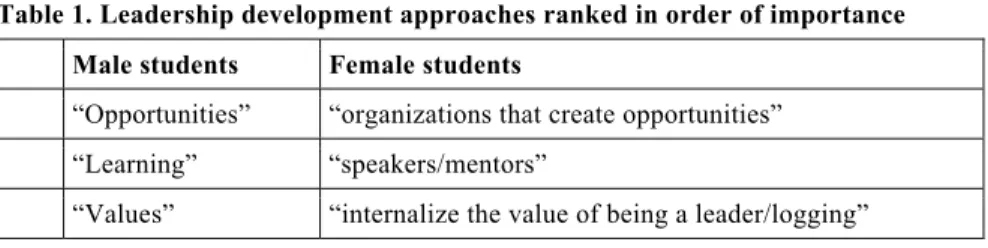
These two approaches to leadership development are both included in the recommendations of a focus group consisting of four male and four female graduate student leaders at the School of Global Policy and Strategy at the University of California, San Diego (GPS/UCSD) (Knight, 2017a,b). Their shared definition of leadership was: “Leadership is the ability to bring people together to achieve a common goal through effective communication.” In addition, they recommended the approaches to “leadership development” in Table 1.
Table 1. Leadership development approaches ranked in order of importance Male students Female students
“Opportunities” “organizations that create opportunities”
“Learning” “speakers/mentors”
“Values” “internalize the value of being a leader/logging”
From their responses above, the female students seem to be clarifying the terms of the male students.
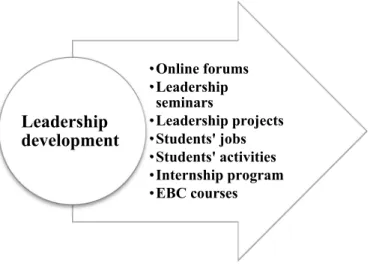
Knight (2015a) conceptualized the leadership development of his KUIS students
as having seven components. (See Figure 1.)
Figure 1. Knight’s conceptualization of leadership development (adapted from Knight, 2015a)
Figure 1 indicates that the seven components, which include the students’ activities on campus and off campus, contribute to the transformation of the students into leaders.
The conceptualization of leadership development in Figure 1 cannot be separated from Knight’s conceptualization of leadership “as an activity involving communication for the purpose of creation”:
Leadership [is] a communication process consisting of two parts: 1) communicating to create a vision and 2) communicating to achieve a vision (Knight, 2013).
• Online forums
• Leadership seminars
• Leadership projects
• Students' jobs
• Students' activities
• Internship program
• EBC courses
Leadership
development
Leadership is making real a vision in collaboration with others (Knight and Candlin, 2015, p. 36).
The conceptualizations of leadership above have their basis in Knight’s (2015a) research described in Knight and Candlin (2015):
[Narratives] concerning the leadership beliefs and communication
experiences of 20 leaders drawn from the fields of business, law,
government, medicine, sports, counseling, and academia were collected
through a process of semi-structured interviews (Grindsted, 2005) by
Skype (audio only), by telephone, and face to face. The responses of 15
of those leaders were subsequently shared with groups of Japanese
undergraduates who were taking part in organizational leadership
seminars as part of their English-medium International Business Career
(IBC) studies. Students added to the “archive” of such leadership
accounts via a Google Group (online forum). In the online forum, the
students posted their own responses to the questions, commented on the
interview responses of the leaders, and posted further responses from
Japanese leaders they themselves had personally selected and
interviewed. The data were then analyzed following Talmy’s precepts for
such research interviews, viewing them in terms of a social practice
(Talmy, 2011), which generated those personal narratives (Riessman,
2002) from the leaders that were then shared with the students. (p. 27)
In effect, Knight’s conceptualization of leadership was based on his study and teaching of leadership, his interactions with leaders in his research of leadership, and his experience of leadership (described in sub-section 4.3).
Knight’s perspective of leadership as a creative and communicative activity has influenced how he has framed the seven components of leadership development in Figure 1 in interactions with his students, as discussed in the sections below. In the next section, The Leadership Connection Project website is explored.
3.0 Exploring The Leadership Connection Project website
Scollon’s (2001) nexus of practice concept makes it possible to view the creation and implementation of the leadership development curriculum and The Leadership Connection Project website under investigation as ongoing action and from multiple perspectives; e.g., Critical Discourse Analysis (CDA), interactional sociolinguistics, and linguistic anthropology where discourse is viewed in terms of social power, mediated actions, and cultural patterns (Scollon and Scollon, 2004). In such an exploration, motivational relevancies (Sarangi & Candlin, 2001) should be illuminated.
Accordingly, such motivational relevancies are clarified in the light of the introduction to The Leadership Connection Project website (which was launched in January 2016):
The Leadership Connection Project website was created for the purpose of
recording the various leadership development activities that I have conducted
with my students in the Career Education Center and in the Department of
International Communication (International Business Career major) at Kanda
University of International Studies (KUIS) in Chiba, Japan. In addition, I have
added information about (and links to) the ESP (English for Specific Purposes)
Project Leader Profiles that I initiated in TESOL International Association as
an ESP blogger. Currently, I am also working with Dr. Jo Mynard, director of the Self-Access Learning Center (SALC) at KUIS, to provide leadership development opportunities for students in the KUIS SALC.
The extract indicates that the website was created as a means to provide for stakeholders a public record of Knight’s curriculum development activities. Such stakeholders would include the administrators and faculty of KUIS.
In connection with the stakeholders, Knight (2017c) writes, “In our profession, it is important to share accomplishments with stakeholders so on the website I have identified the departments of my university together with the relevant programs.” The front page of the website therefore serves as a promotional vehicle (similar to a cover letter for a CV or resume) to introduce Knight’s “leadership development activities and research publications”:
My aim has been to give my students and colleagues the opportunity to explore
“leadership” through leadership-related research and activities. I conceptualize
leadership to be a “creative” activity that involves: 1) “communicating to create
visions” and 2) “communicating to achieve visions.” Click on the links below to
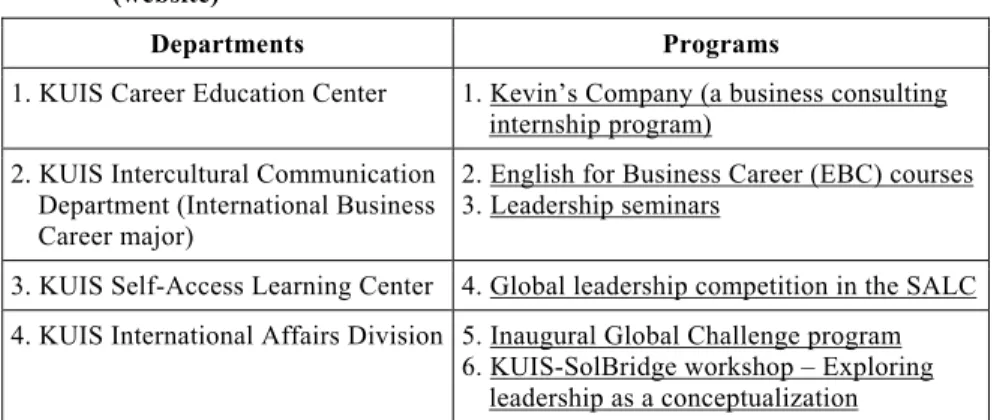
learn more about the activities and research publications. [See Table 2.]
Table 2. Leadership development programs on The Leadership Connection Project (website)
Departments Programs
1. KUIS Career Education Center 1. Kevin’s Company (a business consulting internship program)
2. KUIS Intercultural Communication Department (International Business Career major)
2. English for Business Career (EBC) courses 3. Leadership seminars
3. KUIS Self-Access Learning Center 4. Global leadership competition in the SALC 4. KUIS International Affairs Division 5. Inaugural Global Challenge program
6. KUIS-SolBridge workshop – Exploring leadership as a conceptualization
The programs in Table 2 are listed in time order; i.e., the time when the program was created and implemented. In the next section, how leadership development is conceptualized in each of the programs is illuminated in view of Figure 1 (i.e., Knight’s conceptualization of leadership development).
4.0 Curriculum development at KUIS
Knight (2014a) provides an account of course development at KUIS. In the account, five components from Figure 1 are described in the order that they were created: 1) an internship program, 2) EBC courses, and 3) leadership seminars (which include 4) online forums and 5) leadership projects).
Table 3 (which is based on Figure 1) reflects and expands upon Table 2 (which is
based on The Leadership Connection Project website) by outlining the course content
and stating why the courses were created.
Table 3. Courses created by Knight at KUIS
Order of creation Reason for creation Description 1. Kevin’s Company
(a business consulting internship program)
To give the internship participants the opportunity to experience a company in a high-level role
One-year business internship program in a simulated company (titled Kevin’s Company) in which the participants act as business consultants for British Hills in Fukushima prefecture and propose change
2. English for Business Career (EBC) courses
To give IBC students business knowledge and communication skills that match increasingly higher- level leadership roles in a business organization
15-week English for Business Career courses:
EBC 1 (employee), EBC 2 (manager), EBC 3 (president), EBC 4 (business founder) 3. Leadership seminars To give IBC students the
opportunity to research leadership, experience leadership, and communicate effectively their leadership experiences
Two-year leadership seminars for 2
ndand 3
rdyear IBC students (which include online discussion forums and leadership projects)
Each of the courses in Table 3 is considered in more detail in the sub-sections below.
4.1 Internship program
Table 3 includes an internship program created by Knight. That internship
program evolved to create opportunities to interact more closely with leaders in KUIS
and at BH, which are both organizations of the Sano Educational Foundation. (See
Knight, 2010, 2012a.) For example, after interacting with BH administrators through
In contrast, the internship program component in Figure 1 extends beyond the simulated business consulting company internship in Table 3 to include short-term and long-term internships that the students experience in Japan and overseas. For example, in 2017, one student started to work for the Government of Japan in Hebron for two years as an intern, and he had already completed internships in Vietnam and the Republic of South Africa. Such internship programs provide students with big and small leadership opportunities. A small leadership opportunity was presented to another student when she was given the responsibility to create a Japanese menu for the employees and students of a language institution in Cebu in the Philippines. Internships can be obtained by the students independently or with the help of the KUIS Career Education Center. Further, through the KUIS Career Education Center, the simulated business consulting company internship in Table 3 was offered to all KUIS students.
4.2 EBC courses
In the EBC courses, the students develop various business and English communication skills. In EBC 1, the students, who act primarily in the role of an employee, focus on how to use English language communication to positively influence interviewers, supervisors, colleagues, and subordinates in the workplace. In EBC 2, as recorded in Knight (2011a, 2012b), business case studies are used to teach students to identify business problems and to present solutions to those problems in the role of a manager.
In EBC 3, the students, in the role of leader of their organization, learn by means of a
computerized business simulation to make business decisions and to understand the
financial statements showing the results of those decisions (Knight, 2011b). In EBC 4,
the students act as business founders to propose their business ideas after learning about
crowd funding and creating business plans (Knight, 2015b, 2016a).
The activities in the EBC courses are also framed in alignment with Knight’s conceptualization of leadership. In EBC 1, behavioral questions in job interviews are framed as questions that ask about leadership experiences (e.g., “Tell me about a situation in which you used teamwork to solve a problem,” Knight, 2014b). Similarly, in EBC 2, the business case studies are presented in terms of a problem for which the students must come up with a vision of how the problem can be solved. In EBC 3, the decisions that the students make in leading their companies (e.g., pricing of services, advertising and promotion expenditures, maintenance level, employee training and payment, and acquisition of aircraft) are framed as actions to create a profitable company (i.e., the vision). In EBC 4, the students’ presentations include the students’
visions of businesses to be created, based on their business plans.
4.3 Leadership seminars
The activities in the leadership seminars are designed so that the students can do
the following: 1) learn about leadership from leaders, 2) experience leadership as teams
and individuals, 3) communicate effectively as leaders, 4) reflect on leadership, and 5)
share their leadership stories (Knight, 2014a, 2015a; Knight & Candlin, 2015). First,
learning about leadership from other leaders includes 1) giving presentations about the
leadership styles of famous leaders and 2) interviewing leaders to obtain their
definitions of leadership and their leadership communication success stories. Second,
experiencing leadership means to be involved in creating and achieving projects. The
students initially work together in teams. Then the students need to work as individuals
to propose their own project ideas, build a team, etc. Third, communicating effectively
as leaders refers to the study of framing as the language of leadership (Fairhurst, 2011).
In class, the students also engage in reflective discussions about leadership and tell their leadership stories in mock job/internship interviews. Such leadership stories reflect the students’ experiences in their part-time jobs and in their club activities. For example, off campus, some of the students are involved in training new staff where they work. On campus, some of the students are leaders of the university clubs to which they belong such as the Japanese archery club.
In effect, the creation and implementation of the curriculum enabled Knight to see or hear about (in the classroom) all of the leadership development components in Figure 1. The modification of the curriculum and the teaching of the curriculum in Table 3 have been influenced by Knight’s personal conceptualization of leadership. For example, in the leadership seminars, project leadership is framed as a creative activity in which the students must create the “vision” that they want to achieve “in collaboration with others.” Further, they must obtain stakeholder support for that vision through their “communication to create the vision” (e.g., discussion and modification of a proposal) and “communication to achieve the vision” (e.g., delegating tasks, promoting participation, and so on).
In addition, the students are required to create and achieve projects that no one else in the history of KUIS has ever done before. One of the reasons for this requirement of “originality” is Knight’s project leadership activities in the English for Specific Purposes Interest Section (ESPIS) in TESOL International Association. Such project leadership activities include the creation of the 2011-2012 ESPIS online discussions (“including a one-month discussion with leaders from the TESOL ESPIS and the IATEFL ESP SIG about ESP that is 261 pages and 65,707 words in length,”
Knight, 2016b) and the ESP Project Leader Profiles, which are published on the blog
of TESOL International Association (http://blog.tesol.org/) and feature more than 35
ESP project leaders to date with projects on six continents (Knight, 2017d).
4.4 Part-time jobs, club activities, and internships
The leadership roles in the students’ part-time jobs, club activities, and internships are also framed as involving activities to create and achieve specific visions. For example, a part-time worker in a gym explained how she took action to improve customer service and the treatment of part-time workers (i.e., the goal or vision). In an internship overseas, one student explained how she had gained the trust of experienced and older hotel cleaning staff so that they listened to her when she explained the service Japanese guests expect in a hotel. In a club activity, a successful performance in a school festival may be framed as a vision in the case of the leader of a belly dancing team.
Viewed in the light of Knight’s personal conceptualization of leadership, all of the components in Figure 7 may be seen as developing the students’ skills to create and to achieve visions. In the next section of this paper, the programs on The Leadership Connection Project website that are related to the KUIS SALC and the KUIS International Affairs division are explored as student consulting activities.
5.0 The relevance of student consulting activities
1Carnegie & Associates, Levine, & Crom (1995) write about the importance of leaders’ questions:
Leaders ask:
•
Where is this work team heading?
•
What does this division stand for?
•
Who are we trying to serve?
The specific answers will be as different as the people being led, as different as the leaders themselves. What’s most important is that the questions are asked.
(p. 20)
In addition to leaders, consultants can create visions by asking questions.
Accordingly, in view of section 2 of this article, consultants take on leadership roles of creating visions when they ask questions that point to solutions (e.g., Peter Drucker), or when they present those solutions to their clients.
Knight’s leadership development programs are often connected to consulting. For such consulting activities, there may be a need for ESP training. The six programs in Table 2 include four programs with consulting activities:
1
.Kevin’s Company 2
.Leadership seminars
3
.Global leadership competition in the SALC 4
.Inaugural Global Challenge program
The consulting activities typically involve students working in teams to create visions for organizations (i.e., the clients) through the following:
interacting (through email and/or face to face) with leaders of the organizations
conducting research about the organizations online and onsite
identifying strengths, weaknesses, opportunities, and threats, etc.
delivering recommendations (to the leaders of the organizations) in PowerPoint
presentations
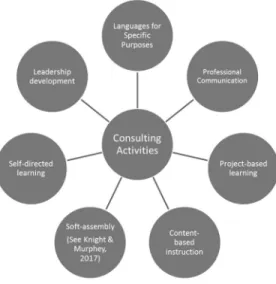
Such activities are related to the development of leaders when leadership is conceptualized as involving communication to create and to achieve visions (Knight, 2013). In effect, the students are creating visions when they deliver their recommendations in PowerPoint presentations. In addition, in Knight’s teaching and research, consulting activities have been connected with the various fields in Figure 2 (adapted from Knight, 2017b).
Figure 2. Consulting activity connections
At the top of Figure 2 appears “LSP” because the students can use both English and
Japanese in their consulting activities. The following sub-section of this article includes
5.1 ESP strands in the consulting programs
The ESP strands in a consulting program are connected with the students’ needs for English as a communication tool in their roles as consultants. For example, the students may need to do the following in English:
conduct research online
conduct research onsite (and accordingly participate in interviews, meetings, discussions, etc.)
write email to various stakeholders (including leaders of the organizations as well as mentors/coaches)
create and deliver presentations
The needs above to use English as a communication tool are immediate needs.
In connection with such immediate needs for communication in English, the students may need to learn specific content. The content is related to the consulting project.
Consider the following examples:
1
.In Kevin’s Company, the students recommend how to improve the business operations of British Hills, a leisure and educational training facility in Japan.
2. In the leadership seminars and in the Global Leadership Competition in the SALC, the students provide consulting services for the KUIS SALC.
3. In the Global Challenge program, the students needed to understand the food
industry in Japan and the business operations of the stores of a food company.
The teacher may not be an expert of such content but may be able to teach the students how to find what they need on their own (i.e., self-access learning). In some cases, the students may have content available in Japanese and need to learn how to communicate the Japanese content in the English language.
5.2 Consulting programs in the KUIS SALC
Knight (2017b) proposes six consulting programs for the KUIS SALC. The first program is the Global Leadership Competition in the KUIS SALC. (See Figure 3, which is adapted from Knight 2017b.)
Figure 3. The global leadership competition in the KUIS SALC KUIS SALC
Student Consulting Teams 1, 2, 3
Coach/Advisorin Overseas SALC 1 and Foreign students abroad
Coach/Advisor in Overseas SALC 3 and Foreign students
abroad Coach/Advisor
in Overseas SALC 2 and Foreign students abroad
KUIS students in Japan will compete in teams.
SALC experts overseas will be team mentors/coaches.
The teams will investigate the SALC (online and onsite through multiple research methods).
The teams will provide competitive presentations about how to improve the SALC.