79
Table 1 Preparation condition of samples
CTAB P123
C1 1.2 0
C2 2.4 0
C3 4.8 0
P3 0 4.8
C1P2 0.4 0.8
C1P1 0.6 0.6
C2P1 0.8 0.4
Surfactant (mass%) RF solution
sample Molar
ratio of Molar ratio of
0.5 50
Effect of surfactant addition on the synthesis of spherical carbon particles by sol-gel method
Kazuo Fukuda1, Hideki Sano2, Guo-Bin Zheng2* and Yasuo Uchiyama2
1Graduate School of Science and Technology,
2Department of Materials Science and Engineering, Faculty of Engineering,
Nagasaki University, 1-14 Bunkyo-machi, Nagasaki 852-8521, Japan
*Tel: +81-95-819-2657, Fax: +81-95-819-2656, E-mail: [email protected]
Introduction
Carbon aerogels(CAs), which were prepared from the sol–gel polymerization of resorcinol (R) and formaldehyde (F) and subsequent carbonization, possess high surface area, large pore volume. Therefore, they are promising in applications such as electrodes for supercapacitors, advanced catalyst supports and adsorbents for gas. By addition of surfactant in the precursor solution of the sol-gel process, spherical carbon particles can be synthesized. It is believed that the surfactant could be absorbed on the surface of RF particles and prevent shrinkage during drying. In this report, different surfactants including cation, anion and non-ionic surfactants were used in the synthesis of RF particles. The effect of the surfactant on the pore structure and electrochemical characteristics of carbons was investigated.
Experimental
RF solutions were prepared from resorcinol (R), formaldehyde (F), surfactant and sodium carbonate, which acts as a catalyst. The solutions were sealed in a flask and kept at 85 ± 3°C for 2 hours, while stirring. The RF gels were held at 85 °C for 24 h. The carbon particles were formed by carbonization of the dried gel in nitrogen at 900-1000°C for 1 h, with
heating and cooling rates of 5°C/min. The surfactants used in this work were glycol non-ionic P123 and cetyltrimethylammonium
bromide (cationic CTAB), respectively. The composition of precursor solution is listed in Table 1. The morphology of the carbon particles was
observed using field emission scanning electron microscopy (FE-SEM).Galvanostatic
Nagasaki Symposium on Nano-Dynamics 2010
P 38
80
Fig. 2 Specific capacitances of carbon particle electrodes with different current in 1M H2SO4 .
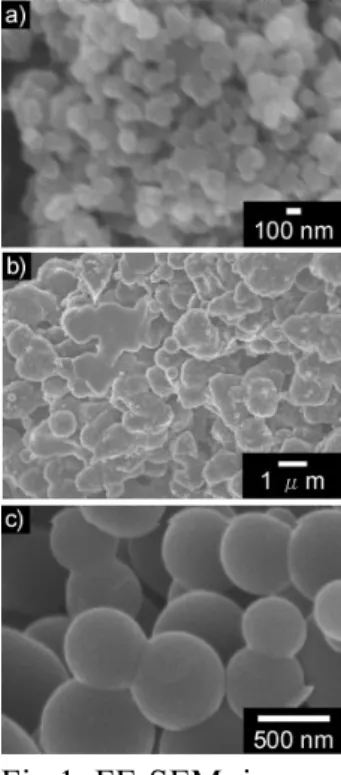
Fig.1 FE-SEM images of the samples a) C1, b) P3 and c) C1P1.
charge/discharge behavior was performed under the constant current of 2-20 mA by a cell test system.
Results and Discussion
Fig.1 showed FE-SEM images of a) C1, b) P3 and c) C1P1. It is estimated that spherical carbon particles of C1, P3 and C1P1 have the average sizes of 131±27 nm, 398±211 nm and 476±86 nm, respectively. When different types of the surfactants were compared, the mean particle size of the sample that added only CTAB was 100-230 nm, which was the smallest and the most narrowly distributed in size. It is thought that this is attributed to micelle formation in the RF solution by the addition of cationic surfactant (CTAB). As for the samples with mixing CTAB and P123, the average particle size is much larger than those obtained with only CTAB.
Fig.2 showed specific capacitances of CAs (C1,C2,C3 P3,C1P1,C1P2,C2C1). Specific capacitances of C1, 72 F/g in current of 2 mA, is the highest value in all the samples (C1, C2, P3, C1P1, C1P2, C1P2). The value of specific capacitance decreased with increasing sweeping rate.
Conclusion
The average particle size of the carbon particles with cation surfactant CTAB was small, and the value of the capacitance was high. Addition of P123 resulted in much larger particles and low capacitance.
Reference
1. Jianhua Zhou, Yajun Ji, Jianping He, Chuanxiang Zhang, Guiwang Zhao Microporous and Mesoporous Materials 2008, vol. 114, pp. 424-430