36 article *1 *2 *3 *4 *1 *2 *3 *4
Tatsuya ARAI *1, Kaname TAJIRI*2, Kazushi MORIYA *3 , Souta KIMURA *4 *1 Graduate Student, Graduate School of Technologists, Institute of Technologists
*2 Dept. of Building Technologists, Institute of Technologists *3 Part-time lecturer ,Institute of Technologists
*4 Saitama Prefectural Izumi High School Environment and Construction Department
Abstract In recent years, many local cities have operated an administratively-led community bus, which is
one of the means of transportation for residents, but it is difficult to operate public transport that accurately captures regional characteristics and residents' usage intentions, etc. There are not a few areas in which service levels are reduced and services are being run by the reduction of users. In Nagatoro Town, Chichibu-gun, Saitama Prefecture, residents, especially vulnerable people such as elderly people who can not drive a car, have difficulty moving because there is no public transport service such as a community bus that operates the town.
In this study, in order to explore the optimum operation mode of public transport service in Nagatoro Town with the above problems, not only the request on the operation mode of the local residents but also the availability of public transport considering the characteristics of daily travel and The purpose is to grasp the potential travel demand and to conduct a basic study on the ideal operation mode of public transport service.
Key Words : Planning city, Public transportation services, Movement characteristics of residents, 19
37
The Bulletin of Institute of Technologists, No. 9
2) 3) 4) 5) 29 35.1 29 2018 Table1
Table1 Overview of the survey
5 Fig1
6 3
Fig1 Main purposes of transportation in Nagatoro
Fig2
65 6
3
Fig2 Respondent's age group
Fig3
2 1
38
Fig3 The occupation of the respondent
Fig4 8
5 6 6
1 2
Fig4 Relationship between means of transport ation and frequency of movement
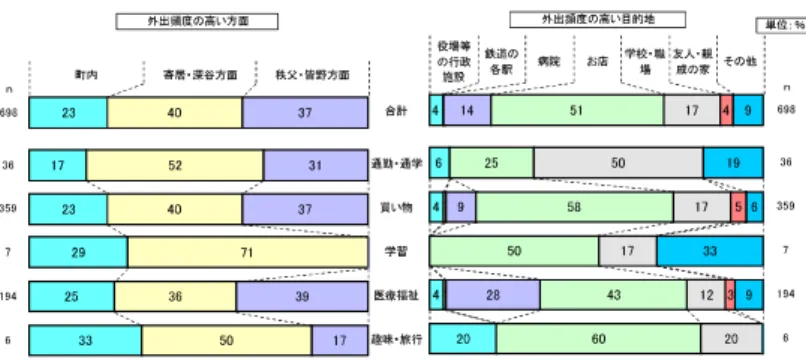
Fig5 8
Fig5 Frequently going out and where to go
Fig6
Fig6 The relationship between the purpose of movement and the alternative means of transportation
39
The Bulletin of Institute of Technologists, No. 9
3
Fig7 The relationship between the intention to use and the return of a driver's license
Fig8 7
2
Fig8 Request for public transportation routes
Fig9
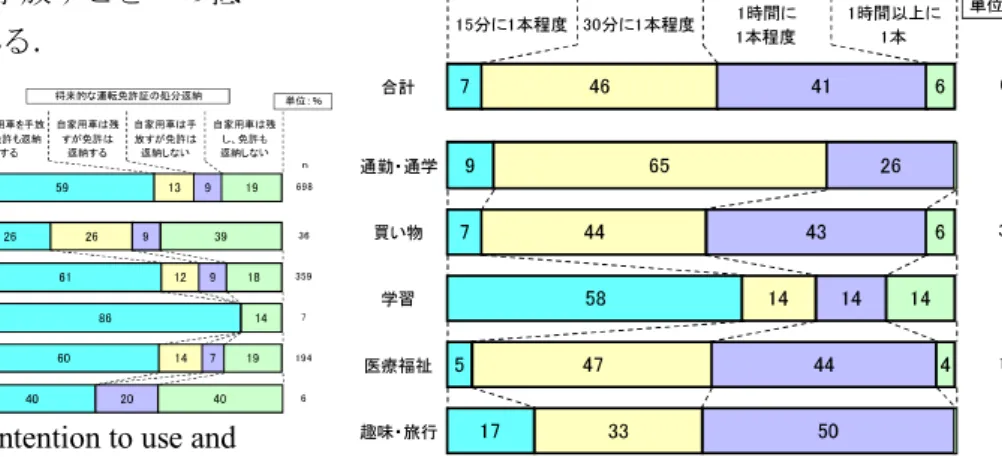
1 1
4
Fig9 Request for service schedule
Fig10 200
Fig10 Requests for fares and reasons for setting fares
Fig11
40
Fig11 Relationship between movement purpose and management burden
Table2
Table2 Mobility Characteristics and Demand for Public Transportation
Fig12
41
The Bulletin of Institute of Technologists, No. 9
30 1 1
Table3