A CROSS‑CULTURAL STUDY OF
SELF‑DISCLOSURE:
THE ETHNIC CHINESE OF SOUTHEAST
ASIA AND THE JAPANESE
Yukio Tsuda
Purpose
This paper conducts a cross‑cultural investigation of the relationship between ethnicityL and self‑disclosing behavior. That is to say, the question being asked is
N
whether a person's self‑disclosing behavior is affected by his'/'her ethpicity. Will different ethnic groups have significantly different self‑disclosure patterns ? To answer these questions, the two ethnic groups in Asia will be examined : the ethnic Japanese of Japan and the ethnic Chinese of Southeast Asia.
The Jourard Self‑Disclosure Questionnaire (JSDQ) serves as a main instrument to collect the data. The subjects were chosen at random from these two ethnic groups of people who were enrolled as undergraduate students at Southern illinois University in 1983. The collected data will be quantified and put to a statistical analysis. One way analysis of variance will be utilized to determine statistically significant differences concern‑
ing self‑disclosure between the two ethnic groups.
Significance of Research Problem
The significance of this study is twofold. First, it is significant that the two ethnicities in the Eastern culture are selected for this study. There have been only a few studies on self‑disclosure which dealt with cultural groups in the East. One study (Barnlund, 1974) examined the Japanese in comparison with the Americans (U.S.A.), and another (Melikian, 1962) investigated different ethnic groups in the Middle East. Past cross‑cultural research on self‑disclosure seems to have placed too much emphasis on the nationalities in the Western culture such as the American, the British, the German, etc.
If cross‑cultural studies are to contribute to the promotion of intercultural understanding, they ought to pay sufficient attention to the Eastern culture as well.
Another significance of this study lies in the fact that it attempts to address the
144
problem in terms of ethnicities, and not in terms of nationalities. Most of the past cross‑cultural studies .of self‑disclosure were so careless as to use the names of the nationalities without distinguishing them from the names of ethnic groups, despite the fact that many nations have a number of ethnic groups. For example, nobody can be sure if it is Anglo‑American, black‑American, or Spanish‑American, etc. ・just from the title
"American." More specific reference to ethnicity in the cross‑cultural research is preferable in order to develop more accurate understanding of cultural differences.
Review of Literature
a. Relevant theoretical literature
The theoretical development of self‑disclosure research has been made by the experts in psychoanalysis, clinical psychology, and social psychology. Initially, the experts"studied self‑disclosing behavior in relation to mental health. ̀
Psychoanalysts emphasize the importance of self‑disclosure in treating the neurotics. They base their argument on Freud's notion that neurosis is incurred by repression, and use self‑disclosure by the patient as "the primary method for uncovering repressed thoughts, feelings, and desire" ( Chaikin and Derlega, 1974, p. 3).
Clinical psychologists emphasize the importance of self‑disclosure for the maintenance of mental health. However, unlike the deterministic orientation of psychoanalysis, clinical psychologists such as Carl Rogers, Abraham Maslow, Rollo May, and Sidney Jourard look at self‑disclosure from a more humanistic orientation. They believe that the self‑disclosure to significant others in a person's life is important.
Particularly, Jourard stresses the need to disclose 'the complete personal information.
He believes a person's personal growth or development of his l her unique potential would be hindered whenever s/he tries to hide the "real" self from others. He says,
When a person has been able to disclose himself utterly to
another person, he learns how to increase his contact with his real self, and he may then be better able to direct his destiny on the basis of this knowledge (Jourard, 1971, p. 6).
As an extension of these humanistic psychologists, the ideas that encourage openness and a fuller self‑disclosure, theso‑called "encounter group" and "experiential group"
blossomed in the 1960's and 70's.
In opposition to humanistic psychology, there have been some critics who pointed out some possible negative consequences of overdisclosure. Koch believes that:
adherence to the idea of total transparency eliminates important qualities
of humanity, including the charm of certain forms of reticence: the grace of certain kinds of containedness...the communicative richness of certain forms of understatement, allusiveness, implicativeness...and modesty (Chaikin and Derlega, 1974, p.4).
Some people point out that an overdiscloser would be considered to be suspicious, strange or maladjusted, and may well be avoided by others. Luft, in an effort to reconcile the conflict between overdisclosure and underdisclosure, has brought Up the notion of appropriateness of self‑disclosure. He believes that appropriate self‑disclosure is regulated and determined by norms or rules of behavior within a culture or subculture. That is to say, appropriate self‑disclosure is culture‑specific, because "appropriate disclosure is disclosure which the members‑ of the discloser's subculture approve and think of as desirable, or at least not undesirable. Inappropriate disclosure is disclosure which others disapprove" (Chaikin and Derlega, 1974, p. 7). This notion clearly suggests a very strong influence of cultural norms and values upon the individual's self‑disclosing behavior.
Moreover, Luft describes the positive effect of appropriate openness and self‑disclosure by proposing the model called the Johari Window (See Figure 1). The Johari Window is a two‑by‑two matrix model which describes the structure of the self in intrapersonal and interpersonal domains.
Known to self Unknown to self
Known to others
Unknown to others
open blind
hidden unknown
Figure l. The Johari Window
Luft's idea about self‑dosclosure basically supports Jourard's contention that a full disclosure is beneficial to personal growth, even though Luft stresses the importahce of appropriateness of self‑disclosure which is culturally acceptable.
Some social psychologists look at self‑disclosure in telation to social relationships.
Social exchange theory, social penetration theory, and incremental exchange theory point
out the development of social relationships in terms of cost and benefit (Chaikin and
Derlega, 1974, pp. 12‑‑13). These theories suggest that people behave in a profit‑oriented manner in a social situation, always trying to increase the rewards while .trying to decrease the costs. Therefore, self‑disclosure takes place mutually in an in‑
terpersonal situation if both persons think the progress of a particular relationship is beneficial to them. .
Lewin looks at self‑disclosure by referring to cultural differences in social distance. He describes the public and private domains of a person's self by usipg two circles as below.
public self private self
self
Figure 2. Public and Private Self
The area between the outer and inner circles represents the social interaction a person has with others. The central area represents the personal domain that a person will not disclose to others. Lewin theorizes that the Americans (U.S.A.) have a larger area between the outer and inner circles than the Germans do, suggesting that Americans disclose about themselves more than the Germans.
b. Relevant research findings
In the past two decades, there have been a number of empirical studies of self‑disclosure in connection with race, ‑nationality, and ethnic groups. The ,American (U.S.A.) college coeds were discovered to self‑disclose more than the British (the United Kingdom) counterparts (Jourard, 1961). American (U.S.A.) males and females were more selfTdisclosing than German (Federal Republic) counterparts (Plog, 1965).
Anglo‑Americans (U.S.A.) disclosed more than Hispanics in the U.S.A., and Anglo‑American females were found to disclose most (Levine and Franco, 1981).
Americans (U.S.A.) disclosed more than the Puerto Ricans of Puerto Rico (Jourard, 1971,
p. 233.). Of black, white, and Mexican‑American adolescents in the U.S.A., white
American females disclosed most, while Mexican‑Americans least disclosed about
themselves (Littlefield, 1974). A study on the relationship between self‑disclosure and
SELF‑DISCLOSURE:・ ‑ ‑ 147
attitude toward psychotherapy icevealed that high self‑disclosure was related to positive attitudes toward psychotherapy for Americans (U.S.A.), but not for the British (U.K.) (Todd and Shapina, 1974). Among the.nine different Middle Eastern ethnic groups, there was no significant difference in self‑disclosing behavior, but the ethnicity was found to affect whom one is inclined to disclose more to (Melikian, 1962). A cross‑cultural study of Japanese in Japan and Americans (U.S.A.) living in Japan with regard to verbal and physical self‑disclosure revealed that Americans self‑disclosed more in both terms than the Japanese (Barnlund, 1974). Black males and females in the U.S.A. disclosed less than white males and females. Females disclosed more than males in each ethnic group. Young unmarried people, both white and black, disclosed most to mother, while married people disclosed most to spouses. People varied the amount of self‑disclosure according to different topics: high disclosure in attitudes and opinions, tastes and interests, and work, and low disclosure about money, personality and body (Jourard and Lasakow, 1958). From this, it is believed that marriage, race, ethnicity, sex, target‑
person, and topics are the variables that will affect self‑disclosing behavior.
It would be very interesting to note that all the studies cited above reported that the Americans of the U.S.A. disclose more than all other cultural groups investigated.
Jourard says, "It may well be true that Americans talk more about themselves to others than just about any other cultural group" (Jourard, 1971, p. 233). The results suggest the.
relationship between the characteristics of the American society such as multiethnicity and cultural diversity, and a high degree of self‑disclosure.
Hypotheses
a. Conceptual and operational definitions a.1 Conceptual definition
Self‑disclosure: one's verbal act of giving the personal information concerning oneself to the other.
Usually, the definitions given by humanistic psychologists include "willingness to disclose" or "tell something that is hidden," because they relate self‑disclosure to mental health. Since this study is not interested in this particular aspect of self‑disclosure, the conceptual definition of self‑disclosure has been developed without a particularly p6sitive value on self‑disclosure.
The conceptual definition of ethnicity is as follows:
ethnic (ity): relating to cpmmunity of physical and mental traits possessed by the
members of a group as a product of their common heredity and cultural tradition
148
(Webster's Third New International Dictionary, 1971, p.781).
a.2 Operational definition
'
self‑disclosure: a person's individual score on the Jourard Self‑Disclosure Ques‑
'
tionnaire (1961) which asks 25 items concerning the person's self‑disclosure behavior.
ethnicity: 1. ethnic‑Japanese of Japan
2. ethnic‑Chinese of Southeast Asian nations a.3 Independent and dependent variables
independent variable: ethnicity dependent variable: self‑disclosure
b. hypotheses: the present study attempts to test the following two hypotheses.
1. There will be significant differences in the amount of self‑disclosure between the ethnic Japanese of Japan and the ethnic Chinese of Southeast Asian
2. The ethnic Chinese of Southeast Asian nations will self‑disclose significantly more than the ethnic‑Japanese of Japan.
Rationale for H!YPothesis 1
As Luft says, "appropriateness" of self‑disclosure is determined by norms or rules of behavior within a culture. It is assumed that the Japanese culture has its own set of values and norms that are different from those of the ethnic‑Chinese culture. These differences will lead to differences in communication behavior such as self‑disclosure.
That is to say, the'Japanese will likely produce cukurally desirable and appropriate self‑disclosure, while the ethnic‑Chinese will also conform to the appropriate self‑disclosure behavior desired in the cultures they belong to.
Rationale for H3yPothesis2 ,
Hall (1977) looked at the underlying structure of culture in terms of high or low context. He said, "the level of context determines everything about the nature of communication"(p.92). Cultures that engage in high‑context commumcation‑‑
"communication in which most of the information is either in the physical context or internalized in the person, while very little is in the coded, explicit, transmitted part of the
message" (p. 91).‑‑‑ are cultures such as China, Japan, Korea andVietnam. In other words, in high‑context communication less language is required to have communication.
In contrast, cultures engaging in a low‑context communication where "the mass of the
f
information is vested in the explicit code" (p. 91) are "complex, multi‑institutional cultures" (p.91) such as the United States, Germany, and Scandinavian nations. In other words, more language interaction is required in low‑context communication. Hall (1977) also says, "the level of context‑‑‑is the foundation on which all subsequent behavior rests" (p. 92). Therefore, it would be possible to assume that in high‑context cultures such as Japan and China, less language interaction and less disclosure are nurtured and encouraged, while in low‑context cultures such as the United States and Germany, more disclosure is desired. Then, why did a past research (Plog, 1965) indicate that the Americans disclosed significantly more than the Germans even though both cultures are low‑context? The reason for this can be attributed to historical and socio‑cultural differences between the two cultures. The United States can be
characterized by high mobility, cultural multiplicity, and multiethnicity in the society.
Packard suggests that high mobility in the U.S. has "a profound effect on human inter‑
action" (Chaikin and Derlega, 1974, p. 30), because it has brought about a dramatic increase in the number of people Americans meet. It seems that because of this socio‑cultural change, speaking more has become a part of American way of life. The same argument can be applied to the ethnic‑Chinese of Southeast Asia and the Japanese.
Culturally, these two groups have a great deal in common, but in terms of historical and socio‑cultural experience, the ethnic‑Chinese of Southeast Asia, who immigrated into this L
area many centuries ago and interacted with various ethnic groups (low‑context experience), have nurtured more cultural diversity and heterogeneity, than the Japanese.
So it can be assumed that the ethnic Chinese are more toward low‑context culture, while the Japanese, who have had little cultural or ethnic multiplicity or interethnic con‑
tact, maintains its high‑context characteristic.
Methodology a. Measurement
Jourard first created a self‑disclosure questionnaire in 1958 in collaboration with his colleague Lasakow. The questionnaire includes 60 items with each 10 items belong‑
'
ing to different content areas ranging from attitudes and opinions, tastes and interests,
'
work (or studies), money, personality, to the body. In this questionnaire subjects answer
each item by indicating the degree to which they have revealed information about
themselves to four target persons: mother, father, best opposite‑sex friend, and best
same‑ sex friend. Each,,item is scored as O, i.e., no disclosure, 1, i.e., disclosure in general
terms, or 2, i.e., full and complete disclosure. This is what is usually called Jourard's
150
Self‑Disclosure Questionnaire ot JSDQ. Later, Jourard modified the JSDQ by adding
̀spouse' to target persons and also widened the rating scale by introducing "X" as "lie or misrepresenting of self" (Jourard, 1971, p. 216), He also used a 25‑item questionnaire for one of his studies (Jourard, 1961). Barnlund and Littlefield revised JSDQ for their researches mainly by reducing the number of items in the questionnaire, but used basically thesamestructure(Barnlund,1974; Littlefield,1974). Evidently,theJSDQisthemostwidely used questionnaire for self‑disclosure research. However, the validity of the JSDQ was put into question by some experts. Cozby cited several studies that reported a lack of relationship between the JSDQ and actual disclosure (Cozby, 1973). Its predictive validi‑
ty was called into question because it can be argued that in answering the JSDQ, the sub‑
jects may be disclosing to the experimenters instead of disclosing to certain target per‑
sons. While the validity of the JSDQ needs to be further examined in the future research,
"The JSDQ may be best interpreted as a measure of past history of disclosure. Some evidence of the subject's present disposition to disclose may be inferred from the subject's reports of disclosure" (Cozby, 1973, p. 80).
Despite some skepticism about validity of the JSDQ presented in the literature, the JSDQ is going to be used for this study because it still is capable of deriving a person's self‑report on and disposition with regard to self‑disclosure, which I believe suffices for the purpose of this study.
Report on a Pilot Study
Based on the research framework I have established above, I conducted a pilot study in April, 1983 at Southern Illinois University at Carbondale, Illinois, U.S.A. The procedure for data collection and the results have been summarized as follows:
Procedure
a. Subjects:the subjects were all undergraduate students enrolled at Southern Illinois
University at Carbondale, Illinois, U.S.A, A total of 20 subjects answered
the questionnaire. The subjects consisted of 10 individuals from each
ethnic group, i.e., 5 males and females in each group. The ethnic‑Chinese
subjects were from Southeast Asian nations such as Malaysia, Singapore
. and Hong Kong. The subjects were all unmarried, and the mean ages and
age range of each group are as follows:
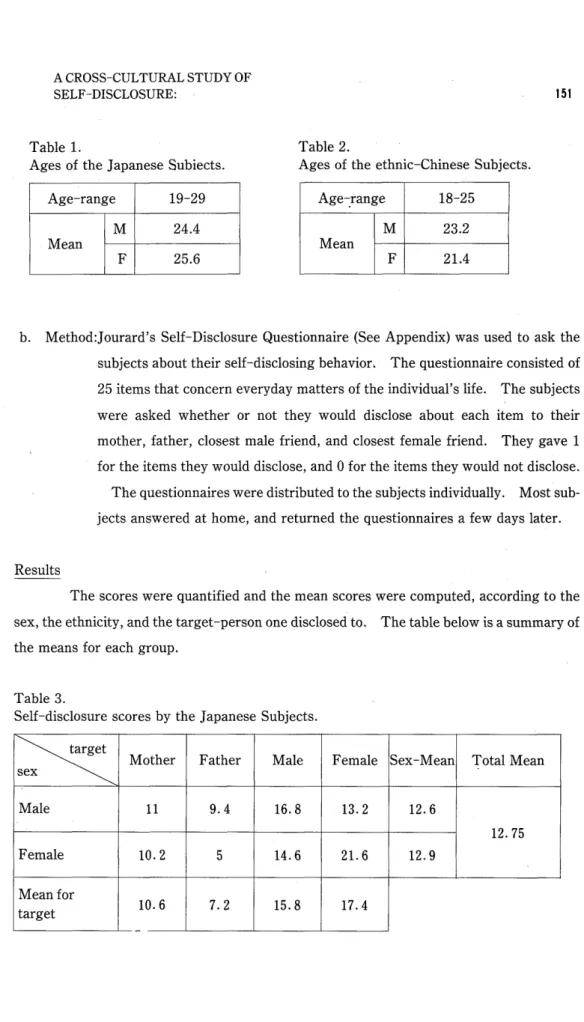
Table 1.
Ages of the Japanese Subiects.
Age‑range 19‑29
M 24.4
Mean F 25.6
Table 2.
Ages of the ethnic‑Chinese Subjects.
Age‑range. 18‑25
M 23.2
Mean F 21.4
b. Method:Jourard's Self‑Disclosure Questionnaire (See Appendix) was used to ask the subjects about their self‑disclosing behavior, The questionnaire consisted of 25 items that concern everyday matters of the individual's life. The subjects were asked whether or not they would disclose about each item to their mother, father, closest male friend, and closest female friend. They gave 1 x for the items they would disclose, and O for the items they would not disclose.
Thequestionnairesweredistributedtothesubjectsindividually. Mostsub‑
jects answered at home, and returned the questionnaires a few days later.
Results
The scores were quantified and the mean scores were computed, according to the sex, the ethnicity, and the target‑person one disclosed to. The table below is a summary of the means for each group.
Table 3.
Self‑disclosure scores by the Japanese Subjects.
target
sex Mother Father Male・ Female Sex‑Mean
TotalMean'Male 11 9.4 16.8 13.2 12.6
Female 10.2 5 14.6 21.6 12.9
12.75
Meanfor
target 10.6 7.2 15.8 17.4
‑
152
Table 4.
Self‑disclosure scores by the ethnic‑Chinese of Southeast Asia target
sex Mother Father Male Female Sex‑Mean 'TotalMean
Male 14.6 14.6 19.8 15.2 16,05
Female 10 7.8 13.6 17.4 12.2
14.25
Meanfor
target 12.3 16.7 16.3
The numbers in each box of tables 3 and 4 are the numbers of the items the subjects would disclose. For example, the Japanese males would disclose 11 out of 25 items to their mothers, as opposed to 14.6 by the ethnic‑Chinese males.
0ne‑way analysis of variance was conducted to determine the statistical significance at .05 level. Table 5 is a summary of the statistical computations'.
' Table 5.
One‑way Analysis of Variance
Target‑persons X 4 groups 1. Mother
2. Father 3. Male 4. Female
Total Self‑Disclosure X 4 groups Total Self‑Disclosure X Male groups Total Self‑Disclosure X Female groups Total Self‑Disclosure X Ethnic groups
F
O.416
1.916
1.109
1.098
O.475
O.712
O.14
O.228
Discussion
As the tables show, there is no statistical significance in differences between the two groups. This may be mainly due to a small sample size. Since there is a trace of differences in some mean scores, a certain significant difference may be discovered if the sample is larger.
Particularly, there are two self‑disclosure patterns which have high likelihood of producing significant difference. First, between the males of the two groups, t‑ratio is .57 (p<.30). Although the $ignificance level is quite
high, the difference between the two male groups is believed to become more significant with a larger sample. Second, the disclosure toward father is significantly different between the two groups according to the t‑ratio between the males: t‑ratio is 1.19 (p<
.25). Also, t‑ratio between the Japanese females and the Chinese males is'as high as 3.4686 (p < .O05).
Again, the difference may become more significant with a larger sample.
It is interesting to note that among the Japanese subjects, self‑disclosure to father is by far the lowest in comparison with other target persons, whereas the Chinese group scores higher self‑disclosure toward their father. This suggests that there may be culturally different self‑disclosure patterns toward father. As far as this pilot study shows, the Japanese father, in comparison with the Chinese father of Southeast Asia,.
seems to be much more detached or avoided by his children. This particular point deserves more attention, and needs to be further examined with a larger sample in the future research.
In terms of methodology, the 25‑item JSDQ is too simplistic to examine
self‑disclosure behavior, though it can provide a general picture of a person's self‑disclosing behavior, The measurement that allows subjects to give more qualitative answers needs to be developed to capture more accurate and detailed description of a person's
self‑disclosure patterns.
154,
References
Barnlund, D. C. (1974). The public self and the private self in Japan and the United States. In J. C. Condon & M. Saito (Eds.), intercultural encounters with foPan.' Communication contact and coptict (pp. 27‑96). Tokyo, Japan: Simul Press.
Chaikin, A. L. and Perlega, V. J. (1974). Self‑disclosure. NJ: General,Learning Press.
Cozby, P. C. (1973). ,Self‑disclosure: A literature review. PsychologicalBulletin, Z9(2), 73‑91.
Hall, E. T. (1977). Bayond cultu re. Garden City, NY: Doubleday & Co.
Jourard, S. M. (1961). Self‑disclosure patterns in British and American college females.
The fournal of Social IZsycholQgy, 54, 315‑320.
Jourard, S. M. (1971). The nansparent se lf New York, NY : Van Nostran Reinhold Co, Jourard, S. M. and Lasakow, P. (1958), Some factors in self‑disclosure. .lburnal of Abnormal and Social .Rsychology, 56, 91‑98.
Levine, E. and Franco, J. N. (1981).A reassessment of self‑disclosure patterns among Anglo‑AmericansandHispanics. 7burnalofCounselingPsycholQgy,28(6),522‑524.
Lewin, K. (1948). Some social‑psychological differences between the United States and Germany. In G. Lewin (Ed.), Resolving social conj7icts: Selected Pape7s on gromp dynamics, 1935‑46. New York, NY: Harper.
Littlefield, R. P. (1974). Self‑disclosure among some negiro, white, and Mex‑
ican‑American adolescents. fournal of Counseling RsycholQgy, 21 (2), 133‑136.
Melikian, L. H. (1962). Self‑disclosure among university students in the Middle East.
.lburnal of Social Rsychol(zgy, 57, 257‑263.
Plog, S. C. (1965). The disclosure of self in the United States and Germany. fournal of Social Ilsychology, 65, 193‑203.
Todd, J. P. and Shapira, A. (1974). U. S. and British self‑disclosure, anxiety, empathy,
and attitudes toward psychotherapy. Iburnal of Cross‑Cultural .Rsyclology, 5 (3),
365‑369.
Appendix'
Self‑Disclosure Questionnaire (Jourard, 1961)
This is the questionnaire on self‑disclosure: "the process of making the self known to other persons" (Jourard, 1958). Please read the instructions, and answer accordingly. I appreclate your cooperatlon.
・ (Check) your Nationality (Ethnicity) Sex i){eamleale Age 8rnadde.rgrad'
Instructions:If you have disclosed the information about each item (1‑25) in the question‑
naire to your Mother, Father, closest Male
Friend at present, and closest Female Friend at present, then write a "1" in the appropriate space on the answer sheet. If you have not told this infor‑
mation to that person, or if you have only given an incomplete version of the information, then write in a "0" (zero).
Mother Father Closest・
MaleFriend
Closest FemaleFriend
1.Whatyouliketodomostinyour sparetimeathome,e.g.,read,
sports,goout,etc.
2,Thekindofpartyorsocialgathering thatyouenjoymost.
3.Yourusualandfavorite
spare‑timereadingmaterial;
e.g.,novels,non‑fiction,science fiction,poetry,etc.
4.Thekindofmusicyoumostenjoy listeningto;e.g.,popular,
classical,folkmusic,opera,etc.
5.Thesportsyouengageinmost,if any;e.g.,golf,swimming,tennis, baseball,etc.
6.Whetherornotyouknowandplay anycardgames;e.g.,bridge, poker,ginrummy,etc.
7.Whetherornotyouwilldrink
alcoholicbeverages;Ifso,your
favoritedrinks...beer,wine,gin,
brandy,whiskey,etc.
Mother Father Closest MaleFriend
Closest FemaleFriend 8.Thefoodsyoulikebest,andthe
waysyoulikefoodprepared;e.g., raresteak,etc.
9.Whetherornotyoubelongtoany church;ifso,whichone,andthe usualfrequencyofattend‑ing.
'
10.Whetherornotyoubelongtoany
clubs,fraternity,civicorganiza‑
tions;ifso,the'namesofthese
organizations.
11.Anyspecialskillsthatyouhave learned;e.g.,playamusical
instrument,sculpture,wood‑car‑
vmg,weavmg,etc.
12.Whetherornotyouhaveany
favoritespectatorsport;ifso,
whattheseare,e.g.,boxing,
.wrestling,football,basketball, etc.
13.theplacesthatyouhavetravelled
to,orlivedinduringyour
life...othercountries,cities,
states.
14.Whatyourpoliticalsentiments
.areatpresent...yourvlewson
localorfederalgovernment
policiesofinteresttoyou.
15.Whetherornotyouhavebeen
seriouslyinloveduringyourlife beforethisyear;ifso,with whom,whatthedetailswere, andtheoutcome.
16.Thecharacteristicsofthatper‑
sonwhichyoudislike,thatyou wishthatpersonwouldchange andimprove.
17.Thepersonaldeficienciesthat
youwouldmostliketoimprove,
orthatyouarestrug‑glingtodo
somethingaboutatpresent;e.g.,
appearance,lackofknowledge,
loneliness,temper,etc.
Mother Father Closest MaleFriend
Closest FemaleFriend
18.Whetherornotyoupresently owemony;ifso,howmuch,and towhom.
19.Thekindoffutureyouareaiming toward,workingfor,planning for...bothpersonallyandvoca‑
tionally,e.g.,marriageandafamily, professionalstatus,etc.
20.Yourchiefcomplaintsaboutyour workorcourseofstudies;
e.g.,thethingsthatboreyou,or
annoyandupsetyou,suchas
tasks,assign‑ments,people.
21.Thedetailsofyoursexlifeupto thepresenttime,including whetherornotyoumasturbate, whetherornotyouhavehador Narehavingsexualrelations,etc.
22.Yourproblemsandworriesabout personality;thatis,Whatyou dislikemostaboutyourseif;any guilt,inferiorityfeelings,etc., thatyoumighthave.
23.Howyoufeelabouttheap‑
peranceofyourbody...your looks,figure,weight...whatyou dislikeandwhatyouacceptin yourappearance,andhowyou wishyoumightchangeyour
lookstoimprovethem.
24.Yourthoughtsaboutyourhealth, includinganyproblems,worries orconcernsthatyoumighthave
atpres‑ent.
25.Anexactideaofyourregular income(ifastudent,ofyour usualcombinedallowanceand
earnings,ifany).
L