The Acquisition of English Aspects in
Achievement Verts by Japanese Learners of English
著者 Shirahata Tomohiko, Mochizuki Kota, Suda Koji, Yokota Hideki, Kondo Takako, Tamura Tomoko, Otaki Ayano
journal or
publication title
Bulletin of the Center for Educational Research and Teacher Development Shizuoka University
volume 26
page range 201‑210
year 2017‑03‑31
出版者 Shizuoka University. Faculty of Education.
Center for Educational Research and Teacher Development
URL http://doi.org/10.14945/00010153
静岡大学教育学部附属教育実践総合センター紀要 N026 p ml〜 210(2017)
く 論文〉
The Acquisition of Englistr Aspects in Achievement Verts
by Japanese Learners ofEnglish
Tomohiko Shimhatall KotaMochizukiめ ,Koii Suda3、 Hideki Yokota4な Takako KondoSな Tomoko Tamurir6) and Ayano OtakiT)
日本語母語話者 における英語達成動詞の習得
Abefirct
The purposG of the sudy is to invcstigate thc aEquisition of English aspcd in ACH (ietcmcnt) verbs with ,e+irE in compadson with the acquisition of STA (tive) verbs witb be+hg. T\e rcseqrchers obtained lhe d8t! from 1l I JLEs to
investigate wh€ther the corr€st interpstalion of the five STA verbs with ,e+irg and th€ five ACH vetbs with De+r4g \{cr€
cqually difrcult for JLEs. The results havc shovn ttd the cCrcct int€rF€tation ofACH ve{b fonns with ,e+i4g arc mort difficult than that of STA verbs with ,e+a8. Howcver, lhere oristed significant ditroences of difficulties ewn anrong the same verb cstEgories- ln STA vcrts, have $d live arc easier thsn *eep, belong ui ttorl. In ACH verb+ /a and dl:e are
easier than ar.!'w, resch fi\d slop. Stop is lhc most difrcult vcrb elong th€ fivc ACH verbs we e,€mirlcd io this strrdy' We propose what teachers should know wh€n tcaching English as a foreign languagp. FiBt, dley should know th8, gencrally sir€akin& ACH v€rb8 arc mor€ diffrqrlt thao STA verbs for al lcast JLES to undqsiand lheit aspecEsl fom& Sccaod, they should lnow tbat ther€ arc significa.ot difficulty ord€rs cv€n ammg tlrc sane vcrb catrgori€s.
Keywods: second longuage acquisition, grammatical asp€ct, lqdcal aspcc't, &chievemont velts
l.INTRODUCTION
The purposc of the sady is to investigare lhe acquisition of English aspect by Jap&€s€ ledners of Eulish (JLES). In particular, the study wiu focus or th€
acquisition of aspect in achievement (AC[I) verbs with
,e+r8 in compariso with the acquisition of $ativc (STA) vcrbs with be+ing. hh Japafl€se and English have aa aspectusl mrrkrr that dmotes imPerfective. In Japanese, it
is y-te-i-tu (yi nverbal steq ,e: the coniunctive morpheme,
,: an exisEntial verbal stenr, rr,: the tEnse morpheme. S€€
also ttarasawa, 194), and in English, it is 6e+rrg (re: a form of the affiliary, r7g! the present pdrtlciplc. See 8ko Pcyne,2011). /rpec, oqrcss€s how 8n eYent unfolds in time, focusing on the intemal properties of an svetrl, such as whefier an svcnt is going. Iezse placc u ev€ot on a
timeline, $levant to the time of speech (Comrie, t976;
Gabrieh, m05, 2009).
It is obscrv€d thal msmy JLES arc convinc€d lhd the foflrr ,e+rsg in English b€hav€s €xactly the s&me as I'-ra-r'-
所属
1)学 術院教育学領域
2)静 岡県立池新田高等学校 (教 育学研究科修了
)3)静 岡県立大学 .
4)静 岡文化芸術大学
5)静 岡県立大学
6)教 育学研究科博士課程 共同教科開発学専攻
7)教 育学研究科博 士課程 共同教科開発学専攻
,? in Japanese (Gabriele, 2005, 2009; Gabriele &
Martohardjono, 2005; Gabriele, Maekawa & Aleuun-
Banon, 2009; Gabriele, Martohadjono & McClure, 2003, 2005). For instance, !,yithout any doubt, quit€ a &w JLES, in padicular JLES with a low English ptoficiency or high school students, will consider a meaning ol be stapping (e.9., The bus is ctWW.) as equll to tmu,-te-i-ru (e.9., Basu-ga tomat-te-i-ru) in Jeaocsc, lf evcry interpretation of De+ir8 is compatibl€ with tha, of ,'-r€-r{a, JLES have
little difriculty using and acquiring the Euglish re+i4g usagss. Howwer, there ee some c&ses in which thcsc two linguistic forErs do not have this one-tGone sernantic mapping. ln this papcr, we will €)(anin€ to whst extent Japsnrse uniyqsity stud€nts with low-ifltennedid€ English pmfioicncy levcls understand these aspectud difrerences betwEen the two languagrs,
2. BACKGROUND
2.1 AJpecG h Jrprrcsc ud English
As m€ntion€d abovc, fot fi*$ce, be $r'ieira @.9., TIE
pl e b atiing al thc ai,?o/r.) is not €quivalent to 6rr-r-
,:-rz in Japmese (e.9., Hihooki-ga h&kao-ni tsui-te-i-ru.).
Ralh€r, ,crri-rea-l,/ in this co[text of Jsp{in€se could cary a mc8tring of present p€rfect whm it is interpretDd in Englisb, urd thus can b€ compafible wt$ have anived (a9., I:he pl@E hds qrrived at tha oirp.ole). Or you could just say by using a simple prosort form ad charlging d|e synEctic
structu€s, 7fte pldne is ar ttg airyort. Thus, wben we
attempt to fonsl& thc Eoglish sstc[c&, Tle plote is
an'iving at ,he airpqt into Japcnes€, u,E would say
自畑知彦・望月孝太・須田孝司・横田秀樹・近藤隆子・田村知子・大瀧綾乃
something likc, fli,too ki-ga hatkaGni tooc hakt -shis oo-da, Hikooki-ga htukoo-ni (noojihi) tooclafu-suru, ot Hihuoki- ga hukoo-ni clalwiht-sunt tokoro-da.
As a matter of fact, at junior high school in Japan, the
foff\ be+ing, is usually taught with the Japaoese translation F-re-r:r,.. Although, itr most cases, lhis Japanese translaiion is all rigbt as mentioned abovq it somstimcs lesds JLES to be confused when the form is used with such verbs as/a4 die, reach, stop ot anive. These verbs belong
10 the group of ACH vcrbs. Thus" it has been claimed that aspectual differences b*!,t(je te-i-ru urd be+rzg used with
ACH vetus have difiiculty for JLES interprcting lho meaning of the sentcnce conectly. When an English ACH verb is used with a 6e +ing fffm (e.9., be dying), it defio,.es a proc€ss lcading up to the erdpoint. On the orher hand when a Japanese ACH vert is us€d with
" yle-i-ru bn
(e.*, shin-dp-i-tu), it shows resultative state (Shirai, 2000).
Wc will detail ttris issue lato agaia.
2J l,3xicd $pccts
Vcndler (1957) divided verbs ido four categories:
Stative (STA) ve6c Activity (ACI') verbs,
Accomplishment (ACC) verbs and Achievement (AC[I) ve6s according to thefu senantic connotatioas. They are csllcd l€rdcal aspects Based on lsdcal aspect classificatiou every verb has three semantic fea\xest dyranticity
(+DYNAMICI), telicity (F"ftulCD eftd purrrtuality ([*PUNCTUAL]) (Anderscn & Shirai, 199.; Gabdelo, ef a1.,2009; tshida 20M; Shirai 2000, 2013; Shirai &
Andersen, 1995).
According to Shimi and Andersen (1995),
[+DYNAMIC] shows that energt is required for the situation to €xist or contillue, [+TELIC] shom having an inher€nt endpoint and [+PUNCTUAL] sho$,s having no dur*ion, See Table l.
Verts such as see aod lore are callod STA verbs! ard thcy have [-DYNAMIC], [-TELIC] and [-Pt NCTUAL]
semantic features (a.g., Jolm lcnes ice cream\. Basically, STA verbs are not used with &e+izg, Thus, it is a rue case when we say, for e"xample, Taro is lotowing ry phone
nurnber. Wa usually say Taro hrtows my phorc rumber because the situations denotcd with sTA verbs alv,ays eKprrss unvaried stak.
However, th€re are some spccial cases- ln lhese
exc€ptional cas€s, STA verbs are us€d with ,e tttg. Th€o, in lhis situatio4 you need an operEtion of crungiog a [- DYNAMICI feerc to a [+DYNAMIC] fcaturE. Examples are the followings: I on terrportrity livif18 in TolEo now lKota is rcsenbling his fart@t tfiote @d more. Sometimes
the sedenc€ requires u advertial phras€ flrch as
temporaily or mue and morc b match the aompdibility 'ttith be+inC. In thaf case, the interpre{8tion be{omes 'vividness' or 't€mporarioess'. lloweYcr, this is an
exceptionat c{se5 8nd indeed t€achers do not normally focus on dris kind of special usage al school in Iapan.
ACT verts suc,h as rrclt play, run have fcaturcs of
[+DYNAMIC], [-TELtCl and [-PUNCI UAI] (a.9., John runs wry fait). T\ce v€rbs can prototypically be used with ,e+irg such as tro& .s playing baseball ww (Gabricle et al., 20(D; Shirai & And€rseo, 1995).
Tablc l
Semontic lbatures of low lexical asrycts and their
examples
Lttal
aspect S€manth featu€s emmples of vAs
STA verbs
I‐
DYNAMIC]
[TELIC]
r̲PttcTuALl
he,kЮ w, belong have
期 verbs
IIDYNAMIC]
l‐
TELIC]
「‐ PUNCTUALl
W泳 ,熱 、 teach,min
SEM velbs
ItDRAMIC]
[η ttLIC]
rIPllNCTUALl
klloCt w詠
,00u」 ,nOd
ACH verbs
IIDYNAMC]
IITELIC]
卜 PUNCTUALl
stop,聰軌 出
,fal ACC verbs such as li,a/* a mile, wql@ q choir, build a ,rorise have [+DYNAMIC], [+TELIC] and [-PIJNCTUAL]
features. Although ACC v€rbs and ACT verbs are dilfercnt according to t]le foatwc [+/-TELIq, the vcrb6 bclonging to these two cafegories are the samq and have almost th€
same interpretatiotr whetr they axe us€d with ,e+rrrg: Both can denote 'action in progress' (Shirai, 2000). Therefore tho rcs€archers have decided to integrate the ACC verbs and ACT ve6s into the category ACT v€fts (Le€clL 2004).
lnstcsd of ACC verbs, tlre current study bas adopted semelfictive (SEM) verbs (Smitlr 1997) although some linguists db not distinguish SEM verbs from ACH verbs.
The trntr 's€melftctive' comes Aom the Latin serrel (once), which is used in Slavic litrguistics to rcf€r to s sufrx $,hich itrdicatcs a single cvent. Thus, ve6,s woh as lotoch hit, wink cottgh sodjut p bclong to this cakgory, SEM verbs
have [+DYNAMrc], t-TELIq an l [+Pt NCTUALI semantic featues. lvhen Ores€ verbs are usd with the folm of be+r'49, they denote it€ratiye action in progress, and the action 6a! bo rep€atcd iDtermittelltly, which is ditrerent
&om the behaviors of the other vsrb categories. Sce same exanples in (l). Tlrreforg thc r€searchss havc d€cided to distinguistr SEM y€rbs from other velb Bp€s.
( | ) SEM verbs: iterative action in progress a" Ken jumped.
b- Kumi knocked st dre door- c. Ken is jrmpin&
d, Knni vas knocking at Ole door,
Th€ most important lo.ical aspect in the pr€sent study is ACH yefts such as die atd oite. These verbs have
[+DYI{AMIC], [+TELIC] ad [+PI.INCTUAL] semantic
白畑知彦 望月孝太 須田孝司・横田秀樹 近藤隆子 田村知子 。大瀧綾乃
The A c q u i s i t i o n o f E n g l i s h Aspects i n Achievement Verbs by J apanese Learners o f E n g l i s h
f e a t u r e s . Thus , t h e y h a v e no p r o c e s s o r d u r a t i o n b e c a u s e t h e y h a v e a [+PUNCTUAL] f e a t u r e . When t h e s e v e r b s a r e u s e d w i t h a b e 十 i n gf o n n , t h e y show a p r o c e s s moving f o r w a r d t o t h e e n d p o i n t ( G a b r i e l e , 2 0 0 5 ) . l t i s i 1 l u s t r a t e d i n F i g u r e 1 b e l o w .
2 . 3 B e + i n g i n E n g l i s h t e x t b o o k s i n Japan
The E n g l i s h i m p e r f e c t i v e m a r k e r b e 十 i n gi s g e n e r a l l y i n t r o d u c e d i n t h e f i r s t y e 町 E n g l i s ht e x t b o o k s i n J a p a n . J u n i o r h i g h s c h o o l s t u d e n t s u s u a l l y l e a r n f r o m t h e i r t e a c h e r s t h a t b e + i n g i s e q u i v a l e n t t o V ‑ t e ‑ i ‑ r u 出 h 部
m e n t i o n e d b e f o r e . Th u s a m a j o r i 句
fo f a d u l t J L E s t h i n k t h 剖
b e + i n g i s e q u a l t o ド t e チ r u .C e r t a i n l y , t h e way o f g r a s p i n g t h e m e a n i n g t h r o u g h t h e o n e ‑ t o ・ o n e mo 中 h o s y n t a c t i c ‑ s e m a n t i c mapping may o f t e n g i v e a n a d v a n t a g e t o JLEs t o i n t e r p r e t b e + i n g c o r r e c t l y . However
令t h ei n t e r p r e t a t i o n o f be+ i n g i s n o t a l w a y s t h e same a s t h a t o f V ‑ t e 千 r u .F o r i n s t a n c e
句o n eo f t h e i n t e 叩 r e 臼 t i o n so f t h e p r e s e n t p e r f e c t ( h a v e + e n ) w h i c h r e p r e s e n t s p a s t ‑ t i m e ‑ r e l a t e d ‑ t o ・ p r e s e n t ‑ t i m e ' ( L e e c h , 2 0 0 4 ) c a n i n some c 部 : e sb e e q u a l t o V ‑ t e ・ i ‑ r u . I n f a c t , f O f i n s 胞 n c e , a s e n t e n c e 1 h a v e / i ved i n C h i b a f o r f i v e y e a r s c a n b e t r a n s l a t e d i n 郎 官 oku‑waC h i b a ‑ n i g o ・
n e n k a n s u n ‑ d e ‑ i ‑ r u . ' S e e ( 2 ) .
( 2 ) a . 1 h a v e l i v e d i n C h i b a f o r f i v e y e a r s .
b . BOku‑wa C h i b a ‑ n i g o ・ n e n k a n s u n ‑ d e ‑ i ‑ r u 1 ・ TOP C h i b a ‑ i n f o r f i v e y e 町 s l i v e ‑ TE‑ASP ' H a b i t u a l e v e n t ' o r s i m p l e s t a t e ' d e n o t e d w i t h t h e s i m p l e p r e s e n t i n E n g l i s h c a n a l s o b e e x p r e s s e d b y u s i n g ド t e ‑ i ‑ r u i n J a p a n e s e . S e e ( 3 ) .
( 3 ) a . 1 l i v e i n S h i z u o k a . b . Boku‑wa S h i z u o k a ‑ n i
I‑TOP S h i z u o k a ‑ i n
s u n ‑ d e ・ i ‑ r u l i v e ‑ TE‑ASP I n sum , V ‑ t e ‑ i ‑ r u i n J a p a n e s e c o v e r s t h r e e l i n g u i s t i c f o r m s o f E n g l i s h ( s i m p l e f o r r n , p r o g r e s s i v e f o r m a n d p e r f e c t f o r m ) a s shown i n T a b l e 2 . I t i s p r o b a b l e 血 a tf o r JLEs , t h i s o n e ‑ t o ‑ t h r e e mapping c a n c a u s e d i f f i c u l t y i n i n t e r p r e t i n g t h e m e a n i n g s e x p r e s s e d w i t h b e + i n g ( F u j i m o r i , e t a l . , 2 0 1 3 ) .
T a b l e 2 .
F o r m ‑ m e a n i n g m a p p i n g s b e t w e e n J a p a n e s e and E n g l i s h S e m a n t i c J a p a n e s e E n g l i s h
R e a d i n g ( L l ) ( L 2 ) H a b i t u a l o r
s i m p l e s t a t e v P r e s e n t
V ‑ t e
鞠i ‑ r u have+en p e r f e c t
P r e s e n t
b e + i n g p r o g r e s s l v e
( B a s e d on F u j i m o r i e t a l . , 2 0 1 3 )
Kuno a n d Takami ( 2 0 1 3 ) c o m p a r e ド t e ‑ i ‑ r u w i t h b e + i n g , 創 l d s u g g e s t t h a t ド t e ‑ i ‑ r u h a s l a r g e l y t w o d e n o t a t i o n s : c o n t i n u u m oJ an e v e n t / a c t i o n a n d r e s u l t a t i v e s t a t e . On t h e o t h e r h a n d
句b e + i n g h a s o n l y o n e d e n o t a t i o n , c o n t i n u u m o f an e v e n t / a c t i o n . Thus , A r i s a i s p l a y i n g t h e p i a n o c 叩 b ee q u i v a l e n t t o A r i s a ‑ g a p i a n o ・ oh i i ‑ t e ‑ i ‑ r u ,
w h i l e T h e b u s i s s t o p p i n g c a n n o t be e q u i v a l e n t t o B a s u ‑ g a t o m a t ‑ t e ‑ I ‑ r u . S e e ( 4 ) a n d ( 5 ) .
( 4 ) a . A r i s a i s p l a y i n g t h e p i a n o .
(ACT v e r b : c o n t i n u u m o f a n e v e n t / a c t i o n ) b . Ar i s a ‑ g a p i a n o ・ o h i i ‑ t e ・ i ‑ r u .
A r i sa‑NOM piano‑ACC p l a y ‑ T E ‑ A S P A r i s a i s p l a y i n g t h e p i a n o . '
(ACT v e r b : c o n t i n u u m o f a n e v e n t l a c t i o n ) ( 5 ) a . Th e b u s i s s t o p p i n g .
(ACH v e r b : c o n t i n u u m o f a n e v e n t l a c t i o n ) b . B a s u ‑ g a t o m a t ‑ t e ‑ i ‑ r u .
Bus‑NOM s t o p ‑ TE‑ASP ' T h e b u s h a s s t o p p 吋 J (ACH v e r b : r e s u l t a t i v e s t a t e )
As shown i n ( 5 ) , Basu ・ gat e i r y u j o ・ n it o m a t ‑ t e ‑ i ‑ r u c a n b e e x p r e s s e d i n E n g l i s h w i t h s e v e r a l d i f f e r e n t ~峨.ys by c h a n g i n g t h e s y n t a c t i c s 加 c t u r e sa n d t e n s e d e p e n d i n g on t h e c o n 胞 x t sw i t h b e + i n g . T h e b u s i s s t o p p i n g i n E n g l i s , h h o w e v e r , c a n n o t e x p r e s s 也 es t a t e a f t e r t h e b u s s t o p s . ' I f you would I i k e t o e x p r e s st h e s t a t e a f t e r t h e b u s s t o p s , ' l i k e t h e e x a m p l e i n ( 5 ) , you h a v e t o u s e t h e f o n n , h a v e + e n .
An impo 目 a n tq u e s t i o n h e r e i s , why t o m a t ‑ t e ‑ i ‑ r u i s n o t c o m p a t i b l e w i t h b e s t o p p 的 g , t h o u g h h i i ‑ t e ‑ i ‑ r u i s c o m p a t i b l e w i t h b e p . l の ' i n g .. Why c a n J a p a n e s e m a t ‑ t e ‑ i ‑ r u and s u w a t ‑ t e ‑ i ‑ r u b e u s e d a s t h e same i n t e 叩 r e t a t i o na s E n g l i s h b e w αi t i n g and b e s i t t i n g r e s p e c t i v e l y w h i l e t o m a t ‑ t e 千 r u i n J a p a n e s e c a n n o t b e e q u a l t o b e s t o p p i n g i n E n g l i s h ? 百 l ei m p o r t a n t p o i n t t o a n s w e r 血 i sq u e s t i o n i s c t o s e l y r e l a t e d t o t h e s e m a n t i c f e a t u r e s e a c h v e r b h a s w i t h b e + i n g . Thus , s e m a n t i c f e a t u r e s o f p l a y , w a i t a n d s i t a r e d i f f e r e n t 合 omt h o s e o f s t o p , d i e a n d a r r i v e when t h e y a r e u s e d w i t h b e + i n g . I n o t h e r w o r d s , s e m a n t i c f e a t u r e s w h i c h bepl
,のi n g , b e w a i t i n g a n d b e s i t t i n g h a v e 訂 ed i s t i n c t f r o m t h o s e o f b e s t o p p i n g , b e φ l i n g , and b e a r r i v i n g . T h e s e d i f f e r e n c e s w i l l b e d i s c u s s e d 仕 omt h e l i n g u i 託 i cp o i n t o f v i e w i n t h e n e x t s e c t i o n .
2 . 4 Grammatical 部 p e c tand l e x i c a l a s p e c t
The i m p e r f e c t 邸 p e c t( o r p r o g r e s s i v e a s p e c t ) c 組 b e d i v i d e d i n t o two s u b g r o u p s . On e i s g r a m m a t i c a l a s p e c t ( e . g . 宅ド t e ‑ i ・ r ua n d b e + i n g ) a n d t h e o t h e r i s l e x i c a l 出 p e c t ( e . g . , S t a t i v e , A c h i e v e m e n t , e t c ふ G a b r i e l e , e t a l . ( 2 0 0 9 ) e x p l a i n 由 a tg r 担 n m a t i c 副 郎 p e c ti s e n c o d e d v i a i n f l e c t i o n a l mo ゅ h o l o g yi n E n g l i s h . Be+ing i s o n e o f g r a m m a t i c a l
邸 p e c t sand a l w a y s d e n o t e s o n g o i n g (G 油 ' r i e l e , e t a l
吋2 0 0 3 ) , o r i n d i c a t e s a h a p p e n i n g i n p r o g r e s s ' ( L e e c h , 2 0 0 4 ) .
The m o s t i m p o r t a n t l e x i c a l 出 p e c ti n t h e p r e s e n t s t u d y
i s ACH v e r b s s u c h a s d i e , s t o p a n d a r r i v e . Th e y h a v e a l l
白畑知彦・望月孝太・須田孝司・横田秀樹・近藤隆子・田村知子・大瀧綾乃
[+DYNAMI C ] , [ + T E L l C ] a n d [+PUNCTUAL] f e a t u r e s 部
s h o w n a t T a b l e 1 a b o v e . T h e r e f o r e , t h e y h a v e n o p r o c e s s o r d u r a t i o n b e c a u s e o f t h e [+PUNCTUAL] f e a f u r e u n l i k e t h e o t h e r t h r e e l e x i c a l a s p e c t s ( S T A s , ACTs a n d A C C s ) . T h u s , t h e y w e r e o r i g i n a l 1 y c o n s i d e r e d 由 a tt h e y c o u l d n o t b e u s e d w i t h b e 十 i n g b e c a u s e o f t h i s f e a t u r e ( G a b r i e l e , 2 0 0 5 ) .
A l t h o u g h i t i s c e r t a i n l y t r u e t h a t s o m e ACH v e r b s , s u c h a s f i n d a n d r e c o g n i z e , 蹴 附 n o r m a l l yu s e d w i t h b e + i n g , o t h e r v e r b s c 加 i n d e e db e u s e d w i t h b e + i n g i n s u c h a s i t u a t i o n a s The t r , α i n i s a r r i v i n g . T h e ACH v e r b s w h i c h c a n b e n a t u r a J l y u s e d w i t h b e + i n g d e n o t e p r o c e s s J e a d i n g u p t o t h e e n d p o i n t ' ( S h i r a i , 2000; G a b r i e l e , 2 0 0 5 ) . 百 l e r e f o r e ,t h e ACH v e r b s c a n b e s a i d t o h a v e a
p r e l i m i n a r y s t a g e . ' F o r i n s t a n c e , T h e 平 a r r o wi s d y i n g c o n t a i n s a p r o c e s s t h a tt h e s p a r r o w w i l l d i e b e f o r e l o n g . ' S e e F i g u r e 1 . T h e p r e ‑ s t a g e e n a b l e s t h e ACH v e r b s t o b e u s e d w i t h b e + i n g . l n a d d i t i o n , S h i r a i (200 的 s h o w st h a t s o m e o f t h e ACH v e r b s d e n o t e " i t e r a t i v e ( a c t i o n i n p r o g r e s s ) ' .
When c o m p a r e d ACH v e r b s i n E n g l i s h w i t h t h o s e j n J a p a n e s e , we w i 1 l u n d e r s t a n d t h e d i 百 e r e n c eb e t w e e n t h e t w o c a t e g o r i e s : p r o c e s s l e a d i n g u p t o t h e e n d p o i n t ' i n E n g l i s h a n d ' r e s u l t a t i v e s t a t e ' i n J a p a n e s e . T h i s i s a n i m p o r t a n t d i f f e r e n c e o n w h i c h 出 ep r e s e n t s t u d y w i l l f o c u s . I t c o u l d b e p o s s i b l e t o g u e s s t h a t J L E s h a v e d i f f i c u l t y i n ACHs v e r b s ・ w i t h b e + i n g i f t h e y s i m p l y r e g a r d i t 部 m e q u i v a l e n t t o t h e J a p 組 . e s e V ‑ t e ‑ i ‑ r u .
I t c a n b e a s s u m e d t h a t 血 ei n c o m p a t i b i 1 i t y b e t w e e n be+ i n g a n d V ‑ t e ‑ i ‑ r u i n 由 eACH v e r b s m i g h t n e g a t i v e l y i n f l u e n c e t h e 邸 q u i s i t i o no f b e + i n g t o r J L E s i f t h e y s i m p l y
reg~訂:d b e + i n g 部 " ( t ' ‑ t e ‑ i ‑ r u . A s p a r r o w 川崎│
( d i e )
S u z u m e ‑ g a s h i n ・ d e ‑ i ‑ r 弘
t n n e ア
F i g u r e 1 . Th e d i 偽 r e n c eb e t w e e n b e 砂 i n g a n d s h i n ‑ d e ‑ i ‑ r u ( b 酪 e don S h i r a i & Kurono , 1 9 9 8 , p . 2 5 3 ) 2 . 5 P r e v i o u s s t u d i e s
L e t u s b r i e f l y r e v i e w a c o u p l e of p r e v i o u s s t u d i e s c 1 0 s e l y r e l a t e d t o t h e p r e s e n t s t u d y . G a b r i e l e ( 2 0 0 9 ) e x a m i n e d w h e t h e r p r o p e r t i e s o f J L E s ' 百四 t1 組 制 a g e( L l ) , t h a t . i s J a p a n e s e , p l a y e d a r o l e f o r t h e J L E s ' a s p e c t u a l i n t e r p r e t a t i o n o f b e + i n g b y u s i n g t h e S t o r y Comp 抵 i b i l i t y T a s k . S h e i n v e s t i g a t e d two l e x i c a l a s p e c t , ACC v e r b s ( e . g . , m a k e a c a l a , b u i l d a s a n d c ω t l e , e 配 . ) and ACH v e r b s ( e . g . , a r r i v e , d i e . come , e t c . ) . I n a d d i t i o n , G a b r i e l e c o m p a r e d two c o n t e x t s ; p r e e r n p t i o n ( c o m p l e 臼 d ) a n d a d d i t i o n ( i n c o m p l e t e ) . The JLEs W e r e a s k e d t o 民 s p o n da c c e p t a b i l i t y o f t h e E n g l i s h s e n t e n c e s b a s e d on t h e c o n t e x t g i v e n w i t h p i c t u r e s on S c a l e 1 , w h i c h c o r r e s p o n d e d 初 出 e S . 阻 . t e m e n t : J d e f i n i t e l y c a n n o t s 勾
F的 i ss e n t e n c e i n t h e c o n t e x t o f t h e s t o η " t o S c a l e 5 , w h i c h c o r r e s p o n d e d t o t h e s t a t e m e n t : 1 d が n i t e l yc a n s a y 的 i ss e n t e n c e i n t h e c o n t e x t o f t h e s t o り ん
Her a s s u m p t i o n on t h e L 1 t r a n s f e r was t h a t i t would c r e a t e a m i s m a t c h o f t h e a c c e p t 油 i l i t yb e t w e e n t h e JLEs a n d 由 G
n a t i v e s p e a k e r s o f Eng 1 i s h o n l y i n t e r m s o f t h e j u d g c r n e n t o f t h e ACH v e r b u s a g e s . The r e s u l t s i n d i c a t e t h a t t h e JLEs w i t h l o w a n d i n t e r m e d i a t e Eng I i s h p r o f i c i e n c y h a d d i f f i c u 1 t y w i t h t h e a s p e c t u a l i n t e r p r e t a t i o n o f t h e ACH v e r b
U 泊 g e s .
I n G a b r i e l e , Maekawa a n d Aleman.Banon ( 2 0 0 9 ) , t h e y e x a m i n e d t o v e r i f y two a c c o u n t s : t h e P r 叫 0 貯 peH y p o t h e s i s ( S h i r a i & An d e r s e n , 円 1 9 9 5 釘 )a n d F u l l T r 司 a I 郎 1 路 s f 色 b 註 伽 r 釘 /
Model ( β S c h w a 副 r 此 t z 加 dSp 戸 i f 加 O 肌 ∞ u s 民 , e 弘 1 9 9 6 ) . Su 吋 e c t so f t h e s t u d y w e r e 1 9 n a t i v e s p e 球 . e r so f M a n d a r i n C h i n e s e a n d 1 9 n a t i v e s p e a k e r s o f K o r e a n . A l t h o u g h M a n d a r i n C h i n e s e h a s t h e i m p e r f e c t i v e m a r k e r z a i , i t i s n o t c o m p a t i b l e w i t h t h e u s a g e s o f E n g l i s h ACH v e r b s . I n c o n t r 出 t , i n K o r e a n , a m a r k e r k o i s s e n c o d e s p r o g r e s s i v e a s p e c t w i t h b o t h ACC v e r b s a n d ACH v e r b s a s e q u a l a s b e + i n g . The P r o t o t y p e H y p o t h e s i s c l a i m s t h a t L2 l e a r n e r s a c q u i r e a l i n g u i s t i c c a t e g o r y s t a r t i n g w i t h t h e p r o t o t y p e o f t h e c a t e g o r y a n d l a t e r e x p a n d i t s a p p l i c a t i o n t o l e s s p r o t o t y p i c a l c a s e s 組 d t h e p r o t o 守 p eo f b e + i n g i s t h e l e x i c a l a s p e c t w h i c h i s [ ‑ TELI C ] a n d [+DURATIVE] (=[‑PUNCTUAL]) ( S h i r a i &
A n d e r s e n , 1 9 9 5 ) . Thu , s ACT v e r b s h a v e t h e p r o t o t y p i c a J l e x i c a l a s p e c t o f b e + i n g .
A c c o r d i n g t o t h i s h y p o t h e s i s , i t i s p r e d i c t e d t h a t b o t h C h i n e s e a n d K o r e a n l e a r n e r s s h o u l d 1 a c e s i m i l a r d i f f i c u l t y w i t h ACH v e r b s w i t h b e + i n g r e g 町 d l e s so f t h e p r o p e r t i e s o f t h e n a t I v e l a n g u a g e b e c a u s e t h e ACH v e r b s a r e n o t t h e p r o t o 句 r p ea n d n e e d t o e x p a n d a n a p p l i c a t i o n o f ACT v e r b s . F u l l T r a n s 島 r / F u l l A c c e s s Model , o n t h e o t h e r h a n d , p r e d i c t s t h a t t h e K o r e a n l e a r n e r s w o u l d . o u 駒 市 rmt h e C h i n e s e l e a r n e r s b e c a u s e K o r e a n h a s t h e same a s p e c t u a l p r o p e r t i e s a s b e + i n g . The 泊 s kwas a l m o s t t h e same 部 t h e o n e u s e d i n G a b r i e l e ( 2 0 0 9 ) . The r e s u l t s showed t h 剖 t h e K o r e a n l e a r n e r s o f E n g l i s h o u t p e r f o r m e d t h e C h i n e s e l e a m e r s o f E n g l i s h i n t e r m s o f t h e ACH v e r b s w i t h b e + i n g a l t h o u g h b o t h l e a r n e r g r o u p s had no d i f f i c u l t y i n t h e ACC v e r b s w i t h b e + i n g . T h a t i s , t h e L l 仕 組 s f e ra c c o u n t w 部 i n 1
i ne w i t h t h e r e s u l t s . However , i t i s i n t e r e s t i n g t h a t t h e K o r e a n l e a r n e r s h a d more d i f f i c u l t y w i 白 血 eACH v e r b s t h a n w i t h t h e ACC v e r b s . l t s u g g e s t s t h a t t h e a s p e c t u a l i n t e r p r e t a t i o n o f ACH v e r b s w i t h b e + i n g s h o w s u n i v e r s a I l y much d i f f i c u l t y f o r a n y L2 l e a r n e r s o f E n g l i s h .
M o c h i z u k i ( 2 0 1 5 ) c o n d u c t e d a n e x p e r i m e n t , w h i c h was d e s i g n e d t o 出 kJ L E s g r a m m a t i c a l i t y o f Eng 1 i s h s e n t e n c e s t e s t e d . Th a t i s , t h e e x a m i n e r i n v e s t i g a t e d w h e t h e r o r n o t JLEs w e r e a b l e t o d i s t i n g u i s h t h e u s a g e s o f b e + i n g f r o m t h o s e o f ド t e 千 r u . Th e l e x i c a l a s p e c t w 出 u s e db a s e d on 出 e V e n d l e r e a n f o u r c a t e g o r i e s . T h a t i s . t h e t 邸 k 旬 r g e t e dSTA v e r b s , ACT v e r b s , ACC v e r b s a n d ACH v e r b s w i t h b e + i n g . T h e r e w e r e s i x t y JLEs a s p 訂 t i c i p a n t s
今whow e r e u n i v e r s i t y s t u d e n t s i n J a p a n . Th e y w e r e a s k e d ωanswer f o 口 y q u e s t i o n s . The i n 比 a ls e n t e n c e o f e a c h q u e s t i o n was w r i t t e n i n J a p a n e s e w i t h t h e e x p r e s s i o n o f ド t e ‑ i ‑ r u . The s e c o n d s e n t e n c e was w r i t t e n i n E n g l i s h a n d i t w 出 c l o s e l yr e l a t e d
t o 由 ei n i t i a l J a p a n e s e s e n t e n c e . 官官 p a r t i c i p a n t sw e r e
The Acquisition of English Aspects in Achievement Verbs by Japanese Learners of Enelish
ssked to clange the v€rb folm in the s€cond sentenc€ into the rnost appropriafe fomr to match the mcaning of the initisl sentence.
One of the findings was {ni th€ JLES in the €)ecriment did not simply rcgud Yae-i-ru as equal to bb+ingt T\ey choso their answcrs dcpendiug on th€ category of lcxical sspecl The difficulty of th€ asp€c'bal interprEtdion of
ACH verbs must be due not only to the Ll transfer but also
to thc scmantic ftature [+PUNCTUAL] th€ ACH vcrbs have. Thus Mochizuki (2015) claims lhst the difficulty of corect interprctatim in the usages of ACH verbs with
Se+hg rclia heavily on the semantic fcah[c
[+PUNCTUAL]. when JLES irtcIplet he sentence
meaning of ACH verbs with 6e+ r& they must crhange the s€nantic.feahrc thc ACH vcrbs have ftom [+PUNCTUAL]
io [-PUNCTUAL] to mect the requir€m€.nt of t]I.e be+v8
brm JLEs need a ccrtain amount of time wheo they accomplish ttis f€dur€ charyc.
3. EPERIMENT
3.1 Porpose ofthD rcscsrch
The purpose of the shdy is to hvestigde the acquisition ofEnglidr aipect in ACH v€rbs with 6e+irg in comparison with the acquisition of STA y€rbs wift ,e+,'rg.
thus, the shrdy will €xatrine whsthcr the five STA verts wiih be+W $.e,, be.hatiag; be ltving be lceeping, be belonging, d be stadbq) sDd th€ fiv€ ACH verbs with be+ing (i.e., be falling, be orfing, be dyirg, be reachw
{Ld be stopbing) arq qudly dificult for JLES to interpret their scntetrtiEl meanin$"
Io the questioms of STA verbs with ,e+ia& JLES must choose fte choic€ WRONG, and then they must setcct a verb simple pres€ot form in ordEr to get a correcl answfi.
ln ACH verts with 6e+t t& JLES must chome the choice, WRONG, then they rdlt choose either a present perfedive or a simplc past folm to r€ach lhe cor€ct judg€rneat.
3.2 Prrticiprott
Orc hudr€d md eleveD univeBity students in Japan whose ndive language is lap6n€sE participated in this exp€rimqlt Thcy werc freshme4 sophomoes and a few juniors wh€n this oeeriment uas conducted. Their mjors
arc either intemational rglations, economics or scicnce.
A gr.fintdicality judgement tlsk (GfD was
adminisEftd for fhcse 110 JLES. Befor€ thc GlT, to grasp their poficieocy lev€ts, 6e ardrors used Oxford Quick PlacrmEnt Test (OQP{). the result is shown in Table 3.
Th€ mardmum scorc ofOQPT is 60. Thc mean score of{rc
test was 2E.03, ud the Staldryd Deviartbr, (SD) was 5'9' Thus, thc prticiparts can be said. to be in lhe lower-
int€rm€diate Eneli$ prcfi ciensy levcl.
Table 3
&諄
=嶽 グα 2Pr"=′ ′ 〃
ν σ″
SD Median Minimum Mslmum 2803 59
3.3 Deslgnl and Procedures
Five STA verbs and flve ACH verbs werc selemd and tested■ ey areshom in(o
t6)STAs: 力 のぁい o呻 、ら 4鴨
s′″″
ACHs/ar/● //1va,花 at s″
me JLEs in this study werc asked to jtldge w皿
"thc
underlned part of the English Ы■mulus sentences on the 應 tsha ttmn団 cally expressed the sanle memhgs as the Japanese回 働
"c wntten above∽ ぬ English selltencc The test memOd adOp・ ●d in this‐ perlment is J面 lar to
that of Moch動直 f2015)■ ¨ were lo target que"麟 ル
smmsand30■ lus mludngthe qutton sentences of ACT alld SmeleCtW。 (sEM)verb usagcs b― in
addi● on to sTA and ACH ve6s,we ttglnally ex"」 薫灘
ACT and SEM verb umges h the ttne expenmem
However.thc researchers wi11■ ot disouss the results oF these two ve5 mtegones h thls paper
7he paFtiCipants were requred"rcnd a short passage
― ten in Japanesc Ⅲ Ch由 組 ibd a SmttOn Of thc
∞ ntext and to judge wbdler the dtuation Ⅷ
l■m in
Japanese and the Engli轟 sentmc mmmmCdly matched
or n∝ Thm,thcy were expe● 配 to choosoり or 7ra辱
we宙 u● ● u this usk First Cholce When the partた oant CI∞SeS Rむ L he/She輛 :l go to the next test sentencc When he/she chooses″ Ю Ⅳ C then hC/She must scld what he/me thhks to be the most approprlate grammamal fonn from the ive almmves wnttcn rl夢 t below the cet Englitt scntcncc We will call ms task Second ChoL Allten testque舘 o6orc」 ● ● lt h(7)and c).
イ
7ヽSTA verb3
● .ぶ ″
Sibl満 正 修 平 の家 には犬 が 3直 い る。 学校 か ら帰 る と、彼 はいつ も一緒 に散 歩す る。
Sentence:Shubd's価 面 ly is keeDhg th口 dogs Judgem前 : WRONG
l will ke" 2 ketts 3 has kept
4.k● pt 5 waske"hg LB輌
simmn:二 郎 は野 球 部 で あ る。 日焼 け して真 つ黒 だ。
Sentence:S働 叩o is belontth2 t● the baseball club Judgement: WRCING
l‖ li belong 2 belongs 3.has belonged
4 belonged 5w belo嗜咤 c LIw
SimatiOn: 健 也 は静 岡在住 亀
42
29 14
4 stood
● H醒
S€ntence: Kenya is livins io shizuoka.
Judgemcnt; WRONG
l- will live 2. livos 3. has live.d
4- lived 5. was liYing
d. Slad
situarion: : @fJl.lttv\#t+rlrb 6" zitltH < #
tLt tj.i DEoDLl.bb "
Seiltencc:Theold church is shoding on the hill.
Judgemcnt; WRONC
1. will stand 2 stands 3. has stood 5 was鋼 彙
situation: i )/i,,*n H tt# < <igly<r,\ 6.
Sfltenc€: Nancy is havins blue eyes.
Judg€mcnt WRONG
l. will have 2. has 3. hss had
4 had 5. was having
̀8)ACH verbs a.Л
″Situatior昨 日は一 日中 、台 風 の 影 響 で 強 い 風 が 吹 い た 。 そ のせ い で 、 こ この道 路 に は 落 ち葉 が た く さん あ る。
Scntence:A lot oftaves ale 制 如菫 on this stre
Judgment: WRONG
l.will■ l1 2 fal1 3 have'1len
4 fell 5w● ● Llling L Di″
Shatlon:昨 日か ら、 そ の 本 の 下 に は 一 匹 の 猫 が 見 え る。 しか し、 全 く動 かず 、 息 づ か い もな い。
Smtence: A cat is dν ttne under the 躊 Judgemm● WRONG
l wln dlc 2 dles 3 has dled 4 dled 5 was dylng
● .■ cI
sh面 on:純 と豊 は今 、富士 山 の頂 上 にい る。
senm∝ : Jun and Ymta " rc"1薦 ne tt top of Mt Fuli
Jud♂ ment: WRONG
l wllreach 2● aches 3 has reachod 4 reached 5 was reaching
d.出 η
Situatlon:あ そ この パ ス停 に清 水駅 行 きの パ スが 見 え る。 そ のパ ス停 に は乗 客 がい る。
Sentcncc: ne bus to ShmZu St前 on 埜
StODDing at the bus "op
Judgment: WRONG
lM‖ stop 2 stoぃ 3hぉ stopped
4 stopped 5 Ч 田 s stopp:ng
e.И ′ ″
"
SItuath:私 は 浜 松 に用 事 が あ り、熱 海 か ら浜松 行 き の東 海 道 線 に乗 つた。 そ して 私 は 今 、静 岡 駅 に い る。
Scntcnce:llle mm to Hamamatsu 執面 on 埜
anivinq at Shizuoka Station.
Judgernenr WRONG
l. will arrive 2. arrives 3. has arivcd
4前 ved ). was amvrng
h (7a-c) for STA vqts, thc participantr sre e,ecctEd to choo6€ ,/RO.lyG. Then, hstcad of 6e+r'ag, ttcy will choos€
the most appropriate form out ofthe five choic€s, which the rcsearcllers believe that th€ simpl€ pr€sent form is the most appropdate form. They do irct believe that th€ other choic€s arc gra0matical for this contoc
In (8s-G), from the context writrcn in Japanese, rhe res€archers also cxpoct the participonts to choose lfRONG.
TheL the participsnts will choose all altemative. Thc rescarchers believe that thcrc arc i^,o possiblc mswem for
these fivc situations They are a pr6€nt progrcssive form or
a simple past form. Thug when the participanB chosc cith€r of thc two choic€s, they chose s corf€ci answcr for the question.
4. RESI'LIS AND DISCUSSION
4.1 Ov.rdl rcsulb of Firct rtrd second Choic.s
We show the test re$tts of Filst Choice d Table 4. lt
indicalcs how mary atrswe$ are RIGIIT or IVRONG. In the cas€ of STA verbs, 4E2 aoswers out of 576 werE conect responses (88,8olo crnecl),. and 94 answers uEre wrong answcrs (l1.2%). On th€ oti€r han4 in tllc rcsults ofACH verbq 375 out of 586 answeni werE corrcct aoslv€rs (62.V/o), and 2ll answets w€te wrong answers (38.@o). A
ooe-way ANovA rev€alEd a significant eifect for lexical aspecf F (3, 44O) : 13.9544, p < .001. Multipte compadson tests by Bonferoni's Msthod found thd a significant differ€nce was found betw€en the STA vetts and tre ACH vcrbs (p < .001). Thus, gpnemlly speaking as a group. the ACH verb goup is morc difficutt than thc STA verb group for ore JLE8,
Table 4.
Results of FirT,t Choice
@ ANSWET *i,IGITI
WRONG (,befing)
STAverbs(576) 482(8880/op 94(11.2ツ o ACH verbs(586) 375f62.00/O1 211(38鋼 り
iable 5 shows Orc results of Second Choice. As wc have discussed esrlicr, in STA velbs, ,[E2 out of 576 answers were corrct rcspons€s, WRONG, wllile in ACH verbs, 375
out of 586 wcrc WRONG. Thus, Table 5 lists the
h€akdo$m r€sults of thm€ shown in Table 4. For STA verbs, tlt€ most appropiiato answer is I/, which means a simple pl€s€trt form. Four hundrcd and eleven answers
wqe Y Q4.lYo), which could be ssid to be a real
percsntagE ofthc cor€ct an$ffim for STA vclbs. W€ found
白畑知彦・望月孝太・須田孝司・横田秀樹・近藤隆子・田村知子・大瀧綾乃
The Acquisition of English Aspects in Achievement Verbs by Japanese Learners of English
a smaf l perc€ntage rate of the other choices excapt hove+en (9.60/ol.
On tho othcr han4 for ACH vcrbs, the most suitable choice can be etlhet have+en ot -<d in the current experimcnl One hundred thineen (20.4yo) wr.e hqve+en answers, and ll2 (20.2yo') werc ad answcrs. In total, 225 (40.6yo) \,vere colloct answers, What is interesting here is that th€re was the same nunbers of responses for the choicq
I' (20.97o) though it is not a cor€ct choic€. Th€ statistics show that thero is a significant difference betwe€n th€
correct numbers of answer for STA velbs and those for the ACH verbs (p < .001). To sum up thes€ Esults, we can say th8t, again in general, ACH verbs are more difficult than STA verbs.
Now. lat us look at the interrclalionships arnong th€ fiYe STA verbs and among the five ACH varbs. The point herc is to sxamine wheth€r therc is afly significant difference in acquisirion among ihe samc cEtegorical verbs, Thcre may bE a poEsibility thal some verbs arc more difficult for JLEs
to interpret corcctly than others evcn in the salll€
catogqrical verbs,
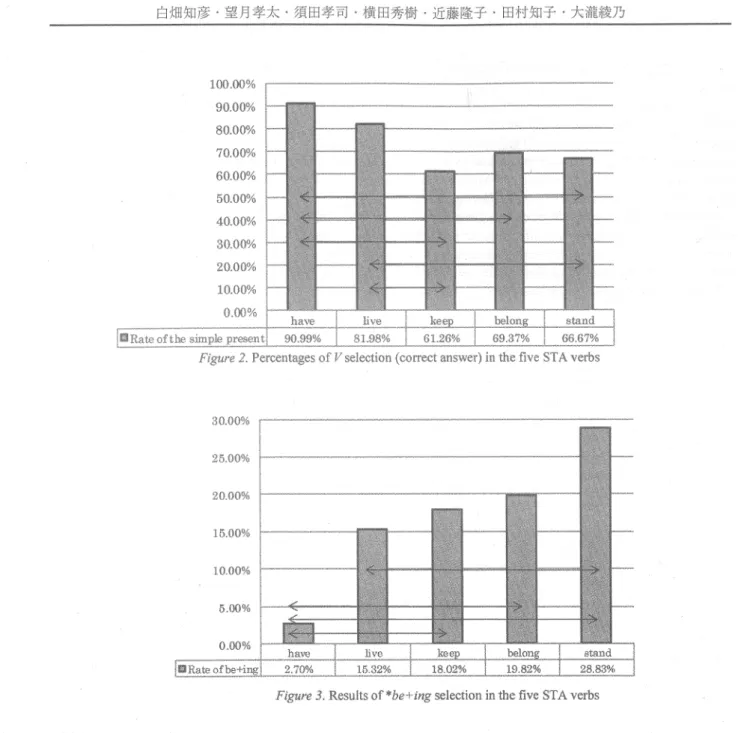
LGt us fllst look at the results of the fiYe STA verbs first.
Se€ Table 6, Figure 2 and Figu!€ 3. First of 8ll, let us look at tho iflr€rBal r€lationship amoog the fivc STAs and the p€rcentagcs of thoir con€ct forms, ,/. The results shown at Table 6 and Figure 2 rweal a signilicant difference among some v€rbs: bstweer. lave afi kaep lp < .001), iave and
belong (p < ,001) and hsee and stard (P < .001) &s wcll as
Answa: Wrong
live and l{eep (p =.002) and /,ne 8nd ,srand Qt -.046}.'lhe participants significantty pe$ormd have and i've belter than the oth€r thre€, which indicates that the JLES do not oten use a 6e+irg form when the verbs arc have nd live.
Thus, although STA verbs are usually said to be easy for JLES to inte+ret corcctly, all the STA Yerbs are not nccessarily equally easy for JLES.
Let us look at the numbers and percentages of JLES' selection of be+i4g in the STA vcrbs, which is showtr in Table 6 and Figure 3, Mulxiple comparison tests by Bonfenoni's Method show that there are significant differenccs barlnaar h6re xtd keep (p -- .016), hava uld
sta d Q) < .([l), have and belong (p =.005), and l,re and stand (p: .044). Thesf- results could indicate that in the cas€
of STA vcrbs, JLES are most likely to selcct the be+W form when thc vcrb is stazd The authors assume that this may be due to the linguistic properties of the verb, staad.
We can use stand wilh be+ing whf,t the object can be moyed. ,1y sisler is standing under the big tee or The
bool<case wds standing in the middles of the room ,sstedoy arc exar$ples offiis case. JLES in this study m8y
bc influenced ofthis usage.
havc+en -ed was/were+ing Tablc 5
STAs ACHs
482o880/Ol 375(6200/Op
2(040/●
L13(23埼
411(7410/Ol
l16(20%)
53(960/Ol
l13(204%)
6(110/O1 10118り
112(202り 21(32%) Note. The totol percehtdges items oe not l00 becquse the pafiicipmts werc
力物 ψ´ ″‐
Sο″ グル ″づο
"
お″′ Zο ′
C力ο ●
9ο44ッ α ″ me
Tablo 6
胸 ″λ J orsT/ rbsソ ″″
bθ+レ g
one verb
STAs ■ レ +姥 中 Will+verb *havelen *-ed rvds+mg
力
″ν ̀
bοl●
″ g
S″ ″′
3(2 7YO/●
17o53つ 22(198釣 32(288■ ヽ
0(00°
/olO(0.0"
0(00°
/Oll(09° /On
1(09°
/0)1(09%)
l109°
/o)2(180/Ol
0(00° /Ol
0000
1(270/Ol 2(180/Ol 101(910°/o) 7(630/on
91(8200/O1 7(63′、
77(6940/O1 13(11動 74 67埼 5(45釣
ル の 20(180埼 1(09%) 68(6130/0) 21(189%) 1(09%) 5(45%)
″
Oλ● sa
will+V
白畑知彦・望月孝太 ・須 田孝司・横 田秀樹 ・近藤隆子・田村知子 ・大瀧綾乃
Figure 2. Percentages of Z selection (corrert answer) in the five STA verbs
Figura 3, Results of *6e+r'4g selection in the five STA verbs
42 Results ofACI verbs with"秘
Now ict us look tt tho intemal relationship alnollg thc nve ACH verbs.As sllo、 vn itt Table 7 and Figure 4,the JLEs selected various kinds ofverb fo鰯 as their answers.
A two‐ way ANOVA indicate a signilicant difお rence bethreen the flve veFbS and the six foms except for ク l lt shows that there aκ difFerences bepeen the verbs alld み θ +ル B(F(4,55o=14.2686,′ <.001),ψ ″ 十 ′ bφ 「(t 550)=5.6056,′ <.001),力 昴η +̀れ (F(4,550)=7.5692,′
<.001),‐ ′ ″IF(4,550)=8.1801,Pく .001),鑢 dẀド キ :鴨
or(4,550)=6.4706,′ <.001),On tte other hand,■ o difFerencc was found be"ccn the ive verbs and tt F
,550)=1.3194,P=0.262.
Let us examinc the intemal relationship bcmeen the nve ACH verbs and b̀+鳩 、 The tests show a signttcatlt direrence betweenヵ ″ and re∝ hむ <.001),and力 ″ and
S′
″ 0く ・ 001),as well as ar″ ″
̀and re軌 o=.024), α
rrtν̀鋤 ds Poく .001),and″ 診 and s Poく .001)
Thus,it oould be said th載 /aJF and α″加 are relatively eぉ y and″ み and∫ ふ り alle rdatively dirlcult fOr the LEs.L was also found that Л■ s alc likcly to useレ 十プ 4g when the verbs are s′ ″ alld″ ′ α
̀み
,MoreovcL"was found that thり olten tend to ttlect a sinple verb fom when they judge tllat the forrn ba+′ ″ gis uttmatical.
5。
CONCLUS10N
The purposc of the stuむ waS tO investigate the acq滅 盤■
o■of枷 」 ish aSpect by adult ILEs(uniVersity studcnts m」 ゅ an3.In particular9 the sttldy htt focused on the acquidtion of asp∝ tin ACH verbs w価 わθ+iFg in comparison with the acquお ition ofSTA verbs withろ o+42g.
We obtained the da伍 飲 )m H l JLEs to investigate whether the corectinterpretation ofthe Flve STA verbs wi■ レ +ル ば (b̀滋 ″ブ 砲トル
JiVノ″ 3溌 滋ψ iFglみ
̀b′ ra嘘掩 ,andゎ θ
s′
滅′ り and me flve ACH t7erbs withら
̀+控
(bθ/aFJメ鶴
わ ̀α ″′ ッ滋&わ oα ン ,43 bι re れЙ感独 dら os″ 9ηブ 婆D were
The Acquisition of English Aspects in Achievement Verbs by Japanese Learners of English
Table 7.
R̀s Jrsグ И C″ ″ rbs
2:お
wi11+
1:*施 +Jな
verb
3:*ア 4:have*en
5:‐̀′
Correct
6:awas+it1g
(4+5)
μ 滋
22(19.8%) 0(0.09り 36(32.4%) 0(0.0%)
arrive 32 (28.8o/A 5 (4.5Yo)
S′9′