https://doi.org/10.1007/s12185-019-02777-w
ORIGINAL ARTICLE
A decision analysis comparing unrelated bone marrow transplantation and cord blood transplantation in patients with aggressive adult T‑cell leukemia‑lymphoma
Shigeo Fuji
1,2· Saiko Kurosawa
1· Yoshihiro Inamoto
1· Tatsunori Murata
3· Atae Utsunomiya
4· Kaoru Uchimaru
5· Satoshi Yamasaki
6· Yoshitaka Inoue
7· Yukiyoshi Moriuchi
8· Ilseung Choi
9· Masao Ogata
10· Michihiro Hidaka
11· Takuhiro Yamaguchi
12· Takahiro Fukuda
1Received: 30 August 2019 / Revised: 29 October 2019 / Accepted: 29 October 2019 / Published online: 7 November 2019
© Japanese Society of Hematology 2019
Abstract
Patients with aggressive adult T-cell leukemia-lymphoma (ATL) have dismal outcomes with intensive chemotherapy. Early up-front allogeneic hematopoietic stem cell transplantation (allo-HSCT) is generally recommended. However, the choice of stem cell source, i.e., unrelated bone marrow transplant (UBMT) or cord blood transplantation (CBT), when an HLA-matched related donor is unavailable remains controversial. Thus, we undertook a decision analysis to compare the outcomes of two therapeutic strategies: chemotherapy followed by up-front UBMT at 6 months, and chemotherapy followed by up-front CBT at 3 months. Patients were stratified into low-, intermediate-, and high-risk groups according to the modified ATL-prognostic index. The model simulated life expectancy (LE) and quality-adjusted LE (QALE). LE following up-front UBMT was higher than that following up-front CBT in the low-risk group (2.63 vs. 2.28 years), but was comparable in the intermediate- (2.06 vs. 2.01 years) and high-risk groups (1.25 vs. 1.30 years). The Monte Carlo simulation for LE and QALE in each risk group showed that there was significant uncertainty in all categories. In conclusion, up-front UBMT was superior to up-front CBT in the low-risk group, but the strategies were comparable in the intermediate- and high-risk groups.
Keywords Adult T-cell leukemia-lymphoma · ATL · Transplantation · Prognostic index · Decision analysis
Electronic supplementary material The online version of this article (https ://doi.org/10.1007/s1218 5-019-02777 -w) contains supplementary material, which is available to authorized users.
* Shigeo Fuji
1 Department of Hematopoietic Stem Cell Transplantation, National Cancer Center Hospital, Tokyo, Japan
2 Department of Hematology, Osaka International Cancer Institute, 3-1-69, Otemae, Chuo-Ku, Osaka 541-8567, Japan
3 Crecon Medical Assessment Inc, Tokyo, Japan
4 Department of Hematology, Imamura General Hospital, Kagoshima, Japan
5 Department of Hematology/Oncology, Institute of Medical Science, The University of Tokyo, Tokyo, Japan
6 Department of Hematology and Clinical Research Institute, National Hospital Organization Kyushu Medical Center, Fukuoka, Japan
7 Department of Hematology, Kumamoto University Hospital, Kumamoto, Japan
8 Department of Hematology, Sasebo City General Hospital, Sasebo, Japan
9 Department of Hematology, National Hospital Organization Kyushu Cancer Center, Fukuoka, Japan
10 Department of Hematology, Faculty of Medicine, Oita University, Oita, Japan
11 Department of Hematology, National Hospital Organization Kumamoto Medical Center, Kumamoto, Japan
12 Division of Biostatistics, Tohoku University Graduate School of Medicine, Sendai, Japan
Chemotherapy followed by up-front UBMT
Chemotherapy followed by up-front CBT
Alive aer PD before UBMT Alive aer UBMT before PD
Dead
Alive without PD before UBMT M M
Alive aer HSCT aer PD ATL paents
Alive aer PD before CBT Alive aer CBT before PD
Dead
Alive without PD before CBT M M
Alive aer HSCT aer PD
(A)
(B)
0 0.2 0.4 0.6 0.8 1
0 5 10 15 20 25 30 35 40 45 50 55 60 UBM all UCB all
35%
33%
All paents
0 0.2 0.4 0.6 0.8 1
0 5 10 15 20 25 30 35 40 45 50 55 60 UBM low UCB low
Low-risk
45%
38%
0 0.2 0.4 0.6 0.8 1
0 5 10 15 20 25 30 35 40 45 50 55 60 UBM intermediate UCB intermediate
33%
33%
Intermediate-risk
0 0.2 0.4 0.6 0.8 1
0 5 10 15 20 25 30 35 40 45 50 55 60 UBM high UCB high
High-risk
18%
19%
Esmated over all surviv al Esmated over all surviv al
Esmated over all surviv al Esmated over all surviv al
Months Months
Months Months
(C)
(D) (E)
3ODQ 8%07 3ODQ &%7 3ODQ 8%07
3ODQ &%7
3ODQ 8%07 3ODQ &%7
3ODQ 8%07 3ODQ &%7
Introduction
Adult T-cell leukemia-lymphoma (ATL) is a distinct periph- eral T-cell lymphoma caused by human T-cell lymphotropic virus type I (HTLV-1), and is associated with unsatisfac- tory outcome following intensive chemotherapy or anti- viral therapy [1–3]. Thus, consolidation with up-front allogeneic hematopoietic stem cell transplantation (allo- HSCT) is strongly considered in transplant-eligible patients [3–6]. However, it is often difficult to find an HLA-matched related donor because ATL generally develops in elderly patients. As an alternative stem cell source, unrelated bone marrow transplantation (UBMT) or cord blood transplanta- tion (CBT) are considered, as the data about haploidentical HSCT for ATL are still limited. UBMT has been widely used in Japan in patients with ATL with a promising overall survival [7], but its coordination usually takes 4–5 months.
Thus, the duration between the diagnosis of ATL and UBMT is around 6 months. However, the importance of early allo- HSCT has recently been recognized in patients with ATL since intensive chemotherapy can often achieve objective response but the response is not durable [3, 8]. Thus, since the publication of several promising studies, the use of CBT early after diagnosis has gradually been increasing in Japan [9, 10]. When CBT becomes a reasonable choice for patients with ATL, it may also be an important option outside of Japan as HTLV-1 infection often arises in minority immi- grant populations, which usually makes it difficult to obtain a suitable unrelated volunteer donor from a registry [6].
Since it is unrealistic to conduct a prospective randomized controlled trial (RCT) that compares UBMT and CBT, we performed a decision analysis using a database constructed using nationwide survey data to compare the outcomes of two therapeutic strategies: chemotherapy followed by either up-front UBMT at 6 months after diagnosis or by up-front CBT at 3 months after diagnosis. Decision analysis is a form of computerized modeling that can simulate the clinical outcomes of different therapeutic strategies and identify an appropriate therapeutic strategy. This technique is useful in various clinical situations in which it is difficult to conduct a prospective RCT [11–13]. Decision-analytic modeling studies can help guide clinical decisions by systematically evaluating expected outcomes of several treatment options.
For the construction of the models for decision analysis, we can use the results from various kinds of studies such
as prospective and retrospective studies. Thus, we do not have to solely rely on the results of large RCTs. Addition- ally, quality of life (QoL), which is often an essential factor for clinical decision making and frequently underreported in clinical trials, can be formally incorporated using these simulation methods.
Patients and methods
Data were derived from a database of 1792 patients that we developed by a nationwide survey of patients with aggressive ATL, as previously reported [3, 14]. Briefly, we conducted a nationwide survey of patients with aggressive ATL to con- struct a new large database. First, we invited 232 hospitals with a department of hematology in Japan to complete a questionnaire; 99 hospitals returned the questionnaire to the data center. We included patients aged 70 years or younger with aggressive ATL (acute and lymphoma type ATL) who were diagnosed between 2000 and 2013 and received inten- sive chemotherapy with multiple chemotherapeutic drugs as first-line therapy. This study was approved by the institu- tional review board of the National Cancer Center, Tokyo, Japan (No. 2014-179). Patients were stratified into low-, intermediate-, and high-risk groups according to the modi- fied ATL-prognostic index (ATL-PI), which we developed previously [3].
We constructed a Markov decision analysis model to compare the outcomes of two therapeutic strategies: chemo- therapy followed by up-front UBMT at 6 months and chemo- therapy followed by up-front CBT at 3 months. As shown in Fig. 1a and Supplemental Fig. 1 , all patients were in one of the following Markov health states within the model:
(1) alive without progressive disease (PD) before HSCT (2) alive after HSCT before PD (3) alive after PD before HSCT (4) alive after HSCT after PD, and (5) dead. HSCT could be UBMT or CBT in each therapeutic strategy, but after PD before HSCT, all stem cell sources were allowed. The cycle length was 1 month and the analyses were performed for 60 cycles over 5 years. The probability of overall survival after UBMT or CBT in the original database is shown in Sup- plemental Fig. 2. The probability of overall survival after CBT was significantly inferior than that after UBMT due to a significantly higher incidence of non-relapse mortality (2-year non-relapse mortality, 26.7% after UBMT vs. 39.1%
after CBT, P < 0.05), although there was no significant dif- ference in the incidence of relapse (2-year non-relapse mor- tality, 28.1% after UBMT vs. 31.3% after CBT, P = 0.62).
The transition probability in the respective health state was calculated from the underlying hazard of survival of the cohort, using the Kernel density estimation. The transition probability is the probability that health state changes in each cycle. Due to the limited number of patients in each
Fig. 1 Abbreviated decision tree and Markov model used to com- pare 2 strategies for treating patients with aggressive adult T-cell leukemia-lymphoma (a), and comparison of expected overall survival between the 2 treatment strategies in all patients (b) and in the low- risk (c), intermediate-risk (d), and high-risk groups (e). ATL adult T cell leukemia-lymphoma, HSCT hematopoietic stem cell transplanta- tion, PD progressive disease, UBMT unrelated bone marrow trans- plantation, CBT cord blood transplantation
◂
of the three risk groups (22 patients in the low-risk group, 48 in the intermediate-risk group, and 18 in the high-risk group), the ratio of the transition probability in UBMT to that in CBT in the whole cohort (1.79) was used to calcu- late the transition probability in CBT in each risk group. In other words, the transition probability in CBT was set as 1.79 times higher than that in UBMT. Since QoL data for patients with aggressive ATL are lacking, estimates from a similar decision analysis study of patients with acute mye- loid leukemia (AML), which were derived from a physician questionnaire, were used to attempt to adjust for QoL in this study [15]. The distribution of utility was transformed to a normal distribution after calculating the mean and standard deviation (SD) using bootstrapping (Supplemental Table 1).
The utility is the value of being in each health state for one cycle. The model simulated life expectancy (LE), quality- adjusted LE (QALE), and the survival curve after diagnosis of aggressive ATL. In the decision analysis, the strategy leading to the highest LE or QALE was considered to be the superior treatment strategy. We used the TreeAge Pro 2016 software package (TreeAge Software Inc., Williamstown, MA), Stata version 12 (Stata Corp., College Station, TX) and R (The R Foundation for Statistical Computing, version 3.2.2, Vienna, Austria).
One-way and two-way sensitivity analyses were per- formed to assess the robustness of the decision analysis model for LE or QALE in response to changes in parameters.
The plausible range of the utility at each health state was set as the mean ± 2SD (Supplemental Table 1). Probabilistic sensitivity analysis (PSA) using second-order Monte Carlo simulation (n = 1000) were performed to assess the uncer- tainty in LE and QALE. The PSA was performed by simul- taneously drawing from normal distribution functions for each model parameter according to their means and standard deviations of 10%.
Results
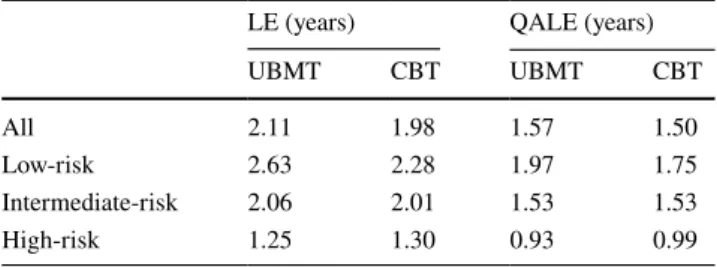
In all patients, LE of up-front UBMT was comparable to that of CBT, with 6.6% higher LE in UBMT (Table 1).
Next, we stratified patients into three groups according to the prognostic scoring system as previously reported [3].
In each risk group, as shown in Table 1, LE of up-front UBMT was 15% higher than that of CBT in the low-risk group, and was comparable to that of CBT in the intermedi- ate- and high-risk groups. The estimated survival rates and survival curves derived using TreeAge are shown in Table 1 and Fig. 1b–e. We also compared QALE between the two therapeutic strategies. As shown in Table 1, QALE of up- front UBMT was comparable to that of up-front CBT in all patients. In each risk group, QALE of up-front UBMT was 13% higher compared to that of CBT in the low-risk group,
and was comparable to that of CBT in the intermediate- and high-risk groups.
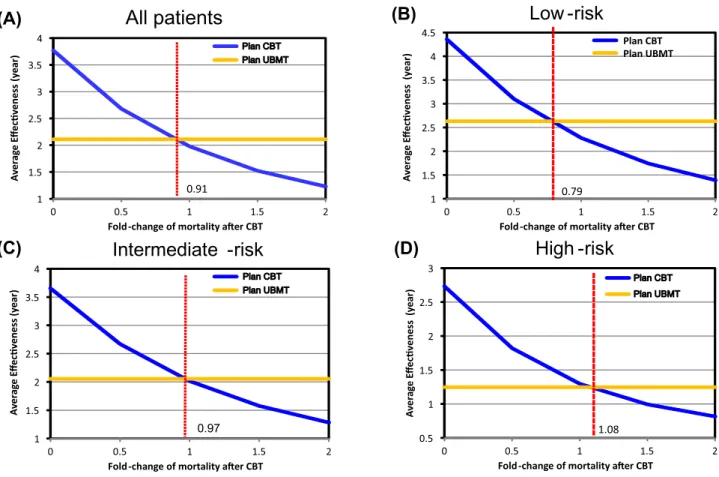
We also assessed the impact of hypothetical changes in the expected overall mortality after up-front CBT. When the rate of overall mortality after up-front CBT decreased more than 9% (below 0.91-fold), the optimal treatment strategy changed to CBT in terms of LE in all patients (Fig. 2a).
In each risk group, the threshold for changing the optimal treatment strategy was a decrease of more than 21% (below 0.79-fold) in the low-risk group, a decrease of more than 3% (below 0.97-fold) in the intermediate-risk group, and an increase of 8% (above 1.08-fold) in the high-risk group (Fig. 2b–d). Additionally, we assessed the impact of change in the timing of UBMT on the expected overall mortality.
When the timing of UBMT after diagnosis changed from 6 to 4 months, the expected 5-year overall survival increased from 26.8 to 33.4% in all patients (24.3% in CBT), from 34.9 to 40.7% in the low-risk group (28.1% in CBT), from 26.6 to 33.9% in the intermediate-risk group (26.0% in CBT), from 12.2 to 17.8% in the high-risk group (12.5% in CBT), respectively.
Two-way sensitivity analysis assessed changes in the clinical benefits of treatment strategies as the utility in two health states changed, which represented a change in QoL. Here we evaluated the impact of change in the utility in two health states: alive after UBMT before PD, which represented QoL in patients after UBMT, and alive after CBT before PD, which represented QoL in patients after CBT. For all patients and for patients in the low-risk group, there was uncertainty in the benefit of CBT if QoL impair- ment occurred after CBT (Fig. 3a–b). For patients in the intermediate- and high-risk groups, two-way sensitivity analyses showed that benefits of up-front CBT were robust across the range of plausible utilities in the two health states (Fig. 3c–d).
The PSA using Monte Carlo simulation demonstrated that there was significant uncertainty in all categories, as shown in Supplemental Table 1, but the probability of superiority of up-front UBMT group in terms of LE and QALE was higher in all patients and in the low-risk and
Table 1 Comparison of expected clinical outcomes between UBMT and CBT
UBMT unrelated bone marrow transplantation, CBT cord blood trans- plantation, LE life expectancy, QALE quality-adjusted life expectancy
LE (years) QALE (years)
UBMT CBT UBMT CBT
All 2.11 1.98 1.57 1.50
Low-risk 2.63 2.28 1.97 1.75
Intermediate-risk 2.06 2.01 1.53 1.53
High-risk 1.25 1.30 0.93 0.99
intermediate-risk groups, but lower in the high-risk group (Supplemental Table 2).
Discussion
This study used a Markov decision analysis model to com- pare chemotherapy followed by either up-front UBMT or up-front CBT in patients with aggressive ATL. In several simulation analyses, with a minor inconsistency, chemother- apy followed by up-front UBMT was superior to chemo- therapy followed by up-front CBT in the low-risk group, but these two strategies were comparable in the intermediate- and high-risk groups. In the absence of prospective RCTs that compare UBMT and CBT in patients with aggressive ATL, our current study using a statistical decision analysis method shows that up-front CBT is an acceptable option in intermediate- and high-risk groups, considering that up-front UBMT is generally recommended in patients with aggres- sive ATL.
The limitations of this study should be clarified. First, all inputs used to build a decision analysis model should ideally come from sources of high-level evidence such as
prospective RCTs, as well as prospective cost and health utility assessments. In this study, as in our previous report [13], all data were derived from a retrospective study. Fur- thermore, due to a lack of QoL estimates in patients with aggressive ATL, we used the data of patients with AML to calculate QALE. Although there are no data about QoL estimates in patients with aggressive ATL, we assume that QoL in patients with ATL may be worse than that in patients with AML. Furthermore, to attempt to adjust for QoL, this study used data from a similar decision analysis of patients with AML in which estimates were derived from a physician questionnaire about each patient’s QoL using a visual ana- logue scale score (n = 35), but that study may have overesti- mated patient QoL [16]. Taking into account this significant uncertainty in the parameters, we performed several simula- tions incorporating a wide range of uncertainty in various parameters. Second, we set the timing of up-front UBMT and CBT at 6 months and 3 months, respectively. The timing of up-front UBMT might be too late [17], although 6 months is often used for UBMT in Japan [18]. If UBMT is per- formed earlier, the expected clinical outcome with UBMT got better than that in the current simulation, as earlier tim- ing of HSCT achieves better clinical outcome. These results
$OOSDWLHQWV /RZ ULVN
,QWHUPHGLDWH ULVN +LJK ULVN
1 1.5 2 2.5 3 3.5 4
0 0.5 1 1.5 2
Fold-change of mortality aer CBT 3ODQ &%7 3ODQ 8%07
0.91
0.5 1 1.5 2 2.5 3
0 0.5 1 1.5 2
Fold-change of mortality aer CBT 3ODQ &%7 3ODQ 8%07
1.08 1
1.5 2 2.5 3 3.5 4 4.5
0 0.5 1 1.5 2
Fold-change of mortality aer CBT Plan CBT Plan UBMT
0.79
1 1.5 2 2.5 3 3.5 4
0 0.5 1 1.5 2
Fold-change of mortality aer CBT 3ODQ &%7 3ODQ 8%07
Average Effecveness(year) Average Effecveness (year)
Average Effecveness (year) Average Effecveness (year)
(A) (B)
(C) (D)
Fig. 2 One-way sensitivity analysis assessing the impact of change in overall mortality after up-front CBT on LE in all patients (a) and in the low-risk (b), intermediate-risk (c), and high-risk groups (d). UBMT unrelated bone marrow transplantation, CBT cord blood transplantation
support the importance of early HSCT in patients with aggressive ATL. Meanwhile, the outcome after CBT in this simulation was rather poor. The ratio of the transition prob- ability in UBMT to that in CBT was calculated to be 1.79, which is almost equivalent to a hazard ratio of 1.79 in para- metric proportional hazards models. This is partly because we included CBT performed before the method was well established. Thus, when the outcome of CBT is improved, as recently reported [9, 10], the clinical outcome using up- front CBT might be better than that achieved in the current simulation. Collectively, the results of simulation analyses should be modified according to any parameter changes in the future. There is also a possibility that haploidentical HSCT can be applied in ATL, as the timing of allo-HSCT is crucial [17]. The role of haploidentical HSCT in ATL should be determined in the future.
In conclusion, our simulation analysis showed that up- front UBMT was superior to up-front CBT in the low-risk group, but these two strategies were comparable in the inter- mediate- and high-risk groups. In the absence of prospective RCTs, our results suggest that up-front CBT for aggressive
ATL is an appropriate treatment choice when an unrelated donor is unavailable.
Acknowledgements This research was partially supported by the Prac- tical Research for Innovative Cancer Control program of the Japan Agency for Medical Research and Development (19ck0106342h0003) and a National Cancer Research and Development Fund (29-A-14).
Author contributions SF, SK, YI, TM, TY, and TF participated in research design, data analysis, and manuscript writing. AU, KU, SY, YI, YM, IC, MO, and MH gathered the data. All authors approved of the submission of this manuscript.
Compliance with ethical standards
Conflict of interest S.F. received honoraria from Kyowa Hakko Kirin Co., Ltd.; T.M. is an employee of Crecon Medical Assessment Inc, Tokyo, Japan; A.U. received honoraria from Japan Blood Products Organization, Roche Diagnostics, Daiichi Sankyo, Siemens, Bristol- Myers Squibb, Pfizer, Astellas Pharma, Kyowa Hakko Kirin, Novartis Pharma, HUYA Bioscience International, Nippon Shinyaku, Chugai Pharma and Celgene, Immuno-Biological Laboratories and Sumitomo Dainippon Pharma; T.Y. had ownership interests in Statcom Co., Ltd., received consulting fees from Ono Pharmaceutical Co., Ltd., received Fig. 3 Two-way sensitivity analysis plot for the utilities of the
Markov states “alive after UBMT before PD” and “alive after CBT before PD” in all patients (a) and in the low-risk (b), intermediate- risk (c), and high-risk groups (d). The blue area indicates the range in which up-front CBT treatment produces superior QALE. The red
area indicates the range in which up-front UBMT treatment produces superior QALE. The yellow square indicates the plausible range of utilities of these parameters. UBMT unrelated bone marrow transplan- tation, CBT cord blood transplantation
honoraria from Taiho Pharmaceutical Co., Ltd., and received research funding from Kyowa Hakko Kirin Co., Ltd.; M.H. received research funding from Chugai Pharm Co., Ltd.
References
1. Tsukasaki K, Utsunomiya A, Fukuda H, Shibata T, Fukushima T, Takatsuka Y, et al. VCAP–AMP–VECP compared with biweekly CHOP for adult T-cell leukemia-lymphoma: Japan clinical oncol- ogy group study JCOG9801. J Clin Oncol. 2007;25:5458–64.
2. Fukushima T, Nomura S, Shimoyama M, Shibata T, Imaizumi Y, Moriuchi Y, et al. Japan clinical oncology group (JCOG) prognos- tic index and characterization of long-term survivors of aggressive adult T-cell leukaemia-lymphoma (JCOG0902A). Br J Haematol.
2014;166:739–48.
3. Fuji S, Yamaguchi T, Inoue Y, Utsunomiya A, Moriuchi Y, Uchimaru K, et al. Development of a modified prognostic index of patients with aggressive adult T-cell leukemia-lymphoma aged 70 years or younger: a possible risk-adapted management strategies including allogeneic transplantation. Haematologica.
2017;102(7):1258–65.
4. Mehta-Shah N, Ratner L, Horwitz SM. Adult T-cell leukemia/
lymphoma. J Oncol Pract. 2017;13:487–92.
5. Bazarbachi A, Cwynarski K, Boumendil A, Finel H, Fields P, Raj K, et al. Outcome of patients with HTLV-1-associated adult T-cell leukemia/lymphoma after SCT: a retrospective study by the EBMT LWP. Bone Marrow Transpl. 2014;49:1266–8.
6. Cook LB, Fuji S, Hermine O, Bazarbachi A, Ramos JC, Ratner L, et al. Revised adult T-cell leukemia-lymphoma international consensus meeting report. J Clin Oncol. 2019;37:677–87.
7. Hishizawa M, Kanda J, Utsunomiya A, Taniguchi S, Eto T, Mori- uchi Y, et al. Transplantation of allogeneic hematopoietic stem cells for adult T-cell leukemia: a nationwide retrospective study.
Blood. 2010;116:1369–76.
8. Malpica L, Pimentel A, Reis IM, Gotuzzo E, Lekakis L, Koman- duri K, et al. Epidemiology, clinical features, and outcome of HTLV-1-related ATLL in an area of prevalence in the United States. Blood Adv. 2018;2:607–20.
9. Fukushima T, Itonaga H, Moriuchi Y, Yoshida S, Taguchi J, Imaizumi Y, et al. Feasibility of cord blood transplantation in chemosensitive adult T-cell leukemia/lymphoma: a retrospective analysis of the Nagasaki transplantation network. Int J Hematol.
2013;97:485–90.
10. Nakamura T, Oku E, Nomura K, Morishige S, Takata Y, Seki R, et al. Unrelated cord blood transplantation for patients with adult T-cell leukemia/lymphoma: experience at a single institute. Int J Hematol. 2012;96:657–63.
11. Koreth J, Pidala J, Perez WS, Deeg HJ, Garcia-Manero G, Mal- covati L, et al. Role of reduced-intensity conditioning allogeneic hematopoietic stem-cell transplantation in older patients with de novo myelodysplastic syndromes: an international collaborative decision analysis. J Clin Oncol. 2013;31:2662–700.
12. Kurosawa S, Yamaguchi H, Yamaguchi T, Fukunaga K, Yui S, Wakita S, et al. Decision analysis of postremission therapy in cytogenetically intermediate-risk acute myeloid leukemia: the impact of FLT3 internal tandem duplication, nucleophosmin, and CCAAT/enhancer binding protein alpha. Biol Blood Mar- row Transplant. 2016;22:1125–32.
13. Fuji S, Kurosawa S, Inamoto Y, Murata T, Utsunomiya A, Uchi- maru K, et al. Role of up-front allogeneic hematopoietic stem cell transplantation for patients with aggressive adult T-cell leukemia-lymphoma: a decision analysis. Bone Marrow Transpl.
2018;53:905–8.
14. Fuji S, Inoue Y, Utsunomiya A, Moriuchi Y, Uchimaru K, Choi I, et al. Pretransplantation anti-CCR4 antibody mogamulizumab against adult T-Cell leukemia/lymphoma is associated with sig- nificantly increased risks of severe and corticosteroid-refractory graft-versus-host disease, nonrelapse mortality, and overall mor- tality. J Clin Oncol. 2016;34:3426–33.
15. Kurosawa S, Yamaguchi T, Miyawaki S, Uchida N, Kanamori H, Usuki K, et al. A Markov decision analysis of allogeneic hematopoietic cell transplantation versus chemotherapy in patients with acute myeloid leukemia in first remission. Blood.
2011;117:2113–200.
16. Kurosawa S, Oshima K, Yamaguchi T, Yanagisawa A, Fukuda T, Kanamori H, et al. Quality of life after allogeneic hematopoietic cell transplantation according to affected organ and severity of chronic graft-versus-host disease. Biol Blood Marrow Transplant.
2017;23:1749–58.
17. Ciurea SO, Bittencourt MCB, Milton DR, Cao K, Kongtim P, Rondon G, et al. Is a matched unrelated donor search needed for all allogeneic transplant candidates? Blood Adv. 2018;2:2254–61.
18. Yanada M, Kanda J, Ohtake S, Fukuda T, Sakamaki H, Miy- amura K, et al. Unrelated bone marrow transplantation or imme- diate umbilical cord blood transplantation for patients with acute myeloid leukemia in first complete remission. Eur J Haematol.
2016;97:278–87.
Publisher’s Note Springer Nature remains neutral with regard to jurisdictional claims in published maps and institutional affiliations.