• 検索結果がありません。

Combination of carbon-ion beam and dual tyrosine kinase inhibitor, lapatinib, effectively destroys HER2 positive breast cancer stem-like cells

N/A
N/A
Protected

Academic year: 2021

シェア "Combination of carbon-ion beam and dual tyrosine kinase inhibitor, lapatinib, effectively destroys HER2 positive breast cancer stem-like cells"

Copied!
17
0
0

読み込み中.... (全文を見る)

全文

(1)

tyrosine kinase inhibitor, lapatinib,

effectively destroys HER2 positive breast cancer stem‑like cells

Author Sai Sai, Eun Ho Kim, Guillaume Vares, Masao Suzuki, Dong Yu, Yoshiya Horimoto, Mitsuhiro Hayashi

journal or

publication title

American Journal of Cancer Research

volume 10

number 8

page range 2371‑2386

year 2020‑08‑01

Publisher  e‑Century Publishing

Rights (C) 2020 e‑Century Publishing Author's flag publisher

URL http://id.nii.ac.jp/1394/00001673/

Creative Commons Attribution‑NonCommercial 4.0 International (CC BY‑NC 4.0)

(2)

Original Article

Combination of carbon-ion beam and dual tyrosine kinase inhibitor, lapatinib, effectively

destroys HER2 positive breast cancer stem-like cells

Sei Sai

1

, Eun Ho Kim

2

, Guillaume Vares

3

, Masao Suzuki

1

, Dong Yu

4

, Yoshiya Horimoto

5

, Mitsuhiro Hayashi

6

1

Department of Basic Medical Sciences for Radiation Damages, National Institute of Radiological Sciences, National Institutes for Quantum and Radiological Science and Technology, Chiba, Japan;

2

Department of Biochemistry, School of Medicine, Daegu Catholic University, Nam-gu, Daegu 42472, South Korea;

3

Okinawa Institute of Science and Technology (OIST), Advanced Medical Instrumentation Unit, Tancha 1919-1, Onna- son, Okinawa 904-0495, Japan;

4

School of Radiological Medicine and Protection, Medical College of Soochow University, Suzhou 215006, China;

5

Department of Breast Oncology, Juntendo University School of Medicine, 2-1-1 Hongo, Bunkyo-ku, Tokyo 113-0033, Japan;

6

Breast Center, Dokkyo Medical University Hospital, 880 Kita- Kobayashi, Mibu-machi, Shimotsuga-gun, Tochigi 321-0293, Japan

Received July 8, 2020; Accepted July 18, 2020; Epub August 1, 2020; Published August 15, 2020

Abstract: To investigate whether carbon-ion beam alone, or in combination with lapatinib, has a beneficial effect in targeting HER2-positive breast cancer stem-like cells (CSCs) compared to that of X-rays, human breast CSCs derived from BT474 and SKBR3 cell lines were treated with a carbon-ion beam or X-rays irradiation alone or in combination with lapatinib, and then cell viability, spheroid formation assays, apoptotic analyses, gene expression analysis of related genes, and immunofluorescent γ-H2AX foci assays were performed. Spheroid formation assays confirmed that ESA+/CD24- cells have CSC properties compared to ESA-/CD24+ cells. CSCs were more highly enriched after X-ray irradiation combined with lapatinib, whereas carbon-ion beam combined with lapatinib significantly decreased the proportion of CSCs. Carbon-ion beam combined with lapatinib significantly suppressed spheroid formation com- pared to X-rays combined with lapatinib or carbon ion beam alone. Cell cycle analysis showed that carbon ion beam combined with lapatinib predominantly enhanced sub-G1 and G2/M arrested population compared to that of car- bon-ion beam, X-ray treatments alone. Carbon-ion beam combined with lapatinib significantly enhanced apoptosis and carbon-ion beam alone dose-dependently increased autophagy-related expression of Beclin1 and in combina- tion with lapatinib greatly enhanced ATG7 expression at protein levels. In addition, a large-sized γH2AX foci in CSCs were induced by carbon ion beam combined with lapatinib treatment in CSCs compared to cells receiving X-rays or carbon-ion beam alone. Altogether, combination of carbon-ion beam irradiation and lapatinib has a high potential to kill HER2-positive breast CSCs, causing severe irreparable DNA damage, enhanced autophagy, and apoptosis.

Keywords: Heavy-ion radiation, breast cancer stem cell, lapatinib

Introduction

Breast cancer (BC) is the most frequently diag- nosed cancer and is the leading cause of can- cer-related deaths in worldwide [1]. BC is rap- is rap- idly increasing in many Asian countries and has become the fifth-leading cause of cancer deaths in Japan [2-4]. BCs represent a group of highly heterogeneous lesions consisting of morphologically distinct subtypes with different molecular and biochemical signatures [5-7].

Tumors that overexpress the receptor tyrosine kinase HER2 (HER2-positive tumors) tend to

be higher grade tumors that are more likely to spread and thus are more aggressive than other types of BCs [8]. Approximately 10~15%

of women diagnosed with BC will have a HER2-

positive disease. HER2-positive type BCs can

be treated with anti-HER2 drugs such as tras-

tuzumab, and new studies shows that trastu-

zumab improves the long-term survival of

patients with HER2-positive BCs [9, 10]. Al-

though the clinical outcomes of patients with

HER2-positive BC are much improved by trastu-

zumab treatment, these patients are more than

twice as likely to develop a recurring cancer

[11-13].

(3)

Because BCs are highly heterogeneous both in their pathology and in their molecular profiles, the treatment of BCs should be designed according to their different subtypes in order to achieve desirable outcome [14-16]. Breast cancer stem-like cell (CSC) populations have recently been identified based on the cell mem- brane markers CD44+/CD24- or ESA+/CD24- cells [17-19]. It has been demonstrated that CSCs are shown to be radioresistant owing to their high DNA repair capacity and upregulated survival pathways, which protect them from various cellular stresses, including radiation. It is therefore very important to develop novel therapeutic strategies that target CSCs in order to improve patient’s survival [20-22].

Carbon-ion beams have a well-localized ener- gy deposition, releasing enormous amount of energy in a well-defined range with insignificant scatter in surrounding tissues. As such, carbon- ion beams can induce more complex DNA dam- age and have been shown to be more effective- ly in killing radioresistant cancer cells, with less cell-cycle and oxygen dependencies, compared to conventional radiation [23-25]. Recently, a phase I clinical trial for early stage BC treat- ment using carbon-ion beam radiotherapy was started. However, one of critical problems was the elevated doses of radiation, especially with aggressive subtypes like HER2-positive tumors, used in carbon-ion radiotherapy, because of its side effects on skin, ribs, and lungs. Lapatinib is a very low molecular weight, dual inhibitor of the intracellular tyrosine kinase domain of HER1 (or EGFR) and HER2, and therefore has potential activity against brain metastases originating from HER2-positive BCs [26-29]. In this study, we reasoned that carbon-ion beam combined with molecular targeting drugs may reduce the doses of irradiation needed to effec- tively destroy BC cells. The combination of lapa- tinib and heavy ion radiotherapy may open new perspectives in the fight against this challeng- ing BC subgroup which suffers from limited therapy options and poor prognosis.

Recently, we have reported that carbon-ion beam irradiation has a marked effect on colon and pancreatic CSCs [30, 31] and also shown that carbon ion beam combined with DNA dam- aging drugs has increased efficacy in killing radioresistant CSCs [32-34]. Considering the fact that lapatinib has been reported to be

effective in treating HER2-positive metastases [26-29], the present study examined the effects of carbon-ion beam irradiation alone or in combination with lapatinib on putative HER2- positive breast CSCs survival, DNA repair, and expression changes of various cell death-relat- ed genes compared to that of X-ray irradiation.

To the best of our knowledge, this is the first study to show that heavy-ion radiation com- bined with lapatinib has an advantage in target- ing HER2-positive breast CSCs when compared to carbon-ion beam alone or conventional X-rays.

Materials and methods Cell lines and reagents

Human HER2-positive breast cancer cell lines, BT474 and SKBR3 were purchased from American Type Culture Collection (Manassas, VA). Unsorted cells were cultured in Dulbecco’s Modified Eagle’s medium (DMEM) supplement- ed with 10% heat-inactivated fetal bovine serum (FBS, Beit-Heamek, Israel), 100 unit/mL penicillin and 100 μg/mL streptomycin (Invitro- gen) at 37°C with 5% CO

2

-in-air. The medium was changed every other day. CSCs and non- CSCs isolated from BT474 and SKBR3 cells were cultured with Cancer Stem Cell medium (Heidelberg. Germany). Lapatinib was purcha- sed from Sigma Japan. The lapatinib solutions were diluted in DMSO immediately before use.

Antibodies used in the present study were as follows: mouse anti-human CD24-FITC (BD Pharmingen™ Cat No. 555427), mouse anti- human CD326 (Miltenyi Biotec, Cat No. 130- 091-253), monoclonal anti-phospho-histone H2AX (Ser139) (γH2AX, abcam, ab26350), LC3 (CST #4108), Beclin1 (CST #3738) and ATG7 (CST #2631).

Spheroid formation assays

Spheroid formation ability assay for ESA+/

CD24- and ESA-/CD24+ cells sorted from

BT474 and SKBR3 cells were performed as

described previously [20]. In brief, 3000 cells

per well were plated in a Low Cell Adhesion

96-well plate (SUMILON, Sumitomo Bakelite,

Tokyo, Japan) for 1-week and then the sphere

area dimension was estimated. The data is pre-

sented as the average size using WinRoof 5.6

software (Mitani Corporation, Tokyo, Japan)

after 1-week incubation.

(4)

Irradiation

Cells were irradiated with carbon-ion beams (accelerated by the HIMAC). Briefly, the initial energy of the carbon-ion beams was 290 MeV/n, 50 KeV/μm, center of 6 cm Spread-Out Bragg Peak (SOBP). As a reference, cells were also irradiated with conventional 200 kVp X-ray (TITAN-320, GE Co., USA).

Cell viability assay

For the analysis of cell viability, a CellTiter-Glo luminescent cell viability and trypan blue stain- ing assays were used. The CellTiter-Glo

®

Luminescent Cell Viability Assay is a homoge- neous method to determine the number of via- ble cells in culture based on quantitation of the ATP present, which signals the presence of metabolically active cells. In brief, a single reagent (CellTiter-Glo

®

Reagent) directly added to cells which cultured in multiwell plate with serum-supplemented medium and estimated by GloMax

®

Discover System (Promega, Wis- consin, USA). Cell viability was also tested by trypan blue exclusion test, which based on the principle that live cells exclude trypan blue dye and do not stain, whereas dead or dying cells will be stained. In brief, dilute the cells by pre- paring a 1:1 dilution of the cell suspension using 0.4% Trypan Blue solution and added to the Counting Slide Chamber and then estimat- ed by using an Olympus Automated Cell Counter model R1 (Olympus, Tokyo, Japan).

Fluorescence-activated cell sorting (FACS) analysis

FACS analysis for the cells irradiated with X-rays or carbon ion beams was performed with BD FACS Aria (Becton Dickinson, San Jose, CA, USA) as described previously [23, 27]. In brief, the cells were prepared and labeled with con- jugated anti-human ESA-PE and CD24-FITC.

Isotype matched immunoglobulin served as control. Cells were incubated for 20 min at each step and were washed with 2% FBS/PBS between steps. The percentage of ESA+, and CD24+ present was assessed after correction for the percentage of cells reactive with an iso- type control.

Apoptotic analysis

The apoptosis was analyzed using Annexin-V/PI doubling staining flow cytometry assay with

Annexin V-FITC Apoptosis Detection Kits, according to the commercial procedure avail- able (R&D Systems, Minneapolis, MN USA).

Briefly, after 24 h of irradiation cells were har- vested by trypsinization, washed in PBS and labeled fluorescently for detection of apoptotic and necrotic cells by adding 100 μL of binding buffer and 1 μL of Annexin V-FITC to each sam- ple. Samples were mixed gently and incubated at room temperature in the dark for 15 min.

Immediately before analysis by flow cytometry (BD FACSCalibur Flow Cytometry System), 1 μL of propidium iodide (PI, 1 mg/mL; Cedarlane Laboratories, Hornby, Ontario, Canada) were added to each sample. A minimum of 10,000 cells within the gated region was analyzed.

Cell cycle analysis

After harvesting and washing cells with phos- phate-buffered saline (PBS), fix in ice-cold 70%

ethanol (ethanol in distilled water) while vortex- ing, then stained with propidium iodide (1 μg/

mL, Sigma) in the presence of RNase A accord- ing to the manufacturer’s protocol, and then analyzed using a BD FACS Calibur flow cytome- ter (BD Biosciences). A minimum of 10,000 cells was counted for each sample, and data analysis was performed with CellQuest softwa- re.

Real time reverse transcription polymerase chain reaction (RT-PCR) analysis of various gene expression related to apoptosis and au- tophagy

RNA was purified using the Qiagen RNAeasy kit, including on-column DNAse treatment to remove genomic DNA. cDNA was prepared with the RT

2

First Strand Kit (SABiosciences, Frederick, Maryland, USA). A PCR specific for apoptosis, autophagy related genes was per- formed (RT

2

SYBR Green/ROX qPCR Master Mix; SABiosciences) in 96-well microtiter plates on a LightCycler

®

96 system (Roche, Basel, Switzerland). For data analysis, the ΔΔCt meth- od was applied using the RT PCR software package and statistical analyses performed (n

= 3). This package uses ΔΔ C

T

-based fold

change calculations and the Student’s t-test to

calculate two-tail, equal variance p-values. The

fold changes were calculated using the equa-

tion 2

-ΔΔCt

. If fold change was greater than 1, the

result was considered as fold-upregulation. If

fold change was less than 1, the negative

inverse of the result was considered as fold-

(5)

downregulation [26, 27]. The primer sequences used in this study was shown as Table 1.

GAPDH used as a housekeeping gene in this study.

Western blotting analysis

Cells were irradiated with carbon-ion beam alone or in combination with lapatinib and incu- bated for 96 h. The cells were harvested and lysed with Denaturing lysis buffer (Minute Total Protein Extraction Kit, Invent Biotechnologies).

The extracted proteins were separated by sodi- um-polyacrylamide gel electrophoresis and transferred to nitrocellulose membranes. The membranes were blocked with 1% (v/v) non-fat dried milk in Tris-buffered saline with 0.05%

Tween 20 and with the approciate antibodies.

Primary antibodies were used at a 1:1000 dilu- tion, and secondary antibodies were used at a 1:5000 dilution. Immunoreactive protein bands were visualized by enhanced chemilumines- cence (Amersham Biosciences) and scanned.

Visualizing autophagy by fluorescence micros- copy

The cells which cultured in chamber slide were stained with Cyto-ID according to the manufac-

turer’s protocol. In brief, cells were washed with PBS (supplemented with 5% FBS) and then mixed with Cyto-ID Dual Detection Reagent solution (Cyto-ID Green Detection Reagent and Hoechst 33342). The cells were then incubated at 37°C for 30 min (Cyto-ID) in the dark, then washed twice with PBS to remove the free dyes.

The autophagic cells stained by Cyto-ID green fluorescence were observed using fluorescence microscope.

γH2AX immunofluorescence assay

γH2AX Immunofluorescence assay was per- formed as described previously [26, 27]. In brief, cultured cells grown on plastic chamber slides (Lab-Tek. Nunc, USA) were fixed in 4%

formaldehyde for 15 min at room temperature.

Then the cells were permeabilized in 0.2%

Triton X-100 and blocked with 10% goat serum, then incubated with mouse monoclonal anti- phospho-histone H2AX (Ser139) (γH2AX) at 37°C in PBS with 10% goat serum and washed with PBS. The cells were incubated with the Alexa 488 anti-rabbit secondary antibody at 37°C in PBS with 10% goat serum and washed in PBS. Cover glasses were mounted in ProLong

®

Gold antifade reagent with DAPI (Invitrogen). Fluorescence images were cap- tured using an Olympus DP70 fluorescence microscope for analysis. All treatment groups were then assessed for γH2AX foci via sequen- tial imaging through each nucleus. A minimum of 100 cells in each treatment group were counted. Nuclear γH2AX foci size was estimat- ed by ImageJ 1.45 software (NIH).

Statistical analysis

One-way analysis of variance (ANOVA) and Bonferroni multiple comparison tests were used when mean differences between the groups were evaluated by StatView software (SAS Institute, Inc., Cary, NC). For all compari- sons, p values less than 0.05 were defined as significant.

Results

Cell viability after carbon ion beam or X-ray irradiation alone or in combination with lapa- tinib

Morphological changes of BT474 cells as shown in Figure 1A, 24 h after carbon-ion beam com- bined with lapatinib greatly destroyed the cells Table 1. The primer sequences for real-time

PCR

Gene Primer sequence GAPDH

Forward 5’-TGAACGGGAAGCTCACTGG-3’

Reverse 5’-TCCACCACCCTGTTGCTGTA-3’

Bax

Forward 5’-CAAACTGGTGCTCAAGGCC-3’

Reverse 5’-GCACTCCCGCCACAAAGAT-3’

Bcl-2

Forward 5’-ATGTGTGTGGAGAGCGTCAACC-3’

Reverse 5’-TGAGCAGAGTCTTCAGAGACAGCC-3’

Caspase-3

Forward 5’-TCATTATTCAGGCCTGCCGTGGTA-3’

Reverse 5’-TGGATGAACCAGGAGCCATCCTTT-3’

LC3-II

Forward 5’-GATGTCCGACTTATTCGAGAGC-3’

Reverse 5’-TTGAGCTGTAAGCGCCTTCTA-3’

Beclin-1

Forward 5’-AGCTGCCGTTATACTGTTCTG-3’

Reverse 5’-ACTGCCTCCTGTGTCTTCAATCTT-3’

ATG-7

Forward 5’-GCTG CTACTTC TGCAATGATGT-3’

Reverse 5’-GCAAGCTCACTAGG CTGCAGAACC-3’

(6)

compared to that of carbon-ion beam alone, X-ray irradiation alone or its combination treat- ment with lapatinib. According to our and other previous reports, the relative biological effec- tiveness (RBE) values are around 2.0, and in this study, we compared a 1 Gy dose of carbon- ions with a 2 Gy of X-rays to evaluate their bio- logical effects. At first, BT474 cell viability was performed using the CellTiter-Glo luminescent cell viability assay. As shown in Figure 1B, cell viability was significantly decreased after 1 Gy of carbon-ion beam, or X-rays alone, and it was predominantly decreased after 1 Gy of carbon- ion beam in combined with 1 μM lapatinib com- pared to 2 Gy of X-rays combined with lapatinib or with lapatinib alone. To further confirm the cell killing effects of carbon-ion beam alone or its combination with lapatinib, we also per- formed Trypan Blue Staining assay. As shown in Figure 1C, cell viability was suppressed by car- bon-ion beam irradiation alone dose-depend- ently and it was significantly further decreased by carbon-ion beam irradiation combined with lapatinib.

Changes in the proportion of ESA+/CD24- cells after carbon-ion beam or X-ray irradiation alone or in combination with lapatinib

Percentage changes of cancer stem like ESA+/

CD24- CSCs 96 h after carbon-ion beam, or X-ray irradiation alone or in combination with 1 μM of lapatinib were investigated by FACS anal- ysis. As shown in Figure 2A, the proportion of ESA+/CD24- cells in BT474 cells was signifi- cantly increased after 2 Gy of X-rays combined with lapatinib or with lapatinib alone, whereas 1 Gy of carbon-ion beam combined with lapa- tinib significantly decreased the proportion of ESA+/CD24- cells. Interestingly, the percentage of ESA+/CD24- cells in SKBR3 cells was signifi- cantly increased when 2 Gy of X-rays combined with lapatinib was used, but no changes were observed with 2 Gy of X-rays alone or with 1 Gy of carbon-ion beam combined with lapatinib.

However, the proportion of ESA+/CD24- cells was predominantly decreased with either 4 Gy of X-rays or 2 Gy of carbon-ion beam combined with lapatinib (Figure 2B).

Figure 1. A. Morphological changes of BT474 cells 24 h after carbon-ion beam irradiation alone, X-ray irra- diation alone or its combination treatment with lapa- tinib. B. Cell viability analysis using the CellTiter-Glo luminescent cell viability assay. BT474 cell viability is shown 24 h after carbon-ion beam irradiation alone, or X-ray irradiation alone or in combination with of lapatinib (1 µM). *, P<0.01, compared to control. C.

Cell viability analysis using the Trypan Blue Staining

assay. BT474 cell viability is shown 96 h after differ-

ent doses of carbon-ion beam irradiation alone, or

in combination with of lapatinib (1 µM). *, P<0.01,

compared to control.

(7)
(8)

Spheroid formation ability of ESA+/CD24- and ESA-/CD24+ cells after carbon-ion beam or X-ray irradiation alone or in combination with lapatinib

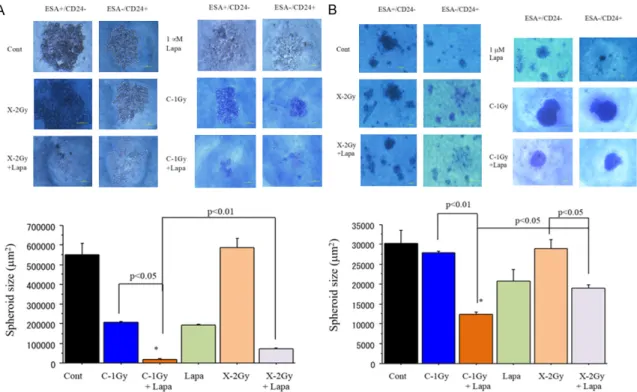
Under experimental condition with a stem cell medium, only cancer cells with self-renewal ability are expected to grow and maintain their spheroid morphology. Thus, spheroid for- mation assays have been widely used to evalu- ate cancer stem cell properties. To investigate the ability to form spheroid bodies, isolated ESA+/CD24-CSCs and non-CSC ESA-/CD24+

cells were cultured in 96-well round-bottomed Sumilon cell tight spheroid plates. After being in culture for 1 week, the ability of ESA+/CD24- cells to form spheroid bodies was significantly higher than that of ESA-/CD24+ cells (Figure 3).

To examine the effects of lapatinib on radio- sensitization to X-rays and carbon ion beams, spheroid formation ability assays of cancer

stem-like ESA+/CD24- cells and non-cancer stem-like ESA-/CD24+ cells after irradiation with an X-rays or carbon-ion beam alone or in combination with lapatinib were performed. As shown in Figure 3A, we found that the tumor spheroid formations of stem-like ESA+/CD24- cells isolated from SKBR3 cell line was signifi- cantly reduced by carbon-ion beam irradiation, and with lapatinib alone, but not by X-ray irradi- ation, and it was extremely decreased by car- bon-ion beam combined with lapatinib. In con- trast, no spheres were formed in non-stem-like ESA-/CD24+ cells after X-rays or carbon-ion beam, either alone or in combination with lapa- tinib. We have also examined the spheroid for- mation ability of ESA+/CD24- cells isolated from the BT474 cell line and found that carbon- ion beam alone did not reduced spheroid size but carbon-ion beam combination with lapa- tinib significantly reduced not only spheroid size and but also the numbers. In contrast, Figure 2. A. Percentage changes of ESA+/CD24- cells by FACS analysis 96 h after carbon-ion beam or X-ray irradia- tion alone or in combination with 1 µM of lapatinib in BT474 cells. Lapatinib was added prior to irradiation and treated for 96 h. B. Percentage changes of ESA+/CD24- cells by FACS analysis 96 h after carbon-ion beam or X-ray irradiation alone or in combination with 1 µM of lapatinib in SKBR3 cells. Lapatinib was added prior to irradiation and treated for 96 h. *, P<0.01 compared to non-CSCs. All experiments were performed in triplicate (n = 3).

Figure 3. Spheroid formation of cancer stem-like cells (CSCs) (ESA+/CD24-) and non-CSCs (ESA-/CD24+) isolated from SKBR3 (A) and BT474 (B) cells. Cells were cultured for one week for spheroid formation ability analyses. *, P<0.01, #, P<0.05 compared to spheres formed from the Control. All experiments were performed in triplicate (n

= 3).

(9)

X-ray irradiation alone, lapanitib alone did not reduced the spheroid size and the numbers, even in combination with lapatinib (Figure 3B).

Apoptosis analyses after carbon-ion beam or X-ray irradiation alone or in combination with lapatinib

Induction of apoptosis in BT474 cells was ana- lyzed using the Annexin V-FITC Apoptosis Detection kits 10 days after carbon-ion beam or X-ray irradiation alone or in combination with lapatinib. The data showed that there is no clear dose-dependent response with carbon- ion beam irradiation, however, only 1 Gy was sufficient to significantly increase apoptosis (Figure 4A). In comparison, there is a clear dose-dependent response with X-ray irradia- tion, but more than 4 Gy is needed to signifi- cantly increase apoptosis (Figure 4B). Inter- estingly, carbon-ion beam in combination with lapatinib synergistically enhanced apoptosis, whereas no such action was observed using X-rays combined with lapatinib.

Cell cycle analyses after carbon-ion beam or X-ray irradiation alone or in combination with lapatinib

Cell cycle analyses of BT474 cells 4 days after a carbon-ion beam, or X-rays alone or in combina- tion with 1 μM of lapatinib were performed.

Lapatinib was added prior to irradiation and constantly applied for 4 days, and then the cell cycle distribution (sub G1, G1, S and G2/M phase) was measured using an FACS Calibur.

As shown in Figure 5, carbon-ion beam irradia- tion combined with lapatinib was more effec- tive in inhibiting cell cycle progression (sub-G1 arrest) and inducing cell death (apoptosis/

necrosis) than X-rays alone or X-rays combined with lapatinib. We have also performed cell cycle analyses in SKBR3 cells and obtained the same results (data not shown).

γH2AX foci formation in ESA+/CD24- and ESA-/CD24+ cells after carbon-ion beam or X-rays alone or in combination with lapatinib To examine the role of lapatinib radiosensitiza- tion on DNA damage and repair in stem-like ESA+/CD24- cells, the γ-H2AX foci formation analysis was performed, which marks DNA dou- ble-strand breaks (DSB). As shown in Figure 6A, carbon-ion beam and X-rays significantly increased the number of γH2AX foci, with no

observable differences between them, and this number was significantly increased further using carbon ion beam combined with lapa- tinib. However, the size of foci (clustered DSB) was frequently found in cells treated by carbon- ion beam combined with lapatinib compared to carbon-ion beam alone, X-rays alone, lapatinib alone, or X-rays combined with lapatinib (Figure 6A). We also examined the nuclear γH2AX foci formed in non-stem like ESA-/CD24+ cells 24 h after a carbon-ion beam or X-ray irradiation alone or in combination with 1 μM of lapatinib.

We found that many more numbers of γH2AX foci were present after carbon-ion beam treat- ment alone compared to X-ray alone, and either carbon ion beam or X-ray irradiation combined with lapatinib enhanced γH2AX foci formation (Figure 6B).

Expression changes of various genes in CSCs after carbon-ion beam alone or X-rays alone or in combination with lapatinib measured by quantitative real-time RT PCR analysis

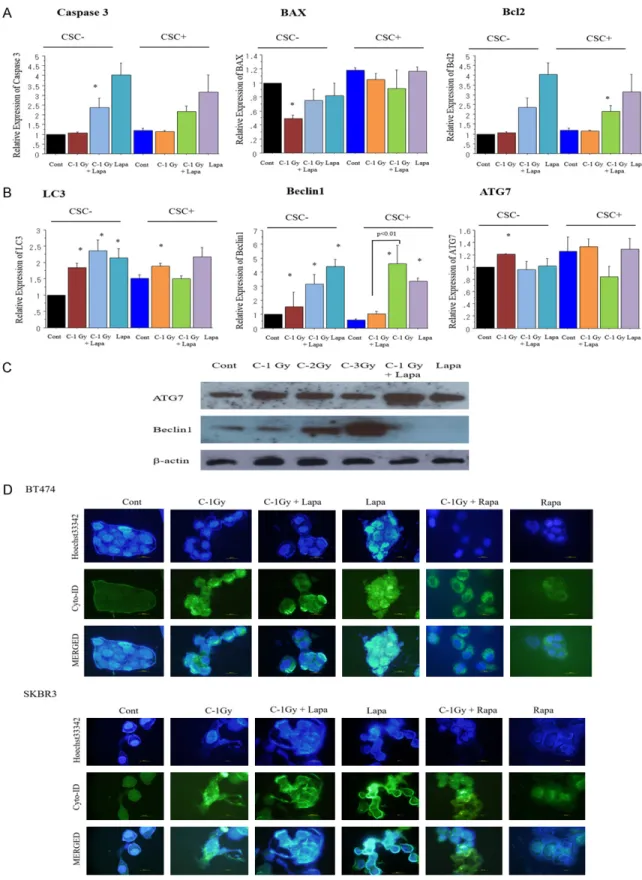
To quantitatively examine multiple gene expres- sion changes in CSCs (ESA+/CD24-) and non- CSCs (ESA-/CD24+) isolated from BT474 cells, quantitative real-time RT-PCR analysis was performed according to the manufacture’s pro- tocol. The data shows that irradiation with a carbon-ion beam combined with a constant treatment of 1 μM of lapatinib for 72 h signifi- cantly increased the expressions of apoptosis- related caspase 3 but not Bax, and increased Bcl2 expression in both non-CSC and CSCs.

Interestingly, expression of autophagy-related

genes varied, LC3 was significantly increased

only in non-CSCs, but Beclin1 expression was

predominantly enhanced in both CSCs and

non-CSCs after carbon-ion beam irradiation

alone or in combination with lapatinib. In addi-

tion, no changes in ATG7 expression were found

after treatment with carbon-ion beam alone, or

X-rays alone or combined with lapatinib when

compared to carbon-ion beam alone, or lapa-

tinib alone in both non-CSC and CSCs (Figure

7A, 7B). We have examined above autophagy-

related genes at protein levels and found that

expressions of ATG7 and Beclin1 and were

increased in a dose-dependent manner by

carbon-ion beam alone and only ATG7 expres-

sion was further enhanced by combination

treatment of carbon-ion beam and lapatinib,

whereas expression of Beclin1 was undetect-

able (Figure 7C). Furthermore, we investigated

(10)

Figure 4. Apoptosis analysis of BT474 cells 10 days after a carbon-ion beam irradiation alone or in combination with 1 µM of lapatinib using the FITC Annexin-V-PI

detection kit. *, P<0.01, #, P<0.05 compared to control. All experiments were performed in triplicate (n = 3).

(11)

autophagosomes using Cyto-ID Autophagy Detection Kit. The cells treated with autophagy inducer rapamycin which used as a positive control. We found that 24 h after carbon-ion beam irradiation alone effectively induced autophagy and in combination with lapatinib seems to induce more strongly (Figure 7D).

Discussion

Although the anti-proliferative and pro-apoptot- ic effects of lapatinib have been reported [35, 36], the molecular mechanism of radiosensiti- zation and modes of cell death by lapatinib combined with high liner energy transfer (LET) carbon-ion beam on HER2-overexpressing breast cancer cells have not been elucidated.

In this study, we found that the HER2 positive breast cancer cell viability was significantly decreased by using carbon-ion beam, or by lapatinib alone, and it was further decreased by using carbon-ion beam in combination with

lapatinib when compared to X-ray irradiation alone, X-rays combined with lapatinib also reduced cell viability, but was less effective than using carbon-ion beam together with lapa- tinib. This is partially consistent with previous reports showing that lapatinib inhibits cell growth, enhances antibody-dependent cellular cytotoxicity and potentiates radiation-induced cell death of HER2-overexpressing cancer cells [37-39].

In the present study, the percentages of cancer stem-like ESA+/CD24- cells (CSCs) in BT474 cell line showed a tendency to increase after either 2 Gy of X-rays or 1 Gy of carbon-ion beam, and it was significantly increased after 2 Gy of X-rays in combination with 1 μM of lapa- tinib. In contrast, 1 Gy of carbon ion beam com- bined with lapatinib significantly decreased the proportion of CSCs in BT474 cells. The propor- tional changes of CSCs in SKBR3 cells were not affected by 2 Gy of X-rays or 1 Gy of carbon-ion Figure 5. Cell cycle analyses of BT474 cells 4 days after carbon-ion beam, or X-rays irradiation alone or in combina- tion with 1 µM of lapatinib. Lapatinib was added 2 h prior to irradiation and continued for 4 days, and the cell-cycle distribution (sub G1, G1, S and G2/M phases) was measured by flow cytometry. Carbon-ion beam combined with lapatinib significantly inhibited cell-cycle progression (sub-G1 arrest) and induced cell death (apoptosis/necrosis).

All experiments were performed in triplicate (n = 3), and the averages of the three separate experiments are shown.

(12)

beam, or with 1 μM of lapatinib alone. However, it was significantly increased by 2 Gy of X-ray irradiation in combination with lapatinib but not 1 Gy of carbon-ion beam in combination with lapatinib, whereas it was significantly decreased by 4 Gy of X-rays or 2 Gy of carbon-ion beam combined with lapatinib. This finding suggests that CSC proportions can be reduced when lapatinib is combined with slightly increasing doses of radiation. This is partially consistent with ours and other previous reports [30-34, 38-40]. At first, to confirm the CSC properties of ESA+/CD24- cells, we sorted this population from SKBR3 cells and examined its spheroid formation capability compared to sorted non- CSC ESA+/CD24- cells. The data showed that ESA+/CD24- cells have a significantly higher spheroid formation capability than ESA-/CD24+

cells, indicating that ESA+/CD24- cells have CSC properties. This is in line with previously reports that ESA+/CD24- is a marker for breast

CSC [18, 33]. We also examined and confirmed that demonstrate that ESA+/CD24- cells have CSC properties compared to ESA-/CD24+ cells sorted from the BT474 cell line based on its high spheroid formation ability (data not shown). Furthermore, the data shows that spheroid formation of CSCs was significantly inhibited by ccarbon-ion beam, or by lapatinib alone, and it was extremely suppressed by car- bon-ion beam combined with lapatinib when compared to X-rays alone or X-rays combined with lapatinib. This suggests that breast CSCs are significantly radiosensitized when carbon- ion beam is combined with lapatinib.

To determine apoptosis induction after long-

term treatments of carbon-ion beam, or X-ray

irradiation alone or in combination with lapa-

tinib, we analyzed the apoptosis using the

Annexin V-FITC Apoptosis Detection Kits 10

days later. The data showed that carbon-ion

Figure 6. A. Quantification and representative photos of nuclear γH2AX foci formation in CSCs (ESA+/CD24-) iso-

lated from BT474 cells 24 h after a carbon-ion beam, or X-ray irradiation alone or in combination with 1 µM of

lapatinib. Quantification of nuclear γ-H2AX foci larger than 1.5 mm

2

is also displayed. Lapatinib was added prior to

irradiation and continued for 2 h. Data represents mean ± SD.

*

P<0.05 compared to control. B. Quantification and

representative photos of nuclear γH2AX foci formation in non-CSCs (ESA-/CD24+) isolated from BT474 cells 24 h

after carbon-ion beam, X-ray irradiation alone or in combination with 1 µM of lapatinib. Lapatinib was added 2 h

prior to irradiation and continued for 24 h. Data represent mean ± SD.

*

P<0.05 compared to control. All experiments

were performed in triplicate (n = 3).

(13)

Figure 7. Quantitative real time RT-PCR analysis of apoptosis (A) and autophagy-related (B) genes in CSCs and non-

CSCs isolated from BT474 cells 96 h after a carbon-ion beam, or X-ray irradiation alone or in combination with 1 µM

of lapatinib. Lapatinib was added 2 h prior to irradiation and continued for 96 h. *, P<0.01, compared to control. All

experiments were performed in triplicate (n = 3). (C) Western blotting analysis of ATG7 and Beclin1 in BT474 cells

96 h after a carbon-ion beam alone or lapatinib alone, or in combination with lapatinib. (D) Visualizing autophagy

by fluorescence microscopy. The autophagic cells stained by Cyto-ID dual detection reagent solution (Cyto-ID Green

Detection Reagent and Hoechst 33342) and were observed using fluorescence microscope.

(14)

beam irradiation alone can increase apoptosis, although there is no dose-related response, whereas X-ray irradiation alone increased apoptosis in a dose-dependent manner. In- terestingly, carbon ion beam in combination with lapatinib dramatically enhanced apoptosis compared to carbon-ion beam alone, lapatinib alone, X-rays alone or in combination with lapa- tinib. The cell cycle distribution of BT474 and SKBR3 cells 4 days after a carbon-ion beam, or X-ray irradiation alone or in combination with 1 μM of lapatinib was analyzed by flow cytometry.

Carbon-ion beam combined with lapatinib more significantly inhibited cell cycle progression (sub-G1 arrest) and induced cell death (apopto- sis/necrosis) compared to carbon-ion beam alone, X-rays alone or X-rays combined with lapatinib in both BT474 and SKBR3 (data not shown) cells. This is in line with previous reports showing that lapatinib induces apoptosis in various cancer cells [35, 36].

There is increasing evidence indicating that high LET particle irradiation can induce com- plex DNA damage such as clustered DNA lesions [41-44]. In this study, the number of double strand breaks (DSBs) visualized by γH2AX foci formation in non-CSCs and CSCs was significantly increased by carbon-ion be- am, X-ray irradiation alone, or in combination with lapatinib with no significant difference among the treatments. However, significantly larger-sized γH2AX foci were only induced by carbon-ion beam irradiation, and carbon-ion beam combined with lapatinib induced more large-sized γH2AX foci, suggesting that a higher complexity of clustered DSB was induced by carbon ion beam in combination with lapatinib.

These results reveal that the greater complexi- ty of DSBs induced by carbon-ion beam com- bined with a molecular target drug which po- tentially leads to increased mutagenicity and decreased reparability of the damaged site [43, 44]. Taken together, our results are the first to show that carbon-ion beam in combination with lapatinib synergistically enhanced cell killing of HER2-positive CSCs. This is partially consistent with previous reports that HER2 is preferential- ly expressed in the CSC population, and HER2 targeting drug trastuzumab found to effectively reduced tumor sphere formation and CSC markers [10, 40].

A number of studies showed that CSC subpopu- lations are shown to be radioresistant com-

pared to non-CSC subpopulations and cross- talk between autophagy signaling and apopto- sis signaling was considered as one of this resistant mechanisms [41]. In the present study, we found that after treatment with car- bon-ion beam combined with lapatinib for radioresistant CSCs, apoptosis-related gene expression of caspase 3 but not Bax, and autophagy-related genes like LC3 and Beclin1 showed significant enhancements compared to that of carbon ion beam, X-ray alone or X-ray combined with lapatinib, suggesting that car- bon-ion beam combined with lapatinib may have more power to induce multiple cell death.

Altogether, carbon-ion beam combined with lapatinib appear to show enhanced effects in inducing apoptosis and autophagy related gene expression at the mRNA levels in vitro in the disruption of HER2-positive breast CSCs. Cyto- ID autophagy flux immunofluorescence analy- sis indicated that 24 h after carbon-ion beam irradiation alone effectively induced autophagy and combination treatment with lapatinib seems to be induced autophagy more strongly.

Furthermore, western blot data showed that

carbon-ion beam dose-dependently increased

expression of ATG7 and Beclin1, however car-

bon-ion beam in combination with lapatinib

only enhanced ATG7 expression, whereas ex-

pression of Beclin1 was lost. We speculated

that relatively long-term treatment (96 h) with

lapatinib and/or in addition with carbon-ion

beam may strongly killed most of tumor cells

and degraded some proteins. It has been

reported that lapatinib radiosensitized BCs are

accompanied with apoptosis and autophagy

[38-40], and lapatinib induces autophagic cell

death and combined treatment with rapamycin,

a autophagy activator, or with radiation further

increased autophagy in HER2 positive breast

cancer cells [45-52]. It has also demonstrated

that Tat-Beclin1 peptide inhibits HER2 positive

human breast cancer xenograft with robust

autophagy induction [53]. Based on above lit-

erature and our present findings, it is implying

that carbon ion beam in combination with lapa-

tinib may enhance cell death via autophagy

induction [54]. However, the deep molecular

mechanisms of carbon ion beam irradiation

alone or lapatinib combination treatment-

induced apoptosis, autophagy and their inter-

action need to be further studied. In addition, it

has been demonstrated that overexpression of

the HER2 gene results in the formation of a

(15)

ligand-independent HER2 homodimer and initi- ate downstream signaling cascades, such as the phosphoinositide 3-kinase (PI3K) and mito- gen-activated protein kinase (MAPK) pathways, which regulate cell proliferation and survival [55]. We plan to further investigate the effects of carbon-ion beam irradiation in combination with lapatinib on these of signaling pathways in the near future.

In summary, relatively low doses of carbon-ion beam combined with lapatinib have promising advantages in targeting putative HER2-positive breast CSCs by inducing complex DNA damage, increased apoptosis, autophagy, and subse- quent cell death then by using carbon-ion beam alone.

Acknowledgements

This work was partially supported by Grant of Japan China Medical Association (to S. Sai), and by Research Project with Heavy-ion at NIRS-HIMAC.

Disclosure of conflict of interest None.

Abbreviations

BC, breast cancer; HER2, human epidermal growth factor receptor-2; ER, estrogen recep- tor; PR, progesterone receptor; CSC, cancer stem-like cell; HIMAC, heavy ion medical accel- erator in Chiba; DMEM, dulbecco’s modified eagle’s medium; ANOVA, analysis of variance;

SOBP, spread-out bragg peak; FACS, fluores- cence-activated cell sorting; FBS, fetal bovine serum; PBS, phosphate-buffered saline; RT- PCR, reverse transcription polymerase chain reaction; PI3K, phosphoinositide 3-kinase; MA- PK, mitogen-activated protein kinase; LET, lin- ear transfer energy; RBE, relative biological effectiveness; DSB, double strand breaks.

Address correspondence to: Dr. Sei Sai, Department of Basic Medical Sciences for Radiation Damages, National Institute of Radiological Sciences, National Institutes for Quantum and Radiological Science and Technology 4-9-1 Anagawa Inage-ku, Chiba, Chiba 263-8555, Japan. Tel: 043-206-3231; Fax:

043-206-4149; E-mail: [email protected]; Dr. Mit- suhiro Hayashi, Breast Center, Dokkyo Medical University Hospital, 880 Kita-Kobayashi, Mibu- machi, Shimotsuga-gun, Tochigi, 321-0293, Japan.

E-mail: [email protected]

References

[1] Siegel R, Naishadham D and Jemal A. Cancer statistics. CA Cancer J Clin 2012; 62: 10-29.

[2] Bhoo-Pathy N, Yip CH, Hartman M, Uiterwaal CS, Devi BC, Peeters PH, Taib NA, van Gils CH and Verkooijen HM. Breast cancer research in Asia: adopt or adapt Western knowledge? Eur J Cancer 2013; 49: 703-709.

[3] Su Y, Zheng Y, Zheng W, Gu K, Chen Z, Li G, Cai Q, Lu W and Shu XO. Distinct distribution and prognostic significance of molecular subtypes of breast cancer in Chinese women: a popula- tion-based cohort study. BMC Cancer 2012;

11: 292.

[4] Katanoda K, Matsuda T, Matsuda A, Shibata A, Nishino Y, Fujita M, Soda M, Ioka A, Sobue T and Nishimoto H. An updated report of the trends in cancer incidence and mortality in Japan. Jpn J Clin Oncol 2013; 43: 492-507.

[5] Reis-Filho JS and Pusztai L. Gene expression profiling in breast cancer: classification, prog- nostication, and prediction. Lancet 2011; 378:

1812-1823.

[6] Patani N, Martin LA and Dowsett M. Biomarkers for the clinical management of breast cancer:

international perspective. Int J Cancer 2013;

133: 1-13.

[7] Sioshansi S, Huber KE and Wazer DE. The im- plications of breast cancer molecular pheno- type for radiation oncology. Front Oncol 2011;

1: 12.

[8] Heitz F, Harter P, Lueck HJ, Fissler-Eckhoff A, Lorenz-Salehi F, Scheil-Bertram S, Traut A and du Bois A. Triple-negative and HER2- overexpressing breast cancers exhibit an ele- vated risk and an earlier occurrence of cere- bral metastases. Eur J Cancer 2009; 45:

2792-2798.

[9] Molnár IA, Molnár BÁ, Vízkeleti L, Fekete K, Tamás J, Deák P, Szundi C, Székely B, Moldvay J, Vári-Kakas S, Szász MA, Ács B, Kulka J and Tőkés AM. Breast carcinoma subtypes show different patterns of metastatic behavior.

Virchows Arch 2017; 470: 275-283.

[10] Ithimakin S, Day KC, Malik F, Zen Q, Dawsey SJ, Bersano-Begey TF, Quraishi AA, Ignatoski KW, Daignault S, Davis A, Hall CL, Palanisamy N, Heath AN, Tawakkol N, Luther TK, Clouthier SG, Chadwick WA, Day ML, Kleer CG, Thomas DG, Hayes DF, Korkaya H and Wicha MS. HER2 drives luminal breast cancer stem cells in the absence of HER2 amplification: implications for efficacy of adjuvant trastuzumab. Cancer Res 2013; 73: 1635-46.

[11] Loibl S and Gianni L. HER2-positive breast can- cer. Lancet 2017; 389: 2415-2429.

[12] Baselga J, Carbonell X, Castañeda-Soto NJ,

Clemens M, Green M, Harvey V, Morales S,

Barton C and Ghahramani P. Phase II study

(16)

of efficacy, safety, and pharmacokinetics of trastuzumab monotherapy administered on a 3-weekly schedule. J Clin Oncol 2005; 23:

2162-71.

[13] Cossetti RJ, Tyldesley SK, Speers CH, Zheng Y and Gelmon KA. Comparison of breast cancer recurrence and outcome patterns between pa- tients treated from 1986 to 1992 and from 2004 to 2008. J Clin Oncol 2015; 33: 65-73.

[14] Polyak K. Heterogeneity in breast cancer. J Clin Invest 2011; 121: 3786-3788.

[15] Place AE, Jin Huh S and Polyak K. The microen- vironment in breast cancer progression: biolo- gy and implications for treatment. Breast Cancer Res 2011; 13: 227.

[16] Higgins MJ and Baselga J. Targeted therapies for breast cancer. J Clin Invest 2011; 121:

3797-3803.

[17] Al-Hajj M, Wicha MS, Benito-Hernandez A, Morrison SJ and Clarke MF. Prospective identi- fication of tumorigenic breast cancer cells.

Proc Natl Acad Sci U S A 2003; 100: 3983- 3988.

[18] Charafe-Jauffret E, Ginestier C, Iovino F, Wicinski J, Cervera N, Finetti P, Hur MH, Diebel ME, Monville F, Dutcher J, Brown M, Viens P, Xerri L, Bertucci F, Stassi G, Dontu G, Birnbaum D and Wicha MS. Breast cancer cell lines con- tain functional cancer stem cells with meta- static capacity and a distinct molecular signa- ture. Cancer Res 2009; 69: 1302-1313.

[19] Hambardzumyan D, Squartro M and Holland EC. Radiation resistance and stem-like cells in brain tumors. Cancer Cell 2006; 10: 454-456.

[20] Rich JN. Cancer stem cells in radiation resis- tance. Cancer Res 2007; 67: 8980-8984.

[21] Dingli D and Michor F. Successful therapy must eradicate cancer stem cells. Stem Cells 2006;

24: 2603-2610.

[22] Vermeulen L, de Sousa e Melo F, Richel DJ and Medema JP. The developing cancer stem-cell model: clinical challenges and opportunities.

Lancet Oncol 2012; 13: e83-e89.

[23] Durante M and Loeffler JS. Charged particles in radiation oncology. Nat Rev Clin Oncol 2010;

7: 37-43.

[24] Liauw SL, Connell PP and Weichselbaum RR.

New paradigms and future challenges in radia- tion oncology: an update of biological targets and technology. Sci Transl Med 2013; 5:

173sr2.

[25] Schlaff CD, Krauze A, Belard A, O’Connell JJ and Camphausen KA. Bringing the heavy: car- bon ion therapy in the radiobiological and clini- cal context. Radiat Oncol 2014; 9: 88.

[26] Estévez LG, Suarez-Gauthier A, García E, Miró C, Calvo I, Fernández-Abad M, Herrero M, Marcos M, Márquez C, Lopez Ríos F, Perea S and Hidalgo M. Molecular effects of lapatinib in patients with HER2 positive ductal carcino- ma in situ. Breast Cancer Res 2014; 16: R76.

[27] Scaltriti M, Verma C, Guzman M, Jimenez J, Parra JL, Pedersen K, Smith DJ, Landolfi S, Ramon y Cajal S, Arribas J and Baselga J.

Lapatinib, a HER2 tyrosine kinase inhibitor, in- duces stabilization and accumulation of HER2 and potentiates trastuzumab-dependent cell cytotoxicity. Oncogene 2009; 28: 803-814.

[28] Gril B, Palmieri D, Bronder JL, Herring JM, Vega-Valle E, Feigenbaum L, Liewehr DJ, Steinberg SM, Merino MJ, Rubin SD and Steeg PS. Effect of lapatinib on the outgrowth of met- astatic breast cancer cells to the brain. J Natl Cancer Inst 2008; 100: 1092-1103.

[29] Blackwell KL, Burstein HJ, Storniolo AM, Rugo HS, Sledge G, Aktan G, Ellis C, Florance A, Vukelja S, Bischoff J, Baselga J and O’Shaughnessy J. Overall survival benefit with lapatinib in combination with trastuzumab for patients with human epidermal growth factor receptor 2-positive metastatic breast cancer:

final results from the EGF104900 Study. J Clin Oncol 2012; 30: 2585-92.

[30] Cui X, Oonishi K, Tsujii H, Yasuda T, Matsumoto Y, Furusawa Y, Akashi M, Kamada T and Okayasu R. Effects of carbon ion beam on pu- tative colon cancer stem cells and its compari- son with X-rays. Cancer Res 2011; 71: 3676- 3687.

[31] Oonishi K, Cui X, Hirakawa H, Fujimori A, Kamijo T, Yamada S, Yokosuka O and Kamada T. Different effects of carbon ion beams and X-rays on clonogenic survival and DNA repair in human pancreatic cancer stem-like cells.

Radiother Oncol 2012; 105: 258-265.

[32] Sai S, Wakai T, Vares G, Yamada S, Kamijo T, Kamada T and Shirai T. Combination of carbon ion beam and gemcitabine causes unrepara- ble DNA damage and death of radioresistant pancreatic cancer stem-like cells in vitro and in vivo. Oncotarget 2015; 6: 5517-5535.

[33] Sai S, Vares G, Kim EH, Karasawa K, Wang B, Nenoi M, Horimoto Y and Hayashi M. Carbon ion beam combined with cisplatin effectively disrupts triple negative breast cancer stem- like cells in vitro. Mol Cancer 2015; 14: 166.

[34] Sai S, Suzuki M, Kim EH, Hayashi M, Vares G, Yamamoto N and Miyamoto T. Effects of car- bon ion beam alone or in combination with cis- platin on malignant mesothelioma cells in vi- tro. Oncotarget 2017; 9: 14849-14861.

[35] Liu CY, Hu MH, Hsu CJ, Huang CT, Wang DS, Tsai WC, Chen YT, Lee CH, Chu PY, Hsu CC, Chen MH, Shiau CW, Tseng LM and Chen KF.

Lapatinib inhibits CIP2A/PP2A/p-Akt signaling and induces apoptosis in triple negative breast cancer cells. Oncotarget 2016; 7: 9135-49.

[36] Nahta R, Yuan LX, Du Y and Esteva FJ. Lapatinib

induces apoptosis in trastuzumab-resistant

breast cancer cells: effects on insulin-like

growth factor I signaling. Mol Cancer Ther

2007; 6: 667-74.

(17)

[37] Mimura K, Kono K, Maruyama T, Watanabe M, Izawa S, Shiba S, Mizukami Y, Kawaguchi Y, Inoue M, Kono T, Choudhury A, Kiessling R and Fujii H. Lapatinib inhibits receptor phosphory- lation and cell growth and enhances antibody- dependent cellular cytotoxicity of EGFR- and HER2-overexpressing esophageal cancer cell lines. Int J Cancer 2011; 129: 2408-16.

[38] Chun SY, Kwon YS, Nam KS and Kim S.

Lapatinib enhances the cytotoxic effects of doxorubicin in MCF-7 tumorspheres by inhibit- ing the drug efflux function of ABC transport- ers. Biomed Pharmacothe 2015; 72: 37-43.

[39] Yu T, Cho BJ, Choi EJ, Park JM, Kim DH and Kim IA. Radiosensitizing effect of lapatinib in hu- man epidermal growth factor receptor 2-posi- tive breast cancer cells. Oncotarget 2016; 7:

79089-79100.

[40] Kaczyńska A and Herman-Antosiewicz A.

Combination of lapatinib with isothiocyanates overcomes drug resistance and inhibits migra- tion of HER2 positive breast cancer cells.

Breast Cancer 2017; 24: 271-280.

[41] Farnie G, Johnson RL, Williams KE, Clarke RB and Bundred NJ. Lapatinib inhibits stem/pro- genitor proliferation in preclinical in vitro mod- els of ductal carcinoma in situ (DCIS). Cell Cycle 2014; 13: 418-25.

[42] Lorat Y, Timm S, Jakob B, Taucher-Scholz G and Rübe CE. Clustered double-strand breaks in heterochromatin perturb DNA repair after high linear energy transfer irradiation.

Radiother Oncol 2016; 121: 154-161.

[43] Ibañez IL, Bracalente C, Molinari BL, Palmieri MA, Policastro L, Kreiner AJ, Burlón AA, Valda A, Navalesi D, Davidson J, Davidson M, Vázquez M, Ozafrán M and Durán H. Induction and re- joining of DNA double strand breaks assessed by H2AX phosphorylation in melanoma cells irradiated with proton and lithium beams. Int J Radiat Oncol Biol Phys 2009; 74: 1226-35.

[44] Ray S, Cekanaviciute E, Lima IP, Sørensen BS and Costes SV. Comparing photon and charged particle therapy using DNA damage biomark- ers. Int J Particle Ther 2018; 5: 15-24.

[45] Hagiwara Y, Oike T, Niimi A, Yamauchi M, Sato H, Limsirichaikul S, Held KD, Nakano T and Shibata A. Clustered DNA double-strand break formation and the repair pathway following heavy-ion irradiation. J Radiat Res 2019; 60:

69-79.

[46] Gayle SS, Arnold SL, O’Regan RM and Nahta R.

Pharmacologic inhibition of mTOR improves lapatinib sensitivity in HER2-overexpressing breast cancer cells with primary trastuzumab resistance. Anticancer Agents Med Chem 2012; 12: 151-62.

[47] Zambrano J and Yeh ES. Autophagy and apop- totic crosstalk: mechanism of therapeutic resistance in HER2-positive breast cancer.

Breast Cancer (Auckl) 2016; 10: 13-23.

[48] Chen S, Zhu X, Qiao H, Ye M, Lai X, Yu S, Ding L, Wen A and Zhang J. Protective autophagy promotes the resistance of HER2-positive breast cancer cells to lapatinib. Tumour Biol 2016; 37: 2321-31.

[49] Zhu X, Wu L, Qiao H, Han T, Chen S, Liu X, Jiang R, Wei Y, Feng D, Zhang Y, Ma Y, Zhang S and Zhang J. Autophagy stimulates apoptosis in HER2-overexpressing breast cancers treated by lapatinib. J Cell Biochem 2013; 114: 2643- [50] 53. Chen YJ, Chi CW, Su WC and Huang HL.

Lapatinib induces autophagic cell death and inhibits growth of human hepatocellular carci- noma. Oncotarget 2014; 5: 4845-54.

[51] Huang HL, Chen YC, Huang YC, Yang KC, Pan Hy, Shih SP and Chen YJ. Lapatinib induces au- tophagy, apoptosis and megakaryocytic differ- entiation in chronic myelogenous leukemia K562 cells. PLoS One 2011; 6: e29014.

[52] Chen YJ, Fang LW, Su WC, Hsu WY, Yang KC and Huang HL. Lapatinib induces autophagic cell death and differentiation in acute myelo- blastic leukemia. Onco Targets Ther 2016; 9:

4453-64.

[53] Vega-Rubín-de-Celis S, Zou Z, Fernández ÁF, Ci B, Kim M, Xiao G, Xie Y and Levine B. Increased autophagy blocks HER2-mediated breast tu- morigenesis. Proc Natl Acad Sci U S A 2018;

115: 4176-4181.

[54] Yu L, Alva A, Su H, Dutt P, Freundt E, Welsh S, Baehrecke EH and Lenardo MJ. Regulation of an ATG7-beclin 1 program of autophagic cell death by caspase-8. Science 2004; 304:

1500-2.

[55] Majewski IJ, Nuciforo P, Mittempergher L, Bosma AJ, Eidtmann H, Holmes E, Sotiriou C, Fumagalli D, Jimenez J, Aura C, Prudkin L, Díaz- Delgado MC, de la Peña L, Loi S, Ellis C, Schultz N, de Azambuja E, Harbeck N, Piccart-Gebhart M, Bernards R and Baselga J. PIK3CA muta- tions are associated with decreased benefit to neoadjuvant human epidermal growth factor receptor 2-targeted therapies in breast cancer.

J Clin Oncol 2015; 33: 1334-9.

Figure 3. Spheroid formation of cancer stem-like cells (CSCs) (ESA+/CD24-) and non-CSCs (ESA-/CD24+) isolated  from SKBR3 (A) and BT474 (B) cells
Figure 4. Apoptosis analysis of BT474 cells 10 days after a carbon-ion beam irradiation alone or in combination with 1 µM of lapatinib using the FITC Annexin-V-PI  detection kit
Figure 7. Quantitative real time RT-PCR analysis of apoptosis (A) and autophagy-related (B) genes in CSCs and non- non-CSCs isolated from BT474 cells 96 h after a carbon-ion beam, or X-ray irradiation alone or in combination with 1 µM  of lapatinib

参照

関連したドキュメント

Accordingly, our results showed that kahweol acetate and cafestol inhibited the proliferation and migration of both ACHN and Caki-1 cells, with their synergistic effects apparent

Character- ization and expression analysis of mesenchymal stem cells from human bone marrow and adipose tissue. IGFBP-4 is an inhibitor of canonical Wnt signalling

(14) Similarly, as observed on other members of Pim family, (15,16) we demonstrated that aberrantly expressed Pim-3 can inactivate a pro-apoptotic BH3-only Bcl-2-like molecule,

To determine the promoter activities of 5 ′ -flanking region of the human Pim-3 gene, we subcloned various deleted 5 ′ -flanking regions of the human Pim-3 gene into a

After the cell divisions of the immediate sister cell and its daughter cells (figure 1a, the green cells), the gametophore apical stem cell divided again to produce a new

• Transplantation model systems were established in the zebrafish and clonal ginbuna carp to evaluate the activity of hematopoietic cells. • Hematopoietic stem cells

During land plant evolution, stem cells diverged in the gametophyte generation to form different types of body parts, including the protonema and rhizoid filaments, leafy-shoot

Recently, we reported that the CSC markers epithelial cell adhesion molecule (EpCAM) and CD90 are expressed independently in primary HCCs and cell lines, and CD90 + cells share