著者 Nan Kyi Kyi Khai journal or
publication title
金沢大学考古学紀要
volume 30
page range 101‑136
year 2009‑03‑01
URL http://hdl.handle.net/2297/17022
Nan Kyi Kyi Khai (the University of Kanazawa)
南 チーチー海 ( 金沢大学 )
Aim of Study
Ceramic study plays an important role in archaeological research in studying socio-economic condition and cultural status of the ancient societies. Generally, ceramic is the most common finds in almost all archaeological excavations.
According to the records of many scholars, period of Myanmar trade ceramic, particularly Martaban jars was in 14th century or early 7th– 8th century. According to travel diaries and ancient Myanmar inscriptions, it was also stated that the date of Myanmar glazed ware was in early 7th – 8th century (Temple 1894, Scott and Hardiman 1900, Yule and Burnell 1903, Duarte Barbosa 1918, Morris 1918, Gutman 1978).
According to the research of Japanese archaeologists, recent discoveries from many excavations of trade ceramics indicated that the trade ceramics including Martaban jars were traded along the maritime regions from the Indian Ocean to East Asian Sea between 15th to 18th century (福岡市教育委員会 1992,
沖縄県立理蔵文化財センター 2001,矢島 2002,長崎県 教 育 委 員 会 2005, 吉 田 2006, 坂 井 2007, 川 口 2007). It was mentioned that the chronology of Myanmar glazed ware took for a long time. The excavated ceramics from the Japan are reliable sources for the study of Myanmar ceramic chronology.
In early stages, it was reported that Myanmar glazed ware, Martaban jar, was unearthed at Hakata site in Fukuoka city as the product of Thai kiln. Recently, similar characteristics of Myanmar glazed sherds were excavated from other sites in Japan, and these findings were made it clear that these were products of Myanmar.
Another discovery of Myanmar ceramic opaque white ware from the two sites in Japan is also highlighted as an important role and reliable sources for Myanmar trade ceramic study. In short, Myanmar ceramic were exported together with Chinese and Southeast Asian trade ceramics by maritime trade route until Japan. In order to clarify Myanmar ceramic history, it is essential to classify between trade ceramics and local ceramics of Myanmar, and analyze them.
Present dating practice of Myanmar Ceramic Archaeology is that the age of excavated findings is commonly dated same as the age of excavated sites. For example, some unglazed pots and potsherds were unearthed together with bronze tools. These
unglazed wares are generally dated as Bronze Age ceramic. As for the Myanmar first kingdom of Bagan period, the ancient buildings, palace, temple and pagoda, are found together with written records. The earthen ware (libation jar) found inside the shrine of a temple was commonly dated same as the age of the building. However, in a few cases, some ceramic found together with the records of inscribed letters or symbols of potter’s mark are reliable to match their ages. It is needed to classify Myanmar ceramics from the excavations to find the characteristics of Myanmar ceramic for the reconstruction of typological sequence of Myanmar ceramic.
Firstly, this paper intends to reveal the features of Myanmar glazed jars or Martaban jars from the sites in Japan to be used as references to compare with other trade and local Martaban jar. It will also be presented together with some collections of Martaban jar from Indonesia and Philippines which were directly traded from Martaban harbour. In addition, I will introduce Martaban jars from excavation sites in Myanmar.
Secondly, in this paper, some information of Bagan kilns and collected glazed wares from these kilns are also included as well.
The third is concerning the classification of opaque white dish of Myanmar. Myanmar opaque white glazed wares unearthed in archaeological sites in Japan and at Jazirat-Hulaylah site in United Arab Emirates and in Myanmar local sites particularly the classification of opaque white dish.
1. Myanmar Ceramics Unearthed from Archaeological Sites in Japan (Map 1, Table 1)
A considerable numbers of trade ceramics have been uncovered from archaeological sites in Japan. The most trade ceramics were from China, Korea, and Thai, Vietnam and Myanmar wares which were unearthed together. Among the Southeast Asian trade ceramics unearthed in Japan sites, Myanmar ceramics were so rare in comparison with the ceramic of Thai and Vietnam.
However, it is reliable source to correct and to reconstruct Myanmar ceramic archaeology. Two types of Myanmar ceramics had been found. Most findings of Myanmar ceramics from Japan sites are black glazed jars or Martaban jars, and another type is opaque white glazed ware. A several numbers of glazed sherds
from fourteen Martaban jars and opaque white glazed sherds from four dishes have been excavated from archaeological sites of Japan. These glazed sherds of Martaban jars were excavated in four places, sites from Fukuoka, Oita, Nagasaki and Okinawa Prefecture. Indeed, Martaban jar means big glazed jar produced from different kilns of Myanmar which had been traded from Martaban or Mottama harbor to other countries. A few glazed sherds from dishes of Myanmar opaque white wares were unearthed from the sites of Osaka and Hirado. These findings are also wonderful although these are a few numbers.
Actually all the glazed sherds unearthed from the sites of Japan are broken fragments from different parts of several glazed jars and a few dishes. These broken sherds are fixed as much as possible by identifying the same characteristics of glaze, fabric and size to reconstruct the original position.
Actually, Myanmar ceramics had not been traded directly from Martaban harbour to Japan. These would be arrived to Japan together with other Southeast Asian ceramics and Chinese wares through by maritime trade route from Martaban harbour to such Southeast Asian countries of Thai, Indonesia, Philippine etc.
The trade Myanmar ceramics and the excavated sites unearthed these finds are mentioned in the following map 1 and table 1.
1.1 Excavated sites in Okinawa Prefecture
Glazed sherds of Martaban jars were uncovered from the two main sites, Shuri-jo castle and Shinan-iseki in Okinawa prefecture. Although it is hard to guess the construction period of Shuri-jo castle, findings of the excavation indicates that Shurijo Castle had existed since the second half of 14th century.
Martaban jars were found in 5 excavated areas, Koufukumon, Kobikimon, Uekimon, Jo-no-shita area and Agari no Azana in Shurijo castle.
Another site, Shinan-iseki, is located at Aza-nishi-zato No.345, Hirara Township in Miyakojima Island. Archaeological findings of local and trade ceramics were unearthed from these excavated sites. The excavations have been carried out several times by leading Okinawa Prefectural Archaeological Research Centre.
Most of the brown glazed-sherds of trade ceramics unearthed from Shinan-iseki site could be presumed the products of China.
The glaze-colours were from olive to black colour. The fabrics were mixed with grains in such colours of dark reddish brown, black or white etc. (沖縄県立埋蔵文化財センター 2003).
1.1-1 Myanmar glazed jar from excavation in Okinawa Prefecture (Figure 1)
22 glazed sherds from 7 glazed jars could be confirmed from the excavations of Okinawa Prefecture. These sherds had been found at different places of adjacent area from the same site of
Shuri-jo-castle and Shinan-iseki site.
All of the jars were made by potter’s wheel, and there were some lines of potter’s wheel marks commonly found around the mouth and body of the interior and on the exterior. White clay- slip was commonly applied under the glazed part on the exterior before glazing.
a. Okinawa.MM-1 (Fig.1.a): The two glazed sherds of Okinawa.
MM-1 are from the same glazed jar. These sherds are exhibited in Okinawa Prefectural Museum. Thus the scale drawing was adopted from figure 42, page 65 of the excavation report of Shuri-jo castle, 2001. The everted mouth is round and thick. A small grooved line of potter’s wheel is at the end of rounded mouth or at the joint to the neck at interior. This feature is commonly found from other trade Martaban jars and local Myanmar glazed jars. Although the full part of neck could not get chance to fix, the neck would be slightly long. The diameter of mouth is 34cm and the body is 80cm. It is with the largest body size among the trade Martaban jar in Japan. The black glazed was thickly applied on the exterior but interior was unglazed. Its fabric colour is dark gray mixed with white, reddish brown and dark brown rough grains. As decoration, a vertical relief line of white clay-slip is on the horizontal line of white clay-slip on the body at the exterior. It is on the upper portion of the body, and perhaps the similar decorated design might be on the lower portion of the body.
b. Okinawa.MM-2 (Fig.1.b): It could be seen that the nine glazed sherds with the same colour of glaze and fabric are from the same one. These were uncovered from the different places of adjacent areas of Koufukumon, Jo-no-shita area and inside the stone-heap of Shuri-jo castle. These sherds are from the body to the waist part or lower body. The black glaze is on the exterior, and white clay slip was clearly seen the lost part of glaze. The fabric is bright reddish brown colour and mixing with rough grains with white colour, reddish brown and dark brown. There are found the horizontal relief line or white slip line on the two sherds, one from upper body and the other from lower body.
Probably, some decorated design of white slip clay would be arranged inside the frame between of two horizontal relief lines.
c. Okinawa. MM-3 (Fig.1.c): The sherd of glazed jar Okinawa.
MM-3 is a fragment of mouth part and two fragments of body part near shoulder. The mouth part was found from the renovated layer of Agari-no-Azana site. The two body parts were found surrounding areas of Kobikimon site and from Uekimon sites. Although the neck part could not be found, these glazed sherds could be seen from the same one because of the same fabric and glazed condition. The everted mouth is round and thick with Diameter of 27.8cm. The diameter of body
Map 1 Sites of Japan unearthed Myanmar ceramics Sea of Japan
Pacific Ocean
0 500 km
Hakata Hirado
Nagasaki Oita
Sakai
Tokyo
Okinawa
Miyako-jima
N
Table 1 Myanmar trade ceramics and excavated sites of Japan
No. Excavated site Location Excavated research centre Date of
excavation
Ceramic
type Number Sum
1 Hakata Hakata Ward, Fukuoka
city Fukuoka Board of Education 1990 - 1991 1
2 Shurijo castle Naha city, Okinawa 1989 - 2002 6
Shinan-iseki Hirara city, Okinawa 2001 1
3 Otomofunai- machi, SX210
Otomomo-funai machi,
Oita Oita City Board of Education 1996 - 1997 1
4 Iwahametsukeyash
ikiato Nagasaki Nagasaki Prefectural Board of Education 2003 5
5 Hiradi-Dutch mercantile house
Hirado city, Nagasaki
prefecture Hirado City Board of Education 1987 1
6 Sakai-kangotoshi Sakai city Sakai Ciry Board of Eduation 1996 3
14
4 Okinawa Prefectural Archaeological
Center Martaban
jar
opaque white dish part is about 51.5cm. Blackish brown colour glaze was applied
around the mouth of interior and exterior part. The glaze colour is yellowish brown on the parts of decorated design. Fabric is composed of dark grayish brown colour paste mixed with black and dark brown grains. A row of white slip buttons were arranged around the mouth-rim of interior. The upper body by fixing from two fragments of body parts near the shoulder was decorated with leaf design depicted by small holes created by pointed stick on the white clay slip. This pattern of design has not been found from other sites of Japan.
d. Okinawa.MM-4 (Fig.1.d): A small sherd of the glazed jar, Okinawa.MM-4 is from a part of body. Several lines of potter’
s wheel were found on the exterior body as decoration. Black glaze is applied on the exterior and the interior is unglazed with the same feature of the Martaban jars. Black and reddish brown colour grains are mixed in yellowish brown colour fabric.
e. Okinawa.MM-5 (Fig.1.e): It would be a large body part of glazed jar recovered from 5 glazed sherds unearthed from the different layers of layer 3 and layer 8 of Kobikimon, Koufukumon and Jo-no-shita area. The renovations of Shuri-jo castle by several times may cause to be scattered these sherds to different places of the surrounded areas or by some cases. These glazed fragments are fixed by identifying the same condition of glazing, fabric and size. The large body with globular shape would be about 60cm in diameter. Black glaze is applied on the exterior and the interior was unglazed but a few pieces of glaze are being stained at the interior. Grayish brown colour fabric is mixed with black and dark brown grains. The simple decoration of vertical pronged stem or white slip relief line is on the horizontal projected line on body of exterior.
f. Okinawa.MM-6 (Fig.1.f): The body part of glazed sherd, Okinawa.MM-6, was found in Ueki site. The black glaze on the exterior had become lost. The interior side is unglazed with
dark gray colour fabric. The black and dark brown grains are mixing inside the fabric. Glazing and fabric is commonly rough.
Horizontal projected line is on the exterior body. It would be a big jar with the diameter about nearly 70cm.
g. Okinawa.MM-7 (Fig.1.g): The sherd of mouth part was excavated from layer 2 of Shinan-iseki site. It is short neck and everted wide-mouth with the diameter of 35.9cm. Black glaze was applied on the exterior and also at the interior part. The glaze colour from the part with thin glaze is brown. The fabric is grayish brown colour mixed with black and dark brown grains with the same feature of other Martaban jars. It would be plain glazed jar without decorated design that is as not like other trade Martaban jars. Among the ordinary glazed jars for using at home in Myanmar are also found with the similar type of this jar without design in some cases.
1.1-2 Observation on Myanmar glazed jar in Okinawa There are commonly found that the glaze colour is black and the fabric is reddish brown, gray and dark gray. Black, white, reddish brown and dark brown colour grains are mixing inside the fabric. It could be generally found three types of fabric colour such as bright reddish brown, dark gray and grayish brown. Yellowish brown colour fabric is rarely found. Reddish brown and white colour grain are commonly found from the reddish brown fabric, and black and dark brown grains are the most common from grayish brown and dark gray fabric.
Almost the glazed jars are decorated with simple design and arranged with single pronged stem on the horizontal projected line except Okinawa.MM-3, and with the leaf design depicted by small holes made by some pointed tool or sharp stick on the white slip. And these glazed sherds were unearthed from different layers and places situated the adjacent area. Shurijo castle has been renovated five times till the present period.
Perhaps archaeological finds would had become to be scattered to different places, and would be changed from the original situation of the existed layers although the two sherds were found from Layer 3 and layer 8 from Kobikimon area. The different decoration of very simple design and different layers found the sherds of Martaban jars distinguish to consider the age of Martaban jars from Okinawa sites. It would be presumed that Martaban jars from Okinawa sites would be earlier than of such other sites, Hakata, Oita and Nagasaki. According to the excavation, historic record and different characteristic of comparing with other Martaban jars, it would be prolonged in slightly long time at least before later half 16th century to mid of 17th century.
1.2 Hakata Excavated Site in Fukuoka Prefecture
Myanmar glazed sherds together with Chinese and Southeast Asian ceramics of Thai and Vietnamese wares were excavated from the cultural layer of Hakata site of Fukuoka city, Fukuoka prefecture. 11 periods could be divided from the excavated finds of different ages of Hakata sites. The 2nd Period lasted about from end of 16th AD to 1st half 17th AD. Celadon wares, white and blue glazed wares and unglazed wares etc. were unearthed from the period. There were abundantly found celadon and white and blue wares from the several periods. Myanmar glazed jar would be presumed from the 2nd period (福岡市教育委員 会, 1992).
1.2-1 Myanmar glazed jar from Hakata site (Figure 2) 31 glazed sherds of a glazed jar were unearthed from Hakata site in Fukuoka city. These glazed sherds are from the mouth to the lower body or waist part. The mouth is everted and round
with the diameter of 23.2cm and the body is 59.1cm. Black colour glaze was applied at the upper portion of around the mouth and neck of interior and until the waist part of lower on the exterior. The interior and the base part were unglazed.
The fabric colour of reddish gray mixed with white, black, and reddish brown grains is similar to the characteristic of Okinawa- Myanmar glazed jar, Okinawa.MM-2. However, the glazed jar from Hakata is with different pattern of white clay slip decorated design. A row of slip buttons are around on the neck or at the joint of shoulder and neck. The decorated design with the pattern of a pronged stem arranged by two vertical lines of slip buttons are between three vertical relief-stems is around on the body from the shoulder to the part of lower body. The similar pattern of decorated design is found in the local Myanmar glazed jars from Bago Museum and Archaeological department, and also from the trade jar of Indonesia.
1.2-2 Observation on Myanmar glazed jar in Hakata site The first discovery of Martaban jar from the research excavation in Hakata archaeological site of during 1977 to 1992 was presumed that the glazed jar with typical relief and white clay-slip buttons would be products of Thai kiln. In the latter part of recent period, archaeological discoveries on similar characteristics of Martaban jars from the excavated sites in Japan and other sites in Indonesia and Philippines provided the data and information to prove them as the products from Myanmar sites. There found some similar characteristics between glazed sherds which were found in Okinawa site and Hakata site.
Southeast Asian ceramics of Thai, Vietnam and Myanmar unearthed from Hakata site are presumed latter half of 14th century to 18th century by Morimoto Asako. She reported the ages of Vietnamese and Thai ceramics from Hakata excavation.
For the Vietnamese wares, white and blue wares are during latter half of 14th to early 15th century, iron glazed wares are between late half 17th century to 18th century and a stone jar is after 17th century. As for the ages of Thai unglazed jar with rounded bottom is between14th to 15th century, iron glazed ware in 15th century, celadon jar with handle from Si Satchanalai kiln is dated from 15th to 16th century and brown glazed jar with loop from about 16th to 17thncentury. And Thai white glazed jar, Vietnamese ash glazed jar and white iron glazed bowl with stamp design and Myanmar blackish brown glazed jar are from about later half 16 century (Morimoto Asako, 2005, p132-136, 福岡市教育委員会, 1992).
1.3 Excavation of Otomo-Funai-machi site in Oita Prefecture Otomo-Funai-machi site lies inside Funai-machi, Otomo City,
Oita Prefecture. Three times of excavation were carried out in Otomo-Funai-machi site by Oita City Board of Education in 1996 - 1997. The excavations yielded several archaeological findings such as the remnants of city-building, road, well, midden-pit altogether with trade and manual art work etc.
The trade ceramics of China, Korea, Vietnam, Thai and Myanmar etc. were unearthed from the burial place of Bizen big earthernware pot of Japan among the excavations. Myanmar glaze-sherds of Martaban jar were excavated together with Chinese, Vietnamese, Thai ceramics and Bizen wares of Japan from SX210 (大分市教育委員会, 2003).
1.3-1 Myanmar glazed jar from Otomo-funai-machi site in Oita city (Figure 3)
The glazed jar found from Otomo-funai-machi is almost perfect. The sherds are from the mouth to the bottom of base.
Half body of upper portion was restored the original position by Oita City Board of Education. The everted mouth is round and with potter’s wheel lines around the mouth-rim. The mouth diameter is 17.4cm, the body diameter is 47.8cm, and the base diameter is 17.8cm and height in 61.2cm. The black glaze was applied at the upper portion of around the mouth of interior until the lower portion or waist part. The fabric is dark gray and black and dark brown colour grains are mixing inside it. A row of white slip buttons are around on the shoulder, and three vertical handles or loops are around the shoulder. Two or three vertical pronged stem with vertical white slip buttons are on the horizontal projected line. Some parts of fabric and glaze are disfigured by the cause of some effects at the interior.
1.3-2 Observation on Myanmar glazed jar from Otomo- funai-machi site, Oita
It has to consider why some parts of fabric and glaze were disfigured at the interior. It could be assumed that the stained marks of disfiguring would be caused from the reaction or erosion by the effect of touching some acid materials like salted or sour things for long time. This similar situation has not yet been found in other Myanmar glazed jars unearthed from the sites in Japan. This phenomenon reminds us to review previous historical information. The previous reports written concerning with this case are as the following:
Martaban jars were first mentioned in1350 by Ibun Battuta, an Arab traveler who visited the busy port of Martaban, and noted ‘Martaban or huge jars filled with pepper, citron, mango, all prepared with salt as for a sea voyage’ (Yule and Burnell, 1903). The Portuguese traveler Duarte Barbosa, visiting early in the 16th century, provided the first-hand reference to the manufacture of Martaban jars: ‘In this town of Martaban very large and beautiful porcelain vases are made, and some of
glazed earthern-ware, of a black colour, which are highly valued amongst the moors, and they export them as merchandise…’
(Duarte Barbosa, 1918)
According to the references, it would be assumed that the characteristic of the black glazed jar unearthed from Otomo- funai-machi site is the very similar to the facts the above mentioned records. However, it could be presumed that the glazed jar filled with salted food would not be carried directly from Myanmar to the Japan. Perhaps, it was brought indirectly along the sea route from the Indian Ocean to the East Asian sea.
The excavation of Otomo-funai-machi site presumed that the collective materials including Martaban jar were dating back to 1586 AD (大分市教育委員会 2003, 吉田 2006).
1.4 Martaban jars from Iwaharametsukeyashikiato site, Nagasaki (Figure 4)
Three archaeological sites of Nagasaki Magistrate’s office, Iwaharametsukeyashikiato and Rokatsu-machi-iseki situated at the same area had been excavated by Nagasaki Prefectural Board of Education during 2003 and 2004. Magistrate’s office was founded in1673, and Iwaharametsukeyashikiato was built at the north part of Magistrate’s office in 1715. Japanese local ceramics of Hizen wares were unearthed together with other trade ceramics of China and Southeast Asia from the three layers of the sites (長 崎 県 教 育 委 員 会2005). The ceramics found from the second layer are local a considerable numbers of Hizen wares, Chinese wares of white and blue wares, white glazed jars, and stone jars, Vietnamese wares of iron glazed bowl and stone wares and Myanmar black glazed wares and etc. 40 glazed sherds of Martaban jars were unearthed from level 5 of the second layer from the site of Iwaharametsukeyashikiato in 2003.
Five glazed jars could be confirmed by fixing from the broken sherds. Black glaze was applied near around the mouth from the interior until the lower body on the exterior. Small pieces of glaze with the colour of brown and black are being stained at the interior part. Fabric colour is reddish brown to gray mixing with blackish brown colour grains in commonly. White slip buttons and vertical relief lines are applied on the body as decoration with similar patterns of other trade Martaban jars.
Nagasaki.MM-1 (Fig. 4.a): It is a big jar with open- mouth and narrow base. It was reconstructed by the 12 fragments from a sherd of mouth part and 11 fragments of body to near base. The neck part could not be identified. The wide open mouth is with the diameter of 39.6cm, and the base diameter is about 25.7cm and the body is 69.6cm. The remnant height is 76.6cm. The height would be assumed about 78cm.
Black glaze was thickly applied around the mouth of interior
until the waist part of exterior. The unglazed part around the waist to the base part of exterior is red in colour. It is the similar condition with the Martaban jar from Okinawa and Fukuoka.
The stains of glaze pieces were found on the wall of interior part, the fabric colour is gray and reddish brown mixing with blackish brown coloured grains.
As the decorated design, two patterns of slip buttons lines such as one type with two vertical lines of slip buttons are arranged on both sides of single vertical relief line and another pattern of a vertical line of slip buttons is between two relief slip lines would be alternately arranged around the body.
Nagasaki.MM-2 (Fig.4.b): The body of this glazed jar is a large conical shape. The diameter of its body is 62.2cm and the remnant height is 56.1cm. All the glazed sherds from the jar are from upper body to lower body.
Black glaze was thickly applied on the exterior part, and some glaze pieces were stained on the interior as well. The fabric is gray and reddish brown colour mixed with blackish brown colour grains inside the paste. The same pattern of vertical slip button lines was decorated around the body. Each line was arranged between the two vertical slip lines with the similar pattern of other Martaban jars.
Nagasaki.MM-3 (Fig.4.c): This glazed jar had been reported by Nagasaki prefectural Board of Education in 2005. This sherd is from the body part with the decorated design of vertical line of slip buttons between two vertical slip lines. The body diameter is 44.9cm and the remnant height is 9.7cm.
Blackish brown glaze was applied on the exterior and some glazed pieces were stained on the inner wall. Blackish brown coloured grains were mixing inside light gray and reddish brown coloured fabric.
Nagasaki.MM-4 (Fig.4.d): Three glazed sherds of Nagasaki.
MM-4 are from the body part. Its body is 51 cm in diameter, and the remnant is 27.3cm. It would also be with conical shape body. Black glaze was applied on the exterior and some pieces of glaze were also stained at the interior part. Fabric is gray and reddish brown colour and mixing blackish brown grains inside the fabric. A vertical single slipped line is on the body. Some other decorations of relief designs would be together with other missing parts.
Nagasaki.MM-5 (Fig.4.e): Four glazed sherds from this jar are from the part of body as well. Its body is with 62.6cm in diameter, and the remnant height is 56.1cm in height. Black glaze was thickly applied on the exterior and thick glaze pieces were also found at the interior. Gray and reddish brown coloured fabric is with blackish brown grains. Single slipped line is vertically fixed on the body. Although these glazed sherds
of this jar are also with imperfect design, other decorations of relief lines or slipped buttons would be comprised together. This glazed jar is also with conical shape.
1.4-1 Observation on Martaban jars from Iwahara-metsuke- yashikiato site, Nagasaki
Typically the base diameter is slightly larger than the mouth diameter in almost all of the Martaban jars unearthed from the sites in Japan. However, the size of wide everted mouth with 39.6cm in diameter would be larger than its base size in the Martaban jar (Nagasaki.MM-1) from the site of Iwaharametsukeyashikiato in Nagasaki. The similar type with narrow base than mouth is found in Myanmar local ware from Twante but this type of Mrtaban jar from Myanmar local sites are with straight mouth, not with everted mouth. The sizes of body diameter of the glazed jars in Nagasaki are slightly changed from about 45cm to 70cm, and many spots of glazed stains are commonly found until the lower body of the interior side. It would be presumed that the date of Martaban jars unearthed from Nagasaki would be from about the end of 16th century to 17th century.
2. Myanmar glazed jars from other archaeological sites In this part of the paper includes about the Martaban jars from the collections of Sato Memorial Art Museum, Toyama, Philippine and from the Museums and excavation of Indonesia as other popular exported Myanmar glazed jars, and local glazed jars from different sites in Myanmar.
2.1 Martaban jar from Sato Memorial Art Museum in Toyama (Figure 5)
It is with straight mouth, 18.6cm in diameter, and the base with the diameter of 22.7cm is larger than mouth’s size. Its height is 39.2cm and the body with 41cm in diameter is slightly larger than its height. Tube liked three horizontal loops were around on the shoulder. A row of horizontal white slip buttons arranged between two horizontal slip lines was around the mouth and one more the same pattern of slip buttons row was arranged around the loops on the shoulder. Two pronged stems were arranged between two loops inside frame of projected lines. Dark brown glaze was applied from the mouth to lower body. There was unglazed at the waist and base part. Fabric is reddish brown in colour. This glazed jar was dated from 16th to 17th century AD.
2.2 Martaban jars from Indonesia and Philippines in Southeast Asia
The previous scholars had been recorded that Martaban jars had played as popular trade ceramic along the maritime route in the
regions of Middle East, India and Southeast Asian countries.
According to the report of Adhyatman and Lammers, Martaban jars were especially popular in the Middle East and India, where they were later imitated and called ‘Matabani’. Martabans have also been found in Indonesia and Philippines along with Chinese and other Southeast Asian exported wares (Adhyatman and Lammers, 1977).
Until the late 1970s, these distinctive Martaban jars were thought to be of Chinese provenance, transshipped to India, the Middle East and Southeast Asia via the port of Martaban.
However, an examination of early literature on Southeast Asia by Gutman and persistent ceramic detective work by Adhyatman have uncovered compelling evidence that Martaban jars were indeed made in coastal lower Burma (Myanmar)(Brown, 1988).
Recent research confirmed that Martaban jars had been profusely used in Indonesia, and the Philippines. There are some collections of Martaban jars from Indonesia and Philippines in this paper. From the research of trade ceramic by Sakai Takashi mentioned that the early date of trading Myanmar black glazed jar was from late 15th century to late 16th century (坂井2007).
2.2-1 Martaban jars from Indonesia (Figure6)
Martaban jars found in Indonesia from this paper were from the collections of Topkapi, Lhok Seumawe Museum, Aceh, Sumatera, Jakata National Museum, Hinpunan Keramik, and from the excavation of Wolio Castle Ruins in Buton Island, Banten Lama Site, Banten, Java Island.
a. Indonesia.MM-1(Fig.6.a): This glazed jar is from Lhok Seumawe Museum, Aceh, Sumatera, and was dated from late 15th AD to late 16th AD. It is with open-wide everted mouth.
Three horizontal handle loops are around on the slope shoulder.
The body is gradually tapering to the wide base. The shape of this jar is like slender shape with a tall height. Each of a vertical single slip line is on both sides of each handle. Black glaze was applied from the mouth to the waist part. The exactly same type of slender shape as this glazed jar is not found in the sites of Japan.
b. Indonesia.MM-2 (Fig.6.b): It is from Topkapi collection of Indonesia. This glazed jar is also with everted mouth with short neck. A row of white slip buttons are around the joint of neck and shoulder. Again, a row of white slip buttons between two horizontal slip lines was arranged around the shoulder. Three horizontal handle loops were applied on the slip button row at three sides around on the shoulder. Three vertical lines with slip buttons were put on three sides around the body inside the frame arranged from the shoulder to the lower body part. Each vertical slip line was arranged by applying clay buttons on both sides of single slip line. The similar pattern of decoration was found in
the local glazed jar from Bago Museum. The body is large and slightly tapering to the base. The black glaze was applied from the mouth to the waist part of exterior.
c. Indonesia.MM-3 (Fig.6.c): This glazed jar is exhibited at Jakata National Museum. The mouth is everted with narrow neck. The body is globular shape. The three vertical handle loops were applied around the on the shoulder. A row of horizontal slip-buttons between two horizontal slip-lines was arranged around on the shoulder below the handles. Six pronged stems were arranged inside the frame between two projected lines from the shoulder to the lower body. The pattern of pronged stems was arranged by two vertical lines of clay slip buttons which were between three single vertical slip lines. Black glaze was applied from the mouth to the waist part of exterior.
d. Indonesia.MM-4 (Fig6.d): Figure 6.d is of Tokapi collection from Indonesia, also with everted mouth rim. A row of white slip buttons between the two horizontal slip lines is around the shoulder. The three horizontal handle loops were on three sides around the shoulder. It is also with applying black glaze on the exterior.
e. Indonesia.MM-5 (Fig.6.e): This glazed jar is also from Topkapi collection. The wide-everted mouth is with short neck.
Four horizontal like tube handles are on the four sides around the shoulder. Pronged stems were arranged around the body.
Each handle has each single line on both sides, and each of three single lines was between two handles on four sides. The black glaze was applied from the mouth to the waist of exterior.
f. Indonesia.MM-6 (Fig.6.f): The three glazed sherds from body part of Martaban jar were unearthed from the site of Wolio Castle Ruins in Buton Island, Southeast Sulawesi, Indonesia.
Some glazed sherds of Myanmar opaque white dishes were also excavated from the same site of Wolio Castle Ruins. Black glaze was applied on the exterior and the thin glaze part of white slip button and relief lines are yellowish brown coloured glaze. As for the decoration, single vertical relief line from two sherds and the pattern of slip buttons between two vertical relief lines and slip buttons applied on both sides of single vertical relief line are found.
g. Indonesia.MM-7 (Fig.6.g): Figures shows the five glazed sherds of Martaban jar which were found in Tirtayasa site and Banten Lama Site, Banten, Java Island. Some Myanmar opaque white glazed sherds were found from the sites as well. These sherds Martaban jars are from the parts of shoulder and body.
Black glaze was applied on the exterior, and the fabric is grayish brown colour mixing with blackish brown grains. White slip buttons are applied around under the neck on the shoulder and slip vertical relief line is arranged on the body. Slip buttons and
relief line are yellowish brown colour because of using white clay.
h.Indonesia.MM.8 (Fig.6.h): This glazed jar found from Hinpunan Keramik of Indonesia is different shape in body among Myanmar glazed jars. The everted mouth rim is with slightly long neck The upper body is large and round, but the lower portion of body is long about 2/3 of the whole body and directly going to taper to the base. A row of white slip buttons are around the mouth rim of interior, and also around the joint of neck and shoulder. Again a slip buttons row arranged between two horizontal slip lines are put around on the shoulder. Four horizontal handle loops like tube were fixed on this horizontal slip line around the shoulder. Pronged stems arranged by slip buttons between two vertical slip lines and single slip lines are found around on the body inside the frame of slip button lines and a single slightly projected line from the shoulder to the lower body. According to the report of Fraser-Lu, this tall black jar is with75 cm in height (Fraser-Lu 1994). Black glaze was applied from the mouth to the waist until the base part of exterior. The similar pattern of mouth rim and decorated design was found Okinawa.MM-3 from the Okinawa excavation.
2.2-2 Martaban jars from Philippines (Figure 7)
Two types of Martaban jar were found from the Philippines.
The glaze jar with globular shape, Philippines.MM-1 from the collection of Manila was dated in 14th century, and the glazed jar with slender shape, Philippines.MM-2 from Lena Cargo was assumed from the end of 16th to 17th century.
a. Philippines.MM-1 (Fig.7.a): This jar was collected by Juan T Lim from Manila, Philippines. The everted mouth is wide with short neck. The diameter of mouth is 40.4cm and the base is 37.8cm. 4 loops are around on slope shoulder with globular shape body. The body diameter is larger than its height. The body diameter is 85.1cm and its height is 79.8cm. Three pronged stems arranged by slip buttons were on four sides of the handle loops. Glaze: Black glaze was applied from the mouth to the waist, and it could be seemed white slip was slightly coated on grayish brown fabric.
b. Philippines.MM-2 (Fig.7.b): This glazed jar is open everted mouth with narrow neck. The body is tall and slender shape.
This shape is the same type of Martaban jar Indonesia.MM-1 from Lhok Seumawe Museum. Three horizontal handles are on three sides around the shoulder. The base is larger than the mouth. Vertical relief stems were around the body. The black glaze was applied from the mouth to the waist of exterior part.
2.2-3 Observations on the Martaban jars from Philippine and Indonesia
There three types of body shape such as conical shape, globular
shape and slender shape are found among the Martaban jars found from Indonesia and Philippines. The type of conical shape with large body and slightly tapering base are mostly found among Martaban jars or trade ceramics and Myanmar local wares. The globular shape body is commonly found as well. The same type of Martaban jar with slender shape body is not yet found among Myanmar local wares as for the present collection.
According to the ceramic research of foreign scholars, the characteristics of Martaban jars from the Philippines and Indonesia were traded from 14th century to 17th century. There were found the different characteristics between the glazed jar dated 14th century and 15th to 17th century. The type of 14 century jar is globular in shape its body is larger than height, and its mouth is wide everted mouth. Any Martaban jar of trade ceramic is with everted mouth rim. The type of Martaban jar with slender shape body from Lhok Seumawe Museum was dated from about late 15th century to late 16th century.
Martaban jars with conical shape with large body would be from about 16th to 17th century. However, it would not be exactly assumed for dating by the types of shape in every case.
2.3 Martaban Jars from the local sites in Myanmar (Map 2) The Martaban jars from Japanese sites are the same characteristics of local black glazed jars from Lower Myanmar.
The earliest Martaban jars or Myanmar big glazed jars were produced from the regions of lower Myanmar and when it became after 17th century, huge Martaban jars have being manufactured abundantly in the region of Upper Myanmar. The famous big glazed jars from lower or Southern Myanmar, were produced in Twante and its surrounding areas, Yangon Division and Bago in Bago Division, Myaungmya in Ayeyarwady Division and Mottama in Mon State. In upper Myanmar, Kyaukmyaung- Shwebo in Sagaing Division is the largest kiln site around 18th century until at the present. Myanmar local black glazed jars mentioned in this paper were collected from Bago Archaeological Museum, Bagan Archaeological Museum, National Museum, Archaeology Department of Ministry of Culture, Twante and Myaungmya kiln.
2.3-1 Martaban jars from Bago Archaeological Museum (Figure 8)
Four glazed jars were collected from Bago Archaeological Museum. The feature of the three glazed jars, Bago.M-1, Bago.
M-2 and Bago.M-3, are similar features with the exported Martaban jars. But Bago.M-4 is different type. It is with olive colour glaze. These jars were generally dated between 15th and 16th century. These glazed jars would be produced in Bago region. The evidence of big jar kilns was found at the kilns
of Kyat-chaung and Phayagyi situated in the north of Bago.
However, it is essential for further detailed research for dating (Don Hein, 1999).
a. Bago.M-1 (Fig.8.a): It is a medium size glazed jar and the diameter its mouth is about 18cm and the diameter is 19cm. The base is slightly larger than mouth size. The body is large, about 50cm, and its height is nearly 60cm. Black glazed was thickly applied on interior part of mouth to the waist part of exterior and some glaze pieces were being stained until the base. Fabric is reddish brown colour. The everted mouth is narrow-short neck.
Four horizontal loops were arranged on the slope-shoulder, and the large body is slightly tapering to the base. Its shape and size are nearly same as with the trade Martaban jar unearthed from Oita, and also similar to Hakata site in Japan. However, Martaban jar from Oiata is with vertical handles.
16 pronged stems with button of white slip were arranged from the shoulder to the lower part around the body. A pronged stem with slip buttons on both sides was inside each of the four handles, and three pronged stems arranged by a slip buttons’
stem were between two plain vertical slip lines. The decorated pronged stems were arranged inside the frame between of horizontal pronged lines.
b. Bago.M-2 (Fig.8.b): It is wide everted mouth with short neck.
4 tubes-like horizontal loops were arranged on wide shoulder, and the wide body is directly tapering to the base like as conical- shape. The base is narrower than the open mouth. Diameter of the base is 18.6cm and the body diameter is 56.8cm. Diameter of the wide mouth is 27.8cm and its height is 58.2cm. Trade Martaban jars from Nagasaki (Nagasaki.MM-2) and Philippines (Philippines.MM-2) are commonly similar shape with wide everted mouth and narrow base.
8 pronged stems were decorated around the body and the frame is in between two horizontal lines. A series of white slip beads were decorated around joint of neck and shoulder above the loops or handles. A pronged stem arranged by two vertical series of slip buttons between vertical slip lines is inside each of the four loops, and each of a pronged stem with a series of slip buttons between two slip stems was decorated on four sides between two loops. Thick glaze with blackish brown colour was applied on the interior part of mouth to the waist part of exterior.
The fabric colour is reddish brown.
C. Bago.M-3 (Fig.8.c): It is everted mouth is with short neck. 4 horizontal loops are on the slope of shoulder and the large body is slightly tapering to the base. The base is slightly wider than the mouth. It looks like globular shape with slightly broad waist.
Diameter of the everted mouth is 18.4cm and the base is 18.6cm.
The base is slightly larger than the mouth. The diameter of body
part is about 39.2 cm, and the height is 40.8cm. It is a plain jar without slip relief designs except four loops. Black glazed was applied inside of mouth rim to the waist part of exterior. The fabric is reddish brown colour.
d. Bago.M-4 (Fig.8.d): This glaze jar is a different type among Martaban jar. It is unusually found. The straight mouth diameter is 13.5cm and it is narrow. The large body is slightly going to taper to the broad base and its diameter is 27.1cm. Dark olive green glaze was applied around the mouth of interior near to the base of exterior. The gray colour fabric is hard. The impress vertical chop-lines are above the six horizontal lines from the neck to the middle of the body.
e. Bago.M-5 (Fig.8.e) This small opaque glazed jar is a different type of Myanmar glazed jar. Its mouth is rounded with short neck. Diameter of the body is about 15cm and the base is 15cm.
The base is slightly smaller than mouth size. Diameter of the body is 28cm and its height is about 30cm. Two horizontal loops are fixed on the shoulder. Opaque white-olive coloured glaze is horizontally applied around the mouth part of interior until waist part. Some glaze pieces are found at the interior part as well.
Glazing style is different from huge Martaban jars. The fabric colour is reddish brown.
2.3-2 Martaban jars from Bagan Museum (Figure 9) As mensioned in the figure 9, the two glazed jars from Bagan museum were unearthed in old Bagan city sites. The glazed jar, Bagan.M-1, was unearthed behind Mingalar Ceti, from the construction of new hotel in Bagan old city. The glazed jar, Bagan.M-2, was found near U Pali-thein (Buddhist religious building of Bagan Period) while the firm was being ploughed.
These two glazed jars from Bagan Museum are with different types of glaze colour and decoration although making technique is similar between them.
Although the age of the two jars are temporary presumed about from 11th to 13th AD according to the age of Bagan Period, it is essential to correct their actual date by identification with other excavated finds.
a. Bagan.M-1 (Fig.9.a): It is a plain glazed jar without decoration. Everted mouth with short neck is slightly thick and round. Its diameter is 26cm.The base diameter with 23.2 cm is smaller than mouth. Its large body is about 72 cm and with 80cm in height. Each of a mall groove line of potter’s wheel is around the mouth rim of interior and exterior with the similar condition of Myanmar glazed jar from Otomo-funai-machi site.
Three small groove lines are also found around the joint of neck and shoulder. Three horizontal handle-loops were around the slope shoulder. The large body is gradually going to taper to the base like conical shape. Olive blackish brown glaze was applied
around from the mouth of interior to the waist of exterior.
Although the lower unglazed part of exterior is reddish brown, the fabric is dark gray reddish brown colour mixed with black and dark brown colour grains.
b. Bagan.M-2 (Fig.9.b): The everted mouth is wide, thick and round. Its diameter is 32.6cm. The diameter of the body is 75.2cm and the height is 77.5cm. Height and body are nearly with the same size. The small groove line interior and exterior of mouth rim is the same with Bagan.M-1 jar. However, the neck is short and a row of slip buttons are around joint of neck and shoulder. Four horizontal handle-loops like tube were arranged around the shoulder. Horizontal projected lines are around the shoulder and the lower body. Black glaze was thickly applied around from the mouth of interior to the lower body or waist part of exterior. The part of thin glaze is yellowish brown colour glaze. Fabric is gray and reddish brown colour mixed with black and dark brown grains. The same clay was used for making the body and the slip buttons.
2.3-3 Martaban jars from National Museum (Figure 10) The ages of glazed jars of National.M-1 and Natioanal.M-2 are assumed between 16 and 17 centuries. National.M-3, reddish brown glazed jar is from late half 19th century.
a. National M-1 (Fig.10.a): This glazed jar is with short and straight mouth with 24.4cm in diameter. The body and its height are nearly the same size. Diameter of the body is 59.6cm and height is 60.3cm. The base diameter, 26.3cm is slightly larger than mouth. Blackish brown glaze was applied around the mouth of interior to the waist part at the exterior. White clay slip was firstly applied before glazing. Fabric is gray reddish brown colour. As for the decoration, a row of white slip buttons were around the neck. Four horizontal loops were arranged on the shoulder. Two vertical white slip lines or two pronged stems were two sides of each handle-loop. These 8 pronged stems were inside the frame between two horizontal slip lines. Four circular floral slip were decorated around the shoulder as well.
b. National M-2 (Fig.10.b) - The straight mouth is round and thick. Its three handles were on the shoulder. The Its mouth is short and wide and the base is narrower than the mouth.
Dark olive brown colour glazed was applied from the mouth of interior to the base part of exterior. Fabric is with dark gray colour. It is without decoration.
c. National M-3 (Fig.10.c): This glazed jar was made for the purpose of religious matter. Myanmar letters were written around the shoulder. The inscribed words mention donors’
name and donated date such as ‘the goodness of donors, Maung Thar Ra and Ma Khar, Myanmar Era 1231, full moon day of Tabotwe or February, 1870’. Thick and rounded mouth is wide
and the base is small. Dark reddish brown glaze was applied from the mouth to the base of exterior part. Fabric is dark gray colour. Three horizontal handle loops were arranged around the shoulder. A row of blackish brown colour slip buttons were applied above the handle loops, and each handle loop was circled by the shape of banyan leaf slip buttons. It would be presumed that the same clay with the body was used for the decoration of slip buttons in this glaze jar because of the slip buttons are found as blackish brown colour after glazing.
Actually, the two glazed jars with the same inscribed letters of the same donors were found separately in each different monastery at Yin Nyein village about 20 miles north of Moattama (Martaban) town. These two jars were manufactured at the same period and in the same kiln site possible within Muttama region. (Myo, 2001)
2.3-4 Martaban jars from Archaeology Department, Ministry of Culture, Yangon (Figure 11)
The two glazed jars from Archaeology Department of Ministry of Culture are with similar shape. These are with globular shape and large body if we compare with others, and these jars were dated from 15th to 16th century of Hantharwady Period.
a. Ac.Dept -1 (Fig.11.a): The body of the glaze jar is globular shape with the circumferences 246cm or 78.3cm in diameter.
The short straight mouth with the diameter of 31cm is without neck. 4 Horizontal loops like tube were arranged on the rounded shoulder. The base diameter is 38cm, and larger than mouth. Its
0 200KM
94º 96º 98º
26º 28º 30º 32º
N E
Kiln sites Location of lava ridge Myauk-U
Bagan
Magway
Bawsaing Heho
Pyinmanar Loikaw
Pyay Shwebo Ma-U
Map 2 Kiln sites in Myanmar Pathein Ngaputaw
Myaungmya
Yangon Kawmue Twante
LagunbyeeBago Yemon
Martaban Mawlamyaing Mandalay
Kyaukmyaung
Sagaing
height is 66cm, and the body diameter is larger than height.
A series of slip buttons was applied around the mouth. 8 pronged stems, each one was arranged by vertical slip buttons between two vertical slip lines were around the body. Each two pronged stems were between two handles of four sides. These pronged stems were arranged inside the frame of two horizontal lines from the shoulder to the lower body or waist part.
Black glaze was applied from the mouth to the waist part at the exterior. The glaze colour on the design of white slip is yellowish brown colour. The fabric is reddish brown colour.
b. Ac.Dept-2 (Fig.11.b): This glaze jar is also globular shape and with short and straight mouth. The mouth diameter is 27.5cm, and the base is 30cm in diameter. The base is larger than the mouth. The body circumference is 229cm or 73cm in diameter, and the height is 61 cm. Its body is also larger than height.
A series of horizontal slip buttons were around the neck. There were tube-like four horizontal loops on the shoulder. Pronged stems were arranged inside two frames from the shoulder to the lower body. There were different patterns of vertical slip button lines such as a pronged stem with two series of vertical slip buttons from the shoulder to the upper body and single vertical slip button lines were around the lower body.
Black glaze is applied from the mouth to the waist part. White slip was clearly found on the part of this glaze around the lower body. The fabric is gray reddish brown colour.
2.3-5 Glazed jar from Twante (Figure 12)
TW.Nijoda: This glazed jar was unearthed from the compound of Nijodayon monastery in Twante. The straight mouth diameter is 27.6cm, and the base is smaller than mouth size with the diameter of 22cm. The diameter of body is 95cm and its height is 90cm. It is found that body size is larger than height. The black glaze was applied around from the mouth of interior until nearly to the base part of exterior. However, the most part is thinly glazed with brown colour. The fabric colour is gray reddish brown.
Each a row with white slip buttons between two horizontal slip lines was arranged around the joint of mouth and shoulder and also around the shoulder. And then, four horizontal handle loops were put on the four sides. There is one horizontal projected line or clay slip line around the lower body or waist part. Three pronged stems were arranged on four sides. Three pronged stems which are arranged by a vertical line composed with slip buttons between two vertical slip lines is put between other two vertical single slip lines are on four sides. Although this jar has not yet been dated, it would be presumed during the period of Hanthawady period about 15th-16th Century.
2.3-6 Glazed jar from Myaungmya Kiln#3 (Figure 13) The sherds of large jars, small glazed bowls, large tubular supports, spurred supports and animal figures were found in the upper layer of the trench about 30cm from Kiln#3 of Myaungmya excavation. It would be presumed that the large tubular supports are the evidences of firing jars in the kilns.
There was found that medium size jar.
The most common cultural find in the trench at the lower levels was unglazed earthern ware which was found at every depth until abandonment of the work about one meter. These were round bottom jars with a rolled mouth-rim and deeply impressed pattern on the upper wall, and spouted vessels. A few pieces of gray stoneware jar were also found at this level, and a few pieces of Chinese celadon (probably from bowl or plate).
Some pieces of plates and bowls with a celadon glaze were found in the area of kiln#3 excavation, but many more were found on the surface elsewhere especially along the old road.
Although these often had three support scar marks on the centre, no evidence could be found of their production (Hein, 1999).
a. Myaungmya.K#3-1 (Fig.13.a): This jar with brown colour natural glaze was excavated from the trench of Myaungmya.
kiln#3. The everted mouth is wide and with short neck. Three horizontal handle loops are around on the shoulder. It is medium size with the diameter of body 45cm, and the height is 50cm.
b. Myaungmya-2 (Fig.13.b): This jar is with three horizontal handle loops around the shoulder. The large body is slightly tapering to the base. Black glaze was applied until to the waist part on the exterior. Short vertical slip lines were arranged between the two frames of horizontal slip lines from the shoulder to the lower body. It would be with everted mouth although the mouth part has broken.
c. Myaungmya-3 (Fig.13.c): It is with straight mouth and globular shape large body. A row of white slip buttons were applied around the joint of mouth and shoulder. Four horizontal loops like tube were around on the shoulder. And a vertical line of slip buttons that was arranged inside two vertical slip lines was put at the place of each handle between the frame of tow horizontal slip lines from the shoulder to the lower body like other Martaban jar. Dark brown glaze was applied from the moth to the waist part. Fabric is gray yellowish brown. The similar style of straight mouth is found from the glazed jars from Archaeological department of Ministry of Culture and from Nijodayon monastery at Twante.
2.3-7 Myanmar glazed jar from Kyaukmyaung-Sgwebo, Upper Myanmar (Figure 14)
King Alaung-min-tayar brought prisoners of war from lower Myanmar to Shewbo about 1757 after his conquest of
Hanthawady (Pegu or Bago). Among them, some people were potters, and the king required to carry on their profession, at a site most suitable for their work. Ma-U, six miles to the north of Kyauk-myaung was their first choice. But they could not get enough clay supply abundantly in there. Therefore, they were to look new site. They found good clay at Nwe-.khwe ridge, and in accordance with the king’s permission, they established the villages of New-nyein, Shwe-gu and Shwe-daik. Thus the potters of Kyauk-myaung were Mon origin thrived under royal patronage Kyauk-myaung potters immensely make large glazed jars. By tradition, they believe that they came from the place of big kiln sites (O-yon) near Mudon in Mon State. They also maintain that Twante was another branch of kiln site (Than Tun, 2003).
The collected glazed sherds from the kilns of Talaing-kone and Ko Ohn Hlaing located in Mandalay Division were reported in Sasaki et al.2004. There are found similar fabrics of reddish brown, gray to reddish brown colour mixed with white, black or dark grayish brown grains. The glazing style is also similar.
However, the slip buttons in decorated designs was used the same clay paste of body fabric. Therefore the glazed colour on the slip buttons are with the same to body glaze colour although the trade glazed jars and the glazed jars from lower Myanmar production are changed to brown or yellowish brown colour.
TLK-2 (Fig.14.a): The glazed jar is with thick and round-everted mouth rim and with short neck. Black glaze was applied on the exterior part but the interior was unglazed. White and dark gray colour grains are mixing inside the gray and reddish brown colour fabric. The slip buttons with the same clay paste of body were applied around the shoulder.
TLK-14 (Fig.14.b): The glazed sherd of TLK-14 is applied with dark brown glaze on the exterior. At the interior is unglazed but small pieces of glaze were being remained at the interior. Dark gray and reddish brown colour fabric is mixing with white and black grains. Horizontal handle loop was applied around the shoulder.
TLK-13 (Fig.14.c): The glazed sherd of TLK-13 is a shoulder part of big jar. Black glaze was applied on the exterior part and until around the neck in the interior part. Small spots of glaze are found on the inside surface of the body. A series of slip buttons are decorated around the shoulder. Blackish brown grains are mixing inside gray and reddish brown fabric.
KOH-A 2 (Fig.14.d): The glazed sherd of KOH-A 2 is the base part. Dark brown glaze was applied on both parts of interior and the waist part of exterior. Large and small size of white and dark gray grains are mixing in gray and reddish brown colour fabric.
KOH-A3 (Fig.14.e): The lower body part of the glazed jar is
also the similar type of the glazed jar, HOH-A2. Dark brown glaze was applied on both surfaces.
After 18th century to the present, big glazed jar with everted mouth and neck are not very found, instead the most of the big glazed jars are common with thick and rounded mouth rim without neck or with very short neck. However, the slip button designs are still being continued with other different decorations.
2.4 General observation on Martaban jars
It would be confirmed that Martaban jar from local sites and trade ceramics were used same making technique and decoration. Applying white clay slip decorations on the reddish brown, gray or gray reddish brown fabric, is the same facts between trade Martaban jars and local jars which were products of lower Myanmar.
The simple decorated design such as a series of slip buttons around the neck and shoulder, and vertical pronged stems arranged by slip buttons between horizontal projected lines with different numbers and different patterns is the most common symbol of Myanmar glazed jar or Martaban jar until the present time. Martaban jars with such the similar pattern are found from the sites of Hakata, Oita, Nagasaki, Indonesia, Philippine, and from the local sites of Myanmar as well. However, the same pattern of pronged stem with slip buttons is not found among the Martaban jars unearthed from Okinawa sites although the similar pattern of very simple design with vertical slip lines without slip buttons around the body of glazed jar and one more interested pattern of white slip leaf design depicted by small holes used by pointed tool are found. Generally, the same characteristics of shape and size are found between the trade Martaban jars from the sites of Japan and Indonesia, Philippines.
Small pieces of glaze are commonly found at the end of glazing part on the exterior of all glazed jars. Many glaze-drops were also found at the interior. This situation indicates that these glazed jars would be glazed by using pieces of cloth or towel that were dipped from glaze liquid.
According to the historical records, the manufacturing of Kyaukmyaung pottery or Upper Myanmar glazed ware, particularly large glazed jars, had been started from 1757 after the conquest of Hanthawady (Pegu) by King Alaungmintaya (Than Tun, 2003). The different characteristic between the Martaban jars of Upper Myanmar and Lower Myanmar is using different coulors of clay slip. From about 18th century, the potters of upper Myanmar did not use white slip clay, instead of white clay, the slip buttons were used same clay of body fabric.
It was found in the Martaban jars of Tahlaing-kone kiln site, Upper Myanmar. However, the fabric mixing white or black
grains, glazing method and pattern of decorated designs are commonly the same until at present. But the sizes of minerals or grains mixed inside the paste of fabric are slightly different among the sites in Japan, Tahlaing-kone and Ko Ohn Hlaing kilns from Upper Myanmar. The black grain sizes from the sites in Japan are commonly larger than the grain size of Upper Myanmar glazed jars.
The same characteristic of using the same clay at the decorated design of white slip buttons and the body fabric is found at the glazed jar of Bagan Museum, Bagan.M-2 and Talaing-kone jar, Upper Myanmar.
This phenomenon mentions to assume whether Bagan glazed jar, Bagan.M-2 would be from the production of Mandalay region, Upper Myanmar. However, these jars would be produced from different age or different kilns. Although the same clay was used in all parts of the glazed jars of Bagan Museum and Talaing- kone kiln, the shape style is different between them. The mouth, neck and body are with the similar styles of trade jars and of lower Myanmar jars.
According to the Myanmar inscription of Bagan period, Luce and Gutman mentioned that at the end of the 13th century (1291) when the Bagan court fled south to Twante (Tala) before the advance of the Mongols. Queen Acaw (Asaw) ordered the Cakyap potters of Tala Twante) circle to supply pots (Luce 1969, Pamela Gutman 1978).The glazed jar of Bagan.M-1 was temporarily dated from about 11th century, and Bagan.M-2 would be between 11th to 13th century which were commonly presumed during the time of Bagan Period. Indeed, it is complexity for dating these jars. According to the typological characteristic, this type of glazed jar, Bagan.M-2 would be assumed as early as after Bagan Period or probable about the end of 17th century to half of 18th century.
3. Bagan kilns and glazed jars from the excavation of these Kilns
Bagan updraft kilns are not for manufacturing utensil ceramics.
According to the previous research, kilns would have been used for making glaze or for glass ware.
3.1 Historical setting
Bagan is located in central plain, on the left bank of Ayeyarwady (Irrawaddy) River, about 450 kilometres north of Yangon. The first kingdom of Myanmar was founded in Bagan city, and its classical period was between 11th and 13th centuries. Its first king, Anawrahta (AD 1044-1077) rapidly expanded his kingdom, attacking the Mon in the south at Thaton and capturing its king Manuha, whom he brought back to Bagan and settled at Myinkaba, a kilometer south of the city wall. Not
only King Manuha and his attendants have been brought to Bagan but also the artisans and craftsmen a supposition relevant to the matter of ceramics. By the 10th century, glazed bricks were used in buildings at Bagan and the following century glazed plaques and fitting were decorated in the Buddhist monuments. Most of the glazed plaques are inscribed with the Mon script, but by the late 12th century use of Myanmar language had begun to dominate. The Mongol invasion of 1287 led to the decline of Bagan.
3.1-1 Previous Research on Bagan Kilns
A several numbers of ancient kilns could be found at the region of Bagan ancient city. In presence, seven kilns were confirmed and had been excavated. The first recorded archaeology on kilns at Bagan is an excavation conducted in 1963 by Sergio Della Strologo and U Kyaw Nyein. They produced a brief unpublished statement titled “Report on Bagan Trip for Analysis of Glazing Kiln. In 1999, the archaeological team included from Archaeology Department, Ministry of Culture and Don Hein, Australian ceramic researcher re-excavated kiln#1 for the purpose to verify the Strologo-Nyein report, and other kilns.
According to the previous excavated research, Strologo and Nyein reported that many glazed potsherds with the glazed colours of turquoise blue, and olive green, a brownish purple and emerald green, a transparent clear glaze and opaque light green. Most of the glazes found in kiln# 1 were on pottery pieces and there were not found relief fragments or discarded glazed bricks.
And some sherds excavated from kiln#1 are very similar to a few ceremonial pots with semi-transparent olive green colour glaze which can be seen in Bagan Museum. But all of the other glazes are new. The Bagan glazes used in the pagodas were all opaque glazes whose colours ran from green to greenish blue with some yellow and cream colour glazes. None of the Bagan glazes on the architecture were transparent. They were shiny on the surface and have become matt due to weathering.
Hein thoroughly reported about the excavated kilns. Glazed potsherds and glass materials such as beads, tube, lumps were commonly found in the excavated kilns. He assumed that the small kilns would be used particularly for producing glass.
However, the first excavators, Strilogo and Nyein did not reported that concerning the findings of glass materials, but they reported about the structure of kiln’s site and they found different colour glazed sherds of jars as common finds.
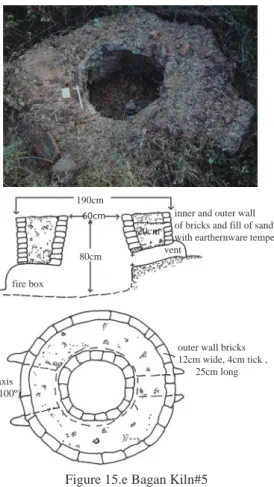
3.1-2 Bagan Kilns and the remnant collected finds (figure 15) Bagan kilns are with updraft kiln type, and with two different forms of circular shape and horseshoe shape. Kiln#1 and #7 are circular in shape with the same size. Among the five smaller