アジア産キイチゴ属の分類学的ノート (6): 新雑種
,カジクマイチゴ
著者 鳴橋 直弘
著者別表示 Naruhashi Naohiro
雑誌名 植物地理・分類研究
巻 58
号 1
ページ 47‑49
発行年 2010‑12‑30
URL http://hdl.handle.net/2297/00053432
Creative Commons : 表示 ‑ 非営利 ‑ 改変禁止 http://creativecommons.org/licenses/by‑nc‑nd/3.0/deed.ja
鳴橋直弘:アジア産キイチゴ属の分類学的ノート(6)新雑種,カジクマイチゴ
Naohiro Naruhashi : Taxonomical notes on Asiatic Rubus( Rosaceae
)(6
)Rubus
×kajikumaichigoNaruh.
,hybr. nov.
1985
年の冬に岐阜県不破郡関ヶ原町関ヶ原インター近くの空き地で,クマイチゴRubus crataegifolius
Bunge
に似たキイチゴ属植物を見つけ,一株富山大学で栽培したところ,よく茂った。翌年よりその植物を観察した結果,クマイチゴの形質とともにその植物にカジイチゴ
R. trifidus Thunb.
の形質も観察された(Fig.
1
)。そこで,この植物をカジイチゴとクマイチゴの自然雑種と推定した。本雑種のカジイチゴとクマイチゴの中間的な形質は,茎の色,葉の切れ込み,托葉の形,葉の縁,花柄の長さ,
苞の形,花の大きさ,花弁の形や開花時の状態などである。この雑種のカジイチゴとの類似形質は,茎,葉柄,
葉裏主脈上,花柄に腺毛があること,初年茎の葉は
5
~7
に深裂すること,花序が集散花序であることである。クマイチゴとの類似形質は,葉の裂片の先端が漸鋭先形であること,ガク片が三角状卵形で先端が尾形である こと,またガク片が開花時外曲すること,果実が赤く熟すことである。
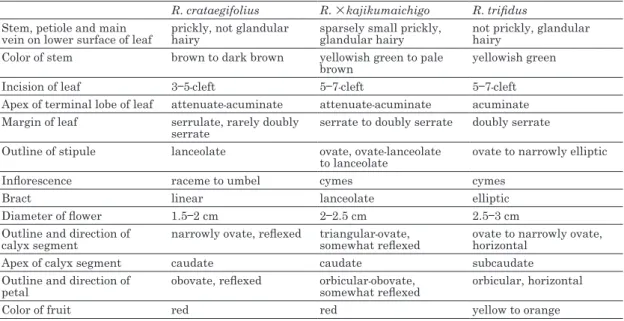
本雑種は,茎,葉柄,葉裏主脈上に小さな刺があること,苞が披針形であること,花弁やガク片が開花時に やや外曲すること,および果実が赤熟することでカジイチゴから区別される(
Table 1
)。また,花序が集散花 序であること,茎,葉柄,葉裏主脈上,花柄に腺毛があること,および苞が披針形であることでクマイチゴか ら区別される(Table 1
)。和歌山県立自然博物館(
WMNH
)収蔵の山元 晃氏採集,1993
年8
月23
日の尾鷲市の標本はステライル 標本ではあるが,この植物と思われた。2
,3
の標本庫で,カジイチゴやクマイチゴのカバー中に,初年茎の 葉が掌状に5
深裂した植物標本があるが,カジイチゴの形質が見られず,これらはクマイチゴの初年茎の葉 の良く切れ込んだ植物と思われる。カジイチゴは
3
月中旬から咲き出し,クマイチゴは4
月に入ると咲き出す,そこでそれらの花期はオーバー ラップすることがある。栽培下の本雑種は果実がよく実り成熟する。これらの種子の発芽能力は未確認である が,地下部の栄養繁殖によって個体数を増やす。標本の閲覧を許可下さった和歌山県立自然博物館の内藤麻子氏と大阪市立自然史博物館の内貴章世氏,原稿 を読んでコメントをいただいた杉本 守氏,及び英文の校閲をしていただいた
Madjit Hakki
氏に心より感謝 いたします。Rubus
×kajikumaichigo Naruh., hybr. nov.
(Fig. 1
)Rubus crataegifolius Bunge
×R. trifidus Thunb.
Haec planta Rubo crataegifolio affinis est, a quo inflorescentiis cymis, caulibus, petiolis, principali-nerv- is foliorum subtus et pedunculis glandulosis, bracteis lanceolatis facile distinguitur. Etiam, haec hybrida Rubo trifido affinis est, a quo caulibus, petiolis et principali-nervis foliorum subtus sparsim breviter acu- leatis, bracteis lanceolatis, petalis et calycibus subreflexis sub anthesi, fructibus rubris facile distinguitur.
Japanese name: Kaji-kuma-ichigo, nov.
Strongly erect shrubs, 1.5
―2 m tall with subterranean rhizomes. Stems stout, yellowish green to pale brown, with sparsely scattered small prickles, pubescent and glandular hairy. Leaves simple, palmately cleft, orbicular to widely ovate, base cordate, 5
―7-cleft on primocane, 3
―5-cleft on floricane, margin ser- rate to doubly serrate, pubescent on vein on upper surface, pubescent and sparsely with small prickles on veins on lower surface. Terminal lobes elliptic, apex attenuate-acuminate. Petioles with sparsely small prickles, pubescent, glandular hairy, 3
―10 cm long. Stipules ovate, ovate-lanceolate to lanceolate, pubes- cent and glandular hairy on margin, 7
―12 mm long, 4
―6 mm wide. Inflorescences terminal, cymes,
(2-
)3
―
6
(-8
)- flowered, pedicel pubescent and glandular hairy, 1
―2 cm long. Flowers 2.5
―3 cm across. Calyces pelviform. Sepals narrowly ovate, apex caudate, somewhat reflexed at flowering. Petals white, orbicular- obovate, somewhat reflexed at flowering, weakly undulate, glabrous, 10
―13 mm long, 8
―11 mm wide. Sta- mens and pistils numerous. Fruits globose, red. Pyrenes kidney-shaped ellipsoidal, reticulate.
Type: Cultivated plant at the garden of University of Toyama, Toyama-shi, Toyama Prefecture
(plant from the place near Sekigahara-Inter, Sekigahara-cho, Fuwa-gun, Gifu Prefecture
), 31 May 2003, N.
-
47
-December 2010 J. Phytogeogr. Taxon. Vol. 58. No. 1
Fig. 1. Rubus×kajikumaichigo cultivated at the garden of University of Toyama, Toyama-shi. A, Primocane ; B, Stipule ; C, A flower ; D, Fruiting plant ; E, Aggregate fruits.
植物地理・分類研究 第 58 巻第 1 号 2010 年 12 月
-
48
-Naruhashi no. 03053101
(holotype, OSA; isotypes, HYO, KYO, MAK, TI, TNS, TOYA
)Specimens studied. Japan. Gifu Pref. Near Sekigahara-Inter, Sekigahara-cho, Fuwa-gun, 29 Decem- ber 1985, N. Naruhashi no. 85122901
(St.
); cult. University of Toyama, Toyama-shi, 12 May 1986, N.
Naruhashi no. 86051201
(Fr.
); 12 April 1986, no. 86041202
(Fl.
); 4 October 1986, no. 86100417
(St.
); 27 April 1987, no. 87042701
(Fl.
); 18 May 1987, no. 87051801
(PFl.
); 5 June 1987, no. 87060503
(Fr.
); 11 May 1988, no. 88051114
(Fl.
); 25 May 1988, no. 88052504
(St.
); 4 June 1988, no. 88060410
(Fr.
): 29 April 1989, no. 89042901
(Fl.
); 27 May 1989, no. 89052701
(Fr.
); 27 May 1989, no. 89052702
(St.
); 12 May 1990, no. 90051204
(St.
); 25 April 1992, no. 92042501
(Fl.
); 23 May 2002, no. 02052303
(Fr.
); 7 December 2002, no. 02120701
(St.
); 12 June 2003, no. 03061201
(St.
); 17 May 2004, no. 04051701
(St.
); 17 May 2004, no. 04051702
(Fr.
); 19 April 2006, no. 06041902
(B
); 28 April 2006, no. 06042805
(Fl.
); 15 December 2006, no. 06121501
(St.
). Mie Pref. Owase-shi, 23 August 1993, A. Yamamoto no. 15391
(St.
)(
WMNH
). Main one set of specimens mentioned above is stored up in the Herbarium of Osaka Museum of Natural History
(OSA
), and the remaining specimens are going to be contributed to other herbaria.
Fl., PFl., Fr., B., and St. each herbarium sheet having flowers, specimen after flowering, specimen having fruits, specimen having buds and sterile specimen of primocane.
Note: The present hybrid was discovered in Sekigahara-cho, Fuwa-gun, Gifu Prefecture in 1985 and has been cultivated at the botanical garden of University of Toyama. Morphological comparison of the hybrid with its presumable parents is shown in Table 1. The hybrid differs from R. crataegifolius by glandular hairs on stems, petioles, main veins of lower surface of leaves and pedicels and lanceolate bracts, and from R. trifidus by sparsely small prickles on stems, petioles and main veins of lower surface of leaves, and red aggregate fruits. Most of the flowers of the hybrid make normal fruits
(Fig. 1E
), but fertilities of those seeds were not examined. This hybrid does a vegetative propagation by an organ under the ground.
The present new hybrid was named after Japanese vernacular name, Kajikumaichigo.
(〒
591
―8022
大阪府堺市北区金岡町1046
―1
Kanaoka-cho 1046
―1, Kita-ku, Sakai 591
―8022, Japan
)(
Received April 26, 2010 ; accepted May 27, 2010
)R. crataegifolius R.×kajikumaichigo R. trifidus Stem, petiole and main
vein on lower surface of leaf prickly, not glandular
hairy sparsely small prickly,
glandular hairy not prickly, glandular hairy
Color of stem brown to dark brown yellowish green to pale
brown yellowish green
Incision of leaf 3―5-cleft 5―7-cleft 5―7-cleft
Apex of terminal lobe of leaf attenuate-acuminate attenuate-acuminate acuminate Margin of leaf serrulate, rarely doubly
serrate serrate to doubly serrate doubly serrate Outline of stipule lanceolate ovate, ovate-lanceolate
to lanceolate ovate to narrowly elliptic
Inflorescence raceme to umbel cymes cymes
Bract linear lanceolate elliptic
Diameter of flower 1.5―2 cm 2―2.5 cm 2.5―3 cm
Outline and direction of
calyx segment narrowly ovate, reflexed triangular-ovate,
somewhat reflexed ovate to narrowly ovate, horizontal
Apex of calyx segment caudate caudate subcaudate
Outline and direction of
petal obovate, reflexed orbicular-obovate,
somewhat reflexed orbicular, horizontal
Color of fruit red red yellow to orange
Table 1. Morphological comparison in Rubus crataegifolius, R.×kajikumaichigo and R. trifidus
-
49
-December 2010 J. Phytogeogr. Taxon. Vol. 58. No. 1