• 検索結果がありません。

DISTRIBUTION OF BUSINESS CATEGORIES AND THE CHARACTERISTICS OF THE TWO MAIN STREETS IN

N/A
N/A
Protected

Academic year: 2021

シェア "DISTRIBUTION OF BUSINESS CATEGORIES AND THE CHARACTERISTICS OF THE TWO MAIN STREETS IN "

Copied!
15
0
0

読み込み中.... (全文を見る)

全文

(1)

GEOGRAPHICAL REPORTS

OF TOKYO METROPOLITAN UNVERSITY 46 (2011) 73-87

- 73 -

DISTRIBUTION OF BUSINESS CATEGORIES AND THE CHARACTERISTICS OF THE TWO MAIN STREETS IN

GEORGETOWN, WASHINGON D.C.

Eiko WADA and Eranga RANAWEERAGE

Abstract In recent years, tourism spaces are changing along with the diversification of the concept of “Tourism”. Subsequently, there is a considerable attention on research focused on capital city tourism. This paper reveals the city of Georgetown in Washington, D.C. as the research target area. Georgetown is a prestigious residential area and a Business Improvement District (BID). There are two commercial corridors, M Street and Wisconsin Avenue, which contain high-end fashion stores, restaurants and bars. The research identifies the difference in commercial concepts of the two streets by analyzing the geographical features and transportation facilities of the two streets. M Street consists of a high variety of business categories targeting different types of people such as tourists, while Wisconsin Avenue has limited business categories with a specific target market such as local residents.

Key words: Georgetown, Washington D.C., capital city tourism, M street, Wisconsin Avenue

1. Introduction

Washington, D.C., the capital of the United States is the world’s economic and political center, as well as a world famous tourism destination with famous tourist attractions such as White House, US Capitol, and Smithsonian Museum Complex. Washington, D.C. is divided into four geographical quadrants; Northwest, Northeast, Southeast, Southwest centering the Capitol. Streets radiate into these quadrants creating several intersections. The cross-streets are named based on the direction of each quadrant. The other streets are like a grid on the map and a well-planned system.

This research focuses on the area called Georgetown in the Northwest quadrant of Washington, D.C (see Fig. 1). Georgetown is a well known, prestigious residential area in Washington, D.C.

and bounded by Georgetown University on the west, Rock Creek, a branch of Potomac River on the east and Potomac River on the south which separates the state of Virginia. The area is about 1.5

Department of Tourism, Tokyo Metropolitan University.

(2)

- 74 - kilometers northwards from Potomac River.

Despite the features of “Urban” have attracted a lot of visitors, urban tourism study has not been gotten an attention. Though urban tourism studies have started since the 1970s, it lacks the construction of the theory and the concept (Page 1995). Capital have tendency to have good accessibility and a lot of famous and historical facilities and commercial facilities so that it attract many visitors. Law (1996) describes that “capital city” can fulfill both requirements for leisure and business, so attracts many visitors. At the same time, “capital city” is not only just famous and big city but also plays a role represent national identity. Hall (2002) focuses on capital city as a tourism destination and suggests the viewpoint of capital city tourism. In response to this, capital city tourism study is getting to become conspicuous (ex. Maitland and Ritchie 2010). Tourism studies recently targets wide range of objects and the viewpoint of capital city tourism should be attracted more attention. Based on an online survey about the image of Washington, D.C., Huang and Lee (2009) explain that Washington, D.C. has received a considerable attraction as a tourism space as well as a prestigious capital city. In case of a capital city, creating an impact on tourists to feel the spirit of a capital city is most important, and offering numerous attractions alone is not enough.

Tourism studies, target capital city, will be more focused and increase in the future. While Huan and Lee describe the image of Washington D.C. as a tourism spot and a capital city, the actual condition of the tourism resource in Washington D.C. should be surveyed. Though there are a lot

Fig. 1 Location of Georgetown.

(3)

- 75 -

of tourism resources in Washington D.C., the commercial area of Georgetown where many travelers to the city visit because of its good accessibility also should be researched.

Georgetown does not have famous political monuments such as US Capitol, however, a prestigious residential area and European style buildings for fashion stores such as COACH, H&M, TOMMY HILFIGER, J. Crew, Ralph Lauren, GAP and ZARA are created in order to generate an impact as a central city in the capital of United States. In addition, the old stone house, the oldest building in Washington, D.C. is also located in Georgetown. Straight-line distance from White House to Georgetown is only two kilometers. This close proximity is also a reason for receiving a high number of tourists. Further, Georgetown is one of the Business Improvement Districts (BID) recognized by the US policy of central city invigoration. According to the policy, a contribution is collected from employers of the city and managed by a NPO to invigorate decaying central cities (Tozaki and Otani 2003). Georgetown became a BID in 1999. According to Georgetown BID’s annual report 2009

1)

, there have been various actions such as activities to improve the appearance of the city (flower baskets on streetlights, more bike racks and sidewalks,

cleaning activities), festivals for rejuvenation of the city, and welfare activities to support homeless people

2)

. Georgetown BID focuses on three streets; M street, Wisconsin Avenue and K Street.

These three areas are considered as the main commercial areas of Georgetown as well as Washington, D.C.

This research describes Georgetown as a tourism space in Washington, D.C., focusing on two main shopping areas, M Street and Wisconsin Avenue which are also included in BID as the main

Fig.2 Study area.

(4)

- 76 -

commercial areas in Georgetown. M Street NW (abbreviated as M Street throughout this paper) lies from east to west in Washington, D.C. and Wisconsin Avenue NW (abbreviated as Wisconsin throughout this paper) lies from north to south until Bethesda, the State of Maryland in northwest of Washington, D.C. The main commercial facilities of Georgetown are concentrated in these two streets consisting various fashion shops, restaurants and bars standing side-by-side which are always crowded at anytime of the day. As shown in Fig. 2, Wisconsin intersects with M Street within Georgetown. Chapter 2 examines the distribution of business categories in these two streets, M Street and Wisconsin Ave., by field survey. The analysis shows that the distribution of the business categories in M Street and Wisconsin Ave. are influenced by the transport facilities in Georgetown. After analyzing the distribution of business categories in two main streets of Georgetown, we estimated how the transportation facilities have an effect on the distribution. The linkage between the feature of the business distribution and accessibility to Georgetown is discussed in terms of availability public transportation in Georgetown. Therefore chapter 3 describes the availability of Georgetown’s public transportation facilities and their access points.

2. Business Category Survey

A field survey was conducted on two days, 26

th

and 27

th

of July 2010 to identify different types of business, their share, and their distribution in M Street and Wisconsin. Six types of business are identified; 1.Garment, 2. Food & Beverage, 3. Interior Design, 4. Sundry, 5.Beauty Culture, and 6.

Other. The first category “Garment” could be further divided into four subcategories; “Men’s Clothing”, “Women’s Clothing”, “Kids Clothing”, and “General-including accessory, footwear, watches and bags”. The second category “Food & Beverage” could also be divided into three subcategories; “Café” including fast food shops, “Pub”, and “Restaurant”.

The number of business categories at each street

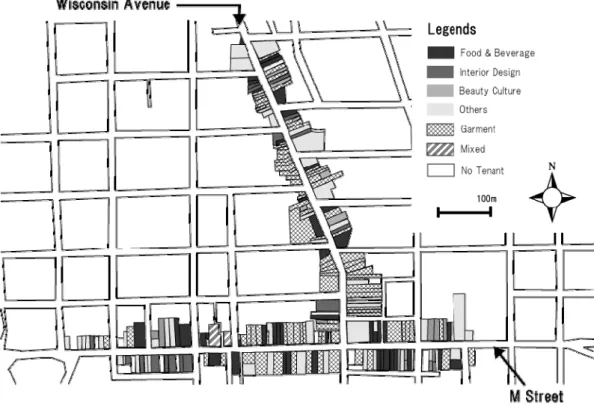
The results of the survey show an obvious difference in the structure of business categories in M Street and Wisconsin. Tables 1 and 2 show the number of business categories in M Street and Wisconsin Ave., and Fig. 3 shows the distribution of these shops. Further, Figs. 4 and 5 show the number of major business categories in M Street and Wisconsin Ave.

In M street, there is a wide variety of business categories, and especially the sixth category

“Other” has the highest number of shops which again shows the wide variation of business types.

In the first category “Garment”, the highest number of shops falls into the subcategory “General”

and the second highest in this category is “Women’s Clothing”. The main noticeable factor of high number of “Women’s Clothing” is the location of shops. These shops are mainly located in the first floor of buildings providing easy access to attract more visitors. Regarding the category “Food

& Beverage”, there are more “Restaurant” than “Café” in spite of the fact that high average

customer spend at “Restaurant”. On the other hand, in Wisconsin, there is a limited type of

(5)

- 77 -

business compared to M Street and the number is only a half of M Street. Main business categories are “Garment”, “Food & Beverage”, “Beauty Culture”, and “Interior Design”. The main characteristic in Wisconsin is that the shops under each category have a specific target market. For example, under “Garment”, there are mainly “Men’s Clothing” stores.

There are various kinds of business categories in M street. Especially “Garment”, mainly targets female customers, is high number.

North South North South North South North South North South North South North South Total

General 1 - 1 0 0 1 8 0 1 2 0 0 11 3 14

Women's 0 - 0 0 1 1 0 5 1 0 0 3 2 9 11

Men's 0 - 0 0 0 0 2 3 0 0 0 0 2 3 5

Kids 0 - 0 0 0 0 0 0 0 0 0 0 0 0 0

Accessories 0 - 0 0 0 0 1 0 0 0 1 0 2 0 2

Shoes 0 - 0 0 0 0 2 0 2 0 0 0 4 0 4

Café 0 - 3 0 0 0 1 2 0 2 0 1 4 5 9

Pub 0 - 0 0 1 0 1 0 2 0 0 1 4 1 5

Restaurant 0 - 0 0 0 1 4 2 2 4 1 0 7 7 14

1 - 0 7 0 0 0 0 0 0 0 0 1 7 8

0 - 2 0 0 0 0 0 0 3 2 3 4 6 10

Sundries 0 - 0 0 0 0 1 0 0 0 0 0 1 0 1

Other 5 - 4 6 1 2 2 3 1 4 4 2 17 17 34

1 - 1 3 2 0 2 0 0 1 0 2 6 6 12

8 - 11 16 5 5 24 15 9 16 8 12 65 64 129

Garment

Food &

Bevarage Interior design

1st 2nd 3rd 4th 5th 6th

Beauty culture

Total

Other categorie No tenant Block total

Total 8 27 10 39 25 20 129

West East West East West East West East West East Total

General 4 3 1 0 2 1 0 0 7 4 11

Women's 2 2 1 0 1 3 1 1 5 6 11

Men's 1 0 3 0 5 2 3 2 12 4 16

Kids 0 1 0 0 0 1 0 1 0 3 3

Accessories 0 3 1 1 1 1 1 0 3 5 8

Shoes 1 2 0 1 3 0 0 0 4 3 7

Café 0 0 0 1 1 2 2 3 3 6 9

Pub 1 0 0 0 0 0 0 0 1 0 1

Restaurant 1 0 2 2 0 0 2 0 5 2 7

1 0 0 1 1 2 2 1 4 4 8

2 0 1 1 0 2 1 2 4 5 9

Sundries 0 0 0 0 0 0 0 0 0 0 0

Other 0 2 0 1 0 4 6 1 6 8 14

1 2 3 0 0 0 0 1 4 3 7

14 15 12 8 14 18 18 12 58 53 111

Garment

Food &

Beverage

1st 2nd 3rd 4th Total

Interior design Beauty culture Other

categories No tenant Block total

Total 29 20 32 30 111

Table 1 Number of business categories of M street

Table 2 Number of business categories of Wisconsin Avenue

(6)

- 78 - Differences depending on the side of the street M Street

M Street lies from east to west of Georgetown and its southern side is close to Potomac River, and also connected with Wisconsin. There is a difference in the distribution of business categories compared to the northern side. Both sides contain a high number of shops which belong to the sixth category “Other.”, However, some categories are not distributed in southern side. For example, regarding the first category “Garment”, shops of “Women’s clothing” are mainly distributed in the southern side while shops of “General” are mainly concentrated in the northern side. Another noticeable difference is the number of shops which belong to the category “Interior Design”. There is only one shop in the northern side while there are seven shops in the southern side.

Wisconsin Avenue

Wisconsin lies from south to north of Georgetown, and joins with M street in the southern part.

The two sides of Wisconsin consist of residencies. As shown in Table 2, the business categories in the west side and the east side are similar. The only difference is the number of “Men’s’ Clothing”

shops. There are twelve “Men’s Clothing” shops in the west side which is three times higher than the east side.

Fig. 3 Distribution of business categories. Source: the authors’ field survey.

(7)

- 79 - Characteristics of each block at the streets M Street

M Street is divided into six blocks (see Fig. 2). The first block begins from the western edge.

There are no buildings in the south side of the street. The shops are concentrated on the north side.

In the neighborhood of these shops, there are buildings which belong to Georgetown University.

The main characteristic of this block is that it has many shops falling into the category “Other”

(see Table 1). The shops in the first block are only concentrated in the North side.

The second block has shops both in north and south sides. There is noticeably a high number of “Interior design” shops, about seven shops concentrated in the south side.

The third block does not have a specific feature due to the short distance of area. This block contains only two types of business categories; “Garment” and “Food & Beverage”.

The fourth block is the widest area in M Street, and at the same time, it has the highest number of shops. This area receives a big number of visitors as it joins with Wisconsin in the east side.

Both north and south sides contain many shops of “Garment” which attract a large number of visitors.

The south side of the fifth block has the highest number of shops, and most of the shops belong to the category “Other”. There is less shops of “Garment.” Regarding the category “Food

& Beverage”, in the fourth block, there are four shops in the north side which locate right in front of two shops in the south side; two shops in the north side and four shops in the south side. In the fifth block, however, there are many restaurants and other types of “Food & Beverage” shops.

Finally, the sixth block has most number of shops in its south side, because the Old Stone House, a famous tourist spot is located in the north side. In this block, there are five shops related to “Beauty Culture”. Among which two shops are located in the north side and three shops in the

Fig. 4 Number of shops at each block in M Street.

1 4 2 2 1 2

5

10

3 6

5 6

2

3

5 1

7 3

2

10 10 3

1

1

3

21

6

4

0 20 40

1st 2nd 3rd 4th 5th 6th

Garment Food&Beverage Interior Design Beauty Culture Other categories No tenant

(8)

- 80 -

south side representing the highest number compared to other blocks. Further, regarding the

“Garment” shops, there is one “General” shop in the north side and three “Women’s Clothing”

shops in the south side. Therefore, shops in the south side mainly target female customers.

Wisconsin Avenue

Wisconsin has impact from other streets differently compared to M Street. Wisconsin lies from south to north in Georgetown. The streets in the west and east in Georgetown go through Wisconsin. The connecting streets from the west and the east take a T-shaped intersection. In Wisconsin, the streets in both sides connect differently. Therefore, the blocks in the west and the east sides are divided arbitrarily (see Fig. 2).

The first block is the area up to the intersection with N Street in both west and east sides. The central business category in this block is “Garment”. The west side has some shops related to

“Food & Beverage”, “Interior Design” and “Beauty Culture” apart from the category “Garment”.

The east side is exclusively “Garments” and “Other”. This locational pattern has a relationship with well-known brand stores. For example, shops like ‘UNITED COLORS OF BENETTON’,

‘Abercrombie & Fitch’, ‘GAP’ are located in the west and ‘GAP Kids’, ‘DIESEL’, ‘RALPH LAUREN’, ‘Adidas’, ‘NINE WEST’, ‘bebe’ are located in the east. Further, ‘UGG’ will open a shop in the east side soon. This distribution of branded shops has influence from M Street which targets a wide range of visitors in the same manner.

The second block covers the area from N Street to O Street in the west and from N Street to Dumbarton Street in the east. This block is narrow in size and half of the west area is a hotel called

“The Georgetown Inn”. However, there are some shops in the first floor of the hotel. Apart from shops which belong to “Other” category, there are restaurants and “Men’s clothing” shops on this

3 3 1

2 1

4

2 2 2 7

1 1 3 3

3

2 5 3

7 19

8

20

9

0 20 40

1st 2nd 3rd 4th

Garment Food&Beverage Interior Design Beauty Culture Other categories No tenant

Fig. 5 Number of shops at each block in Wisconsin Avenue.

(9)

- 81 -

side. The east side of the second block is different from the east side of the first block and has only one “foot wear” shop and one “General” shop. However, there are shops of other business categories.

The third block lies from O Street to P Street in the west and from Dumbarton Street to O Street in the east. In this block, the two sides are not at right angles each other. The category

“Garment” has the highest number of shops in this block, among which “Men’s clothing” are higher than “Women’s clothing” in the west side. On the other hand, there is no much difference in the number of each shop in categories in the east side.

Even in the fourth block, the “Men’s clothing” are higher than the “Women’s clothing”.

Further, there are four cafés.

The fourth block is the area up to the intersection with Q Street. The structure of business categories in the fourth block is identical to the first block. The second and the third blocks have the same tendency with more “Men’s clothing” than “Women’s clothing”. In the fourth block, there are four café shops apart from “Men’s clothing” shops. The area away from M Street has a tendency of having more shops of the category “Café”. As a whole, “Men’s clothing” has the highest number of shops except in the first block. At the same time, there is no “Pub” in Wisconsin except in the first block.

The feature of each street

Variation coefficient is used to clarify the characteristics of the business types in the two streets.

Table 3 shows the variation coefficient by major categories and subcategories. The results of variation coefficient which target the number of subcategories’ shops at each block in the street are different from ones target the number of major categories’ shops at each block in the street.

Computing the variation coefficient of each street by subcategories, the results are 0.89 in M Street and 0.54 in Wisconsin Ave. Computing the variation coefficient of each block in each street, its range is 1.37 in M Street and 0.18 in Wisconsin Ave. These results suggest that the all 6 blocks in M Street have different characteristics. On the other hand, all blocks contain similar

Table 3 Variation coefficient of business types by street and block

Subcategories Major

categories Subcategories Major categories

1st 2.26 1.27 0.86 1.32

2nd 1.56 0.69 0.82 0.75

3rd 1.34 0.75 0.85 1.25

4th 0.89 1.14 1.00 0.57

5th 1.04 0.80 - -

6th 1.32 0.59 - -

total 0.89 0.55 0.54 0.93

Block

M Street Wisconsin Ave.

(10)

- 82 -

characteristics in Wisconsin Ave. The variation coefficient by major business categories is 0.55 in M Street and 0.93 in Wisconsin Ave. which is the opposite of the result for subcategories.

Thus, M Street has variability in subcategories of business compared to Wisconsin Ave.

However, Wisconsin Ave. has a higher variability in terms of major business categories.

3. Public Transportation in Georgetown

It is supposed that the distribution of business categories in M Street and Wisconsin Ave. has been influenced by the flow of people who visit Georgetown. One of measures to visit there is the public transportation. The route of public transportation might be related to the distribution of business categories. This chapter deals with the public transportation in Georgetown. Fig. 6 shows the routes and the names of stations and other public transportation in Georgetown.

Washington Metro Metro

Metro is one of the main transport facilities in Washington, D.C. Metro is also used to access the neighboring states; Maryland and Virginia can also be accessed on metro. It is a convenient means of transport for both residents and tourists. Washington Metro is managed and operated by the Washington Metropolitan Area Transit Authority. It has five railway lines which radiates out from the central Washington, D.C. There is no Metro Station in Georgetown. Therefore, Georgetown residents and visitors have to use the near-by stations. In the west, Rosslyn station in Virginia which is a transfer station for two lines is available. In the southeast, Foggy Bottom GWU station and in the northeast direction, Dupont Circle stations are available. Georgetown is easily accessible from these stations as it is about 1 km from Rosslyn and Foggy Bottom GWU stations, and 1.6 km from Dupont Circle to Georgetown on foot. These stations are in a close distance from M Street, however not directly accessible from Wisconsin. Therefore, people coming from Wisconsin should first come to M Street in order to access these Metro stations.

Metro Bus

As stated earlier, there is no Metro station in Georgetown. However, there is a shuttle bus service operated by Washington Metro to provide access to Washington, D.C.

3)

. The fare is about 1.25 dollars except for one long distance route. These buses can be accessed from both M Street and Wisconsin. There are several bus routes and bus stops in both streets. Buses run every 10 minutes. P Street, O Street and Q Street in Georgetown also have this bus service. The bus routes are connected to nearby stations and it has become an important transport facility for both residents and visitors to Georgetown.

Circulator buses

There are two types of circular bus operating in Washington, D.C.: DC Circulator and Old

(11)

- 83 - Town Trolley.

DC Circulator

DC Circulator is used to access central areas, famous tourist spots and Metro stations. It has five routes. Some DC Circulator routes intersect with roads and can be accessed from nearby bus stops. The bus fare is 1 dollar regardless of the distance. The distance between DC Circulator stops are short. These buses do not always focus on tourist spots. The body of the bus is quite similar to a limousine bus. Therefore, it is more like a normal shuttle bus which is used not only by tourists, but also local residents. There is one DC Circulator line which runs from east to west direction in Washington, D.C. This line runs from the north edge of Wisconsin and then the eastern side of M Street heading to Foggy Bottom GWU station and from there to Union station through K Street.

This line has stops at many places, almost every two blocks. It joins with three routes of other lines at K Street (Fig. 6 shows one of DC Circulator bus’s route which passes through Georgetown).

Old Town Trolley

The second type of circulator bus is called Old Town Trolley. The design of the body is like a trolley and different from a normal limousine bus. This Trolley bus has four lines and operates in the same way as the previous DC Circulator, from and to famous places in Washington, D.C. The difference is that tickets should be purchased at specific shops in advance. The tickets are expensive compared to DC Circulator. For example, the price of two days free pass is 35 dollars.

There are only 19 bus stops for all four lines. All these bus stops are famous tourist spots and there Fig. 6 Route and stops of Trolley bus and Circulator bus. Due to limitations of space, the entire route of

the trolley bus is not shown.

(12)

- 84 -

are gift and souvenir shops nearby. There is one line which passes through Wisconsin Ave. (see Fig.

6. At the same time, it is not a part of the research target area). However, there is no bus stop in Wisconsin. The closest bus stop is the no.17 bus stop at the intersection with M Street and adjacent to a famous shopping mall called Georgetown Park. This line just passes the intersection of Wisconsin and M Street, and do not run in M street. In other words, Trolley Bus mainly focuses on tourism activities and not on usage of general residents.

Other transport facilities

There are taxis and rental bicycles. Further, people living around Georgetown can access M Street and Wisconsin on their own vehicles, however there is very limited parking space available.

There is also a shuttle bus service called “GUTS Bus” which is operated by Georgetown University. However, this shuttle bus service cannot be called a public transport facility as it is only available for Georgetown staff and students

4)

.

Summary of transport facilities

As explained above, there are four types of transport facilities in Washington, D.C.:

Washington Metro, Shuttle bus and two types of Circulator bus. This section examines the impact of these four transport methods on the two main streets (M Street and Wisconsin Avenue) in Georgetown. First, there is no direct impact from Washington Metro as there is no Metro station in these two streets. However, other transport methods such as Metro bus and DC Circulator are operated in M Street to access nearby Metro stations. Metro Bus and DC Circulator are widely used as they run at a reasonable fare. Therefore, M Street plays a role as the transport center in Georgetown. Metro Bus and DC Circulator are used by many people due to the less expensive fare and the availability of bus stops in most places of M Street and Wisconsin Ave. The Trolley bus focuses on tourist destinations. It has a line which runs through Wisconsin. The bus stop is at the intersection of Wisconsin and M Street which provides access to a nearby shopping mall.

Therefore, M Street plays a key role in Georgetown tourism. On the other hand, Wisconsin is not focused on tourism.

4. Discussion

Chapters 2 and 3 dealt with the business categories and their distribution in M Street and Wisconsin along with the main transport facilities in Georgetown. This chapter discusses the difference in business categories of the two streets based on the geographical features and the transportation methods.

Geographical factors

M Street and Wisconsin are closely located, and vertically intersect one another. These two

(13)

- 85 -

streets are commercial corridors with various shops lined up in the sides of the streets. At the same time, M Street and Wisconsin are in a close distance to the residential area. However, M Street has a wide variety of business categories compared to Wisconsin. The area where two streets intersect each other contains a huge number of business types among which “Women’s Clothing” and

“Other” categories are outstanding. In other words, M Street targets various visitors while Wisconsin targets a specific market.

The southern part of M Street which is close to the Potomac River is a commercial area and not a housing area. Main roads called Highway and Parkway can be accessed from the west side of the M Street by crossing the Potomac River and heading to south direction. Further, the edges of the street are connected with Metro stations. In other words, only the northern part of the street is close to the residential area. M Street is also easily accessible from other areas such as Wisconsin Ave.

Wisconsin lies from south to north direction of Washington, D.C. The southern part of Wisconsin is close to Potomac River, and the northern part is up to the State of Maryland’s prestigious residential area called Bethesda. Thus, Wisconsin in Georgetown is directly connected with residential areas and easily accessible from residential areas compared to M Street.

Due to the characteristic of the location mentioned above, Wisconsin is often and widely accessed by the neighborhood residents, while M Street is used by other visitors such as tourists along with the residents. Therefore, specific shops in Wisconsin Ave. target the residents. M street is different from Wisconsin as it is not limited to a certain types of business. Especially, Wisconsin has many “Men’s Clothing Stores” compared to M Street

5)

. At the same time, “Kid’s Clothing Stores” are only located in Wisconsin. These factors show that business in Wisconsin target the daily requirements of local residents. On the other hand, M Street does not target only the neighborhood residents but focuses on attracting various types of visitors. As a result, there are high-end brand shops, “Women’s clothing” shops and other general shops such as accessories, bags and watches.

Impact of transportation conditions

Metro Bus and two circulator buses can be used to access Georgetown and central parts of Washington, D.C. as well as to nearby Metro stations. Especially, DC Circulator fare is cheaper than Metro Bus fare. Circulator buses operate to famous tourist spots and central areas. It has routes passing through M Street as well as Wisconsin. In both streets, there are several bus stops.

Therefore, circulator buses are widely used not only by the tourists as well as local residents. At the same time, these buses operate to nearby stations and the routes lie through M Street. Therefore, M Street plays a key role as the entrance point of Georgetown.

However, DC Circulator does not run in the western part of the intersection which is a residential area. Therefore, DC Circulator buses mainly focus on tourists rather than local residents.

Further, there is another kind of circulator bus called OLD TOWN TROLLEY bus which is only

focused on tourism. Therefore, there is no Trolley bus stop in Wisconsin. Trolley Bus stops only at

(14)

- 86 -

the intersection with M Street where there is a famous shopping mall. This shopping mall in M Street is a tourist attraction. Consequently, the buses stop in M Street. However, Trolley buses do not run within M Street and uses K Street in the south side of Potomac River instead. In other words, Trolley bus does not find any element of tourism in Wisconsin and focus on the area close to the intersection with M Street. In terms of tourism, Wisconsin is not a point of attraction, only the area around the intersection of Wisconsin and M Street is highlighted. As a result, there are many business types in M Streets, especially the area around the intersection with Wisconsin.

Another noticeable factor is that the similar types of business are concentrated in the intersection area.

Further, it is important to study the relationship between the operation of two circulator buses and the distribution of business types. For example, the number of “Interior Design Shops” is the same in both streets. The interior design shops in M Street are more like showrooms of different interiors which are different to home centers. These shops sell general interior good and can be found only in the northern part of the intersection which is not covered by the circulator buses.

This distribution clearly shows that the area of “Interior Design” do not focus on tourism, but only appeal for the needs of local residents.

In addition, there is a shop of rental bicycles in the north side of M Street’s west edge. This is only shop of this type in the study area while there are a few shops selling bicycles there. The location of the shops is very important as the access area of outsiders to Georgetown form neighboring Rosslyn station. Thus, M Street becomes a hub and a central access point in Georgetown.

5. Conclusion

As described in previous chapters, the business concepts of M Street and Wisconsin are different from each other. This difference is influenced by the geographical features such as location and transportation conditions of each street. It is important to investigate the implementation of each transport facility and the transition of business categories in the two streets in order to further analyze the difference in the two streets. It is also necessary to conduct a direct survey on the usage and tendencies of local residents and tourists in M Street and Wisconsin Ave.

Notes

1) Georgetown BID’s annual report of 2009 could be downloaded from its official website.

http://www.georgetowndc.com/_files/docs/gbid_ar2009.pdf (Last accessed date January 21, 2011.)

2) 2009 annual Georgetown BID report can be viewed on the following official site.

http://www.georgetowndc.com/ (Last accessed date November 4, 2010.)

(15)

- 87 -

3) Further details on Metro Bus lines and routes can be viewed on

http://www.wmata.com/pdfs/bus/DC.pdf (Last accessed date October 31, 2010.).

4) In general, it is required to provide the Georgetown Univ. ID when using the GUT services.

However, according to the authors’ experiences during the short term research program at Georgetown University, such identification was not necessary.

5) The most number of “Men’s Clothing Stores” in Wisconsin includes tailor shops and showrooms of men’s suits.

References

Hall, C. M. 2002. Tourism in capital cities. Tourism: An International Interdisciplinary Journal 50(3): 235-248.

Huang, W. and Lee, B. 2009. Capital City Tourism: Online destination image of Washington, DC.

Information and Communication Technologies in Tourism 2009. 7: 355-367.

Law, C. M. 1996. Tourism in Major Cities. London: International Thomson Business Press.

Maitland, R. and Ritchie, B. W. eds. 2010. City Tourism: National Capital Perspectives.

Wallingford UK: C a B Intl.

Page, S. J. 1995. Urban Tourism. London: Routledge.

Tozaki, M. and Otani, E. 2003. Residents initiated community development in the U.S.:

Downtown revitalization at Business Improvement District. Proceedings of AIJ Shikoku Chapter Architectural Research Meeting 3:57-58. *

(* in Japanese)

Fig. 1  Location of Georgetown.
Table 1    Number of business categories of M street
Fig. 3    Distribution of business categories. Source: the authors’ field survey.
Fig. 4    Number of shops at each block in M Street.
+3

参照

関連したドキュメント