Myanmar ʼ s “ Transition Moment ” :
ODA Donors ʼ Technical Assistance/Cooperation
Patrick STREFFORD
1)Abstract
After years of externally imposed international isolation, Myanmar has finally begun a genuine liberalisation of its political system. In the international ODA regime, aid for capacity building is termed technical assistance, and economists such as Paul Collier have argued convincingly that ODA-financed technical assistance could determine the success or failure of such reforms in transition countries.
Without such assistance, the chances of reversal are greatly increased. This paper will investigate the technical assistance given by donors, both its total value and its composition. The basic argument of this paper is that donorsʼ support for Myanmar, in the field of technical assistance, is dramatically short of any amount that could significantly benefit the reform process.
Keywords : Myanmar, democratization, ODA, technical assistance/cooperation, capacity building
I. Introduction
Even just five years ago, it was almost unthinkable to predict that the Myanmar government would undergo such changes as it is now going through, and indeed no one did so. For more than twenty years, because of the perceived slow pace of reform, Myanmar was increasingly isolated internationally and branded a pariah state. However, since coming to office in March 2011, President Thein Sein has instigated a previously unimaginable number of sweeping reforms. A large number of political prisoners have been released (a long-time demand of the international community), a National Human Rights Commission has been established, independent Trade Union Laws have been passed, press censorship has been drastically reduced, and in the words of long-time Myanmar scholar Robert Taylor, there is a
“more open approach to government”2). There is little doubt that Myanmar is in a ʻtransition momentʼ,
the beginnings of a period of great change, and the international community has responded in a positive, if cautious manner, welcoming Myanmar back into the international community. However, considering that, for the last twenty-plus years Myanmar has been governed by a military dictatorship, and for the previous twenty-plus years it was governed by a socialist dictatorship, the amount of reforms necessary to transition Myanmar into a modern open economy, society and polity, are truly immense. A transition on such a scale is fraught with danger, and U-turns are an ever-present threat. The success or failure of such reforms will depend domestically, on the ability of the reform coalition to carry the reforms forward, and internationally, on the response of the international community. This response means timely and sufficient support to empower the reform coalition, enabling it to carry reforms forward.
There are many ways that the international community can support reforms in a country in transition.
However, this paper will focus on one specific type of support that can dramatically improve the chances of such reforms being successful. In any country undertaking such dramatic reforms, the public sector is in the unenviable position of being both the target of reform, as well as being tasked with implementing the reforms. In this way, the public sector is both the problem and the solution, and it is for this reason that public administration reform is a key component of the type of broad and deep reforms that Myanmar is now undertaking. Therefore, the need to improve the ability of the public sector to provide services to the citizens, meaning public sector capacity building, is a prerequisite for sustaining reform.
It is here that the international donor community can play a vital role. Official Development Assistance (ODA), or development aid, often takes the form of Technical Assistance/ Cooperation, the specific purpose of which is capacity building, transferring skills, technology, know-how, etc. from the advanced economies to the developing economies. So, this paper will investigate the technical assistance given by the international donor community to public sector capacity building in Myanmar.
II. Myanmarʼs Transition Moment
According to some observers, Myanmarʼs ʻtipping pointʼ came in 2008 when Cyclone Nargis battered the Irrawaddy delta causing massive loss of life and leaving destruction in its wake. The Myanmar governmentʼs preparations and response were both slow and woefully inadequate, which shocked even some within the military itself3). However, just days after the cyclone, a referendum on the new constitution was held, the result of which was overwhelming support for the new constitution. With the general election held in 2010, the foundations (to the militaryʼs satisfaction) had now been laid to enable the current flurry of reforms.
In some ways, the current wave of reforms is merely the latest manifestation of a program that began
when the military seized power in 1988. PM Khin Nyunt first unveiled this program in 2003 as the “Seven Stage Roadmap to Democracy”, although even after his ousting, subsequent leaders committed themselves to the same roadmap4). The military argued that it was necessary to build the necessary foundations on which such reforms can be safely built, meaning a new constitution and strong military.
Regardless of whether this is the case or not, it is certainly true that the military has been firmly (and increasingly) in control of the state of Myanmar and as such, have indeed laid their foundations for the current reforms. Any observer must accept that the military have created the state in the form that they desired. It just so happens that this has finally begun to be acceptable to the international community (meaning those states of the so-called West). There has been such convergence that cooperation seems to be finally possible.
However, having said that, the chances of reversing the transition to an open society are high. There will inevitably be much resistance from within the group of stakeholders. To overcome this, and to sustain the transition, a reform coalition must be sufficiently broad and powerful. More specifically, the coalition must be ʻinclusive-enoughʼ, meaning that it must contain a wide enough group of stakeholders to outweigh the opposition. It must be seen to represent a large enough proportion of the population to be regarded as ʻinclusiveʼ. Does such a coalition now exist in Myanmar? Certainly the military is represented, and the international community is satisfied with the increasingly prominent role of Aung San Suu Kyi. The increasing role of Aung San Suu Kyi has opened the door to international (Western) investment and aid, which will be crucial for the transition. However, the key to lasting peace in Myanmar will be the participation of the many ethnic minorities living in the periphery of the country.
For these, broadly speaking, the solution is economic development, and this will be the challenge for the government and the international community. The important question of course, is whether the public Thein Sein/Aung San Suu Kyi coalition actually includes sufficient stakeholders to be truly ʻinclusive- enoughʼ, and thus able to carry reforms forward.
After years of military dictatorship, and years of over-investment in the military, the Myanmar military, tatmadaw, is as strong as it has ever been. From the perspective of the military themselves, the
rationale is that the tatmadaw collectively think that they are the only institution in Myanmar capable of running the state and holding the nation together. While this may indeed be true, the types of reforms that are now being initiated need functioning civilian institutions, especially government bureaucracies.
Because of the overemphasis on military institutions and because of the military control over all aspects of the state, the capacity of civilian authorities is extremely low. We know that public institutions must function effectively for economic development to occur, because they provide the public goods that are
the foundation. However, in states undergoing such complete transitions as Myanmar, public institutional capacity is especially important. But, after years of neglect, there is a severe public institutional deficit in Myanmar that threatens to derail the reforms.
III. The International Community and the new rush for Myanmar
It may be that the ʻtipping pointʼ for the international community also came in 2008, in the immediate aftermath of cyclone Nargis. Just two days after Nargis hit Myanmar, US First Lady Laura Bush gave her first ever press conference. She talked very briefly about the cyclone and the US offer of assistance, and then went into a scathing criticism of Myanmarʼs poor human rights record and lack of progress towards democratization5). At the time, these comments were criticized for being insensitive and inappropriate, and even potentially damaging to the relief effort6). This event was clear indication of the dire state of Myanmarʼs international relations. Myanmar had been designated a Pariah State, and had been demonised to such an extent that it didnʼt seem inappropriate to the First Lady to talk in such a manner directly following such a natural disaster.
International aid did eventually flow into Myanmar, under the umbrella of the newly created Tripartite Core Group, which included the Government of Myanmar, ASEAN and the United Nations. While there had been a number of other examples over the years, the Tripartite Core Group was cited as an example of successful international cooperation with the military government of Myanmar7).
From the international perspective, the arrival in office of the new President Barack Obama in 2009 brought new opportunities. The new President almost immediately ordered a review of US policy towards Myanmar, and this review resulted in a significant policy shift. This shift did not include the dropping of sanctions, but did importantly include the opening of dialogue. Whilst the US (and other Western governments) strongly criticised the general election in 2010, they remained committed to continuing a dialogue with the Myanmar government.
The international community was initially extremely guarded in its response to the reforms begun by President Thein Sein when he assumed office in March 2011, although Secretary of State Clinton did visit Myanmar in December 2011. The real ʻrush for Myanmarʼ began after Aung San Suu Kyi was elected to parliament in the by-elections of April 2012. The international community were sufficiently impressed with the progress towards reform since the 2010 elections that they began to ease sanctions. Secretary of State Hillary Clinton said of the elections,
“The results of the April 1st parliamentary by-elections represent a dramatic demonstration of popular will that brings a new generation of reformers into government. This is an important step in
the countryʼs transformation, which in recent months has seen the unprecedented release of political prisoners, new legislation broadening the rights of political and civic association, and fledgling process in internal dialogue between the government and ethnic minority groups.”
The following month, Myanmarʼs Foreign Minister, Wunna Maung Lwin visited Washington, and was warmly received by the US Secretary of State. Reflecting the US administrationʼs positive view of the April by-elections, in the press conference after the meeting between the US Secretary of State and the Myanmar Foreign Minister, Secretary Clinton announced what she termed “the most significant adjustments to our previous policy that have been taken to date”8). This meant that the Secretary of State was announcing the greatest change so far in contemporary US foreign policy towards Myanmar.
After many years of increasing sanctions, this was the most significant reversal in policy, and the biggest step to date in the engagement process with the Myanmar government. Whilst the Secretary of State also announced the nomination of a new Ambassador to Myanmar (the first in over twenty years), she was specifically referring to the lifting of sanctions on American investments in Myanmar. The Secretary of State encouraged US businesses to invest in Myanmar, “to be agents of change”, and “work together to create jobs, opportunity, and support reform”. The sanction on US investments in Myanmar was an Executive Order, so can be overturned by the President. However, other sanctions, such as the 2003 ʻBurma Freedom and Democracy Actʼ or the 2008 ʻTom Lantos Block Burmese Jade (Junta's Anti- Democratic Efforts) Actʼ were made in Congress. These sanctions will need to be unmade in Congress, and this will likely be a slow process.
Also quickly following the 2012 by-election, the Japanese government announced it would cancel 303.5 billion yen, (about US$3.86 billion) of Myanmarʼs debt to Japan. While this amounts to only about 60% of Myanmarʼs outstanding debt to Japan, it importantly allows the Japanese government to disburse
new ODA loans9). The cancelation would be contingent on the joint monitoring of the continued progress towards reform in Myanmar over the following year. The announcement was made after a meeting between Japanese Prime Minister Yoshihiko Noda and Myanmar President Thein Sein that occurred on the sidelines of the Fourth Mekong-Japan Summit held in Tokyo on 21st April 2012. This also amounted to a lifting of Japanese sanctions towards Myanmar. All during the Cold War, until the tatmadaw seized direct power in 1988, Japan was by far the largest aid donor to Myanmar, and the debt was a relic of this era. Furthermore, during the 1990s and 2000s, Japan had continually made the offer of new ODA loans contingent on political and economic reform in Myanmar10), and so it was necessary for Japan to lift the sanctions once the reforms had been acknowledged.
The Council of the European Union announced on 23rd April 2012 that it would suspend sanctions/
restrictive measures on the government of Myanmar, “as a means to welcome and encourage the reform process”11). The arms embargo, the first of the EU sanctions against Myanmar, would not be lifted, but restrictions on Myanmarʼs leadership and companies would be temporarily dropped. Following this announcement the EUʼs foreign policy chief, Catherine Ashton made an official visit to Myanmar, where she met separately with President Thein Sein and Aung San Suu Kyi.
So, in 2012, the sanctions against Myanmar that first began in 1988, and which had been steadily broadened and deepened in the intervening 20-plus years, finally began to be dismantled. How quickly these sanctions can be dismantled will depend not only on the progress of reform in Myanmar, but also on the domestic political economy of those sanctioning states. The easing of sanctions is obviously not just a symbolic gesture of support for the reform effort. The inflow of aid and investment, and accompanying skills and technology, is essential for Myanmarʼs economic development. However, do there exist more specific or targeted methods that the international community could employ to assist the reform effort in Myanmar?
IV. Technical Assistance/Cooperation and Capacity Building
Technical Assistance was first called for in resolution 200(III) adopted by the UN General Assembly on the 4th of December 1948. Importantly, Burma was one of the four countries that were the driving force behind this resolution. The resolution asserted that the lack of expert personnel and technical organization “imped[ed] the economic development of under-developed areas”12). It was therefore, recipient countries themselves who first called for technical assistance, and it was the United Nations that took the lead, creating the Expanded Programme of Technical Assistance in 1950, with a budget of
$20 million. The specialist agencies of the United Nations, along with bilateral donors have been disbursing considerable amounts of technical assistance/cooperation in the intervening sixty-plus years.
As previously mentioned, the economist Paul Collier has argued convincingly that, in the early years of incipient reform, ODA in the form of Technical Assistance/Cooperation “has a big favourable effect” on maintaining reform momentum, and also “substantially reduces the chance that the reform will collapse altogether”13). But, what exactly is Technical Assistance (TA)/ Technical Cooperation (TC), and why can it have such a profound effect in countries in transition?
The term technical assistance is used to mean the provision of personnel (advisers, experts, consultants) with the goal of capacity development in the recipient country. One definition of TA is “the personnel involved (individuals as well as teams of consultants) in developing knowledge, skills, technical know-how or productive aptitudes”14). It is therefore the provision of a service that may or may
not accompany the provision of equipment. As technical assistance is targeting capacity development, the service typically takes the form of training. Traditionally, the personnel carrying out TA came from the donor country, although now the trend is towards broadening this to include so-called South-south cooperation. The location for training sessions can be the recipient or donor country, or a third-country.
The term technical cooperation is used by the Organisation for Economic Cooperation and Development (OECD) to mean the following;
“There are two basic types of technical cooperation: (1) free-standing technical cooperation (FTC),
which is the provision of resources aimed at the transfer of technical and managerial skills or of technology for the purpose of building up general national capacity without reference to the implementation of any specific investment projects; and (2) investment-related technical cooperation (IRTC), which denotes the provision of technical services required for the implementation of specific investment projects.”15)
It seems therefore that Technical Assistance refers to the provision of personnel, while Technical Cooperation includes personnel and other costs, including the provision of materials, and costs related to the training of recipient country nationals in donor countries/ third countries.
TA/TC has long been criticised as being donor-driven. The 1969 Pearson Report on International Development, which reviewed 20 years of World Bank assistance, concluded that “technical assistance often develops a life of its own, little related in either donor or recipient countries, to national or global development objectives” 16).TA/TC is often seen as having a tinge of neo-colonialism in that it is donor- driven, recipient ownership may be extremely limited, and the personnel, while having technical expertise, may have limited knowledge of the culture, politics or institution in which they operate.
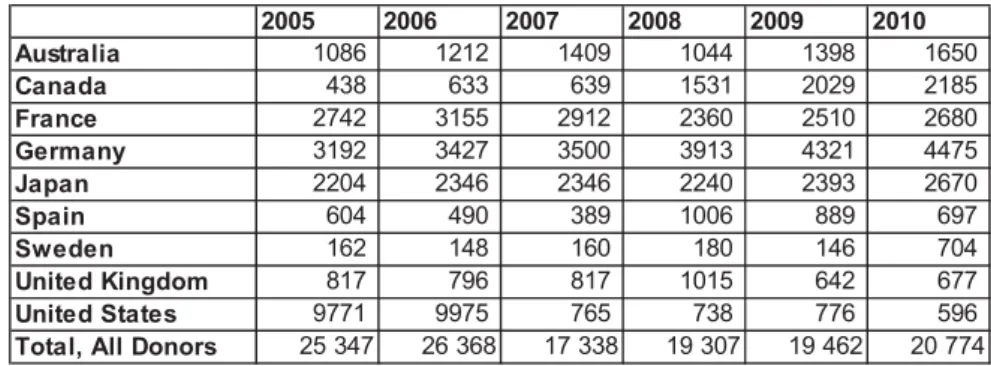
However, conversely, the 1985 OECD report on development cooperation concludes that technical assistance is responsible for the great achievement of aid in transferring and adapting technologies that have had a positive impact in a whole range of development areas, including prolonging life and reducing infant, child and maternal mortality17). Because of this, TC may have amounted to as much as USD 400 billion over the last 50 years18). While TC was just 12.5% of net bilateral ODA in 1964, it had become one- third by 198519). In 1990-91, TC was 22% of total ODA, and in 1995-6, TC was 25% of total OECD donor ODA20). Figure 1 shows OECD/Donor Assistance Committee (DAC) donor countriesʼ technical cooperation between 2005 and 2010. As can be seen, in 2010, TC totalled over US$20 billion, which was just over 20% of the US$90.9 billion total net ODA for that year.
Figure 1: Technical Cooperation for major OECD/DAC donors (US$ millions, 2010 constant prices) Source: OECD. StatExtract
As can be seen from Figures 1 and 2, the percentage of ODA that is TC varies from year-to-year and from donor-to-donor. In 2005, for example, Australian TC amounted to 44% of total net ODA, while Canadian TC for that same year was less than 10% of its total ODA. By 2010, however, Canadian TC had expanded dramatically to over 40% of Canadaʼs total net ODA. In 2010, TC constituted about 25% of Japanʼs net ODA, while German TC made up 35% of its total net ODA. Even though it seems to fluctuate to a considerable extent, we can see that technical cooperation is a substantial component of ODA.
Figure 2: Total Net ODA for major OECD/DAC donors (US$ millions, 2010 constant prices) Source: OECD. StatExtract
It has gained wide acceptance that despite the previously outlined failings of TC it can play a key role in capacity development. The UKʼs Department for International Development (DFID) describes TC as
“one input to the capacity development process”21). However, importantly, in the same document, DFID goes on to say that the countries that most need TC have weak capacity. As previously outlined, it is this capacity that will determine the success or failure of reforms in a transition country.
2005 2006 2007 2008 2009 2010
Australia 1086 1212 1409 1044 1398 1650
Canada 438 633 639 1531 2029 2185
France 2742 3155 2912 2360 2510 2680
Germany 3192 3427 3500 3913 4321 4475
Japan 2204 2346 2346 2240 2393 2670
Spain 604 490 389 1006 889 697
Sweden 162 148 160 180 146 704
United Kingdom 817 796 817 1015 642 677
United States 9771 9975 765 738 776 596
Total, All Donors 25 347 26 368 17 338 19 307 19 462 20 774
2005 2006 2007 2008 2009 2010
Australia 2466 2993 3249 3430 3415 3826
Canada 4920 4399 4472 5053 4561 5209
France 11630 11920 9933 10146 12083 12915
Germany 11233 11477 12197 13066 11557 12985
Japan 15621 14138 9964 11030 9841 11021
Spain 3558 4275 5116 6336 6288 5949
Sweden 3884 4434 4344 4533 4892 4534
United Kingdom 10415 11527 8193 10260 11470 13053 United States 31005 25301 22764 27024 29163 30353 Total, All Donors 82 895 77 268 73 378 86 805 83 665 90 956
In Myanmar, capacity is weak, and this is especially true of non-military public institutions. The World Bankʼs Worldwide Governance Indicators rank Myanmar in the bottom 10% of 215 economies, for
“Government Effectiveness”, “Regulatory Quality”, “Rule of law”, and “Control of Corruption”22). These Governance indicators represent the capacity of the government to provide services to its citizens. Years of military rule prioritised military over non-military institutions, and most non-military public institutions were managed by military officers. The priority given to the military is a common result of military rule, but it has been estimated that upwards of 40% of the national budget went to the military23). Outside of the military, the provision of public services is extremely limited, and this has drastically reduced trust between the state and the citizenry. The restoration of this trust requires strong signals of real change, which must include the expansion of government services, and it is here that technical assistance can have an impact.
Myanmar is an example of the existence of a market for technical assistance. Despite first arguing that donor technical assistance, “had very uneven success in fostering the processes and the institutions needed to underpin and, more importantly, sustain beneficial change”24), Stephen Browne proposes ʻdemand-drivenʼ and ʻcountry-ownedʼ technical assistance25), presumably based on the assumption that in countries such as Myanmar the need does indeed exist.
Technical Assistance to the Republic of Korea after the Korean War, was regarded as one of three areas of foreign aid that were particularly important in helping to build up the physical and social infrastructure that would become the foundations for subsequent development. Technical Assistance assisted in the “expansion of the education system and in technical skills”26).
The public health crisis that was engulfing Myanmar began to be noticed internationally in the early 21st Century. Rates for infant mortality and under-5 mortality are especially high, as are rates for HIV/
AIDS infection. Malaria is endemic in Myanmar, and is regarded as the number one public health issue27). This health crisis is the result of underdevelopment, which includes the low capacity within the public sector.
Obviously this crisis is one of the many imperatives that necessitate the reforms. However, while such capacity building or administrative reforms within the public sector is often presented as a technocratic matter, involving just management techniques and increased efficiencies, it is of course a very political issue. It will alter the balance of power between various stakeholders, as well as between various state institutions. The empowerment of some actors, for example citizens, will inevitably (and intentionally) reduce the power of other actors, for example, civil servants. It is therefore likely that civil servants will resist, possibly vigorously.
When advocating a role for TA in a country in transition it is important to note that the foreign experts cannot push reforms through alone; they are merely advisers. Transforming institutions must be domestically led, country-owned, with foreign experts subordinate to local bureaucrats, while backed by the authority of the reformist leadership. It is of course a paradox that the reforms must be implemented by those very same bureaucrats who are the most likely to resist.
It is because of this that widespread, transformational reforms take a generation. According to the World Bankʼs 2011 World Development Report, “It took the 20 fastest-moving countries an average of 17 years to get the military out of politics, 20 years to achieve functioning bureaucratic quality, and 27 years to bring corruption under reasonable control”. The report then goes on to poignantly add that, “this did not mean perfection, but rather adequacy”28). This is not just because of the vast task of transforming institutions, but also because of the resistance to change that will inevitably arise. The same report advocates a minimum of 15-years of international assistance as being necessary to support most long- term institutional transformations29). While the process is no doubt long and arduous, and while the international community must make a lasting commitment, as previously outlined, it is, according to Paul Collier, in the first few years that TA can ʻmake or breakʼ the transition.
V. Donor technical cooperation with Myanmar
It is not the case that the sanctions against Myanmar resulted in the complete and total suspension of aid. Since the public health crisis came to light, there was a growing recognition, even among donors, that this had, at least in part, resulted from the imposition of sanctions. For example, even as early as 2005, an independent report for the European Commission admitted that regarding development in
Myanmar, “Western trade and investment sanctions have worsened the situation, and the denial of international assistance, by constraining reforms aimed at broad-based economic development, weakens the prospects for national reconciliation and improving the lot of the poor.”30). Because of this imperative therefore, bilateral ODA to Myanmar did increase. Indeed, even while their own governments were continuing to lambast the Myanmar regime, the aid agencies were acknowledging that cooperation with that same regime was both possible and productive. The Joint Programme for HIV/AIDS in Myanmar and the Fund for HIV/AIDS in Myanmar, both of which were established by the UN in 2003 “represent the successful commitment of a variety of partners – international development agencies, the Government of Myanmar, national and international non-Governmental organizations, and the United Nations family to find effective ways of helping the people of Myanmar fight AIDS”31). DFID, one of the financiers of the fund, also regarded it as a success, stating that “policy change is possible: Patient advocacy by NGOs and
the UN on specific issues such as voluntary HIV/AIDS testing has been successful at changing State Peace and Development Council (the military government) policy”32). Such cooperation is an example of the functionalism that seems to always underpin early attempts at international cooperation.
Technocrats from both sides can ignore political issues and focus on specialist areas, where the need for cooperation exists. The model of the functionalist approach to integration, posits that such small scale cooperation will have a ʻspill overʼ effect, providing the foundation for more cooperation in connected specialist areas. It is likely that this same approach would be applicable for TA to public sector capacity building in Myanmar.
Figure 3: Total ODA to Myanmar (US$ millions) Source: OECD. StatExtract
Figure 3 vividly shows the trend in ODA to Myanmar that resulted from the sanctions that began after the military seized power in 1988. However, what is also clear is that the increase in ODA began even before the devastation caused by cyclone Nargis in 2008. Of course, the less-than US$400 million received by Myanmar in 2010 is small when compared to the over-US$700 million received by Cambodia, or the US$1.4 billion received by neighbouring Bangladesh, and in per-capita terms ODA to Myanmar is still very low. In 2010, Myanmar receives just US$7 per-capita ODA, compared to US$52 for Cambodia, US$67 for Laos, and US$34 for Vietnam33). To evaluate these figures in relation to level of development (i.e., need), we can use the Human Development Index (HDI), which is a comprehensive indices encompassing a broad range of measures of development, including health, education and per-capita income. Cambodia (HDI of 0.523, PPP per capita income of $1,848) Laos (HDI of 0.524, PPP per capita
0 100 200 300 400 500 600
1988 1989 1990 1991 1992 1993 1994 1995 1996 1997 1998 1999 2000 2001 2002 2003 2004 2005 2006 2007 2008 2009 2010
income of $2,242) and Vietnam (HDI of 0.593, PPP per capita income of $2,805) are all within the category of Medium Human Development, while Myanmar has a HDI of 0.483 and a per capita income of
$1,535, and is in the category of Low Human Development. Myanmarʼs regional neighbours, despite being “better off”, receive considerably more ODA. Of the US$500 million in ODA in 2008, two-thirds (US$336 million) was humanitarian aid (in response to cyclone Nargis). In 2009, humanitarian aid was about 40% of total disbursals, and in 2010 about one-quarter.
The following figure 4 shows a comparison of donorʼs technical assistance to a number of Asian developing countries. This figure includes the dispatch of experts and other technical assistance only, and so is considerable lower than the figure for technical cooperation. Considering the transition that Myanmar is undergoing, an amount of TA closer to that of Afghanistan would be more appropriate than the current level far below that of Cambodia and Laos.
Figure 4: TA to selected Asian countries, gross disbursements ($US millions) Source: OECD. StatExtract
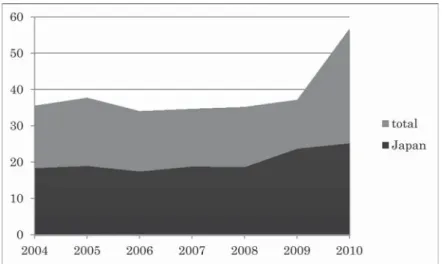
Since the beginning of the 21st Century, despite the (slow but) steady increase in overall ODA, the amount of TC to Myanmar has hardly changed. Figure 5 shows that, until 2010, OECD donor TC to Myanmar remained fairly constant, and that Japan disbursed roughly half of the total. Japanʼs TC includes the relatively high number of Myanmar students/ officials that come to Japan for education and/
or training.
㻞㻞㻜㻝㻜 㻰㼑㼢㼑㼘㼛㼜㼕㼚㼓 㼏㼛㼡㼚㼠㼞㼕㼑㼟㻘 㼀㼛㼠㼍㼘 㻣㻣㻝㻜
㻯㼍㼙㼎㼛㼐㼕㼍 㻠㻝
㻸㼍㼛㼟 㻞㻠
㻭㼒㼓㼔㼍㼚㼕㼟㼠㼍㼚 㻞㻤㻡
㻮㼍㼚㼓㼘㼍㼐㼑㼟㼔 㻢㻥
㻹㼥㼍㼚㼙㼍㼞 㻡㻚㻢
㻿㼞㼕 㻸㼍㼚㼗㼍 㻝㻤
㼂㼕㼑㼠㼚㼍㼙 㻥㻣
Figure 5: OECD donor TC to Myanmar, 2004-2010 ($US millions) Source: OECD. StatExtract
However, the above data masks the real problem. As outlined so far, TA to support capacity building in the public sector is essential to sustain the types of broad and sweeping reforms that Myanmar seems to be now embarking on. It is also the case that the public sector in Myanmar has very low capacity, has suffered from an extreme lack of budgetary resources for an extended period, and has been ʻcapturedʼ by the military. Despite (low capacity and resources) and because (captured by the military) of these trends, ODA to support the public sector in Myanmar has been very limited.
Figure 6: ODA to Myanmar by Sector and Channel, US$ millions (gross disbursements) Source: OECD. StatExtract
Figure 6 shows ODA to Myanmar to the sector, “Government and Civil Society; Total”, which is an OECD category for defining the destination of the ODA. Other sectors include Health, Education, Agriculture, Populations, etc. The data in Figure 5 is for all donors. The two channels, “NGOs and Civil Society”, and “Public Sector” denote the method of disbursal, in that the former is disbursed through
0 1 0 2 9 0 0 2 8 0 0 2 7 0 0 2 SECTOR: Government and Civil Society; Total
31.83 29.449 23.794 32.17
CHANNEL: Public Sector 1.162 3.863 5.320 1.562 CHANNEL: NGOs & Civil
Society
13.362 15.630 13.004 26.227
NGOs or other civil society organisations, and the latter is disbursed through public institutions. It is striking that ODA disbursed through the public sector in Myanmar is a fraction of that disbursed through civil society organisations. Of course this resulted from the sanctions, and the strictly upheld principle of not dealing with/ supporting the military government in any way. The sanctioning states had vilified the Myanmar regime to such an extent that it was impossible for them to provide ODA through the public sector. Because of this, it was also almost impossible for donors to provide TC/TA to the public sector, and this attitude remains to be overcome. However, it is important to recognise that for a government that is still in the early stages of state-building, NGOs are often viewed as a competitor, with the potential to undermine fragile state authority. It is for this reason that new states often view NGOs with suspicion, and do not see them as potential allies. Therefore, an imbalance in donor support for NGOs, at the expense of support for the public sector can have a detrimental effect on economic development in general, as well as on the evolution of state-society relations.
Indeed, further support for this perspective can be found when looking at the details behind the above data for TC ODA to the public sector in Myanmar. For example, in 2010, Finland provided US$132,450 in TC for the public sector in Myanmar. However, in fact, this aid was provided to the (government in exile) National Coalition Government of the Union of Burma (NCGUB), and was for “advice on how best to promote a transition to democracy”. Needless to say, such aid should not be considered public sector, although it vividly indicates the donor perspective. In the same year, Norway also provided TC to the
“recipient government” (channel of delivery name), which was also to support the NCGUB. The fact that
these donors consider the government in exile to be the public sector/ recipient government indicates the dire state of Myanmarʼs foreign relations. This was more than just the result of sanctions, and it shows the extreme behaviour that accompanied the sanctions. There have been countless cases where the sanctioning of a state does not include the complete severing of all ties, and indeed it is usual for dialogue to continue concurrently with sanctions. However, in the case of Myanmar, the sanctioning process was taken to the extreme, and included donor refusals to even meet with Myanmar government officials. There were a number of occasions when EU officials refused to attend ASEAN meetings because Myanmar government officials would be present34).
Like Norway and Finland, in 2010 the Republic of Korea (ROK) also provided TC to the public sector of Myanmar. However, the ROK was providing training to civil servants, and support for capacity building in the judiciary and public finance, which included anti-corruption. Other donors too had been providing very limited ʻrealʼ public sector TA to Myanmar. In 2008, the UK provided US$800,181 for “government economic and development policy/planning”, Australia provided US$51,016 for a “law enforcement
cooperation program”, and New Zealand provided US$726,392 for “English language education for officials”. This is despite pronouncements such as the following one from the UKʼs DFID website, “None of our aid goes through the Burmese Government.”35) It is likely that DFID think it is necessary to advertise this untruth because of the pariah status of the Myanmar government that they themselves had contributed to creating.
So, considering these difficulties and complexities, how have the OECD donors responded to the reforms that began in 2011?
VI. Donor response
According to DFIDs Burma Operational Plan 2011-15, the UK will continue to be a major ODA donor to Myanmar, although “none will go through the central government”. At a May 2012 meeting of the G-8 Prime Minister Cameron reiterated this by stating that “Britain would continue its policy of not giving aid directly to the Burmese government until further progress was made on reform”36). There is no mention of technical assistance for administrative capacity building in the 2011-15 Plan37). According to this document, the UK will continue to provide aid for health and education, as well as to the agricultural sector. However, in 2012, DFID announced that it was providing £750,000 in “Support to the International Financial Institutions to conduct work on the economic opportunities and challenges for Burma”. Recognising both the opportunity (as a result of the reforms) and the constraints (on the operations of the World Bank that remained as a result of the sanctions), DFID proposed financing a World Bank study on the economy of Myanmar, the results of which would become a public good38).
“Because of Burmaʼs human rights record and its debt arrears, IFI [International Financial Institutions]
engagement is currently limited and the IFIs are not able to work directly with Government.” Although the operations of the World Bank are no longer restricted towards Myanmar, this DFID proposal was a novel attempt at circumventing the restrictions that remained from the sanctions-era.
In December 2011, 30 ministry and private sector officials from Myanmar attended a three-week workshop in Japan, which was to be followed by further workshops in Myanmar in 2012. According to the Japan International Cooperation Agency (JICA) the aim of this program is to “support capacity building among government officials”39). This is a continuation of the Prime Minister Obuchi- initiated ʻJapan-Myanmar Cooperation Program for Structural Adjustment of the Myanmar Economyʼ that began in June 2000. It was a JICA-funded project that included a number of workshops in Tokyo and Yangon and completed its report two years later (which was not made public).
The US has drastically reduced its sanctions against Myanmar as part of what the State Department
terms, “principled engagement and an “action-for-action” strategy to respond to the reforms and incentivize further progress”40). However, even though USAID has re-established it Myanmar mission, and even though it recognises the “need and opportunity to engage directly with Burmese organizations and institutions to support political reform”, USAID is yet to announce any new projects in Myanmar, either TC or otherwise41).
In April 2012, the European Union suspended its sanctions for one-year, and in September the European Commission (EC) proposed to reinstate trade preferences to Myanmar. Both are evidence of the recognition within the EU of the reform efforts being undertaken by the Myanmar government.
Although not a Myanmar-specific project, in July 2012, the EC announced €35 million for disaster- preparedness programmes in 2012. The programmes aim to “improve the response capacity and resilience of communities and public institutions”, and Myanmar is named as a recipient42). It seems plausible to assume that this will likely include what has previously been outlined as TC for public sector capacity building. Along a similar line, also in July 2012, the EC announced a new aid project to “ensure birth registration in eight countries”, one of which was Myanmar. Recognising the “first right” (of a child), this project will make registration free, and will enable children to access public services for which registration is often necessary43). It seems safe to assume that this project could also be categorised as TC for public sector capacity building, as registering births obviously falls within the public sector. While these are broad programmes, of which Myanmar is just one member, in 2012 the EU did also announce a €150 million aid package for 2012-13. This was in direct response to the perceived positive pace of reforms in Myanmar. Importantly however, at that time (before the sanctions were suspended), “Burma/Myanmar relations [were] framed by the EU Council Decision that restricts the scope of development cooperation to a number of sectors and work with UN agencies, international organisations and NGOs”44), meaning of course that the EU could not provide aid directly to the Myanmar government. It is likely that the suspension of sanctions will enable the EU to reverse this position, although as yet, no new projects that specifically target capacity building in the public sector have been announced.
It seems then that the 2011 World Development Report is right in its assessment that, “outside the realm of natural disasters, international actors often tend to be more sensitive to the risk that their support will backfire into criticisms of wastage or abuses than to the risk that delays in their support will increase the potential for violence or derail promising reform efforts.”45) Considering this, the donor community, in reversing its sanctions policy, has acted remarkably quickly. It may be of course, that geopolitical considerations, such as countering Chinese influence in this strategically important corner of
South-east Asia, are an important consideration for donors. Certainly, this has long been argued as a reason for at least some level of engagement with the Myanmar government46), and with President Obamaʼs so-called ʻpivotʼ towards Asia, it is likely that the US administration has finally recognized this, and is seizing the opportunity.
ASEAN, as a member of the Tri-partite Core Group on post- Cyclone Nargis Reconstruction, has shown that it can play a key role in channelling OECD donor resources into improving capacity within the public sector. ASEAN has carried out member-wide capacity building programs for many years and these programs could be dramatically expanded, with financial and technical expertise from the international donor community. Indeed, because Myanmar is a member, ASEAN has a natural comparative advantage when compared to the international donor community. There are many examples of successful technical assistance to countries in transition.
In Guatemala, after a 36-year civil war, the national government and the UN set up an International- national institutional partnership called the CICIG (the Spanish language acronym for the International Commission against Impunity in Guatemala). The CICIG provides technical assistance and capacity- building to the National Civilian Police, the Ministry of the Interior and the Public Prosecutor. As of March 2010, the CICIG carried out 1,533 judicial proceedings and arrested 135 individuals47). Such a partnership could be established in Myanmar under the auspices of both the UN and ASEAN.
In Ghana in 2003-4, the United Nations Development Programme (UNDP) and the United Nations Department of Political Affairs (UNDPA) provided technical assistance to the Ministry of the Interior to create a National Architecture for Peace, which supports community dialogue and consensus-building on sensitive issues. While we must recognise that the military government of Myanmar made considerable progress in securing ceasefire agreements with the multitude of ethnic groups, many of the agreements are fragile. Technical assistance will support the process of establishing institutions that can underpin a lasting peace.
Technical assistance could also be provided through UN agencies or ASEAN to the recently established Human Rights Commission. With the passing of new Trade Union laws, the donor community could also provide TA to support the establishment of new trade unions.
VII. Conclusion
After years of self-isolation during the Cold War, and then years more of imposed isolation, Myanmar has finally begun to be reintegrated into the world community.
After years of under-development, the transformation of Myanmar into a modern, prosperous open
society is a mammoth task. All public institutions need to be drastically reformed to enable them to provide those services that underpin economic development. While this is the responsibility of the government of Myanmar, the international community also has a responsibility. Western states initiated sanctions because of human rights violations and the slow transition to democracy. Now that Myanmar is following those policies that the sanctioning states have long advocated, the international community must do all it can to assist. It remains to be seen whether the donor community is able to provide sufficient public sector TA to support the crucial first few years of the reforms. Certainly, considerable rhetoric has been targeted towards supporting the reformers in Myanmar, and the sanctions have been loosened to a considerable extent, but the transition in Myanmar will be facilitated, and the reformers will be empowered, if TA for capacity building in the public sector can be transformed into improved results.
注
1)Associate Professor, Department of International Relations, Kyoto Sangyo University.
2)TAYLOR, Robert H. Myanmar: From Army Rule to Constitutional Rule?, Asian Affairs, Vol. XLIII, No. II, July 2012, page 222.
3)“As Myanmar Changes, So Does Its Leader”, New York Times, April 3, 2012, http://www.nytimes.
com/2012/04/04/world/asia/myanmar-president-praises-weekend-elections.html?pagewanted=all, retrieved 27th July 2012.
4)H-E. U Khin Maung Win, “Myanmar Roadmap to Democracy: The Way Forward”, http://www.ibiblio.org/obl/
docs/KMWroadmap104.htm, retrieved on 12th August 2012.
5)http://www.history.com/speeches/laura-bush-on-myanmar-cyclone, retrieved on 12 Sept 2012.
6)See for example, FROOMKIN, Dan. “Laura Bush's Disastrous Diplomacy”, Washington Post, May 6, 2008.
7) See for example, http://worldvisionmyanmar.net/about-us/message-from-national-director.html, retrieved on 12 Sept 2012.
8)“Remarks With Foreign Minister of Burma U Wunna Maung Lwin After Their Meeting”, http://www.state.gov/
secretary/rm/2012/05/190260.htm, retrieved on 29th August 2012.
9)“Joint Press Statement on Japan - Myanmar Summit Meeting”, http://www.mofa.go.jp/region/asia-paci/
myanmar/thein_sein_1204/joint_press_statement_en.html, retrieved on 29th August 1012.
10)TAKEDA, Isami, “Japanʼs Myanmar Policy: Four Principle, Gaiko Forum, Summer 2001. p. 57.
11)“Council conclusions on Burma/Myanmar”, http://www.consilium.europa.eu/press/council- meetings?lang=ek, retrieved 29th August 2012.
12)STOKKE, Olav. The UN and Development: From Aid to Cooperation. (Indiana University Press, Bloomington), 2009. p. 46.
13)COLLIER, Paul. The Bottom Billion: Why the Poorest Countries Are Failing and What Can Be Done
About It. (Oxford University Press, Oxford), 2008 . p. 114.
14)Europe Aid, 2009, Making Technical Cooperation More Effective, Tools and Methods Series Guidelines No.
3
15) OECD, Glossary of Statistical Terms, http://stats.oecd.org/glossary/detail.asp?ID=6022, retrieved on 29th Nov. 2012.
16) See, for example, OECD Discussion Paper: Technical Assistance for Capacity Development, www.oecd.
org/development/governanceanddevelopment/44696212.pdf, retrieved on 18th Sept 2012.
17)OECD 1985 Report, Twenty-five years of Development Cooperation: A Review. OECD, 1985, p. 17 18)PEARSON, Jenny. “Training and Beyond: Seeking Better Practices for Capacity Development”, OECD
Development Co-operation Working Papers No. 1, 2011. p. 7.
19)OECD 1985 Report, Twenty-five years of Development Cooperation: A Review. OECD, 1985, p. 189.
20)OECD 2005 Report, Efforts and Policies of the Members of the Development Assistance Committee.
OECD, 2005, p. 138.
21)http://www.dfid.gov.uk/mdg/aid-effectiveness/technical-cooperation.asp, retrieved on 18th Sept 2012. 22)See, http://info.worldbank.org/governance/wgi/index.asp, retrieved on 18th Sept 2012.
23)THAWNGHMUNG, A. M. “Burma: a gentler authoritarianism?”, Foreign Policy, 139, Nov/Dec 2003, pp. 39- 40.
24)BROWNE, Stephen, Aid and influence: Do Donors Help or Hinder? (Earthscan, London), 2006. p. 30. 25)Ibid. p. 144.
26)RIDDELL, Roger C. Foreign Aid Reconsidered, (John Hopkins Univ Pr, Baltimore), 1987. p. 250.
27)For a discussion of Myanmarʼs health crisis see, STREFFORD, Patrick. “The International Response to the growing humanitarian crisis in Burma/ Myanmar”, Ritsumeikan Annual Review of International Studies, Vol. 5, 2007, pp. 37-58.
28)World Bankʼs World Development Report, 2011. p. 108. 29)World Bankʼs World Development Report, 2011. p. 193.
30)An Independent Report for the European Commission, Supporting Burma/Myanmar s National Reconciliation process: Challenges and Opportunities, January 2005.
31)Joint Programme for HIV/AIDS in Myanmar and the Fund for HIV/AIDS in Myanmar, Annual Progress Report, http://data.unaids.org/pub/Report/2005/Myanmar_progress_report_03_04_en.pdf, visited on 19 August 2006.
32)DFID, Country Plan for Burma, October 2004, page 8.
33)http://data.worldbank.org/indicator/DT.ODA.ODAT.PC.ZS, retrieved on 23rd August 2012.
34)See, for example, “ASEAN-EU meeting postponed over Myanmar issue”, http://www.tni.org/archives/asem- watch_asem37, retrieved on 12th Sept 2012.
35)http://www.dfid.gov.uk/Where-we-work/Asia-East--Pacific/Burma/, retrieved on Sept 20th 2012.
36)Burma's Aung San Suu Kyi to address parliament on June visit, The Guardian Saturday 19 May 2012 37)DFID, Operational Plan for Burma, 2011-2015 (May 2011).
38)http://projects.dfid.gov.uk/project.aspx?Project=203179, retrieved on 20th September 2012.
39)JICA Press Release, December 20, 2011, Helping to Strengthen Myanmar s Economic Capabilities.
40)Burma Fact Sheet, US Department of State, http://www.state.gov/r/pa/ei/bgn/35910.htm, retrieved on 13th August 2012.
41)See USAID-Burma homepage, http://www.usaid.gov/where-we-work/asia/burma.
42)EC Press Release, 12 July 2012. http://europa.eu/rapid/pressReleasesAction.do?reference=IP/12/774&forma t=HTML&aged=0&language=EN&guiLanguage=en, retrieved on 17th August 2012.
43)EC Press Release, 5th July 2012. http://europa.eu/rapid/pressReleasesAction.do?reference=IP/12/743&forma t=HTML&aged=0&language=EN&guiLanguage=en, retrieved on 17th august 2012.
44)EC Press Release, 10th Feb 2012. http://europa.eu/rapid/pressReleasesAction.do?reference=IP/12/115, retrieved on 17th August 2012.
45)World Development Report 2011, p. 32.
46)STREFFORD, Patrick. “Exclusionary Globalisation: Sanctions, Military Rule and Non-Democratization in Myanmar”. Chapter 3 in Globalization and Human Rights in the Developing World, NAULT, Derrick M and ENGLAND Shawn L. (Editors), (Palgrave Macmillan) 2011. pp. 65-66.
47)World Development Report 2011, p. 190.
References
Browne, Stephen. (2006) Aid and influence: Do Donors Help or Hinder? (Earthscan, London).
Collier, Paul. (2008) The Bottom Billion: Why the Poorest Countries Are Failing and What Can Be Done About It. (Oxford University Press, Oxford).
Department for International Development. (2005) Country Plan for Burma 2005.
Department for International Development. (2011) Operational Plan for Burma, 2011-2015.
Department for International Development website, http://www.dfid.gov.uk European Commission website, http://europa.eu
Ministry of Foreign Affairs (Japan) website, http://www.mofa.go.jp
Nault, Derrick M and England Shawn L. (Editors). (2011) Globalization and Human Rights in the Developing World, (Palgrave Macmillan).
New York Times website, http://www.nytimes.com
Organisation for Economic Cooperation and Development website, www.oecd.org
Organisation for Economic Cooperation and Development. (1985) Twenty-five years of Development Cooperation: A Review.
Organisation for Economic Cooperation and Development. (2005) Efforts and Policies of the Members of the Development Assistance Committee.
Pearson, Jenny. (2011) “Training and Beyond: Seeking Better Practices for Capacity Development”, OECD Development Co-operation Working Papers No. 1.
Riddell, Roger C. (1987) Foreign Aid Reconsidered, (John Hopkins Univ Pr, Baltimore).
Stokke, Olav. (2009) The UN and Development: From Aid to Cooperation. (Indiana University Press,
Bloomington).
Strefford, Patrick. (2007) “The International Response to the growing humanitarian crisis in Burma/ Myanmar”, Ritsumeikan Annual Review of International Studies, Vol. 5.
Takeda, Isami. (2001) “Japanʼs Myanmar Policy: Four Principle, Gaiko Forum.
Taylor, Robert H. (2012) Myanmar: From Army Rule to Constitutional Rule?, Asian Affairs, Vol. XLIII, No. II.
Thawnghmung, A. M. (2003) “Burma: a gentler authoritarianism?”, Foreign Policy, 139. UNAIDS website, http://data.unaids.org
USAID website, http://www.usaid.gov
US Department of State website, http://www.state.gov World Bank. (2011) World Development Report 2011.
World Bank website, http://data.worldbank.org World Vision website, http://worldvisionmyanmar.net
ミャンマーの遷移モーメントと国際社会:
ODA 拠出国の技術援助
ストレフォード・パトリック
要 旨
外的強制による数年間の国際的孤立の後、ついに、ミャンマーは、その政治制度の純粋な自由化を開 始した。国際的なODAレジームでは、キャパシティー・ビルディングへの支援は技術援助と名付けられ ている。ポール・コリヤーのような経済学者は、ODAによる技術援助が、変動期の諸国における、その ような改革の成否を決めるかもしれないと説得的に主張している。この論文は、ドナーによる技術援助、
その全体的価値そしてその構成を検討する。本稿における基本的な論点は、技術援助の分野におけるド ナーのミャンマー支援に関して、改革プロセスに大きく貢献するためにはその分量が劇的に不足してい るということである。
キーワード:ミャンマー、民主化、ODA、技術援助、キャパシティー・ビルディング