Fukushima Medical University
This document is downloaded at: 2021-11-08T00:16:13Z
Title Predicting Falls from Behavioral and Psychological Symptoms of Dementia in Elderly People Residing in Facilities( 本文 )
Author(s) 佐藤, 勢
Citation
Issue Date 2019-03-22
URL http://ir.fmu.ac.jp/dspace/handle/123456789/969
Rights
© 2018 Japan Geriatrics Society. This is the peer reviewed version of the following article: [Geriatr Gerontol Int. 2018 Nov;18(11):1573-1577], which has been published in final form at [https://doi.org/10.1111/ggi.13528]. This article may be used for non-commercial purposes in accordance with Wiley Terms and Conditions for Use of Self-Archived Versions.
DOI
Text Version ETD
論 文 内 容 要 旨(和文)
学位論文 題名
施設に入所している認知症高齢者の行動・心理症状は、
転倒の予測因子になりうるか
目的
本研究の目的は、介護老人保健施設に入所している認知症高齢者を対象に、入所 時の認知症の行動・心理症状が転倒の予測因子になりうるか検討した。
方法
日本の福島県内にある
3
つの介護老人保健施設を対象施設とした。2013年5
月 から2014
年11
月までの期間に入所した305
名のうち、長谷川式スケール20
点以 下の者、242名(男性74
名、女性168
名)を解析対象とした。認知症の行動・心理症 状の項目は、介護認定調査票第4
群の15
項目を用いた。入所時の認知症の行動・心理症状の各項目が入所半年以内の転倒と関連があるか
Cox
比例ハザードモデルを 用いてハザード比および95%信頼区間を計算し、分析した。
結果
非転倒者は
242
名中、非転倒者は153
名、転倒者は89
名であった。性、年齢、お よび単変量分析にて転倒と有意な関連を示した介護度、日常生活動作、過去の転倒 歴を調整したうえで、認知症の行動・心理症状が転倒に与える影響をみたところハ ザード比(95%信頼区間)は‟一人で外出したがる”2.23(1.35-3.68)、‟自分勝手に行動 する”1.94(1.24-3.04)の行動症状2
項目で有意に上昇した。結論
入所時に‟一人で外出したがる”、‟自分勝手に行動する”の認知症の行動・心理症状 がみられた者は転倒の危険性が高いため、転倒の可能性を早期に予測し、見守りや 環境調整など十分な注意や対応が必要である。
Geriatrics & Gerontology International
平成
30
年9
月20
日、DOI:10.1111/ggi.13528Abstract and keywords Aim
The aim of this study was to examine whether behavioral and psychological symptoms of dementia at the time of admission could be a predictor of falls in elderly people with dementia residing in geriatric health service facilities.
Methods
Three geriatric health services facilities located in Fukushima Prefecture, Japan were the targeted facilities. Of the 305 people admitted between May 2013 and November 2014, 242 (74 males, 168 females) who scored 20 or less points on the Hasegawa Dementia Scale-Revised were targeted for analysis. Fifteen items from the Long-term Care Certification Questionnaire Group 4 were used to assess behavioral and psychological symptoms of dementia and were compared by presence or absence of falls.
Results
Of the 242 subjects, 153 were non-fallers and 89 were fallers. After adjusting for sex, age, Revised Hasegawa Dementia Scale-Revised, degree of care (which showed a significant relationship with falls in univariate analysis), activities of daily living, and history of falls, the influence of behavioral and psychological symptoms of dementia on falls was examined, and showed a significant association with falls and a significant increase of hazard ratio (95 % confidence interval) for the behavioral symptoms “wandering” 2.23 (1.35-3.68) and “agitation” 1.94 (1.24-3.04).
Conclusion
Because the risk of falling is high for residents who at the time of admission have the behavioral and psychological symptoms of dementia of “wandering” and
“agitation,” it is necessary to predict the possibility of falling at an early stage, monitor the residents, and adjust the environment.
Keywords: behavioral and psychological symptoms of dementia, elderly with dementia, falling, falling factors, long-term care geriatric health facilities,
abbreviation
behavioral and psychological symptoms of dementia (BPSD) Hasegawa Dementia Scale-Revised (HDS-R)
activities of daily living (ADL) the long-term care insurance (LTCI) standard deviations (SD)
Hazard ratios (HRs)
the 95% confidence interval (95% CI)
I. Introduction
The number of elderly people with dementia has increased with the aging of the population. According to the Japanese Ministry of Health, Labor, and Welfare's report in January 2015, the number of elderly people with dementia in Japan was estimated at 4.62 million. If we include those with Mild Cognitive Impairment (MCI), this total reaches 8.62 million.1 This means that a quarter of elderly people aged 65 and over will face dementia. Worldwide, totals are projected to increase from 35.6 million people in 2010 to 65.7 million people in 2030 and 115.4 million people in 2050.2
With the progression of dementia, the risk of falling rises. It has been reported that the risk of falling is eight times higher in elderly people with dementia than in those without dementia.3 Furthermore, Harlein et al. reported that the risk of falls in elderly people with dementia is related to dementia-related movement disorders, visual impairments, the type and severity of dementia, behavioral and psychological symptoms of dementia (BPSD), history of falls, and psychotropic medication use.4 Therefore, in order to prevent elderly people with dementia from falling, it is important to pay attention to a variety of related topics.
With dementia, memory loss, higher-order dysfunction, and deficits in executive function are defined as core symptoms, whereas BPSD occur as elderly people with core symptoms of dementia respond to interactions with people and their surrounding environment in the form of hallucinations, delusions, agitation, day and night reversal, wandering, aggression, and others.5,6 Studies of non-drug interventions for Alzheimer type dementia and psychotherapy with randomized controlled trials reported that 43% of their participants had improved BPSD.7,8 These results demonstrate a high possibility of improvement of BPSD, although it is difficult to fundamentally improve core symptoms at the present moment, so it is important to focus on and respond individually to BPSD with the prevention of falls for the elderly with dementia. In addition, Aalten et al. carried out principal component analysis on 12 BPSD items, extracted four factors, and stated that it is effective to treat each factor separately.9,10
To prevent people with dementia from falling, it is important to clarify the relationships between falling and each problem as BPSD with dementia. Past studies have indicated that some items such as confusion, wandering, agitation and unsteady gait were related to falling among the community dwelling elderly. 11, 12 On the other hand, other studies about falling of people with dementia, BPSD were assessed via a total score. This suggested that the relationship between falling and each BPSD remains unknown.
The purpose of this study was to investigate whether the corresponding presence of BPSD items at early admission could be a predictor of subsequent falls for elderly people with dementia who are in long-term care geriatric health services facilities.
II. Methods
1. Subjects and Investigation Period
A retrospective cohort design was used for this research. Three geriatric health services facilities (100 beds each) in Fukushima Prefecture, Japan were selected as target facilities. Of the 305 people admitted between May 2013 and November 2014, 242 (74 males, 168 females) who scored 20 points or less on Hasegawa Dementia Scale-Revised (HDS-R) were included in the survey. (Figure 1)
2. Tracking Method
The subjects were tracked for up to 180 days, starting from the date of their admission. The reason for the tracking period was because the average length of stay in the target facilities was 180 days. It was determined that the first fall would be an event occurrence in all three facilities, andthe definition of a fall was "to make contact with the ground or a lower location with a hand or knee, not by one’s own will".13 For those who stayed less than 180 days, tracking was done until their departure.
3. Survey Items
Personal data and falling data of the subjects were extracted from the medical records and accident reports maintained by the facilities. Based on each subjects condition at the time of admission, we extracted data on sex, age (years), height (cm), weight (kg), HDS – R (points), care need levels in the long-term care insurance system (level 1 to level 5), method of movement, activities of daily living(ADL), use of sleeping pills and/or tranquilizers, presence or absence of a history of cerebrovascular disorder, presence or absence of a history of bone and joint disease (osteoarthritis, fracture of bones, etc.), residence before admission (selected from either home, hospital, or facility) and history of falls in the preceding 12 months, in addition to the initial BPSD at admission.
ADL were classified into four levels J (independent), A, B, and C (requiring whole care), according to the independence degree of daily living for the disabled elderly.14 This scale was created to assess the degree of daily living independence of elderly people with some disabilities by public health nurses, etc. in a short time in facilities or regions of Japan.
BPSD were investigated within two weeks of admission using 15 items from the Long-term Care Certification Questionnaire Group 4.15,16,17 These 15 items are required in Japan for monitoring of the long-term care insurance (LTCI) system. The 15 items were classified into psychological symptoms and behavioral symptoms based on previous research. The psychological symptoms included the four items:
“people are stealing things”; “misidentifications”; “house is not one's home”; and
“hallucinations”; and behavioral symptoms were the 11 items: “crying”; “circadian rhythm disturbances”; “repetitive questioning”; “screaming”; “resistiveness to care”;
“wandering”; “repetitive mannerisms”; “physical aggression”; “repetitive anxious complaints”; “repetitive sentences”; and “agitation”.18 The answers were classified into three groups: “Yes” if the symptoms appeared with a frequency of at least more than once per week; “Occasionally” for a frequency of more than once per month but less than once a week; and “No” for no appearances in the last month or rarely more than once per month. Interviewers that had been working for more than five years in the same facility and were certified as either care workers, physical therapists, occupational therapists, or speech-language-hearing therapists, and they evaluated the BPSD and ADL of the subjects. In addition, preliminary training sessions were held for the interviewers to maintain the quality of the study.
4. Statistical Analysis
The subjects were divided into two groups according to the presence or absence of falls during 180 days. For continuous variables, the mean values and standard deviations (SD) were calculated and compared by using Student's t-test. For categorical variables, frequency and ratio were calculated and compared by the chi- square test. Hazard ratios (HRs) and the 95% confidence interval (95% CI) were calculated and analysis was performed using the Cox proportional hazard model
with the presence or absence of falls as a dependent variable and the presence or absence of BPSD as an independent variable. Confounding factors were sex, age, HDS-R, history of falls, level of care required, and ADL.
5. Ethics Committee Approval
This study was approved by the Fukushima Medical University Ethics Committee (Approval number 1188). All data was treated as work-related information, and it was received and analyzed after anonymization at the facility.
We obtained all data from work related information. Instead of informed consent from every subject, we asked for understanding by publishing detail of the study on the homepage on the university and on-site posting in the facility.
III. Results
Table 1 shows the characteristics of the subjects at admission. Of the 242 subjects, 153 (63.2%) were non-fallers and 89 (36.8%) were fallers. There were 168 females and 74 males, with an average age (SD) of 85.3 (7.7) years old. The median (25th - 75th percentile) number of days tracked was 84 (27-122) days.
As for the subjects distinguishing features of subjects, 73.6% had B or C levels of ADL, and 72.3% used wheelchairs as their primary means of movement. Care level 1 had the fewest number of fallers. ADL had many fallers at Level A and fewer fallers at Level C. Level J, a level where outdoor movement is possible, was not included because subjects were nursing care facility residents. Significant difference in care levels (p = 0.027), ADL (p = 0.001), and history of falls in the preceding 12 months (p
<0.001) were observed between fallers and non-fallers.
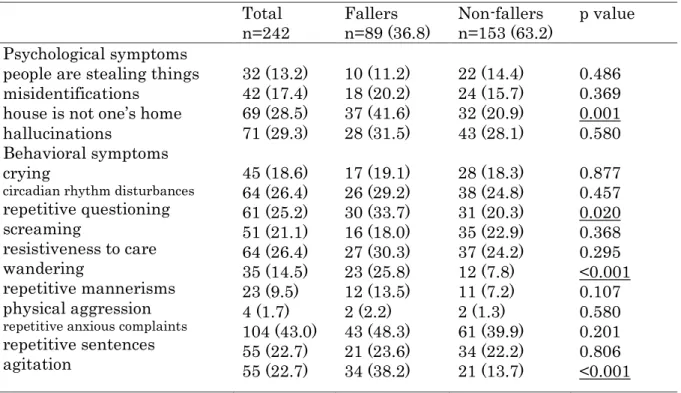
Table 2 shows the prevalence of each BPSD items. The most prevalent BPSD among all subjects were “repetitive anxious complaints” (104 subjects, 43.0%) and
“hallucinations” (71 subjects, 29.3%), while the rarest were “physical aggression”
(four subjects, 1.7%) and “repetitive mannerisms” (23 subjects, 9.5%). "Repetitive questioning" (p = 0.020), "house is not one’s home" (p = 0.001), “wandering" (p
<0.001), and “agitation” (p <0.001) showed the significant higher prevalence for fallers.
Table 3 shows the Cox proportional hazard model. Analysis of the results after adjusting for sex and age, two items showed the hazard ratio for falling significantly, for “house is not one’s home” (HR 1.63, 95%CI 1.07 - 2.49), “wandering" (HR 2.46, 95%CI 1.51 - 3.99), and “agitation” (HR 2.15, 95% CI 1.39 - 3.31). After adjusting for sex, age, HDS-R, care levels, ADL, and history of falls, two behavioral symptoms,
“wandering” (HR 2.23, 95%CI 1.35 - 3.68) and “agitation” (HR 1.94, 95%CI 1.24 - 3.04), were significantly increased in the fallers.
IV. Discussion
The result of the current study suggests that there is a possibility that two BPSD items at the time of admission, “wandering” and “agitation”, may be strongly related to subsequent falls. To I knowledge, while past studies focused on the community dwelling elderly,11,12 we are the first to report that "wandering" and "agitation" of dementia residents in care facilities. In light of past study, that "wandering" and
"agitation" were commonly found among people with dementia.19 We believe that monitoring such symptoms and providing adequate support will contribute to the prevention of falls among many dementia patients.
As Aalten et al.9,10 proposed, we also found that specific behavioral symptoms contributed to the risk of falls.
There were 89 fallers (36.8%) in the present study, which is consistent with the findings to past research20 into critical care nursing home residents (37%). This indicates that the participants of this study were representative of elderly people in current facilities.
Based on the results of distinguishing features of the falling factors of residents, few participants with severe care levels fell; however, many residents with care need level causing difficulty in walking fell. Thus, we believe that the subjects who require light assistance in daily living, including help with getting into and out of their wheelchair due to deterioration in physical functions such as muscle weakness and decline of health conditions and had many opportunities to fall. People with a severe degree of physical deterioration have difficulty in moving with their own strength, since they are in a long-term bed, and they required heavy assistance. On the other hand, it is thought that people with a mild degree of deterioration had more physical function than people with a severe degree, and they had more opportunities to fall because of a greater amount of activity.
Similar to the results of past study21, a history of falling was found to be one of the risk factors for falls in the current study. When receiving new residents, assessing the history of falls is important to prevent future falls. For those who have a history of falls, it is necessary to keep watch, adjust the environment, and pay attention for falls because there is a high possibility of falling.
The prevalence of BPSD in this study was 69.0%, and 167 out of 242 subjects had more than one BPSD. A past study in Japan reported a BPSD prevalence of 88.3%.19 In addition, a past BPSD study included apathy as a behavioral symptom when calculating prevalence, which may be a reason for the difference with the prevalence of this study, which did not make apathy a survey item. In addition, there is a possibility that the difference of subjects may have an effect because the past research was aimed at local residents.
According to studies conducted outside Japan, the prevalence of BPSD symptoms varies by country. For example, the symptom of screaming had a low rate of 9% in England compared to about 30% in the United States and Japan. Therefore, it is important to evaluate each individual symptom of BPSD.22,23
The symptoms of “repetitive questioning”, “house is not one’s home”, “wandering”, and “agitation” showed significant difference for falls in univariate analysis. Among those, the behavioral symptoms of “wandering” and “agitation” had a high possibility of leading to falls in the future, so people with these symptoms need to be monitored carefully. “Desire to return home”, one of the delusions of psychological symptoms which might lead to “wandering” and “agitation” that cause falls. Furthermore, it is thought that there are many cases of falling after hitting an obstacle and losing balance due to declining attention, judgment, and physical function. Actions that cause falls are manifestations of the will of the elderly with dementia wishing to do something, and it is necessary to anticipate the intention of their actions and provide aid. At the same time, it is necessary to keep watch more vigilantly over those who exhibit “wandering” and “agitation” symptoms in order to prevent falls.
As for effective interventions, empirical research has begun to focus on case reports. Psychotherapy has been effective for treating agitation in Alzheimer type dementia.7 In addition, there are reports that interventions such as music therapy, which is a non-pharmacological treatment, dual-task rehabilitation, and person centered care, and more. are also effective countermeasures to agitation and aggressive behaviors of dementia symptoms.24,25,26 From these reports, it is thought that because these interventions for individual BPSD are gradually accumulating
despite being in the research stage, implementing effective interventions will certainly improve and prevent deterioration of symptoms, as well as lead to the prevention of falls.
This research suggests that two behavioral symptoms of dementia, “wandering”
and “agitation”, exhibited by residents at the time of admission to geriatric health services facilities may be closely related to subsequent falls. Care must be taken as those two specific behavioral signs contribute to the risk of falls.
Limitations
Although this study investigated the use of tranquilizers and sleeping pills, we used only existing data, so we could not confirm the medication details. Further studies are needed to investigate detailed medication contexts and check whether falls are adversely affected or not.
V. Acknowledgments
I wish to express deepest appreciation to the residents and staff of the geriatric health services facilities who cooperated in this research.
VI. Disclosure statement Funding
This study was funded by Taiyo Life Welfare Foundation, Japan.
Conflicts of interest
Sei Sato is employed by one of the health care facilities for the elderly.
VII. References
1. Creation of pamphlets on the Comprehensive Strategy for the Promotion of Dementia Measures [Cited 27 Jan 2015] Available from:
http://www.mhlw.go.jp/file/04-Houdouhappyou-12304500-Roukenkyoku- Ninchishougyakutaiboushitaisakusuishinshitsu/02_1.pdf (in Japanese).
2. World Alzheimer’s Report 2009. Alzheimer’s Disease International. [Cited 13
Nov 2017] Available from:
https://www.alz.co.uk/research/files/WorldAlzheimerReport.pdf.
3. Allan LM, Ballard CG, Rowan EN, Kenny RA. Incidence and Prediction of fall in Dementia: A Prospective Study in Older People. PLoS ONE 2009; 4: e5521.
4. Harlein J, Dassen T, Halfens RJ, Heinze C. Fall risk factors in older people with dementia or cognitive impairment: a systematic review: J Adv Nurs 2009; 65:
922-933.
5. Maurer K, Volk S, Gerbaldo H. Auguste D and Alzheimer’s disease. Lancet 1997;
349: 1546-1549.
6. Cerejeira J, Lagarto L, Mukaetova-Ladinska EB. Behavioral and psychological symptoms of dementia. Front Neuro 2012; 3: 73.
7. Ballard C, Brown R, Fossey J, et al. Brief Psychosocial Therapy for the Treatment of Agitation in Alzheimer Disease (The CALM-AD Trial). Am J Geriatr Psychiatry 2009; 17: 726-733.
8. Sakamoto Y, Ebihara S, Ebihara T, et al. Fall Prevention Using Olfactory Stimulation with Lavender Odor in Elderly Nursing Home Residents: A Randomized Controlled Trial. J Am Geriatr Soc 2012; 60: 1005-1011.
9. Aalten P, Verhey FRJ, Boziki M, Bullock R, Byrne EJ, Camus V et al.
Neuropsychiatric syndromes in dementia. Results from the European Alzheimer
Disease Consortium:part I. Dement Geriatr Cogn Disord 2007; 24: 457-463.
10. Aalten P, Verhey FRJ, Boziki M, et al. Consistency of Neuropsychiatric Syndromes across Dementias: Results from the European Alzheimer Disease Consortium. Part II. Dement Geriatr Cogn Disord 2008; 25: 1-8.
11. van Doorn C, Gruber-Baldini AL, Zimmerman S, et a. Dementia as a Risk Factor for Falls and Fall Injuries Among Nursing Home Residents. J Am Geriatr Soc 2003; 51: 1213-1218.
12. Bunn F, Dickinson A, Simpson C, et al. Preventing falls among older people with mental health problems: a systematic review. BMC Nurs. 2014; 13: 4
13. Gibson MJ, Andres RO, Isaacs B, Radebaugh T, Worm-Petersen J. The prevention of falls in later life. A report of the Kellogg International work group on the prevention of falls by the elderly. Dan Med Bull 1987; 34: 1-24.
14. Uza M, Tome K, Imai M, Danboku K, Suzuki M. A Study of Case Finding of the Latent Bedridden Elderly Using Criteria of Activity of Daily Living. Jpn J Health & Human Ecology 1997; 63: 79-89.
15. Moriya S, Murata A, Kimura S, Inoue N, Miura H. Predictors of eligibility for long-term care funding for older people in Japan. Australas J Ageing 2013; 32:
79-85.
16. Tsutsui T, Muramatsu N. Care-Needs Certification in the Long-Term Care Insurance System of Japan. J Am Geriatr Soc 2005; 53: 522-527.
17. Health and Welfare Services for the Elderly-Outline of Long-Term Care Insurance System. [Cited 13 Nov 2017] Available from:
http://www.mhlw.go.jp/english/wp/wp-hw9/dl/10e.pdf.
18. International psychogeriatric association: The IPA Complete Guides to Behavioral and Psychological Symptoms of Dementia (BPSD) [Cited 13 Nov
2017] Available from:
http://www.bsa.ualberta.ca/sites/default/files/____IPA_BPSD_Specialists_Guid e_Online.pdf.
19. Ikeda M, Fukuhara R, Shigenobu K, A et al. Dementia associated mental and behavioural disturbances in elderly people in the community: findings from the first Nakayama study. J Neurol Neurosurg Psychiatry 2004; 75: 146-148.
20. Niino N, Nakamura K. Circumstances and Factors Related to Falls in the Institutionalized Elderly. Jpn J Geriat 1996; 33: 12-16.
21. Developed by the Panel on Prevention of Falls in Older Persons, American Geriatrics Society and British Geriatrics Society. Summary of the Updated American Geriatrics Society/British Geriatrics Society clinical practice guideline for prevention of falls in older persons. J Am Geriatr Soc 2011; 59: 148-157.
22. Lyketsos CG, Lopez O, Jones B, Fitzpatrick AL, Breitner J, Dekosky S.
Prevalence of Neuropsychiatric Symptoms in Dementia and Mild Cognitive Impairment Result From the Cardiovascular Health Study. JAMA 2002; 288:
1475-1483.
23. Sawa GM, Zaccai J, Matthews FE, Davidson JE, Mckeith L, Brayne C.
Prevalence, correlates and course of behavioural and psychological symptoms of dementia in the population. Br J Psychiatry 2009; 194: 212-219.
24. Clark ME, Lipe AW, Bilbrey MB. Use of music to decrease aggressive behavior in people with Dementia. J Gerontol Nurs 1998; 24: 10-17.
25. Smith-Ray RL, Irmiter C, Boulter K. Cognitive Training among Cognitively Impaired Older Adults: A Feasibility Study Assessing the Potential Improvement in Balance. Front Public Healths 2016; 4: 219.
26. Chenoweth L, King MT, Jeon YH et al. Caring for Aged Dementia Care Resident
Study (CADRES) of person-centred care, dementia-care mapping, and usual care in dementia: a cluster-randomised trial. Lancet Neurol 2009; 8: 317-325.
Figure legends
Figure 1.Criteria to register and exclude participants, Tracking Method
Table 1.Comparison of characteristics between fallers and non-fallers n(%) or mean±SD
†: Hasegawa Dementia Scale – Revised
‡: activities of daily living
Fallers n=89 (36.8)
Non-fallers n=153 (63.2)
p value Male
Age (in years) Height (cm) Weight (kg) HDS-R†(points) Level of care required Care Level 1
Care Level 2 Care Level 3 Care Level 4 Care Level 5
Method of movement Independent gait Walking aid Wheelchair ADL‡
A(1,2) B(1,2) C(1,2)
Tranquilizers/
sleeping pills Paralysis
Bone and joint disease Before admission Home
Hospital Facility
Falls in the past year
28 (31.5) 85.8±6.7 147.1±9.9 44.8±9.3 8.9±6.1 9 (10.1) 13 (14.6) 30 (33.7) 24 (27.0) 13 (14.6) 16 (18.0) 13 (14.6) 60 (67.4) 32 (36.0) 46 (51.7) 11 (12.4) 41 (46.1) 15 (16.9) 46 (51.7) 43 (48.3) 28 (31.5) 18 (20.2) 59 (66.3)
46 (30.1) 84.9±8.2 148.7±9.2 44.3±9.6 7.8±6.4 9 (5.9) 27 (17.6) 35 (22.9) 34 (22.2) 48 (31.4) 20 (13.1) 18 (11.8) 115 (75.2) 32 (20.9) 73 (47.7) 48 (31.4) 70 (45.8) 34 (22.2) 84 (54.9) 61 (39.9) 52 (34.0) 39 (25.5) 38 (24.8)
0.820 0.520 0.401 0.970 0.658 0.027
0.421
0.001
0.534 0.316 0.628 0.515
<0.001
Table 2.Comparison of behavioral and psychological symptoms of dementia between fallers and non-fallers
n(%)
Total n=242
Fallers n=89 (36.8)
Non-fallers n=153 (63.2)
p value Psychological symptoms
people are stealing things misidentifications
house is not one’s home hallucinations
Behavioral symptoms crying
circadian rhythm disturbances
repetitive questioning screaming
resistiveness to care wandering
repetitive mannerisms physical aggression
repetitive anxious complaints
repetitive sentences agitation
32 (13.2) 42 (17.4) 69 (28.5) 71 (29.3) 45 (18.6) 64 (26.4) 61 (25.2) 51 (21.1) 64 (26.4) 35 (14.5) 23 (9.5) 4 (1.7) 104 (43.0) 55 (22.7) 55 (22.7)
10 (11.2) 18 (20.2) 37 (41.6) 28 (31.5) 17 (19.1) 26 (29.2) 30 (33.7) 16 (18.0) 27 (30.3) 23 (25.8) 12 (13.5) 2 (2.2) 43 (48.3) 21 (23.6) 34 (38.2)
22 (14.4) 24 (15.7) 32 (20.9) 43 (28.1) 28 (18.3) 38 (24.8) 31 (20.3) 35 (22.9) 37 (24.2) 12 (7.8) 11 (7.2) 2 (1.3) 61 (39.9) 34 (22.2) 21 (13.7)
0.486 0.369 0.001 0.580 0.877 0.457 0.020 0.368 0.295
<0.001 0.107 0.580 0.201 0.806
<0.001
Table 3. Relationship between Behavioral and psychological symptoms of dementia and fall incidence, Cox proportional hazard model
†: adjusted for age and sex
‡: adjusted for age, sex, HDS-R, care level, ADL and history of falls
hazard ratio † hazard ratio ‡ Psychological symptoms
people are stealing things misidentifications
house is not one’s home hallucinations
Behavioral symptoms crying
circadian rhythm disturbances repetitive questioning
screaming
resistiveness to care wandering
repetitive mannerisms physical aggression
repetitive anxious complaints repetitive sentences
agitation
0.64 (0.33-1.24) 0.97 (0.57-1.63) 1.63 (1.07-2.49) 0.99 (0.63-1.56) 0.99 (0.58-1.69) 0.80 (0.50-1.28) 1.41 (0.90-2.19) 0.69 (0.40-1.18) 1.06 (0.67-1.67) 2.46 (1.51-3.99) 1.43 (0.77-2.64) 1.41 (0.35-5.74) 1.12 (0.74-1.70) 0.91 (0.56-1.49) 2.15 (1.39-3.31)
0.58 (0.30-1.13) 1.29 (0.75-2.21) 1.57 (0.99-2.49) 0.97 (0.60-1.56) 1.08 (0.62-1.87) 0.82 (0.50-1.34) 1.46 (0.92-2.31) 0.82 (0.47-1.42) 0.92 (0.57-1.49) 2.23 (1.35-3.68) 1.21 (0.64-2.31) 2.10 (0.47-9.34) 0.98 (0.63-1.52) 1.05 (0.62-1.79) 1.94 (1.24-3.04)