Introduction
Human communication is a complex process which might most reflects human sociality [1]. However, it is still unclear how such “human unique social minds” have emerged and transformed through evolution. Human communication is based on mutual “understanding” about others’ epistemic states, which might be supported by the establishment of a “common ground” among the participants in order to make the communication go smoothly and effectively. Such common ground might be specified into two type of states, knowledge states and attentional states. Knowledge states are the precondition of initiating a communication, requiring all the participants to have basic knowledge about the topic. To keep the communication under its way, attentional states require each counterparty to pay attention or to have enough interest in keep it rolling.
Studies in Developmental Psychology have examined preverbal infants’ communicative expressions in various social contexts to clarify how our communication emerges and transforms over the course of development especially since the turn of this century. The results have indicated that infants seem to understand something about others’ goals and intentions, and they have and understand prosocial motives for interacting with others [2]. For example, 12-month-old infants point more frequently to provide information to another person who is looking for an object without particular knowledge about the object’s location, as compared to situations in which he/she has knowledge of the object’s location [3]. However, most of the studies were primarily concerned about comprehensive aspects of infants’
communication (i.e., a response elicited by the experimenter’s particular actions) [4]. Considering the interactive process of
communication [1] and the culture transmission [5], the
development of spontaneous production also has to be examined, in order to understand the origin of human communication.
The current study has focused on this topic, and suggested that the infants in the first half of their second year of life already have a tendency to spontaneously inform for the other, on the basis of some levels of understanding about the other’s knowledge and attentional states.
Methods
Two experiments were conducted and each infant participated in one of the 2 experiments. Each experiment included 6 trials as maximum and a trial consisted of two phases.
Materials and Set-up
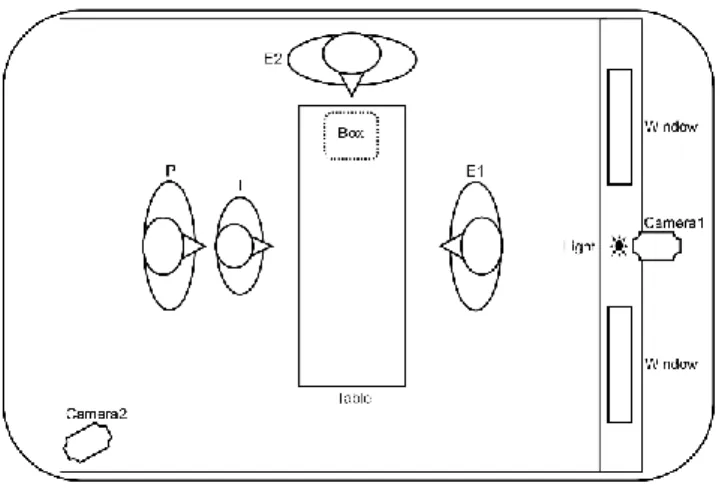
Both experimental phases were completed in an open booth with three draped walls. The central wall had one red light in the center, and two openings (or windows, size: 25 × 25 cm, height: 110 cm) located 30 cm to the right and left of the red light. In the booth, the infants were seated on their mothers’ laps, 200 cm from the central wall and facing Experimenter 1 (E1), who sat across the table. Experimenter 2 (E2) assisted E1 and handled the objects (e.g., removing the objects from a 24 × 24 × 15 cm container) in the Shared Experience Phase, and controlled object presentation in the Pointing Phase.
Six pairs of objects (12 objects in total) were used in the experiment. The two objects in each pair were from the same category (e.g., two balls or two puppets), but differed in color and shape.
Two cameras (SONY DCR-HC96) recorded all scenes from two different angles (Figure 1).
Spontaneous pointing reflects the communication partner’s epistemic states:
An experimental study on the ontogeny of social cognition in humans
Keywords: social cognition, knowledge states, attentional states, pointing, teaching
所属 行動システム専攻心理学コース 氏名 孟 憲巍
Figure 1. The experimental setup and materials.
Participants
Sixteen 13- to 18-month-old infants (nine females; age M = 15 months, 1 day, range = 13 months, 6 days to 18 months, 9 days; final samples) participated in Experiment 1.
Another group of sixteen 13- to 17-month-old infants (seven female; age M = 15 months, 15 days, range = 13 months, 17 days to 17 months, 26 days; final samples) participated in Experiment 2.
Summaries of Procedure
Experiment 1
In the Shared Experience Phase, both the participant and the Experimenter 1 experienced (played with) an object (Familiar to E1), and the participant experienced a second object (New to E1) while the Experimenter 1 was absent. The plays lasted for 1 minute respectively in a random order.
In the following Pointing Phase, the participant was seated on his/her mother’s lap, facing the Experimenter 1, and the same two objects from the Shared Experience Phase were presented side-by-side behind the experimenter in a random order.
The participants’ looking time towards the objects in the Shared Experience Phase and spontaneous pointing in the Pointing Phase were analyzed from video footage.
Experiment 2
In order to ensure that the infants’ pointing behavior observed in Experiment 1 reflected the shared experience between the infants and the experimenter, a new experimenter (E3) were introduced in the Pointing Phase, who was not involved in the
Shared Experience Phase and thus had no experience shared with the infant regarding either object. All other procedures were identical to those in Experiment 1.
*Experimenter 2 was an assistant who handled the objects (e.g., removing the objects from a container in the Shared Experience Phase and controlling object presentation in the Pointing Phase).
Results Experiment 1
All infants produced at least one pointing action in an average of four trials in the Pointing Phase (M = 4, SD = 1.67, range trials = 1–6). Only the data from trials that included pointing in the Pointing Phase were analyzed.
Results showed no significant difference in looking time between the two objects (i.e., New to E1 and Familiar to E1) in the Shared Experience Phase (MNew to E1 = 51.58, SD = 9.34; MFamiliar to E1 = 51.55, SD = 10.9; t(15) = .018, p = .986, two-tailed, r = .001), indicating no significant difference in the visual
experience with the two objects. To measure each infant’s pointing performance in the Pointing Phase, we counted the number of trials in which the infant initially pointed to each object and computed the proportion of NNew to E1 / (NNew to E1 + NFamiliar to E1) as an index. We found that infants initially pointed to the New to E1 object on 66% of all the trials that included pointing on
average, and a one-sample t-test showed that this was significantly above chance (50%) (t(15) = 3.29, p = .005, two-tailed, 95% CI = .56–.76, d = .869). These results demonstrate that despite the lack of difference in the visual experience in the Shared
Experience Phase, in the Pointing Phase, infants had a bias to point to the object that they did not share with E1 (see Figure 2).
To evaluate the possibility of imperative pointing as an explanation of the current results, we conducted a post-hoc analysis to investigate the number of repeated pointing and reaching behaviors because these behaviors can be considered requesting behaviors [6]. If infants’ pointing reflects a request for the object, then we would expect them to repeat the pointing and reaching behaviors until they obtain the object. We analyzed occurrences of these behaviors in the duration between the onset
Figure 2. Test results from Experiments 1 and 2. (a) Mean looking time towards each object in the Shared Experience
Phase in Experiments 1 and 2. (b) Proportion of trials in which infants initially pointed to the object that was “new” to E1 in the Pointing Phase of Experiments 1 and 2 (*p = .005). For both panels, error bars represent SEM.
of E1’s response to the infant’s pointing towards the object and the offset of the object presentation in the Pointing Phase, which was a period of approximately seven seconds. We found that infants’ repeated pointing and reaching occurred very rarely: out of the 64 trials with pointing, repeated pointing occurred on only four trials and reaching occurred on only eight. When we analyzed the data after excluding trials with repeated pointing or reaching, the results did not change (p < .001, d = 1.19) from those reported above. Experiment 2
The results showed that, as in Experiment 1, there was no significant difference in the duration of looking towards the two objects in the Shared Experience Phase (MNew to E1 = 47.5, SD = 11.02; MFamiliar to E1 = 53.07, SD = 9.99; t(15) = -1.619, p = .126, two-tailed, r = .272), indicating that there was no significant difference between the visual experiences with the two objects. Moreover, there was no significant difference in the infants’ total looking time towards the two objects in the Shared Experience Phase between Experiments 1 and 2 (MExperiment 1 = 51.57, SD = 9.71; MExperiment 2 = 50.29, SD = 7.96; t(29) = .408, p = .687, two-tailed, d = .149), suggesting that the infants in Experiments 1 and 2 performed similarly in the Shared Experience Phase.
Identical to Experiment 1, to measure each infant’s pointing behavior in the Pointing Phase, we counted the number of
trials in which he/she initially pointed to each object, and computed the proportion of NNew to E1 / (NNew to E1 + NFamiliar to E1) as an index. However, in clear contrast to Experiment 1, the infants initially pointed to the New to E1 on 51% of all the trials that included pointing on average, which was not significantly different from chance (50%) (t(15) = 0.08, p = .937, two-tailed, 95% CI = .34–.67, d = .02). Furthermore, there was no significant
difference between the two experiments, with reference to the total number of trials with pointing in the Pointing Phase (Wilcoxon rank sum test, p = .626, two-tailed, r = .086). That is, as in Experiment 1, each infant in Experiment 2 produced at least one pointing response in an average of four trials (M = 3.94, SD = 1.53, range = 1–6). Therefore, there was no difference in the frequency of pointing in the Pointing Phase between the two experiments.
We also evaluated the possibility that the imperative interpretation could explain the current results by analyzing the number of repeated pointing and reaching behaviors in the duration between the onset of E1’s response to the infant’s pointing towards the object and the offset of object presentations in the Pointing Phase, which lasted for approximately seven seconds. Similar to that observed in the previous experiment, repeated pointing and reaching behaviors occurred very rarely (across the
63 trials in which pointing was observed, repeated pointing occurred on three trials and reaching occurred on six). Further, when we excluded the trials in which repeated pointing or reaching behavior was observed, the findings did not change (p = .98, d = .007).
Together, these results suggest that infants’ spontaneous pointing in the current setup has selectivity biased toward New to E1,when the experimenter might be considered familiar with one of the objects (as in Experiment 1). However, when objects that the infants had not shared with the experimenter appeared behind the experimenter, selective pointing was not observed (as in Experiment 2). After considering possibilities of alternative interpretation, we concluded that the difference in pointing behavior observed in Experiment 1 most plausibly reflects a shared experience between the infant and E1, and not with the mother.
Discussion
The current study demonstrated that infants in the first half of their second year had a spontaneous tendency to selectively point to an object that the communication partner might not know, reflecting a previously shared experience in a context that lacked a joint-attention frame on the objects’ appearance.
These results might provide new evidence that a preverbal infant is not only an effective learner, who is sensitive to communicative signals of others’ as demonstrated through the theory of natural pedagogy [7], but is also a flexible participant in communication, that is, he/she may serve as an effective
informant.
The pointing behavior observed in the current study might be considered as a form of informing, which consists one major part of altruistic behavior [8]. The adaptive advantage of this pattern of behavior might be understandable based on the
assumption that indirect reciprocity is rooted from early childhood in humans [9].
Although the distance between the behavior of informing about an object’s appearance or location and the more formulated and culturally shaped form of teaching and education
cannot be underestimated [10], the view of the infant as an “effective informant” might provide a perspective worth
consideration when attempting to further our understanding of the basis of human information transmission through communication.
References
[1] Tomasello M (2008) Origins of human communication. Cambridge: MIT Press. pp. 57-241.
[2] Southgate V, Chevallier C, Csibra G (2010) Seventeen-month-olds appeal to false beliefs to interpret others’ referential
communication. Dev Sci 13: 907-912.
[3] Liszkowski U, Carpenter M, Tomasello M (2008) Twelve-month-olds communicate helpfully and appropriately for knowledgeable and ignorant partners. Cogn 108: 732-739. [4] Liebal K, Carpenter M, Tomasello M (2010) Infants’ use of shared experience in declarative pointing. Infancy 15: 545-556. [5] Fogarty L, Strimling P, Laland KN (2011) The evolution of teaching. Evol 65: 2760-2770.
[6] Liszkowski U, Carpenter M, Henning A, Striano T, Tomasello M (2004) Twelve-month-olds point to share attention and interest. Dev Sci 7: 297-307.
[7] Csibra G, Gergely G (2009) Natural pedagogy. Trends Cogn Sci 13 (4): 148-153.
[8] Warneken F, Tomasello M (2009) The roots of human altruism. Brit J Psychol 100: 455-471.
[9] Meristo M, Surian L (2013) Do infants detect indirect reciprocity? Cogn 129: 102-113.
[10] Ando J (2012) On “Homo educans” hypothesis. In: Watanabe S, editor. CARLS series of advanced study of logic and sensibility. Tokyo: Keio University Press. pp. 147-156.