A Study on Route Choice Model in the Case of Recreational Trip
journal or
publication title
福井大学工学部研究報告
volume 45
number 2
page range 311‑317
year 1997‑09
URL http://hdl.handle.net/10098/3557
;~~Hf*~
I~m 7Uf~fi,*
~45~ ~ 2%
1997~9Jl
A Study on Route Choice Model in the Case of Recreational Trip
Tetsuo KATO* and Yoshiaki HONDA**
(Received Aug. 29, 1997)
This study aims to suggest an appropriate road improvement planning for regional exchange, with a view to regard recreational trip as main behavior of regional exchange. We have clarifyied how the facilities which will contribute to regional development influence route choice.
This paper reported the results of the evaluation concerning the attractiveness of recreational facilities which influence route choice in case of a recreational trip, by quantification theory I, using the questionnaire data carried out in Fukui Prefectural TAN - NAN region. These results of analysis of attractive factors suggest that the model using the staying time has most applicable interpretation. However, further investigation on the grasp of the number of visitors is necessary.
Key Worrls: Route Choice Model. Recreational Trip. Regional Exchange, Attractiveness Quantification Theory I
1. I ntraduction
311
Many conceptions to formulate diverse regional connection are suggested, and regional activity is groped by setting new exchange area. Under the situation that regional development goes on by using regional resources as environmental history and culture at many districts, road network is a matter of great importance, in order to connect these developments organically. However, although highway network is concerned with regional connection, route choice of inner region is not consid- ered enough. This study aims to suggest an appropriate road improvement planning for regional exchange, with a view to regard recreational trip as main behavior of regional exchange, by clari- fying how the facilities which will contribute to regional development influence route choice.
In this Papers, firstly significance of this study and relations to previous studies are de- scribed by reviewing existing studies. Secondly the frame of this study is shown. And as a premise of this frame, we make the assumption that driver's route choice are not based on the shortest route or time but based on the attractiveness of recreational facilities. Then, the result of the Questionnaire, which was carried out for the citizens in TAN-NAN region of FUKUI prefecture in
•
••
Dept. of Public Works, Fukui Prefectural Government Dept. of Architectural and Civil Engineering
312
order to survey the number and the staying time of visitors at recreational facilities and to verify the assumption, is reported. Lastly we will propose the structure of attractiveness of re- creational facilities by the analysis of attractive factors with quantification theory I.
2. Existing studies
In the previous studies concerning this study, main theme are demand estimation and behavior analysis for the recreational trip and holiday traffic. Hanaoka et al. 1)2) attended to service for recreational arterials as evaluation factors of recreational road and proposed that improvement menu. Morichi et al.3)4) and Morikawa et al.5) tried to express recreational trip models by one- day trip or infrequent trip, and Tamura et al. 6) analyzed recreational trip by the staying time as attractiveness. Shimizu et al. 7) tried to make clear attractive functions of river parks from the analysis of the staying time. Isobe et al.8) showed that travel mode and duration of activities on non-work days are related with those in weekdays. Yoshida9) make clear the characteristics of re- cognition and reaction in sightseeing information, and Wang et al. 1 0) analyzed the relation between tourist movement and tourist resources. As the route choice models, models with endogenous ratio- nal expectations formation by Kobayashi et al. 11), dynamic traffic simulation model by Iida et al.
1 2) 13) and mapping out method by Takayama 1") are known.
The frames of the previous studies on traffic behavior analysis of recreational area and road might be applied to this study, because this study intend to analyze the recreational trip too.
However, as the structure of attractiveness was not clarified in previous studies. the significance of this study is notable. And, route choice models were mainly dealt in urban area, and applying this model in recreational area is useful to an appropriate road improvement planning.
3. Concept i on of route cho i ce model
When persons start recreational trip, they will chose a certain destination. Then, in choosing the route to destination, many attractive facilities and scenic spots along the route may affect the route choice. Assuming that these regional resources are reasons of route choice, we can pre- sume that persons will choose the most attractive route with much resources'~ in case of going to the same destination. Following model shows the details.
1) Attractive resources have independent attractiveness XI regardless of location. As the factors affecting attractiveness are following things.
XI : Attractiveness of regional resources i
X I
=
f (Scale of facilities, Admission fee, Scale of parking space, etc. )2) Considering that attractiveness of regional resources i relate with accessibility from route j,
accessibility from route j to regional resources i is assumed as L I . As the factors affecting accessibility are following things.
LI : Accessibility from route j to regional resources i
L I
=
f (Distance, Structure of road, Configuration, Information service, etc.3) We make the assumption that both Attractiveness X I and Accessibility L I affect the route choice j because of gravitation Y I J • Generally it is considered that gravitation Y I J is as lower as Attractiveness X I, and Y I J is as higher as X I. And gravitation Y I J is as lower as accessibility L I according to long distance and bad pavement, and Y I J is as higher as L I
according to short distance and well pavement.
Y I I : gravitation of regional resources i in case of route choice j
YIJ
=
f (XI, L,)4) Based on these process, the sunmation of gravitation Y. J by each regional resources i through route j is defined as valuation of route j.
YI : valuation of route j
Y
1=.11
Y. JThe route j to some destination is not restricted only one. Therefore, in this study, in com- parison with valuation of another route j , most high valuation route j is considered to choose.
The relationships among these are depicted in Figure 1 •
... ~ e,.
4-$2f-" '\.
(2) .
~
Accesibi Iit~.>~/
... Gr~vitation Y/il Route j
"'-e-, ...
· · ·
Fig. 1 Conceptual chart of route choice model 4. ~ttractiveness model
Considering the attractiveness model of recreational facilities, it seems to be Quite all right to consider that attractive facilities are used by many persons and stayed for a long time.
Therefore, in this study, the number of visitors, the staying time and the total staying time of visitors are defined as the attractiveness X. of recreational facilities.
1) The number of visitors ( persons )
1 1 n
Average numbers of visitors: X. =- ~ N k n k.:T
Nk : Number of visitors at facilities i by examinee k n : Number of examinee who answered to visit facilities i Though it is possible to grasp the actual number of visitors by records of management at fa- cilities, because of unknown number of visitors at objective facilities of this study, we tried to grasp by Questionnaire.
2) The staying time ( minutes )
2 1 ~
Average staying time of visitor: X. =- T k
n k-
Tk : Staying time at facilities i by examinee k We tried to grasp staying time at objective facilities of this study by Questionnaire.
3) The total staying time of visitors ( J).ersons • minutes
:s 1 n
X • = - ~ (N k • T k)
n k.:T
314
Tab. 1 Result of actual survey
attractiveness Xl
Ave. numbers Ave. staying Ave. total Best Name of recreational facilities
of visitors time staying time 1 0
r - -
-
. - - -(person) order (minute) order (porn) order order 1 ECHIZEN Cape Polyanthus Land 3.53 28 49.6 27 183 27 11
2 YUKYU ROMAN Forest 6.65 1 127. 7 5 938 3 6
3 Botanical Garden PLANTOPIA 4. 00 24 84.1 20 380 21 10
4 ECHIZEN Ceramics Park 4.74 13 101. 6 14 562 12 15
5 MURASAKI-SHIKIBU Park 3.49 30 43. 7 29 168 28 21
6 ECHIZEN Village Park 3.51 29 54.4 26 228 26 23
7 NISHIYAMA Park 4.35 15 92.3 19 498 14 5
8 HANAHASU Park 4.03 23 59.6 25 258 25 18
9 HIRmO Dam Park 3.63 26 70.6 22 308 24 19
10 KOHNO River Park 4.88 10 66.8 23 444 15 27
11 OO'AIKO Hills 4.35 16 94.6 18 424 17 20
12 FUKUI Ceramics Hall 5.32 6 107. 7 10 578 10 12
13 Nife ViI lege Workshop 4.22 20 61. 9 24 314 23 16
14 Eye-glass Hall 3.64 25 36.4 30 144 30 28
15 Papyrus Hall 4.23 19 71. 2 21 335 22 14
16 FURUSATO Workshop 5. 73 4 113.5 8 819 5 7
17 SOBA Workshop 5.15 7 109.2 9 586 8 9
18 KITAMAEBUNE Hall 3.56 27 45.1 28 155 29 22
19 La Pose KAWADA 6.62 2 155.1 2 1,090 2 1
20 OO'OTO Vi 11 age 4. 75 12 119.0 6 603 7 17
21 ECHIZEN Spa [SUISEN NO YU] 4.24 18 102.3 13 429 16 24
22 TAMAGAWA Spa 5.00 9 107.1 11 568 11 26
23 KURIYA Spa 4.66 14 105.2 12 503 13 25
24 ISARIBI Spa 4.05 22 96.8 17 391 20 8
25 AMADANI Spa 4.33 17 96.8 16 409 19 29
26 KAMIKOUTI Spa 4.20 21 99.1 15 419 18 30
27 Stream Spa [KANMURISOU] 6.49 3 155.4 1 1, 144 1 3
28 lMAJYO Spa [YASURAGI] 5.01 8 130.4 4 664 6 2
29 KOUNO Spa [YUUBAE] 4.76 11 115.8 7 580 9 13
30 NANJYO Spa [S<l.tAYAMA] 5. 73 5 133.8 3 827 4 4
Average of total facilities 4.63 93.6 498
Standard deviation 0.91 32.06 260. 76
Tab. 2 Correlation coefficient table
Type of facility Theme park Cultural institution Spa Total
Correlation coefficient O. 258 O. 516 O. 332 O. 276
5. A ctua I survey
TAN-NAN region which became the object of this study is one-day car trip area. Then, famous and usable 30 recreational facilities with much local colour in TAN-NAN region were chosen as regional resources i. These are each 10 theme parks, cultural institutions and spas.
As an information of facilities, name, abstract, charge, parking, distance from main road(pre- fectural road) and map plotting the location of facilities were shown to examinee.
Examinees were required to answer the number of visitors and the staying time under the as- sumptions that they visit these facilities, and to fix the best 10 rank of facilities in useful order. And, if examinee didn't think to visit some facility, he was required to write zero minute as the staying time. Examinees were chosen from public ( prefecture ,city and town) officials, members of consultant and students, because objective facilities were faliliar to them. 101 per- sons answered effectively, age rank being as follows ; 41 persons were aged under 30, 31 persons were aged 30-39, 21 persons were aged 40-49, 5 persons were aged over 50. 72 persons were male and 26 persons were female, and 3 persons' age and sex were unknown.
The results of the survey are displayed in Table 1. The number of visitors, the staying time and the total staying time shown at previous chapter were compared with the best 10 ranking, and 6 higher ranking facilities were nearly same. The facilities from first to 6th ranking such as KAN-
Vital Statistics (1000 persons/year) MURI-SOU spa, La pose KAWADA, FURUSATO work- ECH I ZEN Cape
YUKYU ROMAN PLANTOPIA SHIKIBU Park
o 30 60 90 120 150
... > ... :; ..
---,//"'/
ECHIZEN Vi I I age" • • HANAHASU Park
HIROO Dam OTAIKO Hi lis Eye-g I ass Ha II Papyrus Ha II
•
:Vital :Statistics
FlRJSATO W. shop _ _ . _ . SOBA I. shop
KIT~E
ISARISI KAtfUISOO YAsmAGl Yll&E SOMAYAMA
o 100 200 300 400 500 600 Numbers of Oestionnaire (persons) Fig. 2 Comparison of visitors between the numbers
of questionnaire and annual vital statistics
shop, YUKYU ROMAN forest, SOMAYAMA spa and YASURAGI spa are located in forest area far away from urban area, and these suggest they be a good one-day car trip recreational zone.
Comparing with three types of facilities, such as theme park. cultural institution and spa, though an average error of the number of visitors was relatively small, an average of the staying time of theme parks was shorter and that of spas was longer than that of total facilities.
We adopted the number of visitors by questionnaire as one of the measures to estimate attractiveness. In order to deter- mine whether the results of the survey was applicable or not, we tried to compare the number of visitors by Questionnaire with annual vital statistics of tourist at same facilities, which was published by FUKUI prefectural government. Comparison between the number of questionnaire and vital stat- istics except ECHIZEN ceramics park and NI- SHIYAMA park, which had over 300 thousands annual visitors, are displayed in Figure 2.
316
A correlation coefficient table between the number of questionnaire and vital statistics by three types of fa1ilities is displayed inTable 2. In case of cultural institutions it might reveal a positive correlation, but in case of other two types the correlation was not found. The reasons of non-correlation were the gap between the number of questionnaire and vital statistics concerning YUKYU ROMAN forest,MURASAKISIKIBU park, KANMURISOU spa and SOMAYAMA spa.
Though it is considered that many skiers from other prefectures are included in annual vital statistics of tourist, comparing that examinee live in Fukui prefecture, it is the subject for a future study.
6. A na I ys i s of attract i va factors by Quant i f i cat i on theory I
We tried to make up the estimation model of attractiveness of recreational facilities by use of Quantification theory I. The outline of the method is to define the type, admission fee, the scale of the parking and the distance from main road as nine predictor variable, which were clas- sified by two or three categories, and to define the previous three attractiveness ( The number of visitors, The staying time, The total staying time) as criterion variable, and to calculate the structure of attractiveness by Quantification theory I.
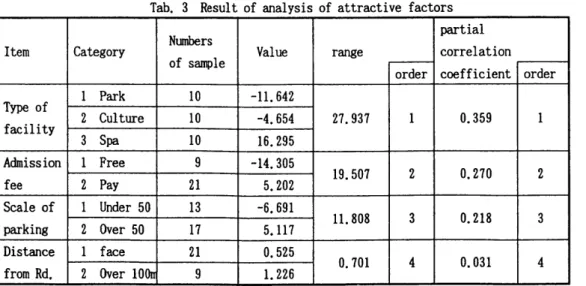
Comparing multiple correlation coefficient of three trials, it is clarified that the model using the staying time have most applicable interpretation. The results of the analysis are dis- played in Table 3. Trough the considerations of Table 3 , following ideas are obtained. The items which influenced the staying time were orderly as follows; the type of facility, admission fee and the scale of parking. By the view point of type of facility, spas had the longest staying time. By the view point of admission fee and the scale of parking, the staying time was increasing at faci- lities with toll and large parking space, in other words, at improved facilities. In case of dis- tance from main road, range and partial correlation coefficient were so lower that it was thought proper to have no interpretation.
Multiple correlation coefficient of model using the staying time is not so high that the grasp of the number of visitors by this questionnaire may be inadequate, but, further investigation is necessary.
Tab. 3 Result of analysis of attractive factors
Numbers partial
Item Category Value range correlation
of sample
order coefficient order
1 Park 10 -11. 642
Type of
2 Culture 10 -4.654 27.937 1 0.359 1
facility
3 Spa 10 16.295
Admission 1 Free 9 -14.305
19.507 2 0.270 2
fee 2 Pay 21 5.202
Scale of 1 Under 50 13 -6.691
11. 808 3 0.218 3
parking 2 Over 50 17 5.117
Distance 1 face 21 0.525
from Rd. Over lOOn O. 701 4 0.031 4
2 9 1. 226
7. Conclusion
This paper reported the results of the evaluation concerning the attractiveness of recreation- al facilities which influence route choice in case of a recreational trip. The subjects for a future study are as follows.
1) Whether the verification with trip generation and attraction standard unit of recreational trip using the estimation model of the attractiveness of recreational facilities is possible or not.
2) How the distribution of recreational facilities influence the cognition of the attractiveness.
3) Are there any other factors influencing to the cognition of the attractiveness?
THe authors express sincere appreciation to public officials of Fukui prefecture, Takefu city, Sabae city, Nanjyo town and Ikeda town who cooperated with them in this questionnaire.
References
[1] T.Hanaoka,T.Nishii and S.Jyo "Analysis of Level of Service for Recreational Arterials and Its Evaluation",Papers on City Planning, No. 27, Nov.,1992
[2J K.Nishii,H.Hanaoka,H.Foruya and T.Sakai "On the Concept of Service Related to the Driver's Evaluation for Recreational Arterials",Papers on City Planning, No. 28, Nov.,1993
[3J S. Morichi, T. Hyodo and N. Okamoto "A Study on Touring Models for One-day Car Trip", Infrastruc- ture Planning Review, No. 10, Nov.,1992
[4J H.Fruya,T.Hyodo and S.Morichi "Study on Recreational Trip Generation with Trip Frequency Analysis",Papers on City Planning, No. 28. Nov •• 1993
[5J T.Morikawa.K.Sasaki and R.Azuma "Modeling Sightseeing Travel Behavior for Evaluation of Road Network Improvement in the Recreational Area". Infrastructure Planning Review,No.15,Aug •• l995 [6J T.Tamura,H.Chiba and K.Oosumi "Studyon the Recreational Trip Choice by use of Behavior
Approach".Proceedings of Infrastructure Planning,No.ll,Nov.,1988
[7J K.Shimizu,K.Kimura and M.Fujita "Analysis of Staying Timel in River Parks",Papers on City Planning, No. 30. Nov .• l995
[8J T.Isobe and S.Kawakami "Travel Behavior Analysis on Non-work Days Using Activity-Based Approaches-Comparison with Travel Behavior in Weekdays-".Papers on City Planning, No. 25.
Nov •• 1990
[9J H.Yoshida"An Empirical Study on the Characteristics of Recognition and Reaction in Sight- seeing Information".Papers on City Planning.No.28,Nov .• l993
[lOJH.Wang.D.Abe.N.Masuda.Y.Shimomura and S.Yamamoto"A Study to Analyze the Patterns of Tourist Resources on Awaji Island".Papers on City Planning.No.3l.Nov.,l996
[llJK.Kobayashi and K.Fujitaka "Route Choice Models with Endogenous Rational Expectations For- mation".Proceedings of The Japan Society of Civil Engineers, No.458.rv-18,Jan •• 1993 [12JY.Iida,T.Uchida and N.Uno "Dynamic Analysis of the Route Choice Behavior Considering the
Effect of Traffic Information",Journal of Infrastructure Planning and Management. No. 470.
rv-20, July 1993
[13JY.Iida,S.Fujii and T.Uchida "A Dynamic Traffic Simulation Model Considering a Route Choice Be- havior on Road Network", Journal of Infrastructure Planning and Management, No. 536, N-18, Apr .1996 [14JJ. Takayama "A Study on Individual Driver's Route Choice Behavior by Mapping out Method",
Papers on City Planning,No.27,Nov.,1992
318