Terahertz spectroscopy of proteins in aqueous solution
journal or
publication title
遠赤外領域開発研究
volume 11
page range 133‑137
year 2010‑07
URL http://hdl.handle.net/10098/2749
Terahertz spectroscopy of proteins in aqueous solution
Christopher T. Que1, Alfonsina Ramundo Orlando2, Kohji Yamamoto1 and Masahiko Tani1
1 Research Center for Development of Far-Infrared Region, University of Fukui, Fukui 910-8507, Japan
2Institute of Neurobiology and Molecular Medicine, Consiglio Nazionale delle Ricerche, Via del Fosso del Cavaliere, 100, 00133 Roma-Italy
Abstract
Terahertz Time-Domain Spectroscopy (THz-TDS) is one of the key techniques in investigating solid-state materials as well as the study of biomolecules in the THz frequency region. THz waves are very sensitive to the strong absorption of water that makes THz-TDS a useful tool in probing water-biomolecule coupled interaction. In this study, a pure water or guanidine hydrochloride (GuHCl) solvent was mixed with Ascorbic Acid Oxidase (AAO) protein to make native or denatured solutions, respectively. Results revealed that the native and the denatured solution samples both absorb THz weakly although the denatured sample, when compared to the native, showed a higher absorbance. The reason could be the catalyzing effect of AAO.
研究報告17
1. Introduction
Recent advances in terahertz technology have made the applications of THz waves attractive in the fields of material investigation, quality control assessment, non-invasive security inspection and the study of chemicals and biomolecules.
THz-TDS, by which we can measure the absorption and the phase change due to the sample, is one of the key techniques for such applications. Since THz waves are very sensitive to the water due to the strong absorption, THz-TDS is considered to be a good tool in investigating water-biomolecules dynamics, such as the water-biomolecule coupled interaction. In addition, there are large amplitude and nonlinear vibrations of proteins in the THz frequency range that are considered to be associated with protein function and protein folding.
Terahertz spectroscopy of aqueous carbohydrate (lactose) solutions was investigated by Heugen et al1. The authors reported a nonlinear trend in the absorbance of the THz wave as the lactose concentration was increased. They concluded that the water molecules act differently compared to bulk when they are placed around biomolecules.
In this report, Ascorbic Acid Oxidase (AAO), in its native and denatured forms, was used to investigate how they interact in aqueous solutions.
2. Sample
AAO is a blue-copper enzyme protein extracted from the plant Cucurbita sp. This protein uses the ascorbic acid as the electron donor to catalyze dioxygen reduction in water, as shown in Fig. 1.
3. Methodology
In this study, a 79 mg/ml of AAO protein, diluted in a 115 μl of pure water, was used as the native sample and pure water as the reference. On the other hand, a 4 Molar concentration of Guanidine Hydrochloride (GuHCl) solution was used to denature another batch of 79 mg/ml of AAO protein solution. The guanidinium solution functioned as the reference for this denatured protein sample. Both the native and
+ 2H
2O + O
2=
2 L-ascorbate 2 dehydroascorbate
Fig. 1 AAO catalyzation of dioxygen
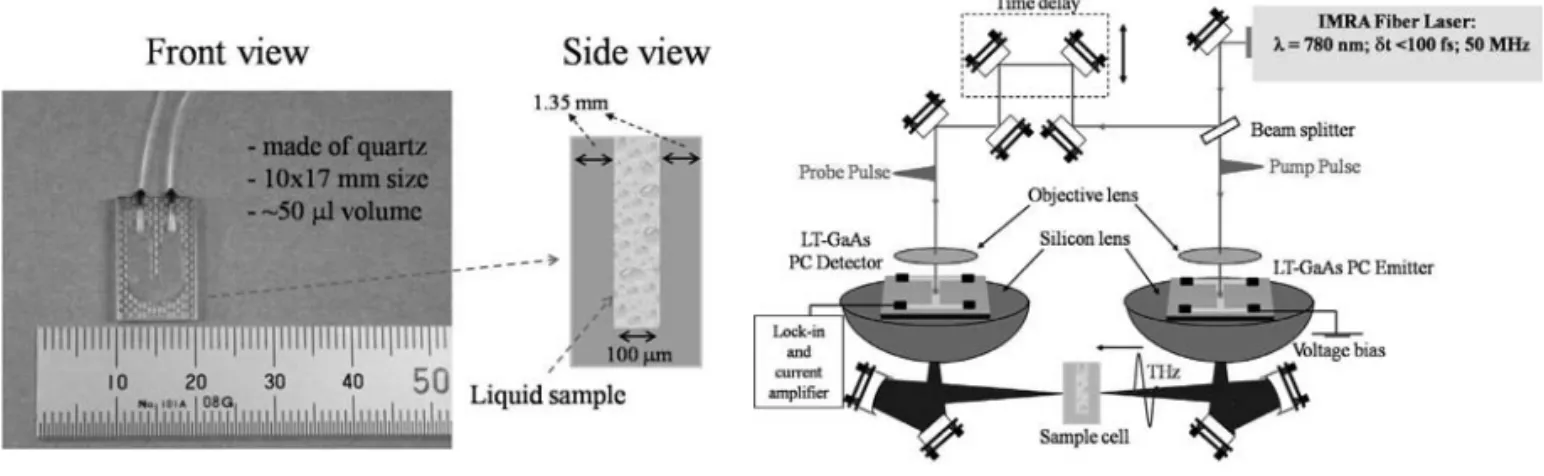
denatured solutions, along with their references (pure water and GuHCl solution), were inserted in a 100-μm thick liquid cell. The liquid cell, made of quartz, was supplied by the Advance Infrared Spectroscopy Co. Ltd (Aispec). The picture and dimensions of the liquid cell is shown in Fig. 2 below.
The liquid cells containing the samples and their respective references were placed in an Aispec THz time-domain spectrometer at room temperature. Figure 3 illustrates the THz-TDS system. The laser pulse from an IMRA fiber laser (λ = 780 nm, δt < 100 fs, repetition rate = 50 MHz) was divided by a beam splitter into a pump and probe pulses that were used to trigger the photoconductive (PC) emitter and detector antennas, respectively. The generated THz radiation is collimated by a silicon lens, attached to the backside of the emitter antenna, reflected by a flat mirror, and focused on to the sample by an off-axis elliptical mirror. A metal pinhole, with a diameter of ~1 mm, was placed in front of the liquid cell to limit the THz beam spot to that size. Subsequently, the THz beam transmitted through the sample is directed on to the PC detector antenna by the same set of optics. By scanning the time-delay between the pump and probe laser pulses we can obtain the THz waveform, from which the THz spectrum is obtained by Fourier transformation. Using this technique, one can measure the absorption and the phase change of the THz wave due to the liquid sample as well as that from the liquid solution served as the reference.
4. Results and Discussions
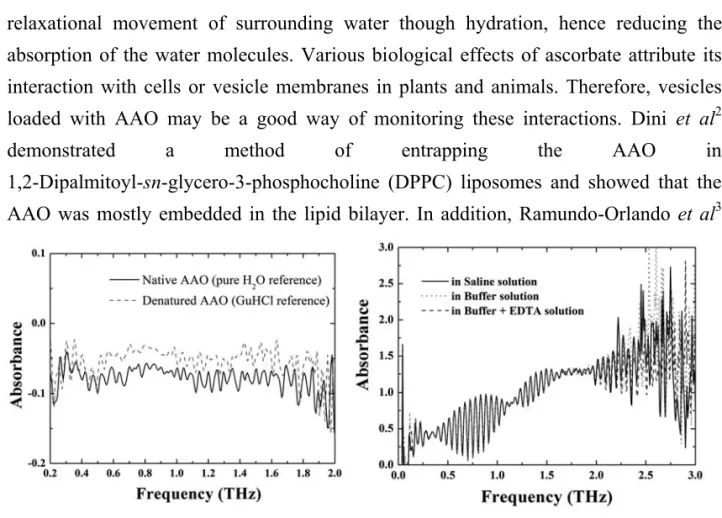
Figure 4 shows the difference absorbance for both the native and denatured AAO samples obtained by subtracting the reference (pure water or GuHCl solution) absorbance from the sample absorbance. Both samples show negative absorbance that indicate the samples absorb THz radiation weakly as compared to their references. The native AAO has a bit lower absorbance than the denatured AAO that could be explained
Fig. 3 THz-TDS setup Fig. 2 Quartz liquid cell
relaxational movement of surrounding water though hydration, hence reducing the absorption of the water molecules. Various biological effects of ascorbate attribute its interaction with cells or vesicle membranes in plants and animals. Therefore, vesicles loaded with AAO may be a good way of monitoring these interactions. Dini et al2
demonstrated a method of entrapping the AAO in
1,2-Dipalmitoyl-sn-glycero-3-phosphocholine (DPPC) liposomes and showed that the AAO was mostly embedded in the lipid bilayer. In addition, Ramundo-Orlando et al3
prepared the same type of liposome and investigated the effect of a 2.45 GHz radiation on this lipid bilayer. In line with this, THz absorbance of the same liposome in different aqueous solutions was studied. Figure 5 shows the initial results of the difference THz absorbance of liposome in saline (0.9% NaCl+99.1% pure H2O), buffer (0.1 M of PO4
at pH = 7.0), and buffer with 1mM of ethylenediaminetetraacetic acid (EDTA) solutions.
It is found that the difference absorbance is positive, that is, the absorbance of liposome is higher than the references. It is also noticed that the difference absorbance of liposome increases monotonically with the frequency. On the other hand, there was no difference among the difference absorbances in different solutions, indicating the absorbance is intrinsic to the liposome itself. Note that the fast oscillations of absorbance observed in Fig. 5 are due to multiple reflections in the sample cell.
5. Summary
THz-TDS was used to study native and denatured AAO solution samples. The denatured solution had a slightly higher absorbance than the native solution but both exhibited weak difference absorption in the THz frequency region observed (< 2 THz), as compared to their respective references, that could be due to the catalyzing effect of
Fig. 4 Difference absorbance of native and denatured AAO
Fig. 5 Difference absorbance of liposomes in different solutions
the AAO protein. Absorbance of DPPC liposomes in different solutions was also investigated. Results show that the samples have nearly the same absorbance in the THz frequency range.
References
[1] U. Heugen, G. Schwaab, E. Bründermann, M. Heyden, X. Yu, D. M. Leitner, and M.
Havenith, Proc. Nat. Acad. Sci. USA, vol. 103, no. 33, pp. 12301-12306, August 2006.
[2] L. Dini, A. Di Giulio, A. Pavan, G. Ravagnan, G. Mossa, Biochimica et Biophysica Acta, vol. 1062, no. 1, pp. 108-112, February 1991.
[3] A. Ramundo-Orlando, M. Liberti, G. Mossa, G. d’Inzeo, Bioelectromagnetics, vol.
25, no. 5, pp. 338-345, July 2004.