1686
IEICE TRANS. INF. & SYST., VOL.E102–D, NO.9 SEPTEMBER 2019
LETTER
Special Section on Log Data Usage Technology and Office Information SystemsA Method for Smartphone Theft Prevention When the Owner Dozes O ff
Kouhei NAGATA†,Nonmember andYoshiaki SEKI†a),Senior Member
SUMMARY We propose a method for preventing smartphone theft when the owner dozes off. The owner of the smartphone wears a wrist- watch type device that has an acceleration sensor and a vibration mode.
This device detects when the owner dozes off. When the acceleration sen- sor in the smartphone detects an accident while dozing, the device vibrates.
We implemented this function and tested its usefulness.
key words: smartphone theft prevention method, wristwatch type device, acceleration sensor, dozing detection
1. Introduction
Wristwatch type devices that have an acceleration sensor and a vibrator mode (hereafter, written as a wristwatch) have become especially common. Life logs can be accumu- lated by routinely wearing these devices. Moreover, utiliz- ing these life logs can improve safety and access control[1].
Smartphones are increasingly important as tools to access cyberspace and as storage tools for personal data like telephone directories and passwords. Therefore, if the owner loses his or her smartphone, the owner will suffer great damage. This paper proposes a method for prevent- ing smartphone theft when the wristwatch is used.
2. Related Research
2.1 Wearable Computing Environment
An access control mechanism that dynamically changes the control of services according to the user’s behavior, position, surrounding environment, etc., was proposed[2]. Here, the user wears a computer that is always running. The security in the wearable environment is as follows. 1) the service does not operate in a situation that the user does not desire, 2) the user does not perform undesired processing, and 3) in- appropriate services do not cooperate.
2.2 Continuous Authentication Using Wearable Devices Continuous authentication that guarantees the authenticity of users continuously was proposed to replace the conven- tional every-time user authentication[3]. For example, it de- tects that two devices equipped with both an acceleration
Manuscript received October 19, 2018.
Manuscript revised April 3, 2019.
Manuscript publicized June 4, 2019.
†The authors are with the Faculty of Informatics, Tokyo City University, Yokohama-shi, 224–8551 Japan.
a) E-mail: [email protected]
DOI: 10.1587/transinf.2018OFL0001
sensor and Bluetooth are held by the same person. It is as a base of trust. This method is effective when a user wearing a wristwatch has a smartphone in his or her hand.
2.3 Activity Recognition Using Accelerometers
An activity recognition method using accelerometers had difficulty classifying routine activities such as sitting and standing[4]. Classification became more difficult if the wrist was placed on a horizontal surface like a desk, particu- larly when using a wristwatch. Therefore, misclassification occurred for activities that had little changes on acceleration, such as dozing off.
2.4 Distinction of Other People Using a Smartphone An anti-theft method using only a smartphone was pro- posed[5]. An owner and other people were distinguished using inertial sensing data acquired from the acceleration sensor of a smartphone. However, because the detection time needed 6 seconds on average, a thief might escape be- fore an alert is issued.
2.5 Identifying Users Using Wrist Sensors
Wristwatches were used to identify users in a house[6]. The acceleration of the user‘s wrist was measured, and each user was identified at high accuracy for actions using objects.
This shows the usefulness of wristwatches that have accel- eration sensors.
2.6 Detection of Detachment of Wristwatch
An experiment of detachment detection of a wristwatch was reported[7]. The differences in acceleration changes of the X, Y, and Z axes are summed over a certain time. Detach- ment from the arm is detected when the summed value is below the threshold value.
2.7 Sleep Detection Using Wrist Sensors
The wearer’s sleep and arousal state were detected using 3D inertia data of wrist sensors[8]. Highly accurate detection was possible because the detection was performed at long time intervals. However, because the time intervals were long, real-time detection of dozing is not suitable for our anti-theft scenario.
Copyright c2019 The Institute of Electronics, Information and Communication Engineers
LETTER
1687
Fig. 1 State transition diagram.
3. System Configuration
We assume the following scene. A smartphone is left on a desk, and the owner dozes offin a classroom. The owner of the smartphone is wearing a wristwatch. The wristwatch detects the owner’s dozing and reduces the theft risk of the smartphone. The state transition of the system is shown in Fig. 1. When the wristwatch detects the owner dozing off, the smartphone starts an acceleration measurement. When the acceleration sensor in the smartphone detects an acci- dent, the wristwatch and the smartphone both show alerts and vibrate.
4. Target Issues
The proposed method detects the movement of the smart- phone when the owner dozes off. We focused on detection sensitivity and detection time for the evaluation.
4.1 Detection Sensitivity
We used an acceleration sensor to detect dozing and theft.
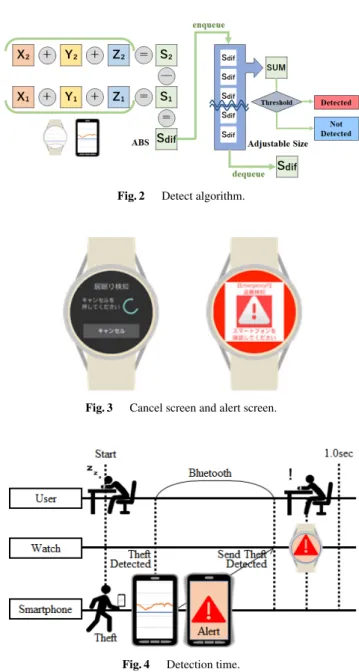
Dozing is detected by the wristwatch and movement is de- tected by the smartphone as follows. The differences in ac- celeration changes of the X, Y, and Z axes are summed for a certain time. Dozing is detected when the summed value is below the threshold value. Movement of the smartphone is detected when the summed value is over the threshold value.
The detection algorithm is shown in Fig. 2.
The detection sensitivity can be optimized by changing the threshold. In addition, the owner can cancel erroneous detection. Figure 3 shows the cancel screen and the alert screen displayed on the wristwatch.
4.2 Detection Time
The method detects and notices loss just after it happens.
Fig. 2 Detect algorithm.
Fig. 3 Cancel screen and alert screen.
Fig. 4 Detection time.
Therefore, the time from detection to actual theft should be made as short as possible.
We installed the method on the wristwatch ASUS ZenWatch3 (WI503Q) and the smartphone Xperia Z5 (SO-01H). When the wristwatch detects the owner is doz- ing off, the smartphone starts measuring the acceleration. In this state, we measured the time from the movement of the smartphone to the display of an alert on the wristwatch. We obtained from 498 to 763 ms with 30 measurements. The average was 610 ms.
5. Discussion and Conclusion
We compared our method with related research. In wearable computing environments[2], the method satisfies 1) situation-dependent safety and 2) automatic execution safety. The method does not need to have the smartphone in the owner’s hand, different from continuous authentica-
1688
IEICE TRANS. INF. & SYST., VOL.E102–D, NO.9 SEPTEMBER 2019
tion[3] and distinction of other people[5]. Using acceler- ation data obtained from wristwatches enables high accu- racy for the user identification[6] and the wearer’s activ- ity recognition[4]. However, dozing detection is more erro- neous than detachment detection[7]and sleep detection[8].
As a solution to that, we implemented a function enabling the owner to cancel erroneous detection.
The novelty of this paper is that the owner can prevent losing his or her smartphone and will not need to search after losing it. We focused on theft that could not be handled with the function of preventing misplacements using Bluetooth radio wave strength.
The usefulness of the outcome is that the method can be optimized by the owner with variable detection sensitivity and detection time. The limit is that erroneous detection occurs when the smartphone is in a pocket or a bag because the method specializes in having a smartphone on the desk of a classroom. Further study is needed for automation to optimize the detection sensitivity and time.
Acknowledgments
This work was supported by JSPS KAKENHI Grant Num- ber JP16K00194.
References
[1] P. Zhang, J.K. Liu, F.R. Yu, M. Sookhak, M.H. Au, and X. Luo, “A survey on access control in fog computing,” IEEE Commun. Mag., vol.56, no.2, pp.144–149, Feb. 2018.
[2] M. Miyamae, T. Terada, M. Tsukamoto, and S. Nishio, “A situation- based access control mechanism for wearable computing environ- ments,” IEICE Trans. Inf. & Syst. (Japanese Edition) D-I, vol.J88-D-I, no.3, pp.617–628, March 2005.
[3] F. Kudoh, K. Hasegawa, K. Takeuchi, T. Nakamura, and Y. Ota, “Con- tinuous authentication system using wearable devices,” IEICE Tech- nical Report, LOIS2016-76, pp.79–83, March 2017. (in Japanese) [4] N. Twomey, T. Diethe, X. Fafoutis, A. Elsts, R. McConville, P. Flach,
and I. Craddock, “A comprehensive study of activity recognition using accelerometers,” MDPI Informatics, vol.5, no.2, 2018.
[5] M. Jin, Y. He, D. Fang, X. Chen, X. Meng, and T. Xing, “iGuard:
A real-time anti-theft system for smartphones,” IEEE Trans. Mobile Comput., vol.17, no.10, pp.2307–2320, Oct. 2018.
[6] J. Ranjan and K. Whitehouse, “Object hallmarks: Identifying object users using wearable wrist sensors,” Proc. ACM Int. Joint Conf. Per- vasive Ubiquitous Computing, pp.51–61, 2015.
[7] M. Matsushita, K. Nagata, and Y. Seki, “User authentication keep- ing method using watch type devices—Case of acceleration sensors,”
IEICE Technical Report, LOIS2017-28, pp.13–18, Nov. 2017. (in Japanese)
[8] M. Borazio, E. Berlin, N. K¨uc¨ukyildiz, P. Scholl, and K. van Laerhoven, “Towards benchmarked sleep detection with inertial wrist-worn sensing units,” Proc. IEEE International Conference on Healthcare Informatics (ICHI), pp.125–134, 2014.