緒 言 ゾウムシ上科(コウチュウ目)は世界で6万種以上が知られる 巨大分類群である。ほとんどのゾウムシ類は植物を食餌資源 としており、多様な植物を生体や枯死体、腐朽体の各段階で 利用し、根、茎、幹、葉、蕾、花、果実など食害部位も多岐 に渡る(Morimoto et al., 2006)。重要な農業害虫を数多く含 んでおり、植物検疫上の重要性も高い分類群である。 輸入検疫では、木材や穀類、切り花、青果物、種苗類な ど非常に幅広い品目から多種のゾウムシ類が発見されており、 神戸植物防疫所にも過去に捕獲された多数の個体が標本とし て保管されている。それらのうち貯穀害虫をはじめとする発見 頻度の高い種は同定されている一方で、未同定のものも多数 残されていた。今回、これらの未同定のゾウムシ類標本を対 象として、同定を行うとともに年代別の分類群構成を解析する ことで、今後の植物検疫上重要となる分類群を特定すること とした。 材料及び方法 神戸植物防疫所管内の輸入検査で1962年から2012年にか けて発見されたゾウムシ上科(キクイムシ科およびナガキクイム シ科を除く、以下同じ)のうち、未同定の219個体を対象として 同定を行った。科および亜科の分類体系についてはAlonso-Zarazaga & Lyal (1999) に従った。
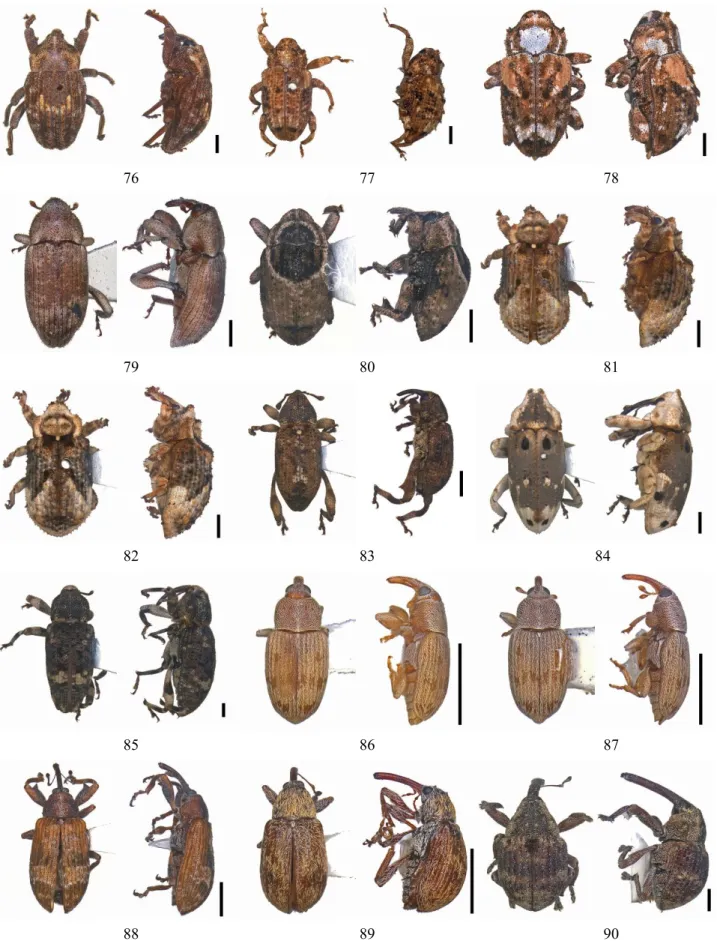
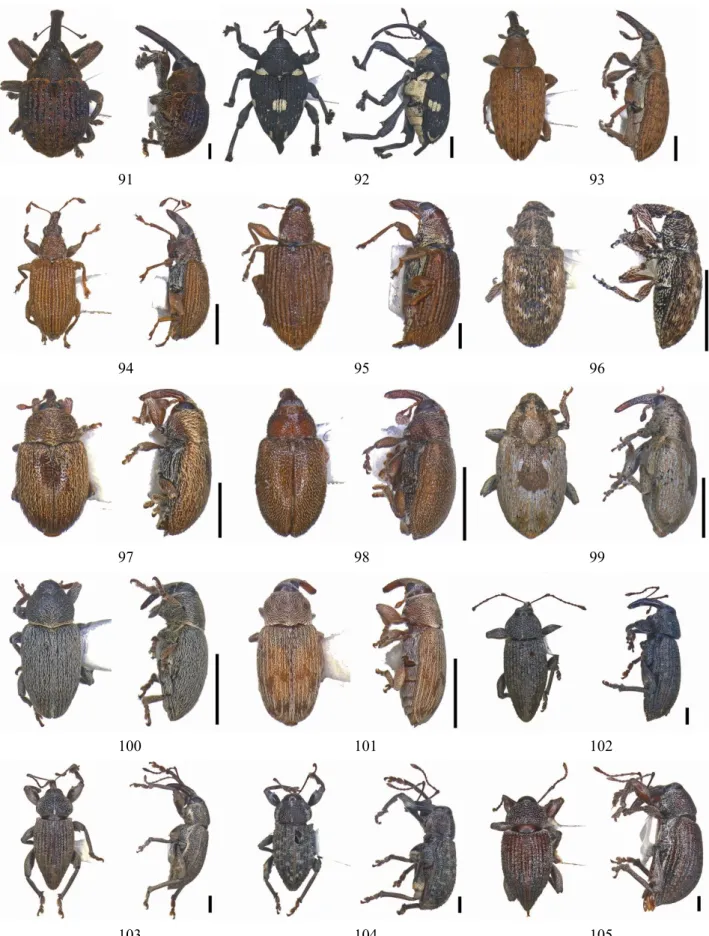
すべての標本について背面および側面の深度合成写真を
撮影し、図版を作成した。写真撮影法はYoshitake(2011)に
基づき、実体顕微鏡LEICA MZ APOに接続したデジタルカ メラLEICA DFC490を使用し、深度合成には画像加工ソフ トウェア LEICA APPLICATION SUITE Montage Ver.3.8 を用いた。一部の大型種については、撮影にデジタル一眼レ フカメラ Nikon D80 を使用し、深度合成にはフリーウェアの CombineZP(Hadley, 2010)を用いた。 また、1960年から2009年までの植物検疫統計を調査し、神 戸植物防疫所管内の輸入検査におけるゾウムシ上科の発見種
輸入植物から発見されたゾウムシ類(コウチュウ目ゾウムシ上科)の
分類群構成の変遷
源河正明
1)・吉武 啓
2) 1)神戸植物防疫所関西空港支所、2)独立行政法人農業環境技術研究所Chronological Change of Taxonomic Composition of Exotic Weevils (Coleoptera, Curculionoidea) Intercepted by Japanese Plant Quarantine. Masaaki Genka1) and Hiraku Yoshitake2) (1)Kansaikuko Sub-station, Kobe Plant Protection Station, Senshukukonaka 1, Tajiri, Osaka 549-0011, Japan; current affiliation: Narita Sub-station, Yokohama Plant Protection Station, Tennamino 2159, Komaino, Narita, Chiba 282-0021, Japan. 2)National Institute for Agro-Environmental Sciences, Kannondai 3-1-3, Tsukuba, Ibaraki, 305-8604, Japan). Res. Bull. Pl. Prot. Japan 50 : 17-46
Abstract: 219 weevil specimens intercepted and stored intact undetermined at the Kobe Plant Protection Station were surveyed and analyzed for chronological change of dominant taxonomic groups, incorporating interception records of exotic weevils from 1960 to 2009. The Cryptorhynchinae and Molytinae were dominant up to 1970s and then decreased, while the Entiminae and Curculioninae have increased rapidly from 1990s. The restriction of log export and development of timber-processing industries in Southeast Asian countries were suggested to be a main factor in decrease of the former groups because those are composed mainly of wood borers. While increase in the latter groups, feeding mainly on live plants, was considered to be associated with growth in air cargo transportation of perishables, suggesting that these groups will become more important for Japanese plant quarantine in the future.
Key Words: Curculionoidea, Curculionidae, Curculioninae, Entiminae, Japanese plant quarantine
1) 現:横浜植物防疫所成田支所
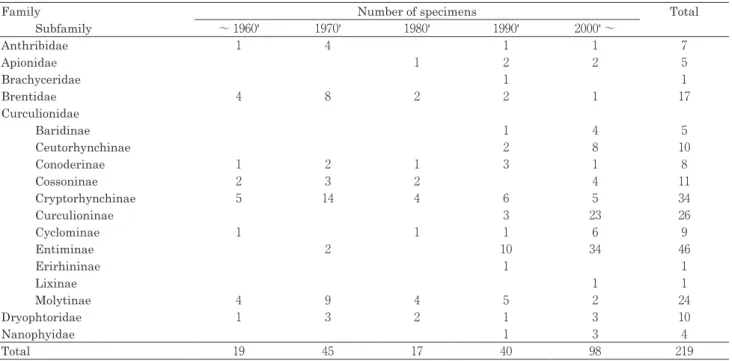
数を年代別にまとめて、検視標本とともに年代別の分類群構 成について解析を行った。 結 果 検視標本の同定結果 同 定 の 結 果、検 視 標 本 は 7 科 22 亜 科 に 類 別 され た (Table 1)。調 査 対 象 の 中 でもっとも多 か った の はゾ ウ ムシ 科 Curculionidae(計 175 個 体 )で 全 体 の 80 %を占め た。このゾウムシ科について亜科別にみると、クチブトゾ ウムシ亜科Entiminae(46個体)、クチカクシゾウムシ亜科 Cryptorhynchinae(34個体)、ゾウムシ亜科Curculioninae(26 個体)、アナアキゾウムシ亜科Molytinae(24個体)の順で多く、 この4亜科でゾウムシ科全体の75%を占めた。
List of Curculionoidea intercepted by Japanese Plant Quarantine
Anthribidae Anthribinae Ecelonerini Dendrotrogus sp.
1ex., Malaysia (Sandakan) → Takamatsu port, ex. Lauan log, Apr. 24, 1972, S. Ooue.
Eucorynus sp.
1ex., Thailand (Bangkok) → Kobe port, ex. Makha or Pradu log, Mar. 17, 1972, anonymous.
Rawasia sp.
2exs., China → Kobe port, ex. Bamboo pole, Sep. 21, 2012, K. Ishida.
Table 1. Number of weevil specimens intercepted at import plant quarantine by the Kobe Plant Protection Station.
Family Number of specimens Total
Subfamily ~ 1960' 1970' 1980' 1990' 2000' ~ Anthribidae 1 4 1 1 7 Apionidae 1 2 2 5 Brachyceridae 1 1 Brentidae 4 8 2 2 1 17 Curculionidae Baridinae 1 4 5 Ceutorhynchinae 2 8 10 Conoderinae 1 2 1 3 1 8 Cossoninae 2 3 2 4 11 Cryptorhynchinae 5 14 4 6 5 34 Curculioninae 3 23 26 Cyclominae 1 1 1 6 9 Entiminae 2 10 34 46 Erirhininae 1 1 Lixinae 1 1 Molytinae 4 9 4 5 2 24 Dryophtoridae 1 3 2 1 3 10 Nanophyidae 1 3 4 Total 19 45 17 40 98 219 Mecocerini Mecocerus sp.
1ex., Indonesia → Hiroshima port, ex. Keruing log, Jan. 28, 1978, I. Ueda.
Stenocerini Phaeochrotes sp.
1ex., Papua New Guinea → unknown port, ex. Taun log, Aug. 5, 1993, Yamaguchi.
Xylinadini Xylinada sp.
1ex., Thailand (Bangkok) → unknown port, ex. Rose wood log, Sep. 11, 1969, S. Ikeda.
Choraginae Araecerini Araecerus sp.
1ex., Taiwan (Kaohshinug) → Kobe port, ex. Paulownia log, Oct. 27, 1971, anonymous.
Apionidae Apioninae Aplemonini ?Perapion sp.
1ex., South Africa → Kansai airport, ex. cut flower Brunia sp., Oct. 18, 2010, Y. Yoshida: South Africa → Kansai airport, ex. cut flower Leucospermum sp., Nov. 4, 1994, K. Yagi.
Aspidapiini
Rhopalapion ?longirostre Olivier
1♂1♀, Turkey → Osaka airport, ex. Wheat, Sep. 2, 1982, T. Hiramatsu.
1ex., South Africa → Kansai airport, ex. cut flower Anthospermum sp., Jun. 13, 2002, H. Masushige. Piezotrachelini
?Chrysapion sp.
1ex., South Africa → Kansai airport, ex. cut flower Berzelia sp., Oct. 4, 1997, T. Takeshita.
Brachyceridae Brachycerinae Brachycerini
Brachycerus aegyptiacus Olivier
1ex., Turkey → Osaka airport, ex. Sternbergia lutea nursery, Sep. 13, 1990, A. Sasaki.
Brentidae Brentinae Arrhenodini
Baryrhynchus sp. (nr. yaeyamensis)
1ex., Malaysia (Sandakan) → Kishiwada port, ex. Lauan log, Feb. 10, 1970, S. Ooue.
Stratiorrhina xiphias Calabresi
1ex., Indonesia (Samarinda) → Hannan port, ex. Meranti log, Dec. 17, 1973, S. Tomomatsu.
Cyladinae Cyladini Cylas sp.
1ex., Uganda → Kansai airport, ex. fresh Sweet potato Ipomoea batatas (hand baggage), Oct. 25, 2005, T. Nakano.
Cyphagoginae Cyphagogini
Carcinopisthius sp. (nr. kolbei)
1ex., Papua New Guinea → Takuma port, ex. Erima log, Sep. 27, 1960, Morinaga.
Cyphagogus sp. (nr. crassitarsus)
1ex., Malaysia (Tg. Manis) → Takuma port, ex. Keruing log, Jul. 30, 1996, N. Higashiyama.
Cyphagogus sp. (nr. splendens)
2exs., Indonesia (Temdilahn) → Takamatsu port, ex. Lauan log, Jan. 10, 1972, S. Ooue.
Cyphagogus sp.
1ex., Liberia (Sionoe) → unknown port, ex. Makore log, Apr. 14, 1977, H. Yuguchi.
Hoplopisthius trichemerus Senna
1ex., Malaysia → Hannan port, ex. Seraya log, Jun. 10, 1980, M. Ishida.
?Hoplopisthius sp.
1ex., Malaysia (Sandakan) → Hannan port, ex. Seraya log, Feb. 23, 1977, G. Koyanagi.
?Opisthenoxys sp.
1ex., Philippines → Kishiwada port, ex. Lauan log, Jun. 23, 1970, S. Ooue.
Stereodermini
Cerobates sexsulcatus Motschulsky
1ex., Papua New Guinea (Vanimo) → Takuma port, ex. Binuang log, Apr. 24, 1997, N. Higashiyama. Taphroderinae
Taphroderini
Bolbocranius distortus (Westwood)
1 ♂ , Cameroun (Douala) → Kobe port, ex. Bubinga log, Jun. 24, 1980, I. Ueda: 1 ♀ , Ghana → unknown port, ex. Mansonia log, Jul. 18, 1966, Hosokawa. Trachelizinae
Trachelizini
Hormocerus ?reticulatus (Lund)
1ex., Cambodia → unknown port, ex. unknown log, Aug. 20, 1962, J. Inoue.
Tracheloschizus angulaticeps (Senna)
1ex., Indonesia (Pantiank) → Wakayama port, ex. Jelutong log, Nov. 15, 1972, I. Ueda.
Trachelizus ?bisulcatus (Lund)
1ex., Cambodia → unknown port, ex. unknown log, Jul. 12, 1962, S. Yoshimura.
Curculionidae Baridinae Apostasimerini
Apinocis deplanatus (Casey)
1ex., USA → Kobe port, ex. White oak log, Oct. 24, 2003, Y. Nomura.
Baridini
Aulacobaris lepidii (Germar)
2exs.(larva), Germany → Kansai airport, ex. fresh Horse-radish, Dec. 18, 2011, M. Genka (2exs. emerged on Jan. 30, 2012).
Cosmobaris orientalis (Roelofs)
1ex., China → Kobe port, ex. fresh Welsh onion, Jul. 7, 2010, anonymous.
Madarini
Orchidophilus sp.
1ex., Malaysia → Kansai airport, ex. cut flower Mokara sp., Mar. 21, 2007, K. Arikawa.
Madarini gen. sp.
1ex., Papua New Guinea (Crocodile point) → Takuma port, on deck, Jun. 23, 1997, M. Hashimoto. Ceutorhynchinae
Ceutorhynchini Ceutorhynchus sp.
Endive, Dec. 22, 2006, A. Karube. Isorhynchus sp.1
1ex., South Africa → Kansai airport, ex. cut flower Leucospermum sp., Oct. 12, 2009, T. Ishida: 1ex., South Africa → Kansai airport, ex. cut flower Leucospermum sp., Aug. 18, 1995, E. Segawa. Isorhynchus sp.2
1ex., South Africa → Kansai airport, ex. cut flower Phylica sp., Jun. 10, 2003, T. Matsumoto.
Isorhynchus sp.3
1ex., South Africa → Kansai airport, ex. cut flower Phylica sp., Jun. 24, 2002, K. Yoshikawa.
Micrelus ericae (Gyllenhal)
1ex., Germany → Kansai airport, ex. Calluna vulgaris nursery, Oct. 1, 2010, K. Hyoudou: 1ex., Germany → Kansai airport, ex. Calluna vulgaris nursery, Oct. 13, 2008, T. Miura.
Micrelus sp.
1ex., South Africa → Kansai airport, ex. cut flower Leucospermum sp., Aug. 17, 2005, T. Oooka.
Hypurini Hypurus sp.
1ex., Taiwan → Kansai airport, ex. cut flower Anthurium sp., Dec. 1, 1999, H. Okajima.
Conoderinae Campyloscelini Phaenomerus sp.
1ex., Thailand (Bangkok) → Kobe port, ex. Sathorn log, Aug. 8, 1973, anonymous.
Mecopini Mecopus sp.1
1ex., Indonesia (Trakan) → Kishiwada port, ex. Lauan log, Sep. 29, 1970, S. Tomomatsu.
Mecopus sp.2
1 ♂ , Papua New Guinea (Karu) → Takuma port, ex. Calophyllum log, Jan. 6, 1993, S. Morinaga: 1 ♀ , Papua New Guinea (Sauren) → Takuma port, ex. Calophyllum log, May 2, 1997, N. Higashiyama. Zygopini
Zygops sp.
1ex., Mexico → Kobe port, ex. Shitan log, May 2, 1997, S. Tomomatsu.
Tribe unknown Conoderinae gen. sp.1
1ex., Mozambique → unknown port, ex. Black wood log, Nov. 13, 1964, Hosokawa.
Conoderinae gen. sp.2
1ex., Tanzania → Kobe port, ex. Sesame seed, Jul. 22, 2004, T. Ishibe.
Conoderinae gen. sp.3
1ex., Congo (Pointe Moire) → Kobe port, ex. Moabi log, Apr. 26, 1984, A. Sasaki.
Cossoninae Cossonini Cossonus sp.
1ex., USA (Everett) → Takuma port, ex. Douglas fir log, May 15, 1979, T. Tanabe.
Eremotes sp.
1ex., New Zealand (Maungani) → Takuma port, ex. Radiata pine log, Feb. 27, 1980, T. Tanabe.
Macrorhyncolus sp.
1ex., USA → Kobe port, ex. Paulownia log, Jun. 11, 2012, K. Tanaka.
Oxydema sp.
1ex., Indonesia → Kobe port, ex. Cactus sp. nursery, Jul. 22, 1988, S. Makiguchi.
Pachyops sp.
1ex., Taiwan → Kobe port, ex. Hinoki log, Oct. 8, 1975, M. Uwada.
Phloeophagosoma sp.
1ex., South Africa → Kobe port, ex. Cycas sp. nursery, Apr. 23, 1969, M. Takada.
Proeces sp.
1ex., Thailand → Kobe port, ex. dryed Palm nut, Nov. 5, 2002, T. Ueno.
Xenocnema sp.1
1ex., New Zealand → Kansai airport, ex. cut flower Magnolia sp., Jun. 12, 2010, M. Ishiguro.
Xenocnema sp.2
1ex., South Africa → Kobe port, ex. cut flower Cycadaceae gen. sp., Dec. 9, 1968, M. Takada. Cossonini gen. sp.
1ex., Guatemala → Kansai airport, ex. Tillandsia juncea nursery, Aug. 8, 2005, M. Okamoto.
Rhyncolini Himatium sp.
1ex., Canada (Vancouver) → Kobe port, ex. Black walnut log, Oct. 16, 1971, anonymous.
Cryptorhynchinae Aedemonini Mechistocerus sp.
1ex., Indonesia (Palembang) → Kishiwada port, ex. unknown log, Apr. 10, 1971, S. Tomomatsu.
Parendymia sp.
1 ♂ , Philippines (Maligay Bay) → Sakai-minato port, ex. Mangrove log, Jul. 19, 1971, Ishikawa. Rhadinomerus sp.1
1ex., Thailand (Bangkok) → unknown port, ex. Ching-chan log, Feb. 2, 1970, S. Ikeda.
1ex., Papua New Guinea (Manus Is.) → Sakai-minato port, ex. unknown log, Feb. 20, 1990, I. Ueda: 1ex., Burma (Rangoon) → Kobe port, ex. Teak log, Apr. 21, 1971, S. Ikeda.
Rhadinomerus sp.3
1ex., Indonesia → Hannan port, ex. Binuang log, Apr. 18, 1980, Uchida: 1ex., Indonesia (Berau) → Hannan port, ex. Meranti log, Apr. 3, 1972, T. Taguchi.
Camptorhinini
Camptorhinus dorsalis Schoenherr
1ex., Philippines → unknown port, ex. Lauan log, Aug. 7, 1962, S. Yoshimura.
Camptorhinus mangiferae Marshall
1ex., Indonesia (Berau) → Hannan port, ex. Meranti log, Apr. 3, 1972, T. Taguchi.
Camptorhinus sp.
1ex., Papua New Guinea (Paia Inlet) → Takuma port, ex. unknown log, Jun. 3, 1997, N. Higashiyama. Cryptorhynchini
Bartolozziella (= Endymia) sp.1
1ex., Papua New Guinea → Takuma port, ex. Taun log, Jun. 23, 1994, F. Dote.
Bartolozziella (= Endymia) sp.2
1 ♂ 1 ♀ , Papua New Guinea → Takuma port, ex. Taun log, Jun. 23, 1994, F. Dote.
Cryptorhynchus sp.1
1ex., USA (Baltimoke) → unknown port, ex. Black walnut log, Jun. 18, 1969, S. Ikeda.
Decilaus ?albohumeralis Lea
1ex., Australia → Kansai airport, ex. cut flower Leucadendron sp., Oct. 1, 2008, J. Yamada.
Gerstaeckeria sp.1
1ex., USA → Kobe port, ex. Cactus sp. nursery, Feb. 20, 1967, H. Takada.
Gerstaeckeria sp.2
1ex., USA → Nagoya port, ex. Cactus sp. nursery, Jul. 26, 1972, H. Nagaki.
Mitrastethus baridioides Redtenbacher
1ex., New Zealand → Kansai airport, ex. fresh Cantaloupe melon Cucumis melo, Mar. 3, 2004, S. Morimoto: 1ex., New Zealand → Kansai airport, ex. fresh Asparagus, Dec. 11, 2008, A. Karube.
Shirahoshizo insidiosus (Roelofs)
1ex., USSR (Vladivostok) → Sakai-minato port, ex. Cedar log, Sep. 4, 1972, Ishikawa.
Shirahoshizo rufescens (Roelofs)
1ex., Taiwan (Taiyuin) → unknown port, ex. Tohi log, Sep. 11, 1962, T. Tomoda: 1ex., Burma (Rangoon) → Kobe port, ex. Pine log, Jan. 31, 1981, I. Ueda.
Synacalles sp.
1ex., New Zealand → Kansai airport, ex. cut flower Lycopodium sp., Feb. 26, 2008, Y. Gyouji.
Trigonopterus (= Idotasia) sp.
1ex., Papua New Guinea (Konos) → Takuma port, ex. unknown log, Aug. 23, 1984, T. Gohda (intercepted at immature stage and reared with artificial diet).
Zeugenia sp.1
1ex., Philippines → unknown port, ex. Apitong log, May 29, 1962, T. Tomoda.
Zeugenia sp.2
1ex., Indonesia (Muara Sabak) → Amagasaki port, ex. Mersawa log, Oct. 2, 1979, Y. Joukou.
Gasterocercini Neoampagia sp.
1ex., Indonesia (New Guinea, Laenawguinea) → Kochi port, ex. Hoop pine log, Jul. 10, 1973, U. Sakata.
Orochlesis sp.
1ex., Taiwan → Kansai airport, ex. cut flower Phalaenopsis sp., Dec. 24, 2011, M. Genka.
Psepholacini Therebus sp.
2exs., Indonesia (New Guinea, Ringi Coue) → Hannan port, ex. unknown log, Feb. 3, 1972, S. Ikeda.
Tribe unknown
Cryptorhynchinae gen. sp.1
1ex., Cameroun (Douala) → Hannan port, ex. Billec sapelli log, Apr. 9, 1974, S. Ikeda.
Cryptorhynchinae gen. sp.2
1ex., Congo (Pointe Moire) → Kobe port, ex. Pao rosa log, Apr. 18, 1984, A. Sasaki.
Cryptorhynchinae gen. sp.3
1ex., Mozambique (Port Ameria) → Kobe port, ex. Pao rosa log, Oct. 9, 1971, T. Muramatsu.
Curculioninae Acalyptini Orsophagus sp.
1ex., Thailand → Kansai airport, ex. Cabomba sp. nursery, Mar. 13, 2005, M. Sekiya: 1ex., Thailand → Kansai airport, ex. Azadirachta indica, Dec. 15, 1997, I. Tomita.
Anthonomini Anthonomus sp.1
1ex., China → Kansai airport, ex. Pot pourri, May 16, 2001, T. Hiramatsu.
Anthonomus sp.2
Juniperus sp., Nov. 1, 2007, M. Mizuta. Cryptoplini
?Haplonyx sp.
1ex., Australia → Kansai airport, ex. cut flower Eucalyptus sp. (in fruit), Aug. 10, 2004, M. Sekiya: 1ex.(larva), Australia → Kansai airport, ex. cut flower Eucalyptus sp. (in fruit), Aug. 26, 2010, Y. Hara.
Curculionini Curculio sp.
1ex., Thailand → Osaka airport, ex. fresh Mangosteen (hand baggage), Jan. 19, 1993, H. Masuda.
Eugnomini
Myossita ?melanocephala Pascoe
1ex., Australia → Kansai airport, ex. cut flower Banksia sp., Dec. 14, 2007, R. Kasukabe.
?Ancyttalia sp.
1ex., Australia → Kansai airport, ex. cut flower Berzelia sp., Oct. 11, 2006, S. Fujita: 1ex.(dead individuals), Australia → Kansai airport, ex. cut flower Boronia sp., Oct. 20, 2007, T. Miura.
Smicronychini ?Smicronyx sp.
1ex., Israel → Kansai airport, ex. cut flower Chamelaucium sp., Dec. 17, 2004, Y. Kusakari. Storeini
?Elleschodes sp. 1
1ex., Australia → Kansai airport, ex. cut flower Chamelaucium sp., Nov. 26, 2008, R. Kasukabe. ?Elleschodes sp. 2
1ex.(dead individuals), Australia → Kansai airport, ex. cut flower Chamelaucium sp., Oct. 17, 2007, S. Fujita.
Tychiini Sibinia sp.
1ex., Israel → Kansai airport, ex. cut flower Echinops sp., Jun. 14, 2010, M. Genka.
Tychius sp.
1ex., Germany → Kansai airport, ex. Calluna vulgris nursery, Oct. 15, 2006, Y. Yamaji.
Incertae sedis Epamoebus ?ziczac Lea
1ex., Australia → Kansai airport, ex. cut flower Chamelaucium sp., Sep. 15, 2010, Y. Hara.
Tribe unknown Curculioninae gen. sp.1
1ex., South Africa → Kansai airport, ex. Phoenocoma prolifera nursery, Oct. 17, 1994, F. Aramaki.
Curculioninae gen. sp.2
1ex., South Africa → Kansai airport, ex. cut flower Brunia sp., Dec. 9, 2000, Y. Kounoike.
Curculioninae gen. sp.3
1ex., South Africa → Kansai airport, ex. cut flower Berzelia sp., Oct. 19, 2000, F. Aramaki.
Curculioninae gen. sp.4
1ex., South Africa → Kansai airport, ex. cut flower Berzelia sp., Feb. 17, 2008, T. Kawakami.
Curculioninae gen. sp.5
1ex., South Africa → Kansai airport, ex. cut flower Aspalathus sp., Dec. 5, 2007, K. Arikawa.
Curculioninae gen. sp.6
1ex., South Africa → Kansai airport, ex. cut flower Brunia sp., May 17, 2004, Y. Kusakari.
Curculioninae gen. sp.7
1ex., South Africa → Kansai airport, ex. cut flower Berzelia sp., Nov. 1, 2002, K. Yoshikawa.
Curculioninae gen. sp.8
1ex., South Africa → Kansai airport, ex. cut flower Berzelia sp., Feb. 7, 2004, T. Hashimoto.
Curculioninae gen. sp.9
1ex., South Africa → Kansai airport, ex. cut flower Thryptomene sp., Aug. 3, 2002, K. Joukou.
Curculioninae gen. sp.10
1ex., Australia → Kansai airport, ex. cut flower Banksia sp., Dec. 6, 2006, M. Okamoto.
Cyclominae Aterpini
Aesiotes ?notabilis Pascoe
1ex., Indonesia (Poso) → Hannan port, ex. Agathis log, Feb. 21, 1981, M. Ishida.
Aterpini gen. sp.1
1ex., Germany → Kansai airport, ex. Sarcocaulon crassicaule nursery, Sep. 2, 2011, M. Hashimoto. Aterpini gen. sp.2
1ex., Australia → Kansai airport, ex. cut flower Helichrysum sp., Sep. 23, 2007, Y. Gyouji.
Aterpini gen. sp.3
1ex., South Africa → Kansai airport, ex. cut flower Brunia sp., Dec. 2, 2007, F. Noda.
Rhythirrinini
Listroderes costirostris Schoenherr
1ex., Australia → Kobe port, ex. Rape seed, Jan. 31, 2004, T. Naruo.
Listronotus ?bonariensis (Kuschel)
1ex., USA → Kobe port, ex. Rye grass hay, Dec. 10, 1967, K. Ozaki.
Steriphus ?diversipes (Pascoe)
Rape seed, Dec. 2, 2003, K. Nakashiba: 1ex., New Zealand → Kobe port, on the floor of container with fresh Squash, Feb. 25, 2010, H. Kishida.
Tribe unknown Cyclominae gen. sp.
1ex., New Zealand → Kobe port, ex. Fern tree, Sep. 1, 1990, anonymous.
Entiminae Blosyrini
Blosyrus asellus (Olivier)
1ex., Thailand → Kobe port, ex. fresh Durian Durio zibethinus, May 18, 2012, K. Koumekawa: 1ex., Thailand → Kansai airport, ex. fresh Asparagus Asparagus officinalis, May 25, 2011, M. Genka: 1ex., Thailand → Osaka airport, ex. cut flower Orchidaceae gen. sp., Jul. 28, 1977, S. Oishi.
Strophosoma sp.
1ex., Belgium → Kobe port, ex. Yellow cedar log, May 25, 2004, T. Murata: 1ex., Denmark → Kobe port, ex. Abies procerus nursery, Nov. 18, 2003, I. Tomita.
Cyphicerini Myllocerus sp.
1ex., Sri Lanka → Osaka airport, ex. Dracaena marginata nursery, May 25, 1992, Y. Yoshida. ?Oophthalmus sp.
1ex., Australia → Kansai airport, ex. cut flower Helichrysum sp., Oct. 31, 2008, K. Imai.
Cyphicerini gen. sp.1
1ex., New Zealand → Kansai airport, ex. cut flower Leucospermum sp., Dec. 21, 2001, H. Masushige. Cyphicerini gen. sp.2
1ex., Thailand → Kansai airport, ex. fresh Asparagus Asparagus officinalis, Jun. 30, 2002, F. Aramaki.
Cyphicerini gen. sp.3
1ex., Thailand → Kansai airport, ex. fresh Asparagus Asparagus officinalis, Nov. 16, 2004, Y. Dodo.
Eupholini
Eupholus schoenherri (Guérin-Méneville)
1ex., Indonesia → Kansai airport, ex. unknown, May 15, 2003, M. Sekiya.
Gonipterini Gonipterus sp.1
1ex., Australia → Kansai airport, ex. cut flower Persoonia sp., Jun. 4, 2010, Y. Yoshida.
Gonipterus sp.2
1ex., Australia → Kansai airport, ex. cut flower Leucadendron sp., May 1, 2004, M. Sekiya.
Laparocerini ?Merimnetes sp.
1ex., Australia → Kansai airport, ex. cut flower Chamelaucium sp., Aug. 25, 2007, T. Kawakami. Naupactini
Pantomorus cervinus (Boheman)
1ex.(dead individual), New Zealand → Kansai airport, ex. cut flower Protea sp., Apr. 9, 2008, M. Mizuta.
Otiorhynchini Otiorhynchus sp.
1ex., Australia → Kobe port, ex. Rape seed, Jan. 31, 2004, T. Naruo: 1ex., Australia → Kansai airport, ex. cut flower Protea sp., Mar. 14, 2003, Y. Kojima. Phlyctinus callosus Boheman
1ex., Australia → Kobe port, ex. Rape seed, Jan. 31, 2004, T. Naruo.
Otiorhynchini gen. sp.1
1ex., South Africa → Kansai airport, ex. cut flower Protea sp., Jul. 12, 2004, Y. Kojima.
Otiorhynchini gen. sp.2
1ex., Zimbabwe → Kansai airport, ex. cut flower Anigozanthos sp., Nov. 7, 2008, K. Imai.
Pachyrhynchini Metapocyrtus sp.1
1ex., Philippines → Kobe port, ex. fresh Pineapple, Aug. 22, 1995, anonymous.
Metapocyrtus sp.2
1ex., Philippines → Kobe port, ex. fresh Pineapple, Mar. 8, 2011, M. Watanabe.
Sitonini Sitona sp.1
1ex.(dead individual), South Africa → Kansai airport, ex. cut flower Leucospermum sp., Oct. 11, 2010, N. Ichiryu.
Sitona sp.2
1ex., South Africa → Kansai airport, ex. cut flower Leucospermum sp., Nov. 7, 1995, M. Hashimoto. Sitona sp.3
1ex., Australia → Kansai airport, ex. cut flower Chamelaucium sp., Nov. 23, 2005, F. Noda.
Sitona sp.4
1ex., New Zealand → Kansai airport, ex. cut flower Elegia sp., Dec. 11, 1999, K. Fujita.
Sitona sp.5
1ex., Germany → Osaka airport, ex. Crassula herreana nursery, Sep. 4, 1991, M. Mizuta.
Sitona sp.6
1ex., Germany → Kansai airport, ex. Calluna vulgris nursery, Oct. 9, 2003, H. Nanchi.
Tanymecini (Piazomiina) ?Beardiella (= Xenorrhinus) sp.1
1ex., South Africa → Kansai airport, ex. cut flower Berzelia sp., Dec. 20, 2004, S. Maeta.
?Beardiella (= Xenorrhinus) sp.2
1ex., South Africa → Kansai airport, ex. cut flower Berzelia sp., Jul. 19, 1999, F. Aramaki.
Tanymecini (Tanymecina) Tanymecini gen. sp.
1ex., South Africa → Kansai airport, ex. cut flower Leucospermum sp., Sep. 6, 1997, T. Murakami. Tropiphorini
?Perperus sp.
1ex., Australia → Kansai airport, ex. cut flower Chamelaucium sp., Jun. 25, 2004, K. Ueno.
?Psapharus sp.
1ex., Australia → Kansai airport, ex. cut flower Doryanthes sp., May 24, 2003, M. Sekiya.
Catasarcus sp. (nr. impressipenis)
1ex., Australia → Kansai airport, ex. cut flower Persoonia sp., Apr. 8, 2011, T. Inaba.
Catasarcus sp. (nr. pallidiventris)
1ex., Australia → Kansai airport, ex. cut flower Leucadendron sp., Nov. 3, 2007, Y. Gyouji.
?Essolithna (= Pascoellus) sp.
1ex., Australia → Kansai airport, ex. cut flower Scholtzia sp., Jan. 15, 2012, M. Hashimoto.
Polyphrades ?brevirostris Lea
1ex., Australia (Port Geraldton) → Kobe port, ex. Wheat, Dec. 12, 1979, K. Nakano.
Scotasmus ?litoralis (Lea)
1ex., Australia → Kobe port, ex. Rape seed, Dec. 2, 2003, K. Nakashiba.
Tribe unknown Entiminae gen. sp.1
1ex., South Africa → Kansai airport, ex. cut flower Leucospermum sp., Oct. 18, 1995, N. Kubota. Entiminae gen. sp.2
1ex., South Africa → Kansai airport, ex. cut flower Berzelia sp., Nov. 4, 2002, C. Higashitanaka. Entiminae gen. sp.3
1ex., South Africa → Kansai airport, ex. cut flower Berzelia sp., Nov. 14, 2010, T. Ishida.
Entiminae gen. sp.4
1ex., South Africa → Kansai airport, ex. cut flower Aspalathus sp., Dec. 5, 2007, K. Arikawa.
Entiminae gen. sp.5
1ex., Thailand → Kansai airport, ex. fresh Holy basil Ocimum tenuiflorum, Feb. 12, 2003, K. Yamaguchi.
Entiminae gen. sp.6
1ex., Thailand → Osaka airport, ex. fresh Asparagus Asparagus officinalis, Jun. 16, 1992, A. Tanaka. Entiminae gen. sp.7
1ex., New Zealand → Kansai airport, ex. cut flower Astartea sp., Dec. 12, 2001, T. Sakaguchi.
Entiminae gen. sp.8
1ex., New Zealand → Kansai airport, ex. cut flower Viburnum sp., Nov. 11, 1999, T. Ogino.
Erirhininae Tribe unknown Erirhininae gen. sp.
1ex., Thailand → Osaka airport, ex. Crinum thianum nursery, Nov. 7, 1997, H. Fujimoto.
Lixinae
Tribe unknown Lixinae gen. sp.
1ex., Israel → Kansai airport, ex. cut flower Leucadendron sp., Dec. 18, 2002, K. Yamaguchi. Molytinae
Acicnemidini Acicnemis sp.1
1ex., Thailand (Bangkok) → Kobe port, ex. Sathorn log, Oct. 26, 1971, anonymous.
Acicnemis sp.2
1ex., Thailand (Bangkok) → Kobe port, ex. Sathorn log, Oct. 26, 1971, anonymous.
Aminyopini Niphades sp.
1ex., Malaysia (Kinanis) → Kishiwada port, ex. unknown log, May 10, 1985, A. Miyoshi.
Hylobiini
Aclees ?cribratus Gyllenhal
1ex., Indonesia (Kekeo) → Takuma port, ex. Meranti log, Aug. 26, 1980, T. Kobayashi.
Aclees sp.
1ex., Papua New Guinea → Takuma port, ex. Pencil cedar log, Mar. 22, 1994, F. Dote.
Hylobiini gen. sp.
1ex., Malaysia (Sarawak Bintulu Suai) → Sakai-minato port, ex. Lauan log, May 25, 1984, S. Inoue. Ithyporini
Colobodes sp.
1ex., Indonesia (Palopo) → Hannan port, ex. unknown log, Jun. 20, 1973, S. Ikeda.
?Deretiosus (= Deretiosomimus) sp.
1ex., Malaysia → Hannan port, ex. Seraya log, Jun. 19, 1979, M. Fujiwara.
Ectatorhinus sp.
Lauan log, Mar. 31, 1970, S. Ooue. Molytini
Steremnius carinatus (Boheman)
1ex., USA → Kansai airport, ex. Juniperus sp. nursery, Dec. 1, 1996, K. Fujita.
Pissodini Pissodes sp.1
1ex., USSR → Sakai-minato port, ex. Red pine log, Jun. 1, 1965, K. Fujioka.
Pissodes sp.2
1ex., USA → Sakai-minato port, ex. Hemlock log, May 12, 1964, S. Sugahara.
Pissodes sp.3
1ex., USA → unknown port, ex. Hemlock log, Jun. 2, 1968, Wakayama (captured at larva or pupa and emerged on Jun. 6, 1968).
Pissodes sp.4
1ex., USA (Astoria) → Kishiwada port, ex. Spruce log, Jan. 23, 1971, S. Tomomatsu.
Tribe unknown Molytinae gen. sp.1
1ex., Cameroun (Douala) → Kobe port, ex. Bubinga log, Jun. 24, 1980, I. Ueda.
Molytinae gen. sp.2
1ex., Gabon → Kobe port, ex. Moabi log, Apr. 4, 1992, H. Mizuta.
Molytinae gen. sp.3
1ex., Papua New Guinea → Takuma port, ex. Calophyllum log, Feb. 18, 1993, F. Dote.
Molytinae gen. sp.4
1ex., Papua New Guinea (Crocodile point) → Takuma port, ex. Pencil cedar log, Sep. 30, 1997, N. Higashiyama.
Molytinae gen. sp.5
1ex., Philippines (Aparri) → unknown port, ex. Lauan log, Apr. 8, 1963, S. Orita.
Molytinae gen. sp.6
1ex., Cameroun (Douala) → Hannan port, ex. Billec sapelli log, Apr. 9, 1974, S. Ikeda.
Molytinae gen. sp.7
1ex., Australia → Kansai airport, ex. cut flower Chamelaucium sp., Jun. 15, 2007, M. Itou.
Molytinae gen. sp.8
1ex., Brazil (Belem) → Kobe port, ex. Jutai log, Mar. 15, 1973, anonymous.
Molytinae gen. sp.9
1ex., South Africa → Kansai airport, ex. cut flower Brunia sp., Oct. 17, 2007, R. Kasukabe.
Dryophthoridae
Rhynchophorinae Diocalandrini
Diocalandra elongata (Roelofs)
1ex., Philippines → Kobe port, ex. fresh Coconut Cocos nucifera, Jun. 20, 2002, K. Nakashiba.
Litosomini
Sitophilus zeamais (Motschulsky)
1ex., South Africa → Kansai airport, ex. cut flower Berzelia sp., Oct. 16, 1995, M. Sunakawa.
Tryphetus incarnatus Csiki
1ex., Indonesia → Kansai airport, ex. Jengkol bean, Jun. 13, 2004, Y. Kusakari.
Sphenophorini Nassophasis sp.
1ex., Taiwan → Osaka airport, ex. Pleione formosana nursery, Feb. 4, 1981, Y. Tanida.
Trochorhopalus dipterocarpi Marshall
1ex., Indonesia (Samarinda) → Kishiwada port, ex. Lauan log, Jan. 23, 1971, S. Ooue.
Trochorhopalus sp.1
1ex., Malaysia (Baram) → Takuma port, ex. Seraya log, Apr. 10, 1984, T. Gohga.
Trochorhopalus sp.2
1ex., Malaysia (Sandakan) → Takuma port, ex. Seraya log, Apr. 6, 1979, S. Inoue.
Trochorhopalus sp.3
1ex., Philippines (Real) → Kishiwada port, ex. Lauan log, Mar. 9, 1971, S. Ooue.
?Sphenophorus sp.
1ex., South Africa → Kobe port, ex. Cycas sp. nursery, Apr. 26, 1969, H. Takada.
Subfamily unknown Dryophthoridae gen. sp.
1ex., South Africa → Kansai airport, ex. cut flower Berzelia sp., Nov. 13, 2000, H. Masushige.
Nanophyidae Nanophyinae Nanophyini Nanophyes sp.
1ex., South Africa → Kansai airport, ex. cut flower Erica sp., Feb. 24, 2003, K. Fujii: 2exs., South Africa → Kansai airport, ex. cut flower Erica sp., Mar. 3, 2003, Y. Tanaka: 1ex., South Africa → Kansai airport, ex. cut flower Erica sp., Nov. 3, 1999, Y. Atobe.
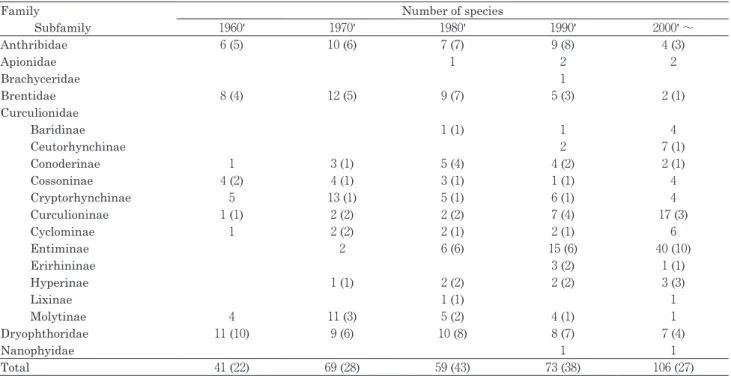
植物検疫統計に記録されたゾウムシ類 1960年から2000年までの植物検疫統計に掲載されたゾウム シ上科は4科79種(属までの同定のものを含む)であった。検 視標本と同様にゾウムシ科が最も多く12亜科41種で全体の 52%を占めた。ゾウムシ科について亜科別にみると、クチブト ゾウムシ亜科が12種で最も多かった。 ゾウムシ類の分類群構成の変化 検視標本および植物検疫統計の両方を合わせた年代別の ゾウムシ上科の発見種数について、科および亜科の構成を年 代別に見ると、各年代を通してゾウムシ科が大半を占めてい た。しかし、ゾウムシ科内の構成を亜科レベルで見ると、1980 年代前後で顕著な変化が認められた。クチカクシゾウムシ亜 科およびアナアキゾウムシ亜科の発見種数は1970年代に最大 となり、ゾウムシ科の中でそれぞれ42%(13種)、35%(11種)を 占めた。それ以降は急激に減少して2000年代にはゾウムシ科 全体の5%以下になった。一方、クチブトゾウムシ亜科および ゾウムシ亜科の発見種数は、前者が1980年代以降、後者が 1990年代以降にそれぞれ急増し、2000年代以降にはゾウムシ 科全体のそれぞれ44%(40種)、18%(17種)を占めるようになっ た(Table 2)。 また、ゾウムシ科の各亜科と発見品目の関係をみると、クチ カクシゾウムシ亜科およびアナアキゾウムシ亜科は木材から、 クチブトゾウムシ亜科およびゾウムシ亜科は切り花および青果 物から、それぞれ大半の種が発見されていた(Fig.1)。 ゾウムシ科以外の科の発見種数を年代別にみると、ミツギ リゾウムシ科Brentidaeは1970年代をピークとして徐々に減少 していった。ホソクチゾウムシ科Apionidaeとチビゾウムシ科
Table 2. Number of weevil species intercepted at import plant quarantine by the Kobe Plant Protection Station.
Family Number of species
Subfamily 1960' 1970' 1980' 1990' 2000' ~ Anthribidae 6 (5) 10 (6) 7 (7) 9 (8) 4 (3) Apionidae 1 2 2 Brachyceridae 1 Brentidae 8 (4) 12 (5) 9 (7) 5 (3) 2 (1) Curculionidae Baridinae 1 (1) 1 4 Ceutorhynchinae 2 7 (1) Conoderinae 1 3 (1) 5 (4) 4 (2) 2 (1) Cossoninae 4 (2) 4 (1) 3 (1) 1 (1) 4 Cryptorhynchinae 5 13 (1) 5 (1) 6 (1) 4 Curculioninae 1 (1) 2 (2) 2 (2) 7 (4) 17 (3) Cyclominae 1 2 (2) 2 (1) 2 (1) 6 Entiminae 2 6 (6) 15 (6) 40 (10) Erirhininae 3 (2) 1 (1) Hyperinae 1 (1) 2 (2) 2 (2) 3 (3) Lixinae 1 (1) 1 Molytinae 4 11 (3) 5 (2) 4 (1) 1 Dryophthoridae 11 (10) 9 (6) 10 (8) 8 (7) 7 (4) Nanophyidae 1 1 Total 41 (22) 69 (28) 59 (43) 73 (38) 106 (27)
Figures in parentheses from annual reports of Japanese plant quarantine.
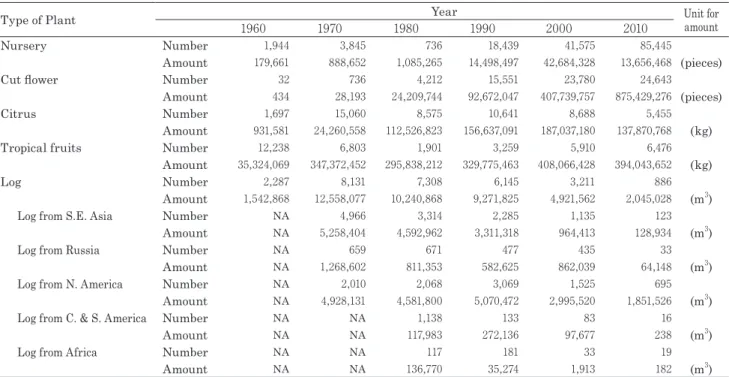
Nanophyidaeはそれぞれ1980年代、1990年代以降に発見され ていた。ヒゲナガゾウムシ科Anthribidaeおよびオサゾウムシ 科Dryophthoridaeは各年代を通じて発見数に大きな変化は みられなかった。 考 察 クチカクシゾウムシ亜科およびアナアキゾウムシ亜科の急減 1970年代以降の輸入検査におけるクチカクシゾウムシ亜科 およびアナアキゾウムシ亜科の急激な減少は、東南アジア地 域における木材の輸出規制強化が関係していると考えられる。 両亜科には木材穿孔性の種が多く含まれており、今回の検視 標本では南洋材から発見された種が大半を占めていた。東南 アジアにおける南洋材の輸出規制は1970年代以降に段階的に 強化され、1990年代前半までには主要な産地で丸太の輸出が 禁止された。また、輸出規制の強化と並行して現地の木材加 工産業が発展していった(立花、2000)。その結果、害虫の付 着リスクが低いことから輸入検疫の対象としていない合板お よび製材での輸出量が増加し、神戸植物防疫所管内における 南洋材の輸入検査件数は1970年以降急速に減少した(Table 2)。このため、両亜科に属するゾウムシ類の発見機会も減少 していったと推測される。ミツギリゾウムシ科も木材穿孔性の 種を多く含み、検視標本も南洋材から発見された個体がほと んどであったことから、同様な理由で発見種数が1970年代以 降に徐々に減少していったと推測される。 クチブトゾウムシ亜科およびゾウムシ亜科の急増 クチブトゾウムシ亜科およびゾウムシ亜科の急激な増加は、
Table 3. Number and amount of inspection of import plant by Kobe Plant Protection Station during 1960-2010.
Type of Plant Year Unit foramount
1960 1970 1980 1990 2000 2010
Nursery Number 1,944 3,845 736 18,439 41,575 85,445
Amount 179,661 888,652 1,085,265 14,498,497 42,684,328 13,656,468 (pieces)
Cut flower Number 32 736 4,212 15,551 23,780 24,643
Amount 434 28,193 24,209,744 92,672,047 407,739,757 875,429,276 (pieces)
Citrus Number 1,697 15,060 8,575 10,641 8,688 5,455
Amount 931,581 24,260,558 112,526,823 156,637,091 187,037,180 137,870,768 (kg)
Tropical fruits Number 12,238 6,803 1,901 3,259 5,910 6,476
Amount 35,324,069 347,372,452 295,838,212 329,775,463 408,066,428 394,043,652 (kg)
Log Number 2,287 8,131 7,308 6,145 3,211 886
Amount 1,542,868 12,558,077 10,240,868 9,271,825 4,921,562 2,045,028 (m3)
Log from S.E. Asia Number NA 4,966 3,314 2,285 1,135 123
Amount NA 5,258,404 4,592,962 3,311,318 964,413 128,934 (m3)
Log from Russia Number NA 659 671 477 435 33
Amount NA 1,268,602 811,353 582,625 862,039 64,148 (m3)
Log from N. America Number NA 2,010 2,068 3,069 1,525 695
Amount NA 4,928,131 4,581,800 5,070,472 2,995,520 1,851,526 (m3)
Log from C. & S. America Number NA NA 1,138 133 83 16
Amount NA NA 117,983 272,136 97,677 238 (m3)
Log from Africa Number NA NA 117 181 33 19
Amount NA NA 136,770 35,274 1,913 182 (m3)
Data from annual reports of Japanese Plant Quarantine. NA: Data not available
航空貨物による生鮮野菜や切り花等の輸送技術の発達が関 係していると考えられる。これらの亜科には生きた植物を寄主 利用する種が多く含まれており、両亜科の大半の種は切り花 および生鮮野菜から発見されていた。 生果実、生鮮野菜、切り花類は鮮度劣化が速く、かつて は柑橘類やバナナなど一部を除き船舶貨物での輸送が困難 であった。しかし、1990年代には航空貨物での輸送が一般化 したことにより輸入量が増加した。神戸植物防疫所管内では 1996年に関西国際空港が開港したことにより、切り花や熱帯 果実の輸入量および検査件数が急増し(Table 3)、同時に輸 入品目も著しく多様化した。また、航空機によって輸送時間 が大幅に短縮されることにより、植物の鮮度が保たれるだけ でなく、害虫類の輸送中の死滅も減少したと推測される。こ れらの理由により、それまで検疫で発見例が少なかったクチ ブトゾウムシ亜科およびゾウムシ亜科に所属する未同定のゾウ ムシ類の発見種数が増加したと考えられる。 また、ホソクチゾウムシ科およびチビゾウムシ科も生きた植 物を寄主利用する種を多く含み、検視標本は1個体(1980年代) を除きすべて切り花から発見されたものであったことから、同 様な理由で1990年代以降に発見されるようになったと考えら れる。 今後の植物検疫で重要となる分類群 今回の調査結果により、今後の植物検疫上重要なゾウムシ 類は、クチブトゾウムシ亜科ならびにゾウムシ亜科などの生植 物類に付着する分類群であると考えられた。航空貨物の輸送 技術の発達に伴う遠隔地からの輸入量の増加および輸入品 目の多様化は現在も続いていることから、これまで輸入検疫 で発見された種の侵入・定着のリスクは高まっているとともに、 検疫未記録の種が発見されていく可能性も高いと考えられる。 生植物類を食害するゾウムシ類は、侵入・定着した場合は 国内の農業および生態系に大きな影響を及ぼす恐れがあるた め、そのリスクを評価したうえで適切な検疫措置を講じていく 必要がある。このリスク評価を行う際には、発見されたゾウム シ類の種名が明らかになることが前提である。しかしながら、 生植物類を食害するゾウムシ類がこれほど多種類発見される ようになったのは我が国の植物検疫の歴史上比較的最近のこ とであり、標本や情報の蓄積はまだ十分ではない。また、原 産地域によっては分類学的研究が遅れており、種までの同定 が困難な場合も多い。例えば、 2010年に三重県内の観葉植物 栽培施設内でクチブトゾウムシ亜科の一種が害虫化した事例 では、当該種は日本未記録で未記載のカタゾウムシ族の一種 であった(吉武, 2012: Yoshitake et al., 2012)。当該種は2011 年以降の発生は確認されておらず根絶されたとみられるが、こ のように未記載種が侵入した場合には、原産地や寄主植物等 の情報がなく侵入経路の特定が難しいことから輸入検疫での 対応策の検討も困難である。したがって、適切な輸入検疫を 実施するためには、現在侵入・定着のリスクが高い前述の分 類群について、分類学的研究を基軸とする基盤情報整備を行 うことが非常に重要であると考えられる。 今回作成した図版には属および種までの同定に至らなかっ た検視標本も掲載した。植物防疫所として調査を継続し、こ れらの標本の同定を進めていくことが今後の課題である。 摘 要 神戸植物防疫所管内の輸入検疫で発見され未同定のまま保 管されていたゾウムシ類標本219個体の同定を行うとともに、 1960年から2009年の輸入検疫におけるゾウムシ類の発見記録 と併せて年代別の分類群構成を解析した。1980年代前後を境 として、それまで多数を占めていたクチカクシゾウムシ亜科と アナアキゾウムシ亜科の発見種数が減少する一方で、クチブト ゾウムシ亜科とゾウムシ亜科は急増した。前者は木材穿孔性 の種を多く含むことから、東南アジアの丸太輸出規制強化お よび木材加工産業の発達による丸太の輸入量の減少が原因と 考えられた。後者は生きた植物体を食害する種を多く含むこ とから、その増加には航空貨物での生鮮野菜、切り花等の輸 入量増加が関係していると推定され、今後の我が国の植物検 疫において一層重要となる分類群であると考えられた。 謝 辞 検視標本の一部について同定の労を賜った森本桂博士(九 州大学名誉教授)ならびにEnzo Colonneli博士(ローマ市)、 Jens Prena博士(ロストック市)に記して厚く御礼申し上げる。 本研究は平成24年度に独立行政法人農業環境技術研究所に おける技術講習制度を利用して行われたものであり、多大な ご協力を賜った農業環境技術研究所ならびに植物防疫所の 関係者各位にこの場を借りて厚く御礼申し上げる。 引用文献
Alonso-Zarazaga, M. A. and C. H. C. Lyal (1999) A World Catalogue of Families and Genera of Curculionoidea (Insecta: Coleoptera) (Excepting Scolytidae and Platypodidae). Entomopraxis, Barcelona Spain: 315pp.
Anderson, R. S. (2002) Family 131. Curculionidae Latreille 1802. In American Beetles, 2: Polyphaga: Scarabaeoidea through Curculionoidea. (Arnett, R. H. Jr., M. C. Thomas, P. E. Skelley and J. Howard Frank, eds.). CRC Press, Boca Raton U.S.A.: 722-815.
Anderson, R. S. and D. G. Kissinger. (2002) Family 129. Brentidae Billberg 1820. In American Beetles, 2: Polyphaga: Scarabaeoidea through Curculionoidea (Arnett, R. H. Jr., M. C. Thomas, P. E. Skelley and J. Howard Frank, eds.). CRC Press, Boca Raton U.S.A.: 711-719.
Brachyderinae of the world. Annals and Magazine of Natural History, (11) 11: 503-532, 559-586. Colonnelli, E. (2004) Catalogue of Ceutorhynchinae of
the World with a Key to Genera. Argania Editio, Barcelona Spain: 124pp.
Friedman, A. and A. Sagiv (2010) Review of the genus Brachycerus Olivier in Israel (Coleoptera: Curculionoidea: Brachyceridae: Brachycerinae). Israel Journal of Entomology, 40: 25-70.
Hadley, A. (2010) Combine ZP. Available from http://www.hadleyweb.pwp.blueyonder.co.uk. Hong, K.-J., S.-W. Park and K.-D. Han (2011) Weevils I.
Arthropoda: Insecta: Coleoptera: Curculionidae: B agon i nae, B a r id i nae, C eut orhy nch i nae, Conoderinae, Cryptorhynchinae, Molytinae, Orobitidinae. Insect Fauna of Korea, 12 (2). National Institute of Biological Resources, Incheon Korea: 301pp.
Kojima, H. and K. Morimoto (2005) Weevils of the tribe Acalyptini (Coleoptera: Curculionidae: Curculioninae): redefinition and a taxonomic treatment of the Japanese, Korean, and Taiwanese species. Esakia, (45): 69-115.
Kuschel, G. (1990) Beetles in a suburban environment: a New Zealand case study: the identity and status of Coleoptera in the natural and modified habitats of Lynfield, Auckland (1974-1989). DSIR Plant Protection Report, (3). DSIR Plant Protection, Auckland New Zealand: 119pp.
Lyal, C. H. C. (1993) Cryptorhynchinae (Insecta: Coleoptera: Curculioninae). Fauna of New Zealand, 29. Manaaki Whenua Press, Lincoln New Zealand: 307pp.
Morimoto, K. (1962) Taxonomic revisions of weevils injurious to forestry in Japan I. Bulletin of the Government Forest Experiment Station, 135: 35-48.
Morimoto, K. (1972) A key to the genera of Oriental A nth r ibidae (C oleopt era). Bulletin of th e Government Forest Experiment Station, 246: 35-54.
Morimoto, K . (1973) On the genera of Oriental Cossoninae (Coleoptera: Curculionidae). Bulletin of the Government Forest Experiment Station, 257: 81-100.
M or i mot o , K . (19 7 8 ) C he ck-l i st of the fa m i ly Rhynchophoridae (Coleoptera) of Japan, with description of a new genus and five new species. Esakia, (12): 103-118.
Morimoto, K . (1978) On the genera of Oriental
Cryptorhynchinae (Coleoptera: Curculionidae). Esakia, (11): 121-143.
Morimoto, K. (1982) The family Curculionidae of Japan I. Subfamily Hylobiinae. Esakia (19): 51-121.
Morimoto, K. (1984) Curculionidae. In The Coleoptera of Japan in Color, 4 (Hayashi, M., K. Morimoto and S. Kimoto, eds.), Hoikusha, Osaka. (In Japanese, with English book title) : 269-345 [incl. pls. 53-68]. Morimoto, K. (1986) The family Curculionidae of Japan
V. Tribe Camptorhinini. Entomologocal Papers Presented to Yoshihiko Kurosawa on the Occasion of his Retirement, Tokyo: 321-334.
Morimoto, K. (1994) Notes on orchid weevils in Japan, with description of a new species (Coleoptera: Curculionidae). Transactions of the Shikoku Entomological Society, 20(3-4): 233-241.
Morimoto, K. (1996) On the genera of the oriental Baridinae (Coleoptera, Curculionidae). Esakia (36): 1-59.
森本桂 (2008) ミツギリゾウムシ科研究入門(1) ―概説と日
本産の種―. 月刊むし, (443): 4-16.
Morimoto, K., H. Kojima and S. Miyakawa. (2006) Curculionoidea: General Introduction and Curculionidae: Entiminae (Part 1). Phyllobiini, Polydrusini and Cyphicerini (Coleoptera). The insect of Japan 3. Touka Shobo, Fukuoka Japan: 406pp.
Porion, T. (1993) Eupholus. Les Coleopteres du Monde, 19. Sciences Nat, Venette France: 112pp.
Sforzi, A. and L. Bartolozzi (2004) Brentidae of the World (Coleoptera, Curculionoidea). Monographie del Museo Regionale di Scienze Naturali, 39. Museo Regionale di Scienze Naturali, Torino Italy: 976pp.
立花敏 (2000) 東南アジアの木材産出地域における森林開発 と木材輸出規制政策. 地域政策研究, 3(1): 49-71. Zimmerman, E. C. (1991) Colour Plates 1-304. Australian
Weevils (Coleoptera: Curculionoidea), 5. CISRO, Australia: x + 633pp.
Zimmerman, E. C. (1992) Colour Plates 305-632. Australian Weevils (Coleoptera: Curculionoidea), 6. CISRO, Australia: viii + 707pp.
Z i m m e r m a n , E . C . (1 9 9 3 ) N a n o p h y i d a e , Rhynchophoridae, Erirhinidae, Curculionidae: Amycterinae, Literature Consulted. Australian Weevils (Coleoptera: Curculionoidea), 3. CISRO, Australia: x + 854pp.
Zimmerman, E. C. (1994) Orthoceri, Anthribidae to Attelabidae, The Primitive Weevils. Australian Weevils (Coleoptera: Curculionoidea), 1. CISRO,
Australia: xxxii + 741pp.
Zimmerman, E. C. (1994) Brentidae, Eurhynchidae, Apionidae and a Chapter on Immature Stages by Brenda May. Australian Weevils (Coleoptera: Curculionoidea), 2. CISRO, Australia: x + 755pp. Yoshitake, H. (2011) A new species of the subgenus
A r t a p o c y r t u s of t he genu s M e t a p o c y r t u s (Coleoptera: Curculionidae: Entiminae) from Mindanao, the Philippines. Esakia, (50): 115-119.
吉武啓 (2012) 三重県で発生したヘデラの害虫カタゾウムシ (コウチュウ目ゾウムシ科). 昆虫と自然, 47(4) : 24-26. Yoshitake, H., S. Miyahara, M. Nishino and K. Suzuki
(2012) Metapocyrtus (Trachycyrtus) hederaephilus sp. nov. (Coleoptera, Curculionidae, Entiminae), a pest of the English ivy cultivated in Mie Prefecture, Honshu, Japan. Japanese Journal of Systematic Entomology, 18: 261-267.
1
2
3
4
5
6
7
8
9
10
11
12
13
14
15
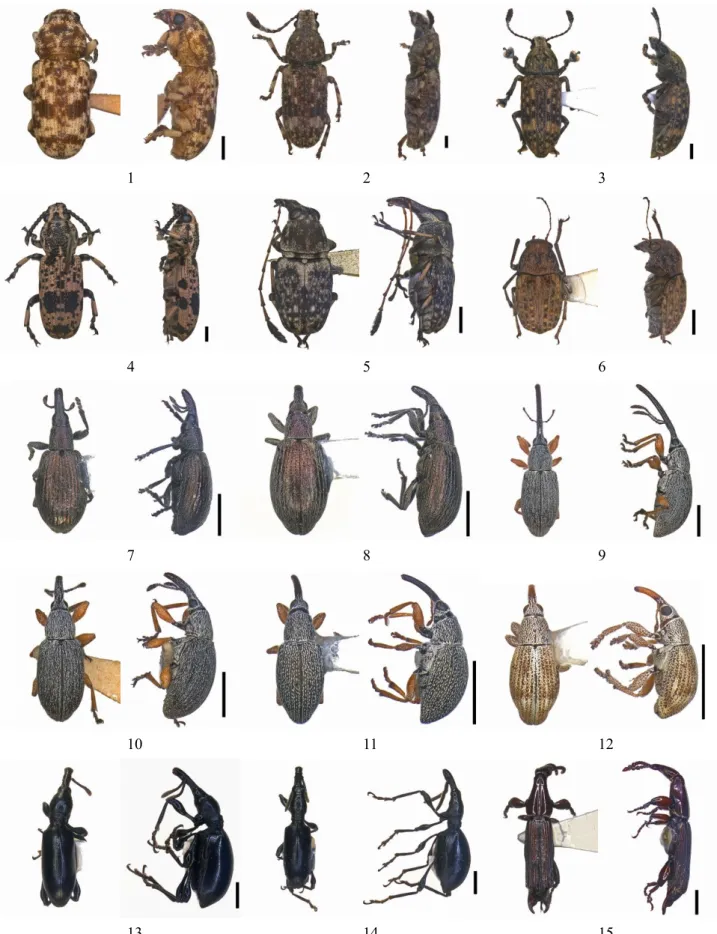
Fig. 2. Dorsal and lateral habitus of exotic weevils intercepted by the Kobe Plant Quarantine Station. Scale bar: 1mm. 1. Dendrotrogus sp. 2. Eucorynus sp. 3. Rawasia sp. 4. Xylinada sp. 5. Phaeochrotes sp. 6. Araecerus sp. 7-8. ?Perapion sp. 9-10. Rhopalapion ?longirostre 11. ?Rhopalapion sp. 12. ?Chrysapion sp. 13-14. Cylas sp. 15. Carcinopisthius sp. (nr. kolbei)
16
17
18
19
20
21
22
23
24
25
26
27
28
29
30
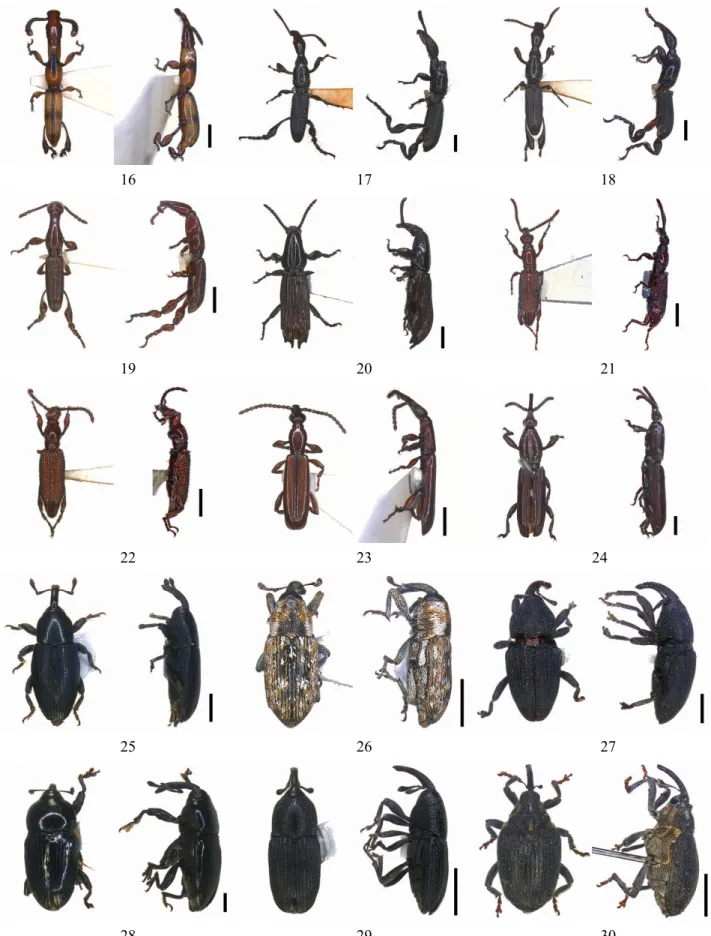
Fig. 2 (continued). 16. Cyphagogus sp. (nr. crassitarsus) 17-18. Cyphagogus sp. (nr. splendens) 19. Cyphagogus sp. 20. Hoplopisthius trichemerus 21. ?Hoplopisthius sp. 22. ?Opisthenoxys sp. 23. Cerobates sexsulcatus 24. Trachelizus ?bisulcatus 25. Aulacobaris lepidii 26. Cosmobaris orientalis 27. Orchidophilus sp. 28. Madarini gen. sp. 29. Apinocis deplanatus 30. Ceutorhynchus sp.
31
32
33
34
35
36
37
38
39
40
41
42
43
44
45
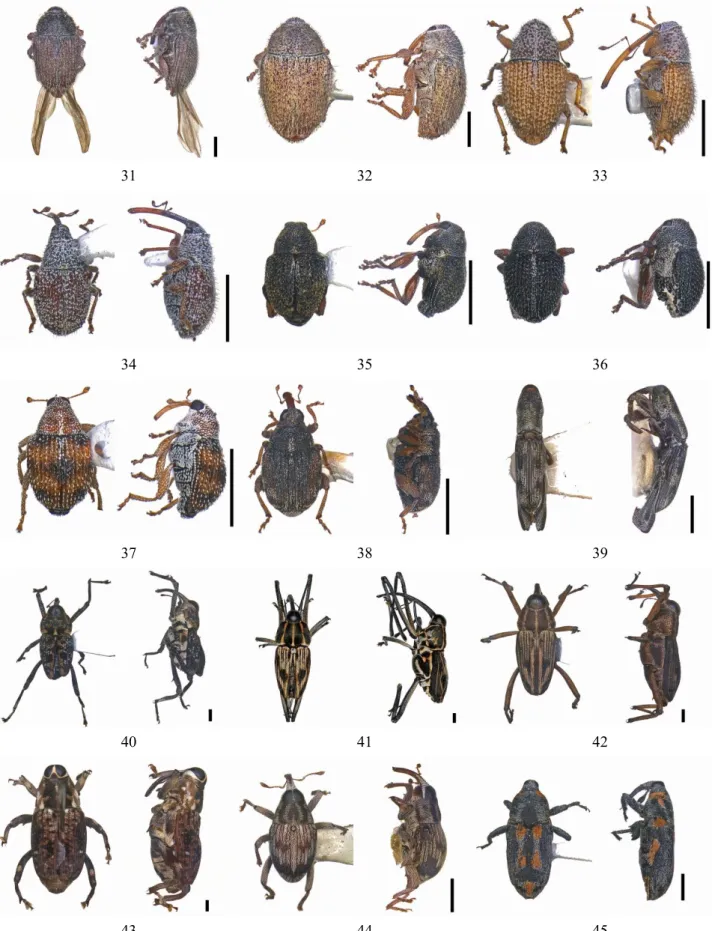
Fig. 2 (continued). 31-32. Isorhynchus sp.1 33. Isorhynchus sp.2 34. Isorhynchus sp.3 35-36. Micrelus ericae 3 7. Micrelus sp. 3 8 . Hypurus sp. 3 9. Phaenomerus sp. 4 0. Mecopus sp.1 41- 4 2 . Mecopus sp. 2 43. Zygops sp. 44. Conoderinae gen. sp.1 45. Conoderinae gen. sp.2
46
47
48
49
50
51
52
53
54
55
56
57
58
59
60
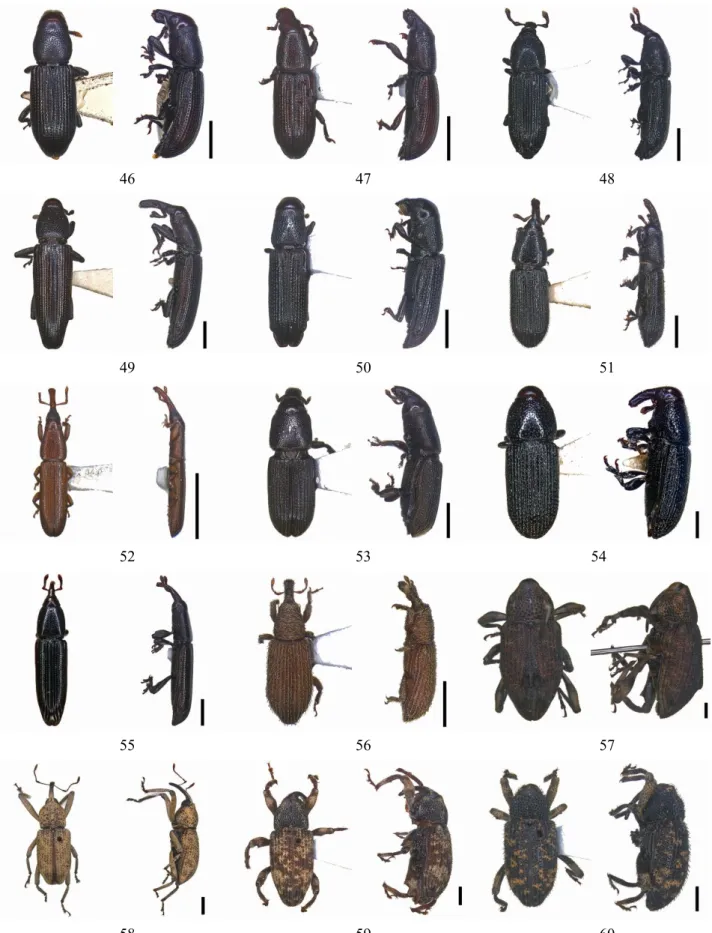
Fig. 2 (continued). 46. Cossonus sp. 47. Eremotes sp. 48. Macrorhyncolus sp. 49. Oxydema sp. 50. Pachyops sp. 51. Phloeophagosoma sp. 52. Proeces sp. 53. Xenocnema sp.1 54. Xenocnema sp.2 55. Cossonini gen. sp. 56. Himatium sp. 57. Mechistocerus sp. 58. Parendymia sp. 59. Rhadinomerus sp.1 60. Rhadinomerus sp.2
61
62
63
64
65
66
67
68
69
70
71
72
73
74
75
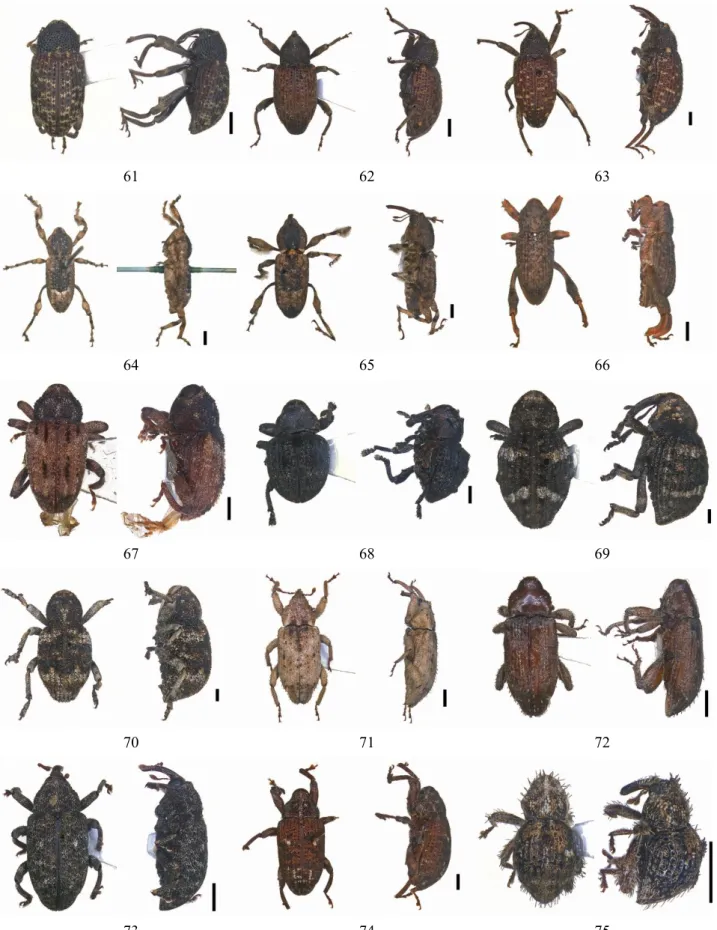
Fig. 2 (continued). 61. Rhadinomerus sp.2 62-63. Rhadinomerus sp.3 6 4. Camptorhinus dorsalis 65. Camptorhinus mangiferae 66. Camptorhinus sp. 67. Cryptorhynchus sp.1 68. Decilaus ?albohumeralis 69. Gerstaeckeria sp.1 70. Gerstaeckeria sp.2 71-72. Mitrastethus baridioides 73. Shirahoshizo insidiosus 74. Shirahoshizo rufescens 75. Synacalles sp.
76
77
78
79
80
81
82
83
84
85
86
87
88
89
90
Fig. 2 (continued). 76. Trigonopterus (= Idotasia) sp. 77. Zeugenia sp.1 78. Zeugenia sp.2 79. Neoampagia sp. 80. Orochlesis sp. 81-82. Therebus sp.1 83. Cryptorhynchinae gen. sp.1 84. Cryptorhynchinae gen. sp.2 85. Cryptorhynchinae gen. sp.3 86-87. Orsophagus sp. 88. Anthonomus sp.1 89. Anthonomus sp.2 90. ?Haplonyx sp.
91
92
93
94
95
96
97
98
99
100
101
102
103
104
105
Fig. 2 (continued). 91. ?Haplonyx sp. 92. Curculio sp. 93. Myossita ?melanocephala 94-95. ?Ancyttalia sp. 9 6. ?Smicronyx sp. 97. ?Elleschodes sp.1 9 8. ?Elleschodes sp.2 9 9. Sibinia sp. 10 0. Tychius sp. 101. Epamoebus ?ziczac 102. Curculioninae gen. sp.1 103. Curculioninae gen. sp.2 104. Curculioninae gen. sp.3 105. Curculioninae gen. sp.4
106
107
108
109
110
111
112
113
114
115
116
117
118
119
120
Fig. 2 (continued). 106. Curculioninae gen. sp.5 107. Curculioninae gen. sp.6 108. Curculioninae gen. sp.7 109. Curculioninae gen. sp.8 110. Curculioninae gen. sp.9 111. Curculioninae gen. sp.10 112. Aterpini gen. sp.2 113. Listroderes costirostris 114. Listronotus ?bonariensis 115-116. Steriphus ?diversipes 117. Cyclominae gen. sp. 118. Blosyrus asellus 119-120. Strophosoma sp.
121
122
123
124
125
126
127
128
129
130
131
132
133
134
135
F i g. 2 (c ont i nue d ). 1 2 1. ?O ophth a lmu s sp. 1 2 2 . Myll o c e r u s sp. 1 2 3 . C y ph ic er i n i gen . sp.1 12 4. Cyphicerini gen. sp.2 125. Cyphicerini gen. sp.3 126. Gonipterus sp.1 127. Gonipterus sp.2 128. ?Merimnetes sp. 129. Pantomorus cervinus 130-131. Otiorhynchus sp. 132. Phlyctinus callosus 133. Otiorhynchini gen. sp.1 134. Otiorhynchini gen. sp.2 135. Metapocyrtus sp.1
136
137
138
139
140
141
142
143
144
145
146
147
148
149
150
Fig. 2 (continued). 136. Metapocyrtus sp.2 137. Sitona sp.1 138. Sitona sp.2 139. Sitona sp.3 140. Sitona sp.4 141. Sitona sp.5 142. Sitona sp.6 143. ?Beardiella (= Xenorrhinus) sp.1 144. ?Beardiella (= Xenorrhinus) sp.2 145. Tanymecini gen. sp. 146. ?Perperus sp. 147. ?Essolithna (= Pascoellus) sp. 148. Polyphrades ?brevirostris 149. Scotasmus ?litoralis 150. Entiminae gen. sp.1
151
152
153
154
155
156
157
158
159
160
161
162
163
164
165
F ig. 2 (continued). 151. Entiminae gen. sp.2 152. Entiminae gen. sp.3 153. Entiminae gen. sp.4 154. Entiminae gen. sp.5 155. Entiminae gen. sp.6 156. Entiminae gen. sp.7 157. Entiminae gen. sp.8 158. Erirhininae gen. sp. 159. Lixinae gen. sp. 160. Acicnemis sp.1 161-162. Acicnemis sp.2 163. Niphades sp. 164. Aclees ?cribratus 165. Aclees sp.
166
167
168
169
170
171
172
173
174
175
176
177
178
179
180
Fig. 2 (continued). 166. Hylobiini gen. sp. 167. Colobodes sp. 168. ?Deretiosus (= Deretiosomimus) sp. 169. Ectatorhinus sp. 170. Steremnius carinatus 171. Pissodes sp.1 172. Pissodes sp.2 173. Pissodes sp.3 174. P issodes sp.4 175. Moly tinae gen. sp.1 176. Moly tinae gen. sp. 2 17 7. Moly tinae gen. sp. 3 178. Molytinae gen. sp.4 179. Molytinae gen. sp.5 180. Molytinae gen. sp.6
181
182
183
184
185
186
187
188
189
190
191
192
193
194
195
F ig. 2 (continued). 181. Molytinae gen. sp.7 182. Molytinae gen. sp.8 18 3. Molytinae gen. sp.9 184. Diocalandra elongata 185.Sitophilus zeamais 186. Tryphetus incarnatus 187. Trochorhopalus dipterocarpi 188. Trochorhopalus sp.1 189. Trochorhopalus sp.2 190. Trochorhopalus sp.3 191. ?Sphenophorus sp. 192. Dryophthoridae gen. sp. 193-195. Nanophyes sp.
196
197
198
199
200
201
202
203
Fig. 2 (continued). 196. Stratiorrhina xiphias 197. Hormocerus ?reticulatus 198. Tracheloschizus angulaticeps 199-200. Bolbocranius distortus 201. Baryrhynchus sp. (nr. yaeyamensis) 202. Conoderinae gen. sp.3 203. Bartolozziella (= Endymia) sp.1
204
205
206
207
208
209
Fig. 2 (continued). 204-205. Bartolozziella (= Endymia) sp.2 206. Aesiotes ?notabilis 207. Aterpini gen. sp.3 208. Aterpini gen. sp.1 209. ?Psapharus sp.
210
211
212
213
214
215
Fig. 2 (continued). 210. Catasarcus sp. (nr. impressipenis) 211. Catasarcus sp. (nr. pallidiventris) 212. Brachycerus aegyptiacus 213. Nassophasis sp. 214. Mecocerus sp. 215. Eupholus schoenherri