1 Nilo-Ethiopian Studies 26: (2021) doi: 10.11198/niloethiopian.26.a01 Copyright © 2021. Japan Association for Nilo-Ethiopian Studies
of Tera Askebari in Addis Ababa
EUNJI CHOIGraduate School of Asian and African Area Studies, Kyoto University
Tera askebari are people who maintain order among minibus taxis and passengers at the
mini-bus terminals in Addis Ababa. From 2011, tera askebari, who had been working informally for decades, started registering for a micro and small enterprises (MSEs) development program. However, affiliation with a government institution did not coerce tera askebari to comply with formality; rather, it enabled them to exhibit both formality and informality. This article aims to examine the dynamics of in/formality by observing the public transport management activities of tera askebari at terminal X. The findings of the study demonstrate that tera askeabri actively participate in the process of creating complex forms of informality. In a situation that MSEs program permitted tera askeabri to run their business autonomously, the legalized tera askebari (de jure) strategically utilized formality as well as informality through their operations. Meanwhile, the management activities of employed tera askebari (de facto) showed an informal aspect that was influenced by weak state control. The result illustrates that “informality” is not a static con-cept defined by particular characteristic, but a formulating process through which participants constantly negotiate and reproduce through their interactions with the formal configuration. Key words: tera askebari, transport management, informality, micro and small enterprises
(MSEs) development, Addis Ababa
1. INTRODUCTION
Urban transport services have been meeting the growing mobility needs of many developing coun-tries. Minibus taxis (hereinafter, minibuses) in Addis Ababa, have actively served the citizens’ trans-portation needs for decades. As a major mode of transtrans-portation, minibuses perform more than 90% of the public transportation share, and more than 19,000 vehicles are currently operating in the city (AARTB 2019). Notwithstanding its dominant market share and high accessibility, however, the industry gave rise to several social challenges. The minibus workers’ irregular touting practices created conflicts and disarray in the terminal, while passengers, in a bid to find transport as quickly as possi-ble, often became involved in physical altercations. The city’s transport bureau was reluctant to pro-vide effective services to mitigate the issue. This catalyzed street youths to manage the minibuses and disorder at the terminals, which created a self-organized group called the tera askebari.
Etymologically, terä means order, sequence, or queue, and askäbbärä means to uphold and enforce the law in Amharic (Kane 1990. vol. 1: 962–963, vol. 2: 1416). Thus, tera askebari refer to persons who
uphold or enforce shifts or the order of something. Of the various classes of tera askebari, my focus is confined to minibus-tera askebari, who keep the shifts of the minibuses. The first tera askebari are believed to have begun working at the end of the 1980s. Most tera askebari were affiliated with street gangs at that time, so their thuggish behavior worked to their advantage in forcing minibus operators to abide by their rules. The business expanded rapidly as many youths in several sefer (village, area, or neighborhood) began working as tera askebari. It evolved beyond mere moneymaking for the street youths, with tera askebari observed in nearly every terminal in the mid-2010s. Because tera askebari’s business operated without government control, the city government attempted to intervene in their business operations several times. But due to several reasons, it could not achieve success till the mid-2000s. Through trial and error, tera askebari began to be formalized through the micro and small enterprises (MSEs) development program launched in 2011. Since the program began, most of the tera askebari have incorporated into the MSEs scheme and attained legal business rights. However, this formalizing process did not compel the tera askebari to act “formally,” but rather, to act both for-mally and inforfor-mally in their management practices.
The concept of “formal” and “informal” arouses us a question that what exactly is the in/formality. Development studies scholars have made several attempts to define the nature of the informal sector since the 1970s, but its diversity and heterogeneity made it elusive to make clear clarification (Jenkins 1988: 5–9; Chen 2007: 1). Currently, the notion of “informality” is widely accepted as an extra-legality arising outside of the regulatory framework (Castells & Portes 1989). However, this concep-tual clarity has not been effective in capturing the increasing complexity of current economies (Meagher 2010: 16–19). Several studies have pointed out that informality sometimes appears inside regulatory boundaries, and the formal environment could also produce transfigured forms of infor-mality (Chae 2015: 107–108). Therefore, investigating the dynamic mechanism through how it is working on the ground will be useful for understanding its intricacy (Chen 2007: 6–11). Tera askebari’s activities provide a new starting point for discussing the dynamics of in/formality. Their practices were not limited to specific characteristics but exhibiting both formality and informality, which were highly intertwined with each other.
Tera askebari plays an important role in the urban transportation sector in Addis Ababa, which is also the livelihood of many urban youths (Di Nunzio 2012: 433–440). Their high influence on the street economy once became a target of government control (Di Nunzio 2014: 451–453). The need to understand their way of conducting business has been accentuated (AACCSA 2009), so recent studies have focused on exploring the role of tera askebari in the transport sector (Choi 2020). However, despite increasing attention, there is a lack of interest in understanding their current prac-tices. This paper aims to examine the dynamics of in/formality by analyzing the minibus manage-ment activities of tera askebari, along with the process of state intervention, through the lens of MSEs promotion policy. The paper will start with an overview of tera askebari’s general background. Next, I describe my observations of the activities of both the de facto and de jure strata at Terminal X. Finally, the paper describes the characteristics of the MSEs promotion program and examines how it shaped the dynamics of in/formality of tera askebari’s current practices. The study is based on three rounds of fieldwork conducted from 2017 to 2019. All names in the paper are pseudonyms to ensure anonymity and confidentiality. In addition, I concealed the exact number of de jure tera askebari, to prevent sensitive information being released concerning the group of research subjects.
2. GENERAL BACKGROUND OF THE TERA ASKEBARI 2.1. Street gangs as the first tera askebari
The first tera askebari trace back to the late 1980s, the latter period of the Ethiopian socialist regime. Based on interviews and literature, it is believed that a couple of street gang leaders in the Piazza area inaugurated this line of work (Di Nunzio 2012: 440; Di Nunzio 2019: 67–70; Choi 2020: 17). “The
menced this line of work. At the time, there were not many terminals because the city was not as big as it is now” (Mr. Abebe, tera askebari, July 10, 2018, Piazza Arada Terminal). The tera askebari busi-ness was an idea that the street gangs invented to earn a pittance from the minibuses operating on their territory. At that time, the minibus service was not as important because the number of vehicles and routes were not as complex as they are now. In other words, the services provided by the tera askebari early on were more a means for street gangs to make some money than a means for managing the minibuses.
Tera askebari demanded a service charge from minibus operators to operate in their territory as well as to maintain order. It appears frequent quarrels occurred between minibus operators and tera askebari regarding these services. “There were many fights because some weyala [insolent way to refer the minibus assistants] often refused to pay. But we were strong, so many of them accepted the payment” (Mr. Getahun, tera askebari, July 05, 2017, Bole Bras Terminal). Mr. Getahun’s response demonstrates that there was some tension between tera askebari and the minibus operators in the early stages. Minibus operators could work comparatively easily because tera askebari gave the orders, but they may have regarded the tera askebari’s conduct and service charges as unsatisfactory. However, the tera askebari’s “thuggish” management methods, such as chasing minibuses away, threatening the drivers, or refusing to allow intractable minibus drivers to work at their terminal, gave the operators no choice but to abide by their rules. “My older brother was a gang leader in this area. That is why it was easy for me to start this job” (Mr. Yohannes, tera askebari, July 12, 2018, Megenagna Terminal). “It would be a problem if we did not pay the fee. We might not be able to work here anymore” (Mr. Solomon, driver, September 6, 2019). These two descriptions from opposite sides of the spectrum explain how tera askebari’s thuggish management methods helped sustain their business (Di Nunzio 2019: 63–65).
2.2. Expansion of the tera askebari under the growing demands of transport management
Addis Ababa, the capital city of Ethiopia, has undergone and continues to undergo considerable change since the 1990s. Over the past year, Ethiopia achieved a high level of economic development and GDP growth. While the world average GDP growth in the past 10 years (2009 to 2018) remained at 2.5%, Ethiopia achieved 9.8%, demonstrating the country’s ambitious aspirations for economic development (World Bank 2020). While Addis Ababa was positioned as an engine for the country’s development, urbanization did not always yield positive consequences. Many social chal-lenges occurred, such as unemployment, urban poverty, insufficient land usage, and sanitation prob-lems (Berhanu et al. 2005; CSA 2007; Tsegaye 2010). The growing population also expedited the necessity for providing suitable urban transport services to meet the high mobility demand (Wondimu 2012: 3). While there were only 10 operating minibus routes in the late 1980s, the business expanded enormously, with over 350 routes and hundreds of terminals by 2019 (AARTB 2019).
These minibuses—12-to-14 seats Toyota Hi-Ace bongo buses—are one of the major modes of transport in Addis Ababa, although the city has a number of public transportation options. Since 1952, the city administration has provided a public transport service called anbessa bus. However, due to weak operational performance and the lengthy-time intervals, it has not been favored by most citizens (Eshetie et al. 2013: 726–727; Berhanu 2016). Recently, in an attempt to address challenges related to high traffic volumes, the government instituted a municipal transport service called sheger bus and light railway transit services in 2014 and 2015 (Bikila 2019). The city government is cur-rently implementing a traffic modernization policy centered on city buses by installing a bus rapid transit line and introducing online ticketing services, using QR codes (Pojani & Stead 2015: 10; Sukheja 2020). Despite the availability of various modes of transport, minibuses are still the city’s most important mode of public transport because they provide rapid service and high accessibility (Kumar & Barrett 2008; AARTB 2012; Fekadu 2014).
Despite their many positive roles, minibuses have not always been favored by citizens. They were notorious for congestion, air pollution, unsafe driving behavior, and unmethodical touting practices
of the assistants (Kumar et al. 2004; Gebeyehu & Takano 2007; Newman et al. 2014). Various factors, such as high transport demand, time-related pressure from passengers, and operators’ economic sur-vival compelled operators to transgress regulations in order to generate more profit (Fekadu 2013; Agbiboa 2018). The vacuum left by a lack of city transportation authorities from 2005 to 2011, as well as the absence of traffic regulation, led minibus operators to work on any route they chose until 2009 (Tilahun 2014). Furthermore, passengers’ eagerness to find a minibus has given rise to several tussles, along with line cutting and rushing to board, ultimately giving rise to unexpected social prob-lems such as robberies and hit-and-run accidents. “Before tera askebari started their work, taking a taxi was like a war. I have also lost mobile phones when getting in taxis” (Mr. Michael, passenger, June 23, 2017, Gerji Mabrat Hail Terminal). Even though the minibuses have produced much disorder and inconvenience, efforts to address these problems were not actively implemented at the govern-ment level.
Under these circumstances, it was local youths who initiated the tera askebari service to manage the minibuses and the disorder of the terminals. The first tera askebari, consisting of members of street gangs, had little influence. However, urbanization consolidated the tera askebari’s role in the city’s transport system. The many problems that occurred at the terminals catalyzed youths from the local sefer to begin working as tera askebari, over which the government failed to institute effective control and management. As the city expanded, many new tera askebari groups were created at the new ter-minal. This phenomenon gradually became an essential service for the citizens rather than as a mere means for street thugs to make a pittance. In the mid-2010s, tera askebari were observed at almost every terminal in the city.
3. TERA ASKEBARI AT TERMINAL X 3.1. Outline of the research site and Group Y
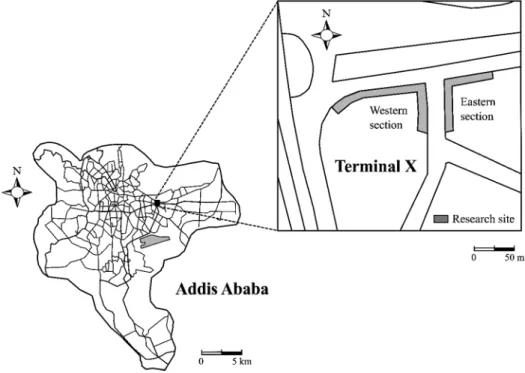
The researched terminal is one of the major terminals in Addis Ababa, with transportation services to about 30 destinations. My research site was the southeastern part of this terminal, which I named Terminal X (Figure 1). The site was geographically divided into the western and eastern sections. For minibus management, two tera askebari groups were operating, each group working on a specific day of the week. One group was on duty for three days (Monday, Wednesday, and Friday), while the other group worked for the remaining days of the week. The two groups showed small disparities in terms of management, such as work schedule, a form of subcontracting, and ability to manage the mini-buses. Regardless of these differences, all the tera askebari in this terminal were generally responsible for three tasks: they oversaw and maintained the order of the minibuses, as well as the queuing of the passengers, and surveilled for criminal activity such as robbery (Choi 2020). In the current paper, I focus on one group, Group Y, which provides rich material for examining the concept of informality. The research was conducted from August 24 to October 31, 2019. In terms of research methods, participant observation was mainly used, especially focusing on tera askebari’s behavior in operating their business. I also attempted to understand the group composition and their legal status to deter-mine the relationships with the MSEs development program. I interviewed tera askebari as well as officers in the relevant regional MSEs bureau (Addis Ababa Job Opportunity Creation and Enterprise Development Bureau) with which the group was affiliated.
In Group Y, a total of six tera askebari were working at the terminal during the fieldwork period (Figure 2). The members consisted of two managers and four employees. As the terminal was divided into western and eastern sections, one manager was in charge of one section, with two employees assisting him. Money flowed from passengers to minibuses and from minibuses to tera askebari. First, passengers paid the fare to the minibus operators (① in Figure 2). After that, minibus operators were required to pay a service charge to the tera askebari, which they referred to as sadi amongst themselves (② in Figure 2). Both managers and employees could collect money. Tera askebari managed only the
minibuses in their respective sections, so revenue was separately managed.
Although there were often differences in the amount collected, tera askebari usually collected sadi in accordance with Table 1. Table 1 illustrates 7 operating routes at this terminal, distance, permission status, passenger fare, and sadi. Sadi seems to vary depending on the amount of money a minibus driver can earn from passengers. As an example, the shortest route at this terminal was Route C, with a
Figure 1. Maps of Addis Ababa and the research site
Figure 2. Flowchart of money in Terminal X (Above tera askeabri are those who practically working in Group Y)
passenger fare of 1.5 ETB (Ethiopian birr), the tera askebari collect 5 ETB as a service charge for one vehicle. In most cases, the sadi (A, B, D, E, and F) was 7 ETB, with passenger fares ranging from 4.5 to 7.5 ETB. However, for Route G, the distance did not differ significantly from that of Route F, but the sadi was 20 ETB. This is because tera askebari collect sadi based on the amount of money each minibus can earn at once at the terminal, rather than the distance of the route. The Addis Ababa Road and Transport Bureau (AARTB) did not permit minibuses to operate on Route G, but it was always in high demand for passengers because there was a large condominium complex at its final destina-tion. Therefore, despite being illegal, many minibuses operated on the route, and the drivers did not hesitate to accept twenty passengers per vehicle, six more than regulations allow. Because minibuses on Route G have higher profit potential than minibuses on other routes, a higher sadi was imposed. 3.2. Fluid management features of de facto tera askebari
To control minibuses effectively, AARTB announces a monthly schedule assigning minibuses to specific routes.(2) If the minibus driver violates this regulation, they will face legal measures, such as
penalty points and fines. Thus, the prime objective of the AARTB in minibus management is to monitor that minibuses operate in designated routes, and the surveillance is conducted by transporta-tion agents called tekkottattari. However, tera askebari do not consider the legal status of minibuses. They do not receive traffic and operational information, nor any guidance or training on how to manage the minibuses. This means that they work independently from the transport authority and control minibuses by their own standards.
In a practical setting, the de facto tera askebari (managers and employees) work to manage the minibuses. Their management activities showed varied range of informalities. First, they permitted minibuses to work illegally in places where passenger demand was high. At terminal X, only three routes (Route A, D, and E) were permitted by the AARTB, and other routes (Route B, C, F, and G) were not officially permitted (Table 1). However, minibuses were operating in unauthorized routes vigorously under the permission of the tera askebari. This is because these routes are continuously in demand from the passengers. Such routes were shaped in response to user demand and were operat-ing informally by tera askebari’s permission.
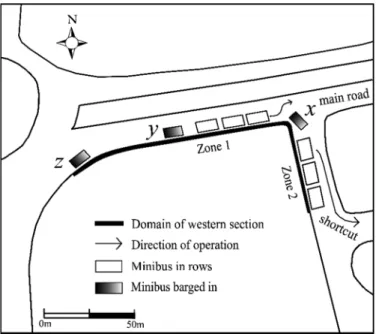
Contrary to their negligence in the legitimate operation of minibuses, tera askebari were more concerned with keeping the order of the minibuses. Their major role is to maintain order among the minibuses operating in their terminal. Thus, when tera askebari find a minibus that disregards the order, they are required to chase them out or take other measures as part of their duties. Minibus operators, in turn, pay a sadi to tera askebari, expecting to receive an equitable service. Figure 3 shows an aerial view of the western section of Terminal X. The black line along the road indicates a domain in the western section controlled by the tera askebari. This section serves two service lines. Minibuses bound for both destinations work in zones 1 and 2, as these lines share common operating routes; passengers are informed of the destination through the assistant’s touting. The differences between
Table 1. Minibus fares and sadi (tera askebari service charge) of the routes
Section Route Distance (km) from AARTBPermission Minibus Fare ETBSadi (service charge)
Western AB 7.299.76 OX 4.56 77 Eastern C 1.93 X 1.5 5 D 8.27 O 6 7 E 11.28 O 7.5 7 F 12.09 X 7.5 7 G 14.71 X 10 20
zone 1 and 2 are based on the roads on which vehicles travel. Vehicles that work in zone 1 use the regular route along the railroad, designated by AARTB, while the vehicles in zone 2 use short-cuts, avoid signals, and travel fast, but with fewer chances to collect passengers outside of the terminal. Based on research so far, minibus drivers could work freely in either zone. Tera askebari in the western section were obliged to maintain the queues for both zones 1 and 2.
Minibuses should operate in the order they arrive at the terminal; however, minibuses often do not follow these rules and attempt to solicit passengers faster, referred to as efem [foul or infraction in Amharic slang] among minibus workers. In this section, three types of infraction activities were observed. The first is “brave” infraction activities (spot x), where the vehicle cut in line between the front part of zones 1 and 2. In this case, the transgressors were highly likely to be aware of those in the queue, and their actions received strong opposition. The second case was operating at the back of zone 1 (spot y), which was less risky than in the case of spot x, as the operators were not directly confronting the authority of the tera askebari and queuers. This type of infraction was mostly com-mitted by vehicles that already had some passengers. The third case was committing an infraction far from the western section where the tera askebari’s influence was weak (spot z). In these cases, minibuses often collected passengers successfully, although they risked being threatened by the tera askebari if they were caught.
As the tera askebari’s main duty is to regulate minibus queues, they actively expelled and intimi-dated the offenders described above and took various measures to maintain the sequence of the queue. Most often, tera askebari insulted the transgressor, slammed the door, and moved passengers to another vehicle (spot y, August 30, 2019). In another case, despite the other operators’ continuous resistance and the tera askebari’s threats, the operator continued touting. At spot z, 10 of the trans-gressors were caught by one competent tera askebari on one working day (spot z, October 15, 2019), while no single tera askebari could catch any offenders on the next day (spot z, October 16, 2019). Sometimes, tera askebari took other measures such as imposing a higher sadi, called a derebo. On October 15, the tera askebari collected 10 ETB per contravening minibus, which was 3 ETB higher than the normal sadi. This measure was an alternative method for dealing with deviance. To sum-marize, tera askebari’s management activities are not restricted to a certain order, but rather are fluid and rely on informal elements like individual ability.
Within these irregularities, however, the informality of tera askebari in this terminal reaches a climax when they act against their responsibility. Tera askebari often prioritizes personal acquain-tances and give prior permission to specific minibuses. As an example, a minibus intruded into the front of the queue and tried to operate in the western section on September 6, 2019. Many queueing minibus operators complained and asked tera askebari to intervene in the situation. However, the tera askebari overrode the complaints of the other operators and condoned non-compliant operators’ deceptions. Because the operator was a friend of his, he did not take any action, but rolled his eyes and mumbled, “It’s okay, just once.” Further, he did not even collect the sadi or penalty. Cases similar to the one above, in which tera askebari secretly approved of the specific minibus operators commit-ting infractions, did occasionally occur. This illustrates that the criteria for minibus management of tera askebari can sometimes be altered by informal factors such as intimacy with the operators. Queuing up the minibuses, handling minibus drivers that commit infractions, imposing different penalties depending on circumstances, or infringing the terms of their duties all demonstrate fluid and variable features of management practices.
3.3. The hiring system of de jure tera askebari (wanna)
In Group Y, however, the members were not only constituted by tera askebari that we observed before. There were other groups of members, who were not practically working. The hierarchy was largely divided into two classes (Figure 4). The first comprises members who conduct their work at the ter-minal, which was de facto tera askebari. The other members, however, were not practically working but owned the business license of Group Y approved by the MSEs agency. They were de jure tera askebari, known as wanna, which means “major” or “main” in Amharic. During the initial period of fieldwork, I assumed that tera askebari, who actually works at the terminal, was registered with the MSEs promoting offices in the woreda (administrative division under sub-city in Addis Ababa) because operating a business without a legal license was considered illegal. However, none of their personal information was registered in the MSEs office. After a few days of investigation, I found that they were contract laborers, who were informally hired by the wanna. Tera askebari in the wanna stratum, comprising of about 10 people, started their work at the end of the 1990s. In 2011, when the government embarked on a city-wide MSEs promotion campaign, they registered their group to the MSEs agency and attained legal license.
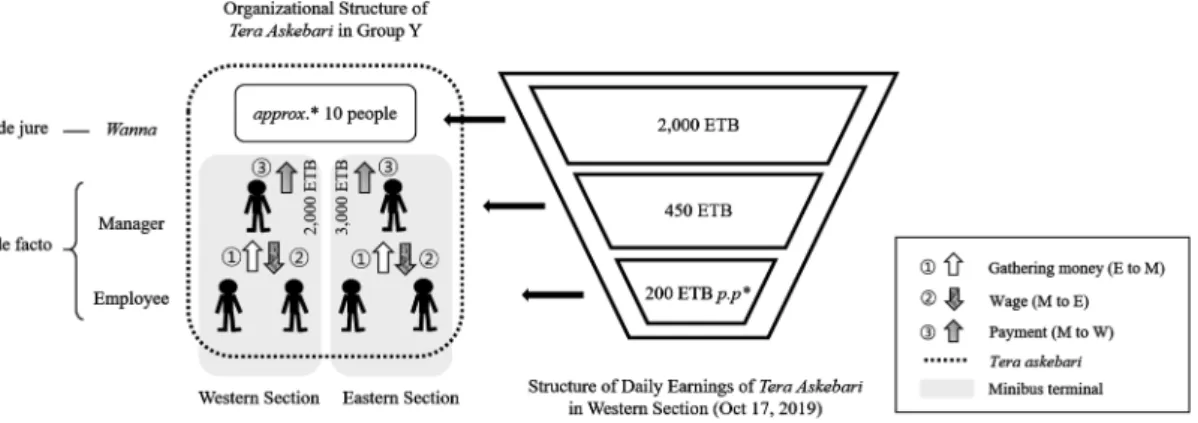
The wanna worked as tera askebari for some time, but at some point, they started hiring laborers instead of working themselves. They hired two managers and ordered them to pay more than half of the daily earnings: 2,000 ETB for the manager in the western section and 3,000 ETB for the man-ager in the eastern section. The revenue system of group Y was analyzed through observing daily
Figure 4. The organizational structure of Western section tera askebari and their earning structure
*p.p = per person
expenditure of manager-level tera askebari in the western section. Table 2 shows the list of managers’ expenditures in the western section on one day. On October 17, 2019, the manager had six times of expenditures. First, he had breakfast with two employees. The manager hired two boys (substitutes) while they were having a meal. He paid 115 ETB for the breakfast, and 25 ETB for each substitute. They ate lunch individually, so the substitute workers were not needed this time. The manager gave the employee 50 ETB each for lunch and spent 45 ETB for his lunch. The work continued until 6:30 pm. After work, he paid his employees a salary of 200 ETB per person. However, the manager was not able to take all the money left just because the day’s work was over. He had to pay the compulsory payment of 2,000 ETB, which he should hand over to wanna. As the total earnings on that day was 3,160 ETB, the manager was able to earn 450 ETB at that time. But the compulsory payment was fixed, that is 2,000 ETB in a day.
The flow of money within tera askebari appears in Figure 4. The manager collected the money at the end of the working day from the employee (①). Next, managers paid the daily wage to employees (②). After that, they need to pay 2,000 ETB and 3,000 ETB respectively to wanna (③), regardless of the amount of daily earnings. This resulted in the creation of a reverse pyramid-type revenue structure, as shown on the right side of Figure 4: employees earn only 200 ETB per person for around 12 hours’ work, but the wanna earns more than half of the total earnings (70.2%) without providing any labor. The exact beneficiaries and distribution among the wanna should be further investigated, but the mem-bers of wanna had fixed daily income by only possessing the legal license that MSEs agency provided.
4. GOVERNMENT INTERVENTION THROUGH THE MSES SCHEME 4.1. MSEs promotion program in Addis Ababa
Since the 1990s, the MSEs development program has received attention in development settings because of its huge potential in economic growth and improving the livelihoods of the poor (ILO 1986; Harper and Finnegan 1998: 7–9; CLEP 2008: 68–70; World Bank 2013). As many MSEs were engaging in informal economy activities, accounting for more than 90% of the informal econ-omy, formalizing the MSEs was perceived as a major way to shift informality (ILO 2015). In Ethiopia, MSEs made up the second-largest employment-generating sector after agriculture, and the informal economy accounted for 60% of the national economy in 2003, with about 40% of the urban labor force engaging in MSEs activities (CSA 2003; Rahel & Paul 2010: 233–234). To tackle this sector, the Ethiopian government initiated the MSEs development strategy by establishing the Federal Micro and Small Enterprises Development Agency (FeMSEDA) in 1997/1998.(3) This
pro-(October 17, 2019 from 6:00 am to 6:30 pm)
Contents ETB
Breakfast for himself and two employees 115 Salary to two substitutes at breakfast time (2 people) 50
Lunch for himself 45
Giving lunch money to employees (2 people) 100 Salary to employees (2 people) 400
Compulsory payment to wanna 2,000
Total 2,710
Note: After paying above expenditures, the manager’s remaining revenue was 450 ETB. Thus, the total earning of western section on that day was 3,160 ETB.
gram received attention in the mid-2000s, launching the Regional Micro and Small Enterprises Development Agencies (ReMSEDAs) in 2004/2005, but the actual implementation commenced in 2011 (Arega et al. 2016: 582). The government positioned MSEs at the core of national development and attempted to solve unemployment by asking people to “create the job by yourself ” (FeMSEDA 2011; Berihu et al. 2014: 8–10). The MSEs development program in Addis Ababa focuses on three aspects: management of MSEs by local government, group participation, and promoting saving prac-tices (Chinigò 2019: 84–85). Informal workers and unemployed people were encouraged to form groups and to affiliate their groups with local government (woreda), specifically in the Addis Ababa Job Opportunity Creation and Enterprise Development Bureau. All registered groups were required to deposit their profits into a bank account linked to the MSEs bureau; 5% of the savings were taxed, 85% considered private savings, and 10% automatically transferred to the MSEs program to serve as seed money when each group wanted to upgrade their business after the contract period. After the program’s inception, about 500,000 MSEs have been created, with about 1.9 million people engaged in the program from 2011 to 2015 (FeMSEDA 2015).
4.2. MSEs program’s intervention in the tera askebari’s operations
The MSEs scheme was somewhat successful in incorporating tera askebari into government control. After their first emergence in the late 1980s, the tera askebari have acted as informal regulators in several minibus terminals. At the time of the 2005 demonstration against allegations of fraudulent elections, there was several governmental attempts to interfere in tera askebari’s business (Di Nunzio 2014: 447–453). “It was us who initiated the work. We struggled so many times not to let the gov-ernment take this work away.” (Mr. Beyene, tera askebari, July 8, 2017, Sumit Terminal). Mr. Beyene’s statement shows how he has tried to protect his work from the government. The government tries to control the tera askebari through various methods, such as designating Ethiopia-Eritrean war veterans in the business or attempting to employ tera askebari as civil servants. However, the tera askebari could not find any merit in cooperating with the government. Mr. Beyene, for example, explained that the government suggested a monthly salary of 1,000 ETB upon handing over their work in the mid-2000s; however, that amount was easily obtainable through a single day’s work. In addition, the tera askebari would work mostly part-time, permitting them to adjust their personal schedules to suit their needs. Due to the fluidity and high profitability of their job, the tera askebari refused to cooperate with the government. Furthermore, most tera askebari businesses were organized in each sefer, and so, it was difficult for the government to incorporate the dissimilar groups into one policy.
Government intervention, however, achieved success through the MSEs development scheme. The government’s ambitious promotion of the program in 2011 led many informal workers to join, with 1.9 million people signing up (FeMSEDA 2015). Even if some participants operating MSEs had been working informally up to that point, they could earn legally by registering their businesses. Tera askebari, who were initially hesitant to cooperate with the government, found great merit in the MSEs scheme. The major aim of the scheme was developing “private” MSEs through “public” sup-port (Eversole 2008), which means that the enterprises could operate legally but autonomously with-out the government’s interference. Therefore, the MSEs scheme allowed tera askebari to operate as formal private enterprises and enabled them to use a variety of methods in operating the business. 4.3. Understanding the systematic in/formality of tera askebari
The concept of “informal economy” or “informality” has been widely debated in developmental stud-ies. The development of capitalism led to the establishment of corresponding national regulations, and from the 19th century onward, being affiliated with this new system came to be regarded as being part of the formal sector (AlSayyad 2004: 25–27; Polanyi 1944). With the ascendancy of formal institutions and regulations, economic activities that were not regulated by the system began to be viewed as informal (Portes & Haller 2010: 404–405). In the early stages of discussion, informality was perceived as existing in confrontation with formality, relegated to the domain of the “pre-modern, traditional, and marginalized,” and failing to attain “modern, capitalist, urban, and formal” features
specific economic activities to the “informal sector,” the term “informality” has been more effectively used to conceptualize the characteristics of economic activity (Chang 2011: 117–119). The current notion of informality is widely perceived as an extra-legality arising outside of the regulatory environ-ment (Castells & Portes 1989). It is notable that scholars have started understanding the informal economy is not separately operating but as part of the overall economic frame; however, the analyses maintained the early dualistic view that the informal economy arises outside of the legislative frame-work (Castells & Portes 1989; Feige 1990: 2–7).
This dyadic concept, however, which regard the informal economy as “outside of regulation,” could not efficiently capture the increasing complexity and heterogeneity of current economies, because most informal activities are intertwined with and affected by economic policies (Meagher 2010: 16–19; Chen 2007: 6–10). Many informal economic activities not only show a strong connection with the formal regulation, but the formal environment also produces the transfigured forms of infor-mality, influenced by historical and sociopolitical contexts (AlSayyad 2004: 14–15; Bromley 2004: 278–279; Chae 2015: 116–118). Thus, scrutinizing the dynamic mechanism of formality and infor-mality through analyzing specific cases plays out on the ground has been highlighted. The case of the tera askebari at Terminal X provides insight into the dynamics of informality. Their practices demon-strated that informality is not a specific characteristic, but a conceptual process that is constantly shaped and produced through interaction with the formal milieu.
First, in the case of the de facto tera askebari, their management activities revealed various aspects of an informal economy. First, they permitted minibuses to operate illegally in places where passen-ger demand is high. Route G is a prime example, but they also permitted three other illegal routes, which were shaped in response to user demand and maintained informally. Also, the minibus was managed with somewhat informal and fluid rules. They devised various methods to maintain order among the minibuses, such as chasing away non-compliant operators, collecting different amounts of money, or collecting penalties depending on the situation. All these rules were often infringed by the tera askebari themselves, who neglected their own duties in managing minibus queues. However, such complex informality should not be defined as characteristic. Their inconsistent way of conducting was influenced by the weak regulatory power of the MSEs program which formed the current feature of the business. The MSEs bureau did not interfere with the tera askebari’s management practices, nor did it provide them with supervision or guidelines, allowing the de facto tera askebari to express infor-mality in their management.
The de jure tera askebari (wanna) displayed both formality and informality in their hiring system. Wanna developed a system for subcontracting informal workers. The employment relationships of wanna-manager and manager-employee were “informal,” as neither contract was recognized by the government. However, the wanna-manager relationship was observable because this case showed the formalized economic units can create “informal contracts” even though they are affiliated with the formal agency. Wanna profited from the informal hiring system by tactically using their formal status. The system was highly beneficial to the wanna because they could earn income without having to do any labor. However, they did not relinquish their formal licenses, as the income that was generated was substantial. Acting informally while trying to maintain formality, wanna’s strategic activities showed that informality appeared inside the regulatory boundary, and the formal environment pro-duced transfigured forms of informality. These dynamics of in/formality were also influenced by the MSEs program, which enabled them to act autonomously and act strategically in expressing both formality and informality.
Through observing the management practices and employment system of two strata of tera askebari at Terminal X, we identified the factors and backgrounds of the complex of informality. Tera askebari actively participated in the process of producing the dynamics of in/formality under the influence of government policy. The analysis found that tera askebari’s informality is not a simple feature formed outside of state regulation, nor possesses specific characteristics. Rather, it reveals that depending on the sociopolitical context and interaction with the formal environment, different features of
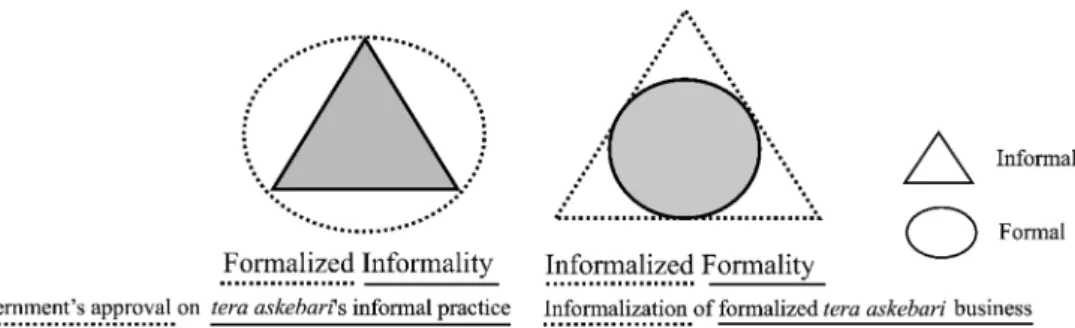
“infor-mality” could be formulated. The informalities of both de jure and de facto tera askebari were tacitly approved under the MSEs program’s private management scheme, which is to say that their infor-malities were “formalized.” The de jure tera askebari’s activities, which were legally authorized under the feeble MSEs scheme, not only created a complex of informality but intensified as a phenomenon of “informalization” of tera askebari. Consequently, the tera askebari’s practice which generated two intertwined forms of “formalized informality” and “informalized formality,” elucidates that the con-cepts of in/formality cannot be explained by themselves but are intertwined, which accentuated the need to observe specific cases that occurs on the ground (Figure 5).
5. CONCLUSION
Tera askebari has been working as “informal” minibus managers in Addis Ababa since the 1980s. In a situation where government-running public transportation did not satisfy citizens’ demands, the privately operated minibuses have been filling this gap. However, factors such as excessive transport demand, pressure from time-constrained passengers, operators’ profit-seeking behavior, and irregular touting practices often created disorder in the minibus terminals. While the city’s transport bureau was reluctant to provide effective services to mitigate the issue, local street youths took control of the state of disarray, ultimately leading to the formation of the tera askebari.
The initial tera askebari are believed to have appeared at the end of the 1980s, initiated by a couple of street group leaders. As tera askebari claimed sadi from the minibus operators, there were frequent tensions between tera asekbari and minibus operators in the early stages. However, their thuggish behavior worked to their advantage which forced minibus operators to abide by their rules. The tera askebari business expanded rapidly, with many youths joining the sector. The government attempted to intervene in tera askebari’s business several times but could not gain access to the sector. Through trial and error, the government achieved formalization of the tera askebari through the MSEs devel-opment program from 2011. Smooth incorporation was feasible, as tera askebari perceived the pro-gram to be to their advantage; they could operate their businesses legally as well as autonomously. After the MSEs program’s inception, many tera askebari groups were incorporated into the program and attained legal business rights. The MSEs program took a private enterprises’ self-help approach, implying that tera askebari would be able to run their businesses autonomously. Thus, formalization through the MSEs agency did not limit tera askebari’s practices to “formality,” but enabled them to strategically use both formality and informality in their management practice.
Tera askebari, who were able to operate without strict regulations, were able to strategically express the dynamics of in/formality with the “authorization” of the state. In the case of one tera askebari group at Terminal X, members were divided into two strata, de facto and de jure tera askebari. In a practice, the de facto tera askebari exhibited pervasive informality. They permitted the illegal opera-tion of minibuses in response to user demand. They also devised various methods of maintaining order among the minibuses, including chasing away non-compliant operators out or collecting
neglected their own duties. Inconsistent conducting behavior was influenced by the weak regulatory power of the MSEs program, as the government did not interfere in the tera askebari’s management practices. The de jure tera askebari, exhibited both formality and informality in their management. The subcontracting through which de jure tera askebari hired de facto tera askebari created a signifi-cant income for the de jure tera askebari, without the latter needing to do any labor. This informal hiring system was “legitimated” because they were maintaining the formal licenses. In other words, the “formality” of the de jure tera askebari gave them a platform to manifesting “informality.”
Formalizing the MSEs was perceived as a major method for shifting informality and has been utilized as a major governmental strategy for economic development. However, tera askebari’s strate-gic activities raise the question of why the government did not regulate these businesses more rigor-ously. Minibuses have been working as an indispensable means of transportation for citizens but were treated unfavorably by the government as they can easily cause traffic congestion. With the growing necessity of modernized transportation services in Addis Ababa, the city government and its related bureaus have developed a city-wide municipal bus system, aimed at decreasing reliance on minibuses (Banchialem 2019). The government is currently constructing the Bus Rapid Transit (BRT line) infrastructure, which aims to enhance mobility by public buses. With the future influence of mini-buses declining, investing in the minibus business is not a good option for the government in the long term. In this situation, the government transferred direct responsibility to the tera askebari by choos-ing to maintain the current minibus management system instead of actively intervenchoos-ing in it. With the MSEs program allowing tera askebari to operate autonomously, the government did not interfere in the way they manage the minibuses. In other words, the government’s passive attitude toward minibuses and the background of the MSEs program, which empowered tera askebari to become private entrepreneurs, shaped current tera askebari’s behavioral patterns.
The findings of the study demonstrate that tera askebari actively participate in the process of creat-ing complex forms of informality through continuous interaction with the formal economic structure. The study demonstrated that tera askebari’s affiliation with a formal environment did not coerce them into complying with formality. Rather, their management practices were shaped through the process by which they negotiated and interacted with the state, together with their strategies in utilizing the benefits of both formality and informality. The dynamics of in/formality of the tera askebari’s prac-tices, therefore, illustrates that the features of in/formalities can transform and are capable of develop-ing new features of in/formality by the diverse actors on the ground in urban Africa.
ACKNOWLEDGEMENTS
I am thankful to the tera askebari who generously participated in the interview and allowed me to conduct the research. I would like to express my gratitude to the two institutions that financially supported me, Korea Institute for International Economic Policy (Graduate program for area studies) and the Center for On-Site Education and Research of Kyoto University (Explorer program) for sponsoring the fieldwork. Lastly, I would like to extend my sincere gratitude to Prof. Masayoshi Shigeta, Prof. Morie Kaneko, and Prof. Misa Hirano-Nomoto for their unwavering support and guidance in me.
NOTES
(1) Mengistu Haile Mariam is a leader as well as president of the socialist regime of Ethiopia from 1974 to 1991.
(2) Vehicles that are privately owned and not registered with any association (mainly vehicles with an OR license plate registered in Oromia state) will change their route once every three months. Vehicles that
mostly belong to the Automobile Owners Association (mostly vehicles with an AA number registered in Addis Ababa City) are provided with a certain route by the AARTB every month. Vehicles belonging to the association will be directed at the association’s discretion.
(3) The Ethiopian government established the Federal Micro and Small Enterprises Development Agency (FeMSEDA) and announced proclamation no. 33/98 in 1998, amended by proclamation no. 104/2004 in 2004 under the Ministry of Trade and Industry.
REFERENCES
AACCSA (Addis Ababa Chamber of Commerce and Sectoral Associations) 2009 The Management of Commercial Road Transport in Ethiopia. Addis Ababa. AARTB (Addis Ababa Road and Transport Bureau)
2012 Statistics on Number of Vehicles Registered in Addis Ababa by Type between 1993 and 2011. (written in Amharic)
2019 Statistics on Routes and Vehicles on Paratransit Transportation in Addis Ababa. (written in Amharic) Agbiboa, D.E.
2018 Introduction: Transport, Transgression and Politics in African Cities. In Agbiboa, D.E. (ed), Transport, Transgression and Politics in African Cities. New York: Routledge, pp. 1–16.
AlSayyad, N.
2004 Urban Informality as a ‘New’ Way of Life. In Roy, A. & N. AlSayyad (eds), Urban Informality: Transnational Perspectives from the Middle East, Latin America, and South Asia. Lanham: Lexington Books, pp. 7–30.
Arega, S., A. Muhammed & T. Daniel
2016 Growth of Micro and Small Enterprises in Addis Ababa City Administration: A Study on Selected Micro and Small Enterprise in Bole Sub City. International Journal of Scientific and Research Publications 6(1): 581–592.
Banchialem, A.
2019 Ethiopia-AFRICA-P151819-Ethiopia: Transport Systems Improvement Project (TRANSIP)-Procurement Plan (No. STEP23497). The World Bank.
Berhanu, D., T. Abraham & H. van der Deijl
2005 Characteristics and Determinants of Youth Unemployment, Underemployment and Inadequate Employment in Ethiopia. Employment Strategy Papers by Employment Policies Unit, Employment Strategy Department, Ministry of Labour and Social Affairs of Ethiopia.
Berhanu, W.
2016 Sustaining Sustainable Mobility: The Integration of Multimodal Public Transportation in Addis Ababa (Doctoral Dissertation). Department of History. Université de Lyon.
Berihu, A., Z. Abebaw & T. Biruk
2014 Identifying Key Success Factors and Constraints of Ethiopia’s MSE Development: An Exploratory Research. Research Report 18, Ethiopian Development Research Institute.
Bikila, T.
2019 Public Bus Study on Assessment of Sheger Bus Service and Operation (Doctoral Dissertation). Addis Ababa Science and Technology University.
Bromley, R.
1978 Introduction-The Informal Sector: Why is it Worth Discussing? World Development 6(1978): 1033– 1039.
2004 Power, Property and Poverty: Why De Soto’s “Mystery of Capital” Cannot be Solved. In Roy, A. & N. AlSayyad (eds), Urban Informality: Transnational Perspectives from the Middle East, Latin America, and South Asia. Lanham: Lexington Books, pp. 271–288.
Castells, M. & A. Portes
1989 World Underneath: The Origins, Dynamics, and Effects of the Informal Economy. In Castells, M., A. Portes & L. Benton (eds), The Informal Economy: Studies in Advanced and Less Developed Countries. Baltimore: The Johns Hopkins University Press, pp. 11–37.
Chae, H.
Chang, H.
2011 China’s Informal Economic Theory and Its Socio-political Implications. 중국의 비공식경제론과 그 사회정치적 함의. Journal of International Area Studies 20(3): 111–149. (written in Korean)
Chen, M.A.
2007 Rethinking the Informal Economy: Linkages with the Formal Economy and the Formal Regulatory Environment. DESA Working Paper No. 46, United Nations Department of Economic and Social Affairs.
Chinigò, D.
2019 ‘The Peri-urban Space at Work’: Micro and Small Enterprises, Collective Participation, and the Developmental State in Ethiopia. Africa 89(1): 79–99.
Choi, E.
2020 Traffic Management by Informal Workers: Analyzing the Role of Tera Askebaris in Megenagna Terminal, Addis Ababa. African Studies Monographs Supplementary Issue 59: 13–31.
CLEP (Commission on Legal Empowerment of the Poor)
2008 Making the Law Work for Everyone (Vol II: Working Group Reports). United Nations Development Programme. New York.
CSA (Central Statistical Agency of Ethiopia)
2003 Report on Urban Informal Sector Sample Survey. Addis Ababa. (written in Amharic)
2007 Summary and Statistical Abstract of Census Issues from 1967/68 - 2007/2008. Addis Ababa. (written in Amharic) Di Nunzio, M.
2012 “We Are Good at Surviving”: Street Hustling in Addis Ababa’s Inner City. Urban Forum 23(4): 433–447.
2014 Thugs, Spies and Vigilantes: Community Policing and Street Politics in Inner City Addis Ababa. Africa 84(3): 444–465.
2019 The Act of Living: Street Life, Marginality, and Development in Urban Ethiopia. New York: Cornell University Press.
Eshetie, B., B. Birhanu & K. Daniel
2013 Performance Analysis on Public Bus Transport of the City of Addis Ababa. International Journal of Computer Information Systems and Industrial Management Applications 5(2150–7988): 722–728. Eversole, R.
2008 Solving Poverty for Yourself: Microenterprise Development, Microfinance and Migration. In Krishna, S. (ed), Micro-enterprises: Perspectives and Experiences. Hyderbad: Icfai University Press, pp. 1–10.
FeMSEDA (Federal Micro and Small Enterprise Development Agency)
2011 Micro and Small Enterprise Development Strategy, Provision Framework and Methods of Implementation. Addis Ababa.
2015 Micro and Small Enterprises Development Sector, Annual Statistical Bulletin (2010/2011–2013/2014). Addis Ababa.
Feige, E.L.
1990 Defining and Estimating Underground and Informal Economies: The New Institutional Economics Approach. World Development 18(7): 989–1002.
Fekadu, K.
2013 Role of Informal Bus Operators in the City of Addis Ababa, Ethiopia. Urban Transport Journal 12(1): 63–73.
2014 Informal Transport and its Effects in the Developing World: A Case Study of Addis Ababa, Ethiopia. Journal of Transport Literature 8(2): 113–133.
Gebeyehu, M. & S. Takano
2007 Diagnostic Evaluation of Public Transportation Mode Choice in Addis Ababa. Journal of Public Transportation 10(4): 27–50.
Harper, M. & G. Finnegan
1998 Value for Money? Impact of Small Enterprise Development. London: Intermediate Technology Publications. ILO (International Labour Organization)
1972 Employment, Incomes and Equality: A Strategy for Increasing Productive Employment in Kenya. Geneva. 1986 The Promotion of Small and Medium Sized Enterprises. International Labour Conference 72nd Session. Geneva.
2015 Transition from the Informal to the Formal Economy Recommendation, 2015 (No. 204). Geneva. Jenkins, J.
1988 Informal Economies: Emerging from Undergrounds. In Jenkins, J. (ed), Beyond the Informal Sector: Including the Excluded in Developing Countries. ICS Press, pp. 1–14.
Kane, T.L.
1990 Amharic-English Dictionary (2 vols.). Harrassowitz, Wiesbaden. Kumar, A. & F. Barrett
2008 Stuck in Traffic: Urban Transport in Africa. Africa Infrastructure Country Diagnostic, World Bank and Infrastructure Consortium for Africa.
Kumar, A., E.A. Kwakye & Z. Girma
2004 (2004, April 22–24). What Works in Private Provision of Bus Transport Services: Case Study of Accra and Addis Ababa [paper presentation]. In 11th Conference of Cooperation for Urban Mobility in the Developing World, Bucharest, Romania.
Meagher, K.
2010 Identity Economics: Social Networks & the Informal Economy in Nigeria. Suffolk: Boydell & Brewer Ltd. Newman, S., G. Wondwessen & S. Getu
2014 Exploring Differences in Driving Behaviour across Age and Years of Education of Taxi Drivers in Addis Ababa, Ethiopia. Safety Science 68: 1–5.
Pojani, D. & D. Stead
2015 Sustainable Urban Transport in the Developing World: Beyond Megacities. Sustainability 7(6): 7784–7805.
Polanyi, K.
1944 The Great Transformation: Economic and Political Origins of Our Time. New York: Rinehart. Portes, A. & W. Haller
2010 The Informal Economy. In Smelser, N.J. & R. Swedberg (eds), The Handbook of Economic Sociology. New Jersey: Princeton University Press, pp. 403–425.
Rahel, W. & I. Paul
2010 Growth Determinants of Women Operated Micro and Small Enterprises in Addis Ababa. Journal of Sustainable Development in Africa 12(6): 233–246.
Sukheja, B.
2020 Ethiopia Announces Internet-based Transportation Payment Service to Curb COVID-19 Spread, Republic World, https://www.republicworld.com/world-news/africa/ethiopia-announces-internet-based-transportation-payment-service.html (Accessed on September 12, 2020)
Tilahun, M.
2014 Demands for Urban Public Transportation in Addis Ababa. Journal of Intelligent Transportation and Urban Planning 2(3): 81–88.
Tokman, V.E.
1982 Unequal Development and the Absorption of Labour: Latin America 1950–1980. CEPAL Review 17: 121–133.
Tsegaye, T.
2010 Urbanization in Ethiopia: Study on Growth, Patterns, Functions and Alternative Policy Strategy. Stockholm University.
Wondimu, A.
2012 (2012, October 22–25). Sustainable Urban Mobility Planning for Coping Challenges of Urban Transportation in the Fast Urbanizing Ethiopia [paper presentation]. In 15th Conference of Cooperation for Urban Mobility in the Developing World, Addis Ababa, Ethiopia.
World Bank
2013 Jobs: 2013 World Development Report. Washington DC: World Bank.
2020 GDP Annual Growth of Ethiopia and World. https://data.worldbank.org/indicator/NY.GDP.MKTP. KD.ZG?end=2018&locations=ET-1W&start=2009 (Accessed on March 6, 2020).
EUNJI CHOI: Graduate School of Asian and African Area Studies, Kyoto University, 46 Shimoadachi-cho, Yoshida, Sakyo-ku, Kyoto 606-8501, Japan.