タイトル
Responsibility (CSR) and the Role of Government
in China
著者
Liu, Ling
引用
北海商科大学論集, 4・5: 62-97
The Development of Corporate Social Responsibility (CSR) and the Role of Governments in China
中国における企業の社会的責任(CSR)の発展と政府の役割 Liu Ling
劉泠 Abstract
This paper aims at analyzing comprehensively the development of Corporate Social Responsibility (CSR) under the environment of market economy in China. First, the main incidents caused by ignoring the CSR, for example the poor treatment to employees in the coal industry, and food safety problems in the milk industry are analyzed. Second, the process of introducing the CSR policies in China is traced. It includes the establishment of the CSR faculty in the Academy of Social Sciences, as well as the promulgation of policies for promoting the CSR by the central government and the local governments. Finally, this paper examined the practice of CSR policies as the case study in Yantai Economic and Technology Development Zone (YEDZ) in China.
Keywords: Corporate Social Responsibility (CSR), Chinese market economy, role of governments, state –owned enterprises, private enterprises
要旨 本稿は、中国型市場経済の下で企業の社会的責任がどのように発展してきたかを総合的に 検討しようとするものである。第 1 に、改革開放後の中国で企業の社会的責任がいかに軽 視されてきたか、主要な事件について検証した。例えば、炭鉱業界における労働者への劣 悪な待遇、乳業における食品安全問題などを扱った。第 2 に、社会科学院における CSR 研 究部の設置、および中央政府と地方政府による CSR を推進するための政策の発布など、中 国で CSR 政策が導入される過程を跡づけた。第 3 に、中央政府と地方政府による CSR 政 策の実践について検討した。とくに CSR 政策の具体的な実践過程について、煙台経済技術 開発区の取り組みを事例研究として取り上げた。 キーワード:企業の社会的責任(CSR)、中国型市場経済、政府の役割、国有企業、私営 企業
Introduction:
The concept of CSR was presented by European researchers at first. British scholar Oliver Sheldon defined the concept of CSR as “morals and ethical pursuing rather than business” in his book Managerial Philosophy in 1923(Sheldon, O. 1923, p.58). However, H.R.Bowen is accepted by public as the father of modern CSR theory even now.
He gave the definition of CSR in his book, Social Responsibilities of the Businessman in
1953, which is “the CSR is implemented by businessmen who take ownership for the decisions followed society values, the actions they take, and the consequences that result” (Bowen, 1953, p.6). Based on previous studies, Carroll presented a more advanced conceptual framework on CSR in 1979. Carroll recognized the CSR as a kind of expectation of social obligations toward enterprises. The four-dimensional CSR model indicated by Carroll was widely accepted and recognized in the academic world. Since then, Carroll’s theory has been successfully used in western world for more than 30 years (Cui Li, 2013).
In China, the commonly acknowledged concept of modern CSR is that enterprises are responsible for keeping the benefit of employees, consumers, and communities and protecting the environment. These responsibilities include business ethics, safe production, occupational health, protection of rights and interests of workers, environment protection, and charity support, etc. (Huang etc., 2009, p. 25). Moreover, based on the study by Xu Shangkun and Yang Rudai (2008, p.133), “China’s CSR has both common and unique dimensions as compared with Western CSR”. They further found 6 common points and 3 different points between Chinese and Western CSR. That is to say, Chinese and Western CSR share common in economic responsibility, legal responsibility, environmental protection, “people focus”, “customer focus” and charity undertaking, whereas business ethics, employment and social stability are unique dimensions in China.
In summary, all these previous studies make us confirm that the concept of CSR cannot be necessarily unified over the world. Western world corporations focus on the inner requirements while Chinese companies care more about government policies. Therefore, this paper indicates that the characteristics of China's CSR can be considered as a kind of obligations and requirements especially for governments among all of the stakeholders. The commonly accepted definition on CSR is that enterprises should be responsible for the stakeholders' interests while creating profits.
The CSR has been regarded as an important part of economic growth since the reform and opening-up policy in China. However, Chinese businessmen just began to be concerned about taking social responsibilities in the early years. According to the
investigation report by Chinese Academy of Social Sciences (CASS), The Development
of Chinese CSR Report (2010, pp.50-60), a huge amount of Chinese corporations are still in the beginning stage of practicing the CSR. Only a handful of firms have taken up a positive attitude to practicing the CSR. It means that most of enterprises have remained taking passive attitude. Based on the investigation of the Social Research Center, Economic Department of Enterprise, CASS in 2011, only 76 enterprises and organizations in China joined the "global compact" advocated by the United Nations. Short-sighted businessmen in China often have the action of cheating customers and damaging the environment because of seeking after short-term profits, which results in intensifying social contradictions. Compared with other developed countries, there is still a long way to go for China to implement well the CSR.
All these problems existing in the past decades have impeded China’s social stability and fairness. And the whole society has begun to realize that all enterprises should take
up their social responsibility. For example, Fortune magazine took an investigation of
CSR in China in 2009. On the one hand, based on this statistics the 56% of surveyed enterprises agreed that CSR strategy was a trend in China and some corporations took CSR as a core content of internal management activity. It means CSR has already become a part of corporate strategic management. On the other hand, in the 75% of surveyed enterprises their policymakers agreed that the combination of social influence and enterprise strategy is one of the most important content of enterprise management (www.fortunechina.com).
This paper aims at analyzing comprehensively the development of CSR and specifying the importance of CSR in China. The specific research objective includes two points: 1) to analyze that the CSR is the part of social responsibilities imposed by Chinese governments, and 2) to discuss the Chinese governments’ leading role in promoting the spread of the CSR policies and their practices.
This paper contains three parts. Firstly, the main incidents caused by ignoring the CSR, for example the poor treatment to employees in the coal industry, and food safety problems in the milk industry are analyzed. Secondly, the process of introducing the CSR policies in China is traced. It includes the establishment of the CSR faculty in the
Academy of Social Sciences, as well as the promulgation of policies for promoting the CSR by the central government and the local governments. Thirdly, this paper examined the practice of CSR policies as the case study in Yantai Economic and Technology Development Zone (YEDZ) in China.
1 The Incidents Neglecting the CSR under China’s Market Economy
The development of China's socialist market economy can be divided into four stages since China's reform and opening (Chen Yanbing, 2009, p.51). The first period from December 1978 to October 1984, the main purpose is to get rid of the planned economy system, and introduce preliminarily the market regulation. The second stage began in October 1984 and it continued to November 1989. Then the government legalized the socialist commodity economy, and strengthened the role of market mechanism at the same time. In the third period from November 1989 to November 2002, the system of socialist market economy was preliminarily established. The fourth stage, from 2006 till now, the system of socialist market economy has been gradually developing. On the other hand, other scholars emphasized that the evolution of CSR in modern China was linked to economic reform. They separated China’s economic system to two types. The first type is a socialist planned-economy in the period of 1950-1978. The second type has begun since 1978, when China has gradually changed from socialist planned economy to a socialist market economy.
The development of CSR in China has begun from 2006. It related closely to the political change. For example, the revised “Corporate Law” clearly demanded large – scaled enterprises to abide by the laws and administrative regulations, such as social ethics, business ethics, honesty and trustworthiness in business activities, and accept the supervision of the governments and the social public. Since then, governments have given the rights and obligations of enterprises to fulfill social responsibility from various angles such as the quality standard, consumers' rights, institutionalized market and environmental protection. In consequence of that, "Employment Law", "Labor Contract Law", "Environmental Protection Act" and other more than 30 relevant laws and regulations have been published one by one. However, enterprises’ behaviors ignoring social responsibilities cannot be stopped. The incidents that enterprises damage the interests and rights of employees and consumers have often occurred throughout the development process of the CSR in China.
Although the marketization of Chinese economy has progressed rapidly, there are still problems in fulfilling social responsibility of Chinese enterprises. During the developing period there are two major problems which hinder enterprises running in good condition. The first is the bad environment for workers, where the rights and interests of employees can't be guaranteed. The market competition and pressure derived from entering the World Trade Organization (WTO) in 2001 can be regarded as the driving force for promoting the CSR in China. In several enterprises subsidized by public finance, employees’ motivation and diligence become a major competitive power. In these types of companies, poor welfare of employees generally spoils the quality of products and weakens the corporation’s competitive power. The second problem is the proliferation of false advertising and the market is flooded with fake and shoddy goods in China. Mass media around the world continually repeated the news full of bad image of Made-in-China products, which is popularly associated not only with low prices but also with the low quality of products and the disordered production process (Li-Wei Lin, 2010, p.2). Ironically, these enterprises’ irresponsible behaviors may have been the strong push for the development of CSR in China.
1.1 Conflicts of Labor Rights in Coal Industry
In recent years, the development of coal industry accelerates regional economic growth and provides energy security to China's rapid economic development. However, the prospect of moral responsibility is not optimistic in coal industry. Handful of small and medium-sized coal enterprises consciously take legal responsibility. Those enterprises’ unconscious behaviors lead to waste of resources, illegal mining, tax evasion, ecological destruction and unprotected miners rights.
The most important thing is to protect employee’s benefits when enterprises develop their social responsibility (Yin Xiuqing, 2006, p41-43). However, if the labors are in a weak position, some of their legitimate rights and interests cannot be well protected, and those basic rights can even be harmed. Specifically speaking, it has been found that most of the mining environment in coal industry was poor, which leads to the fact that employees' personal safety cannot be guaranteed (Zhang and Liu, 2001). “The Safety Net of China” mentioned the number of China’s coal mining deaths counts to 80% of the world's total deaths accumulation, which means more than 6,000 people were killed by explosions, floods, landslides and other accidents in the mining industry in 2000.
Wu Qiong and Wen Qian are both graduate students from The Sociology Department of Peking University, have done an investigation about Shuangyashan coal mining area that is owned by Dragon Coal Group. That mining area is the biggest state-owned enterprise in Heilongjiang province, China. The report shows that mining accidents happened twice just in 2013. Furthermore, with reference to The Study of Transformation and Upgrading of Present Manufacturing Trade Situation and Problems in China (2009, p56), it obviously finds that employees have no labor contracts so that their rights have no basis in private enterprises. Besides, employees who have no labor contracts couldn't find any credentials to complain when they are facing with various problems, such as occupational diseases, salary payment issues and dismissal. Many private enterprises use this way to escape from law suit of their employees for rights protection. Since China joined WTO, more than 20 institutions around the world like human rights organizations and consumer institutions have drafted a basic Chinese corporation trading principle which specialized in labor rights. Some corporations signed it and claimed that they would not break the labor standards and
other human rights standards such as the International Covenant on Civil and Political
Rights and Chinese Corporate Law which were made by International Labor Rights Fund (ILRF) (Shan, 2006, p144). Xu Chuanshen (2011, p23-26) agreed with previous thoughts and led the discussion to the overtime working issues in small and medium sized enterprises. He thinks that the low salary payment is an urgent problem for those enterprises in manufacturing business. Most of entrepreneurs in coal industry do not have a strong bargaining power to make global buyers carry costs of implementing the standards, so they reduce incentives to implement the standards.
According to the report of Xinhua Hebei Channel (www.xinhuanews.com/heb ei.html), pneumoconiosis has become the most serious occupational disease in China. The Mining Bureau of Datong, Shanxi province, has detected 10,082 people with pneumoconiosis over those years. Only in the jurisdiction district, the number of serious patients which includes second and third stage is up to 2,500 people. There are 3,131 miners who died of pneumoconiosis. There are 6,951 patients still suffering from pneumoconiosis, including more than 400 people in serious condition. Shanxi Province has detected 36,000 patients suffering from pneumoconiosis. The number of patients are accounted thousandth of the total population in the province. National Health and
Family Planning Commission issued Occupational-Disease-Prevention Working Report
reporting 27,420 occupational disease cases were, including 24,206 cases of pneumoconiosis, 88.28% of the total accounting for 2012.
Pneumoconiosis workers have finally become bony and unable to breathe. Lots of patients can't stand the pain and then commit suicide. Chief expert researcher, Li Dehong, at the Centers for Disease Control of National Occupational Disease and Poison Control Bureau calculates that the national pneumoconiosis cases cause a direct economic loss of 8 billion RMB annually and indirect loss of 30 billion RMB to 40 billion RMB. At the same time, this caused not only economic decrease but also social impact. Although pneumoconiosis workers have such a serious occupational disease problem, they actually face with the difficulty of preserving deserved rights. The appraisal on occupational disease was monopolized at all levels by certain institutions. Besides, the diagnosis of pneumoconiosis was difficult at the beginning. Once occupational disease of a patient was confirmed, the long legal process also makes a lot of pneumoconiosis patients fall down on the way to protect their rights. Even workers suffering from occupational diseases won the lawsuit that they still can't get timely and necessary compensation.
Based on the forgoing analysis, there are two reasons why enterprises are irresponsible to CSR standards. Firstly, it costs a lot to enhance social and environmental standards. For economic profits, most of entrepreneurs choose to take risks to sacrifice employees’ interests. They prefer to save money by creating an unqualified working environment and low salary payment strategy rather than improve production standards. Secondly, it claims that most of international CSR standards are not appropriate for Chinese economic reality. Entrepreneurs lack resources and other kinds of protection to devote to labors because most of manufacturers positioned their companies in the early stage of CSR development.
1.2 Consumer Interests’ Damage Owing to Food Safety
Currently, China’s business operates in a weak legal system, which especially lack civic accountability (Tan, 2009, p172). In recent years, several serious incidents of food safety in China have done great harm to customers’ interests. Since the year of 2000, multiple food safety events have been reported.
Firstly, Guangdong “Heyuan Poisoned Pork” is one of the serious events in 2001.
China Daily reported that Zhongyang Company has purchased 21kg chemicals (commonly known as F89 elements, "clenbuterol") to produce 20 tons of compound pig feed and sold 8 tons compound pig food to Heyuan city from March to September in 2001
(People's Daily South China news on June 24, 2002, in the fourth edition). On November 6, 2001, Farmer Zhang sold 28 pigs fed with such chemicals to meat factory in Heyuan city. There were 484 residents who ate meat from those chemical fed pigs were poisoned and sent to hospital. On June 19, 2002, the Heyuan intermediate people's court finally sentenced to dismiss the appeal of Lin chin-yen who is the former manager and the legal representative of the company. The court sentenced the illegal business fines of the company of 150,000 RMB. Lin chin-yen was sent to prison for four years with 100,000 RMB fine. The former chief Qiu Guoqiang and section chief Li Xiqing both from Deputy Economic Culture Safeguard Section of Guangdong Public Security Bureau were respectively sentenced to seven years and 14 years owing to cover up criminals and corruption (People's Daily on November 8, 2001, p9-10, p13, 3 edition series).
Secondly, “Nanjing dirty moon cakes” incidents showed profit drove entrepreneurs to ignore interests of consumers. On September 3, 2001, CCTV news reported Nanjing Guanshengyuan Corporation who extensively used filling material which was produced decades ago to produce moon cakes. This immoral behavior caused massive public complaints. At the beginning of crisis, problem moon cakes were quickly removed from the shelf. But Nanjing Guanshengyuan still showed no sincerity. The company argued that those tricks of producing moon cakes were very common in the industry. The company denied that it was illegal to use expired filling material during production
because the Health Management Law just regulated the expiration date of final
products but not the filling material. After these ridiculous activities, the company issued an open letter in a hurry to clarify, but they still did not make any apologies to consumers. Finally, "Eastern News" (February 16. 2004, third edition) reported that Health and Epidemic Prevention Departments and Technical Supervision Departments investigated Nanjing city and Jiangsu province’s factory. Nanjing Guanshengyuan food factory was forced to halt production. After 2001, other corporations who had the same brand name of Guanshengyuan were deeply trapped by this food safety accident. Most of their production was reduced by 50%. Although authorities informed Nanjing Guanshengyuan moon-cakes were detected qualified and could be on sale again after several years, consumers still did not buy their products.
Food safety problems in China have attracted more attention since 2000. Two accidents mentioned above have caused great damage to the whole society. As far as we are concerned, both cases have diverse behaviors which focused on the fake and shoddy
products. Due to the infinite pursuit of profits, some unscrupulous enterprisers produced a lot of fake, shoddy even adulterated products. These unsafe and unqualified products not only threat the safety and health of consumers but also violate the legitimate rights and interests of consumers (Huihui Wang, Xue Lingxian, 2013).
Since serious problems happened in food industry, Chinese government has taken
some political and legal measures on CSR. Although Advertisement Law of China
explicitly stipulated "No false advertising content, no cheating and misleading", lots of producers boasted their own goods, exaggerated the function, or made false promises to deceive consumers by ignoring the quality enhancement of their products as well as the customers’ feelings (Wang Maolin, 2005). CSR strategy of an enterprise reflects its ethics to the public. However, although the public and media have the awareness of CSR, Chinese businessmen are often unfamiliar with CSR practices and provisions. Hui (2010, p4-8) expresses that some Chinese companies claimed to promote CSR through developing CSR guidelines while employees were presumably unaware of the company’s CSR activities. Hui also concludes that “CSR initiatives are utilized by enterprisers as a tool to ensure that employees work hard for the company’s interests.” In this condition, those companies’ CSR activities are rarely checked by governments owing to poor regulation and enforcement of government, weak surveillance of the media and the public. So the following "Sanlu Milk Powder" incident exploded with irreversible consequences.
Sanlu group in Shijiazhuang was a large enterprise of dairy farming, dairy processing, scientific research and development. The group was in China's top 100 of food industry, China top 500 enterprises. It was also the largest local tax payer in Shijiazhuang city, Hebei province (Yang Yantao, 2008, p10). The Sanlu group had cooperation with more than 30 enterprises all around China. It revitalized the assets of 1.8 billion RMB, employed more than 30,000 laid-off workers. Sanlu also absorbed more than 80% surplus labor from rural areas by extending the industrial chain (Yang Yantao, 2008, p9). However, Sanlu was complained that the corporation had changed its main duty of employment to profit earning. In March 2008, Sanlu group was complained by customers for their milk powder quality problem. The company had no responsible actions even though they realized that their milk powder was unqualified. Sanlu chose to neither inform consumers nor stop sales and recall all toxic products. On June 28, 2008, the first child who had kidney stones symptom after drinking Sanlu milk powder was sent to the First Hospital of People's Liberation Army (PLA) in Lanzhou city. Then
after no more than two months, similar cases appeared in Gansu province, Shaanxi, Ningxia, Hunan, Hubei, Shandong, Anhui, Jiangxi, Jiangsu and other places. An investigation of government indicated that milk power production line of Sanlu group had been contaminated with melamine. On August 1, 2008, Sanlu group found that many batches of their milk powder contained melamine material through inner multi-level inspection. But they did not inform the government and the public. On
September 9, 2008, the “Lanzhou Morning Post” reported babies had kidney stones for
drinking milk powder. Then people’s attention was drawn to Sanlu group.
On 19:00 September 11, 2008, Cui Yanfeng from Sanlu media department responded that all products had no problem. However, Sanlu announced the recall statement just two hours later at the same day. The company confirmed that some batches of milk powder sold before August 6, 2008 was contaminated by melamine, which meant there was about 700 tons of poisoned milk powder on the market. On September 12, 2008, Sanlu group stated that melamine was added to the milk by illegal dairy farmers for obtaining more profits. On September 16, 2008, General Administration of Quality Supervision issued inspection results of Sanlu, Yili, Mengniu, Yashili and other 22 infant milk powder production enterprises. There were 69 batches found out containing different quantities of melamine. Some liquid milk had also been tested containing melamine. On 8:00, September 21, 2008, 12,892 children were reported to have kidney stone condition and were sent to hospital for treatment. Among those children, 104 infants were in serious conditions and three were killed. On February 12, 2009, Sanlu group officially announced bankrupt.
"Sanlu Milk Powder" incident directly changes Sanlu from well-known enterprise to bankruptcy, which reflects two problems in the implementation of CSR in China. One is the lack of integrity. The other is the lack of supervision by the government. Since the Sanlu milk powder incident, the company did not actively solve the problem but delay time. According to Xinhua News Report, in March 2008, the enterprises had already received complaints from customers about milk powder, but they chose to be quiet instead of stopping sales or recalling all toxic products. Moreover, on August 1, 2008, Sanlu group found their milk powder containing melamine material through multi-level inspection, but they did not inform governments and the public.
“Sanlu milk powder incident pushed the Sanlu group and the entire dairy industry on dangerous ground. People reject dairy products, which make dairy farmers reluctant
to sell their cows at a low price. The milk industry is dark now” (Zhao Xia, 2008). CSR actions are more powerful than words in the crisis event. Customers are more likely to make a decisive judgment of enterprises when facing crisis event. Therefore, under the background of CSR consciousness in China, it is necessary to establish credibility of CSR. If the Sanlu incident was immediately reported to the public and the government, positive measures can be taken to reduce damage, the enterprise may have survived. In summary, two sides of consequences have been addressed from discussions above. One is that CSR requires companies on the premise of being abode by social contracts, which allows large scale corporations to control its inherent economic power. The other is that enterprises have inevitable social responsibility in the developing process, such as product safety, environmental protection, fair employment and undertaking of public welfare.
Government plays the role of protecting public interests. The government fulfills the CSR by serving as watch dog and supervising the social behavior. Since Sanlu milk powder incident happened, many products from well-known brands in the dairy industry have been identified containing toxic substances. Zhong expresses that “Yili, Mengniu and other enterprises have been exempted from government’s inspection of its products. Their products have always been regarded as the best and exempted from quality inspection. So when these enterprises chase for profits, they carelessly check their products” (Zhong DaJun, 2002, p35-36). This reflects the excessive protection of local brand which causes these enterprises to pay no attention to self-checking and management, which shows its lack of consciousness on social responsibility. Therefore, government should play a positive role in promoting CSR and should be careful in labeling "exempted from national quality control inspection" or "famous brand”. Other evaluation of enterprise products should be more practical in accordance with the relevant provisions. Monthly, quarterly or yearly inspection should be taken and be responsible for the general consumer, eventually enhancing and upgrading CSR consciousness in China.
2 The Process of CSR Development in China
2.1 The Guidance of CSR by the Chinese Academy of Social Sciences (CASS) As an economic department of CSR research center, CASS was established in August 2008. The CASS is a non-profit academic research institution. The center annually publishes The Blue Book of CSR, which is designed to track Chinese CSR
theory and the latest events. Annually since 2011, CASS issues The White Report on China's CSR Research featuring different characteristics of CSR report in the developing progress. The center at the same time actively promoted and issued the
Classification of Chinese CSR Report, which was related to 150 diverse enterprises’ CSR reports. The center also hosted "Cloud of Responsibility" (www.zerenyun.com) network platform with advanced technology to provide real-time data and theoretical basis for the development of Chinese CSR.
The central government facilitated the CSR development in China by establishing the researching center. Since 2008, we have witnessed a lot of CSR events every year. Those serious events were like floods in southern China, earthquake in Wenchuan, Sanlu toxic milk powder and financial crisis that brought public CSR awareness. On the conference of 2008 OPEC, President Hu Jintao claimed that enterprise should consciously establish the concept of global responsibility and take this concept into strategic management so that the unification of economic efficiency and social efficiency could be achieved. This is the most explicit instructions made by Chinese central government for the first time. CASS Official website demonstrated research significances of Chinese CSR study as researcher, impeller and observer, which were summarized in Table 1.
Table 1: Research Significances of Chinese CSR study
Researcher Study Chinese CSR system theory, research and publish CSR 3.0/1.0/2.0), organize and publish "Chines Corporate Social Responsibility” serious books, promote the The Chinese CSR Report Writing Guide (CASS - formation and development of CSR theory system with Chinese characteristics.
Impeller
Provide government, social organizations and corporations consulting character, open MBA course of CSR, carry out CSR training course and spread knowledge and practice experience of CSR theory; Organize and participate in discussion of various CSR activities, share the achievements of CSR research.
Observer
Publish "CSR Blue Book" annually, track the development of Chinese CSR theory and practice annually; Publish "CSR White Book" annually, records the stage characteristics of Chinese CSR report development; founder of (www.zerenyun.com) and related technology application.
Source:http://www.cass-csr.org/index.php?option=com_content&module=22&sortid=77&artid=90
Members of CASS also illustrate their opinions on “The 2009 CSR Blue Book
Conference”. Chen Jiagui (2009), economic division director, National People's Congress standing committee, the acting chairman of the presidium of the department of CASS, stated that “The center aimed to improve the level of CSR theory and practicing research, one of the important tasks is to track the latest progress of CSR theory and practice. So when the center is established they have a plan and vision for preparing to publish an annual blue book of Chinese CSR. The book traces significant progress of CSR research and practice in all aspects, which has annually reported China CSR
development index".
The center has built up a set of comprehensive evaluation system based on the reality of CSR development. The system evaluates the development level of CSR in four aspects, which are liability management, market responsibility, social responsibility and environmental responsibility. The research has been carried out by few steps. Firstly, the research object focuses on China's top 100 enterprises. Secondly, the center collected information of those enterprises from their CSR report, financial report, official website and other open channels. Thirdly, all collected data was classified into two standards, one is the obligation of disclosing present situation, and the other is the level of information disclosure of the social responsibility management. Finally, the center has annually carried on a comprehensive research to form CSR index of the top 100 Chinese enterprises.
2.2 Overview of “The Blue Book of CSR”
“The Blue Book of CSR 2013” (p31) shows that China’s CSR has rapidly developed since 2009. In 2010, two features are obvious to illustrate, one is that the state-owned enterprises have developed smoothly. The other is that the foreign capital enterprises have a great development. The research based on China's top 100 series of CSR index by focusing on continuing liability management, market responsibility, social responsibility and environmental responsibility. CSR index is one of the most significant
achievements presented in “The Blue Book of CSR 2013”. By using the CSR index, the
establishment status of CSR management system can be evaluated, social and environmental information disclosure level can be presented. Three aspects are worth
mentioning based on past series published "The Blue Book of CSR”. Charts are made
according to data from “The Blue Book of CSR 2013” (p31-35).
Firstly, table 2 indicates the CSR index of top 100 enterprises from 2009 to 2013. Since 2009, China top 100 series CSR index has been growing at a fast speed. In 2009, the China's CSR development index was 15.2. Most of enterprises were observers. In 2012, the index rose to 23.1 and a wide range of enterprise were transformed from “observer” to “starter”. By 2013, the index rise to 26.4, the average growth rate in five years was 18.4%. At the same time, the development index on CSR of top 100 foreign capital enterprises was higher than top 100 private enterprises in 2013 for the first time. Top 100 national enterprises performed well than both of top 100 private enterprises
and top 100 foreign enterprises. Foreign enterprises performed well than private enterprises in 2013.
Secondly, in national enterprises, the CSR development index continued to grow and was in the
leading position, state-owned
financial enterprises index had a slow growth condition. In last two
years, the index of local
state-owned enterprises increased
rapidly. From the data in “The
Blue Book of CSR 2013” (p34), in 2009, the central enterprises sustained growth with 35.1 points, and reached up 47.8 points in 2013 with an increase of 12.7 points, and the average increasing points were 2.17. In 2009, the state-owned financial institutions of the state-owned enterprises were 38.3 points, but the social responsibility of state-owned financial index grew slowly to only 40.5 points till 2013, with an increase of 2.2 points and an average of 0.55 points. Other state-owned enterprises (mainly the local state-owned enterprises) had low starting point with only 10.5 points in 2009. After 2011, the growth of index rose from 11.9 to 31.5.
Thirdly, this study collects social responsibility information from CSR reports, corporate annual reports, and official website of the top 100 state-owned enterprise, top 100 private enterprises and top 100 foreign enterprises. The negative information is from People's Daily online, Xinhua net and other authoritative media related to government websites. Then the CSR information content is analyzed the quantitative evaluated to be the initial CSR index. The score is adjusted with the liability awards, enterprises whose lack of responsibility and innovation management program will loss score, which accounts to get the final CSR index scores and rankings. The results are used to differentiate the characteristics in each stage of CSR development process of China. The study also refers to the international and the domestic CSR initiative and index system which makes China's CSR index complies with international standards
Table 2: Top 100 CSR Index TimeLine from 2009-2013
Source: Made by the author, based on “The Blue Book of CSR 2013” P32 12.9 13.9 13.3 15.2 16.6 25.6 28.9 31.7 40.9 43.9 7.1 8.1 12.6 13.2 18.6 15.2 16.96666667 19.2 23.1 26.36666667 0 5 10 15 20 25 30 35 40 45 50 2009 2010 2011 2012 2013 Top100Private Enterprises Top100National Enterprises Top100Foregin Enterprises Comprehensive Index
and to in accordance with Chinese CSR practices. According to the score, enterprises can be divided into five categories: excellence (80 points), the leader (60 to 80 points), the chaser (40 to 60 points), the starter (20 to 40 points) and the bystanders (20 points). 2.3 The Formulation and Implementation of CSR Policy by Central Government in
China
Enterprises actuated by central government are an obvious characteristic in the process of implementing CSR in China. And the increasing number of CSR reports is the result of the government’s promotion.
In the mid-1990s, China's Corporate Law was promulgated, established to fulfill the social responsibility for legal entity and establish the legal status of the enterprise. Furthermore, the law for environmental protection, labor, and consumer rights and interests protection are the bottom line to fulfill the social responsibility. Some multinational enterprises began to assume the social responsibility and donations for poverty alleviation. Those projects include Hope Project launched in 1989 and China Charity Federation started in 1994.
With the rapid development of economic globalization, Chinese enterprises are facing more fierce competition. CSR is a challenge for Chinese enterprises, which put forward new requirements through the supply chain by multinational companies. China has become an important center of global social responsibility movement. For example, more than 8,000 export processing enterprises have already received all kinds of social responsibility investigations from multinational corporations. Some companies are given more and better orders because of better performance, while some other enterprises were suspended or even their supplier’s qualification was canceled due to poor performance.
In 2005, President Hu Jintao on the Third Plenary of the 16th Session explicitly proposed to "build a harmonious society" as the party’s strategic task and a new blueprint for China social structure. This is the first time for the state to support the sustainable development of the CSR and extensive policy explicitly put forward (Xinhua News Agency, 2006).
The year of 2006 was a new era for CSR development in China. In this year, three important CSR activities were carried out: Firstly, the amendment of The Corporate
Law of the People's Republic of China that was carried out formally since January 1, 2006, the conditions specified in China's enterprises "must abide by the laws, its general principles regulate enterprises should obey social morality and ethics, and carry social responsibility" (chapter 5) (Shi Jichun, etc., 2008; Lou JianBo, 2009). Secondly, in March, 2006, premier Wen Jiabao fully affirmed to the SGCC (State Grid Corporation of China) to firstly release social responsibility report of central enterprise. Thirdly, in October
2006, Party's Sixth Plenary of Sixteen Session carried out Major Issue Decision about
Constructing the Harmonious Society by the Central Committee of The Communist Party of China. This document clearly puts forward to enhance social responsibility of citizens, enterprise and organizations. At this moment, the argument of enterprises was on how they should bear the social responsibility. Since 2006, a lot of action plans of CSR have made certain progress at the national level (GTZ, 2007; China - Europa Forum, 2010; Wang Dan, 2010). In terms of perfecting the socialist market economy system, Wang Mengkui (2006, p12) pointed out that fairness and efficiency were necessary in developing through process by balancing speed and quality, balancing group and personal interests, balancing regional development, balancing development between urban and rural areas, both domestic and international development. All of these will be conducive to the establishment of a socialist harmonious society. So the goal of building a harmonious society is combined with CSR involving community development and the maintenance of environment.
Among most of the measures taken by the government, CSR guidelines are the most important one which includes, promoting enterprises to carry out self-checking and disclosure; paying attention to stakeholders; gaining environmental sustainable development; complying with the law; gaining development of charity activities. These
CSR guidelines include the CSR guide of Shenzhen Stock Exchange Listed Company
(Shenzhen Stock Exchange, 2006), Guide for Environmental Information Disclosure of
Shanghai Stock Exchange Listed Companies (Shanghai Stock Exchange, 2008), and
The CSR Guidelines of Inherent Enterprises published by the State-owned Assets Supervision and Administration Commission. The China Banking Regulatory Commission has issued guidelines for big Banks to obey the principles of the UN global
compact core (The China Banking Regulatory Commission, 2008). The Party's
Important Documents Compilation of All Previous National Congress of The Central Plenary Since Party's 11 Session of Third Session (1997, p200) pointed out at the meeting, that China should establish the scientific concept of development, emphasized
the comprehensive, coordinated and sustainable development, adhered to the people-oriented, also stressed people-oriented thoughts as the basic starting point to improve the socialist market economic system. The meeting stressed in developing and improving the socialist market economic system and the developing steps should keep slow and narrow the gap between urban and rural area, keep balancing with the regional development, economic and social development, the harmonious natural development.
Since 2007, the central and local government departments have issued a series of documents that require or encourage companies to release sustainable development report. In December 2007, the State-owned Assets Supervision and Administration
Commission issued Guidelines for The Central Enterprises to Fulfill Social
Responsibility; as a guide for the central enterprises to fulfill social responsibility, which caused a strong reaction among central enterprises. In detail, the guiding significances of the following four aspects, that helps the further development and improvement of socialist market economic system. The first is the development and the basic purpose of perfecting the socialist market economy system. The government should thoroughly and continuously improve the level of the people's material and cultural life; meet the needs of the people. The second is to promote enthusiasm, initiative and creativity of people in the socialist market economic system, helping people to have full scale vision of the socialist market economy mechanism. The third is to establish and improve the multi-level social security system. This is not only in accordance with the development but also the inevitable requirement of perfecting the socialist market economy system, which is also following people-oriented thought. The forth is to pay attention to giving full play to the superiority of the socialist system.
Socialist market economic system should give full play to the superiority of the socialist system and give full consideration to the interests of the majority of people in the whole society. About 20 central enterprises made positive responses and issued the enterprise sustainable development report in 2008. Meanwhile, the number of CSR report has rapid growth because some branch companies of multinational enterprises in China also started publishing CSR report by following the calling from the Chinese government. In addition, in 2007, the China Banking Regulatory Commission, The State Environmental Protection and The People's Bank of China introduced the "Green Finance Measures”, requiring public, credit, insurance and tax refund departments to follow environmental standards (The People's Bank of China, 2007). All government
departments reacted actively with the international non-governmental organizations and institutions to constantly promote the development and implementation of CSR. For example, the Ministry of Commerce has promoted international business partnership, which initiatively cooperates with CSR projects with Germany, the Swedish government.
In 2008, the cold rain and snow freeze disaster, Wenchuan earthquake, Milk powder melamine accidents and subprime mortgage crisis by the U.S triggered the global financial crisis, causing great influence to the global economic and social development. But it also further promoted the responsibility consciousness and the development idea of the whole society. Enterprises began to be well aware of the social responsibility as an obligation concept. President Hu Jintao promoted at the APEC 2008, “enterprises should take caution in the market operation, safe, and responsible attitude, and fully consider the economy running smoothly in the pursuit of economic efficiency. On the 2008 summer Davos forum, China's premier Wen jiabao messaged entrepreneurs: "entrepreneurs should have morality. I hope that every entrepreneur, every enterprise keeps morality in their blood. The combination of production and business operation and morality can make a social need enterprise." Also in 2008, the
new revision of the Energy Conservation Law of The People's Republic of China was
formally implemented. Moreover, the Ministry of Commerce issued the CSR guidelines
of foreign enterprises investment (draft). The China Banking Association issued China Banking 2007 Social Responsibility Report. China Textile Industry Association announced CSR standards at the same year. In summary, all these beneficial practices are well echoed the learning practice of the scientific outlook on development, vigorously promoting the research and practice of CSR in China. Specific representative policies are listed in Table 3:
Table 3: National CSR Policies in China
Department Title Date
SASAC ( The state-owned assets supervision and administration commission of the state council)
SASAC issued The Guidance on Fulfilling Social Responsibility for Xiamen Municipal State-owned Enterprises
09December,2011 MIIT ( The People's Republic of China
ministry of industry and information technology)
MIIT Issued Implementation Plan on Establishing
Food Enterprise Credit System 13 March,2012 AQSIQ(General Administration of Quality
Supervision, Inspection and Quarantine o of the People's Republic of China)
AQSIQ and SAC(Standardization Administration Of China) Jointly issued General Rules of Grading Enterprise Quality Credit
16 June,2009 CSRC(China Securities Regulatory
Commission)
CSRC help SSE (Shanghai Stock Exchange) issued Guidelines on Credit Construction for SMES(Small And Medium sized Enterprises Shut) in Shenzhen Stock Exchange
23November,2009 CBRC(China Banking Regulatory CBRC issued the Opinions on Strengthening Social 05December,2007
Commission) Responsibility of Banks and Financial Institutions
Source: Sino-Swedish Corporate Social Responsibility Website. http://csr2.mofcom.gov.cn/
2.4 The Formulation and Implementation of CSR Policies by Local Government in China
At the local level, local governments have made a lot of efforts to develop the CSR. They formulated the CSR guidelines, implemented relevant laws, and took measures of encouragement and punishment for enterprises (Wang Dan, 2010; CASS, 2011). Main CSR policies promulgated by local governments in China are shown in table 4. The common items adopted for promoting the CSR by local governments were the introduction of tax incentives, the implementation of green credit and green finance program. Local governments also made efforts to implant the consciousness of CSR by conducting various CSR award project actively. Projects combined with the actual local CSR guidelines were also implemented by local governments in Shanghai, Tianjin, Jiangsu, Zhejiang and Shandong (Wang Dan, 2010). For instance, Pudong District of Shanghai has developed a CSR audit model, with integrating more than 60 indexes for measuring the degree of contribution to stakeholders. Meanwhile, the members for operating the CSR system are consisted of government officials in charge and representatives of enterprises and civil society. It is established under the control of the Economic Commission in the District, in order to coordinate various CSR activities in this district and implant CSR consciousness and make the CSR audit system function (Wang Dan, 2010; the Xinhua news agency, 2007).
Table 4: Local CSR Policies in China
Location Title Date
Shandong
Weihai ETDZ Issued Trial Measures on the Establishment of Incentive and Restraint
Mechanisms for Implementing Social Responsibility in Enterprises 16 January, 2010 Shandong Province Yantai City Issued Opinions on Implementing CSR Evaluation System
among Enterprises in Yantai Economic and Technological Development Zone (for trial) March,2008
Shanghai
Shanghai Issued Guidebook on CSR Reporting for Civilized Units in Shanghai (for Trial) February, 2012 Shanghai Pudong New Area Issued Opinions on Promoting the Implementation of Social
Responsibility among Enterprises in Pudong New Area
On 3 June, 2011 Shanghai Pudong New Area Government Issued Three-year Action Plan for Promoting the
Establishment of CSR System in Pudong New Area(2011-2013) June 2011 Shanghai Banking Regulatory Bureau Issued Guidelines on Corporate Social
Responsibility for Shanghai Banking Financial Institutions April, 2007 Shanghai Pudong New Area Government Issued Guidelines of Pudong New Area on
Corporate Social Responsibility 24 July, 2007 Guangdong
The People’s Government of Guangdong Province Issued Guidance on Strengthening
Human Care and Improving Working Environment 07 July, 2010 Shenzhen Issued Opinions on Further Promoting the Implementation of Social
Responsibility among Enterprises 09 May, 2007
As known from Table 4, local governments in China commonly promulgated local guidelines and facilitated the audit programs function. A few local governments sought help from international experts or state authorities such as CASS, but a lot of local governments collaborated with personnel of provincial or local governments to issue their policies or build evolutional systems for enterprises’ local audit programs. Most of these procedures on the CSR matters have been taken by regional governments. Especially so called evaluation system run by the office in charge of the CSR is set up under the direction of the local Party Committee or regional government. Also, those evaluation systems are related to some trade union office and local governments can easily get statistical data to analyze the indexes on CSR.
CSR evaluation system is generally composed of multiple indexes with a score based on matrix covering all relative stakeholders with weight. For example, by interviewing Shanghai Pudong CSR office (2015), it shows Shanghai Pudong’s audit matrix (essential reference for other regional evaluation system) gives basic standard score to companies that do not obey the law, treating employees equally and paying taxes. However, a company can be disqualified to instant close just by one serious violent behavior such as hiring child labor. Moreover, this system encourages firms with bonus score who involves international standards, such as ISO or SA standards. But no extra score can be earned from amount of philanthropic activities.
Table 5 illustrates construction and implementation of policies in Pudong District of Shanghai, YEDZ, and Shenzhen City of Guangzhou Province. Different sections contain identical policies made by each local government. Advantages and disadvantages are also listed out from each region’s local government. According to the report “The Analysis of Local Government’ CSR Policies in China", Pudong Distract of Shanghai, Yantai Economic Development Zone and Shenzhen city of Guangdong province are outstanding from all local CSR policy development regions. Shanghai, Yantai and Shenzhen are having different regional characteristics, their unique development model and implementation of CSR can be reflected by their CSR reports.
Table5: Three Regions Comparison
Regions Pudong District of
Shanghai YEDZ Province Shenzhen City of Guangzhou Construction of Policy CSR guidelines of
Pudong District of Shanghai (July 24, 2007)
Action Outline for Three Years of the
CSR working Group (2008)
Opinions for Yantai Economic
Development Zone CSR evaluation
Opinions for Enterprises Further Advance to Fulfill Social Responsibility.(2008)
Pudong District of Shanghai to Establish CSR System (2007-2009) (July 24, 2007) system implementation (Beta) .( March 20, 2008) Summary of Conducting policy on CSR
Advantages The incentive, promote of cooperation, and regulatory policy measures is relatively complete and effective.
The first to launch Implementation Opinion Assessment of CSR Evaluation System in The Development Zone.
Formulate scientific and reasonable Policy preparation, expert argumentation, consult public opinion, policy. Disadvantages Lack of effective
policies and measures to guide small and medium-sized enterprises to fulfill social responsibility Lack of statistics on policy implementation results. Motivation, promote, cooperation, supervision are all lack of system
Government is blind to the important role of cooperative measures in the construction of CSR.
Local businessmen did not take into account in the design of framework for the enterprise to provide the social responsibility of training and related financial and professional support.
Source: Made by the author, based on Overview of CSR Policy Development by Local Government in China (2010, p107, p136, p150, p187, p239)
As selected from local CSR reports, policy, implementation and practice are three major introducing sections. Policy introduces capacity building, incentives, promotion, cooperation and regulatory measures. Implementation introduces advantages and disadvantages of the policy construction in those three regions. Practice introduces changes after implementation of CSR policy practice across income levels, the social responsibility standard enterprise quantity and various aspects.
All those three local government have some achievements on practicing of CSR. Achievements contain regulations of CSR based on central government and regional characteristics, increasing GDP and local financial interests. Among all three regions, Yantai Economic Development Zone has a huge progress in its policy establishment and economy condition
Firstly, Pudong District of Shanghai: After 20 years of development, the Pudong District of Shanghai GDP rose from 60 billion RMB in 1990, 400.1 billion RMB in 2009, and fiscal revenue has increased from 1.1 billion RMB to 1356 billion RMB (the 20th anniversary special report of Pudong Development and Opening website, (http://www.pudong.gov.cn/website/html/shpd/pdkfkf20_subject/List/index.htm). As the window of domestic reform and opening up, by the end of 2008, Pudong District of Shanghai has owned more than 260 corporations which are the world top 500 companies, 115 regional headquarters of multinational corporations, 138 foreign research and development centers, 544 foreign state funded financial institutions, and
nearly hundreds of big domestic enterprise, big group headquarters (Pudong district foreign investment association website). By the end of 2009, more than 500 enterprises have already finished social responsibility evaluation. There were more than 120 enterprises establishing social responsibility standard (Pudong District of Shanghai CSR office data). The tertiary industry GDP amounted to 226.449 billion RMB, which was the leading industry to promote the development of the economy. (http://www.pudong.gov.cn/website/html/shod/pdkfkf20_ subject/ List/index.html)
Secondly, Yantai Economic Development Zone: In 2008, the district 11 indicators in the city's first social insurance business, the union formation rate and attendance of union has reached more than 90%. There are more than 100 enterprises implementing the wage negotiation system, Labor dispute complaint cases fell 30% every year. More than 40 enterprises pass through the ISO14001 international environmental management system certification. In 2009, the main economic indicators of Yantai Economic Development Zone achieved double-digit growth, 1 state-level development zone average growth to 5%, with GDP of 67 billion RMB, Gross industrial output value reached 210 billion RMB, becoming the sixth state-level development zone output value over 200 billion RMB; Industrial added value reached 52.2 billion RMB, the top five increased to 23% of the total of the GDP of the city, gross industrial output value, industrial production, import and export, high and new technology industrial output value indicators such as total amount and increase ranks the first in the city. A total of 330 million RMB was used, which equals to a third of the city expense. The total annual import and export is 22.7 billion RMB, an increase of 3.9%, higher than the national average of 17.8%, becoming the one of a handful to maintain positive growth zone (www.YEDZ.gov.cn).
Thirdly, Shenzhen City of Guangzhou Province: In 1980, Shenzhen became the first special economic zone in China. After 30 years of development, Shenzhen has become China's best economic benefit, the highest trade and the largest GDP per capital city. In 2008, Shenzhen gross domestic product (GDP) was 780.654 billion RMB, with an increase of 12.1% than 2007, the import and export total profits were 299.955 billion RMB, per capital GDP of 13,153 RMB (http://www.sz.gov.cn/cn/). Shenzhen pioneered the use of the "green GDP" index to do quality evaluation in the overall urban
development. In the year of 2006, Shenzhen local government completed Shenzhen
Should Urge Enterprises Perform Social Responsibility. To further improve corporate social responsibility consciousness, a good atmosphere of the social responsibility of
supervision should be formed. 3 CSR Development of YEDZ
According to the report “The Analysis of Local Government' CSR Policies in China”,
the development of YEDZ is based on manufacturing industry. Most of CSR policies and practices in YEDZ are on environmental protection and labor relations. YEDZ is one of the first and well developed economic development zones in China.
3.1 Overview of YEDZ
In October 1984, approved by the State Council, YEDZ became one of the first batches of 14 development zones in China. From 36 countries and regions, many well-known enterprises including 24 enterprises ranked among World Top 500, invested in YEDZ. On the base of registration, the foreign capital investment amounted to $1.717 billion in2009. In the same year, the GDP of YEDZ reached 372.868 billion RMB, with an increase of 13.5% than previous year. YEDZ ranks sixth in the nation-wide comprehensive evaluation on environment among 54 state-level development zones and ranks eighth in the comprehensive evaluation on economic strength. Also, YEDZ is the only city whose ranking in the comprehensive evaluation on economic strength kept rising in six consecutive years (from the secretary of the YEDZ management committee,
Wang Xiuchen). YEDZ published The YEDZ Assessment of CSR Evaluation System
which pioneered in the development zone social responsibility appraisal system among 54 development zones in China in 2008. Also in the same year it obtained the certification of the ISO14000 on the environment management system and ISO9001 on the quality management system (www.YEDZ.gov.cn).
3.2 Evolution of the CSR Policies
Yantai municipal government put forward the CSR strategy clearly through the "Three Stages".
The first stage began in 2008. The government focused on facilitating the social consciousness of CSR and built an operational mechanism and a basic framework of the CSR system. Simultaneously they set the conditionality of more than 100 million RMB of revenue from principal business for enterprises to participate in this system. Moreover, the system has been gradually improved by summarizing experiences
collected from the affiliated enterprises. The second stage began in 2009, forming a more mature system with very strong maneuverability standard. The new system assessed more than 300 enterprises, with guiding enterprises participate voluntarily in the system. The third stage began in 2010. The evaluation was implemented through the whole Development Zone, and the scope of inspection covered all of the enterprises. The previous system only evaluated the sales income of enterprises and the tax payable as economic indicators, while the new system focuses on economic development, energy conservation and emissions reduction, good faith and compliance, and retention of employment etc. The new system contains 8 categories and 33 sub indicators. This is the first feasible management system of CSR established specifically among 54 state-level Development Zones.
3.3 YEDZ CSR Evaluation System
The CSR evaluation system in YEDZ is a regional CSR information disclosure system. It uses composite index to rate CSR management status of companies in YEDZ. The first step of evaluation process is daily recording based on evaluation index system. All data should be reported to higher level related department. The next step is that each single appraisal department verifies the information supplement according to the enterprise report situation combined with job functions. Then form and report the inspection data to evaluation work leading group by each quarter. Besides, mass media in the development zone needs to supervise negative activities of corporations and report to evaluation work leading group. At the end of the year, evaluation work leading group office summarizes all scores and list from high to low. Enterprises score 90 points or more are outstanding to fulfill social responsibility, enterprises scored 70-90 are qualified to fulfill the social responsibility, enterprises scored below 70 points need rectification according to the actual situation with the supervision of functional departments.
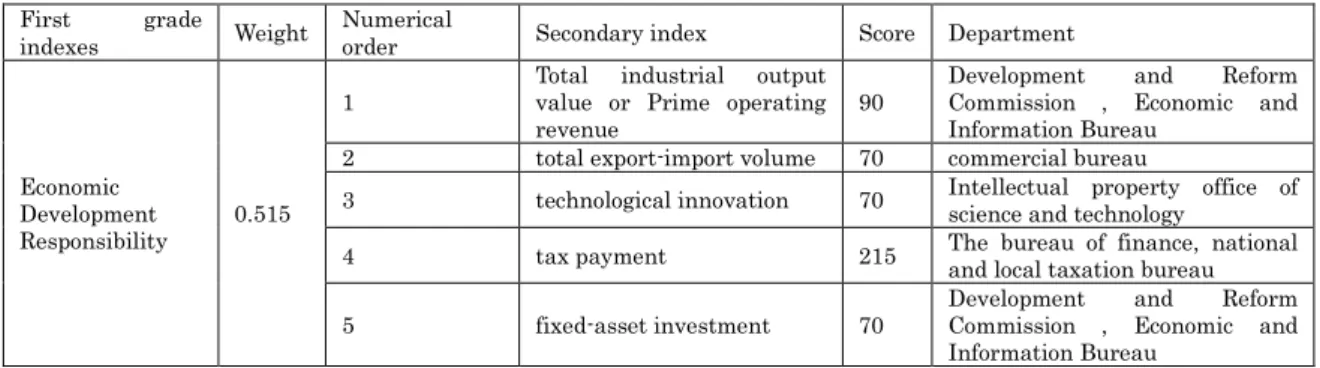
The calculation based on Economic Development Responsibility section in appendix is showed in Table 6. Valuable assignment of CSR development index takes place in following steps. First, the weight of Economic Development Responsibility is 0.515 which is based on relative importance in government’s regulation. Second, the diversity of each secondary index score figures with total marks 1000 multiplies each sector’s weight. Finally, Total industrial output value or Prime operating revenue(total score 90)
=Total assessment(total score 55)+ Increase assessment (35)
Table 6: The Index and Weight Distribution
First grade
indexes Weight
Numerical
order Secondary index Score Department
Economic Development Responsibility
0.515 1
Total industrial output value or Prime operating revenue 90
Development and Reform Commission , Economic and Information Bureau
2 total export-import volume 70 commercial bureau
3 technological innovation 70 Intellectual property office of science and technology 4 tax payment 215 The bureau of finance, national and local taxation bureau 5 fixed-asset investment 70 Development Commission , Economic and and Reform
Information Bureau
Source: “The YEDZ assessment of CSR evaluation system implementation opinions (Beta)”, YEDZ management committee, 2008
3.3.1 Computational Formula
First, CSR initial index score=∑ 𝐴𝑗
𝑗=1,2,3,4
*𝑊𝑗𝐴𝑗is score,𝑊𝑗is corresponding to
weight. Second, The mixed operating enterprises CSR index final score =
∑ 𝐵𝑗
𝑗=1…𝑘
*𝐼𝑗𝐵𝑗is sensitive score,𝐼𝑗 is corresponding to weight. Third, Industrial CSR
index final score=Initial score +Bonus score. Finally, Bonus score explanation is showed in following Table 7 and Table 8
Table 7 Social responsibility sensitivity
Corporate production Benchmark Bonus requirement (Each time plus) Bonus score (plus till maximum)
≥50 亿元 50 10 亿元 1
1-50 亿元 30 1 亿元 0.4
1000 万-一亿元 21 1000 万 1
<1000 万 21 Conversion based on practical situation
Source: “The YEDZ assessment of CSR evaluation system implementation opinions (Beta)”, YEDZ management committee, 2008
In the second formula, the final score is decided by the fine-tuning of social responsibility sensitivity. Social responsibility sensitivity is influenced by environmental sensitivity and customer sensitivity. Enterprises with high energy consumption and pollution will have high environment sensitivity. In addition, industry with direct contact with consumers has high sensitivity. For example, business of Sino-Steel corporation involves mining, wholesale trade and equipment manufacturing industry. These three industries do not directly contact with consumers, so fine tuning considered with the perspective of environmental sensitivity. The environmental sensitivity of mining industry on the environment is the highest among them. And its
weight reaches 50%; Machinery and equipment manufacturing environment sensitivity is high, whose weight reaches 30%; and wholesale establishments have less effect on the environment, the weight reaches 20%.
Table 8 Enterprises operating across two industries
Corporate condition Benchmark Bonus requirement Bonus score Higher than average 21 1% (Each time plus) 1 (plus till maximum) Average 10 Conversion based on practical situation
Lower than average 10 1% (Each time minus) 1(minus till 0)
Source: “The YEDZ assessment of CSR evaluation system implementation opinions (Beta)”, YEDZ management committee, 2008
Industrial weight set is based on the industry's social responsibility sensitivity. Enterprises operating across two industries give weights in accordance with the principle of “6, 4”, the higher sensitivity industry weight is 60%, the lower one is 40%. Enterprises operating across three industries give weights in accordance with the principle of "5, 3, and 2". The highest sensitivity industry with the weight reaches 50%, decreased by 30%, then 20%.
3.3.2 Grading method
1) Verify the information supplement(Each functional appraisal department) 2) Form the inspection data
3) Grade specification
Score Status Corporation type ≥700 Qualified Normal
≥564 Qualified Trade, construction, real estate companies
4) Summary and order score from high to low at the end of year 3.4 Achievements of CSR Practice in YEDZ
In 2008, YEDZ organized the working group for CSR which was led by the Secretary of the Party Committee of the District. The group was consisted of personnel from the administrative departments concerning economic development and the local enterprises. In January 2010, YEDZ spent 10 million RMB to reward for advanced
enterprises performing well in the sphere of CSR (CSR online reprint of “YEDZ
Rewarded Advanced CSR Practicing Enterprises”). Since 2012, YEDZ has been carrying out "Peony Prize" each year to reward for enterprises with better performance in CSR. (http://www.YEDZ.gov.cn).