Improve Corporate Reputation:
Lessons from Cases of Japanese
Business Misconduct
Toru Kiyomiya
西 南 学 院 大 学 学 術 研 究 所 英 語 英 文 学 論 集 第 52 巻 第 2 号 抜 刷 2 0 1 1 ( 平 成 23 )年 12 月
Communication Perspectives and
Strategies to Improve Corporate
Reputation:
Lessons from Cases of Japanese
Business Misconduct
1
Toru Kiyomiya
INTRODUCTION
Communication has become one of the most important approaches to innovative management control and organizational practices. In particular, the contribution of Weick (1979, 1995) has led organization and management scholars to emphasize ‘organizing’, instead of ‘organization’, and to focus their attention upon the communication processes within an organization. However such an understanding of communication is not, as yet, highly popular in either theory or practice. In particular, Japanese executives often show a lack of understanding regarding communication. I have often interacted with Japanese management executives and have observed that although they mention the importance of communication, this is rarely reflected or emphasized in practice. I believe that their understanding of communication is limited to a small area of management, and that it arises from a narrow definition of communication, such as social activities aimed at promoting good interpersonal relationships (e.g., dining out or drinking together, termed nomi-nication in Japanese).
Communication should not be regarded as an area of management but recognized as a constructive process involving daily interactions in the
workplace. Such recognition of communication is obvious and self-evident, however many people regularly neglect the importance and centrality of the communication process in the workplace. Deetz (1994) recognizes communication as a ‘perspective’, and emphasizes the constructionist’s point of view that all reality is constructed through the communication process. This indicates that corporate reputation is both created and recreated through the communication process, both in terms of internal and external organizational communication. Therefore, in this paper communication will be defined as perspectives, per the constructionist’s view, and ‘strategies’ as per managerial practices.
I propose that the improvement of organizational communication is central to successfully building corporate reputation. Therefore, the purpose of this paper is to demonstrate theoretical and practical implications of communication, based on case analyses of Japanese business scandals. In doing so, I will address communication as both a strategy and a perspective, in order to change and improve a platform for corporate reputation.
Communication Approaches to Business Scandals
When communication perspectives are considered for the purposes of improving corporate reputation, it is useful to analyze both ‘good’ examples, which can generate insights from a successful process that has built up corporate reputation, and ‘bad’ examples, from which we can infer lessons from a negative process that has resulted in the loss of social trust. In this paper, I will adopt the latter approach to gain important lessons from bad examples as there have been a number of business scandals which have recently led to serious managerial crises and significant losses of corporate reputation in Japan. I propose that the proliferation of such recent business scandals is related to communication problems in organizations. In the following sections, I will proffer three different reasons as to why communication is central in overwhelming corporate misconduct.
1. Japanese Corporate Misconduct (JCM) Research
In order to critically study corporate misconduct, I began a three-year research project in 2003 which investigated Japanese corporate misconduct (JCM)2 through three separate studies. The first study is a case analysis of
business scandals, which will be referred to in the next section as an aid to understanding the process of losing social trust. The second study includes both quantitative and qualitative approaches for obtaining data from business people3. I will present survey results from the second study in order to
support the centrality of communication in JCM.
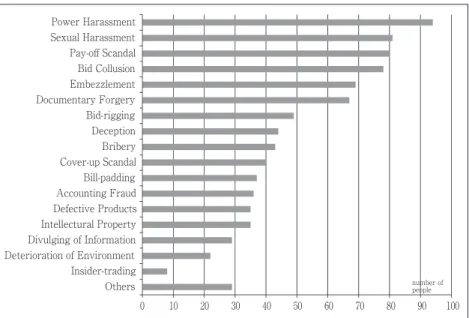
Firstly, I will explore how corporate misconduct is closely related to our working life, and how a substantial percentage of people closely experience and observe misconduct in their workplace. We identified that 51 percent of the respondents indicated an experience of workplace misconduct4. This is a
surprising result; almost half of the business people surveyed had experienced some form of misconduct in Japan5.
Figure 1: Experienced Misconduct
0 10 20 30 40 50 60 70 80 90 100 Others Insider-trading Deterioration of Environment Divulging of Information Intellectural Property Defective Products Accounting Fraud Bill-padding Cover-up Scandal Bribery Deception Bid-rigging Documentary Forgery Embezzlement Bid Collusion Pay-off Scandal Sexual Harassment Power Harassment number of people
In addition, we investigated what kinds of misconduct are most frequently experienced in the workplace6. As Figure 1 shows, six types of
misconduct are experienced significantly more frequently than others. The top two forms of misconduct which are most often experienced are power harassment and sexual harassment. Following these, pay-off scandals, bid collusion, documentation forgery, and embezzlement compose the remainder of the top six most frequently experienced business scandals. The top two are related to harassment in the workplace. Bid collusion and pay-off scandals are both traditional behaviors in Japanese business which emphasize social relationships with counterpart companies. Thus, these types of corporate misconduct obviously arise from problems with human relationships in the workplace and distorted business relationships.
The data clearly shows that the risks of losing social trust are related to organizational communication both within and outside a company. In other words, both the locus of risk management and the means for avoiding losses of social reputation should be analyzed in communication theory and practice.
2. Organizational Identity Approaches
The risk of losing corporate reputation is ever present in organization and business processes. Tony Bishop (President of the Association of Certified Fraud Examiners) notes that, “In the past, fraud was viewed as a rare event that happened to unlucky organizations. Now it is commonly accepted that fraud is taking place at virtually every organization, every business” (Cited in Anand, Ashforth, and Joshi. 2005, p9). Anand, et al (2005) address the issue that corruption scandals are related to organizations, and they reason that the popularity of corruption derives from socialization processes and rationalization tactics. They comment that “Rationalizations and socialization practices allow perpetrators of unethical activities to believe that they are moral and ethical individuals, thereby allowing them to continue engaging in these practices without feeling pangs of conscience”
(Anand, et al. 2005, p10).
I partly agree with their insights regarding the relationship between socialization processes and the perpetuation of corruption; however their perspective is limited to conventional approaches in management studies. In their view, organizational culture exists a priori as context before individuals are socialized, and they automatically assume that socialization and organizational identity reflect fraudulent culture. However, they overlook the importance of (re-) contextualization, which implies that organizational culture and context are created and recreated through the dynamic process of communication, in particular, discursive interactions.
Many cases of corporate misconduct are related to manipulation, distortion or concealment of information; such distortions of communication are common in organizations, and lead to misconduct. From a critical management perspective (Deetz, 1992), as communication is systematically distorted in the workplace, it will create a culture and becomes normalized in modern management. Organizational culture works as a hegemonic device (Alvesson and Deetz, 2006, Willmott, 2003), and workplace values are hegemonized by communication. Thus, it is necessary to focus more on the communication process of identity formation; which is how communication is systematically distorted in organizational culture.
3. Two Major Approaches to JCM
There is a third reason why communication is central in JCM. The idea is linked with a critique of current approaches to business scandals in management practices by academics. Since the late 1990s, there have been a number of business scandals in Japan, and the Japanese industry has taken some action. This was composed of two main approaches. The first was to encourage business ethics, while the second was to emphasize surveillance control in management. Typically, the former approach is to create ethical codes in the workplace and emphasize compliance. Major management
associations, such as Keidanren, launched their statements and the charters for improving business ethics and compliance after 1991. According to a survey (Asahibunkazaidan, 2003), more than eighty percent of Japanese major companies were engaged in creating ethical codes, and about 70 percent of them had already established their own ethical codes by 2002. However, business scandals have proliferated even after ethical intervention, leading to the conclusion that ethical approaches have not worked particularly well.
Typical examples of the latter approach emphasizing surveillance control are the strengthening of risk management and the improvement of corporate governance. Behind this movement, there is an assumption that the Japanese style of corporate governance may have serious problems, which is why corporate misconduct has occurred (Demise, 2004, Sakuma, 2003). Japanese government and management associations have attempted to shift the governance system to a more Americanized form (Sakuma, 2003). In 2002, Japanese commercial law was amended on the basis of the American model of corporate governance, however most companies have not followed this movement (Sakuma, 2003). Individual behaviors and attitudes did not change, even though the governance systems changed. Whereas Japanese practitioners and management scholars overestimate the American model of business and corporate governance, they underestimate tacit knowledge perpetuated in the workplace. I propose that strengthening control and monitoring behaviors missed the essence of reform, and past approaches and intervention practices lack an important aspect of organization, namely perspectives and strategies in communication.
CASE ANALYSIS
When considering the foundation of corporate reputation, I sought to investigate the problematic communication process which led to the loss of social trust. There are several methods available to collect data on this issue.
For example, I could obtain actual case histories through interviews with individuals who are closely involved. However this is often problematic. Information about such cases is highly confidential and restricted, so that it is seldom feasible for actual research. Instead, I analyzed specific incidents that have been publicized through the news media and a variety of business journals. In order to learn from the actual cases, such documented information is recognized as an important source of understanding and is frequently used for case analysis (Yin, 2003). One of the weaknesses in documented data is a ‘reporting bias,’ so I utilized three different newspapers7 in an attempt to reduce reporting bias and improve the
reliability of data. Also, I focused on discourse that appeared in news conferences and courtroom trials. In addition to documented data, I had a chance to conduct an in-depth interview with an official of the company where one case appeared, Snow Brand Milk Products, in March 2004. This one and half hour interview aids in understanding Case 1 (see Table 1). Table 1: Japanese Corporate Misconduct Cases and Background Information
Case Name & Case Description Background Information
Case 1 : Mass Milk Poisoning (2000) Snow Brand Milk Products (SBMP) Major milk producer initially concealed
milk-poisoning and could not handle internal and external corporate communication. A poor hygienic environment was common place.
• Established: 1925
• Number of Employees: about 6,900 • Number of Plants: 32
• Branch Offices: 29
• Major Products: milk, butter, various spreads, cheese, ice cream, and frozen-foods
Case 2 : Cover-up Scandal (2000) The Mitsubishi Motor Company (MMC) Auto-maker had hidden serious defect
information for more than 30 years: it did not deal properly with customer complaints and tried to avoid massive recalls.
• Established: 1970 (independent from Mitsubishi Heavy-Industries)
• Number of Employees: about 35,000 • Number of Plants: 5 assembly plants in
Japan
• International Operations: 8 manufactu-ring facilities in 6 countries
• Major Products: passenger cars, trucks and buses
Case Overviews
I analyzed three major incidents of corporate misconduct8. The first
case is that of Yukijirusi Nyugyou, Snow Brand Milk Products (SBMP), which led to massive food poisoning in 2000. The second case is that of Mitsubishi Jidousya, the Mitsubishi Motor Company (MMC), which perpetrated a cover-up scandal in 2000. The third is that of Yukijirushi Shokuhin, Snow Brand Food (SBF), which perpetrated a beef mislabeling scam in 2002. Although these incidents occurred in the past, they still have a significant influence on Japanese industry. They are equivalent to Enron in the US in terms of the significance and the level of social impact. As such, they provide valuable lessons for the Japanese industry. Following will be a summary of each incident.
Case 1 : Mass Milk Poisoning – Snow Brand Milk Products (SBMP)
Snow Brand Milk Products (SBMP), a leading company in the dairy industry, was established on the basis of several dairy cooperatives, and as such has received significant respect and trust from consumers.
Massive food poisoning caused by SBMP products came to light in more than thirty thousand victims on June 27, 2000. Consumers began to complain about food poisoning symptoms after drinking Snow Brand low-fat milk products made by the Osaka plant, and more than 1,500 people had suffered from food poisoning by July 1. Officials at a medical laboratory detected a gene in the milk which the victims had Case 3 : Beef Mislabeling Scam (2002) Snow Brand Food (SBF)
Government’s buy-back system for BSE problem was abused by a food company. It mislabeled domestic beef and disguised Australian beef as domestic meat.
• Established: 1950
• Number of Employees: about 1,100 • Number of Plants: 3 meat-processing
plants
• Major Products: Ham, sausage and other processed foods
drunk which was linked to the toxin present in yellow staphylococcus. While SBMP stopped low-fat milk production at the Osaka plant, it started to recall the affected milk from June 29. SMBP failed to reach a decision on a recall until two days after initial calls about food poisoning.
On July 1, the SBMP president announced that the staphylococcus aureus bacteria was found in a valve that carries low-fat milk residue in the production process to a spare tank in the Osaka plant. It was believed to have caused the food poisoning. However, on August 18, the Osaka local government announced that the primary cause of the food poisoning was identified in a toxin in the powdered milk produced at the Hokkaido plant two months prior to the incident. This powdered milk was part of raw material and used for production in Osaka. On March 31, a huge icicle broke through the roof of the plant and led to a power failure in the Hokkaido plant. As a result, the raw milk was left in the storage tank for several hours without the cooling systems, and subsequently became warm enough to allow the growth of staphylococcus aureus bacterium. The powdered milk was produced on April 10 and delivered to the Osaka plant on June 20 for making low-fat milk and other dairy products.
Case 2 : Cover-up Scandal – The Mitsubishi Motor Company (MMC)
The Mitsubishi Motor Company (MMC) is the fourth largest auto company in Japan. It is a member of the Mitsubishi Group of companies, and a former Zaibatsu company, which hold strong power and authority in the Japanese industry. As such, business people respect them as the most traditional and central companies in Japan. On July 18, 2000, officials of the Ministry for Transport searched
the MMC headquarters due to the exposure of cover-up scandals via an anonymous phone call. This call indicated that the quality
assurance (QA) department of the MMC had hidden records of customer complaints from the Ministry for Transport. The officials found a huge number of reports concerning complaints from customers stored in the male locker room of the MMC headquarters. This was consistent with the allegations of the whistle blower. (Customer complaints are usually used to decide whether vehicles should be recalled or not.) In fact, the MMC was keeping two different sets of records –one to be submitted to the Ministry for Transport, and the other to be kept at the company –which began shortly after the recall system was introduced in 1969. This meant that the MMC had kept two different records of customer complaints and deceived Japanese people for more than thirty years.
The MMC did not take proper measures to deal with the discovery of defective parts that required vehicle recalls in 2000. Although the MMC received enormous criticism in Japanese society, it still continued to conceal defect information which led to fatal car accidents in both 2002 and 2004.
Case 3 : The Beef Mislabeling Scam – Snow Brand Food
The now-defunct Snow Brand Food Company (SBF) was one of the subsidiary companies of SBMP, and committed serious misconduct one year after SBMP was embroiled in their own food poisoning scandal.
The SBF abused the Japanese government’s beef buy-back program, which sought to help an industry hit hard by Bovine spongiform encephalopathy (BSE, more popularly known as mad cow disease). The sales volume of beef critically declined in 2001 after BSE was identified in Japanese cows in September of that year. The Japanese government provided a buy-back program in October to incinerate about 12,600 tons of beef from Japanese cows, which were
butchered before nationwide cattle testing began on October 18. SBF disguised about 30 tons of imported (Australian) beef as domestic (i.e., Japanese) meat, and consequently the company received approximately 195 million Yen (approximately 1.8 million U.S. dollars) in subsidies under the buy-back program. SBF initially announced that this mislabeling scam was conducted by one of the SBF managers. However, the police investigation revealed that the mislabeling scam involved senior management who gave tacit approval on this matter. In addition, the mislabeling scam involved collaboration with other associated companies, which was kept secret. This came to light because of whistle-blowing by one of the company’s business partners.
Interpretation
The three above cases are typical examples depicting how a company may lose both societal and market trust. As a result of their misconduct, SBF went into liquidation, and the other two companies suffered considerable losses in the marketplace. Corporate misconduct is considered the most serious risk to corporate reputation, and the most serious and complex problem in management. An important question is whether these companies are abnormal in the Japanese marketplace. The answer is no. Many companies have the same risks and potential to lose social trust9. In other
words, business scandals are neither accidental nor unfortunate happenings, but collectively created by organizational members. In Case 1, even though the initial cause was an accident causing electrical power failure, massive food poisoning was created through incorrect communication processes by organizational members. It is important to analyze how an accident can potentially be transformed into a business scandal. Problematic behaviors in communication processes are identified among the three cases below.
[Case 1]
1 .Underestimation of initial complaints from customers in Osaka Office and neglect of this information.
2 .Rejection of cooperation with health officials and failure to submit food poisoning information.
3 .Failure to inform senior management of negative information surrounding possible food-poisoning.
4 .A delayed recall decision.
5 .Unethical press conference behavior; a failure to share information among officials.
6 .Unawareness of the unsanitary work environment in the plants. 7 .Manipulation of information about possible causes of food-poisoning;
i.e., contaminated valves.
8 .Failure to destroy a large amount of contaminated raw milk in the Hokkaido plant.
[Case 2]
9 .Concealing the reports with information about serious defects. 10.Concealing information for more than thirty years; which was
routine.
11.Ignoring product defects and underestimating customers. 12.A strong loyalty to Mitsubishi.
13.Rarely talking with other groups; strong in-group norms or over-identification with a group.
14.Whistle blowing occurred. [Case 3]
15.Managers ordered to mislabel international beef as domestic. 16.Subordinates followed the order with no strong objection.
17.Senior management gave tacit approval.
18.Associate companies cooperated to aid the scam.
19.One manager attempted to take all the responsibility for the scam. 20.A business partner blew the whistle.
These behaviors allowed accidents or managerial errors to result in business scandals. This transformation is clearly related to an incorrect or distorted communication process of information sharing. Namely, poor information and incorrect decisions are not properly handled within a group, and such information which is negative to individuals and organizations is concealed or manipulated in all three cases. Therefore, corporate misconduct is recognized as organizational deception, collective creation of information manipulation and distortion (Kiyomiya, Matake, and Matsunaga, 2006). Information concealment was aimed at protecting either an individual’s or the company’s integrity in Cases 1 and 2. In contrast, economic gains are obviously the main purpose of information manipulation in Case 3.
In addition, many employees were involved in the misconduct, and collaboration for deception is identified in each of the three cases. The employees who were committed to the deception did not have strong motivation or clear purpose, but were just doing their daily jobs. In other words, they simply made sense of their daily lives on the basis of their organizational culture and corporate environment, and they were collaborating, not rejecting, information concealment and manipulation. The current president of SBMP stated, “Our common sense had deviated from that of society.” Workplace values and sense-making frameworks have already been hegemonized in organizational culture and unobtrusively controlled in the implicit communication process. For example, an SBF employee said about the mislabeling, “I initially felt strange, but then I thought it was ok and I didn’t think it was a bad thing to do.” Distorted
communication creates and recreates bad customs such as information manipulation, and organizational culture creates a system where it is natural for its members to conceal and manipulate documents and information. Taking this into account, we can conclude that a sense of risk and ethical awareness did not apply in SBF’s culture.
DISCUSSION:
From The Communication Perspective
In this section, I will focus on discussing the communication problems in the above case studies. The goal of communication is not only to deliver a message through symbols, but also to understand the meaning in exchanged messages. Mutual understanding among internal and external stakeholders is its most important purpose in organizational communication. In this sense, the goal of communication was incomplete and led to a management failure in the three case studies. Three types of incomplete (problematic) communication can be identified in the cases.
Lack of Communication
The first type of communication problem is a lack of communication, which is considered from a structural-functional perspective. This is defined as communication and information which is not being properly shared or is insufficient for the stakeholders involved. A lack of information is often linked with business scandals, and accidents and errors result in the loss of social trust. Following are some examples of discourse featuring a lack of communication.
Example 1 : Little information sharing in senior management and
upward distortion of negative information (Food-poisoning case)
In the press conference, one of the SBMP officers was asked, “Is there anything in the valve?” He replied, “I am not sure about that.” Another officer (the Osaka plant manager) interrupted, “There was a stain on the
valve about the size of a coin. The cleaning was inadequate.” “Really! Is that true?” the president of SBMP asked.
Example 2 : Little information sharing between groups (Food-poisoning
case)
A SBMP employee of the delivery department was asked about the incident. He said, “I work in a different department and the company did not inform us, the first I knew about this incident was by watching the helicopters flying above the Osaka plant.”
Lack of information has two aspects. The first is the ‘quantity’ of communication. The evidence shows there is little information sharing with senior management (Example 1 ), and communication occurs at a low frequency between groups (Example 2 ). From this analysis, we can come to understand that upward message flows and inter-group communication are key to achieving good organizational communication under both normal and crisis situations.
The second aspect is the ‘quality’ of communication. Namely, communication is dependent on the contents of information, and some specific contents were not communicated well. The evidence shows that a lack of communication usually occurs when dealing with negative messages. We can imagine that good information or pleasant messages are easy to communicate, and they are diffused in the organization quickly. However, bad messages and negative information are difficult to handle. Communicating negative types of information among stakeholders is crucial in establishing a strong foundation for corporate reputation.
Quantity and quality of communication are the basic approaches to considering problematic communication. It is important to note that frequency and content of communication are not independent but
interdependent. Therefore, it is best to observe communication structure in terms of both quantity and quality. The emergence of communication structure depends on the social networks among organizational members, and it is different from formal organizational structure as typically illustrated by organizational charts. We can identify the problematic communication in the relationship between organizational members and their roles. In particular, we can observe that the upward flow of negative messages are distorted or concealed, as demonstrated by Example 1 . Such an assessment of communication structure1 0 provides an effective means of avoiding
business scandals related to communication problems. Miscommunication and Communication Gaps
Another type of problematic communication is miscommunication which is considered from the interpretative point of view. It implies that a message sender and a receiver exchange a symbol (i.e., via language), however the intended meaning is not correctly interpreted in some contexts. In other words, people communicate but the ultimate goal of communication remains unfulfilled because of gaps in understanding. This type of incomplete communication is distinguishable from a lack of communication. Miscommunication or communication gaps are relevant to business scandals, and they occur in the cases as follows.
Example 3 : Internal information manipulation and concealment
(Mislabeling scam case)
A subsidiary company was involved in the scam, and the president of this company said, “We didn’t know that it was the imported beef. We just used the label that the headquarters personnel brought here.”
Example 4 : Internal information manipulation and upward distortion in
negative information (Cover-up scandal case)
MMC included some vehicles that had been secretly repaired to avoid recall when the MMC submitted the records of nine recalled cars. He admitted it and said, “I think it was illegal.” The MMC president was surprised and stated “That’s different from your report !”
Example 5: External information manipulation (Food-poisoning case)
The areas of the contaminated valve were much larger than the previous announcement, and a SBMP manager explained “We did not intend to lie about this. We didn’t know how serious they were. We sincerely regret this matter.”
Example 6 : Tacitness (Mislabeling scam case)
In the meeting room, three managers were asked about the mislabeling scam. One manager opposed mislabeling, and the other two managers kept silent for a couple of minutes. Then, after a short while, one of them started to say, “OK, we have to do. We need some helps, so let’s ask for some help from one factory that I know.”
We know daily communication is not perfect in terms of information transition; rather we modify information and messages for our own purposes. This modification of information is a central point when considering corporate misconduct. According to the information manipulation theory (McCornack, 1992), there are four types of violations in communication; ⑴ avoidance, ⑵ distortion, ⑶ ambiguity, and ⑷ withholding. Avoidance and withholding are the type of manipulation that resulted in the concealment of negative information in the above cases (Example 3 ).
Miscommunication often emerges through the distortion of messages. Distortion refers to the intended manipulation of data and information, and is a common phenomenon in all three cases. The companies (i.e., producers) had
manipulated the information for the purpose of economic gain and self-maintenance, and they told lies to those outside the organization (i.e., consumers). This is recognized as external information manipulation (Example 5 ). Internal information manipulation occurs within the organization. For example, the degree of contamination in the valve of the Osaka plant had been reported differently to the president of SBMP (Example 4 ).
Ambiguity that is closely linked to misunderstanding quite often appears in the communication process among the case studies. In particular, the Japanese language uses ambiguous discourse in communication when seeking to avoid hurting or offending another. People avoid using overt message expressions and explicit communication, but prefer instead to use implicit discourse. Tacit approval is a typical method of dealing with ambiguity which often leads to Japanese corporate misconduct. In Case 3, the SBF senior management did not directly conduct mislabeling but it was committed with their tacit approval. Tacit approval is used not only by senior management but also employees. SBMP employees approved the reuse of contaminated milk as well as approving work in the unsanitary environment to produce milk without any strong objection. Similarly, MMC employees approved two different reports to hide recall information from the government without any strong objection, while SBF employees approved mislabeling without any strong objection (Example 6 ). Thus, tacitness did not stop the corporate misconduct, but rather such ambiguous communication continuously created an organizational culture that approved misdeeds. Systematic Distortion of Communication
Deetz (1992) points out that all communication is distorted to some degree but without overt awareness, communication is distorted systematically. Distortion of communication is inevitable when the context is distorted. People are not aware that context distorts human relations and
communication, and therefore the organizational members feel normal in the misconduct cases. However, the person who felt normal and intended to behave normally in such a distorted context seems to act unethically. In a context where the manipulation and concealment of information are normal to them, it is difficult to stop or prevent misconduct through whistle blowing. In the cases of corporate misconduct, the distorted context of the workplace is a priori, so that their communication will inevitably lead to inappropriate behavior, as the examples of discourse below show.
Example 7 : Information manipulation is normal (Mislabeling scam case)
One of the SBF employees who was implicated in the scam was interviewed and stated “I went to the warehouse, but I did not commit mislabeling. I was just there to check the products. After the scam was disclosed, I didn’t feel that it was a bad thing to do.”
Example 8 : Strong human relationships (Mislabeling scam case)
An employee of the warehouse where the mislabeling scam occurred admits his manipulation of documents for SBF. “I thought that it was wrong, but I could not reject helping them because they are good customers.”
Example 9 : Economic efficiency and employee morale (Food-poisoning case)
Four officials of the SBMP held a press conference and apologized. “We sought efficiency in production and deviated from an important objective, taking the customer’s perspective. This has resulted in a decline of employee morale”
The notion of systematic distortion indicates that corporate misconduct is neither an accident nor a mistake by individuals, but is rooted in the
history and culture of the organization. In the case of the MMC, strong organizational identity forced the employees to manipulate defect information. In the case of SBMP, a strong feeling of face-saving was related to tacit approval for the reuse of contaminated milk and the concealment of the contaminated valves. Strong organizational identity and face-saving are often described as features of Japanese culture, and this Japanese mentality is related to the systematic distortion of communication.
The cases show two more features of the systematic distortion of communication. All three cases are related to excessive bureaucracy. In these organizations, employees pay more attention to internal affairs and corporate gossip, for example, who receives a promotion. There is also sectionalism in bureaucratic organizations. People create communication gaps with other groups and the internal group norms become the most important. According to an interview with an official from SBMP, the most significant problem that he felt was sectionalism and bureaucracy.
The other source of systematic distortion is the capitalistic principles of efficiency and market competition. According to Polanyi (1977), market competition fosters distortion of social and human relations. It makes employees blind to what is normal and what is good for customers. The employees underestimate their customers and only pay attention to the capitalist principles of efficiency and market competition. All three cases embrace information manipulation that reflects such capitalist orientations. Typically, the beef mislabeling resulted from a fear of market competition. Also, the re-use of contaminated milk and the concealment of recall data are obviously related to systematic distortion created by capitalist principles. Capitalism is not a perfect system. We should not premise such capitalist context as normal, otherwise communication is systematically distorted.
IMPLICATIONS:
From a Strategic Point of View
Communication perspectives reveal three types of problematic communication processes, from which many insights are gained. In this section, I will focus more on communication strategies that overcome such problems and create a platform for high corporate reputation and social trust.
While lack of communication is closely related to a loss of social trust, it is necessary to improve communication in terms of quality and quantity. As mentioned earlier, social network analysis is an effective tool to assess organizational communication and obtain network structure, which is recognized as emergent (real) communication relationships. Once the communication structure is assessed, the problematic communication relationships can be reformed and information sharing strengthened. In particular, management should pay attention to in-group and out-group relationships, which emerge as a clear distinction of informal communication groups, as well as bridge networks between informal groups. These tendencies are related to bureaucratic communication and sectionalism. Also, strong internal communication within a group may indicate risks about strong group norms and excessive group identity, which may be related to communication problems such as tacit approval, groupthink, and concertive control. Using network analysis, management can improve communication relationships and create the foundation for a socially trusted organization.
A strategy that overcomes problems of miscommunication is to pay more attention to organizational discourse. Typically, Japanese people have a number of ambiguous expressions and implicit communications. The Japanese maxim ishin-denshin is often used in good human relationships. This maxim implies tacit understanding between close interpersonal relations. Japanese traditionally believe in the virtue of tacitness; language
expressions are limited and rarely truthful. So, Japanese do not rely on speech and discourse. Although there are advantages in this type of tacit communication, the disadvantages are clearly linked with corporate misconduct. We have to pay more attention to the types of discourse used in the workplace in order to overcome business scandals. Japanese people need to change their tacit modes of communication and need to speak freely in the workplace.
The most complicated issue is the systematic distortion of communication. This problem is related to both history and culture, so it is very difficult to overcome1 1. One possible approach to addressing this issue
is to reform organizational culture, because systematic distortion originates in this context. According to Alvesson (2002), there are three types of cognitive interests in organizational culture1 2, with one in particular being
postulated by postmodernists and critical scholars. This group is characterized by emancipatory interests that emphasize challenging and liberating organizational culture. For example, in order to contend with gender problems in the workplace, employees and management should jointly attempt to change the male-dominated organizational culture to a gender sensitive environment. Likewise, organizations must adopt a culture which is more sensitive to misconduct and justice in the organization. Such transitions as reframing organizational culture are important for two reasons. The first is to highlight what is normal and natural. The second is to take into account other stakeholder perspectives. In other words, it is necessary to reframe one’s identity and shift (reframe) towards taking care of other stakeholder identities. The accumulation of these practices and experiences will result in a more liberal organizational culture.
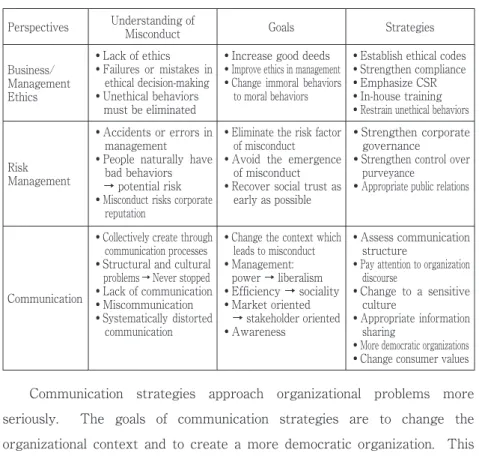
Thus, communication perspectives provide important strategies for organizational communication. As summarized in Table 2 , communication strategies are different from conventional strategies, which arise from
business ethics and risk management. Both approaches emphasize checking (monitoring) and controlling (restricting) erroneous behaviors, but their approaches are ineffective in changing individual mind-sets and behaviors. They are superficial in regards to problem solving. In fact, companies have never seriously attempted to rectify the problems of misconduct. When I conversed with corporate executives, they said that they did not want to be bothered by these matters ; they just prepare for conventional ways of compliance because of taking consideration of the case for a law-suit.
Table 2 : Three Different Approaches to Corporate Misconduct
Communication strategies approach organizational problems more seriously. The goals of communication strategies are to change the organizational context and to create a more democratic organization. This strategy emphasizes sociality rather than economic rationality and focuses on
Perspectives Understanding ofMisconduct Goals Strategies Business/ Management Ethics • Lack of ethics • Failures or mistakes in ethical decision-making • Unethical behaviors must be eliminated
• Increase good deeds • Improve ethics in management • Change immoral behaviors
to moral behaviors
• Establish ethical codes • Strengthen compliance • Emphasize CSR • In-house training • Restrain unethical behaviors
Risk Management
• Accidents or errors in management • People naturally have
bad behaviors → potential risk
• Misconduct risks corporate reputation
• Eliminate the risk factor of misconduct • Avoid the emergence
of misconduct • Recover social trust as
early as possible
• Strengthen corporate governance
• Strengthen control over purveyance
• Appropriate public relations
Communication
• Collectively create through communication processes • Structural and cultural problems → Never stopped
• Lack of communication • Miscommunication • Systematically distorted
communication
• Change the context which leads to misconduct • Management: power → liberalism • Efficiency → sociality • Market oriented → stakeholder oriented • Awareness • Assess communication structure
• Pay attention to organization discourse
• Change to a sensitive culture
• Appropriate information sharing
• More democratic organizations • Change consumer values
stakeholder-oriented communication rather than market-oriented behaviors. These are fundamental transitions from conventional management to postmodern management. Thus, in order to seriously tackle corporate misconduct and improve corporate reputation, management has to make more fundamental innovations. To this end, I would like to articulate future directions and a proposal for innovating corporate reputation.
a) Improving organizational justice and democracy
One feature of the communication approach is to transform the organization into a more democratic culture. As Figure 1 illustrates, the problems are related to power relationships that lead to losses in corporate reputation. In addition, the three cases show a number of communication problems arising from power and political group pressure. Thus, the workplace that is related with such organizational context has serious problems in democratic human relations, and needs to be more liberalized and free for organizational justice to be achieved. Democratized organizations will be able to stop power-related scandals and facilitate better information sharing.
b) Multiple stakeholder communication
The essence of the communication approach is the shift from market-oriented behaviors to stakeholder-market-oriented communication. As mentioned in the previous section, excessive market competition enforces to change human relationships and their communication becomes distorted. In particular, while the win-lose perspective on the market competition focuses on the winner’s happiness and satisfaction, the losers are underestimated in the global market system. In contrast, the win-win perspective is at the core of successful negotiation among various stakeholders in the long term. This means that multiple stakeholders (i.e., stockholders, employees, unions, consumers, customers, communities, and the government) all share the values and satisfaction that the company produces. In other words, all
stakeholders must coexist over time, and so the corporate mission must embrace multiple-stakeholder satisfaction. To this end, the most important thing is communicating with all the company stakeholders. This does not mean strategic public relations outside of the organization, but consistent information sharing between internal and external stakeholders. Thus, management must be dictated by the mutual benefits for the multiple-stakeholders, not the market.
c) Customer-satisfaction (CS) and employee-satisfaction (ES)
As the previous two proposals for communication strategies illustrated, it is necessary to alter the business ‘common sense’ in order to create healthier organizations. I believe that CS is one of the most popular objectives in business. However, customers were underestimated and both the individual and organizational face and economic-gains were given a higher priority in the three above case studies. On the principle of the social division of labor, after the customers consume the products and services and they are satisfied, the profits eventually return to the company. This basic principle is often forgotten. Namely, CS becomes nominal and it is merely a kind of lip service. This promotes misconduct and degrades corporate reputation.
This is because there is social distance between the customers and the company. While society has become complicated and the social division of labor has expanded in the modern world, the locus of consumption is far from the locus of production. Therefore, it is difficult to see customer concerns and interests. That is why we need to consider who the customers are. In short, the most important customers are the employees. The most loyal customers are the employees who create the value of the products and services. The employees have to be satisfied with their own products and services as the customers; otherwise corporate reputation can decline. The gap between consumption and production becomes smaller when employees
identify themselves as both customers and producers. In this regard, employee satisfaction is the best approach to increase customer satisfaction. d) De-commodification: from economic rationality to sociality
The last point of importance for the innovation of corporate reputation is to change the core concept of businesses from economic rationality to sociality. Economic rationality and efficiency have traditionally been the norms and have guided common sense in business decisions and behaviors. However, such rationale should only be used for a small part of business and management. This rationale, for example, was not effective in crisis situations, as the three case studies in this paper have shown. Sociality provides a higher level of rationale for management philosophy. Businesses should be aware that economic rationality can only be applied in limited areas of business, and there is a need to include sociality in business models.
Many companies include elements of CSR and corporate citizenship, however rarely have either become central to management. Rather, they are often only superficially incorporated, and often only considered a peripheral issue in management. Moreover, while business ethics and risk management are commonly implemented as short-term remedies, most businesses rarely use them to innovate the foundations of their traditional management. In order to overcome business scandals and enhance corporate reputation, a fundamental transition is essential for current management, which will lead to the metamorphosis of modern corporations.
In conclusion, businesses must consider management innovation over the long term if they are to seriously attempt to improve their corporate reputation. The core of future business lies in negotiation and consultation with a variety of stakeholders. In other words, management will no longer consider business administration as simply controlling resources, but as multiple-stakeholder communication (including competing stakeholders). I believe that this will be the future for business innovation.
Notes
1 An earlier version of this article was presented at the 11th International Conference
on Corporate Reputation, Brand, Identity and Competitiveness at BI Norwegian School of Management in Oslo, Norway.
2 This is supported, in part, by MEXT (Ministry of Education, Culture, Science, Sports,
and Technology), KAKENHI 15530360.
3 The third study is not described here due to limited space. The focus of the third
study is on various issues of corporate social responsibility, and we collected data from top executives of small and medium-sized enterprises via questionnaire.
4 There were 612 responses (457 participants did not answer), and interestingly 314
participants said ‘yes.’
5 In other words, many cases of misconduct have not been exposed, or they have been
concealed in the Japanese workplace.
6 There are 813 in total; multiple answers were allowed in this question.
7 The two newspapers that I used in this analysis are the largest and second largest
subscribed papers in Japan. Relatively speaking, one newspaper is conservative, whereas the other is liberal. The third is a newspaper written in English and relatively neutral.
8 These incidents are the most typical and representative cases among many
corporate scandals in Japan (Okamoto and Konno 2003; Ueno 2005). Selection of these cases is considered as valid in this research.
9 According to the social survey (Keizai Koho Center 1997), about 40 percent of
responses indicate that any company is susceptible to business scandals.
1 0 Communication structure is measurable in ‘social network analysis’ which is usually
used for this end, and it measures quantity and quality of communication.
1 1 This may require not only organizational reform but also social reform.
1 2 The other two are technical and analytical interests. Functional scholars emphasize
technical interests which control and manipulate organizational culture. Interpretative scholars postulate analytical interests that emphasize understanding organizational culture.
REFERENCES
Alvesson, M. (2002) Understanding Organizational Culture. Sage Publications.
Alvesson, M. & Deetz, A. S. (2006) Critical Theory and Postmodernism Approaches to Organizational Studies. IN CLEGG, S., HARDY, C., LAWRENCE, T. B. & NORD, W. R. (Eds.) The Sage Handbook of Organization Studies. 2nd ed. London, Sage Publication.
Anand, V., Ashforth, B. E. & Joshi, M. (2005) Business as Usual: The acceptance and perpetuation of corruption in organizations. Academy of Management Executive, 19, 9-23.
Asahi bunkazaidan (2003) Yuryokukigyo-no Shyakaikokendo (Social Contribution in Japanese Excellent Comanies). Asahi-shinbunsha.
Deetz, A. S. (1992) Democracy in An Age of Corporate Colonization, Albany, NY, State University of New York Press.
Deetz, S. A. (1994) Future of the discipline. IN DEETZ, S. A. (Ed.) Communication Yearbook 17. Thousand Oaks, CA, Sage Publications.
Demise, N. (2004) Corporate Ethical Behavior and Corporate Governance. Organizational Science, 37, 33-42.
Keizai-Koho-Center (1997) Kigyoujin 1000nin Kinkyu Anketo-Chosa (Emergency Survey from 1000 Business Persons), Tokyo, Keizai Koho Center.
Kiyomiya, T. (2011) Corporate Hegemony in Japanese Collaborative Management: A Case Study of Corporate Misconduct in Japan. Studies in English Language and Literature, 52(1) p.113-135.
Mccornack, S. A. (1992) Information Manipulation Theory. Communication onographs, 1-16.
Okamoto, K. & Konno, H. (2003) Risuku-Manejimento-no Shinrigaku (Psychology in Risk Management: Lessons from cases), Tokyo, Shinyosya.
Polanyi, K. (1977) The livelihood of man, New York, Academic Press.
Sakuma, N. (2003) Nippon-no Kigyoutouchi Kouzou (Japanese Corporate Governance Structure). IN SAKUMA, N. (Ed.) KigyounoTouchikozou-no Kokusaihikaku (International Comparison in Corporate Governance). Tokyo, Mineruba-shobo. Ueno, H. (2005) Genbadeikasu Risukumanejimento (Risk Management Used in the
Workplace), Tokyo, Daiyamondosya.
Weick, K. E. (1979) The Social Psychology of Organizing (2nd), Reading, MA, Addison-Wesley.
Weick, K. E. (1995) Sensemaking in Organizations, Thousand Oaks, CA, SAGE Publications.
Willmott, H. (2003) Organizational Theory as a Critical Science. IN TSOUKAS, H. & KNUDSEN, C. (Eds.) Oxford Handbook of Organizational Theory. Oxford, Oxford University Press.
Yin, R., K. (2003) Case Study Research: Design and methods, Thousand Oaks, CA, Sage Publications.