The Japanese Psychonomic Society
NII-Electronic Library Service
The JapanesePsychonomic Society
TheJaPaneseJournalof Ps.1/chonomicScience
2007,Vo],25,No.2,273-274
Summary
ofAwardedPresentationIP08
Spatiotemporal
integration
of
object
features
in
the
stream/bounce
event
perception
Yousuke
KAwAcHi*,
Takahiro
KAwABE**,
andJiro
GyoBA*
DqPartmentof
Ils),cholagy,7bhoku UitiversitJ,*,LlserScienceinstitute,ts'ushu
University** When two identicalvisual objects move across each other ina two-dimensional display,thereisa perception of streaming through, or bouncing off each other, at the positionof their
coinci-dence. Inour prcliminary observation, a switch of object
features
such as colorbetween
the twoobjeets, biased theperception towards
bouncing.
We
have
examined the characteristics oispati-oternporal
integration
of objectfeatures
inthestreamfbounce evcnt, By changing theduration ofthe object presentation after a color switch at theircoincidence we explored the spatioternporal
propertiesofobiect color tosubstantially affect the stream or
bounce
event.The
results revealedthat
100
ms after the color switch, the observers can utilizethe
color changelnformation
to
determine the streamfbounce event, Additional]y,the percentage of
bouncing
percepts reached arnaximurn rate 150 ms after theco]or switch. A follow-upexperiment showed thattheresults were
not affectcd by thcspccd of theobjects. This result suggested thatthe post-coincidenceduration iscrucial forspatiotemporal integrationof theobject color
feature
in
event perception.Key words: spatiotemporal integration,feature,stream/bounce event perception
In the perception of stream/bounce events,
changes
in
thefeatures
of moving objects after theircoincidence have been reported toinfiuencethe
per-cept of the streamlbounce display
<e.g.
Feldman&
Tremoulet, 2006).However, itisunclear hew long it
takes for the object featurechange to affect visual event perception. We manipu]ated thepresentation
duration of a stimulus
(Watanabe
& Shimojo, 2001)afterswitching objects' colors at theceincidence.
We
attempted to specify the spatiotemporal condiition
for the visual system to utilize the object feature
information effectively invisual event perception.
Experiment
la
andb
Methods
Seven Tohoku university students including the
author
(YK)
participatedin
Experiment
la, InEx-periment lb,seven new naive students participated.
A white fixationcross was presented at thecenter of a CRT display. The display background wa$
black. The two moving objects, subtending O.5
de-grees,were colored red and green and thecolors were
subjectively isoluminant toeach other, Thc objects
Department of Psychology, Graduate School of
Arts and Letters,Tohoku University,27-1 Kawa-uchi, Aoba-ku, Sendai 980-8576
appeared separately, 4.2degrees frorneach other, and
O.9
degree$
above thewhitefixation
cross, Theymoved toward each other with a vclocity of 5,7
deg s-i, coincided and then continued as
they
movedaway from each other. After the coincidence the
colored objects either moved inthc same
direction
(no
switch condition) or in the opposite dire¢tion(switch
condition}, InExperiment 1bthe two objectswere
isochronous,
so that the object coLor wascon-stant
before
and after thecoincidence{control
condi-tion).The duration was varied after the coincidence
(Post
coincidence duration(PCD)
of O,53.2,106.4,159.6.212,8,319.2.or 372.4ms). An occluder was
presented at
O,9
degrees
above thefixation
cross,in
order to make the
instant
of thecolor switchinvisi-bleforthe participants.
The participantswere asked to
judge
whether theobjects streamed through or bounced offeach other
at theceincidenee. Ifpartieipantswere unsure about
their perception they could pressthe "unsure" key.
In Experiment la there were two color switch
(no
switch or switch) conditions and seven PCD
copdi-tions,InExperiment lb therewere seven PCD
condi-tion$only. There were 20 trial6foreach condition.
Results and Discussion
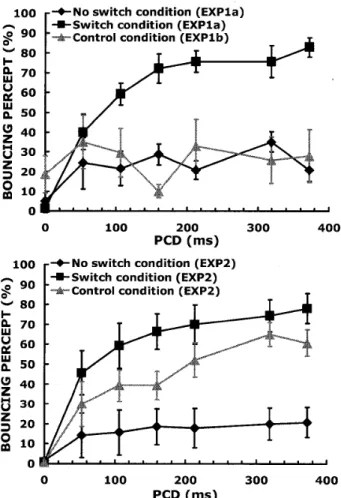
The resu]ts are shown inthe upper partof
Figure
The Japanese Psychonomic Society
NII-Electronic Library Service
The JapanesePsychonomicSociety
274 The
Japanese
Journai
of Psychonomic Science VoL25, No. 2100fi8 9ov 80Fa 7o-v 60ctwa soe 4ozV 30z= 202 io o 90gv 80'tu 70-Y 60: 50e 4oZa 3oz= 202 ie o O tOO 200 300 PCD
(ms)
400o loe 2oo 3oo 4oo
PCD
(ms)
Figure 1. The mean percentage of bouncing percept
in
Experiments
la,b
and 2. Theerror
bars
denote the mcan standard errorsof mean
<N=7).
1. Because more than ten percent oi the responses wcre 'unsure'
in
theOms
PCD
conditionin
both
Experiments la and b,we excludcd thiscondition
from
the statist.ical analysis. A two-way ANOVA revealed that the main effects of both PCD and colorswitch were significant
(F(5,30)=2.62,
p<O.05;
F(1,6)=41.76,
p<O.OOI,
respectively).There
wasalso a significant interaction between thc factors
(F(5,
30)=-,8.94,P<O.OOI). A post-hoc analysis indi-cated thatinthePCD condition$ from100
ms to350
ms, the percentage of bounce percepts was
sig-nificanUy higher inthc switch condition than
in
the no switch condition(all
P<.O.05).For
the switch condition, the percentage of bounce percepts washigherjnPCD 150 ms to
350
ms than PCD50
ms{all
P<O.05),
For Experimentlb
a one-w・ayANOVA
revealed that thc main effect of
PCD
was notsig-nificant
(F(5,
30)=O.99,p=O.442).
From theresults ofExperiments laand b,
it
was apparent thatacriticalduration of approximately
150ms
is
requiredfor
observers to utilize object color information
effec-tively forperceivingthe streamfbounce event.
Experiment
2
Method
Seven
Tohoku university students participatcdin
thisexperiment.
Except forthefollowing,thesti'muli were identical
to
that
ofExperiment
1.
In
Experiment
2
there
werethreeconditions
(no
switch condition, switchcondi-tion,and contrel condition) in a within-subject
de-sign, Inaddition, the spced of theobject motion wasdoubled. The motion
distance
was also doub]ed,
Results
and DiscussionThe results are shown inthe lower partof Figure 1.
As in
Experirnent
1,
regardless of the speed of theobject motion, when the
PCD
was above 100ms thedifferencebetween theswitch and control condition, and between the no switch and control condition,
reached significant levels
(P<O,05).
Moreover,
for
the switch condition thepercentage of
bouncing
per-cept was higherinthePCD [rom 150 to 350 rns than
in the PCD 50ms
{a]l
p<O,05).
Meanwhile, inthecontrel condition, the percentage of
bouncing
per-cepts was
higher
in
the PCD 200 to350 ms than inthe
PCD
50ms(all
P<
O.05).
General
Discussion
Thc results revealed that
150
ms was requiredfor
observers to consistently
judge
a perception ofstreaming or bouncing
(Experiment
1). Moreover,the temporal characterTstTc of the effect of color
switch was invariant even when the motion speed
was doubled
(Experiment
2).A
critical durationthereforeseems to
be
necessaryfor
thespatiotempo-ral integrationof object featurestoform the repre-$entation of thestreamlbounce event.
Referenees
Feldtnan,
J.
&
Tremoulet
2e06 Individuation ofvis-ual objects over tirne.
CQgnition,
99,135-161,Watanabe,
K, & Shimojo, S,2001 Postcoincidence trajectoryduration affects motion cvcntpercep-tion.PercePtion