Title
Simultaneous Determination of Inorganic Cations by Capillary
Ion Chromatography with a Non-suppressed Contactless
Conductivity Detector( 本文(Fulltext) )
Author(s)
RONG, Li; LIU, Zhiguo; MA, Menglin; LIU, Jiaqin; XU,
Zhihong; LIM, Lee Wah; TAKEUCHI, Toyohide
Citation
[Analytical sciences : the international journal of the Japan
Society for Analytical Chemistry] vol.[28] no.[4] p.[367]-[371]
Issue Date
2012-04-10
Rights
The Japan Society for Analytical Chemistry (公益社団法人日本
分析化学会)
Version
出版社版 (publisher version) postprint
URL
http://hdl.handle.net/20.500.12099/46150
Introduction
Due to a strong environmental impact, trace cations determination and speciation have received particular attention in the recent years. Moreover, the determination of cations is also important for routine quality control of beverage products.1,2 The content of cations is not only related to the fruit type, but also shows correlations with the nature of the soil and the fertilization procedures. Therefore, it is clearly important to develop an appropriate analytical method for cations determination.
Since the description published by Rokushika et al. in 1983,3 capillary ion chromatography (IC) has proved itself to be a powerful technique for the determination of trace inorganic and organic ions in environmental, industrial and clinical samples,4–9 due to potential benefits such as low reagent consumption, rapid and efficient separations, and analysis of small sample volumes of high matrix complexity. Capillary IC offers a versatile, selective, and sensitive analytical tool, and it is relatively low in cost.10,11 For the determination of cations, a number of cation-exchange columns have been developed and a variety of cation-exchange columns are now commercially available for applications.
Conductivity detection has been a simple and universal detection technique in IC because it allows us to detect many kinds of ionized species simultaneously with good sensitivity.12–15 Two methods are well-known, involving the suppressed
conductivity method and the non-suppressed conductivity method. In the suppressed conductivity method, a special device (a suppressor) installed after the analytical column is needed for lowering the eluent background. The non-suppressed conductivity method can be easily performed only by adding a conductivity detector and IC columns to an ordinary HPLC system, without using a suppressor. Since the use of a suppressor is unnecessary, the non-suppressed system is simple and inexpensive.
This paper presents another simple capillary IC method for the determination of five common inorganic cations in one injection using a non-suppressed contactless conductivity detector. For better resolution, organic solvents and crown ethers were added in the eluent. The optimized condition was applied for the determination of inorganic cations in river water and in commercial drinks.
Experimental
Apparatus
Porous silica-based packing materials, Develosil Diol-5, (5 μm mean particle diameter and 14 nm mean pore diameter, %C = 11.7%) which possess chemically-bonded diol groups were kindly supplied from Nomura Chemical (Seto, Japan). The chromatographic measurements were carried out by using a capillary IC system which comprised an MF-2 Micro Feeder (Azumadenkikogyo, Tokyo, Japan) equipped with an MS-GAN 050 gas-tight syringe (0.5 ml; Ito, Fuji, Japan) as a pump, a Model 7520 injector with an injection volume of 0.2 μl
2012 © The Japan Society for Analytical Chemistry
† To whom correspondence should be addressed.
E-mail: [email protected]
Simultaneous Determination of Inorganic Cations by Capillary
Ion Chromatography with a Non-suppressed Contactless
Conductivity Detector
Li R
ONG,*
,** Zhiguo L
IU,* Menglin M
A,* Jiaqin L
IU,* Zhihong X
U,* Lee Wah L
IM,** and
Toyohide T
AKEUCHI**
†* Department of Chemistry, School of Physics and Chemistry, Xihua University, 999 Jinzhou-Road,
Chengdu 610039, P. R. China
** Department of Chemistry, Faculty of Engineering, Gifu University, 1-1 Yanagido, Gifu 501–1193, Japan
A non-suppressed capillary ion chromatographic method with a laboratory-made packed cation-exchange column (100 mm × 0.32 mm i.d.) was developed for the separation and simultaneous determination of five common inorganic cations (sodium, ammonium, potassium, magnesium and calcium). Cation exchangers were prepared by the reaction of the hydroxyl group on the surface of diol-group bonded silica gel with 1,3-propanesultone in methanol. Simultaneous separation of these five common inorganic cations were achieved within 17 min using 1 mM methanesulfonic acid and 0.1 mM 15-crown-5 ether in methanol–water (8:2, v/v) as the eluent. The effects of organic solvents and crown ethers in the eluent on the retention of analytes were investigated. The limits of detection (S/N = 3) of the cations were in the range of 18 – 124 μg/l, the linear correlation coefficients were 0.9991 – 0.9998, and the RSD values of retention time and peak height were all smaller than 2.1%. The present analytical method was successfully applied to the rapid and direct determination of inorganic cations in samples of river water and commercial drinks, with satisfactory results.
(Rheodyne, Cotati, CA) as an injector, a 100 mm × 0.32 mm i.d. microcolumn, and a Tracedec contactless conductivity detector (Istech, Strasshof, Austria). The flow-rate of the pump was kept at 4.2 μl/min. The data were acquired by a Chromatopac C-R7Ae plus data processor (Shimadzu, Kyoto, Japan). A Model 5220 centrifuge (Kubota, Tokyo, Japan) was used for washing the reaction products.
Reagents
The reagents employed were of guaranteed reagent grade and were obtained from Wako Pure Chemical Industries (Osaka, Japan) or Nacalai Tesuque (Kyoto, Japan), unless otherwise noted. 15-Crown-5 ether was obtained from Alfa Aesar (Ward Hill, MA). Purified water was produced in the laboratory by using an RFU424CA ultrapure water system (Advantec, Tokyo, Japan). All solutions used in this study were prepared using the purified water, filtered through a 0.45-μm membrane filter, and stored at 4°C in a refrigerator.
Column preparation
In order to prepare a stationary phase with cation-exchange functional groups, 0.05 g of Develosil Diol-5, 0.04 ml of 1,3-propanesultone (PS), and 0.01 ml of 10 mM NaOH were added to 5 ml of methanol. The solution was heated at 50°C for 24 h under slow stirring. The expected reaction scheme is shown in Fig. 1. After the reaction, the product, Diol-propanesultone (Diol-PS) silica gel, was centrifuged and washed repeatedly with methanol and water. The prepared Diol-PS silica gel was packed in a fused-silica capillary tube with 0.32 mm i.d. by using a slurry packing method previously reported,16 and then conditioned with purified water and eluent at a flow-rate of 4.2 μl/min until the baseline was stabilized. The column was operated at room temperature (ca. 25°C).
Results and Discussion
Eluent selection
In non-suppressed ion chromatography, weak organic acids are usually used as the eluent for determination of cations because of their low background conductivity. So, at first, some weak acids, such as phthalic acid, 5-sulfosalicylic acid, tartaric acid, citric acid, succinic acid, benzoic acid, and methanesulfonic acid (MSA), with different concentrations were used as the eluent for the separation of five common inorganic cations (sodium, ammonium, potassium, magnesium and calcium ions). As expected, the retention time decreased with increasing concentration of organic acid in the eluent, but the cations with the same electric charge exhibited similar retention times. Furthermore, the Diol-PS column could only separate monovalent cations from divalent cations as long as aqueous
solutions of the above organic acids were used as the eluent. The background conductance of the eluent increased with increasing concentration of organic acid in the eluent. Since an increase of the eluent conductance also caused a decrease in the sensitivity of conductivity detection, we concluded that the lowest possible eluent concentration of organic acid in eluent should be used. Since MSA gave better sensitivity compared with other organic acids examined in this work, MSA was selected as the eluent for the separation of cations in the following experiments.
Effect of organic solvents in eluent
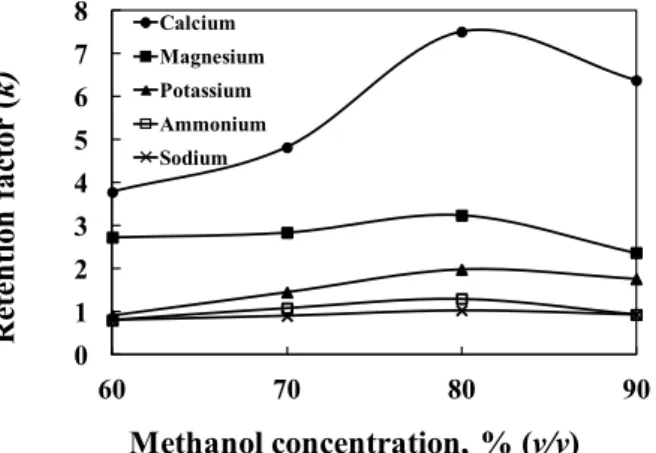
Some organic solvents, such as acetonitrile and methanol, can effectively improve resolution, peak shapes and retention time.17,18 So, the influence of acetonitrile and methanol on the retention of cations was investigated in the present work. Although acetonitrile was added to the eluent up to 90% (v/v), the selectivity for analyte cations was not improved. Contrarily, the addition of methanol was effective to improve the selectivity. Figure 2 shows the retention factors, k, of the cations as a function of methanol concentration in the eluent. The addition of methanol increased the retention time; when its concentration was increased to 80%, the five common inorganic cations could be separated from each other. But, when the concentration was increased to 90%, the retention time decreased, and Na+ could not be separated from NH4+. The ion-exchange selectivity varied with the concentration of methanol in the eluent.
In the present work, the dielectric effect seems to play the major roles. Methanol has a smaller dielectric constant than water, resulting in stronger attraction between analyte cations and sulfonate groups on the cation-exchanger resin.19,20 It is expected that the dielectric constant of the eluent decreases with increasing methanol concentration, which leads to the increase in the electrostatic interaction (Coulombic attraction) between the ion-exchange site and the analyte cation. It is also expected that hydration of ions is suppressed with increasing methanol concentration, which leads to the decrease in the radii of the hydrated analyte cation and the increase in the electrostatic interaction between the ion-exchange site and the analyte cation. It is therefore expected that the retention of the cation increases
Fig. 1 Expected reaction between Develosil Diol-5 and 1,3-propanesultone. 0 1 2 3 4 5 6 7 8 60 70 80 90
R
et
en
tio
n
fa
ct
or
(k
)
Methanol concentration, % (v/v)
Calcium Magnesium Potassium Ammonium SodiumFig. 2 Effect of methanol concentration on retention factor of inorganic cations on Diol-PS column. Column, Diol-PS packed column (100 mm × 0.32 mm i.d.); eluent, 1 mM MSA in different concentrations of methanol–water; flow rate, 4.2 μl/min; detection, contactless conductivity detector; analyte, 0.3 mM each of sodium, ammonium, potassium, magnesium and calcium; injection volume, 0.2 μl.
with increasing methanol concentration. Contrarily, with further increase in the methanol concentration, solvation of the analyte cation due to methanol is accelerated, resulting in the increase in the solvated radii of the analyte cation, which in turn leads to the decrease in the electrostatic interaction and the decrease in the retention time. Owing to the above competing effects, the maximum retention time was observed at around 80%. So, it was concluded that the reasonable concentration of methanol to be added into the eluent was 80%.
Figure 3 demonstrates the separation result of five common inorganic cations using 1 mM MSA in methanol–water (8:2, v/v) as the eluent. The elution order of cations: Na+ < NH
4+ < K+ < Mg2+ < Ca2+, was the same as that observed in common ion chromatography. From Fig. 3, it should be noted that the five common inorganic cations could be separated, but Na+ could not be separated from NH4+ completely, and the peaks of the cations were severely tailed.
Effect of crown ethers added to eluent on chromatographic behavior
It is well known that crown ethers form stable complexes with many cations. On the basis of their unique characteristics, the addition of crown ethers to acidic eluent was carried out to improve peak resolution of cations on columns packed with cation exchangers.21 Therefore, in order to improve the resolution of cations, we added 12-crown-4, 15-crown-5 and 18-crown-6 ethers to the eluent to completely separate these inorganic cations on the Diol-PS column.
Firstly, the effect of 12-crown-4 ether was investigated, and 0.05 – 0.2 mM 12-crown-4 was added to 1 mM of MSA in methanol–water (8:2, v/v). As for the divalent cations, the retention time decreased with increasing 12-crown-4 ether concentration, while there is no change of retention time for the monovalent cations.
When 0.05 – 0.2 mM 15-crown-5 was added to the 1 mM MSA in methanol–water (8:2, v/v), the retention time of both mono- and divalent cations decreased with increasing crown ether concentration. The retention time of Na+ clearly decreased compared with that of NH4+; as a result, the peak resolution between Na+ and NH
4+ was slightly improved.
In addition, 18-crown-6 ether was also added to the eluent in order to improve the peak resolution of cations. The retention
time of cations also decreased with increasing the crown ether concentration. But it was decreased more than when 15-crown-5 ether was added to the eluent, and the monovalent cations were overlapped.
Figure 4 shows the typical chromatograms of inorganic cations on the Diol-PS stationary phase when 0.1 mM of each crown ether were added to the 1 mM MSA in methanol–water (8:2, v/v) eluent. It is seen that, when 15-crown-5 ether was added to the eluent, the resolution between Na+ and NH4+ became better, while there was no change when 12-crown-4 was added to the eluent.
Since the resolution and the peak shape were slightly improved by the addition of 15-crown-5 ether to the eluent, 0.1 mM 15-crown-5 ether was added in the eluent. As shown in Fig. 4, when 1 mM MSA and 0.1 mM 15-crown-5 ether in methanol–water (8:2, v/v) were used as the eluent, good simultaneous separation of the five common inorganic cations was achieved in 17 min. In addition, the peaks that appeared before 3 min are due to a component contained in MSA or 15-crown-5 used as the eluent. When purified water is injected, such peaks also appeared at the same time.
In addition, the selectivity of the present stationary phase is not superior to that of cation exchangers commercially available, but the selectivity was improved by optimizing the eluent conditions. We have not examined Rb+ and Cs+, because the concentrations of these species in common environmental samples are too low. It would be possible to separate Rb+ and Cs+ from other alkali metal ions, but it might be difficult for us to separate Rb+ and Cs+ from Mg2+ and Ca2+ under the present conditions because of the poor column efficiency.
Validation
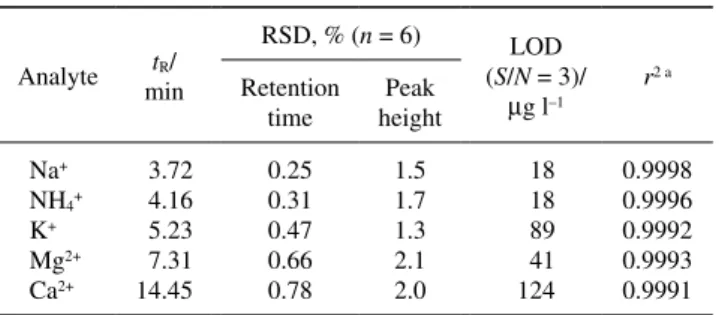
Under the optimized operating conditions, the repeatability of the retention time (tR) and the peak height were examined for six successive chromatographic runs. The results are given in Table 1. From the table, it can be seen that the relative standard deviations (RSDs, n = 6) of the retention time and of the peak height were all smaller than 2.1% for all of the analyte cations. These values show comparatively satisfactory repeatability for the present method.
Fig. 3 Separation of inorganic cations on Diol-PS column using 1 mM MSA in methanol–water (8:2, v/v) as the eluent. Operating conditions as in Fig. 2 except for the eluent.
Fig. 4 Typical chromatograms of inorganic cations on the Diol-PS column using 0.1 mM crown ethers and 1 mM MSA in methanol–water (8:2, v/v) eluent. Analyte, 0.3 mM each of (1) sodium, (2) ammonium, (3) potassium, (4) magnesium and (5) calcium. Other operating conditions as in Fig. 2.
The limits of detection (LOD) of these five common inorganic cations were determined by injecting 0.2-μl volume of the sample solution, 0.3 mM for each cation, and were calculated at a signal-to-noise ratio of 3. The results are shown in Table 1. LOD obtained by the method were 18 – 124 μg/l for the cations. Although the present system achieved worse peak shape than those achieved by Shen et al.,4 the present system achieved much better LOD for cations than the latter.
Calibration graphs were obtained by plotting peak height against the concentration of the five common inorganic cations, as shown in Table 1. All the calibration graphs of the cations showed good linear correlations. From the table, the correlation coefficients r2 > 0.999 proved the good linearity of the present method.
Application to cation analysis in real samples
The proposed method was applied for the determination of common inorganic cations in some real samples. The river sample was taken from near Gifu University, Gifu, Japan, and the commercial drink samples were bought from a supermarket. In the case of river and mineral water, the samples were filtered through a 0.45-μm membrane filter before being injected into
the system. For injection without acid digestion, the commercial drink samples were diluted 20 times by purified water and then filtered through a 0.45-μm membrane filter before being injected into the system, because the concentrations of the analyte cations were too high to be determined by the present operating conditions.
Figure 5 shows the typical chromatograms of river water and an authentic mixture of five common inorganic cations. It can be seen that good separation and detection for these inorganic cations were achieved. The concentrations of Na+, NH
4+, K+, Mg2+, and Ca2+ were determined to be 3.5, 2.9, 1.2, 2.1, and 11 mg/l, respectively, by using the standard addition method. The proposed ion chromatographic method was also successfully applied to the determination of cations contained in commercial drink samples, and the data for the real samples using standard addition method are summarized in Table 2. In addition, the recoveries were found to be 93 – 105% by measuring spiked samples.
Conclusion
A capillary ion chromatographic method using a laboratory-made packed cation-exchange stationary phase Diol-PS (100 mm × 0.32 mm i.d.) was developed. Five common inorganic cations (Na+, NH
4+, K+, Mg2+, and Ca2+) could be determined by contactless conductivity detector at a rather low detection limits without a suppressor. Using 1 mM methanesulfonic acid and 0.1 mM 15-crown-5 ether in methanol–water (8:2, v/v) as the eluent was suitable for the determination of the above inorganic anions. The present system was satisfactorily applied to the determination of common inorganic cations in real samples, such as river water and commercial drinks. The determination of cations in this real water sample could be carried out within 17 min.
The present stationary phase requires the addition of methanol and 15-crown-5 ether in the eluent, which is not preferred in IC, although capillary IC facilitates the use of such a complex eluent. It will be necessary to investigate the structure of the functional group so that much more simple eluents can be utilized in capillary IC.
Acknowledgements
This work was a project supported by the Scientific Research Fund of SiChuan Provincial Education Department (No. 09233023) and the Key Research Fund Program of Xihua University (No. 81023313).
Table 1 Summarized data for the retention times (tR), relative
standard deviations (RSDs), limits of detection (LODs), and calibration graphs (r2) of inorganic cations obtained under the
optimum operating condition as in Fig. 5
Analyte mintR/ RSD, % (n = 6) LOD (S/N = 3)/ μg l–1 r2 a Retention time Peak height Na+ NH4+ K+ Mg2+ Ca2+ 3.72 4.16 5.23 7.31 14.45 0.25 0.31 0.47 0.66 0.78 1.5 1.7 1.3 2.1 2.0 18 18 89 41 124 0.9998 0.9996 0.9992 0.9993 0.9991 a. Concentration range: 0.1 – 0.5 mM for all cations.
Table 2 Determination results (mg/l) for inorganic cations in river water and commercial drink samples (n = 6) using the proposed IC method Result Nagara river Mineral water Peach drinka Acerola drinka Na+ NH4+ K+ Mg2+ Ca2+ 3.5 2.9 1.2 2.1 11 9.0 3.2 1.2 1.4 8.8 6.9 3.1 2.2 1.2 5.6 12 3.2 2.5 1.4 7.6 a. Injected after 20-time dilution.
Fig. 5 Typical chromatograms of river water and an authentic mixture of five common inorganic cations. Upper trace, river water; lower trace, 0.3 mM each of cations; eluent, 1 mM MSA and 0.1 mM 15-crown-5 in methanol–water (8:2, v/v). Other operating conditions as in Fig. 4.
References
1. L. Wicker, J. L. Ackerley, and M. Corredig, J. Agric. Food
Chem., 2002, 50, 4091.
2. L. Wicker, J. L. Ackerley, and J. L. Hunter, Food
Hydrocolloids, 2003, 17, 809.
3. S. Rokushika, Z. Y. Qiu, Z. L. Sun, and H. Hatano, J.
Chromatogr., 1983, 280, 69.
4. D. Shen, D. Li, X. Yang, Y. Zhu, J. Dong, and Q. Kang,
Talanta, 2011, 84, 42.
5. T. Takeuchi, B. Oktavia, and L. W. Lim, Anal. Bioanal.
Chem., 2009, 393, 1267.
6. C. Ó Ríordáin, E. Gillespie, D. Connolly, P. N. Nesterenko, and B. Paull, J. Chromatogr., A, 2007, 1142, 185.
7. E. Gillespie, D. Connolly, M. Macka, P. N. Nesterenko, and B. Paull, Analyst, 2007, 132, 1238.
8. A. Suzuki, L. W. Lim, and T. Takeuchi, Anal. Sci., 2007,
23, 1081.
9. Y. Ueki, T. Umemura, J. Li, T. Odake, and K. Tsunoda,
Anal. Chem., 2004, 76, 7007.
10. P. Kuban and P. K. Dasgupta, J. Sep. Sci., 2004, 27, 1441.
11. T. Takeuchi, Chromatography, 2005, 26, 7.
12. T. Takeuchi, A. Sedyohutomo, and L. W. Lim, Anal. Sci.,
2009, 25, 851
13. M. Mori, K. Tanaka, T. Satori, M Ikedo, W. Hu, and H. Itabashi, J. Chromatogr., A, 2006, 1118, 51.
14. M. Amin, L. W. Lim, and T. Takeuchi, Anal. Bioanal.
Chem., 2006, 384, 839.
15. W. Zeng, Y. Chen, H. Cui, F. Wu, Y. Zhu, and J. S. Fritz, J.
Chromatogr., A, 2006, 1118, 68.
16. T. Takeuchi and D. Ishii, J. Chromatogr., 1981, 213, 25. 17. S. Nussbaumer, S. Fleury-Souverain, L. Bouchoud, S.
Rudazb, P. Bonnabry, and J. Veuthey, J. Pharm. Biomed.
Anal., 2010, 53, 130.
18. H.-B. Meng, T.-R. Wang, B.-Y. Guo, Y. Hashi, C.-X. Guo, and J.-M. Lin, Talanta, 2008, 76, 241.
19. P. J. Dumont and J. S. Fritz, J. Chromatogr., A, 1995, 706, 149.
20. W. R. Heumann, Crit. Rev. Anal. Chem., 1971, 2, 425. 21. K. Ohta, H. Morikawa, K. Tanaka, Y. Uwamino, M.
Furukawa, and M. Sando, J. Chromatogr., A, 2001, 920, 109.