21
Changes in Children’s QOL after Pectus Excavatum Repair
Mihoko NAKANII
*1, Kiyoka INOUE
*1, Tomoko NAMBA
*2,
Kazuma KAWASAKI
*3and Sadashige UEMURA
*4(Accepted November 27, 2017)
Key words: pectus excavatum, Nuss procedure, QOL, body image, children
Abstract
The objective of this study is to clarify changes in child QOL after pectus excavatum repair. An anonymous, self-administered questionnaire was given to 54 (33 males and 21 females) patients aged 7-17, who had undergone the Nuss procedure for pectus excavatum at the Department of Pediatric Surgery Hospital-A between August 2012 and March 2014, in order to examine their pre- and postoperative QOL using a Japanese version of the PEEQ. Their responses were collected by mail. Changes in their QOL were analyzed using the Wilcoxon signed-rank test (P<0.05). We obtained the following results: The answers to 7 out of the 9 body image-related questions changed positively after surgery, and there were no negative changes in this subscale. As for physical difficulties, the answers to 2 out of the 5 related questions changed negatively after surgery, and positive changes were not observed in this subscale. In addition, 98.2% answered that they were happy that they had the surgery. The children who had undergone the Nuss procedure for pectus excavatum were highly satisfied after surgery, demonstrated by their improved QOL as a result of positive changes in their body image, even if they perceived some physical difficulty. Thus, parents and medical professionals should acknowledge the importance of children’s body image.
Original Paper
*1 Department of Nursing, Faculty of Health and Welfare, Kawasaki University of Medical Welfare, Kurashiki, 701-0193, Japan
E-Mail: [email protected]
*2 Department of Health and Sports Science, Faculty of Health Science and Technology, Kawasaki University of Medical Welfare
*3 Department of Health Informatics, Faculty of Health and Welfare Services Administration,
Kawasaki University of Medical Welfare
*4 Kawasaki Medical School
1. Introduction
The Nuss procedure is a minimally invasive surgical technique for pectus excavatum (PE) developed by Nuss et al. in 19981) that has been widely employed in Japan2,3). Unlike conventional methods, this procedure does not involve the removal of the depressed sternum or ribs, which causes precordial wounds; therefore, it has been reported to improve thoracoplasty and increase patients’ satisfaction with their body image. On the other hand, surgery-related difficulties, such as pain caused by bar insertion and inconvenience due to activity limitation, have been noted4).
Kelly et al.5) surveyed patients from 11 pediatric hospitals in the United States using the PE Evaluation Questionnaire (PEEQ), a psychosocial evaluation scale, for which reliability and validity verification studies were conducted by Lawson et al.6). They reported in 2008 that there were proactive changes in both physical and psychosocial function after surgery5). Studies on the QOL using several scales have also been
conducted in other countries, including Canada7), Denmark8), and South Korea9). In contrast, there has been no study to evaluate the QOL using objective scales in Japan10).
The present study examined the pre- and postoperative QOL of children undergoing the Nuss procedure for PE.
2. Methods
2.1 Subjects
Excluding those with congenital anomalies and those with a history of previous PE, 85 patients aged 7-17 who had undergone the Nuss procedure for PE at the Department of Pediatric Surgery of Hospital-A between August 2012 and March 2014 were recruited; the largest annual number of pediatric patients are treated with this procedure in Japan at this hospital.
2.2 Study procedures 2.2.1 Subjects’ attributes
The patients’ sex, age, and decision-making process were examined.
2.2.2 Pre- and postoperative QOL questionnaires
The patient’s QOL was evaluated using the PEEQ, which was developed by a group of clinicians specializing in PE who had also devised the Nuss procedure and by the psychologist Lawson to measure the QOL before and after the procedure for the disorder5,6). After obtaining the developers’ permission to modify the questionnaire, Japanese versions of the [Preoperative Child Pectus Excavatum Evaluation Questionnaire] (preoperative QOL questionnaire) and [Postoperative Child Pectus Excavatum Evaluation Questionnaire] (postoperative QOL questionnaire) were created. Furthermore, these versions were back-translated into English to be confirmed and validated before use.
The preoperative QOL questionnaire consisted of 15 questions with 3 subscales: body image (Q1-Q9), physical difficulties (Q10-Q14), and expectations of the surgery (Q15: How much do you want to have your chest look different after surgery?). Answers were given with 4-point scales (Q1-Q3: Very happy, Mostly happy, Mostly unhappy, Very unhappy; Q4-Q14: Very often, Often, Sometimes, Never; and Q15: Very much, Somewhat, A little, Not at all).
The postoperative QOL questionnaire consisted of 17 questions with 3 subscales: body image (Q1-Q9), physical difficulties (Q10-Q14), and satisfaction with the surgery (Q15-17). They were answered with 4- (Q1-Q14: the same as above; and Q17: Very happy, Mostly happy, Mostly unhappy, Very unhappy) or 5- (Q15 and Q16: Much better, A little better, The same as before, A little worse, Much worse) point scales.
2.3 Data collection methods
The children were introduced by their doctors in charge, and provided with explanations of the study outline, objective, and ethical considerations on the surgical day before being presented with the anonymous, self-administered questionnaires. To pair their pre- and postoperative responses, each response form was numbered. They were asked to answer each question of the pre- and postoperative QOL questionnaires while remembering their condition over the 6 months before surgery and over the last year after surgery, respectively. As responses to the latter were to be collected one year later, agreement over the phone was also confirmed before asking them to sign the consent form. Following an explanation to the subjects (children) and their parents, oral consent was obtained from the children and oral and written consent from their parents.
All responses were collected by mail. When it was difficult for them to fill in or return the questionnaires independently, cooperation from their parents was sought.
2.4 Analysis
in answers to 14 questions were examined overall, and compared based on the sex (male/female), age (7-11/12-17), and decision-making process (own decision/following parents’ or doctors’ advice), using the Wilcoxon signed-rank test (P<0.05).
The students were classified into two age groups: "7-11- and 12-17-year-old groups", from the viewpoints of growth and development stages.
2.5 Ethical considerations
The study was approved by the ethics committee of the study hospital (No. 1253-1). 3. Results
3.1 Subjects’ attributes
Among the 85 recruited patients, the 54 who responded to both the pre- and postoperative QOL questionnaires were examined (response rate: 63.5%). Nine (10.6%) with complications (dislocation of the bar, infection, or pneumothorax) and 22 (25.9%) who did not return their responses were excluded.
Patient attributes are outlined in Table 1.
Table 1 Cross tabulation of the attributes N=54
Background n %
Sex Male 33 61.1
Female 21 38.9 Male (n) % Female (n) %
Age 7-11 years old 34 63.0 18 54.5 16 76.2 12-17 years old 20 37.0 15 45.5 5 23.8 7-11 years old(n) % 12-17 years old(n) % Decision making process Own -decision 44 81.5 29 87.9 15 71.4 24 70.6 20 100.0 Following parents’ or doctors’ advice 10 18.5 4 12.1 6 28.6 10 29.4 0 0.0
There were 33 (61.1%) males and 21 (38.9%) females. Their age during the preoperative QOL questionnaire survey ranged from 7 to 17 (mean: 11.1 ± 3.1): 34 (63.0%) aged 7-11, and 20 (37.0%) aged 12-17. The patients were also divided into 2 groups based on the decision-making process: those who decided to undergo surgery based on their own decision (own-decision group): 44 (81.5%); or those following their parents’ or doctors’ advice (following-advice group): 10 (18.5%). The results of cross tabulation for each group were as follows: Among males (n=33), 18 (54.5%) and 15 (45.5%) were aged 7-11 and 12-17, respectively. There were 29 (87.9%) own-decision and 4 (12.1%) following-advice group members, indicating that male children tended to decide to undergo surgery based on their own decision. Among females (n=21), 16 (76.2%) and 5 (23.8%) were aged 7-11 and 12-17, respectively; thus, the former was the majority. There were 15 (71.4%) own-decision and 6 (28.6%) following-advice group members. On overall cross tabulation based on the age and decision-making process, 24 (70.6%) and 10 (29.4%) belonged to the own-decision and following-advice groups, respectively, among those aged 7-11 (n=34), whereas those aged 12-17 (n=20) belonged to the former only.
3.2 Pre- and postoperative QOL questionnaire responses
Table 2 summarizes the patients’ responses to the pre- and postoperative QOL questionnaires.
To the 9 and 1 questions related with body image (Q1-Q9) and satisfaction with the surgery (Q15), respectively, responses were as follows: <Q1: How do you feel when you look at your chest?>: 31 (57.4%)
Question items postoperative
N n % n % n % n % n %
Much
better A littlebetter The same as before A littleworse worseMuch Q15. How did the surgery change your
chest ? 54 37 68.5 15 27.8 2 3.7 0 0.0 0 0.0
Q16. How do you feel about your chest
now? 54 32 59.3 11 20.3 7 13.0 4 7.4 0 0.0
Very
happy Mostly happy unhappyMostly unhappyVery Q17. How happy are you that you had the
surgery? 54 42 77.8 11 20.4 1 1.9 0 0.0
Table 2 Answers to the QOL questionnaire distribution pre- and postoperative
Question items pre-and postoperative N n % n % n % n %
Very happy Mostly happy Mostly unhappy Very unhappy Q1. How do you feel when you look at
your chest ?
Pre 54 4 7.4 19 35.2 24 44.4 7 13.0
Post 54 23 42.6 23 42.6 6 11.1 2 3.7
Q2. How do you feel when you take your top clothes off ?
Pre 53 5 9.4 13 24.5 24 45.3 11 20.8
Post 53 20 37.7 26 49.1 5 9.4 2 3.8
Q3. How do you feel when you continue to live without surgery ?
Pre 54 3 5.6 10 18.5 26 48.1 15 27.8
Post 54 4 7.4 8 14.8 29 53.7 13 24.1
N Never Sometimes Often Very often Q4. Have your friends ever made fun of
you about your chest?
Pre 54 30 55.6 19 35.2 3 5.6 2 3.7
Post 54 47 87.0 7 13.0 0 0.0 0 0.0
Q5. Have you ever stopped visiting your friend’s house because of your chest ?
Pre 53 48 90.6 5 9.4 0 0.0 0 0.0
Post 53 50 94.3 3 5.7 0 0.0 0 0.0
Q6. Have you ever tried to hide your chest ?
Pre 54 29 53.7 11 20.4 12 22.2 2 3.7
Post 54 38 70.4 14 25.9 0 0.0 2 3.7
Q7. How often are you bothered because of your chest ?
Pre 54 23 42.6 22 40.8 8 14.8 1 1.9
Post 54 31 57.4 18 33.3 5 9.3 0 0.0
Q8. Have you ever been bothered because your chest is different from others ?
Pre 54 22 40.8 15 27.8 14 25.9 3 5.6
Post 53 31 58.5 18 33.9 3 5.7 1 1.9
Q9. How often did you feel bad about your chest ?
Pre 54 19 35.2 23 42.6 8 14.8 4 7.4
Post 54 33 61.1 16 29.6 3 5.6 2 3.7
Q10. How often did you have trouble exercising because it made your chest hurt ?
Pre 54 34 63.0 16 29.6 3 5.6 1 1.9
Post 54 24 44.4 22 40.8 8 14.8 0 0.0
Q11. How often have you had shortness of breath ?
Pre 54 23 42.6 18 33.3 10 18.5 3 5.6
Post 53 24 45.3 22 41.5 7 13.2 0 0.0
Q12. How often have you been tired because of your chest ?
Pre 54 27 50.0 19 35.2 6 11.1 2 3.7
Post 54 28 51.9 20 37.0 6 11.1 0 0.0
Q13. How often have you not been able to participate in PE classes ?
Pre 54 47 87.0 4 7.4 1 1.9 2 3.7
Post 54 24 44.4 21 38.9 8 14.8 1 1.9
Q14. How often have you missed school because of your chest ?
Pre 54 52 96.2 1 1.9 1 1.9 0 0.0
Post 54 51 94.4 3 5.6 0 0.0 0 0.0
Question item preoperative N Very much Somewhat A little Not at all Q15. How much do you want to have your
responded with <Mostly unhappy/Very unhappy> before surgery, but the number of those who chose these answers decreased to 8 (14.8%) afterwards, with an increase in the number of those answering <Very happy/Mostly happy> from 23 (42.6%) to 46 (85.2%); <Q2: How do you feel when you take your top off?>: 35 (66.1%) responded with <Mostly unhappy/Very unhappy> before surgery, but the number of those who chose these answers decreased to 7 (13.2%) afterwards, with an increase in the number of those answering <Very happy/Mostly happy> from 18 (33.9%) to 46 (86.8%); <Q4: Have your friends ever made fun of you for your chest?>: 24 (44.4%) responded with < Very Often /Often/Sometimes> before surgery, but the number of those who chose these answers decreased to 7 (13.0%) afterwards, with an increase in the number of those answering <Never> from 30 (55.6%) to 47 (87.0%); and <Q9: How often did you feel bad about your chest?>: 35 (64.8%) responded with < Very often/Often/Sometimes> before surgery, but the number of those who chose these answers decreased to 21 (38.9%) afterwards, with an increase in the number of those answering <Never> from 19 (35.2%) to 33 (61.1%). In contrast, to <Q15: How did the surgery change your chest?>, one of the satisfaction-related questions on the postoperative QOL questionnaire, 37 (68.5%) responded with <Much better>, 15 (27.8%) with <A little better>, and 2 (3.7%) with <The same as before>. None chose <A little worse/A lot worse> for this question.
To the 5 questions regarding physical difficulties (Q10-Q14), the responses were as follows: <Q10: How often did you have trouble exercising because it made your chest hurt?>: 20 (37.0%) responded with < Very often/Often/Sometimes> before surgery, but the number of those who chose these answers increased to 30 (55.6%) afterwards, with a decrease in the number of those answering <Never> from 34 (63.0%) to 24 (44.4%); and <Q13: How often have you not been able to participate in PE class?>: 7 (13.0%) responded with < Very often/Often/Sometimes> before surgery, but the number of those who chose these answers increased to 30 (55.6%) afterwards, with a decrease in the number of those answering <Never> from 47 (87.0%) to 24 (44.4%). To <Q16: How do you feel about your chest now?>, one of the physical difficulty-related questions on the postoperative QOL questionnaire, 32 (59.3%) responded with <Much better>, 11 (20.3%) with <A little better>, 7 (13.0%) with <The same as before>, and 4 (7.4%) with <A little worse>.
On examining the patient’s expectations of the surgery, 15 (27.8%) responded to the related question on the preoperative QOL questionnaire <Q15: How much do you want to have your chest look different after surgery?> with <Very much>, while 32 (59.2%) and 7 (13.0%) answered it with <Somewhat/A little> and <Not at all>, respectively. To <Q17: How happy are you that you had the surgery?>, one of the questions to examine their levels of satisfaction with the surgery, 42 (77.8%) responded with <Happy>, 11 (20.4%) with <Mostly happy>, and 1 (1.9%) with <Mostly unhappy>; thus, 98.2% of all patients were satisfied with the surgery.
3.3 Changes in the QOL after surgery
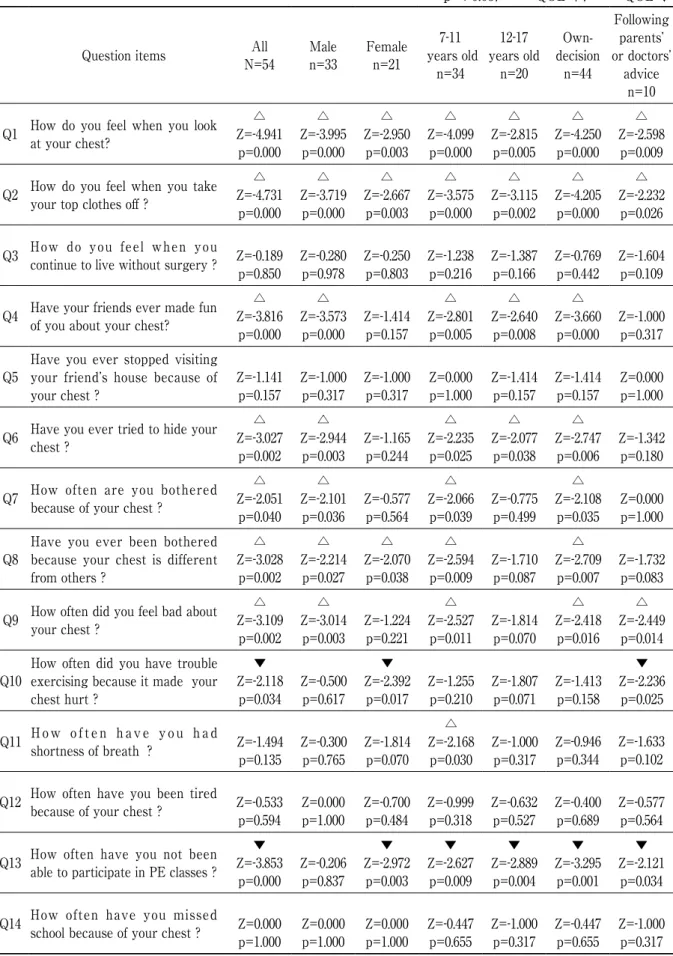
Table 3 shows the results of analysis of the pre- and postoperative QOL.
Overall (n=54), the answers to 7 (Q1, Q2, Q4, and Q6-Q9) out of the 9 body image-related questions (Q1-Q9) changed positively after surgery. There were no negative changes in this subscale. In contrast, their answers to 2 (Q10 and Q13) out of the 5 physical difficulty-related questions (Q10-Q14) changed negatively after surgery, and no positive changes were observed in this subscale.
Among males (n=33), their answers to 7 (Q1, Q2, Q4, and Q6-Q9) out of the 9 body image-related questions (Q1-Q9) changed positively after surgery. There were no negative changes in this subscale. There were no significant differences in their answers to the 5 physical difficulty-related questions (Q10-Q14).
Among females (n=21), their answers to 3 (Q1, Q2, and Q8) out of the 9 body image-related questions (Q1-Q9) changed positively after surgery. There were no negative changes in this subscale. In contrast, their answers to 2 (Q10 and Q13) out of the 5 physical difficulty-related questions (Q10-Q14) changed negatively after surgery, and no positive changes were observed in this subscale.
Among those aged 7-11 (n=34), their answers to 7 (Q1, Q2, Q4, and Q6-Q9) out of the 9 body image-related questions (Q1-Q9) changed positively after surgery. There were no negative changes in this subscale. As for
Table 3 The results (Wilcoxon signed-rank test) of the pre-and postoperative QOL analysis
p< 0.05,△:QOL ↑,▼:QOL ↓
Question items N=54All Malen=33 Femalen=21 years old7-11 n=34 12-17 years old n=20 Own-decision n=44 Following parents’ or doctors’ advice n=10
Q1 How do you feel when you look at your chest? △ Z=-4.941 p=0.000 △ Z=-3.995 p=0.000 △ Z=-2.950 p=0.003 △ Z=-4.099 p=0.000 △ Z=-2.815 p=0.005 △ Z=-4.250 p=0.000 △ Z=-2.598 p=0.009
Q2 How do you feel when you take your top clothes off ?
△ Z=-4.731 p=0.000 △ Z=-3.719 p=0.000 △ Z=-2.667 p=0.003 △ Z=-3.575 p=0.000 △ Z=-3.115 p=0.002 △ Z=-4.205 p=0.000 △ Z=-2.232 p=0.026
Q3 How do you feel when you continue to live without surgery ? Z=-0.189
p=0.850 Z=-0.280p=0.978 Z=-0.250p=0.803 Z=-1.238p=0.216 Z=-1.387p=0.166 Z=-0.769p=0.442 Z=-1.604p=0.109
Q4 Have your friends ever made fun of you about your chest? Z=-3.816△ p=0.000 △ Z=-3.573 p=0.000 Z=-1.414p=0.157 △ Z=-2.801 p=0.005 △ Z=-2.640 p=0.008 △ Z=-3.660 p=0.000 Z=-1.000p=0.317
Q5 Have you ever stopped visiting your friend’s house because of
your chest ? Z=-1.141p=0.157 Z=-1.000p=0.317 Z=-1.000p=0.317 Z=0.000p=1.000 Z=-1.414p=0.157 Z=-1.414p=0.157 Z=0.000p=1.000
Q6 Have you ever tried to hide your chest ? Z=-3.027△ p=0.002 △ Z=-2.944 p=0.003 Z=-1.165p=0.244 △ Z=-2.235 p=0.025 △ Z=-2.077 p=0.038 △ Z=-2.747 p=0.006 Z=-1.342p=0.180
Q7 How often are you bothered because of your chest ? Z=-2.051△ p=0.040 △ Z=-2.101 p=0.036 Z=-0.577p=0.564 △ Z=-2.066 p=0.039 Z=-0.775p=0.499 △ Z=-2.108 p=0.035 Z=0.000p=1.000
Q8 Have you ever been bothered because your chest is different from others ? △ Z=-3.028 p=0.002 △ Z=-2.214 p=0.027 △ Z=-2.070 p=0.038 △ Z=-2.594 p=0.009 Z=-1.710p=0.087 △ Z=-2.709 p=0.007 Z=-1.732p=0.083
Q9 How often did you feel bad about your chest ? △ Z=-3.109 p=0.002 △ Z=-3.014 p=0.003 Z=-1.224p=0.221 △ Z=-2.527 p=0.011 Z=-1.814p=0.070 △ Z=-2.418 p=0.016 △ Z=-2.449 p=0.014
Q10 How often did you have trouble exercising because it made your chest hurt ? ▼ Z=-2.118 p=0.034 Z=-0.500p=0.617 ▼ Z=-2.392 p=0.017 Z=-1.255p=0.210 Z=-1.807p=0.071 Z=-1.413p=0.158 ▼ Z=-2.236 p=0.025 Q11 H o w o f t e n h a v e y o u h a d shortness of breath ? Z=-1.494 p=0.135 Z=-0.300p=0.765 Z=-1.814p=0.070 △ Z=-2.168 p=0.030 Z=-1.000p=0.317 Z=-0.946p=0.344 Z=-1.633p=0.102
Q12 How often have you been tired because of your chest ? Z=-0.533
p=0.594 Z=0.000p=1.000 Z=-0.700p=0.484 Z=-0.999p=0.318 Z=-0.632p=0.527 Z=-0.400p=0.689 Z=-0.577p=0.564
Q13 How often have you not been able to participate in PE classes ? Z=-3.853▼
p=0.000 Z=-0.206p=0.837 ▼ Z=-2.972 p=0.003 ▼ Z=-2.627 p=0.009 ▼ Z=-2.889 p=0.004 ▼ Z=-3.295 p=0.001 ▼ Z=-2.121 p=0.034
Q14 How often have you missed school because of your chest ? Z=0.000
the 5 physical difficulty-related questions (Q10-Q14), their answers to Q11 and Q 13 changed positively and negatively, respectively, after surgery.
Among those aged 12-17 (n=20), their answers to 4 (Q1, Q2, Q4, and Q6) out of the 9 body image-related questions (Q1-Q9) changed positively after surgery. There were no negative changes in this subscale. As for the 5 physical difficulty-related questions (Q10-Q14), their answers to Q13 changed negatively after surgery, and no positive changes were observed in this subscale.
Among the own-decision group members (n=44), their answers to 7 (Q1, Q2, Q4, and Q6-Q9) out of the 9 body image-related questions (Q1-Q9) changed positively after surgery. There were no negative changes in this subscale. As for the 5 physical difficulty-related questions (Q10-Q14), their answers to Q13 changed negatively after surgery, and no positive changes were observed in this subscale.
Among the following-advice group members (n=10), their answers to 3 (Q1, Q2, and Q9) out of the 9 body image-related questions (Q1-Q9) changed positively after surgery. There were no negative changes in this subscale. As for the 5 physical difficulty-related questions (Q10-Q14), their answers to Q10 and Q13 changed negatively after surgery, and no positive changes were observed in this subscale.
On comparison among the questions, changes in answers to Q1 and Q2 as body image-related questions after surgery were significantly positive in all groups. In contrast, changes in answers to Q13 as a physical difficulty-related question after surgery were markedly negative in all groups, except for males.
4. Discussion
The body image-related problems faced by patients with PE had previously been regarded as ‘aesthetic issues’, with pediatricians tending to underestimate them6). The ideas that the sunken chest becomes less marked with increases in muscle mass and fat volume when children grow up and that the chest can be covered with clothes were dominant in Japan. However, as reported in the present study, approximately 70% of children with the disorder had a negative view of their sunken chest, 60% had developed a sense of hatred against their appearance, and nearly half had experienced being made fun of by their friends. These findings indicate that such problems influence patients’ self-recognition during adolescence, possibly leading to the development of psychosocial disorders. Therefore, it is necessary for parents and medical professionals to recognize the importance of body image when visiting specialists or making treatment-related judgments. However, it takes time for some patients to consult specialists for treatment, and it may be necessary to improve websites operated by specialist groups, so that more information is provided. The significance of the early detection of PE and its treatment and specific measures to maintain the postoperative QOL of students in their school lives should also be published for nursing teachers and other people involved in school health, as well as children and their parents.
In the present study, the patients’ answers to the body image-related questions positively changed after surgery in several groups (based on the sex, age, and decision-making process), reflecting their improved QOL. On the other hand, their answers to some of the physical difficulty-related questions negatively changed; this may have been associated with the necessity of being absent from physical education classes due to their chest condition. In the Nuss procedure, a support bar is inserted and it remains placed in the chest even at 1 year after surgery. Although activity restrictions are removed by that time, contact sports, such as floor mat exercises and judo, may still be contraindicated. It should also be noted that martial arts became compulsory for junior high school students in Japan in 201211), possibly forcing children aged 12-14 with PE in junior high school to be frequently absent from physical education classes due to their chest condition. Such absences may negatively affect their learning in this area and QOL. In 2011, we reported that pain persists for 6 to 12 months after chest surgery12), revealing that pain-related problems still reduce the QOL of patients requiring such treatment despite marked advances in analgesics. As another problem, some patients also exhibit new pain caused by an inappropriate bending angle of the bar throughout their growth because the duration of support bar placement has been extended to 2-3 years or longer13). These points should be explained when providing discharge guidance for these patients14).
Although there were no positive changes in the subscale of physical difficulties, 98.2% of all patients were satisfied with the surgery. This rate is higher than the 97% achieved in the study conducted by Kelly et al.5), involving patients at pediatric hospitals. The results suggest that even if pediatric patients perceive physical difficulties, positive changes in their body image markedly contribute to their QOL. As PE is well-known to negatively influence patients’ physical/motor functions, the degree of PE is measured using CT as an index for surgical judgment3,5,15). In such situations, it may be important for medical professionals who deal with individual children undergoing the Nuss procedure to fully understand how their body image influences QOL and consider their school curricula when determining the period of surgery. On comparison among groups, positive changes were observed less frequently among females, those aged 12-17, and those who decided to undergo surgery following their parents’ or doctors’ advice. Factors associated with this in the first and second groups should be clarified in future studies. As for the third group, such decisions should be made by the patients themselves, even in pediatrics.
It is necessary for health care professionals to develop preparation tools using pictures and images to help 7 to 11-year-old children understand surgery and appropriate ways to spend time during the postoperative period.
5. Conclusion
The children who had undergone the Nuss procedure for PE were highly satisfied after surgery, demonstrated by their improved QOL as a result of positive changes in their body image, even if they perceived some physical difficulty. Thus, parents and medical professionals should acknowledge the importance of children’s body image.
Acknowledgments
This study was supported by a Grant-in-Aid for Scientific Research (C) (Grant Number: 24593421), FY 2012-2016, and presented at the 18th CWIG Annual Meeting in Florence, Italy.
References
1. Nuss D, Kelly RE Jr, Croitoru DP and Katz ME : A 10-year review of a minimally invasive technique for the correction of pectus excavatum. Journal of Pediatric Surgery, 33(4), 545-552, 1998.
2. Uemura S,Yoshida A and Choda Y : Our experience with Nuss Procedure for pectus excavatum. The
Japanese Society of Pediatric Surgeons, 37(2), 264-269, 2001. (In Japanese, translated by the author of this
article)
3. Uemura S : Surgery adaptation and treatment for pectus excavatum. Japanese Journal of Pediatrics, 69(11), 28-34, 2016. (In Japanese, translated by the author of this article)
4. Nakanii M, Haji E and Takao K : An analysis of children’s anxietes after Nuss procedure on pectus excavatum and support for them. Kimura Nursing Education Promotion Foundation Nursing Research
Collecting, 17, 43-54, 2010. (In Japanese, translated by the author of this article)
5. Kelly RE Jr, Cash TF, Shamberger RC, Mitchell KK, Mellins RB, Lawson ML, Oldham K, Azizkhan RG, Hebra AV, Nuss D, Goretsky MJ, Sharp RJ, Holcomb GW 3rd, Shim WK, Megison SM, Moss RL, Fecteau AH, Colombani PM, Bagley T, Quinn A and Moskowitz AB : Surgical repair of pectus excavatum markedly improves body image and perceived ability for physical activity : Multicenter study. American
Academy of Pediatrics, 122(6), 1218-1222, 2008.
6. Lawson ML, Cash TF, Akers R, Vasser E, Burke B, Tabangin M, Welch C, Croitoru DP, Goretsky MJ, Nuss D and Kelly RE Jr : A pilot study of the impact of surgical repair on disease-specific quality of life among patients with pectus excavatun. Journal of Pediatric Surgery, 38(6), 916-918, 2003.
7. Roberts J,Hayashi A, Anderson JO, Martin JM and Maxwell LL : Quality of life of patients who have undergone the Nuss procedure for pectus excavatum: Preliminary findings. Journal of Pediatric Surgery,
8. Jacobsen EB, Thastum M, Jeppesen JH and Pilegaard HK : Health-related quality of life in children and adolescents undergoing surgery for pectus excavatum. European Journal of Pediatric Surgery, 20(2), 85-91, 2010.
9. Kim HK, Shim JH, Choi KS and Choi YH : The quality of life after bar removal in patients after the nuss procedure for pectus excavatum. World Journal of Surgery. 35(7), 1656-1661, 2011.
10. Kashihara R, Nakanii M, Namba T, Kiriyama H, Goshima H, Satou N and Imasaki Y : Literature examination about the quality of life of children who underwent pectus excavatum surgery (the Nuss procedure). Kawasaki Medical Welfare Journal, 23(1), 177-183, 2013. (In Japanese)
11. Ministry of Education, Culture, Sports, Science and Technology : Martial arts/dance compulsion. http://www.mext.go.jp/a_menu/sports/jyujitsu/1330882.htm, 2013. (September 11, 2017)
12. Nakanii M, Namba T and Uemura S : Pain caused by the pectus bar implant after the Nuss procedure for pectus excavatum among junior high and high school children. Kawasaki Journal of Medical Welfare,
l7(1), 15-21, 2011.
13. Nuss D : Minimally invasive surgical repair of pectus excavatum. Seminars in Pediatric Surgery, 17(3), 209-217, 2008.
14. Nakanii M, Inoue K, Namba T, Takao K, Omuro M, Ishimoto T, Yoshida A and Uemura S : Development of discharge instructions for patients who have undergone the Nuss procedure for pectus excavatum.
Kawasaki Medical Welfare Journal, 24(2), 117-128, 2015. (In Japanese with English abstract)
15. Nakagawa Y, Uemura S,Nakaoka T, Yano T and Tanaka N : Evaluation of the Nuss procedure using pre- and postoperative computed tomographic index. Journal of Pediatric Surgery, 43(3), 518-521, 2008. 16. Matuda M and Nakanii M : Literature review of preparations conducted by operating room nurses.