Teaching Materials in Elementary School English
Language Education
Ayami K
ATO1. Introduction
New elementary school curriculum guidelines will be rolled out full-scale from the 2020 school year. These guidelines make 35 units of “Foreign Language Activities” a year compulsory as a field for 3rd and 4th year students in the middle years of elementary
school. These guidelines also 70 units of “Foreign Languages” a year compulsory as a subject for the 5th and 6th years in the upper years of elementary school. The history
of “English” becoming compulsory at elementary school dates back to the inclusion of foreign language conversation and others topies being introduced in 2002 as a part of education for “the Period for Integrated Studies” (Tanabe, 2018). Following this, in 2011, as “Foreign Language Activities” became a compulsory subject, all public elementary school implemented unified handling of “Foreign Language Activities” in “the Period for Integrated Studies” which each individual school had been in charge of up to that point. Due to the fact that “Foreign Language Activities” became compulsory, education has been consistent in line with elementary school curriculum guidelines but as the positioning of “Foreign Language Activities” was as a field rather than a subject, there were no authorized textbooks. Although there were no authorized textbooks, when newly establishing “Foreign Language Activities”, the Ministry of Education, Culture, Sports, Science and Technology (MEXT) issued common teaching materials that follow elementary school curriculum guidelines. There have been three common English teaching materials for elementary school issued by MEXT up until now: Eigo Note (English Notebook), Hi, friends! and We Can!. As each of these was created following the elementary school curriculum guidelines at the time, it can be said that they actually play the role of textbooks for both teachers and students. In addition, it seems that MEXT anticipates the creation of compulsory “Foreign Languages” subject authorized textbooks from 2020 utilizing the common teaching materials that have been used up until now.
Consequently, this paper focuses on the common teaching materials that have been used in elementary school English language education and summarizes their composition and contents. By investigating the teaching materials that have been used up until now, we expect that it will be possible to discover how to specifically handle contents in English education in elementary schools when it become a compulsory subject.
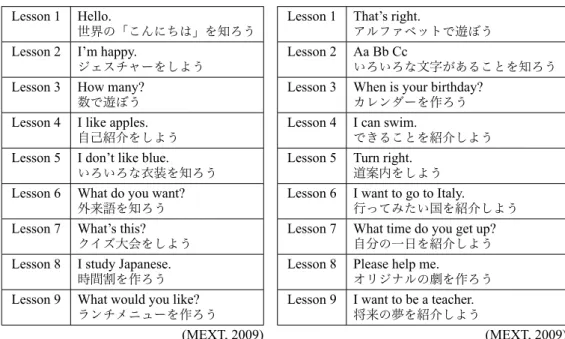
Table 1: Contents of Eigo Note 1 Table 2: Contents of Eigo Note 2 Lesson 1 Hello.
世界の「こんにちは」を知ろう
Lesson 1 That’s right.
アルファベットで遊ぼう Lesson 2 I’m happy.
ジェスチャーをしよう
Lesson 2 Aa Bb Cc
いろいろな文字があることを知ろう Lesson 3 How many?
数で遊ぼう
Lesson 3 When is your birthday? カレンダーを作ろう Lesson 4 I like apples.
自己紹介をしよう
Lesson 4 I can swim.
できることを紹介しよう Lesson 5 I don’t like blue.
いろいろな衣装を知ろう
Lesson 5 Turn right. 道案内をしよう Lesson 6 What do you want?
外来語を知ろう
Lesson 6 I want to go to Italy.
行ってみたい国を紹介しよう Lesson 7 What’s this?
クイズ大会をしよう
Lesson 7 What time do you get up? 自分の一日を紹介しよう Lesson 8 I study Japanese.
時間割を作ろう
Lesson 8 Please help me.
オリジナルの劇を作ろう Lesson 9 What would you like?
ランチメニューを作ろう
Lesson 9 I want to be a teacher. 将来の夢を紹介しよう
(MEXT, 2009) (MEXT, 2009)
2. Eigo Note (English Notebook)
When the elementary school curriculum guidelines were published in 2008, “Foreign Language Activities” were made compulsory for years 5 and 6. However, as they were made compulsory as a field, there were no authorized textbooks. For this reason, Eigo Note
(English Notebook) was published by MEXT in 2009 as a teaching material for the transition
period before full-scale roll out of “Foreign Language Activities” in 2011.
Two editions of Eigo Note (English Notebook) were issued: Eigo Note (English
Notebook) 1 for year 5 and Eigo Note (English Notebook) 2 for year 6. In addition to Eigo Note (English Notebook) 1 and 2, which are teaching materials, Eigo Note (English Notebook) teachers’ reference materials, companion CDs and digital teaching materials
were distributed to each elementary school (Takizawa, 2011). Eigo Note (English Notebook) contents were created based on the aims of “Foreign Language Activities” in the 2008 elementary school curriculum guidelines: to form the foundation of pupils’ communication abilities through foreign languages while experiences, fostering a positive attitude toward communication, and familiarizing pupils with the sounds and basic expressions of foreign languages (MEXT, 2008). Eigo Note (English Notebook) 1 and 2 are both composed of 80 pages and 9 lessons (each lesson is 4 hours; lesson 1 is only 3 hours) with cards that can be used for children’s activities at the back of the book (Sugiyama, 2010).
Tables 1 and 2 show a list of lesson titles from each edition of Eigo Note (English
Notebook). Eigo Note (English Notebook) teachers’ reference materials are composed
mainly of yearly “Foreign Language Activities” teaching plans, lesson pages (explanation of aim and contents of each unit, etc.), the explanation of texts (aim, flow and script for each
class hour), examples of class teaching plans (presentation of examples of class teaching plans for each class hour). They also contain the vocabulary and the grammar as well as explanations of cultural background (vocabulary, grammar and explanations about culture).
Eigo Note (English Notebook) contains children’s activities that compose classes in the
following manner. It should be noted that every 3 lessons, pages called “Let’s Enjoy,” with which students can have fun with English, are also included (Kikuchi, 2014).
According to Sugiyama (2018), the vocabulary that is used in Eigo Note (English
Notebook) includes familiar things in the life of an elementary school student such as
numbers, positions and professions, food and drink, countries, languages and people and school life. Its activities focus on listening with speaking next, followed by writing in terms of volume.
Table 3: Main Activities of Eigo Note
1 Let’s Listen Getting used to the sounds of English through listening activities. 2 Let’s Sing Singing English songs through listening activities.
3 Let’s Chant Getting used to the rhythms of English through listening activities. 4 Let’s Play Individual or group activities while having fun.
5 Activity Communication activities by the whole class.
(Kikuchi, 2014)
3. Hi, friends!
After a two-year transition period, “Foreign Language Activities” were rolled out full-scale in all public elementary schools from the 2011 school year. At the same time, teaching materials transitioned from Eigo Note (English Notebook), which had been used during the transition period, to the new Hi, friends!. This was created as a new common teaching material by MEXT and issued in 2012.
There were two editions: Hi, friends! 1 for year 5 and Hi, friends! 2 for year 6. In addition to Hi, friends! 1 and 2 which are teaching materials for children, teachers’ reference
materials and digital teaching materials such as audio CDs were distributed to each
elementary school. In addition, it was possible to browse yearly teaching plans and teachers’ guides, etc. on MEXT’s website.
The contents of Hi, friends! were created in line with the aim of “Foreign Language Activities” in the elementary school curriculum guidelines in the same way as Eigo Note
(English Notebook) and it can be said that they embody the contents of “Foreign Language
Activities” that have become compulsory.
Hi, friends! 1 and 2 are both composed of 56 pages. Hi, friends! 1 has 9 lessons (lessons
1 and 2 are 2 hours; lessons 3, 5, 7 and 9 are 4 hours and lessons 4, 6 and 8 are 5 hours) and
Hi, friends! 2 has 8 lessons (each lesson is 4 hours, however lessons 6 and 7 are 5 hours).
With cards that can be used for children’s activities at the back of the book, it has the same composition as Eigo Note (English Notebook).
Table 6: Comparison of Eigo Note 1 and Hi, friends! 1 Eigo Note 1 Hi, friends! 1 Changes
Total pages 80 56 −24 Lesson 9 9 0 Let’s Listen 18 16 −2 Let’s Sing 4 2 −2 Let’s Chant 6 10 4 Let’s Play 18 14 −4 Activity 30 11 −19 Let’s Enjoy 3 0 −3 (Kan, 2012)
Table 4: Contents of Hi, friends! 1 Table 5: Contents of Hi, friends! 2 Lesson 1 Hello!
世界のいろいろな言葉であいさつしよう
Lesson 1 Do you have “a”?
アルファベットクイズを作ろう Lesson 2 I’m happy.
ジェスチャーつけてあいさつしよう
Lesson 2 When is your birthday? 友だちの誕生日を調べよう Lesson 3 How many?
いろいろなものを数えよう
Lesson 3 I can swim.
できることを紹介しよう Lesson 4 I like apples.
好きなものを伝えよう
Lesson 4 Turn right. 道案内をしよう Lesson 5 What do you like?
友だちにインタビューしよう
Lesson 5 Let’s go to Italy. 友だちを旅行にさそおう Lesson 6 What do you want?
アルファベットをさがそう
Lesson 6 What time do you get up? 一日の生活を紹介しよう Lesson 7 What’s this?
クイズ大会をしよう
Lesson 7 We are good friends. オリジナルの物語を作ろう Lesson 8 I study Japanese.
「夢の時間割」を作ろう
Lesson 8 What do you want to be? 「夢宣言」をしよう Lesson 9 What would you like?
ランチメニューを作ろう
(MEXT, 2012) (MEXT, 2012)
Tables 4 and 5 show a list of lesson titles from each edition of Hi, friends!. In addition,
the teachers’ reference materials show the aims for each unit as well as detailed information
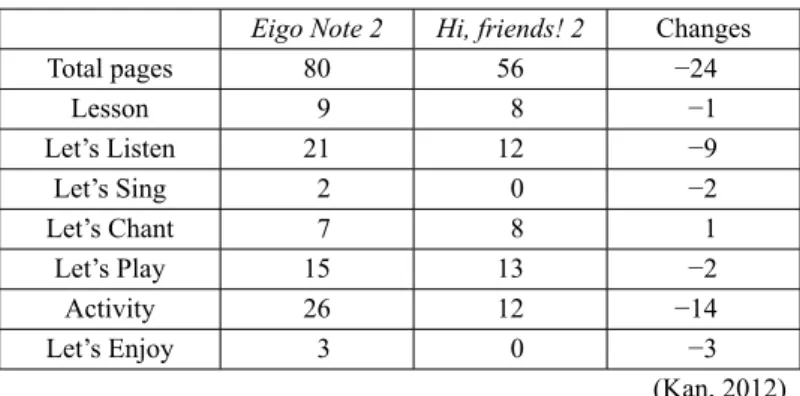
including instructions for each activity, the English expressions that are used, listening activity scripts and points to note when teaching. There are 5 pillars for children’s activities that make up classes: 1) Let’s Listen, 2) Let’s Play, 3) Let’s Chant, 4) Let’s Sing and 5) Activity, which is almost the same as Eigo Note (English Notebook). However, Hi, friends! has considerably fewer activities when compared to Eigo Note (English Notebook). Table 6 below compares the number of pages, lessons and activities in Hi, friends! 1 and 2 and
Eigo Note (English Notebook) 1 and 2. As can be seen from Table 6 and 7, there has been
a significant change in the number of activities in “Foreign Language Activities” classes. The reason for this can be said to be principally in proportion with the decrease in the total
number of pages of the teaching materials. Furthermore, according to Kan (2012), as the total number of hours remains unchanged at 35, it is necessary to spend sufficient time on the smaller number of activities.
Table 7: Comparison of Eigo Note 2 and Hi, friends! 2 Eigo Note 2 Hi, friends! 2 Changes
Total pages 80 56 −24 Lesson 9 8 −1 Let’s Listen 21 12 −9 Let’s Sing 2 0 −2 Let’s Chant 7 8 1 Let’s Play 15 13 −2 Activity 26 12 −14 Let’s Enjoy 3 0 −3 (Kan, 2012)
Furthermore, Kan (2012) notes two significant changes in the transition from Eigo Note
(English Notebook) to Hi, friends!: 1) the teaching of capital letters of the alphabet has been
moved from lesson 1 of Eigo Note (English Notebook) 2 for year 6 to lesson 5 of Hi, friends!
1 for year 5 and 2) English reading text is in the text of lessons 3 and 7 in Hi, friends! 2 for
year 6.
MEXT also issued Hi, friends! Plus, new supplementary teaching materials, in order to verify new foreign language education with the aim of making it a subject for the upper years of elementary school. The effects of this were verified in model schools, utilized as a trial over two school years from 2015 to 2016, to position the proposed teaching materials for use in each school during the following curriculum guidelines transition period. MEXT anticipated the revision of curriculum guidelines for the following period. In addition to listening and speaking through basic expressions about familiar things, audio and visuals were used to strengthen the foundations of communication skills including the cultivation of attitudes towards reading and writing. These teaching materials are required for the teaching of 1) recognition of the letters of the alphabet, 2) awareness of the differences in sounds between Japanese and English and their characteristics and 3) awareness of sentence structures such as the differences in word order and so on.
4. We Can!
The elementary school curriculum guidelines that were published in 2017 newly established compulsory “Foreign Languages” subjects for years 5 and 6 and “Foreign Language Activities” for years 3 and 4. “Foreign Language Activities” are compulsory as a field for the middle years of elementary school but the most significant change is that “Foreign languages” have been made compulsory as a subject for the upper years of elementary school. MEXT published We Can! in September 2017 as teaching materials for the upper years of elementary school, corresponding to new curriculum guidelines as a
transition period measure. We Can! is composed of two editions: We Can! 1 for year 5 and
We Can! 2 for year 6. To ensure that transition measures and priority implementation over
the two-year transition period go smoothly, booklets for the children and teachers’ guides have been created and distributed and classes using these materials are currently taking place all over the country. Reference materials such as teachers’ guides, study guide proposals, examples of yearly teaching plans, worksheets, proposals for activities and training guidebooks are all available of the MEXT website where they are updated as necessary. It should be noted that Lets Try! 1 and 2, which are teaching materials for “Foreign Language Activities” for the middle years of elementary school, have also been published but as this paper focuses on the flow and contents of teaching materials that have already been used for English language education in elementary school, it will not cover this publication.
We Can! 1 and We Can! 2 are both composed of 96 pages. We Can! 1 has 9 units (each
unit is 8 hours; however, units 2 and 3 are 7 hours); We Can! 2 also has 9 units (each unit is 8 hours; however unit 6 only is 6 hours). Both editions have cards that can be used for children’s activities at the back of the book, giving them the same composition as previous teaching materials.
Table 8: Contents of We Can! 1 Table 9: Contents of We Can! 2 Unit 1 Hello, everyone.
アルファベット・自己紹介
Unit 1 This is ME! 自己紹介 Unit 2 When is your birthday?
行事・誕生日
Unit 2 Welcome to Japan. 日本の文化 Unit 3 What do you have on Monday?
学校生活・教科・職業
Unit 3 He is famous. She is great. 人物紹介
Unit 4 What time do you get up? 一日の生活
Unit 4 I like my town. 自分たちの町・地域 Unit 5 She can run fast. He can jump high.
できること
Unit 5 My summer Vacation. 夏休みの思い出 Unit 6 I want to go to Italy.
行ってみたい国や地域
Unit 6 What do you want to watch? オリンピック・パラリンピック Unit 7 Where is the treasure?
位置と場所
Unit 7 My Best Memory 小学校生活・思い出 Unit 8 What would you like?
料理・値段
Unit 8 What do you want to be? 将来の夢・職業 Unit 9 Who is your hero?
あこがれの人
Unit 9 Junior High School Life 中学校生活・部活動
(MEXT, 2018) (MEXT, 2018)
Tables 8 and 9 show a list of unit titles from each edition of We Can!. In addition, the teachers’ guide shows unit goals and there is an explanation of the characteristics, aims and points to note when teaching each unit. There are detailed explanations of activity contents and instructions and audio scripts for the companion digital teaching materials. Furthermore, there are also examples of expressions that teachers can use in each unit and it is possible to listen to audio by reading QR codes. We Can! contains children’s activities that compose classes in the following manner.
Table 10: Main Activities of We Can! 1
1 Let’s Listen 聞いてみよう
2 Let’s Watch and Think 映像を見て、考えてみよう
3 Let’s Play ゲームをしよう 4 Let’s Chant リズムに合わせて言ってみよう 5 Let’s Sing 英語で歌おう 6 Jingle 最初の音を意識して言ってみよう 7 Activity 考えや気持ちを伝え合おう (MEXT, 2018) Table 11: Main Activities of We Can! 2
1 Let’s Listen 聞いてみよう
2 Let’s Watch and Think 映像を見て、考えてみよう
3 Let’s Play ゲームをしよう
4 Let’s Talk 会話をしよう
5 Let’s Read and Write 文章を読んで、書いてみよう
6 Let’s Read and Watch 文章を読んで、映像を見てみよう
7 Let’s Chant リズムに合わせて言ってみよう
8 Activity 考えや気持ちを伝え合おう
(MEXT, 2018)
The number of words in Hi, friends!, which has been used for “Foreign Language Activities” up until now is approximately 300. However, now children will learn more than twice as many words as the number of words set for foreign languages is between 600 and 700. This easily leads us to imagine that the level of difficulty of We Can! is higher than that of Hi, friends!. Furthermore, as the number of hours devoted to study has increased from 35 to 70 units, it is understandable that the total number of pages in the teaching materials has also increased. The most significant changes up to now are that the language activities of reading and writing have been added to “Foreign Language Activities” which used to focus on listening and speaking. Moreover, the original four abilities of the so-called English operational skills (listening, speaking, reading and writing) that have been the fields of teaching up until now, have been increased to the five fields of listening, reading, speaking (interaction), speaking (presentation) and writing in the new curriculum guidelines. This provides the understanding that contents following these fields are included in activities in
We Can!, which are the new teaching materials.
5. Conclusion
This paper has summarized the teaching materials that have been used in elementary school English language education in Japan. Since the publication of Eigo Note (English
Notebook) by MEXT in 2009, Hi, friends! and We Can! were developed as supplementary
English language education in elementary schools has not been positioned as a subject up until now and as it was positioned as a field, there were no authorized textbooks. However, in anticipation of the full-scale roll out of “Foreign Languages” as a subject from the 2020 school year, the teaching materials that have been created up until now are thought to have been very useful and have been a great reference in the creation of authorized textbooks. By summarizing teaching materials up to this point, it has become clear that the level of the difficulty of contents to be studied in the upper years of elementary school has increased. In addition, it is thought that the role played by “Foreign Language Activities” for the middle years of the school will become important when considering the level of the contents to be studied in the upper years. Furthermore, we must also reset our recognition of learning “Foreign Languages” as a subject in the upper years of elementary school linking them directly to learning at junior high school. Based on English language education at elementary school and the teaching materials used up until now, we would like to investigate the practical aspects in the future, including an analysis of the authorized textbooks that will be used from the 2020 school year.
References
菅正隆 (2017)『これからの小学校における外国語(英語)教育─子どもをいかに英語好きにさせるか ─』大日本図書
菅正隆 (2012)『成功する小学校英語シリーズ外国語活動を徹底サポート! Hi, friends! 指導案&評価 づくりパーフェクトガイド』明治図書出版
Kikuchi, S. (2014) “How Do We Teach English at Elementary School?” Focusing on “English Note” and “Hi,
Friends!” as Common Teaching Materials. Bulletin of Musashigaoka College, 21, 27–36.
Ministry of Education, Culture, Sports, Science and Technology (2018) We Can! 1 & 2: Tokyo Shoseki.
Ministry of Education, Culture, Sports, Science and Technology (2017) Foreign Language Activities for elementary
school/ foreign language training guide book: Foreign Languages. http://www.mext.go.jp/a_menu/kokusai/
gaikokugo/1387503.htm (accessed 2019-01-04).
Ministry of Education, Culture, Sports, Science and Technology (2016) Creation of supplementary teaching
materials (Hi, Friends! Plus) in elementary school new foreign language education (for 5th & 6th grade):
Foreign Languages. http://www.mext.go.jp/a_menu/kokusai/gaikokugo/1355637.htm (accessed 2019-01-04).
Ministry of Education, Culture, Sports, Science and Technology (2012) Hi, friends! 1 & 2: Tokyo Shoseki. Ministry of Education, Culture, Sports, Science and Technology (2012) Related materials of “Hi, friends!”:
Foreign Languages. http://www.mext.go.jp/a_menu/kokusai/gaikokugo/1314837.htm (accessed 2019-01-04).
Ministry of Education, Culture, Sports, Science and Technology (2009) Eigo Note 1 & 2 (English Notebook 1 &
2): Kyoiku-Shuppan.
Ministry of Education, Culture, Sports, Science and Technology (2008) Elementary school curriculum guidelines:
Chapter 4 Foreign Language Activities (updated 2010-10-07). http://www.mext.go.jp/component/a_menu/
education/micro_detail/_icsFiles/afieldfile/2010/10/20/1261037_12.pdf (accessed 2019-01-04).
Sugiyama, A. (2018). The process of the introduction of public elementary school English Education and the process of its progress —Focusing on the transition from “English Note” to “Hi, Friends!”— IREE Journal, 1, 83–94.
杉山明枝 (2010)「『英語ノート』の効果的な使用法と活動実践例─英語教育特区荒川区における小学 校での取り組みから─」『STEP BULLETIN』 22, 63‒83.
Takizawa, Y. (2011). The Organization of Lessons in the Teacher’s Mnual of “Eigo Note” With Special Reference to Syllabus type and teaching Sequence. Bulletin of Center for Research and Development of Education,
Fukushima University, 11, 10–18.
Tanabe, N. (2018). A Study of Cross-Cultural Understanding in Elementary School English Education—Focusing on the Textbooks Hi, Friends! And We Can!— Childhood education research journal, 27, 63–69.