On the Number of
Iterations of Dantzig’s Simplex
Method
*Tomonari
Kitahara
\daggerand Shinji Mizuno
\ddagger1
Introduction
We analyze the primal simplex method with the most negative coefficient
pivoting rule (Dantzig‘s rule) under the condition that the primal problem has
an
optimalsolution. We giveanupper bound for the number of different basic feasible solutions (BFSs) generated by the simplexmethod. The bound is$n \lceil m\frac{\gamma}{\delta}\log(m\frac{\gamma}{\delta})\rceil$,
where $m$ is the number of constraints, $n$ is the number of variables, $\delta$ and
$\gamma$
are
the minimum and the maximum values of all the positive elements ofprimal BFSs, respectively, and $\lceil a\rceil$ is the smallest integer bigger than $a\in\Re$
.
When the primal problem is nondegenerate, it becomes
a
bound for thenumber ofiterations. Note that the bound depends only
on
the constraintsof LP, but not the objective function.
Our work is motivated by
a
recent research byYe [4]. He shows that thesimplex method is strongly polynomial for the Markov Decision Problem.
We apply the analysis in [4] to general LPs and obtain the upper bound.
Our results include his strong polynomiality.
When we apply
our
result to an LP wherea
constraint matrix is totally unimodular and a constant vector $b$ of constraints is integral, the number ofdifferent solutions generated by the simplex method is at most $n\lceil m\Vert b\Vert_{1}\log(m\Vert b\Vert_{1})\rceil$ .
$*$
本稿は平成22年度 RIMS 研究集会「最適化モデルとアルゴリズムの新展開」における発
表「特殊な線形計画問題に対する単体法の反復回数に対する新評価」の内容を改良発展させ
てまとめたものである.
\dagger Graduate School of Decision Science and Technology, TokyoInstitute of Technology, 2-12-1-W9-62, Ookayama, Meguro-ku, Tokyo, 152-8552, $J$apan. Tel.: $+81-3-5734-2896$
Fax: $+81-3-5734-2947$E-mail: [email protected]
\ddagger Graduate School of Decision Science and Technology, Tokyo Institute ofTechnology, 2-12-1-W9-58, Ookayama, Meguro-ku, Tokyo, 152-8552, Japan. Tel.: $+8I-3-5734-2816$
2
The
Simplex
Method
for LP
In
this paper,
we
consider
the linear
programming problemof the standard
form
$\min$ $c^{T_{X}}$,
(1) subject to $Ax=b,$ $x\geq 0$,
where $A\in\Re^{m\cross n},$ $b\in\Re^{m}$ and $c\in\Re^{n}$
are
given data, and $x\in\Re^{n}$ isa
variable vector. The
dual
problemof
(1) is$subject\max$
to $A^{T}y+s=cb^{T}y,,$ $s\geq 0$, (2)
where $y\in\Re^{m}$ and $s\in\Re^{n}$
are
variable vectors.We
assume
that rank$(A)=m$, the primal problem (1) hasan
optimalsolution and
an
initial BFS $x^{0}$ is available. Let $x^{*}$ bean
optimal basicfeasible
solution of (1), $(y^{*}, s^{*})$ bean
optimal solution of (2), and $z^{*}$ be theoptimal value of (1) and (2).
Given
a
setof
indices $B\subset\{1,2, \ldots, n\}$,we
split the constraint matrix $A$, the objective vector $c$, and the variable vector $x$ according to $B$ and$N=\{1,2, \ldots, n\}-B$ like
$A=[A_{B}, A_{N}],$ $c=\{\begin{array}{l}c_{B}c_{N}\end{array}\},$ $x=\{\begin{array}{l}x_{B}x_{N}\end{array}\}$
.
Define the set of bases
$\mathcal{B}=\{B\subset\{1,2, \ldots, n\}||B|=m, \det(A_{B})\neq 0\}$
.
Then
a
primal basic feasible solution for $B\in \mathcal{B}$ and $N=\{1,2, \ldots, n\}-B$is written
as
$x_{B}=A_{B}^{-1}b\geq 0,$ $x_{N}=0$
.
Let $\delta$ and
$\gamma$ be the minimum and the maximum values of all the positive
elements of
BFSs.
Hence for anyBFS
$\hat{x}$ and any$j\in\{1,2, \ldots, n\}$, if$\hat{x}_{j}\neq 0$,
we
have$\delta\leq\hat{x}_{j}\leq\gamma$
.
(3)Note that these values depend only
on
$A$ and $b$, but noton
$c$.
Let $B^{t}\in \mathcal{B}$ be the basis of the t-th iteration of the simplex method and
set $N^{t}=\{1,2, \ldots, n\}-B^{t}$
.
Problem (1)can
be written in the dictionaryform: $\min_{subject}$ $to$ $x_{B^{t}}=A_{B^{t}}^{-1}b-A_{t}^{\frac{}{B}1\prime}A_{N^{tX}N^{t}}c_{B^{t}}^{T}A_{B^{t}}^{-1}b+\overline{c}_{N^{t}}^{T}x_{N^{t}}$ , (4) $x_{B^{t}}\geq 0,$ $x_{N^{t}}\geq 0$
.
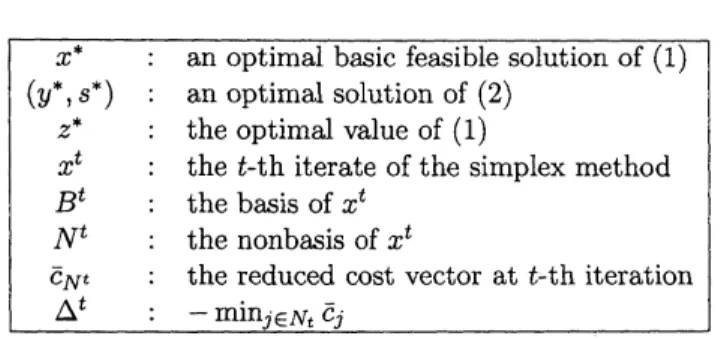
Table 1: Notations
$x^{*}$ : anoptimal basic feasiblesolution of (1)
$(y^{*}, s^{*})$ : anoptimalsolution of (2)
$z^{*}$ : theoptimalvalue of(1)
$x^{t}$ : thet-th iterate of the simplex method
$B^{t}$ : thebasis of$x^{t}$
$N^{t}$ : thenonbasis of$x^{t}$
$\overline{c}_{N^{t},\triangle^{t}}$
: the reduced cost vector at t-thiteration $:$ $- \min_{j\in N_{t}}\overline{c}_{j}$
The coefficient vector $\overline{C}_{N^{t}}=c_{N^{t}}-A_{N^{t}}^{T}(A_{B^{t}}^{-I})^{T}c_{B^{t}}$ is called
a
reduced costvector. When $\overline{c}_{N^{t}}\geq 0$, the current solution is optimal. Otherwise
we
conduct
a
pivot. That is,we
chooseone
nonbasicvariable (entering variable)and increase the variable until
one
basic variable (leaving variable) becomeszero.
Thenwe
exchange the two variables.Under the
most negative rule,we
choosean
entering variable whose reduced cost is minimum. To put itprecisely,
we
choosean
index$j_{MN}^{t}= \arg\min_{j\in N_{t}}\overline{c}_{j}$.
We set $\triangle^{t}=-\overline{C}\cdot t$
$\mathcal{J}_{MN}^{\cdot}$
We summarize the notations in Table 1.
3
Geometric
Interpretation
If
we
write LP inthedictionary form (4), itcan
beseen as a
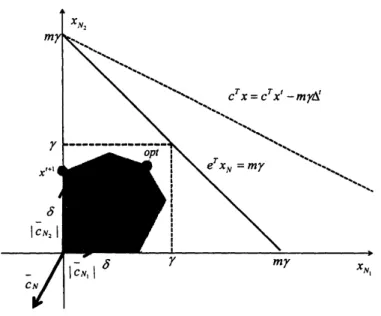
problem in $x_{N^{t}}$space. The current point $x^{t}$ corresponds to the origin (Figure 1). Assume
that $x^{t}$ is not optimal. Then at least
one
component of the reduced cost $C_{N^{t}}$ is negative. From the definition of$\delta$ and
$\gamma$, all the BFSs other than
$x^{t}$
are
contained in the square with length $\gamma$ minus the square with length$\delta$
.
Under the most negative rule,
a
nonbasic variable whose coefficient of thereduced cost is minimum is chosen
as
the enteringvariable. In Figure 1, $x_{N_{2}}$is chosen
as
the entering variable. Then the iteratemoves on
the $x_{N_{2}}$ axis.The objective function decreases $\triangle^{t}=\overline{c}_{N_{2}}$ per unit distance. In this
case
the iterate
moves
at least $\delta$, thus the objective function decreases at least$\delta\Delta^{t}$. Then
we
get the following inequality.$c^{T}x^{t+1}\leq c^{T}x^{t}-\delta\triangle^{t}$ (5)
We
go
on
with Figure 1. All the BFSsare
contained in the set $S=$$\{x_{N^{t}}|x_{N^{t}}\geq 0, e^{T}x_{N^{t}}\leq m\gamma\}$. Then the intercept of each axis is $m\gamma$. If
we
consider the contour at the intercept of the axis with the minimumco-efficient (in this
case
$x_{N_{2}}$), the contour passes outsideFigure
1:
Thefeasible
regionseen
from
a
nonoptimalBFS
$x\in S\Rightarrow c^{T}x\geq c^{T}x^{t}-m\gamma\Delta^{t}$ . If
we
takean
optimal BFSas
$x$,we
get thefollowing lemma.
Lemma 3.1 $[2J$ Let $z^{*}$ be the optimal value
of
Problem (1) and $x^{t}$ be thet-th itemte generated by the simplex method with the most negative rule.
Then
we
have$z^{*}\geq c^{T}x^{t}-\triangle^{t}m\gamma$. (6)
By combining (5) and Lemma 3.1, we obtain the following theorem.
Theorem 3.1 [2] Let$x^{t}$ and$x^{t+1}$ be the t-th and$(t+1)$-thiterates generated
by the simplex method with the most negative rule.
If
$x^{t+1}\neq x^{t}$, thenwe
have
$c^{T}x^{t+1}-z^{*} \leq(1-\frac{\delta}{m\gamma})(c^{T}x^{t}-z^{*})$. (7)
Next we consider a dictionary at an optimal BFS (Figure 2).
$\min$ $c_{B^{*}}^{T}A_{B^{*}}^{-1}b+\overline{c}_{N^{*}}^{T}x_{N^{*}}$,
$s$.$t$ $x_{B^{*}}=A_{B^{*}}^{-1}b-A_{B^{*}}^{-I}A_{N}*x_{N^{*}}\geq 0$,
$x_{N^{*}}\geq 0$
In this case, all the components of the reduced cost $\overline{c}_{N^{*}}$ is nonnegative.
The
gap
betweenthe
objective valueof
the current iterate $x^{t}$ and $z^{*}$ is$c^{T}x^{t}-z^{*}=\overline{c}_{N^{*}}^{T}x_{N^{*}}^{t}$ and
we
draw the contour at $x^{t}$.
Then there existsan
index $j\in N^{*}$ whose intercept is less than
or
equal to $mx_{j}^{t}$ (in Figure 2, $N_{1}^{*}$is such
an
index). The contourof$\overline{c}_{N^{*}}^{T}x_{N^{*}}$ is derived by reducingthecontourat $x^{t}$ by $\frac{c^{T}x-z^{*}}{c^{T}x^{t}-z^{*}}$ times, and the intercept reduces at the
same
rate. Thuswe
Figure 2: Feasible region seen from an optimal BFS
Lemma 3.2 [2] Let $x^{t}$ be the t-th iterate genemted by the simplex method.
If
$x^{t}$ is not optimal, there exists $\overline{j}\in B^{t}$ such that$x \frac{t}{j}>0$ and
for
any $k$, the k-th itemte $x^{k}$satisfies
$x \frac{k}{j}\leq\frac{m(c^{T}x^{k}-z^{*})}{c^{T}x^{t}-z^{*}}x\frac{t}{j}$.
Figure 3 is useful to show how
we
obtain the bound for the number ofdifferent basic solutions. If the primal problem (1) is nondegenerate,
we
Figure 3: Changes in $x_{\overline{j}}$
have $x^{t+1}\neq x^{t}$ for all $t$. Then by theorem 3.1, the upper bound of
implied in Lemma
3.2
becomes $m(1- \frac{\delta}{m\gamma})^{k-t}x\frac{t}{j}$. If$k$ is bigger than $k_{0}$, theupper bound is less than
$\delta$, meaning
$x \frac{k}{j}$
is
zero
from the definition of
$\delta$
.
More
generally,
we
have the following result.Lemma 3.3 $f2$] Let$x^{t}$ be the t-th itemte genemted by the simplex method
with the most negative rule.
Assume
that $x^{t}$ is notan
optimal solution.Then there exists $\overline{j}\in B^{t}$ satisfying the following two conditions.
1. $x \frac{t}{j}>0$
.
2.
If
the simplex method genemtes $\lceil m1\log(m)1$different
basicfeasible
solutions
afler
t-th itemte, then $x_{\overline{j}}$ becomeszero
and stays $zem$.
The event described in Lemma
3.3 can occur
at mostonce
for each variable.Thus
we
get the following result.Theorem 3.2 [2] When we apply the simplex method withthe most negative
rule
for
$LP(1)$ having optimalsolutions,we
encounterat most$n\lceil m_{\delta}^{f}\log(m_{\delta}^{f})\rceil$different
basicfeasible
solutions.Note that the result is valid
even
if the simplex method fails to findan
optimal solution because of
a
cycling.Ifthe primal problem is nondegenerate,
we
have$x^{t+1}\neq x^{t}$ for all$t$.
Thisobservation leads to
a
bound for the number of iterations of the simplexmethod.
Corollary 3.1 $[2J$
If
theprimalproblem is nondegenemte, the simplexmethodfinds
an
optimal solution in at most$n\lceil m_{\delta}^{f}\log(m_{\delta}^{f})\rceil$ itemtions.4
Applications
to
Special LPs
We havethe following result for
an
LP whose constraint matrix $A$ is totallyunimodularand allthe elements of$b$
are
integers. Recallthat the matrix$A$ istotally unimodular ifthedeterminant of every nonsingular squaresubmatrix
of $A$ is 1 or-l.
Corollary 4.1 $f2$]
Assume
that the constmint matrix $A$of
(1) is totallyunimodular and the constmint vector $b$ is integml. When
we
apply thesimplex method with the most negative rule
for
(1),we
encounter at mostReferences
[1] G. B. Dantzig: LinearProgramming andExtensions. Princeton
Univer-sity Press, Princeton, New Jersey, 1963.
[2] T. Kitahara and S. Mizuno: A Bound forthe Number of Different Basic
Solutions Generated by the Simplex Method. Technical report, 2010.
[3] V. Klee and G. J. Minty: How good is the simplex method. In O.
Shisha, editor, Inequalities III, Academic Press, New York, NY,
1972.
[4] Y. Ye: The Simplex Method is StronglyPolynomial for the Markov
De-cision Problem with