Coloring Comparability-ke Graphs
電気通信大学情報工学科 武永 康彦 (Yasuhiko Takenaga)
Department
of
Computer Science,The University
of Electro-Communications
1
Introduction
Many graph problems
are
$\mathrm{N}\mathrm{P}$-completefor general graphs. It is natural to consider thatif the graph problem is tractable for a graph class $\mathcal{F}$, it is also tractable for
a
class ofgraphs which
are
close to graphsin F. $\mathcal{F}+k\mathrm{e}$and$\mathcal{F}- k\mathrm{e}$graphsare
classes of graphs closeto$\mathcal{F}$
.
Theyare
the classes of graphsobtained by adding or deleting $k$ edges from graphs
in $F$
.
Wecan
consider the complexity of several problemson
such graph classesfrorn
parametricpoint ofview. In general, problemsbecome difficult as$k$ increases. Aproblem
withparameter $k$ is called to be fixed parameter tractable ifit canbe solved in $f(k)|x|^{c}$
time, where $f$ is
an
arbitrary functionand
$|x|$ is the size ofinput.Vertex coloringproblem isa very importantgraph problem,which is $\mathrm{N}\mathrm{P}$-completefor
general graphs. Vertex coloringforparameterizedgraph classesare consideredin [1]. It is shown in [1] that, when vertex coloring of$\mathcal{F}$graphs is solved in polynomial time, vertex
coloring of$F+k\mathrm{e}$graphs is fixedparameter tractable if JPis closedunder identification of nonadjacent vertices, and that vertexcoloringofS-ke graphs is fixedparameter tractable
if$F$ is closed under edge contraction.
Inthis paper, weconsidervertex coloringofcomparability-kegraphs. A comparability
graph is
an
undirected graph which becomes a transitive graph ifwe
give appropriatedirection to each edge. As
a
comparability graph is a perfect graph, vertex cploring of comparability graphscan
be solved in polynomial time [3]. In addition, comparability graphs areclosed neither under identification ofnonadjacent vertices norunderedge con-traction. On $\mathrm{c}\mathrm{o}\mathrm{m}\mathrm{p}\mathrm{a}\mathrm{r}\mathrm{a}\mathrm{b}\mathrm{i}\mathrm{l}\mathrm{i}\mathrm{t}\mathrm{y}+k\mathrm{e}\mathrm{g}\mathrm{r}\mathrm{a}\mathrm{p}\mathrm{h}\mathrm{s},$$.\backslash r\mathrm{e}\mathrm{r}\mathrm{t}\mathrm{e}\mathrm{x}$ coloring is solved in polynomial time for
$k=1$ and $\mathrm{N}\mathrm{P}$-completefor
$k\geq 2[4]$
.
In this paper, we first show that vertex coloring ofcomparability-le graphs is solved inpolynomialtime. Next,weshowthat vertex coloring ofcomparabihty-kegraphs
can
be polynomially reduced toa
vertex coloring problem ofcomparability graphs with restric-tions that given pairs of nodes should have the same color.2
Preliminaries
Let$G=(V, E)$ be
an
undirected graph. Then vertex coloring problemisdefinedas
follows. VERTEX COLORINGInput : A graph $G=(V, E)$ and apositive integer $t\leq|V|$
.
Question: Is$G$t-colorable? Thatis, is thereafunction$f$ : $Varrow\{1,2, \ldots, t\}$thatsatisfies
The chromatic number of $G$, denoted as $\chi(G)$, is the smallest $t$ for which $G$ is
t-colorable. Thecliquenumber ofagraph$G$, denotedas $\omega(G)$, is the degree of themaximum
complete subgraph of$G$
.
For agraphclass$F$, let $F+k\mathrm{e}$be the class of graphs whichcanbe obtained by adding
at most $k$ edges to
an
$F$ graph. Similarly, let :F-ke be the class of graphs whichcan
beobtained by removing at most $k$edges from an$F$graph. The modulator ofan$F+k\mathrm{e}$graph
$G=(V, E)$ is
a
set of edges $E_{k}(\subset E)\mathrm{s}.\mathrm{t}$.
$(V, E-E_{k})\in F$and $|E_{k}|\leq k$.
The modulatorof
an
F-ke graph$G$ is a set of edges $E_{k^{\mathrm{S}.\mathrm{t}}}$.
$(V, E\cup E_{k})\in F$and $|E_{k}|\leq k$.
In thispaper,we assume that the modulator is given. For
a
fixed $k$, the modulator of$F+k\mathrm{e}$or
$\mathcal{F}- k\mathrm{e}$graphs
can
be found in polynomial time provided that it can be checked in polynomial time whether a graph is in class$\mathcal{F}$ or not.A comparability graph is an undirected graph $\mathrm{s}.\mathrm{t}$
.
a
transitive graphcan be obtainedby giving appropriate orientation to each edge. A directed graph is called transitive if $(u, v)\in E$ and $(v, w)\in E$
,
then $(u, w)\in E$ holds. Itcan
be recognized whether agraphis
a
comparability graphor
not and its transitive orientationcan
be found in $O(\gamma|E|)$time, where 7 is the maximum degree of
a
vertex [2]. Ifa
comparability graph is given,its transitive orientation is obtained in linear time [5]. A comparability graph is aperfect
graph, whose clique number equals the chromatic number. The clique number and the chromatic number ofacomparability graph
can
be computed inpolynomial time.A transitive graphcanbe represented byaHassediagram. If$(u, v)\in E$and$(v,w)\in E$,
$(u, w)$ is omitted in
a
Hasse diagram. When there existsa
path from $u$ to $v$ in a Hassediagram, we call that $u$ is an ancestorof$v$ and $v$ is adescendant of$u$, denoted
as
$u\prec v$.
In this paper, for simplicity,
we
write a Hasse diagramas
an undirected graph. All the edgesare
assumed to be downward edges.For
a
transitive graph $G$, a function $f$ : $Varrow\{1,2, \ldots, \omega(G)\}$ is called a levelingfunction if$f(u)<f(v)$ is satisfied for all $(u, v)\in E$
.
We define levmin and levmaxas
follows.
levmin$(v)=\{$ 1 if
$v$ is
a
source
$\max_{(u,v)\in E}levmin(u)+1$ otherwise
levmax$(v)=\{$
$\omega(G\rangle$ if$v$ is
a
sink$\max_{(v,u)\in E}levmax(u)-1$ otherwise
Then levmin and levmax are leveling functions. We call that levmin(v) is the level of vertex $v$, and that $v$ is in level levmin(v). As a maximal path in the Hasse diagram
corresponds to
a
maximal clique in a transitivegraph, $\omega(G)=\max_{v\in V}levmin(v)$.
Ifwecolor vertex $v$ by $f(v)$ for
some
leveling function $f$, it isan
optimalvertex coloringof$G$.
Inthis paper, wecall such coloring alevelwise coloring of$G$ by$f$
.
3
Coloring
Comparability-ke
Graphs
3.1
Coloring Comparability-le GraphsInthis section,
we
considervertex coloring ofcomparability-le graphs. Let $G=(V, E)$ beFirst, we consider the relation between $\chi(G),$$\omega(G)$ and $\omega(G_{c})$. If$\omega(G)=\omega(G_{c})$, then
$\chi(G)=\omega(G_{c})$ holds. If$\omega(G)=\omega(G_{c})-1$, then$\omega(G_{\mathrm{c}})-1\leq\chi(G)\leq\omega(G_{c})$ holds. Inthe
latter case, there may exist an $(\omega(G_{c})-1)$-coloring of$G$. In the $(\omega(G_{c})-1)$-coloring, $a$
and $b$have the same color.
We first show that it is not difficult to check if$\omega(G)=\omega(G_{c})$ or not.
Lemma 1 The equality$\omega(G)=\omega(G_{c})-1$ holds
iff
there exists no vertex$v(v\neq a, b)$ suchthatlevmin(v) is equalto levmin$(a)$ orlevmin$(b)$ and levmin$(v)+levmax(v)-1=\omega(G_{\mathrm{c}})$
.
Proof First,
we
should note that, foravertex$v$, thesize of themaximumclique including $v$ is levmin$(v)+levmax(v)-1$.
$(arrow)$ $\omega(G)=\omega(G_{c})-1$ impliesthat all themaximumcliquesof$G’$ includesthemodulator
$(a, b)$
.
Assume that there exists a vertex $v(v\neq a)$ such that levmin(v) $=levmin(a)$ and
levmin$(v)+levmax(v)-1=\omega(G$‘$)$
.
Aslevmin$(v)+levmax(v)-1=\omega(G_{c}),$ $v$ is includedin
a
maximum clique of$G_{c}$.
However, as levmin$(v)=levmin(a),$ $v$ and $a$ are not in thesame
clique. Therefore, $G_{c}$ hasa
maximumcliquewhich does
not include $(a, b)$.
Itmeans
that $\omega(G)=\omega(G_{c})$
.
$(arrow)$ Ifthere exists no vertex $v(v\neq a, b)$ such that levmin(v) is equal to levmin$(a)$
or
levmin$(b)$ and levmin$(v)+levmax(v)-1=\omega(G_{c})$, all the vertices which is insome
maximum clique of $G_{c}$ must be connected with $a$ and $b$
.
Thus, the modulator $(a, b)$ is included in all the maximum cliques of$G_{c}$.
$\square$The condition ofthis lemmais checked easily using levmin and levmax of each node. Thus, it
can
be checked inpolynomial time ifthe condition is satisfied. In the following, weconsider the graphs satisfying the condition of Lemma 1.Even though$\omega(G)=\omega(G_{\mathrm{c}})-1$holds,it is notalways possibleto color$G$with$\omega(G_{\mathrm{c}})-1$ colors. Weconsider how tocompute if$G$is $(\omega(G_{c})-1)- \mathrm{c}o$lorable. Toconsider thecoloring
of $G$,
we
first obtaina
transitive orientation of $G_{c}$.
Let $G_{t}$ be the obtained transitivegraph. $G_{t}$ is represented
as a
Hasse diagram $H=(V, E_{H})$.
In the following, we assume w.l.o.g. that$a\prec b$in$H$.
InaHasse diagram, all theverticesinapathmusthave differentcolors. However, in this case,
as
we
consider the coloring of$G$,we
admit that $a$and$b$have thesame color in $H$.
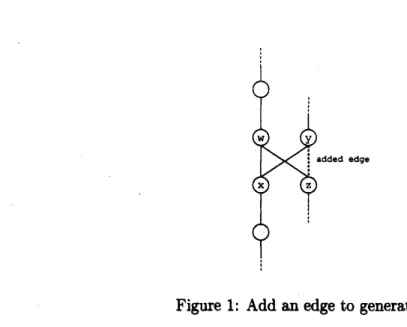
We consider to modify the graph without changingitschromatic number. Let$w,$$x,y,$$z$
be the vertices satisfying the following conditions: $(w, x),$$(y,x),$$(w, z)\in E_{H}$ and $w$ and
$x$
are
in thesame
$(\omega(G_{c})-1)$-clique of$G_{c}$ (see Fig.1). Let $H’=(V, E_{H}\cup\{(y, z)\})$ andlet $G’$ be the comparability-le graph representedby $H’$when the modulator is added.
Lemma 2 $\chi(G’)=\chi(G)$
.
ProofAs $G’$ is obtained by adding edges to $G$, a coloring of $G’$ is also a coloring of$G$
.
That is, $\chi(G’)\geq\chi(G)$ holds. We show that if$G$ is $(\omega(G_{c})-1)$-colorable, then$G^{j}$ is also
$(\omega(G_{c})-1)$-colorable.
Consider a $(\omega(G_{c})-1)$ coloring of$G$
.
Let $U(v)$ be the set of colors used in $v$ and itsancestors, and $L(v)$ be the set ofcolors used in $v$ and its descendants. As $(w, x)\in E_{H}$, it holds that $U(w)\cap L(x)=\emptyset$
.
Similarly, $U(y)\cap L(x)=\emptyset$ and $U(w)\cap L(z)=\emptyset$ alsoFigure 1: Add
an
edge togenerate $H’$.
hold. In addition, as $w$ and $x$ are in the
same
$(\omega(G_{\mathrm{c}})-1)$-clique of $G_{\mathrm{c}}$, $U(w)\cup L(x)=$$\{1, \ldots, \omega(G_{c})-1\}$
.
Therefore, wecan see
that $U(y)\subseteq U(w)$ and $L(z)\subseteq L(x)$ hold. Itfollows that $U(y)\cap L(z)=\emptyset$
.
It means that even when $(y, z)$ is added to $H$, no
pathoftheHasse diagramcontains the
same
color (except two endpoints ofthe modulator). $\square$Add edges satisfying the above condition
as
far as possible. Let the resulting Hasse diagram be $H_{+}$ and the corresponding comparability-le graph be $G_{+}$.
Lemma2 showsthat $\chi(G_{+})=\chi(G)$
.
Let $V_{a}=${
$v|a\prec v$ in $H_{+}$}
and $V_{b}=${
$v|v\prec b$in $H_{+}$}.
Lemma 3 There exists an $(\omega(G_{c})-1)$-colonng
of
$G_{+}$iff
there existsno
$(\omega(G_{\mathrm{c}})-1)$-cliquethat does not include
an
endpointof
the modulator andwhose all verticesare
in $V_{a}\cup V_{b}$.
Proof The vertices in $V_{a}$
or
$V_{b}$ cannot be colored with thesame
color as$a$ and $b$becausetheverticesin $V_{a}(V_{b})$ and $a(b)$
are
onthesame pathin $H_{+}$. If thereexistsan
$(\omega(G_{\mathrm{c}})-1)-$clique that does not include
an
endpoint of the modulator and whosean
verticesare
in$V_{a}\cup V_{b}$
,
thereexistsno
$(\omega(G_{c})-1)$-coloring of $G_{+}$ because only $\omega(G_{c})-2$ colorscan
beused to color theclique.
Otherwise,
we
cancolorall the vertices using colors $\{1, 2, \ldots,\omega(G_{\mathrm{c}})-1\}$inthefollowingmanner.
Color$a$and$b$with 1. In each $(\omega(G_{c})-1)$-clique, color thevertex of the smallestlevel not in $V_{a}\cup V_{b}$ with 1. From the assumption, each $(\omega(G_{\mathrm{c}})-1)$-cliqueincludes at least
one vertex colored with 1. In addition,
we can
show thatno
clique includesmore
thanone vertices colored with 1.
Assume that
a
vertex $d$ is colored with 1. Then, there existsa
vertex $e$ satisfying$(e,d)\in H_{+},$ $e\in V_{b}$ and $d,$$e$ are in thesame $(\omega(G_{c})-1)$-clique, and
a
vertex $f$ satisfying$(e, f)\in H_{+}$ and $f\in V_{b}$
.
From the constructionof$H_{+}$, for each vertex$g\mathrm{s}.\mathrm{t}$.
$(g, d)\in H_{+}$,an
edge $(g, f)$ must exist in $H_{+}$.
Itmeans
that any predecessor of $d$ is included in $V_{b}$.
Therefore,
no
two vertices ina
$(\omega(G_{c})-1)$-cliquecan
be colored with 1.Color the other vertices with the following rule: if$v$ is
a
source, color $v$ with 2, andotherwise color $v$with the minimum number which is notused inthe predecessors of$v$ in
$H_{+}$
.
We can observe that the coloring rule approves that no two vertices in a clique has$v$ with levmin$(v)=i$ is at most $i$
.
Therefore, the color ofasink is at most $\omega(G_{c})-1$.
$\square$ [Algorithm COLOR-IE]Input: comparability-le graph $G=(V, E)$, modulator$E_{1}=\{(a, b)\}$
Output: chromatic number of$G$
1. Computea transitive orientationof$G_{c}=$ ($V,$EU$E_{1}$) (represented by
a
Hasse diagram$H=(V, E_{H}))$ and compute $\chi(G_{c})$
.
2. Repeat the following until no
more
edge is added.Find the
vertices
$w,x,$$y,$$z$ satisfying the following conditions: $w$ and $x$are
in thesame $(\omega(G_{c})-1)$-clique of$G_{c},$ $(w,x)\in E_{H},$ $(y,x)\in E_{H}$ and $(w,z)\in E_{H}$
.
If thereexist such vertices, add
an
edge $(y, z)$ to $E_{H}$.
Let $G_{+}$ be the obtained graph.
3. Compute $V_{a}=$
{
$v|a\prec v$ in $H_{+}$}
and $V_{b}=${
$v|v\prec b$ in $H_{+}$}.
4. Compute
a
subgraph of$H_{+}$ induced by $V_{a}\cup V_{b}-\{a, b\}$.
5. If the induced subgraph includes
a
path oflength $\chi(G_{c})-1$,
then output $\chi(G_{c})$.
Otherwise, output $\chi(G_{c})-1$
.
Theorem 4 Vertex coloring problem
of
comparability-le graphscan
be solved in polyno-mial time.3.2
Reductionto
a Restricted
Coloring of Comparability GraphsIn this vection,
we
show that vertex coloring of comparability-ke graphscan
be reduced toa
kind of vertex coloring problem of comparability graphs. We define pair coloring problem as follows.PAIR COLORING
Input : A graph $G=(V, E)$,
a
set of pairs ofvertices $P\subseteq V^{2}$ anda
positive integer $k$.
Output : If there exists
a
vertexcoloringof$G$ with$k$ colors which colors$u$and$v$with thesame
color for all $(u,v)\in P$.
If there isnorestriction
on
$G$, pair$\mathrm{c}\mathrm{o}\dot{\mathrm{l}}\mathrm{o}\mathrm{r}\mathrm{i}\mathrm{n}\mathrm{g}$isequivalenttovertexcoloringof thegraphobtained from$G$byidentifying all the pairs ofverticesin$P$
.
However, many graph classesincluding comparabilitygraphs
are
not closed under identification of nonadjacent vertices. Theorem 5 Vertex coloringof
comparability-ke graphscan
be reducedto pair coloringof
comparability graphs.ProofFor an instance $(G=(V, E),$$k\rangle$ ofvertex coloring ofcomparability-ke graphs,
we
construct an instance of pair coloring of comparability graphs $\langle G’=(V’, E’), P, k’\rangle$
as
follows.
Let $M$ be the modulator of$G$ and $G_{t}=(V, E_{t})$ be
a
transitive graph obtained from(V,$E\cup M$). Instead of$G’$
,
we
definea
transitive graph $G_{t}’=(V‘, E_{t}’)$ obtained from $G’$.
Let $B=$
{
$w|(u,w)\in E_{t}$ and $(w,v)\in E_{t}$ forsome
$(u,$$v)\in M$}.
For each vertex$w\in B$,modulator: $\mathrm{l}\mathrm{b},$$\mathrm{e}$)
(a) Hasse diagram of Gt. (b) Hasse diagram of $\mathrm{c}_{\mathrm{t}}’$.
Figure 2: Anexample ofreduction.
$B\}\cup\{(w’, s)|(w, s)\in E_{t},w\in B\}\cup$
{
$(r,$$s)|(r,$$s)\in$ Et–M,$r\not\in B,$ $s\not\in B$}.
Let the pairsofvertices be $P=\{\langle w, w’\rangle|w\in B\}$ and $k’=k$
.
Now check that $G_{t}’$ is really
a
transitive graph. Let $B’=\{w’|w\in B\}$.
Note thatthere is no outgoing edges fromvertices in $B$ and
no
incoming edges from vertices in $B’$.
Consider two edges $(a, b),$$(b, c)\in E_{t}’$
.
When $a,$$b,$$c\in V’-(B\cup B’)$, both $(a, b)$ and $(b, c)$are
edges of$E_{t}$.
As $G_{t}$ isa
transitive graph, there existsan
edge $(a,c)\in E_{t}$, and thus$(a,c)\in E_{t}’$
.
When $c\in B$, there also existsan
edge $(a,c)\in E_{t}$,
and thus $(a, c)\in E_{t}’$.
Itis similar for the case when $a\in B’$
.
Fig.2 isan
example of the $G_{t}$ and $G_{t}’$ representedas
Hasse diagrams.
If we identify $w$ and $w’$ for all $w\in B$
on
$G$‘, the obtained graph is thesame as
$G$.
Therefore, it is obvious that $G’$ has apair coloring with $k$colors iff$G$ is$k$-colorable. $\square$
On the pair coloring problem, the number ofpairs can be regarded as a parameter. However,
as
the number of pairs does not depend on the size of the modulator, this reduction is not aparameterized reduction.References
[1] L. Cai, Parameterized Complexity of Vertex Colouring, Discrete AppliedMathematics, Vol.127, No.3, pp.415-429 (2003).
[2] M. C. Golumbic, Algorithmic Graph Theory and Perfect Graphs, Annals of Discrete Mathematics 57, Elsevier, 2ndEdition, 2004.
[3] M. Grotschel, L. Lovasz, and A. Schrijver, PolynomialAlgorithms for Perfect Graphs, Annals of Discrete Mathematics, 21, 325-356, 1984.
[4] K. Higashide and Y. Takenaga, Complexity of Coloring $\mathrm{C}\mathrm{o}\mathrm{m}\mathrm{p}\mathrm{a}\mathrm{r}\mathrm{a}\mathrm{b}\mathrm{i}\mathrm{l}\mathrm{i}\mathrm{t}\mathrm{y}+k\mathrm{e}$ Graphs,
Tbchnical Report ofIEICE, COMP2004-82, 2005.
[5] R.M.McConneUand J.P. Spinrad, Modular Decomposition and Transitive Orientation,