cond-mat/0506613
States with
$v_{1}=\lambda,$ $v_{2}=-\lambda$and
reciprocal
equations
in
the
six-vertex
model
M.J.
Rodr\’iguez-Plazai
Departamento de Fisica Te\’orica$I$, Facultadde Ciencias Fisicas
Universidad Complutense de Madrid,
28040
Madrid, SpainAbstract
The eigenvalues of the transfermatrixin asix-vertexmodel (withperiodic boundary
condi-tions)
can
bewritten in termsof $n$ constants $v_{1},$$\ldots,$$v_{n}$, thezeros
ofthefunction $Q(v)$.
Apeculiarclass of eigenvalues
are
those in which two of the constants $v_{1},$ $v_{2}$are
equal to $\lambda,$$-\lambda$, with $\Delta=-\cosh$A and $\Delta$ related to the Boltzmann weights of thesix-vertexmodelbytheusualcombination $\Delta=(a^{2}+b^{2}-c^{2})/2ab$
.
Theeigenvectorsassociated to these eigenvaluesare Bethe states(although theyseemnot). Wecountthe number of such states (eigenvectors)
for $n=2,3,4,5$ when $N$, thecolumnsina rowofa squarelattice,is arbitrary. The number
obtained isindependent of the value of $\Delta$, but dependson $N$
.
We give the explicitexpres-sion of the eigenvalues in terms of $a,$$b,$ $c$ (when possible)orin termsoftherootsofacertain
reciprocal polynomial, beingverysimpleto reproduce numerically these special eigenvalues
for arbitrary $N$ in the blocks $n$ considered. For real $a,$$b,c$ such eigenvalues are real.
$PACS$numbers: 05.50.$+q7\mathit{5}.\mathit{1}\theta.Hk$
Keywords: Statistical mechanics; six-vertex model;
transfer
$mat’\dot{\mathrm{w}}_{i}$ Bethe ansatz; $Q(v)$ function; $|\mathfrak{r}ci\mathrm{p}\mathrm{r}ocal$polynomial
1 Theproblem
Sometime
ago
the author ofthis note read in thepaper Completenessof
the Bethe Ansatzfor
the Sixand Eight-
Vertex
Models by R.J Baxter [1, Sect. 4] the following sentenceconcerning certainproper
states of the transfer matrixin the six-vertex model at zero-field:
The other problem that we encountered first occurs for $N=4$ and $n=2$, thenfor even $N$ and $2\leq n\leq N-2$
.
It is referred to byBethe himself and has been considered by otherssince2.
For some eigenvalueswith momentum $\pm 1$, 3i.e. $k_{1}+\cdots+k_{n}=0$ or $\pi_{)}$wefound that$Q(v)= \prod_{j=1}^{n}\sinh[(v-v_{j})/2]$ hadapairofzeros $v_{1},$ $v_{2}$ such that $v_{1}=\lambda,$$v_{2}=-\lambda$
.
1E–mail: $\mathrm{m}\mathrm{j}\mathrm{r}\mathrm{p}\mathrm{l}u\mathrm{a}\emptyset \mathrm{f}\mathrm{l}\mathrm{s}.\mathrm{u}\mathrm{c}\mathrm{m}.\infty$
$2$
[$2$, aftereq. (23)],$[3],$ $[4],$ $[5]$
The lines continued lateras follows:
For $N=4$ therewasjustonesucheigenvalue $\Lambda$, in the $n=2$ central block. For $N=6$ therewas onein
the $n=2$ block, two in the $n=3$ block, andonein the $n=4$ block. For $N=8$ there were 1, 2, 5, 2, 1 in the $n=2,3,4,5,\mathit{6}$ blocks,respectively. Thissuggests (tentatively)that theCatalannumbersmaycount such
eigenvalues.4
The momentawere $-1$ exceptfor a single eigenvalue with momentum +1 in each block with $3\leq n\leq N-3$.
If the author had understood properly the eigenvectors associated to such eigenvalues and how to
obtainthemfrom Betheansatz,probablywould have notdetained
so
long when reading these sentences.But that
was
not thecase: we were
calculating atthat time the free.energy per site ofavertex modelwhose ground state
was a
stateofthistype, andthevalue ofthefree-energythatwe were
derivingwas
once
andagain the incorrectone.
Wedecidedinconsequence
to putaside thefree-energyproblemfora
time and studyinstead these statesin the six-vertex model. We ignore the correct
name
thatwe
shalluse
for them. In the literature they have received thename
ofsingularBethe statesor
singularitiesof the Bethe solutions [3, 4, 6], and also non-Bethe eigenvectors [7]. We might even remember
some
references inwhichthey
are
alludedas
improperstates. Since they needa
name
and nootherstatesare
considered inthispaperwe will refer tothem
as
boundpairs merely.Thisnotecommunicates
some
results of thestudyandanswers
theinterrogation suggested inBaxter’spaper: Are Catalan numbers counting the boundpair states
of
a square six-vertex model with periodicboundary $conditions^{Q}$
2 The $\mathrm{m}o$del
Themodel to beconsidered is a six-vertex model in a square lattice $[8, 9]$
.
In this model to eachsiteof the latticeis associated
one
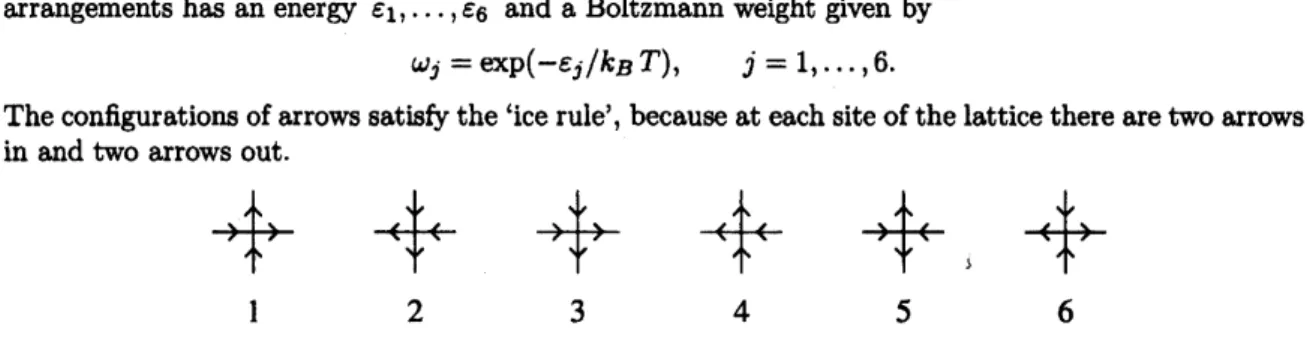
of thesixarrangementsofarrows
shownin figure 1, where each of thesearrangementshas an
energy
$\epsilon_{1},$$\ldots,\epsilon_{6}$ anda
Boltzmannweight givenby$\omega_{j}=\exp(-\epsilon_{j}/k_{B}T)$, $j=1,$$\ldots$, 6.
Theconfigurationsof
arrows
satisfythe ‘icerule’,becauseateachsiteofthe latticethereare
twoarrows
inand two
arrows
out.$\not\simeq$ $\prec\#$ $\not\simeq$
$1$
2
3
$\not\simeq$ $arrow*\iota$ $\not\simeq$
$4$
5
6
Figure 1. Thesixconfigurationsallowed atavertex. At each site of the lattice there aretwoarrows inand two arrowsout.
Thisis knownasthe ‘ice-rule’.
Suppose that the lattice has dimensions $M\mathrm{x}N$, that is $N$ sites horizontally and $M$ vertically,
with theimpositionofperiodic boundary conditions in both directions. Thestate of
an
arbitraryrow
of $N$ vertical edges is then specified by the configuration ofup and down
arrows on
the edge. Let$\sigma=(\sigma_{1}, \ldots, \sigma_{N})$ denote thestate ($\sigma_{j}=+1$ for
an
uparrow
atvertex $j,$ $\sigma_{j}=-1$ fora downarrow).If $\sigma$ is the stateofa
row
and $\sigma’$ the stateof the rowbellow, thetwo adjacentstatesare
coupled bythe transfer matrix $T_{\sigma\sigma’}$, whose entries
are
given bya
traceof 2$\mathrm{x}2$ matrices$T_{\sigma\sigma’}=\mathrm{t}\mathrm{r}\mathrm{a}\mathrm{c}\mathrm{e}R_{\sigma_{1}\sigma_{1}’}R_{\sigma_{2}\sigma_{2}’}\cdots R_{\sigma_{N}\sigma_{N}’}$ , (2.1)
where
$R_{++}=,$
$R_{+-=}$ ,$R_{-+}=$
,$R_{--}=$
.
A consequenceofthe (icerule’ together with thehorizontalperiodicityof thelatticeisthatthe number
$n$ ofdown (or up) arrowsina rowis
a
conserved quantity fromrowto row,and $T$,a $2^{N}\cross 2^{N}$ matrix,breaksup into $N+1$ diagonalblocks withone block for each value $n=0,1,$$\ldots$,$N$
.
Thedimension ofblock $n$ is
of the lattice $Z=\mathrm{t}\mathrm{r}\mathrm{a}\mathrm{c}\mathrm{e}T^{M}$, and this has implied the diagozalization of matrix $T$
.
In thecase
ofazero electrical field (the
case
treated here)where$a=\omega_{1}=\omega_{2}$, $b=\omega_{3}=\omega_{4}$, $c=\omega_{5}=\omega_{6}$, (2.2)
the eigenvalues A of the transfer matrix
are
known tobe [9]$\Lambda(v)=(-1)^{n}\frac{\phi(\lambda-v)Q(v+2\lambda)+\phi(\lambda+v\rangle Q(v-2\lambda)}{q(v)}$, (2.3)
wherefunctions $\phi(v),$ $Q(v)$
are
$\phi(v)=\rho^{N}\sinh^{N}(v/2)$ (2.4)
$Q(v)= \prod_{j=1}^{n}\sinh[(v-v_{j})/2]$, (2.5)
and $\rho,$ $\lambda,$ $v$
are
definedso
that$a= \rho\sinh\frac{1}{2}(\lambda-v)$, $b= \rho\sinh\frac{1}{2}(\lambda+v)$, $c=\rho\sinh\lambda$
.
(2.6)To write the eigenvalues (2.3) we have to locate $v_{1},$$\ldots,$$v_{n}$ for these eigenvalues. There
are
manysolutions, corresponding to thedifferenteigenvalues.
3 Catalan numbers
or
notDo Catalan numbers count the bound pairstates
of
a
square six-vertexmodel wath periodic boundaryconditions$Q$The answer
is $no$
.
Aswascommunicated in ref. [1], it is true that for $N=4$ there isonebound pairin the $n=2$ central
block,that for $N=\mathit{6}$ thereare 1,2, 1 in the $n=2,3,4$ blocks, respectively, and that for $N=8$ there
are
1,2,5, 2,1 inthe $n=2,3,4,5,6$ blocks. However, if thecountingstarted inthepreviousreferencehadcontinued it would havefoundthat there
are
1, 2, 6,10 in $n=2,3,4,5^{5}$for $N=10$, and 1, 2, 7,12in $n=2,3,4,5$ for $N=12$
.
In factour calculations
hereshow thatfor generaleven
$N$ the numberisexactly 1, 2,$N/2+1,$$N$ inthe blocks $n=2,3,4,5$
.
The numbers of statesfor $n=6$ and beyondwont be studied inthis paper.
4 Bound pairs and Bethe Ansatz
To obtain the eigenfunctions of the transfer matrix
one
can
either diagonalize exactly the matrix(impossible when the size is not reasonable)
or
use the Bethe ansatz, the trial form that Betheused for diagonalizing the quantum-mechanical Hamiltonial ofthe one-dimensionalHeisenberg model
[2]. The ansatz suggests that the eigenstate of $T(v)$, $T(v)|\psi\rangle=\Lambda(v)|\psi\rangle$,
can
be writtenas
$| \psi\rangle=\sum_{x_{1}<\ldots<x_{*}},f(x_{1}, \ldots, x_{n})|x_{1},$$\ldots,x_{n}\rangle$ ,where thecoefficients $f(x_{1}, \ldots,x_{n})$
are
$f(x_{1}, \ldots,x_{n})=\sum_{P}A_{\mathrm{p}_{1},\ldots,p_{n}}e^{1k_{P1}x_{1}}\cdots e^{1k_{\mathrm{p}n}x_{\mathrm{n}}}$
.
(4.1)5Weomittomentiontheblocks $n=N/2+1$ to $N-2$ sincethe numberof thesestatesis thesame asinthe blods
The numbers $x_{1},$$\ldots$,$x_{n}$ indicate thepositionsof $n$ down
arrows on
the lower vertical edges ofa
row
of the lattice, and
are
orderedso
that $1\leq x_{1}<x_{2}<\ldots x_{n}\leq N$.
We have experienced that thecoefficients $A_{\mathrm{p}_{1},\ldots,p_{\iota}}$, suitable to construct bound
pairs6
aregivenby$A_{\mathrm{p}_{1},\ldots,\mathrm{p}_{l}},= \epsilon_{P}/C\prod_{1\leq\dot{\iota}<j\leq n}s_{\mathrm{p}_{\mathrm{j}},p:}$ , (4.2)
where $\epsilon_{P}=\pm 1$ isthesignofthepermutation $\{p_{1}, \ldots,p_{n}\}$ of $\{1, \ldots, n\}$ and $C$ is
a
non-zero
constantto be
fixed
laterinthe most convenientmanner
(usually normalization). The vertex model defined byactivities $a,$$b,$ $c$ sothat
$\Delta=\frac{a^{2}+b^{2}-c^{2}}{2ab}$ (4.3)
enters in $s_{1j}$ ,
defined
as
$s:j=1-2\Delta e^{1k_{j}}+e^{1(k_{\mathrm{t}}+k_{j})}$
.
(4.4)To writethe eigenstates isonly
necessary
then to know the factors $e^{ik_{1}},$$\ldots,$
$e^{:k_{n}}$ that appear in (4.1)
and (4.4). These factors
are
the solutions of theequations$e^{iNk_{p_{1}}}A_{\mathrm{p}_{2\prime}p_{n},p_{1}},\ldots=A_{\mathrm{P}1p},\ldots,,.$ ,
(4.5)
that impose the periodic boundary conditions
on
the problem making that $f(x_{1},x_{2}, \ldots,x_{N})=$ $f(x_{2}, \ldots , x_{N},x_{1}+N)$ what identifies the $N+1$ and 1 vertices. To be (4.5) consistent equationsamong
themselves, it isnecessary
that$e^{iN(k_{1}+\cdots+k_{n})}=1$
.
(4.6)Equations (4.1), (4.2), (4.4), (4.5) and (4.6),
are
sufficient
equationsto writeboundpair eigenfunctions,andwhenneeded
we
willreferto themas “the Betheansatz equationsfor boundpairs”. However, andthis is not lessimportant, it is alsonecessary
a
correctnormalization of the eigenfunction. Without it,thestatecannot beobtained. Wehavelearned thecorrectnormalization in ref. [1, Sect.4],and show
an
example later for $N=\mathit{6}$ and $n=3$
.
Equations (8.2), (8.3) and (8.2), (8.3), (8.6)are
deducedtakinginto account such normalization.
It isimportanttowrite,before finishing, therelation between $k_{1}\ldots,$$k_{n}$ and $v_{1},$$\ldots,$$v_{n}$ in (2.5) (or better between $e^{:k_{\dot{f}}}$ and $e^{v_{j}}$ )
$e^{:k_{\mathrm{j}}}= \frac{e^{\lambda}-e^{v;}}{e^{\lambda+v_{\mathrm{j}}}-1}$
,
(4.7)
as
mentioned in many papers. This relationpermitstomove
from theeigenvalue (2.3)tothe eigenvector(4.1)ofthe transfer matrix when
we
precise it.5 A change of variables
Before describing any eigenvalue
we
makea
useful change of variables concerning $v$ and $\lambda$ in (2.6).The changeis convenientfor those(the author inthisspecificproblem
among
them)whoprefer to workwithpolynomialsrather thanwith hyperbolic functions
as
in(2.5). Define the variables$z=e^{-v}$, $y=e^{-\lambda}$ (5.1)
6Becausethey give thesameresultthat whenthetransfermatrixis directly diagonalized. When the size of the matrix
instead of $v$ and $\lambda$, then (2.5) is
essentially7
the polynomial in$z$ and $1/z$ given by
$Q(z)= \frac{1}{z^{n/2}}\prod_{\mathrm{j}\approx 1}^{n}(z-z_{j})$, (5.2)
with $z_{j}=e^{-v_{j}},$ $j=1\ldots,$$n$
.
Tobecorrectwe
should havedefined anothersymbolfor (5.2), $\tilde{Q}(z)$ forinstance, however
we
willuse
thesame
letterwith the understandingthat $Q(v)$ stands for (2.4) and$Q(z)$ for (5.2). In terms of these variables and togetherwith definitions (2.4) and (2.5), relation (2.3)
becomes
$(2/ \rho)^{N}\Lambda(v)Q(z)=\frac{(-1)^{n}}{(zy)^{N/2}}[(z-y)^{N}Q(zy^{2})+(1-zy)^{N}Q(z/y^{2})]$, (5.3)
where multiplicative constant factors in $Q$ cancel out of the calculations. To operate in
a
computerweprefer toworkwith this relation
more
than with (2.3).6 $\mathrm{n}=2$
Thisis
the
simplestcase
to study because the transfer matrixof
$N$ edges (with $N$ even)hasonlyone
bound pair state in thisblockfor arbitrary $\Delta$ defined in (4.3). Since boundpairs
are
characterized by$v_{1}=\lambda,$ $v_{2}=-\lambda$
as
mentioned inSec. 1, function (5.2) factorizesas
$Q(z)=(zy-1)(z-y)/z$
, (6.1)the zerosof $Q(z)$ being $z_{1}=y$ and $z_{2}=1/y$
.
Introducedthis functionin (5.3) and noting that ther.h.s. is exactly divided by $Q(z)$ in thel.h.s,the quotient affords the
eigenvalue8
$\Lambda(v)=a^{2}b^{2}(a^{N-4}+b^{N-4})-c^{2}(a^{N-2}+b^{N-2})$, $N\geq 4$, $n=2$, (6.2)
thatisvalidforgeneric $N$
even.
Itcan
becheckednumericallythat(6.2) is alwaysaneigenvalue of thetransfer matrix forall values of $a,$$b,$ $c$ real
or complex,9
and since the block $n=2$ isamongtheblocksof smallest dimensions, it
can
be doneeven
for $N$ not too small. The eigenvector associated to (6.2)was knowntoBethe himself [2, also after eq. (23)] and is proportional to
$| \psi\rangle=\sum_{l=1}^{N}(-1)^{l}|l,$$l+1\rangle$, (6.3)
afterappropriatenormalization. Wedonot reproduce here this eigenvectorwiththeBethe ansatz (the
examplethat
we
reproduce is for $N=6,$ $n=3$ later), but want to comment about $e^{:k_{1}}$ and $e^{:k_{2}}$.
Theproductof these two factorsisfor theeigenfunction (6.3) equalto $-1$, since from (4.1)derivesthe
relation
$f(x_{1}+1,x_{2}+1)=e^{i(k_{1}+k_{2})}f(x_{1},x_{2})$, with $N+1\equiv 1$, (6.4)
which is simply
a
consequenceofthe translation invarianceofthe transfer matrix(2.1). But also $v_{1}=\lambda$in (4.7) fixes $e^{:k_{1}}=0$, what obliges to set
$e^{ik_{1}}=-e^{-ik_{2}}=0$, (6.5)
7Essentiallymeans up tomultiplicativeconstants that do not depend on $z$ (theymay dependon $y$ because $y$ is
regarded as aconstant: after all $y$ is fixedby thevalue that we choose for $\Delta$, andviceversa). Theconstants arenot
relevantbecause do not change the value of $\Lambda(v)$, ascommented afterequation (5.3)
$\epsilon\Lambda(v)$ in(5.3)is obtained in terms of
$\iota$ and $y$,ofcourse. We have reexpressed theresultin terms of a,$b,$$c$ to write
(6.2)
$\mathfrak{g}_{a,b,c}$, the Boltzmann weights(2.2) of thevertexmodel,arereal andpositive,but when diagonalization ofamatrix
as was donein [1]. Thishappens for all bound pairs thatwe haveobtained no matter the values of $N$
and $n$: it is simply a
fact
thatfor these states in this model$e^{i(k_{1}+k_{2})}=-1$
.
(6.6)
Thiscondiction, together with the two identities in (6.5) mark how towork appropiately with bound
pairs.
7 $\mathrm{n}=3$
The trial function (5.2) is
now
of theform$Q(z)=(zy-1)(z-y)(z-A)/z^{3/2}$ , (7.1)
with $A$ a constant (numerical
or
dependingon
$y$) to bedetermined. Substituting (7.1) in (5.3), ther.h.s. of this equation is exactly divided by $Q(z)$ in the l.h.s. if and only if $A=0,$$-1,1$
or
$A$ isthesolution of
a
certain polynomial whose coefficientsdepend onlyon
$\Delta$.
The root $A=0$ is notan
admissible solution because (7.1)has not therequired expansion (5.2);
on
the contrary, roots $A=-1,1$yield admissible functions $Q(z)$ because the associated A(v) by (5.3) are always in the spectrum of
the transfermatrix, as wehaveverifiedin
numerous
experiments. Forexample,the numbers$\Lambda_{+}\equiv 2a^{3}b^{3}-abc^{2}(a^{2}+ab+b^{2})+c^{4}(a^{2}-ab+b^{2})$, (7.2) $\Lambda_{-}\equiv 2a^{3}b^{3}-abc^{2}(a^{2}-ab+b^{2})-c^{4}(a^{2}+ab+b^{2})$, (7.3)
areeigenvalues of the $N=6$ transfermatrix for arbitrary values of $a,$$b,$ $c$
.
The first is for $A=-1$,thesecond for $A=1$
.
We presentsome
ofthesenumericaltests inTable 1. Regarding the situation inwhich $A$ isthe solutionofacertain polynonial, when $N=6$ such polynomial is
$A^{4}+(8\Delta^{3}-4\Delta)A^{3}+(20\Delta^{2}-14)A^{2}+(8\Delta^{3}-4\Delta)A+1=0$, (7.4)
butithastode discarded because
none
of thefourroots of (7.4) is linked toan
eigenvalue of the transfermatrix for arbitrary $\Delta$ (it
can
be checked also with Table 1). There are only two $Q’ \mathrm{s}$ (that is, twoboundpairs intheblock) andtwoeigenvalues.
Table1. In vertical areshownthe 20 eigenvaluesof thetransfer matrix block $N=6,$ $n=3$ fordifferent values of $a,$ $b,$$c$.
The eigenvalues areobtained bynumericaldiagonalization ofthematrix in (2.1), andeachresultapproximatedtothenumber arrayedin thetablewiththe rule of 5. In all theexampleswe havefixed $z,$ $y,$$\rho$, and $a,$$b,$$c$ arederived fromthem through
(2.6). The valuesmarkedwith $+$ and –coincide,nomatter thenumber ofdigitsof accuracy demanded in the computation,
withthetheoretical values (7.2), (7.3) obtained in thispapersolving (5.3). In the third columnit is necessaryto multiply by
$10^{6}$ toobtain the correct eigenvalue. Noticethatwhen $\Delta=-1/2$ the bound pair(7.9)isdegenerated and thetransfermatrix
has another linearly independentproperstate with thesameeigenvalue $a^{6}+b^{6}$ . This degeneration happensforatl valuesof $a,$$b,$$c$ and not onlyfor theparticularvalue listed here.
The situation isthe
same
for arbitrary $N$even:
thereare
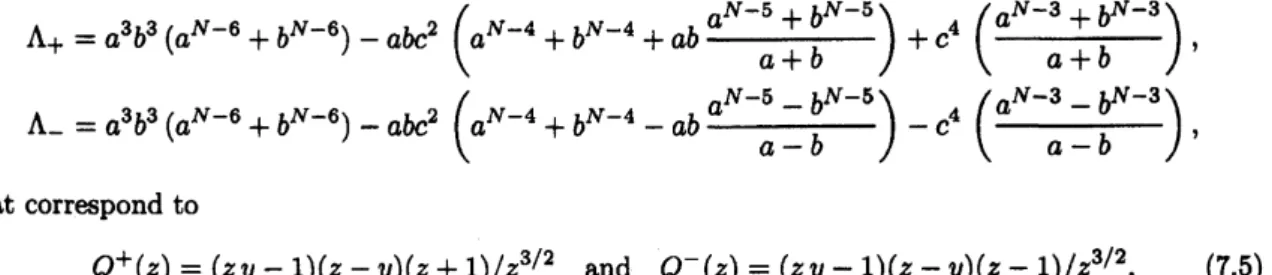
onlytwo bound pairs in the blockandthe generalization of(7.2) and (7.3) is
$\Lambda_{+}=a^{3}b^{3}(a^{N-6}+b^{N-6})-abc^{2}(a^{N-4}+b^{N-4}+ab\frac{a^{N-5}+b^{N-5}}{a+b})+c^{4}(\frac{a^{N-3}+b^{N-3}}{a+b})$
,
$\Lambda_{-}=a^{3}b^{3}(a^{N-6}+b^{N-6})-abc^{2}(a^{N-4}+b^{N-4}-ab\frac{a^{N-5}b^{N-b}}{ab}=)-c^{4}(\frac{a^{N-3}b^{N-3}}{ab}=)$ ,that correspondto
$Q^{+}(z)=(zy-1)(z-y)(z+1)/z^{3/2}$ and $Q^{-}(z)=(zy-1)(z-y)(z-1)/z^{3/2}$, (7.5)
respectively. The quotients written in $\Lambda_{\pm}$ above
are
$\mathrm{f}\mathrm{i}\mathrm{c}\mathrm{t}\mathrm{i}\mathrm{t}\mathrm{i}\mathrm{o}\mathrm{u}\mathrm{s}^{1}$because the divisionscan
beperformedexactly giving asresult polynomials in $a,$$b,$ $c$ with nodenominators.
Each eigenvectorof thetransfer matrix has associatedagiven $Q(z)$,
we
now calculate as anexamplethe eigenvector associated to $Q^{+}$ in (7.5) for $N=6$ usingBethe
ansatz.11
For such state the product$e^{i(k_{1}+k_{2}+k_{3})}=1$, (7.6)
that
can
bejustifiedin severalmanners:
one, ifthe eigenvalue is known, (7.2) inthis
case, it is enoughto set $b=0,$ $a=c$ in the eigenvalue. The coefficient of $c^{N}$ is precisely $e^{\mathrm{t}(k_{1}+\cdots+k_{*})}$’ [9];
or
two,evaluating $(-1)^{n}Q(zy^{2})/Q(z)$ atthe point $z=1/y[1]$
.
This gives also such product. Sincethe thirdzero ofthe function $Q^{+}$ is at $z_{3}=-1$, relation (4.7) indicates that $e^{1k_{3}}=-1$, that substituted in
(7.6) gives the product $e^{:(k_{1}+k_{2})}=-1$, something that seemsto be sharedby all boundpairs ofthe
model
as we
remarkedin (6.6). Forour
pair holds again (6.5) what makes that the factor $s_{21}$ vanishesaccording to (4.4). To obtain the correct boundpairstatethe rule$\mathrm{i}\mathrm{s}^{12}$: calculate the
$s_{1j}$ that donot
vanish (in the present case there
are
five ofthem) with (4.4), keeping onlythe dominant termas
$e^{:k_{1}}$goes to zero, andcalculate $s_{21}$ with(4.5). In thismanner,insteadofwritting $‘ s_{21}=0$
’in theformulae,
$s_{21}$ takesthe expressionthatvanishes most rapidly as $e^{:k_{1}}$ goes to
zero.
Thisexpression is$s_{21}=2\Delta(1+2\Delta)e^{i(N-1)k_{1}}$
,
(7.7)while
$s_{12}=2\Delta e^{-ik_{1}}$
,
$s_{13}=1+2\Delta$, $s_{31}=1$,$s_{23}=e^{-1k_{1}}$, $s_{32}=(1+2\Delta)e^{-ik_{1}}$
.
(7.8)Notethat theamplitudesobtained with (4.2) afterthesubstitution of(7.7)and (7.8) do satisfy exactly
equations (4.5),
as
expected. Takenow
$N=6$.
Inserting the values (4.2) into (4.1)we
find that for$1_{\mathrm{I}.\mathrm{e}}.$, introducedby the author tomake the
exPraesions comPact
1iWeinsistonthewords Bethe ansatzbecausesomeauthorsrefer to bound pair statesasnon-Bethestates,and they
areBethestates
example, $f(1,2,3)=-2\Delta(1+2\Delta)^{2}/C$ and $f(1,2,4)=2\Delta(1+2\Delta)e^{-ik_{1}}/C$
.
In thecase
$N=6$two
more
componentsare necessary
to write theeigenvector, namely$f(1,2,5)=-2\Delta(1+2\Delta)e^{-ik_{1}}/C$, $f(1,3,5)=-\mathit{6}\Delta(1+2\Delta)/C$,
sincethe remaining componentsare deducedfrom thesefour with thegeneralization of property (6.4)to
the
case
$n=3$.
Clearly $f(1,2,4),$ $f(1,2,5)$are
the elements that grow most rapidlyas
$e^{ik_{1}}$vanishes
and the sensible choice here is to take $C$ so that $f(1,2,4)=1$
.
The result is the right eigenvectorassociatedto $Q^{+}$ in $(7.5)^{13}$
$|\psi\rangle=|1,2,4\rangle+|2,3,5\rangle+|3,4,6\rangle+|1,4,5\rangle+|2,5,6\rangle+|1,3,6\rangle$
$-|1,2,5\rangle-|2,3,\mathit{6}\rangle-|1,3,4\rangle-|2,4,5\rangle-|3,5,6\rangle-|1,4,6\rangle$, (7.9)
whichcoincides with thevectorfound in [3,
eq.
(22)] using different methods.8 $\mathrm{n}=4$ and $\mathrm{n}=5$
Thereis
no
problem inrepeatingthesame
stepsas
in $n=3$ todeducethe number ofboundpairswhen$n=4$
or
$n=5$.
In fact introducing$Q(z)=(zy-1)(z-y)(z^{2}+Az+B)/z^{2}$ (8.1)
into (5.3), it ispossible to find constants $A$ and $B$
so
that thefunction A(v) isan
eigenvalue ofthetransfer matrixblock $n=4$ forarbitrary $a,$$b,$ $c$ activities. However,
we
followa
different method inthissectionwiththeintentionof obtainingabetter trialfunction $Q$ notasgeneralasin(8.1): wesolve
directly Bethe ansatz equations (4.5)
instead14.
Theequations are alreadysolved for $e_{1}$ and $e_{2}$ (forbrevitywe will
use
fromnow
the notation $e_{1}$ to denote the number $e:k_{1},$ $e_{2}$ to denote $e^{k_{2}}$, andso
on), since
we
know that $e_{1}=0,$ $e_{2}=-1/e_{1}$, with the product $e_{1}e_{2}$ equal to $-1$as
a characteristic
ofboundpairs. Itremainsto solve for $e_{3},$ $e_{4}$ inthe
case
$n=4$, and for $e_{3},$$e_{4},e_{6}$ inthecase
of $n=5$.
And
when resolvingthesame
care
about $s_{1j}$ has to betaken thatwhen
the eigenfunction (7.9)was
constructedin the previoussection: $s_{21}$ that vanisheshas to be evaluatedwith (4.5), taking then the
expressionthatvanishes most rapidlyas $e_{1}$ goes to zero, and the remaining $s_{1j}$ with (4.4). Withthese
remarks takeninto consideration theequationsto solve are
$e_{3}^{N-1}=-( \frac{1-2\Delta e_{3}}{e_{3}-2\Delta})(=\frac{12\Delta e_{3}+e_{3}e_{4}}{12\Delta e_{4}+e_{3}e_{4}})$
,
(8.2)$e_{4}^{N-1}=-( \frac{1-2\Delta e_{4}}{e_{4}-2\Delta})(=\frac{12\Delta e_{4}+e_{3}e_{4}}{12\Delta e_{3}+e_{3}e_{4}})$, $N\geq 8$, (8.3)
inthe block $n=4$, and
$e_{3}^{N-1}=( \frac{1-2\Delta e_{3}}{e_{3}-2\Delta})(=\frac{12\Delta e_{3}+e_{3}e_{4}}{12\Delta e_{4}+e_{3}e_{4}})(=\frac{12\Delta e_{3}+e_{3}e_{6}}{12\Delta e_{5}+e_{3}e_{6}})$, (8.4) $e_{4}^{N-1}=( \frac{1-2\Delta e_{4}}{e_{4}-2\Delta})(=\frac{12\Delta e_{4}+e_{3}e_{4}}{12\Delta e_{3}+e_{3}e_{4}})(=\frac{12\Delta e_{4}+e_{4}e_{5}}{12\Delta e_{5}+e_{4}e_{6}})$, $N\geq 10$ (8.5) $e_{5}^{N-1}=( \frac{1-2\Delta e_{5}}{e_{5}-2\Delta})(=\frac{12\Delta e_{6}+\mathrm{e}_{3}e_{6}}{12\Delta e_{3}+e_{3}e_{5}})(=\frac{12\Delta e_{5}+e_{4}e_{5}}{12\Delta e_{4}+e_{4}e_{6}})$, (8.6)
$\underline{\mathrm{w}\mathrm{h}\mathrm{e}\mathrm{n}n=5.}$Remember that $\Delta \mathrm{i}\S$givenby (4.3) and $N$ is
an
even
number.i3Fbrgeneral $N$ theeigenvectoris $|\psi\rangle$ $= \sum_{l\approx 1}^{N}(|l,l+1, l+3\rangle-|l,l+2, l+3\rangle)$
.
The state thataccompaniesto $Q^{-}$is $|\psi\rangle$ $= \sum_{l=1}^{N}(-1)^{l}(|1,l+1,[+3\rangle+|l,l+2,[+3\rangle)$
.
Ithaseomesimilary with(6.3)but intheblock $n=3$14Once $\epsilon:k_{\theta},$
$\ldots$,
Consider the equations relative to $n=5$ for a moment. Notice that if $(e_{3}, e_{4}, e_{5})$ is a solution ofequations $(8.4)-(8.6)$ for given $N$ and $\Delta^{15}$, also $(e_{4}, e_{3}, e_{5})$, the interchange of $e_{3}$ with $e_{4}$, is a
solution; and also it is $(e_{3}, e_{5}, e_{4})$
.
Equations $(8.4)-(8.6)$ do not distinghisha
solution from any ofits permutations. It is for this reason that two solutions
are
considered thesame
if coincide up topermutations.
There is another relevant property of the equations: if $(e_{3}, e_{4}, e_{5})$ is
a
solution, $( \frac{1}{e_{8}},$$\frac{1}{e_{4}},$$\frac{1}{e_{5}})$ isalso
a
solution for thesame
$N$ and $\Delta$.
Thisfeature brings considerableinsight into the resolutionof$(8.4)-(8.6)$
.
For example, if $e_{3}$ is in the solutionso
does $1/e_{3}$,as
this property establishes, therefore$1/e_{3}$ is
one
ofthe
numbers in $(e_{3}, e_{4}, e_{5})$.
Ifit is equal toitsinverse, $e_{3}$ is1 or
$-1$ ,but
ifnot, theinverse of $e_{3}$ has to be say, $e_{4}$, andthus $e_{3}e_{4}=1$. The argument is repeatedwith $e_{4}$ to conclude
that $e_{4}$ is 1
or
$-1$ ortheinverseof$e_{3}$.
Finally, it istheturn of $e_{5}$,thatcan
be only $\pm 1$ and nottheinverse of any other number becausethere
are no more
left numbers to bepaired with.In
conclusion:$(e_{3}, e_{4}, e_{5})$ are (1, 1,1), $(-1, -1, -1)$ or $(e_{3}, e_{4}, \pm 1)$ , with $e_{3}e_{4}=1$
.
There areno more possibilitiesfor
arbitrary $\Delta$.
Something similar happens when $n=4$: the only solutions $(e_{3}, e_{4})$ of (8.2), (8.3)with $\Delta$ arbitrary
are
$(1, -1)$or
the combinations $(e_{3}, e_{4})$ that satisfy$e_{3}e_{4}=1$
.
Obviouslythis is sobecause
the two properties explained above, permutationand inversion, hold forequations (8.2), (8.3)as
well16.
Lemma 8.1 $(n=4)$ The numbers $e_{3},$ $e_{4}$ given by equations (8.2), $($8.$S)$ subject to the condition
$e_{3}e_{4}=1$,
are
the rootsof
the quadratic polynomial$x^{2}-(r+1/r)x+1=0$
,
(8.7)where $r$ is, in $tum$, the solution
of
thepolynomialof
degree $N$ withcoefficients fixed
by $\Delta\dot{\varphi}ven$ by$r^{N}-3\Delta r^{N-1}+2\Delta^{2}(r^{N-2}+r^{2})-3\Delta r+1=0$
.
(8.8)Proof Very simple. Just substitute directly $e_{3}=r,$ $e_{4}=1/r$ in (8.2) and write the relation that
results. Zero solutions $r=0$
are
notwanted17.
$\square$Surprisingly, the polynomial in (8.8) has the
same
coefficientswhen $N=8$, say,that when $N=1\mathrm{O}\mathrm{O}$,only that inthiscasethecoefficientsare distributedaccording to adegree 100. Equality(8.8) belongs
to the class of reciprocal equations [10] because the coefficient of $r^{N}$ is the same as the independent
term, thecoefficient of $r^{N-1}$ the
same as
the coefficient of $r$, andso on.
If $R$ isa
rootofa
reciprocalequation, soit is its reciprocal $1/R$
.
This cannot be asurprise, merely it isan expectedconsequenceofthe second property of theBetheequationsremarked a few paragraphs above.
Lemma 8.2 $(n=5)$ The numbers $e_{3},$ $e_{4},$ $e_{5}$ givenby equations$(\mathit{8}.\mathit{4})-(\mathit{8}.\mathit{6})$ with the additiond
require-ment $e_{3}e_{4}=1$, $e_{5}=-1$,
are
the rootsof
the cubicpolynomial$(x+1)(x^{2}+(r+1/r)x+1)=0$, (8.9)
$wheoe\sim r$ is the solution
of
(for simplicitywe
write the polynomialwhen $N=10$)$r^{10}+(5\Delta+2)r^{9}+2(2\Delta+1)^{2}r^{8}+2(2\Delta+1)(\Delta+1)^{2}(r^{7}+r^{6}+r^{5}+r^{4}+r^{3})$
+2$(2 \Delta+1)^{2}r^{2}+(5\Delta+2)r+1=0$
.
(8.10)$1\epsilon_{\Delta}$ flxed thougharbitrary
16Observethat for all boundpairsobtain\’esofar theproduct $e_{1}\cdots e_{n}=\pm 1$,something alreadymentioned in[1]and
[3].The momentum of thaeestates,thesumofthe $k’ \mathrm{s}$, is therefore $0$ or $\pi$ (mod $2\pi$)
17Wewant $e_{3}\mathrm{e}_{4}=1$ with $\mathrm{c}_{3}$ and $e_{4}$ finitenumbers. Thereforenoneofthem vanishes. We do not wantmoresnial
This is a reciprocal equation too. When $N$ is arbitrary, the polynomial that generalizes (8.10) is
a polynomial of degree $N$: $r^{10},$ $r^{9},$ $r^{8}$ above change into $r^{N},$ $r^{N-1},$ $r^{N-2}$, respectively, and
$r^{7}+\cdots+r^{3}$ into $r^{N-3}+\cdots+r^{3}$
.
Nothingelsechanges. With thesedirectionswe
avoidto write thegeneralization explicitly.
When therequirement is $e_{3}e_{4}=1,$$e_{5}=1$, the solution (es,$e_{4},$$e_{5}$) ofequations $(8.4)-(8.6)$ is given by
$(x$ –1$)$ $x^{2}+(r+1/r)x+1$ $=0$, i.e., $e_{3}=-r,$ $e_{4}=-1/r,$$e_{5}=1$, with $r$ the rootsof the polynomial
obtained changing $r$ by $-r$ and $\Delta$ by $-\Delta$ in (8.10). Thepolynomial thus obtained is generalized to
other $N‘ \mathrm{s}$with the directions explained in the previous lines.
Proof The substitution of $e_{3}e_{4}=1$ and $e_{6}=-1$ in (8.6) gives
no information
because the l.h.s. of(8.6)reducesto
a
number andthe
r.h.s. to thesame
number. However,substituted
in(8.4) (orin(8.5))isobtained
a
relation between thesum
$e_{3}+ \frac{1}{e_{3}}=e_{4}+\frac{1}{e_{4}}=u$ and $\Delta$.
This relation dependson
$N$and, forexample, when $N=10$ is given by
$u^{5}-(5\Delta+2)u^{4}+(8\Delta^{2}+8\Delta-3)u^{3}-(4\Delta^{3}+10\Delta^{2}-12\Delta-6)u^{2}$
$+(4\Delta^{3}-14\Delta^{2}-16\Delta+1)u+2(2\Delta-1)(\Delta^{2}+3\Delta+1)=0$
.
(8.11)It is hard to
see
anyrecurrence
inthis equationbut if $u$ isdecomposed into anumber and itsinverse,i.e.,as $u=-(r+1/r),$ $r$ is aroot of(8.10), which is
a
much simplerequationthanthe previousone.
The numbers $e_{3}=-r,$ $e_{4}=-1/r,$ $e_{5}=-1$, are therefore roots of(8.9) with $r$ given by (8.10) if
$N=10$
.
$\square$Now
we
count states. Starting with $n=4$,we
have the statecharacterized
by $(e_{1},e_{2},e_{3},e_{4})=$$(e_{1}, -1/e_{1},1, -1)$ obtained beforeLemma 8.1. For this state $e_{1}e_{2}e_{3}e_{4}=1$, and $Q$ and A
are
givenby
$Q(z)=(zy-1)(z-y)(z^{2}-1)/z^{2}$, (8.12)
$\Lambda=a^{4}b^{4}(a^{N-8}+b^{N-8})-a^{2}b^{2}c^{2}(a^{N-6}+b^{N-6}-2a^{2}b^{2}\frac{a^{N-8}b^{N-8}}{a^{2}b^{2}}=)$
$-3a^{2}b^{2}c^{4}( \frac{a^{N-6}b^{N-6}}{a^{2}b^{2}}=)+c^{6}(\frac{a^{N-4}b^{N-4}}{a^{2}b^{2}}=)$, $N\geq 8$ (8.13)
as deduced from(4.7), (5.2) andthe relation (5.3). Asin $\Lambda_{\pm}$ obtain\’einSect.7, the quotients in(8.13)
are artificial, and the divisions
can
be performed exactly giving for A an homogeneous expression oforder $N$ in $a,$$b,$ $c$ with constantcoefficients. Regarding thesolution $(e_{1}, -1/e_{1},r, 1/r)$ ofLemma 8.1,
notice that since the roots of (8.8) are single or at most
double18,
thereare
$N/2$ differentsolutions
because of the reciprocityof(8.7) and(8.8). Forthese $N/2$ solutions(i.e., states) $e_{1}e_{2}e_{3}e_{4}=-1$, and
$Q$ isgiven by
$Q(z)=(zy-1)(z-y)(z^{2}-(t+1/t)z+1)/z^{2}$, (8.14)
with
$t+ \frac{1}{t}=-\frac{2\Delta(r+1/r)-4}{r+1/r-2\Delta}$, $\Delta\neq\pm 1$
.
(8.15)The number A(v) isobtained inserting (8.14) and (8.15) into (5.3). This result shows also that (8.12)
and (8.14) are
more
accuratetrial functions to solve (5.3) than the general (8.1). Contrary to whati8Thediscriminant of (8.8) in $r$ vanishesonly for $\Delta=\pm 1/2,$$\pm 1$, thus indicatingmultiplicityoftheroots $r$ more
than 1 only forthaeevalues. Why for these$\mathrm{v}\mathrm{a}\mathrm{l}\mathrm{u}\mathrm{a}\mathrm{e}^{\gamma}$ Notice that the bilineartransformation $\mathrm{e}_{3}arrow 1\underline{-}2\Delta \mathrm{e}$ inthe$\mathrm{r}.\mathrm{h}.\epsilon$
.
$\mathrm{e}0-2\Delta$
of(8.2) (andin ther.h.s. of(8.3)for $e_{4}$) collapsestoaconstant when $\Delta=\pm 1/2$ insteadof beingaone-toonemapping.
This$\mathrm{j}\mathrm{u}\epsilon \mathrm{t}\mathrm{f}\mathrm{f}\mathrm{i}\infty$themultiplicities at $\Delta=\pm 1/2$. Asimilar reasonhappengwhen $\mathrm{e}_{3}e_{4}=1$ and $\Delta=\pm 1$ to thesecond
we have done along this paper, wedo not write the function A(v) associatedto (8.14) and (8.15) for
general $N$, butwewrite it when $N=8$, which is
$\Lambda(v)=2a^{4}b^{4}+c^{2}$
(
$2\lambda_{2}a^{3}b^{3}-\lambda_{3^{O^{2}}}b^{2}(a^{2}+b^{2})-2\lambda_{1}$ab$(a^{4}+b^{4}-a^{2}b^{2})-a^{6}-b^{6}$),
(8.16)with $\lambda_{1},$$\lambda_{2},$$\lambda_{3}$ certain numbers depending on $\Delta$ that wedo not specify. The object topresent (8.16)
is to commentabout theexcluded
cases
$\Delta=\pm 1$ pointedin (8.15). Wehaveexcluded
thesetwo pointsfor mathematical
reasons
only. Letus
fix $\Delta=1$ (we center the discussion in this value because thepolynomial (8.8) indicates that the situation when $\Delta=-1$ is thesamejust negating $r$). Subtituting
$\Delta=1$ in (8.15), the r.h.s. reduces either to theconstant $-2$ orto the indetermination 0/019: which
is then the function (8.14) and how
many
of themcan
one
write when $\Delta=1$? We wont bemore
explicit inthispoint now,however
we
wanttoconvincethe reader thatfor $N=8,$$\Delta=1$ thereare
four(eventually $N/2$ forgeneral $N$, if thingsgo
as
theyshall) bound pair stateswith $e_{1}e_{2}e_{3}e_{4}=-1$: wehavejustconstructedthestates (4.1)with(4.2), (4.4)and (4.5) imposing theconditions (6.5)and (6.6);
we
have obtained exactly four states, and have checked (diagonalizing numericaUy the matrix block)that they areeigenvectosof the transfermatrix (2.1) when $N=8,$$n=4$
.
The associated eigenvaluesareprecisely (8.16) with $\lambda_{1}=0,$$-3.69963$,-1.76088,
0.46050520,
and $\lambda_{2},$$\lambda_{3}$ given in terms of $\lambda_{1}$ by$\lambda_{2}=\frac{2-3\lambda_{1}^{2}-4\lambda_{1}}{2+\lambda_{1}}$, $\lambda_{3}=2\lambda_{1}^{2}+2\lambda_{1}-1$, $\Delta=1$
.
(8.17)In conclusion, for each real value of $\Delta$ in the vertex model, there
are
$N/2+1$ bound pair statesin the $n=4$ block of the $N$-site transfer matrix. The number of such states is
correct21
becauseexact diagonalization ofthe block corroborates it:
our
numericalexperiments carried up to $N=12$with different but arbitrary values of the activities $a,$$b,$ $c$ confirm that the numbers A(v) obtained
substituting $Q$ by (8.14) with (8.15) and (8.8) into (5.3) are true eigenvalues of the transfer matrix.
The number (8.13)isalso aneigenvalue. We haveno reasonthentodoubtthatthey
are
eigenvaluesforgeneral $N$ as well. The author thus admits thenumber $N/2+1$
as
absolutely right.For $n=5$, we count a total of $N$ bound pairs. This is
so
because the solutions $(e_{3}, e_{4}, e_{6})=$$(1,1,1),$$(-1, -1, -1)$ ofequations $(8.4)-(8.6)^{22}$ donot affordeigenvalues of the transfer matrix for $\Delta$
generic. We noticed this fact from
our
numerical tests carried with different values of $a,$$b,$ $c$ and$N=10,12$: thenumbers A obtained with (5.3) and $Q$ asin(5.2)withzerosat $z_{1}=y,$$z_{2}=1/y,$$z_{3}=$
$z_{4}=z_{5}=\pm 1$ and $y$ arbitrary, do not correspond to eigenvalues of the transfer
matrix23.
Unlikethis,the solutions in Lemma 8.2 that $\mathrm{s}\mathrm{a}\mathrm{t}\mathrm{i}\mathrm{s}6^{r}e_{3}e_{4}e_{5}=-1$ afford $N/2$ bound pairs for each $\Delta$, and the
solutions that satisfy $e_{3}e_{4}e_{5}=1$ afford another $N/2$ bound pairs (even for $\Delta=\pm 1$ in both cases).
Thecorresponding numbers A
were
checked numerically. These eigenvaluesare
obtained with$Q(z)=(zy-1)(z-y)(z^{2}-(t+1/t)z+1)(z\pm 1)/z^{5/2}$, (8.18)
the plus sign in $\pm \mathrm{i}\mathrm{s}$for $e_{1}e_{2}e_{3}e_{4}e_{6}=1$ (i.e.,
$e_{3}e_{4}e_{5}=-1$), theminus signfor $e_{1}e_{2}e_{3}e_{4}e_{5}=-1$
.
Inbothfunctionswritten in (8.18)
$t+ \frac{1}{t}=-\frac{2\Delta(r+1/r)+4}{r+1/r+2\Delta}$, $\Delta\neq\pm 1$, (8.19)
but $r$ is theroot of differentpolynomials,
as
statedin Lemma8.2.$19_{f}=1$ issolutionof(8.8)when $\Delta=1$
$20\mathrm{A}\mathrm{p}\mathrm{p}\mathrm{r}\alpha \mathrm{i}\mathrm{m}\mathrm{a}\mathrm{t}\mathrm{e}\mathrm{d}$to the nearest sixdigitnumberthe lastthreedata
21Inreference [1]were found 5 states when $N=8,$ $n=4$ ,aswe mentionedinSect. 1. Our result agreeswith that number
22Wementioned these solutionsintheparagraph before Lemma8. 1
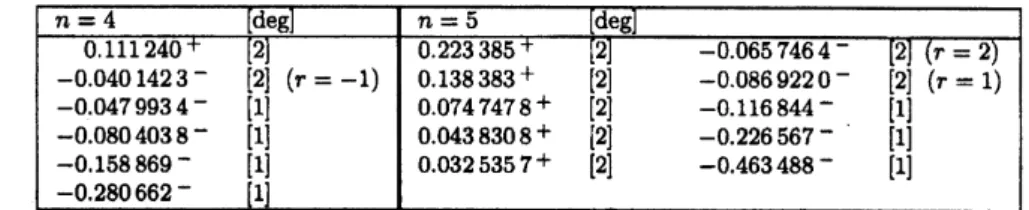
Wewrite anexamplefor $N=10$ and $\Delta=-1/2$, with the choice of $z,$$y,$$\rho$ as inthe left column
ofTable 1. After diagonalizing numerically the blocks $n=4,5$ of the transfer matrix, theeigenvalues
corresponding to bound pairs (we have recognized them because they match exactly
our
predictedvalues)$\mathrm{a}\mathrm{p}\mathrm{n}\mathrm{r}\mathrm{o}\mathrm{x}\mathrm{i}\mathrm{m}\mathrm{a}\mathrm{t}_{}\theta \mathrm{d}$ tothe $\mathrm{n}\Leftrightarrow \mathrm{a}\mathrm{r}\mathrm{p}..\mathrm{q}\mathrm{t}.$six $\mathrm{d}\mathrm{i}\sigma \mathrm{i}\mathrm{f},$ $\mathrm{n}\iota\iota \mathrm{r}\mathrm{n}\mathrm{b}_{6\mathrm{r}\mathrm{a}YP}..24$
:
Table2. Eacheigenvaluelisted isfollowedbyasign $+\mathrm{o}\mathrm{r}$ –: the sign $+\mathrm{i}\mathrm{n}\mathrm{d}\mathrm{i}\mathrm{c}\mathrm{a}\mathrm{t}\mathrm{e}\mathrm{s}$that $e_{1}e_{2}e_{3}e_{4}=1$ (orthat $e_{1}e_{2}\epsilon_{3}\epsilon_{4}\mathrm{e}_{6}=1$
if $n=5$),the sign –that theproductof the Betherootsis $-1$
.
The degeneration of the eigenvalue is$[\deg]$. In the columncorresponding to $n=4$,the number 0.111240 coincides with (8.13), andthe remainingfive values agreewiththe theoretical
A obtainedinserting(8.14)and(8.15)into(5.3). Theeigenvalue that corresponds to $r=-1$,remember thatin this column $r$
isasolutionof(8.8), is degenerated. $\mathrm{T}\mathrm{h}\dagger \mathrm{s}$degenerationis
notasurprise, because it$is$acasein which two Bethe roots coincide
$(e_{3}=e_{4}=-1)$ , and whenit is true that the eigenvector associatedtosuchcasesisusually thezerovector, when $\Delta=-1/2$
it is not. Regardingthe list when $n=5$ ,the values with a $+$ correspond to solutions $r$ of(8.10), and thevalueswitha
-tosolutions $r$ of thepolynomial thatisobtained changing in (8.10)the variables $r,$$\Delta$ by
$-r,$$-\Delta$
.
Totally expected isthedegenerationof the eigenvalue -0.0869220 since $e_{3}=e_{4}=-1,$$e\mathrm{s}=1$. But the degeneration of -0.0657464 which
happensfor $e_{3}=-2,$$\epsilon_{4}=-1/2,$$e_{6}=-1$ islessexpected.
The last comment ofthe paper: the numerators of (6.1), (7.5), (8.12), (8.14) and (8.18)
are
polyno-mials in $z$ with
a
reciprocal property: if $R$ isa
solution,so
it is $1/R$.
When lookingfor other $Q’s$ in$n=7$ (say)
one
has to restricttonumerators withthis property. AcknowledgmentsI am pleased to thank Prof. J. Shiraishi and the organizers of the RIMS 2004 Symposium, Recent
progressin Solvable LatticeModels, held in Kyoto forallowing meto exposethese ideas. Inmywork
I amgrateful to G.
Alvarez
Galindo for resolving some of mydoubts. But to whom I feel inevitablygrateful every day is to Pepe Aranda: seventy times
seven
I have knockedon
his door asking aboutpolynomials, roots andother mattersof Calculus, andseventy times
seven
he has receivedme
withoutever
showing the slightest unwelcomegesture in his faceor manners
that preventedme
from knockingon
hisdoor again.Thisworkis financially supported bythe Ministerio de Educacio’n $\mathrm{y}$Cienciaof Spainthrough grant
No. BFM2002-00950.
References
[1] R.J. Baxter, Completeness
of
he Bethe ansatzfor
the six and eight-vertex models, J. Statist. Phys. 108(2002) 1.cond-mat/0111188.
[2] H. Bethe, Zur Theorie derMetalle,Z. Physik 71 (1931)205. English translation: On thetheory
of
metals, I: Eigenvalues and eigenfunctionsof
alinearchainof
atoms in “The many-body problem”,ed.D.C. Mattis, WorldScientific,Singapore, 1993. pages 689-716.[3] R. Siddharthan, $Singu\iota_{af};ties$ in the Bethe solution
of
the XXX and XXZ Heisenberg spin chains, cond-mat/9804210.[4] J.D. Noh, D-S. Lee and D. Kim, Origin
of
the $sin\phi ar$Bethe ansatzsolutionsfor
the Heisenberg XXZspin chain, PhysicaA287 (2000) 167.$\mathrm{c}\mathrm{o}\mathrm{n}\mathrm{d}-\mathrm{m}\mathrm{a}\mathrm{t}/\mathfrak{M}1175$.
[5] M.T. Batchelor,Finite latticemethods in statistical mechanics,Ph.D.thesis,Australian NationalUniversity,
Canberra, 1987.
[6] N. Beisert, J.A.Minahan,M. Staudacher and K. Zarembo, StringingSpins andSpinning Strings,JHEP09 (2003) 010. hep-th/0306139.
[7] T. Fujita, T. Kobayashi and H. Takahashi, Large $N$ behavtor
of
string solutions in the Hersenberg model,J. Phys. $\mathrm{A}$: Math. Gen. 36 (2003) 1553. cond-mat/0207117.
[8] E.H. Lieb, Exact solution
of
the problemof
the entropyof
two-dimensionalice, Phys.Rev. Lett. 18 (1967) 692; Residual entropyof
square ice, Phys. Rev. 162 (1967) 162. B. Sutherland, Exact solutionof
a two-dimensional modelfor
hydrogen-bonded crystals, Phys. Rev. Lett. 19(1967) 103. C.P. Yang, Exactsolutionof
amodelof
two-dimensionalferroelectrecs
inanarbrtraryexternalelectrec field, Phys. Rev. Lett. 19(1967)586.B. Sutherland,C.N. Yang andC.P.Yang, Exact solution
of
a modelof
two-dimensional$feffoelect;\dot{\backslash }cs$in anarbitrary external fidd, Phys. Rev.Lett. 19(1967) 588.
[9] R.J. Baxter,Exactlysolvedmodels in statisticalmechanics,AcademicPress, London,1982. [10] J.V. Uspensky, Theory