EPIMORPHISMS
BETWEEN 2-BRIDGE LINK GROUPS: ESSENTIALSIMPLE
LOOPS ON 2-BRIDGE SPHERESDONGHI LEE ANDMAKOTO SAKUMA
1.
INTRODUCTION
The purpose of
this
note is toexplainsome
of the ideas in [4] which givesan
answer
toa question
on
certain word problemson
2-bridge link groups raised in [10]. The key toolused in the proofis small cancellation theory, applied to two-generator and one-relatior
presentationsof 2-bridge link groups. We note that it has been proved by Weinbaum [16]
and Appel and Schupp [2] that the word and conjugacy problems for prime alternating
link groups
are
solvable, by using small cancellationtheory (see also [3] andreferences
in it). Moreover, itwas
also shown bySela [14] and Pr\’eaux [11] that the word and conjugacyproblems for any link group
are
solvable. A characteristic feature of [4] is that we give acomplete
answer
toa
special (but also natural) word problem for the groups of 2-bridgelinks, which form a special (but also important) family ofprime alternating links. In the
sequels [5, 6, 7] of [4],
we
givea
completeanswer
to certain natural conjugacy problems,and the
solutions
will be used in [8] to establisha
variation ofMcShane‘s
identity for2-bridge link groups, which had been conjectured by [13].
2. MAIN RESULTS
Consider the discrete
group,
$H$, of isometries ofthe Euclidean plane $\mathbb{R}^{2}$ generated bythe $\pi$-rotations around the points in the lattice $\mathbb{Z}^{2}$
. Set
$(S^{2}, P)$ $:=(\mathbb{R}^{2}, \mathbb{Z}^{2})/H$ and callit the Conway sphere. Then $S^{2}$ is homeomorphic to the
2-sphere, and $P$ consists offour
points in $S^{2}$
.
Wealso call $S^{2}$ the Conway
sphere. Let $S$ $:=S^{2}-P$ be the complementary
4-times punctured sphere. For each $r\in\hat{\mathbb{Q}}$ $:=\mathbb{Q}\cup\{\infty\}$, let
$\alpha_{r}$ be the simple loop in $S$
obtained
as
the projection ofa
line in $\mathbb{R}^{2}-\mathbb{Z}^{2}$ of slope$r$. Then $\alpha_{r}$ is essential in $S$,
i.e., it does not bound
a
disk in $S$ and is not homotopic toa
loop arounda
puncture.Conversely,
any essential simple loop in $S$ is isotopic to $\alpha_{r}$ fora
unique $r\in\hat{\mathbb{Q}}$. Then $r$ iscalled
the slope of thesimple loop. Similarly, anysimplearc
$\delta$ in $S^{2}$ joining two differentpoints in $P$ such that $\delta\cap P=\partial\delta$ is isotopic to the image of a line in $\mathbb{R}^{2}$
of
some
slope$r\in \mathbb{Q}$ which intersects $\mathbb{Z}^{2}$. We
call $r$ the slope of $\delta$
.
A trivialtangleis apair $(B^{3}, t)$, where$B^{3}$ is
a
3-balland $t$ isa
unionof twoarcs
properly embeddedin $B^{3}$ whichis parallel toa
unionof two mutually disjointarcs
in$\partial B^{3}$. Let
$\tau$ be
thesimple unknotted
arc
in $B^{3}$ joiningthe twocomponentsof$t$
as
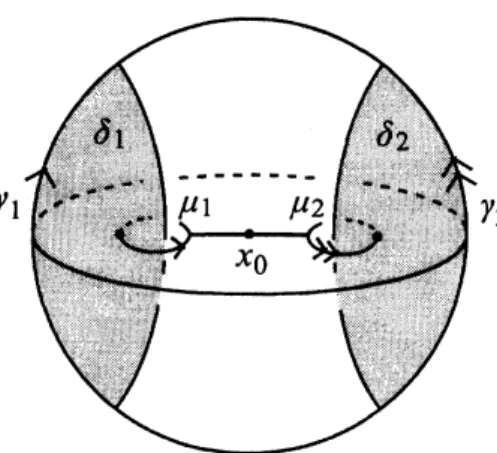
illustrated in Figure 1.Wecall itthe
core
tunnelofthe trivial tangle. Picka
basepoint $x_{0}$ in int$\tau$, andlet $(\mu_{1}, \mu_{2})$be thegenerating pairofthe
fundamental
group$\pi_{1}(B^{3}-t, x_{0})$ eachofwhich is representedby
a
based loop consisting ofa
smallperipheral simple loop arounda
component of$t$ anda
subarc of $\tau$ joining the circle to$x_{0}$. For any base point $x\in B^{3}-t$, the generating
pair of $\pi_{1}(B^{3}-t, x)$ corresponding to the generating pair $(\mu_{1}, \mu_{2})$ of$\pi_{1}(B^{3}-t, x_{0})$ via
a
FIGURE 1. A trivial tangle
path joining $x$ to $x_{0}$ is denoted by the
same
symbol. The pair $(\mu_{1}, \mu_{2})$ is unique up to(i)
reversal
of the order, (ii) replacement ofone
of
the members with its inverse, and (iii)simultaneous conjugation. We
call
the equivalence class of $(\mu_{1}, \mu_{2})$ the meridian pairofthe fundamental group $\pi_{1}(B^{3}-t)$
.
By
a
rational tangle,we
mean
a
trivial tangle $(B^{3}, t)$ which is endowed witha
homeo-morphismfrom $\partial(B^{3}, t)$ to $(S^{2}, P)$
.
Through thehomeomorphismwe
identifythebound-ary of
a
rational tangle with the Conway sphere. Thus the slopeof
an
essential
simpleloop in $\partial B^{3}-t$ is defined. We define the slope of
a
rational tangle to be the slope ofan
essential loopon
$\partial B^{3}-t$ which boundsa
disk in $B^{3}$ separating the components of $t$.(Such
a
loop is unique up to isotopyon
$\partial B^{3}-t$ and is calleda
meridian of the rationaltangle.) We denote
a
rational
tangleof
slope $r$ by $(B^{3}, t(r))$.
Byvan
Kampen’s theorem,the
fundamental group
$\pi_{1}(B^{3}-t(r))$ isidentified
with the quotient $\pi_{1}(S)/\langle\langle\alpha_{r}\rangle\rangle$,where
$\langle\langle\alpha_{r}\rangle\rangle$ denotes the normal closure.
For each$r\in\hat{\mathbb{Q}}$, the 2-bridge link$K(r)$
of
slope $r$ is defined tobe thesum
ofthe rationaltangles ofslopes $\infty$ and $r$, namely, $(S^{3}, K(r))$ is obtained from $(B^{3}, t(\infty))$ and $(B^{3}, t(r))$
by identifying their boundaries through the identity map
on
the Conway sphere $(S^{2}, P)$.
(Recall that the boundaries of rational tangles
are
identified with the Conway sphere.)$K(r)$ has
one or
two components accordingas
the denominator of$r$ isoddor
even.
We call$(B^{3}, t(\infty))$ and $(B^{3}, t(r))$, respectively, the upper tangle and lower tangle of the 2-bridge
link.
Let $\mathcal{D}$ be the Farey tessellation, whose ideal vertex set is identified with
$\hat{\mathbb{Q}}$. For each
$r\in\hat{\mathbb{Q}}$, let $\Gamma_{r}$ be the
group
ofautomorphisms of$\mathcal{D}$ generated by reflections inthe edges of
$\mathcal{D}$ with
an
endpoint$r$,
and
let $\hat{\Gamma}_{r}$ be the group generated by $\Gamma_{r}$ and $\Gamma_{\infty}$.Then
the region,$R$, bounded by
a
pair of Farey edges withan
endpoint $\infty$ anda
pair of Farey edges withan
endpoint $r$ formsa
fundamental domain ofthe action of $\Gamma_{r}$on
$\mathbb{H}^{2}$ (see Figure 2). Let$I_{1}$ and $I_{2}$ be the closed intervals in
$\hat{\mathbb{R}}$
obtained
as
the intersection with $\hat{\mathbb{R}}$of the closure
of $R$
.
Suppose that $r$ is a rational number with$0<r<1$
. (We may alwaysassume
thisexcept when
we
treat the trivial knot and the trivia12-component link.) Write$r= \frac{}{m_{1}+\frac{11}{m_{2}+\cdot..+\frac{1}{m_{k}}}}=:[m_{1}, m_{2}, \ldots, m_{k}]$
where
$k\geq 1,$ $(m_{1}, \ldots, m_{k})\in(\mathbb{Z}_{+})^{k}$, and $m_{k}\geq 2$. Then the above intervalsare
given by$I_{1}=[0, r_{1}]$ and $I_{2}=[r_{2},1]$, where
$r_{1}=\{\begin{array}{ll}[m_{1}, m_{2}, \ldots, m_{k-1}] if k is odd,[m_{1}, m_{2}, \ldots, m_{k-1}, m_{k}-1] if k is even,\end{array}$
$r_{2}=\{\begin{array}{ll}[m_{1}, m_{2}, \ldots, m_{k-1}, m_{k}-1] if k is odd,[m_{1}, m_{2}, \ldots, m_{k-1}] if k is even.\end{array}$
2$]$
FIGURE 2.
A fundamental
domainof
$\hat{\Gamma}_{r}$in the Farey tessellation (the
shaded domain) for
$r=5/17= \frac{1}{3+\frac{1}{2+\frac{1}{2}}}=:[3,2,2]$
.
We recall the following fact ([10, Proposition
4.6
and Corollary4.7] and [4, Lemma7.1])which describes the role of$\hat{\Gamma}_{r}$ in the study of 2-bridge link
groups.
Proposition 2.1. (1)
If
two elements $s$ and $s’$of
$\hat{\mathbb{Q}}$belong to the same orbit $\hat{\Gamma}_{r}$-orbit,
then the unoriented loops $\alpha_{s}$ and $\alpha_{s’}$
are
homotopic in $S^{3}-K(r)$. (2) For any $s\in\hat{\mathbb{Q}}$, there isa
uniquemtional number $s_{0}\in I_{1}\cup I_{2}\cup\{\infty, r\}$ such that
$s$ is contained in the $\hat{\Gamma}_{r}$
-orbit
of
$s_{0}$. In particular, $\alpha_{s}$ is homotopic to $\alpha_{s0}$ in $S^{3}-K(r)$.
Thus
if
$s_{0}\in\{\infty, r\}$ then $\alpha_{s}$ is null-homotopic in $S^{3}-K(r)$.Thus the following question naturally arises (see [10, Question $9.1(2)]$).
Question 2.2. (1) Which essential simple loops
on
$S$are
null-homotopic in $S^{3}-K(r)$?(2) For two distinct rational numbers $s,$$s’\in I_{1}\cup I_{2}$, when
are
the unoriented loops $\alpha_{s}$and $\alpha_{s’}$ homotopic in $S^{3}-K(r)$?
A complete
answer
to Question 2.2(1) is given by [4, Main Theorem 2.3]as
follows.Theorem 2.3. The loop $\alpha_{s}$ is null-homotopic in $S^{3}-K(r)$
if
and onlyif
$s$ belongs tothe $\hat{\Gamma}_{r}$-orbit
of
$\infty$or
$r$.
In other words,if
$s\in I_{1}\cup I_{2}$ then $\alpha_{s}$ is not null-homotopic in$S^{3}-K(r)$
.
This theorem impliesthe following
theorem
[4,Main
Theorem 2.4], whichgivesa
partialTheorem
2.4.
There isan
upper-meridian-pair-preserving epimorphismfrom
$G(K(s))$to $G(K(r))$
if
and onlyif
$s$or
$s+1$ belongs to the$\hat{\Gamma}_{r}$
-orbit
of
$r$or
$\infty$.The following theorem, established in the series of papers [5, 6, 7], gives
a
completeanswer
to Question 2.2(2).Theorem 2.5. (1) Suppose $r=1/p$, where $p\geq 2$ is
an
integer. Then,for
any
twodistinct $s,$$s’\in I_{1}\cup I_{2}$, the
unoriented
loops $\alpha_{s}$ and$\alpha_{s’}$are
homotopic in $S^{3}-K(r)$if
andonly
if
$s=q_{1}/p_{1}$ and $s’=q_{2}/p_{2}$ satisfy $q_{1}=q_{2}$ and$q_{1}/(p_{1}+p_{2})=1/p$, where $(p_{i}, q_{i})$ isa
pair
of
relatively prime positive integers.(2) Suppose $r=3/8$, namely $K(r)$ is the Whitehead link. Then,
for
any two distinct$s,$$s’\in I_{1}\cup I_{2}$,
the
$unor\dot{v}ented$ loops $\alpha_{s}$and
$\alpha_{s’}$are
homotopic in $S^{3}-K(r)$if
and
onlyif
the
set
$\{s, s’\}$ equalseither
{1/6,
3/10}or
{3/4,
5/12}.(3) Suppose $r\neq 1/p$ and $r\neq 3/8$. Then,
for
any two distinct $s,$$s’\in I_{1}\cup I_{2}$, theunoriented loops $\alpha_{s}$ and $\alpha_{s’}$
are never
homotopic in $S^{3}-K(r)$.These results will be used in [8] to prove the following variation ofMcShane‘s identity,
which had been conjectured in [13].
Theorem 2.6. Suppose $r=q/p$
satisfies
the condition $q\not\equiv\pm 1(mod p)$, and let $\rho$ bethe holonomy representation
of
the complete hyperbolicstructure
of
$S^{3}-K(r)$.
Then thefollowing identity holds:
2$\sum_{s\in intI_{1}}\frac{1}{1+e^{l_{\rho}(\alpha_{8})}}+2\sum_{s\in intI_{2}}\frac{1}{1+e^{l_{\rho}(\alpha_{S})}}+\sum_{s\in\partial I_{1}\cup\partial I_{2}}\frac{1}{1+e^{l_{\rho}(\alpha_{S})}}=-1$.
Further the modulus
$\lambda(L(r))$of
the cusp torusof
the cuspedhyperbolic
manifold
$S^{3}-K(r)$with respect to
a
suitable choiceof
a longitude is given by the followingformula:
$\lambda(K(r))=2\sum_{s\in intI_{1}}\frac{1}{1+e^{l_{\rho}(\alpha_{8})}}+\sum_{r\in\partial I_{1}}\frac{1}{1+e^{l_{\rho}(\alpha_{s})}}$ .
In the above theorem, $l_{\rho}(\alpha_{s})$ is
an
element of $\mathbb{C}/2\pi\sqrt{-1}\mathbb{Z}$ definedas
follows. The$PSL(2, \mathbb{C})$-representation of $\pi_{1}(S)$ induced by $\rho$ extends to
a
representation, denotedby the
same
symbol $\rho$, of the orbifold fundamental group of the$($2,2, 2,$\infty)$-orbifold,
$\mathcal{O}$, obtained
as
the quotient of $S$ by the natural $\mathbb{Z}/(2\mathbb{Z})\oplus \mathbb{Z}/(2\mathbb{Z})$-action (see e.g., [1,Proposition 2.2.2]$)$
.
Each simple loop $\alpha_{s}$ in $S$ doublycovers
a
simple loop in$\mathcal{O}$. Let $\sqrt{u_{s}}$
be (aconjugacy classof)
an
element of$\pi_{1}(\mathcal{O})$ representedby the simple loop. Then $l_{\rho}(\alpha_{s})$denotes the
complextranslation
lengthof
the hyperbolic isometry$\rho(\sqrt{u_{s}})\in PSL(2,\mathbb{C})\cong$Isom$(\mathbb{H}^{3})$.
Wealso obtainthe following theoremconcerningthe set of end invariants $\mathcal{E}(\rho)$, defined
by Tan, Wong and Zhang [15], of the $PSL(2, \mathbb{C})$-representation of $\pi_{1}(T)$ induced by the
representation $\rho$ in Theorem 2.6, where
$T$ is the once-punctured torus
obtained
as
thedouble covering of the orbifold $\mathcal{O}$.
Theorem 2.7. Let $r=q/p$ be a mtional number.
If
$q\not\equiv\pm 1(mod p)$, then let $\rho$ bethe holonomy representation
of
the complete hyperbolic structureof
$S^{3}-K(r)$.If
$q\equiv$$\pm 1(mod p)$, then let $\rho$ be the
faithful
discrete $PSL(2, \mathbb{R})$-representationof
the quotientof
$G(K(r))$ by theinfinite
cyclic center. In both cases,we
continue to denote by thesame
symbol $\rho$ the $PSL(2, \mathbb{C})$-representationof
$\pi_{1}(T)$ induced by $\rho$.
Then the setof
endinvariants $\mathcal{E}(\rho)$
of
$\rho$ is equal
to
the limitset
$\Lambda(\hat{\Gamma}_{r})$
FIGURE 3. $\pi_{1}(B^{3}-t(\infty), x_{0})=F(a, b)$, where $a$ and $b$
are
represented by$\mu_{1}$ and $\mu_{2}$, respectively.
3.
PRESENTATIONS
OF 2-BRIDGE LINK GROUPSIn this section, we introduce the upper presentation of
a
2-bridge link group which weshall
use
throughout this paper. Byvan
Kampen’s theorem, the linkgroup
$G(K(r))=$$\pi_{1}(S^{3}-K(r))$ is
identified with
$\pi_{1}(S)/\langle\langle\alpha_{\infty},$ $\alpha_{r}\rangle\rangle$.We call the
image inthe link group of
the meridian pair ofthe
fundamental
group $\pi_{1}(B^{3}-t(\infty))$ (resp. $\pi_{1}(B^{3}-t(r))$ the uppermeridian pair (resp. lower meridian pair). The link group is regarded
as
the quotient ofthe rank 2 free group, $\pi_{1}$$(B^{3}-t(oo))\cong\pi_{1}(S)/\langle\langle\alpha_{\infty}\rangle\rangle$, by the normal closure of$\alpha_{r}$. This
gives a one-relator presentation of the link group.
To find the presentation of$G(K(r))$ explicitly, let $a$ and $b$, respectively, be the elements
of$\pi_{1}(B^{3}-t(oo), x_{0})$ represented by the oriented loops$\mu_{1}$ and $\mu_{2}$ based
on
$x_{0}$as
illustratedin Figure 3. Then $\{a, b\}$ forms the meridian pair of $\pi_{1}(B^{3}-t(\infty))$, which is identified
with the free group $F(a, b)$
.
Note that $\mu_{i}$ intersects the disk, $\delta_{i}$, in $B^{3}$ bounded bya
component of $t(\infty)$ and the essential arc, $\gamma_{i}$,
on
$\partial(B^{3}, t(\infty))=(S^{2}, P)$ of slope 1/0, inFigure
3.
Obtain a word $u_{r}$ in $\{a, b\}$ byreading the intersection ofthe (suitably oriented)loop $\alpha_{r}$ with $\gamma_{1}\cup\gamma_{2}$, where
a
positive intersection with $\gamma_{1}$ (resp. $\gamma_{2}$) corresponds to $a$(resp. $b$). Then the word
$u_{r}$ represents the
free
homotopy class of$\alpha_{r}$.
It thenfollows
that$G(K(r))=\pi_{1}(S^{3}-K(r))\cong\pi_{1}(B^{3}-t(oo))/\langle\langle\alpha_{r}\rangle\rangle$
$\cong F(a, b)/\langle\langle u_{r}\rangle\rangle\cong\langle a,$ $b|u_{r}\rangle$.
If $r\neq\infty$, then $\alpha_{r}$ intersects $\gamma_{1}$ and $\gamma_{2}$ alternately, and hence $a$ and $b$ appear in $(u_{r})$
alternately.
By using the universal abelian covering $\mathbb{R}^{2}-\mathbb{Z}^{2}arrow S$,
we can
write down the word$u_{r}$
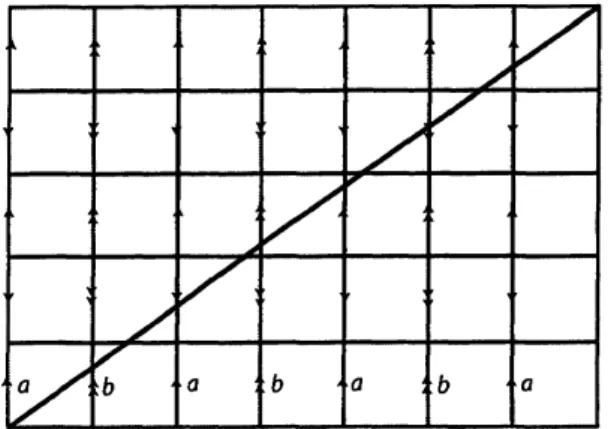
explicitly. Note that the inverse image of $\gamma_{1}$ (resp. $\gamma_{2}$) in
$\mathbb{R}^{2}-\mathbb{Z}^{2}$ is the union of the
single arrowed (resp. double arrowed) vertical edges in Figure 4. Let $L(r)$ be the line in
$\mathbb{R}^{2}$
of slope $r$ passing through the origin, and let $L^{+}(r)$ be the line obtained by translating
$L(r)$ by the vector $(0, \eta)$ for sufficiently small positive real number $\eta$. Then $L^{+}(r)$ lies in
$\mathbb{R}^{2}-\mathbb{Z}^{2}$ and projects to
the simple loop $\alpha_{r}$
.
Picka
base point, $z$, from the intersection of$L^{+}(r)$ with the second quadrant, and consider the sub-line-segment of$L^{+}(r)$ bounded by
$z$ and $z+(2p, 2q)$
.
Then it formsa
fundamental domain of the covering $L^{+}(r)arrow\alpha_{r}$, andthe word $u_{r}$ is obtained by reading the intersection
of
the line-segment with the verticalFIGURE 4. Thelineofslope 5/7gives$\hat{u}_{5/7}=ba^{-1}bab^{-1}a$,
so
thefree homo-topyclass of$\alpha_{5/7}$is represented bythe cyclicword $(u_{5/7})=(a\hat{u}_{5/7}b^{-1}\hat{u}_{5/7}^{-1})=$$(aba^{-1}bab^{-1}ab^{-1}a^{-1}ba^{-1}b^{-1}ab^{-1})$.
Since
the inverse image of $\gamma_{1}$ (resp. $\gamma_{2}$)in $\mathbb{R}^{2}$
is the union of the single arrowed (resp. double arrowed) vertical
edges,
a
positive intersection witha
single arrowed (resp. double arrowed)edge corresponds to $a$ (resp. $b$).
the
line-segment
withthe
vertical lattice line $x=i$.We define
the letterat $P_{i}^{+}$ tobe
$a$or
$b$ according
as
$P_{i}^{+}$ lieson a
verticaledge witha
singlearrow
or double
arrow
in Figure 4,namely according
as
$i$ iseven
or odd. We define the sign of$P_{i}^{+}$ to be $+1$ or-l accordingas
the correspondingarrow
is upwardor
downward. Then the letter and the sign of$P_{i}^{+}$,respectively, give the letter and the exponent of the $(i+1)-$th term of the word $u_{r}$ for
each $0\leq i\leq 2p-1$. This gives the following formula for the word$u_{r}$ (see Figure 4). $u_{r}=a^{\epsilon_{1}}b^{\epsilon_{2}}\cdots a^{\epsilon_{2p-1}}b^{\epsilon_{2p}}$,
where $\epsilon_{i}=(-1)^{\lceil(i-1)q/p\rceil^{*}-1}$
.
Here $\lceil t\rceil^{*}$ denotes the smallest integer greater than $t$.
In order to simplify this formula, let $\hat{u}_{r}$ be the subword of$u_{r}$ corresponding to the set
$\{P_{i}^{+}|1\leq i\leq p-1\}$
.
Then $\hat{u}_{r}$ is obtained from the open interval in $L(r)$ bounded by$(0,0)$
and
$(p, q)$ by reading its intersection with thevertical
lattice lines, andso we
obtainthe following
formula.
$\hat{u}_{r}=\{\begin{array}{l}b^{\epsilon 1}a^{\epsilon 2}\cdots b^{\epsilon_{p-2}}a^{\epsilon_{p-1}} if p is odd,b^{\epsilon_{1}}a^{\epsilon 2}\cdots a^{\epsilon_{p-2}}b^{\epsilon_{p-1}} if p is even,\end{array}$
where $\epsilon_{i}=(-1)^{\lfloor iq/p\rfloor}$
.
By using the symmetry around $(p, q)$ of $\mathbb{R}^{2}-\mathbb{Z}^{2}$,we
can
observe that the subword of $u_{r}$ corresponding to the set $\{P_{i}^{+}|p+1\leq i\leq 2p-1\}$ is equal to$\hat{u}_{r}^{-1}$
.
Hencewe
obtain the following formula (see [12, Proposition 1]).$u_{r}=\{\begin{array}{ll}a\hat{u}_{q/p}b^{(-1)^{q}}\hat{u}_{q/p}^{-1} if p is odd,a\hat{u}_{q/p}a^{-1}\hat{u}_{q/p}^{-1} if p is even,\end{array}$
We
now
describe
a
natural
decompositionof
the word $u_{r}$, which playsa
keyrole in thispaper.
Let
$r_{i}=q_{i}/p_{i}(i=1,2)$ be the rational number introduced inSection
2.Consider
the infinite broken line, $B$, obtained byjoining the lattice points
$Can\sigma \mathfrak{n}\dot{\backslash }c\wedge Ad_{\ell C\prime\eta^{\delta si}}t\cdot’\vee\llcorner p\}$ {& $rp1_{\alpha} m$ $u\overline{\sim}$ $Of$ $;/_{\ell}$
$swarrow r_{\dot{Y}}\{\mathfrak{i}--1.2_{\tau}):p_{At}\eta Y4lX3^{kb_{\rho}v\cdot s}$ $\{\theta f\prime\prime_{P}3*$
$\frac{t_{a}}{r_{a}}<tilde{f}$ く $\frac{t_{1}}{t_{I}}$
$(\theta.\theta)$
$u\overline{\sim}\nu$
,
va
$v_{\delta}v_{2*}$ , $|-$lva
1
$\overline{\sim}\}\mathcal{V}_{4}|=r_{a}-|$FIGURE 5. The decomposition ofthe relator $u_{r}=v_{1}v_{2}v_{3}v_{4}$
which is invariant by the translation $(x, y)\mapsto(x+p, y+q)$
.
By slightly modifying $B$near
the lattice points,we
obtaina
(topological) line, $B^{+}$, in $\mathbb{R}^{2}-\mathbb{Z}^{2}$, invariant by thetranslation, which is homotopic to the line $L^{+}(r)$
.
Picka
point, $z_{0}\in B^{+}$ in the secondquadrant, and consider the sub-path of $B^{+}$ bounded by
$z_{0}$ and $z_{4}$ $:=z_{0}+(2p, 2q)$. Then
theword $u_{r}$ is also obtained by reading the intersection
of
the sub-path with the verticallattice lines. Pick
a
point $z_{1}\in B^{+}$ whose x-coordinate is $p_{2}+$ (small positive number),and set $z_{2}$ $:=z_{0}+(p, q)$ and $z_{3}$ $:=z_{1}+(p, q)$
.
Let $B_{i}^{+}$ be the sub-path of$B^{+}$ joining $z_{i-1}$with $z_{i}(i=1,2,3,4)$
.
Let $v_{i}$ be the subword of $u_{r}$ corresponding to $B_{i}^{+}$.
Thenwe
havethe decomposition
$u_{r}=v_{1}v_{2}v_{3V_{4}}$.
The subword$v_{i}$ is non-empty exceptwhen$r=1/p(p\in N)$ and$i\in\{1,3\}$. Theimportance of this decomposition is described in the following section.
4. SEQUENCES ASSOCIATED WITH THE SIMPLE LOOP $\alpha_{r}$
Inthissection,
we
definea
sequence$S(r)$ ofslope$r$ anda
cyclicsequence$CS(r)$ ofslope$r$ all
of which
arise from the single word $u_{r}$ representing the simple loop $\alpha_{r}$, and observeseveral
important propertiesof
thesesequences,
so
thatwe can
adoptsmall
cancellationtheory in the succeeding sections.
We
fixsome
definitions andnotation. Let$X$ bea
set. Bya
wordin $X$,we
mean
a
finitesequence $x_{1}^{\epsilon_{1}}x_{2}^{\epsilon_{2}}\cdots x_{n}^{\epsilon_{n}}$ where $x_{i}\in X$ and $\epsilon_{i}=\pm 1$
.
Herewe
call $x_{i}^{\epsilon:}$ the i-th letter of thethat if$u=x_{1}^{\epsilon_{1}}\cdots x_{n}^{\epsilon_{n}}$ and $v=y_{1}^{\delta_{1}}\cdots y_{m}^{\delta_{m}}(x_{i}, y_{j}\in X;\epsilon_{i}, \delta_{j}=\pm 1)$, then $n=m$
and
$x_{i}=y_{i}$ and $\epsilon_{i}=\delta_{i}$ for each $i=1,$$\ldots,$$n$. The length of
a
word $v$ is denoted by $|v|$.A
word $v$ in$X$ is said to be reduced if$v$ does not contain $xx^{-1}$
or
$x^{-1}x$ for any $x\in X$. A word is saidto be cyclically reduced ifall its cyclic permutations
are
reduced. A cyclic wordis definedto be the set of all cyclic permutations of
a
cyclically reduced word. By (v)we
denotethe
cyclic wordassociated
witha
cyclicallyreduced
word $v$.Also
by $(u)\equiv(v)$we mean
the visual equality of two cyclic words $(u)$ and (v). In fact, $(u)\equiv(v)$ if and only if$v$ is
visually
a
cyclic shift of$u$.Definition 4.1. (1) Let $v$ be
a
nonempty reduced word in $\{a, b\}$.
Decompose $v$ into$v\equiv v_{1}v_{2}\cdots v_{t}$,
where, for each $i=1,$ $\ldots,$$t-1$, all letters in $v_{i}$ have positive (resp. negative) exponents,
and all letters in $v_{i+1}$ have negative (resp. positive) exponents. Then the sequence of positive integers $S(v)$ $:=(|v_{1}|, |v_{2}|, \ldots, |v_{t}|)$ is called the S-sequence
of
$v$.
(2) Let (v) be
a
nonempty reduced cyclic word in $\{a, b\}$ represented bya
word $v$.Decompose (v) into
$(v)\equiv(v_{1}v_{2}\cdots v_{t})$,
where
all letters
in $v_{i}$ have positive (resp. negative) exponents,and
all letters in $v_{i+1}$have negative (resp. positive) exponents (taking subindices modulo $t$). Then the cyclic
sequence
ofpositive integers $CS(v)$ $:=((|v_{1}|, |v_{2}|, \ldots, |v_{t}|))$ is called the cyclic S-sequenceof
(v). Here the double parentheses denote that thesequence is considered modulo cyclicpermutations.
Definition
4.2. Fora
rational number $r$ with $0<r\leq 1$, let $u_{r}$ be the word in $\{a, b\}$defined in Section 3. Then the symbol $S(r)$ (resp. $CS(r)$) denotes the S-sequence $S(u_{r})$
of$u_{r}$ (resp. cyclic S-sequence $CS(u_{r})$ of $(u_{r})$), which is called the S-sequence
of
slope $r$(resp. the cyclic S-sequence
of
slope $r$).In the remainder of this
paper
unless specifiedotherwise,we
suppose that$r$ isa
rationalnumber with
$0<r\leq 1$,and
write $r$as a
continued
fraction:
$r=[m_{1}, m_{2}, \ldots, m_{k}]$,
where $k\geq 1,$ $(m_{1}, \ldots, m_{k})\in(\mathbb{Z}_{+})^{k}$ and $m_{k}\geq 2$ unless $k=1$. For brevity,
we
write $m$for$m_{1}$.
The following proposition plays
a
key role in the proofof Lemma 5.4 and Theorem 5.2.Proposition 4.3 ([4, Proposition 4.10]). The sequence $S(r)$ has
a
decomposition $(S_{1},$$S_{2}$,$S_{1},$$S_{2})$ which
satisfies
the following.(1) Each $S_{i}$ issymmetri$c$, i.e., the sequence obtained
from
$S_{i}$ by reversing the orderisequal to $S_{i}$
.
(Here, $S_{1}$ is emptyif
$k=1.$)(2) Each $S_{i}$
occurs
only twice in the cyclic sequence $CS(r)$.
(3) $S_{1}$ begins and ends with $m+1$
.
(4) $S_{2}$ begins and ends with $m$.
The above decomposition corresponds to the decomposition $u_{r}=v_{1}v_{2}v_{3}v_{4}$ introduced
in
Section
3. To be precise,we
have $S_{1}=S(v_{1})=S(v_{3})$ and $S_{2}=S(v_{2})=S(v_{4})$. TheProposition 4.4.
Let
$S(r)=(S_{1}, S_{2}, S_{1}, S_{2})$ beas
in Proposition4.3.
Fora
mtionalnumber$s$ with $0<s\leq 1$, suppose that the cyclic S-sequence $CS(s)$ contains both $S_{1}$ and $S_{2}$
as
a
subsequence. Then $s\not\in I_{1}\cup I_{2}$.
5. SMALL CANCELLATION CONDITIONS FOR 2-BRIDGE LINK GROUPS
Let $F(X)$ be the free group with basis $X$. A subset $R$ of$F(X)$ is called symmetrized,
if all elements of$R$
are
cyclically reduced and, for each $w\in R$, all cyclic permutations of$w$ and $w^{-1}$ also belong to $R$
.
Definition 5.1. Suppose that $R$ is a symmetrized subset of$F(X)$
.
A nonempty word $b$is called
a
pieceif there exist distinct $w_{1},$$w_{2}\in R$ suchthat $w_{1}\equiv bc_{1}$ and $w_{2}\equiv bc_{2}$.
Smallcancellation conditions $C(p)$ and $T(q)$, where $p$ and $q$
are
integers such that $p\geq 2$ and$q\geq 3$,
are defined
as
follows (see [9]).(1)
Condition
$C(p)$: If $w\in R$ is a productof
$n$ pieces, then $n\geq p$.
(2) Condition$T(q)$: For $w_{1},$
$\ldots,$$w_{n}\in R$with
no
successiveelements$w_{i},$$w_{i+1}$ aninversepair $(imod n)$, if$n<q$, then at least
one
of the products$w_{1}w_{2},$$\ldots,$ $w_{n-1}w_{n},$ $w_{n}w_{1}$
is freely reduced without cancellation.
The following key theorem enables us to apply small cancellation theory to the groups
presentation $\langle a,$$b|u_{r}\rangle$ of $G(K(r))$.
Theorem 5.2. Let $r$ be
a
mtional number such that$0<r<1$
. Recall the presentation$\langle a,$$b|u_{r}\rangle$
of
$G(K(r))$ given inSection
3, and let $R$ be the symmetrized subsetof
$F(a, b)$genemted by the single relator $u_{r}$. Then $R$
satisfies
$C(4)$ and $T(4)$.Definition 5.3. For
a
positive integer$n$,a
non-empty subword $w$ ofthe cyclic word $(u_{r})$is called
a
maximal n-pieceif$w$ isa
product of$n$ pieces and if any subword $w’$ of$u_{r}$ whichproperly contains $w$
as an
initial subword is nota
product ofn-pieces.Theorem 5.2 actually follows fromthe following complete characterizations ofthe
max-imal n-pieces for $n=1,2,3$. (For simplicity,
we
describe the result only for generic case.)Lemma 5.4. Suppose that $r$ is a rational number such that
$0<r<1$
and $r\neq 1/p$for
any integer $p\geq 2$. Let $v_{ib}^{*}$ be the maximal proper initial subword
of
$v_{i}$, i. e., the initialsubword
of
$v_{i}$ such that $|v_{ib}^{*}|=|v_{i}|-1(i=1,2,3,4)$. Then the following hold, where$v_{ib}$ and $v_{ie}$
are
nonempty initial and teminal subwordsof
$v_{i}$ with1
$v_{ib}|,$ $|v_{ie}|\leq|v_{i}|-1$,respectively.
(1) The following is the list
of
all maximal l-piecesof
$(u_{r})_{f}$ arranged in the orderof
the position
of
the initial letter:$v_{1b}^{*},$ $v_{1e}v_{2},$$v_{2}v_{3b}^{*},$$v_{2e}v_{3b}^{*},$$v_{3b}^{*},$$v_{3e}v_{4},$$v_{4}v_{1b}^{*},$ $v_{4e}v_{1b}^{*}$
.
(2) The following is the list
of
all maximal 2-piecesof
$(u_{r})$, awanged in the orderof
the position
of
the initial letter:$v_{1}v_{2},$$v_{1e}v_{2}v_{3b}^{*},$$v_{2}v_{3}v_{4},$$v_{2e}v_{3}v_{4},$ $v_{3}v_{4},$$v_{3e}v_{4}v_{1b}^{*},$$v_{4}v_{1}v_{2},$ $v_{4e}v_{1}v_{2}$
.
(3) The following is the list
of
all maximal 3-piecesof
$(u_{r})$, arranged in the orderof
the position
of
the initial letter:Corollary 5.5. (1)
A
subword $w$of
the cyclic word $(u_{r}^{\pm 1})$ isa
pieceif
and onlyif
$S(w)$does
not
contain $S_{1}$as a
subsequence anddoes
not contain $S_{2}$ in its interior, i. e., $S(w)$does
not
containa
subsequence $(\ell_{1}, S_{2}, l_{2})$for
some
$l_{1},\ell_{2}\in \mathbb{Z}_{+}$.(2) For
a
subword $w$of
the cyclic word $(u_{r}^{\pm 1}),$ $w$ isnot
a
pmductof
two
piecesif
andonly
if
$S(w)$ either contains $(S_{1}, S_{2})$as a
proper initial subsequenceor
contains $(S_{2}, S_{1})$as
a
proper terminal subsequence.6.
OUTLINE
OF THE PROOF OF THEOREM2.3
Let $R$ be the symmetrized subset of $F(a, b)$ generated by the single relator $u_{r}$ of the
group
presentation$G(K(r))=\langle a,$$b|u_{r}\rangle$.
Supposeon
thecontrary that$\alpha_{s}$ isnull-homotoicin $S^{3}-K(r)$, i.e., $u_{s}=1$ in $G(K(r))$, for
some
$s\in I_{1}\cup I_{2}$. Then there isa van
Kampendiagmm $M$
over
$G(K(r))=\langle a,$$b|R\rangle$ such that the boundary label is $u_{s}$.
Here $M$ isa
simply connected2-dimensional
complexembedded
in $\mathbb{R}^{2}$,together with
a
function
$\phi$assigningto
each oriented
edge $e$ of$M$,as a
label,a
reduced word
$\phi(e)$ in $\{a, b\}$such that
the following
hold.
(1) If$e$is
an
orientededgeof$M$and $e^{\vee}1$ is theoppositelyorientededge, then $\phi(e^{-1})=$$\phi(e)^{-1}$
.
(2) For any boundary cycle $\delta$ of any face of $M,$ $\phi(\delta)$ is a cyclically reduced word
representing
an
element of R. (If$\alpha=e_{1},$$\ldots,$$e_{n}$ is
a
path in $M$,we
define
$\phi(\alpha)\equiv$
$\phi(e_{1})\cdots\phi(e_{n}).)$
We may
assume
$M$ is reduced, namely it satisfies the following condition: Let $D_{1}$ and$D_{2}$ be
faces
(not necessarily distinct) of $M$ withan
edge $e\subseteq\partial D_{1}\cap\partial D_{2}$, and let $e\delta_{1}$ and$\delta_{2}e^{-1}$ be boundary cycles of $D_{1}$ and $D_{2}$, respectively. Set $\phi(\delta_{1})=f_{1}$ and $\phi(\delta_{2})=f_{2}$.
Then
we
have $f_{2}\neq f_{1}^{-1}$.
Moreover,
we
may
assume
the
followingconditions:
(1) $d_{M}(v)\geq 3$ for every vertex $v\in M-\partial M$.
(2) For every edge $e$ of $\partial M$, the label $\phi(e)$ is
a
piece.(3) For
a
path$e_{1},$ $\cdots,$ $e_{n}$ in$\partial M$of length $n\geq 2$such that the vertex$\overline{e}_{i}\cap\overline{e}_{i+1}$ has degree2 for $i=1,2,$ $\cdots,$$n-1,$ $\phi(e_{1})\phi(e_{2})\cdots\phi(e_{n})$ cannot be expressed
as
a
product ofless than $n$ pieces.
Since
$R$ satisfies the conditions $C(4)$and
$T(4)$ by Theorem 5.2, $M$ isa
[4, 4]-map, i.e.,(1) $d_{M}(v)\geq 4$ for every vertex $v\in M-\partial M$
.
(2) $d_{M}(D)\geq 4$ for every face $D\in M$.
Here, $d_{M}(v)$, the degree
of
$v$, denotes the number of oriented edges in $M$ having $v$as
initial vertex, and $d_{M}(D)$, the degree
of
$D$, denotes the number of oriented edges in aboundary cycle of $D$
.
Now,
for
simplicity,assume
that $M$ is homeomorphictoa
disk. (In general,we
need toconsider
an
extremal disk of $M.$) Then by theCurvature
Formula ofLyndon and Schupp(see [9, Corollary V.3.4]),
we
have$\sum_{v\in\partial M}(3-d_{M}v))\geq 4$
.
By using this formula,
we see
that thereare
three edges $e_{1},$ $e_{2}$ and $e_{3}$ in $\partial M$ such that$e_{1}\cap e_{2}=\{v_{1}\}$ and $e_{2}\cap e_{3}=\{v_{2}\}$, where$d_{M}(v_{i})=2$for each $i=1,2$
.
Since $\phi(e_{1})\phi_{(}e_{2})\phi(e_{3})$of $M$ contains
a
subword, $w$, with $S(w)=(S_{1}, S_{2}, \ell)$or
$(\ell, S_{2}, S_{1})$.
This in turn impliesthat
the S-sequence of the boundary label contains both $S_{1}$ and $S_{2}$as
subsequences.Hence, by Proposition 4.4,
we
have $s\not\in I_{1}\cup I_{2}$,a contradiction.
7. OUTLINE OF THE PROOF OF THEOREM 2.5
Suppose, for twodistinct $s,$ $s’\in I_{1}\cup I_{2}$, theunoriented loops$\alpha_{s}$ and $\alpha_{s’}$
are
homotopicin$S^{3}-K(r)$
.
Then there isa
reduced annular R-diagram, such that $u_{s}$ isan
outerboundarylabel and $u_{s}^{\pm 1}$ is
an
inner boundary label of $M$. Againwe can
see
that $M$ isa
[4, 4]-map and hencewe
have the following curvature formula.$0 \leq\sum_{v\in\partial M}(3-d_{M}(v))$
.
Byusingthis formula,
we obtain
the following verystrongstructuretheorem for$M$, whichplays key roles throughout
the
series of papers [5, 6, 7].Theorem 7.1. Figure $6(a)$ illustmtes the only possible type
of
the outer boundary layerof
$M_{f}$ while Figure $6(b)$ illustmtes the only possible typeof
whole M. (The numberof
faces
per layer and the numberof
layersare
vantable.)In the above theorem, the outer boundary layerof the annular map $M$ is
a
submap of$M$ consisting of all faces $D$ such that the intersection of $\partial D$ with the outer boundary of
$M$ contains
an
edge, together with the edges and vertices contained in $\partial D$.(a) (b)
FIGURE 6.
The first paper [5] of the series treates the
case
when the 2-bridge link is a $($2,$p)-$torus link, the second paper [6], treats the
case
of 2-bridge links ofslope $n/(2n+1)$ and$(n+1)/(3n+2)$ , where $n\geq 2$ is
an
arbitrary integer, and the third paper [7] treatsthe general
case.
The two families treated in the second paper play special roles in theproject in the
sense
that the treatment of these links forma
base step ofan
inductiveproofof thetheorem for genera12-bridge links. We note that both a 2-bridge linkofslope
$n/(2n+1)$ with $n=2$ and
a
2-bridge link of slope $(n+1)/(3n+2)$ with $n=1$are
thefigure-eight knot. It is
a
bit surprising that the treatment of the figure-eight knot is themost complicated. This reminds
us
of the phenomenon in the theoryofexceptional DehnREFERENCES
[1] H. Akiyoshi, M. Sakuma, M. Wada, Y. Yamashita, Punctured$tor\llcorner tS$groups and 2-bridge knotgroups.
I. Lecture Notes inMathematics, 1909, Springer, Berlin, 2007.
[2] K.I. Appel and P.E. Schupp, The conjugacy problem
for
the groupof
any tame altemating knot issolvable, Proc. Amer. Math. Soc. 33 (1972), 329-336.
[3] K. Johnsgard, The conjugacy problem
for
the groupsof
altemating prime tame links ispolynomial-time, ?Yans. Amer. Math. Soc. 349 (1977), 857-901.
[4] D. Lee and M. Sakuma, Epimorphisms between 2-bridge link groups: Homotopically trivial simple
loops on 2-bredge spheres, arXiv:1004.2571.
[5] D. Lee and M. Sakuma, Homotopically equivalent simple loops on 2-bridge spheres in 2-bridge link
complements (I), arXiv:1010.2232.
[6] D. Lee and M. Sakuma, Homotopically equivalent simple loops on 2-bridge spheres in 2-bridge link
complements (II), arXiv:1103.0856.
[7] D. Lee and M. Sakuma, Homotopically equivalent simple loops on 2-bridge spheres in 2-bridge link
complements (III), preliminary notes.
[8] D. Lee and M. Sakuma, A variation
of
$McShane$’s identityfor
2-bridge links, in preparation. [9] R.C. Lyndon and P.E. Schupp, Combinatorial Group Theory, Springer-Verlag,Berlin, 1977.[10] T. Ohtsuki, R. Riley, and M. Sakuma, Epimorphisms between 2-bmdge link groups, Geometry and
Topology Monographs 14 (2008), 417-450.
[11] J.P. Pr\’eaux, Conjugacy problems in groups
of
oriented geometrezable 3-manifolds, Topology 45(2006), 171-208.
[12] R. Riley, Parabolic representations
of
knotgroups. $I$, Proc. London Math. Soc. 24 (1972), 217-242.[13] M. Sakuma, Variations
of
McShane’s identityfor
the Riley slice and 2-bridge links, In “HyperbolicSpacesand Related Topics“, RIMS Kokyuroku 1104 (1999), 103-108.
[14] Z. Sela, The conjugacy problem
for
knot groups,Topology 32 (1993), 363-369.[15] S.P. Tan, Y.L. Wong, and Y. Zhang, End invariants
for
$SL(2, \mathbb{C})$ charactersof
the one-holed torts,Amer. J. Math. 130 (2008), 385-412.
[16] C.M.Weinbaum, Thewordand conjugacy problems
for
the knotgroupof
anytame,prime, altemating$knot$, Proc. Amer. Math. Soc. 30 (1971), 22-26.
DEPARTMENT OF MATHEMATICS, PUSAN NATIONAL UNIVERSITY, SAN-30 JANGJEON-DONG,
GEUMJUNG-GU, PUSAN, 609-735, KOREA
E-mail address: [email protected]
DEPARTMENT OF MATHEMATICS, GRADUATE SCHOOL OF SCIENCE, HIROSHIMA UNIVERSITY,
HIGASHI-HIROSHIMA, 739-8526, JAPAN