Japan Advanced Institute of Science and Technology
Author(s)
Kiyomi, Masashi; Saitoh, Toshiki; Uehara, Ryuhei
Citation
Discrete Mathematics, Algorithms and
Applications, 4(3): 1250039
Issue Date
2012-08-01
Type
Journal Article
Text version
author
URL
http://hdl.handle.net/10119/11475
Rights
Electronic version of an article published as
Discrete Mathematics, Algorithms and
Applications, 4(3), 2012, 1250039.
DOI:10.1142/S1793830912500395. Copyright World
Scientific Publishing Company,
http://dx.doi.org/10.1142/S1793830912500395
Description
Bipartite Permutation Graphs are Reconstructible
MASASHI KIYOMI
International College of Arts and Sciences, Yokohama City University, 22-2 Seto, Kanazawa-ku, Yokohama, Kanagawa 236-0027, Japan.
TOSHIKI SAITOH
Department of Electrical and Electronic Engineering, Graduate School of Engineering, Kobe University, 1-1 Rokkodai, Nada, Kobe, 657-8501, Japan.
RYUHEI UEHARA
School of Information Science, JAIST, 1-1 Asahidai, Nomi, Ishikawa 923-1292, Japan. [email protected]
The graph reconstruction conjecture is a long-standing open problem in graph theory. The conjecture has been verified for all graphs with at most 11 vertices. Further, the conjecture has been verified for regular graphs, trees, disconnected graphs, unit interval graphs, separable graphs with no pendant vertex, outer-planar graphs, and unicyclic graphs. We extend the list of graph classes for which the conjecture holds. We give a proof that bipartite permutation graphs are reconstructible.
Keywords:the graph reconstruction conjecture, bipartite permutation graphs
1. Introduction
The graph reconstruction conjecture proposed by Ulam and Kellya
has been studied by many researchers intensively. In order to state the conjecture, we first introduce some terms. A graph G′ is called a card of a graph G = (V, E), if G′ is isomorphic to G − v for some v ∈ V , where G − v is a graph obtained from G by removing v and incident edges. A multi-set of n graphs with n − 1 vertices for some positive integer n is called a deck. Especially, the multi-set of the |V | cards of G, each of which is isomorphic to G − v for each v ∈ V , is a deck of G. A graph G is a preimage of a deck D, if D is a deck of G. We also say that a graph G is a preimage of the n graphs if each card of G is isomorphic to each of them. The graph reconstruction conjecture is that there is at most one preimage of given n graphs (n ≥ 3). No one has found a proof nor a counter example of this conjecture, while it was verified for small graphs by exhaustive checking [12].
a
Determining the first person who proposed the graph reconstruction conjecture is difficult, actu-ally. See [7] for the detail.
The graph reconstruction conjecture has been verified for some graph classes. Kelly showed that the conjecture is true on regular graphs, trees, and disconnected graphs [9]. Other classes proven to be reconstructiblebare unit interval graphs [13], separable graphs with no pendant vertex [2], outer-planar graphs [5], unicyclic graphs [11], etc. We extend the list of graph classes for which the conjecture holds; We give a proof that bipartite permutation graphs are reconstructible.
Rimscha showed that unit interval graphs are reconstructible [13]. Unit interval graphs have somewhat path-like structures, and so do bipartite permutation graphs. Further, the representation of a unit interval graph is unique, similar to that of a bipartite permutation graph. Thus, we first thought that we can easily prove that bipartite permutation graphs are reconstructible. There are two differences between the two classes, that make it difficult to prove that bipartite permutation graphs are reconstructible. One is that, bipartite permutation graphs are bipartite. Therefore, we have to determine from which partite a vertex was removed for cards in a deck. The second difference is that, in the case of unit interval graphs, there is no disconnected card obtained by removing a vertex laying at the end of the path structure. In a deck of a bipartite permutation graph, there can be a disconnected card that is obtained by removing a polar vertex which lays at the end of the path structure (We will define a polar vertex later.) Therefore, we had to consider many exceptional cases.
Kelly showed the following lemma.
Lemma 1.1 (Kelley’s Lemma [9]). Let G be any preimage of the given deck, and let H be a graph whose number of vertices is smaller than that of G. Then we can uniquely determine the number of subgraphs in G isomorphic to H from the deck.
Greenwell and Hemminger extended this lemma to a more general form [6]. We can determine the degree sequence of a preimage of the given deck from these lemmas. Moreover, given a deck of a graph, we can determine the degree of removed vertex for each card in the deck. Note that Pv:vertex deg(v) = 2 × (# of edges). Thus, we can easily show for example that cycles are reconstructible, since a graph is a cycle if and only if it is connected, and all its vertices have degree exactly two. Tutte proved that the dichromatic rank and Tutte polynomials are recon-structible (i.e. looking at the deck, they are uniquely determined) [15]. Bollob´as showed that almost all graphs are reconstructible from three well-chosen graphs in its deck [1]. About permutation graphs, Rimscha showed that permutation graphs are recognizable in the sense that looking at the deck of G one can determine whether or not G belongs to permutation graphs [13]. To be precise Rimscha showed in the paper that comparability graphs are recognizable. Even’s result [4] directly gives a proof in the case of permutation graphs. Rimscha also showed in the same paper that many subclasses of perfect graphs including perfect graphs themselves
b
are recognizable, and moreover, some of subclasses, such as unit interval graphs, are reconstructible. There are a lot of papers about the conjecture, and many good surveys about this conjecture. See for example [3,7].
We explain about bipartite permutation graphs in the next section. Then, we prove the statement in Section 3. The proof has two subsections. In the first subsec-tion, we give the main idea of the proof. In the second subsecsubsec-tion, we consider some exceptional cases. The proof uses some lemmas on bipartite permutation graphs. Since we think that checking these lemmas one by one may make readers lose the way, we write the proofs of some of them in Section 4.
2. Bipartite Permutation Graphs
All the graphs in this paper are simple and undirected unless stated otherwise. Given a graph G = (V, E) and a vertex v ∈ V , we denote by degG(v) the degree of v in G.
2.1. Permutation diagram
Let π = (π1, π2, . . . , πn) be a permutation of 1, . . . , n. We denote (πn, πn−1, . . . , π1) by π.
We call a set L of line segments connecting two horizontal parallel lines on Euclidean plane a permutation diagram. A permutation diagram represents a per-mutation. Let l1, l2, . . . , l|L| be the line segments in L. We assume that the end-points of them appear in this order from left to right on the upper horizontal line. Then, the permutation represented by L is (π1, π2, . . . , π|L|), where the end-points of l1, l2, . . . , l|L|appear in the order of π1, . . . , πnon the lower horizontal line. Equiv-alently, the ith left-most end-point among those of the segments in L is that of lπi −1,
on the lower horizontal line, for each i ∈ {1, 2, . . . , |L|}. See Fig. 1(a) for example. The permutation diagram represents (2, 7, 3, 5, 1, 6, 4) = (5, 1, 3, 7, 4, 6, 2)−1.
Let P be a permutation diagram. We denote by PH
a permutation diagram obtained by reversing P horizontally. See Fig. 1(b) for example. The permutation diagram is obtained by reversing (a) horizontally. Similarly, we denote by PV
and PR permutation diagrams obtained by reversing P vertically, and by rotating P 180◦, respectively.c
2.2. Bipartite permutation graphs
Let π be a permutation of the numbers 1, 2, . . . , n. Gπ= (Vπ, Eπ) is a graph satis-fying that
• Vπ= {1, . . . , n}, and
c
Let P be a permutation diagram representing a permutation π. For those who want concrete expressions, it is not difficult to check that PV
represents πV = π−1, PH represents πH = π−1−1, and PR represents πR = π−1.
(a)
(c) (d)
(b)
Fig. 1. (a) is an example of a permutation diagram. (b), (c), and (d) are permutation diagrams obtained from (a) by reversing horizontally, reversing vertically, and rotating 180◦, respectively. They represent permutations (2,7,3,5,1,6,4), (4,2,7,3,5,1,6), (5,1,3,7,4,6,2), and (6,2,4,1,5,7,3), re-spectively.
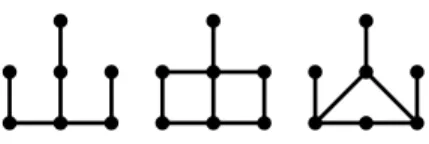
Fig. 2. Forbidden graphs of bipartite permutation graphs are these graphs, K3, and cycles of length more than four.
• {i, j} ∈ Eπ⇔ (i − j)(π−1i − π −1 j ) < 0.
A graph G is called a permutation graph if there exists a permutation π such that G is isomorphic to Gπ. Equivalently, a graph G is a permutation graph if there exists a permutation π such that G is an intersection model of the permutation diagram of π. We say that π (or, sometimes, the permutation diagram of π) represents G. If a permutation graph G is bipartite, we call G a bipartite permutation graph.
There is a good characterization for bipartite permutation graphs.
Theorem 2.1 (P. Hell and J. Huang [8]). A graph G is a bipartite permutation graph if and only if G has neither the graphs in Fig. 2, nor K3, nor cycles of length more than four as an induced subgraph.
It is known that a connected bipartite permutation graph has at most four rep-resenting permutation diagrams. If a permutation diagram P is reprep-resenting a con-nected bipartite permutation graph G, the other representing permutation diagram of G must be one of PH
, PV
, and PR
[14]. Thus a permutation diagram repre-senting a connected bipartite graph is essentially unique. Note that a disconnected bipartite permutation graph may have more than four representing permutation diagrams. Together with the fact that cards in a deck of a connected graph can be disconnected, this is the reason why our proof is not very simple.
s 1
s2 a
b
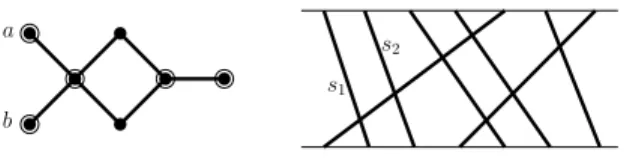
Fig. 3. An bipartite permutation graph and its representation. The polar vertices are circled. Vertices a and b are isomorphic, and can correspond to both the segments s1 and s2. Thus, both aand b are polar vertices.
Let P be a permutation diagram representing a connected bipartite permutation graph G. There are two left-most segments in P , and there are two right-most segments in P . Here, we say that a segment is the left-most (right-most) if it is the left-most (right-most) among the segments not intersecting with it. We call the vertices that can correspond to the left-most or right-most segments polar vertices. the number of polar vertices can be less than four, since the left-most segment in P can also be the right-most segment when the segment intersecting all the segments belonging to the other partite. The number of polar vertices may be more than four, since there may exist some isomorphic polar vertices.d
See Fig. 3 for an example. By repeatedly removing degree one polar vertices from a connected bipartite permutation graph G, we obtain a connected bipartite permutation graph G′. We call the graph G′ trunk of G, and we denote the trunk by Tr(G). The vertex in Tr(G) nearest from a degree one polar vertex v of G is called the root of v. The path in G whose ends are v and v’s root is called a limb.
It is clear that every card G′ of a bipartite permutation graph G is a bipartite permutation graph, since we can obtain a representing permutation diagram of G′ by removing a line segment from a representing permutation diagram of G.
3. Main Proof
The main idea of our proof is simple. However, if there is a degree one polar vertex, there are many exceptional cases, and the proof gets complex. Therefore, we first show the simple case, and then prove the exceptional cases.
3.1. No degree one polar vertex case
We show an algorithm which reconstructs G from its deck. The algorithm directly shows the uniqueness of the preimage. However, the proof of the uniqueness uses a bunch of bipartite permutation graph specific properties. We are afraid that check-ing the properties one by one makes the readers lose the way in the main-line of the proof. Therefore, we leave some of the proofs in Section 4.
d
We need the two lemmas below to keep the main proof simple.
Lemma 3.1. All the preimages of the deck of a bipartite graph G are bipartite. Proof. Immediate from the fact that the chromatic number of G is recon-structible [16].
Lemma 3.2. All the preimages of a deck of a bipartite permutation graph are bipartite permutation graphs.
Proof. Immediate from Lemma 3.1 and the fact that permutation graphs are rec-ognizable [13].
We can easily check the following lemma.
Lemma 3.3. A card obtained from a connected bipartite graph G by removing its polar vertex is connected, if every polar vertex of G has degree more than one. Proof. Let L be a set of segments representing G. Let l1 be the left-most segment in L, and l2 be the second left-most one. Note that there must exist l2, since the right-most polar vertex has degree more than one. Since G is connected, NL(l1) ⊂ NL(l2) holds, where NL(l) is the set of segments in L intersecting l. Therefore, for a polar vertex v corresponding to l1, there exist a vertex whose neighbors contain the neighbors of v. Thus the graph obtained from G by removing v is connected.
Our main proof assumes that a bipartite permutation graph G = (X, Y, E) does not have a polar vertex in X whose degree is |Y |. Therefore, we need the following lemma.
Lemma 3.4. Let G = (X, Y, E) be a connected bipartite permutation graph such that a polar vertex in X has degree equal to |Y |. Then G is reconstructible.
We leave the proof in Section 4. In the rest of this subsection, we consider a con-nected bipartite permutation graph G = (X, Y, E) satisfying the condition below. Condition 1. There is no polar vertex of degree |Y | in X, and there is no polar vertex of degree |X| in Y .
Note that, under this condition, a polar vertex on the left-end cannot be adjacent to any polar vertex on the right-end. And, |X|, |Y | ≥ 2 holds, since if |X| = 1, then x∈ X must be a polar vertex and adjacent to every vertex in Y .
Now, we explain the main idea. Let G = (X, Y, E) be a connected bipartite permutation graph satisfying Condition 1.
We can prove that |X| and |Y | are reconstructible. Since the proof of this fact becomes a bit long, we leave it in Section 4.
We first consider the case that |X| 6= |Y |. We assume without loss of generality that |X| > |Y |. There are the left- and the right-polar vertices xl and xrin X, such that xl corresponds to the left-most line segment, and xr corresponds to the right-most line segment in a permutation diagram representing G. In a similar fashion, we define vertices yl and yras the left- and the right-polar vertices in Y . We assume without loss of generality that degG(xl) ≤ degG(xr) holds.
Let Gl= (Xl, Yl, Rl) and Gr= (Xr, Yr, Rr) be cards of G obtained by removing yland yrfrom G, respectively. By Lemma 3.3, Gl and Grare connected. We denote by DY the set of G’s connected cards that are obtained by removing a vertex belonging to Y . Clearly, Gl and Grare in DY.
Consider a connected bipartite permutation graph G′ = (X′, Y′, E′) in D Y. We assume without loss of generality that |X′| ≥ |Y′| holds. Then, since |X| > |Y | holds, |X′| = |X| and |Y′| = |Y |−1 hold. On the other hand, with a connected graph G′′ = (X′′, Y′′, E′′) obtained by removing a vertex in X from G, |X′′| = |X| − 1, |Y′′| = |Y | hold. Therefore, we can choose all the cards that belong to D
Y from the deck of G, and we can determine which partite of each card corresponds to X.
Now, consider the degrees of the polar vertices in X′. If G′ is G
l, the degrees of the polar vertices in X′ are {deg
G(xl) − 1, degG(xr)}. If G′ is Gr, the degrees of the polar vertices in X′ are {deg
G(xl), degG(xr) − 1}. Otherwise, the degrees of the polar vertices in X′ are either {deg
G(xl) − 1, degG(xr)}, {degG(xl), degG(xr) − 1}, {degG(xl), degG(xr)}, or {degG(xl)−1, degG(xr)−1}. We call G′good, if the degrees of the polar vertices in X′ are {deg
G(xl) − 1, degG(xr)}. Note that we can chose good cards from DY, since degG(xl)− 1 is the minimum degree of the polar vertices, and degG(xr) is the maximum degree of the polar vertices. And, the key point is that, in a good card, the degrees of the left- and the right-polar vertices in X differ.
Let {G′
1, . . . , G′k} be the set of good graphs in DY. Let vi be a vertex such that G′iis obtained by removing vifrom G. We can determine degG(vi), since the degree sequence is reconstructible. We can prove that degG(yl) = mini=1,...,kdegG(vi) by Lemma 4.2 which we will state in Section 4. Thus, we can uniquely reconstruct the preimage from the deck. (We only have to add a degree degG(yl) polar vertex in Y′ adjacent to the polar vertex of degree degG(xl) − 1 in X′. This can be done deterministically on the permutation diagram by Lemma 4.3 which we will prove in Section 4.)
Now we consider the case that |X| = |Y |. In this case, every connected card is in the form Gi = (Xi, Yi, E) such that |Xi| = |Yi| − 1. Thus we cannot determine which partite of G′corresponds to which partite of G. However, we know that G
i is obtained by removing a vertex in Yi’s partite. Therefore, polar vertices of Gi in Xi are also polar vertices of a preimage. Thus, the minimum degree of polar vertices in Xi among all the connected cards is equal to p′− 1, where p′ is the minimum degree of polar vertices of a preimage. Moreover, a card that has a polar vertex of degree p′− 1 in X
i is obtained by removing a vertex adjacent to a polar vertex of degree p′ from a preimage. Hence, we can uniquely reconstruct a preimage in the
same fashion above (using Lemmas 4.2, 4.3). Therefore, we have the theorem below.
Theorem 3.5. A connected bipartite permutation graph G = (X, Y, E) satisfying Condition 1 is reconstructible, if every polar vertex of G has degree more than one. 3.2. Polar vertices with degree one
We can determine if a preimage G has a polar vertex of degree one, by Lemma 4.4 in Section 4. In this subsection, we consider the case that G has a polar vertex of degree one.
First, we show the fundamental lemmas.
Lemma 3.6. Let P be a permutation diagram of a connected bipartite permutation graph G having at least one cycle. Any two limbs of the same side (the left-side or the right-side) of P have the same root.
Proof. If not, G cannot be connected.
Lemma 3.7. If a connected bipartite permutation graph G has a polar vertex of degree one, Tr(G) is reconstructible.
Proof. Let G′ be a card obtained by removing a polar vertex of degree one from G. Then, Tr(G′) and Tr(G) are clearly isomorphic. Let G′′ be a connected card obtained by removing a vertex that is not a polar vertex of degree one. Then, |V (Tr(G′′))| < |V (Tr(G))| holds. Thus, we can reconstruct Tr(G) by choosing the Tr(G′) whose number of vertices is the maximum.
Now we prove the reconstructivity, one by one.
Lemma 3.8. A connected bipartite permutation graph G = (X, Y, E) with a limb whose length is more than one is reconstructible.
Proof. Let L be a permutation diagram of G. Let {G′
1, . . . , G′k} be the multi-set of connected cards of G that satisfy Tr(G′
i) = Tr(G). If there are more than one limbs having the same root, and both of them have the lengths more than one, G contains the left forbidden graph in Fig 2. Thus, only one limb can have the length more than one among limbs of the same root. We concentrate the limbs of the maximum length, on the both sides.
First we consider the case that there are two limbs, one is on the left-side of L having the maximum length among limbs on the left-side, and the other is on the right-side having the maximum length among limbs on the right-side. If both the two limbs have the lengths more than one, we can easily reconstruct G, since we can determine the lengths p, q of the two limbs from {G′
1, . . . , G′k}. Note that each G′i has limbs of lengths p − 1, q, or p, q, or p, q − 1. Hence, we consider the case that the
left-side limb has the length exactly one. The right-side limb has the length q more than one. Even in this case, we can determine that the maximum lengths of limbs on the both sides of any preimage are one and q. The remaining problem is how to reconstruct G from {G′1, . . . , G′k}. If q is more than two, the reconstruction is easy. Only find the limb of length q − 1, and add a degree one vertex to it. Thus, we consider the case that q is equal to two. In this case, there is a card in {G′
1, . . . , G′k} that has length one limbs on the both side. Thus, we can determine if the roots of the two limbs of a preimage belongs to the same partite. And, there is a card G′ in {G′
1, . . . , G′k} that has a limb l of the length of two. Thus, we can reconstruct G uniquely by adding a degree one vertex to the opposite side to l.
Next, we consider the case that G has limbs only on the left-side. It is easy to reconstruct G in this case, since finding the connected card that has limbs most, and adding a degree one vertex to the longest limb (the other limbs have length one), we have G.
Lemma 3.9. A bipartite permutation graph G = (X, Y, E) with two limbs of dif-ferent roots is reconstructible.
Proof. From Lemma 3.8, we only have to prove the case that every limb has length exactly one. In this case, we can determine if the two roots belong to the same vertex set, since we can reconstruct {|X|, |Y |}. Thus we can reconstruct G uniquely. Lemma 3.10. A bipartite permutation graph G = (X, Y, E) whose limbs have the same root is reconstructible.
Proof. If there are more than one limbs, it is easy to reconstruct G. Let G′ be a connected card satisfying Tr(G′) = Tr(G). Find a limb in G′ and add a degree one vertex to its root. Therefore, we consider the case that G has only one limb, and the length is one. Assume that the limb is on the left-side of L, where L is a permutation diagram of G. Then two polar vertices on the right-side have degrees p, q larger than one. If both of p and q are larger than two, we can reconstruct G, since connected cards of G with degree one polar vertex on the one side of their permutation diagram have polar vertices of degree p, q, or p − 1, q, or p, q − 1, on the opposite side.
Now we consider the case that p is exactly two, and q is also equal to two. There is a connected card of G whose polar vertices on the same side have degrees one and two. Since the limb of G has length exactly one, the polar vertices of the same side having degree one and two cannot be the degree one vertex of G. Therefore we can reconstruct G uniquely.
Lastly, we consider the case that p is exactly two, and q is larger than two. Let {G′
1, . . . , G′k} be connected cards of G obtained by removing a vertex whose degree is larger than one. Looking {G′
1, . . . , G′k}, we can determine the value p and q. Hence we can reconstruct G uniquely.
From above lemmas, we have the theorem below.
Theorem 3.11. A connected bipartite permutation graph with a polar vertex of degree one is reconstructible.
Combining Lemma 3.4, Theorems 3.5 and 3.11, we have the main theorem. Note that since disconnected graphs are reconstructible, disconnected bipartite permu-tation graphs are of course reconstructible.
Theorem 3.12. Bipartite permutation graphs are reconstructible. 4. Miscellaneous Proofs
We prove Lemmas not proved yet, in this section.
Lemma 4.1. The numbers of vertices in X and Y are reconstructible for a con-nected bipartite permutation graph G = (X, Y, E).
Proof. Let D be the deck of G. There are at least two connected cards in a deck of a connected graph with more than two vertices (Consider removing a vertices which are leaves of a spanning tree of G.) Let G1 = (X1, Y1, E1), G2 = (X2, Y2, E2), . . . , Gk = (Xk, Yk, Ek) be connected bipartite permutation graphs in D. The following cases can occur.
(1) {|Xi|, |Yi|} = {p1, q1} for some i ∈ {1, . . . , k}, and {|Xi|, |Yi|} = {p2, q2} for other i ∈ {1, . . . , k}, where {p1, q1} 6= {p2, q2} holds.
(2) {|Xi|, |Yi|} is the identical set {p, q} for every i ∈ {1, . . . , k}.
First we consider the case 1. Clearly, max{p1, p2, q1, q2} is equal to max{|X|, |Y |}, and min{p1, q1, p2, q2} is equal to min{|X|, |Y |} − 1. Therefore, we can uniquely determine {|X|, |Y |}, in this case.
Now, we consider the case 2. There are two more detailed cases. One case is that |X| = |Y | (case 2a), and the other case is that every connected card is obtained by removing a vertex from one partite (case 2b).
In the case 2a, max{p, q} = min{p, q} + 1 = |X| = |Y | holds. Thus, we can determine {|X|, |Y |}, if we can realize that the case is 2a, not 2b. We explain how to distinguish the case 2a from the case 2b later.
In the case 2b, let T be a spanning tree of G. Since a graph obtained from G by removing a leaf of T is connected, all the leaves of T belong to the same partite. We can assume without loss of generality that the partite is X. Then apparently |X| > |Y | holds. Thus {|X|, |Y |} is {max{p, q} + 1, min{p, q}}.
The remaining problem is how to distinguish the case 2a from the case 2b. In the case 2a, |p − q| = 1 always holds. Therefore, we consider the case that |p − q| = 1 holds in the case 2b. In this case, |X| = |Y | + 2 must hold.
Let L be a permutation diagram of G. Let xl and xrbe polar vertices in X that correspond to the left-most segment, and the right-most segment of L, respectively.
Let P be the shortest path in G from xl to xr. Let yl be the vertex adjacent to xl in P , and let yr be the vertex adjacent to xr in P . Since every vertex y ∈ Y is a cut-vertex of G, every path from xl to xr passes y. Therefore, all the vertices in Y are in P . Hence, there exist |Y | + 1 X-vertices in P . Note that the graph induced from G by these |Y | + 1 X-vertices and all the vertices in Y is exactly P , since otherwise some vertex in Y is not a cut-vertex of G. Since we here consider the case that |X| = |Y | + 2 holds, there is only one vertex v ∈ X remaining not in P . There are four possibilities,
(i) The vertex v is adjacent to yl, and not adjacent to yr. (ii) The vertex v is adjacent to yr, and not adjacent to yl. (iii) The vertex v is adjacent to both yl and yr.
(iv) The vertex v is not adjacent to neither yl nor yr.
In the case i, iii, and iv, by removing a vertex yr, we obtain a isolated vertex xrand a connected component of remaining vertices. In the case ii, by removing a vertex yl, we obtain a isolated vertex xl and a connected component of remaining vertices. In both the cases, the connected components are bipartite, and the difference of the numbers of vertices in the two partite is exactly two. On the other hand, if there is a card consists of an isolated vertex and a connected component in the case 2a, the size of each partite of the connected component must be the same. Therefore, we can distinguish the two cases.
Proof of Lemma 3.4. If min{|X|, |Y |} = 1, G is a tree, and is thus reconstructible. Therefore we assume that min{|X|, |Y |} ≥ 2.
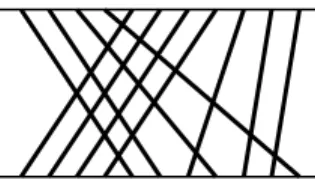
Let x be a polar vertex adjacent to every vertex in Y . Let L be a permutation diagram representing G. Assume without loss of generality that x corresponds to a line segment s in L whose lower-end is the left-most among all the lower-ends of the segments in L. Then each vertex in X \ {x} corresponds to each segment that lays on the right-side of s in L. On the other hand, a segment s′ corresponding to a vertex in Y must intersect with s. Therefore, the upper-end of s′ must be on the left-side of that of s. Consider the segment s′′ whose upper-end is the right-most among segments corresponding to vertices in Y . Then lower-end of s′′ must be the right-most, since otherwise G cannot be connected. Hence, the vertex corresponding to s′′is adjacent to all the vertices in X. This means that if a bipartite permutation graph G = (X, Y, E) has a polar vertex x ∈ X satisfying deg(x) = |Y |, then G also has a polar vertex y ∈ Y satisfying deg(y) = |X|. See Fig. 4 for an illustration.
Now, we know that there are two special polar vertices x and y in G. There must be two other polar vertices. One corresponds to the segment in L whose upper-end is the left-most, and the other corresponds to the segment whose upper-end is the right-most. We denote the vertices by v and w, respectively. We assume without loss of generality |X| ≥ |Y |. Removing v(∈ Y ) results in a connected bipartite graph G′. The size of the vertex sets of G is |X| and |Y | − 1. Thus, there is at least one connected card whose vertex sets have sizes |X| and |Y | − 1. Moreover, since
Fig. 4. An example of permutation diagram of a connected bipartite graph G = (X, Y, E) with a polar vertex x ∈ X whose degree is |Y |.
|X| > |Y | − 1, we can find such a card from the deck of G. Let G′′ be a card of Gwhose vertex sets have sizes |X| and |Y | − 1. Since the degree sequence of G is reconstructible, we can determine the degree of the vertex z, where G′′is obtained by removing z from G. Hence, we can determine the preimage uniquely.
Lemma 4.2. Given a connected bipartite permutation graph G = (X, Y, E) satis-fying Condition 1, let x be a polar vertex in X, and let Y′ be the set of vertices adjacent to x. A vertex y ∈ Y′ is a polar vertex of G if and only if y’s degree is the minimum in Y′.
Proof. Let L be a permutation diagram representing G. Since x is a polar vertex of G, we can assume without loss of generality that the line segment s in L whose upper-end is the left-most corresponds to x. Then, all the line segments correspond-ing to the vertices in X \ {x} are at the right-side of s.
Let y∗ be a polar vertex in Y′. Since G satisfies Condition 1, a line segment s′ in L corresponding to y∗ is the left-most in those corresponding to vertices in Y′. Therefore, the degree of y∗ is the minimum among the vertices in Y′.
Lemma 4.3. Let G′= (X′, Y′, E′) be a connected bipartite permutation graph. Let xbe a polar vertex in X′. Then, graph G = (X, Y, E) that is obtained by adding a degree k ∈ {1, . . . , |X′|} vertex y to Y′ is uniquely determined, under the conditions that G is a bipartite permutation graph, y is a polar vertex of G, and y is adjacent to x in G.
Proof. Let L′ be a permutation diagram representing G′, and let L be a permuta-tion diagram representing G. It is clear that L can be obtained by adding to L′ a line segment sy corresponding to y.
Since x is a polar vertex of G′, we can assume without loss of generality that the line segment sx in L′ and L corresponding to x is the left-most among those corresponding to vertices in X. We can assume without loss of generality that the upper-end of sx is the left-most among the upper-ends of all the segments in L. Since y is a polar vertex in G, sy in L corresponding to y is the left-most among those corresponding to vertices in Y . That is, the lower-end of the syis the left-most among the lower-ends of all the segments in L. Then, we can determine the position
of the upper-end of sy uniquely, since sy must intersect to exactly k segments in X.
Lemma 4.4. The number of polar vertices whose degree is one is reconstructible for a connected bipartite permutation graph G = (X, Y, E) satisfying Condition 1. Proof. If a polar vertex v of G has degree one, the polar vertex adjacent to v has degree more than one, since otherwise G is disconnected.
When we remove a polar vertex that is adjacent to another polar vertex of degree one from G, we obtain a graph consisting of some isolated vertices and a connected component. Conversely, if there is a graph consisting of some isolated vertices and a connected component in the deck of G, this graph must be obtained from some preimage by removing a polar vertex adjacent to an other polar vertex of degree one. Otherwise, there must be at least two connected components. Thus, the number of polar vertices whose degree is one is equal to the number of cards consisting of some isolated vertices and a connected component.
5. Concluding Remarks
Proving that permutation graphs are reconstructible is a challenging problem. Since a permutation diagram of a permutation graph is not unique, it seems not to be easy. Recently, we developed an algorithm which enumerates all the preimages of a deck that consists of permutation graphs in the polynomial time [10]. The algorithm shows that the number of preimages for a deck of permutation graphs is at most O(n3
).
References
[1] B. Bollob´as: Almost every graph has reconstruction number three. Journal of Graph Theory, vol. 14 (1990) 1–4.
[2] J. A. Bondy: On Ulam’s conjecture for separable graphs. Pacific Journal of Mathe-matics, vol. 31 (1969) 281–288.
[3] J. A. Bondy: A graph reconstructor’s manual. Surveys in Combinatorics, London Mathematical Society Lecture Note Series, vol. 166 (1991) 221–252.
[4] S. Even: Algorithmic Combinatorics, Macmillan, New York, 1973.
[5] W. B. Giles: The reconstruction of outerplanar graphs. Journal of Combinatorial Theory, Series B, vol. 16 (1974) 215–226.
[6] D. L. Greenwell, and R. L. Hemminger: Reconstructing the n-connected components of a graph. Aequationes Mathematicae, vol. 9 (1973) 19–22.
[7] F. Harary: A survey of the reconstruction conjecture. Graphs and Combinatorics, Lecture Notes in Mathematics, vol. 406 (1974) 18–28.
[8] P. Hell and J. Huang: Certifying LexBFS recognition algorithms for proper interval graphs and proper interval bigraphs, SIAM Journal on Discrete Mathematics, vol. 18 (2005) 554–570.
[9] P. J. Kelly: A congruence theorem for trees. Pacific Journal of Mathematics, vol. 7 (1957) 961–968.
[10] M. Kiyomi, T. Saitoh, and R. Uehara: Reconstruction algorithm for permutation graphs. Lecture Notes in Computer Science vol. 5942 (WALCOM2010) 125–135. [11] B. Manvel: Reconstruction of unicyclic graphs. Proof Techniques in Graph Theory,
Academic Press, New York, 1969.
[12] B. D. McKay: Small graphs are reconstructible. Australasian Journal of Combina-torics, vol. 15 (1997) 123–126.
[13] M. von Rimscha: Reconstructibility and perfect graphs. Discrete Mathematics, vol. 47 (1983) 283–291.
[14] T. Saitoh, Y. Otachi, K. Yamanaka, and R. Uehara: Random generation and enumer-ation of bipartite permutenumer-ation graphs. Lecture Notes in Computer Science vol. 5868 (ISAAC2009) 1104–1113.
[15] W. T. Tutte: On dichromatic polynomials. Journal of Combinatorial Theory, vol. 2 (1967) 310–320.
[16] W. T. Tutte: All king’s horses. A guide to reconstruction. Graph Theory and Related Topics, Academic Press, New York, 1979, 15–33.