Japan Advanced Institute of Science and Technology
JAIST Repository
https://dspace.jaist.ac.jp/
Title
The Dependency of Turbo MIMO Equalizer
Performances on the Spatial and Temporal
Multipath Channel Structure - A Measurement Data
Based Evaluation
Author(s)
Schneider, C.; Thoma, R.; Trautwein, U.;
Matsumoto, T.
Citation
The 57th IEEE Semiannual Vehicular Technology
Conference, 2003. VTC 2003-Spring., 2: 808-812
Issue Date
2003-04
Type
Conference Paper
Text version
publisher
URL
http://hdl.handle.net/10119/4828
Rights
Copyright (c)2003 IEEE. Reprinted from The 57th
IEEE Semiannual Vehicular Technology Conference,
2003. VTC 2003-Spring. This material is posted
here with permission of the IEEE. Such permission
of the IEEE does not in any way imply IEEE
endorsement of any of JAIST's products or
services. Internal or personal use of this
material is permitted. However, permission to
reprint/republish this material for advertising
or promotional purposes or for creating new
collective works for resale or redistribution
must be obtained from the IEEE by writing to
[email protected]. By choosing to view
this document, you agree to all provisions of the
copyright laws protecting it.
The Dependency of Turbo MIMO Equalizer
Performance on the Spatial and Temporal Multipath
Channel Structure
-
A
Measurement Based Evaluation
Christian Schneider, Reiner
Thoma
Uwe
TrautweinTad
MatsumotoTechnische Universitat llmenau Tewisoft GmbH University of Oulu
Ilmenau, Germany Ilmenau, Germany Oulu, Finland
christian.schtieider~~~ti-ilmenau.de uwc.traiitwein(;i!tcrisoft.d~ tadashi.matsumotoMee.oulu.fi Absiract- In this paper a performanee analysis of the turbo
MIMO equalizer concept for broadband MIMO channels is presented. The channel modeling in the link-level simulations is based on MlMO measurements in different scenarios. The results reveal the strong relationships between the propagation conditions in terms of the available spatial and temporal multipath diversity, the antenna configurations, and the achievable bit error rates. It is shown that the consideration of a simple transmit diversity concept and the application of antenna subset selection leads to remarkable performance improvements.
Keywords- Turbo MIMO equalization, measuremen1 data, single carrier, pcrformanee evoluotion, subset selection, transmit diversiq
1. INTRODUCTION
Multiple-input multiple-output (MIMO) air interfaces based on antenna arrays at both the transmitter as well as the receiver side are considered to be the ultimate means to increase the available capacity for high bit rate wireless links. Commonly known MlMO signal processing concepts like BLAST [I] aim
to exploit the spatial diversity of the propagation channel. A straightforward extension of such narrowband algorithms to broadband single carrier systems would mostly result in an unacceptable numerical complexity. The turbo MIMO equalizer (TME) concept has shown the potential for a low-
complexity signal separation method which exploits the spatial as well as the temporal stlucture of frequency selective MIMO channels [2], [6].
The performance evaluation regarding efficiency, usability and deployment of MlMO systems in various different propagation scenarios - combined with the optimization and enhancement of such systems is still a white spot. Adaptive space-time signal processing concepts, e.g., antenna subset selection
[7],
seem to be steps towards reasonable and robust MIMO communication.Channel sounding techniques provide the possibility to evaluate the performance of radio multiple access and signal processing schemes under realistic propagation conditions. Complex channel impulse responses (CIR) gathered through MIMO measurements in different real field scenarios have been used in link-level simulations. The characterization of the multipath channel by means of high resolution parameter
estimation is essential for investigating the influence of the spatial and temporal structure on the performance of the TME. Therefore this paper employs the results of double-directional channel sounding experiments for MIMO link-level simulations [3].
First, in section II a brief overview of the considered turbo
MIMO detector is presented. This is followed by a description and notes to the measurement scenarios and the data used for realistic link-level simulations. Section IV shows bit error rate (BER) curves as performance results. The TME’s performance is investigated under different propagation conditions. Furthermore, the impact of a transmit antenna subset selection test and a simple transmit diversity concept is highlighted.
II. MIMO SYSTEM
A. Turbo MMO Detection
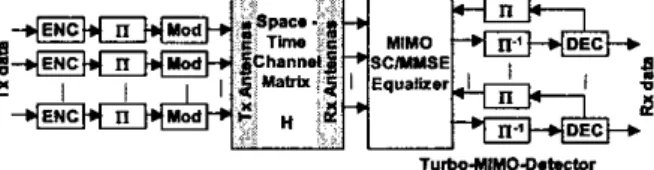
The considered MlMO transmission system based on an iterative receiver concept was inspired through [2] and is shown in Fig. I . The receiver consists of two main parts: the
MIMO SC/MMSE equalizer producing soft outputs and the sofl input soft output channel decoder. Both are linked in order to exchange reliability information for the coded bits and together they perform the hxhn MIMO detection. The reliability information is used within the MlMO equalizer block in order to perform a soft interference cancellation (SC) step of the interference components, which arise from inter- symbol interference (ISI) and multiple access interference (MAI). In the multiuser (MU) MIMO case the MA1 are caused
by different users (e.g., equipped with one antenna) transmitting signals at the same time and frequency slot. In a high data rate point-to-point
(P2P)
MlMO setup the MA1 comes up from the multiple antennas of one uansmitter. A spatial-temporal minimum mean square error (MMSE)Figure 3. M e a m e n t scenario with 2 different meks
equalizer subsequently follows the SC step to minimize remaining IS1 and MA1 components at the filter output. For
each transmitted data stream one filter output exists and consequently one decoder embedded together with de- interleaver and interleaver in an iterative feedback loop. In the first iteration no SC step can he applied due to the fact that no reliability information of the coded bits is available at this point. Therefore, the MMSE filter alone plays the role to suppress all interferences.
B. Transmit Schemes
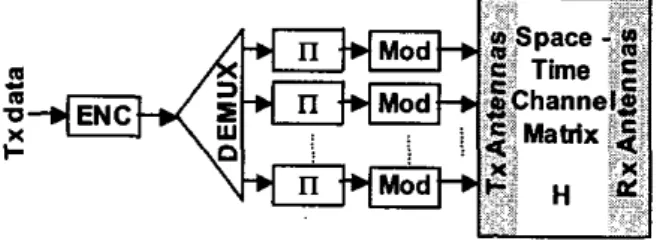
The MIMO system concept illustrated in Fig. I was primarily designed for MU-MIMO applications [2]. In this transmit concept, each user is equipped with one antenna and generates a transmit data stream with independent convolutional encoding, interleaving and modulation. For the P2P-MIMO system the same principle can be used. A demultiplexer block in front of the encoders divides the total data stream into sub streams according to the number of transmit antennas. Again, each data stream is independently encoded, interleaved, modulated and transmitted over a fixed allocated antenna. As an altemative, a simple modified transmit scheme arises if the convolutional error correction encoding is shified before the
(,”.“ %
, .-in(
Figure 2. PZP-MIMO Vanstnit concept using transmit diversity
demultiplexer
as
depicted in Fig. 2. Considering an encoder with a code rate of 0.5 and a P2P-MIMO system with 2 transmit antennas, the 2 coded bits representing 1 information bit are split over two sub streams and transmitted by both antennas. This can he seen as coding over the transmit antennas, thus yielding a transmit diversity scheme. The 2 decoders embedded in the iterative turbo MIMO detection receiver can potentially obtain a diversity gain from this modification.111. REALISTIC LMK-LEVEL SIMULATIONUSING MEASUREMENT DATA
A . Importance of Measurement Data
Link-level or system-level simulation methods have the aim to evaluate and compare the performance of different air interface concepts as well as system concepts under realistic considerations. In contrast to the development of prototypes, multi-dimensional channel sounding techniques provide efficient possibilities to perform such simulations with a manifold of variations. Furthermore, these techniques open the way to high resolution path parameter estimation results, and hence, face simulation performances with the physical nature of propagation. Realistic conclusions and understandings of the system or algorithm under test can he drawn and consequently used to enhance and optimize the considered concept. The broadband real-time channel sounder RUSK MIMO from MEDAV [4] supports multiple antennas at both sides and was used for the measurement campaign treated in this paper. Important aspects for performing MIMO measurements and using the measurement data in transmission system simulations are discussed in [6].
B.
Two measurements were performed within a large courtyard at the campus of the Technische Universiat Ilmenau. This place is completely enclosed by a building of about 15 m height, whereby several different metal objects (container, mesh fence and tubes) were located withih the courtyard. Measurement track “I”, see Fig. 3, is characterized by a non line of sight (NLOS) part for approx. 3 m from position TXl and line of sight (LOS) conditions for the rest of the track. The transmit antenna, an omnidirectional 16 element uniform circular array (UCA), fastened at a height of 2.10 m, was moved at walking speed. For the receive antenna, an 8 element uniform linear patch array with separate ports for horizontal and vertical polarization was considered, whereby the antenna was mounted at a height of 1.67 m and only the vertical polarization was measured. During measurement track “11,” the same antenna configuration, hut with different heights (transmitter at 1.10 m and receiver at 1.13 m) was applied. Most parts of the track had NLOS. The emphasis of this selected run laid on the passage (tunnel) between transmitter and receiver’. The passage has a length of 13.10 m, a height and width of 4.15 m and 4.47 m, respectively. All measurements have been performed at 5.2 GHz carrier frequency and with a bandwidth of 120 MHz.
Selected Scenario and Measurement Setups
I Data from this xenario C M be downloaded hn of charge from 141.
-'"I 50 LOO 150 200 250 299 Position#
~i~~~ 4. R-I~S of propagation esttmarim for
meamrement track "P' (delay normalized to 1TT = 12 Msym/s, ma@iNdessmller than-15 dBareplotted~th-15 dB)
IV.
LINK L E V n SIMULATION mSTJLTS A . Simulation setupIn this paper all simulation results have been produced for TME based systems operating at 12 Msymholds per Tx antenna.
T h e
transmit space-time signal processing uses a convolutional encoder with code rate 0.5 and constraint length 3, random interleaver and BPSK modulation for each sub stream. The channel impulse responses for both selected tracks are modeled, according to the delay components observed within the measurement data, using 17 delay taps. For complexity reasons the receiver itself is only equipped with L = 5 temporal taps. This is sufficient to capture the significant part of the received energy within the channel impulse responses. The signal to noise ratio ( S N R ) at the receiver is held constant and identical for each transmit signal by an adaptive power control. The total transmitted power is independent of the numbers of transmit antennas.'"
1 50 100 150 200 250 293Position #
Figure 5 . BER of a 313 "ME (gay bars) vs. Rx and Tx azimuth spread along measurement track "P'
B. NLOS- LOSpropagation
Using the high resolution path parameter estimation approach
[3], two different propagation conditions for track "I" can be identified. In Fig. 4 the estimation results for the multipath components over the whole measurement run are shown in terms of direction of arrival
(Rx
azimuth), direction of departure (Tx azimuth) and path delay time. From the beginning until position #I25 strong multipath components between 0" and 4 YRx
azimuth and for the Tx azimuth ranges of -50" 170' and respective 60 o...120° characterize the NLOS part. The different multipath components can also be separated within the delay time plot. Obviously, for a small number of positions (#1-#20) only very minor changes in theestimated parameters and additional strong multipath components for 2 T in delay time as well as for the Tx azimuth around +70° can be found. Here, the Tx antenna did not move. After this section the paths disappear. As expected from Fig. 3, LOS condition can be observed for the rest of the track (#12ī). Multipath contributions are attenuated by
15 dB and more relative to the strongest path. T h e displayed
BER
results (after 4 iterations and at 6 dBSNR)
for aTME
system using 3 Tx antennas and 3 Rx antennas (denoted by
313) in Fig. 5 reflect very well the dependency of the considered MIMO system on the spatial and temporal
E5
m
I
2 4 6 8 10
SNR [dB]
Rgvre 7. BER C U W ~ S for 2n2, 414, 616 and 8/8 TME, under stationary
NLOS
multipath diversity for different propagation conditions. Here, the NLOS parts are indicated by Tx azimuth spreads between 50” and looo, whereas the LOS parts show values between 20” and 40”. Due to the limited view of the uniform linear patch array (Rx antenna), the spread for the Rx azimuth is significantly lower as for the Tx azimuth, but still a small dependency on the different propagation condition (NLOS- LOS) can be found. The TME performance strongly depends on the NLOS and LOS propagation. This relation can be more distinctly seen in Fig. 6. After 4 iterations the 3/3 TME shows reasonable performance for the dynamic NLOS part (position
#21-#125) and slightly better curves for the stationary NLOS
part (#1#20), but for the LOS part the transmission completely fails. Fig. 7 compares BER curves after the 1st and 4th iteration of a 2/2, 4/4, 616, and 818 TME, respectively, within the stationary NLOS part. For the 1st iteration, the performance decreases with an increasing number of considered streams, due to the increased MAL ARer the 4th iteration, 2/2 and the 414 systems reach the same performance. For the 6/6 and 8/8 TME a good iteration gain can be observed, but the BER performance of a 414 system can not be achieved. The TME is capable to exploit multipath diversity by performing iterations.
Position #
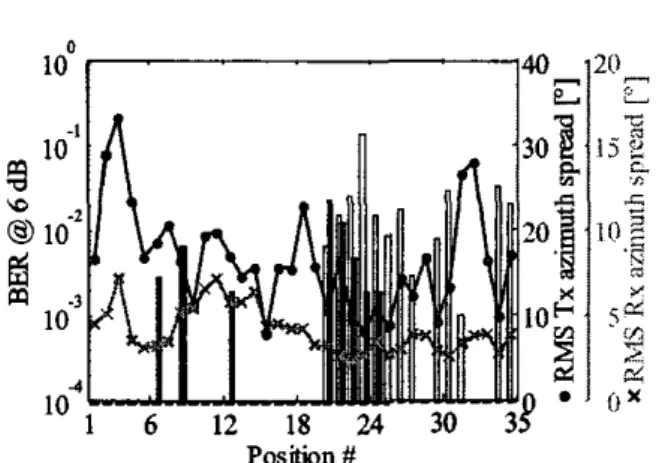
Figure 8. BER of2/2 TME’s considering 2 different transmit antenna subsets (dark and light bars) YS delay spread along track “II”
10’
@,
10’B
10)
\o L9 “‘16
12 1824
30
3
Position #Figure 9. BER ofZ2 TME‘s considering 2 different transmit ant- subsets (dark and light bars) vs Rx and Tx azimuth spread along hack “IF’ C. MMO Antenna Subset Selection and Transmit Diversify Measurement track “Ii” in particular was selected due to the passage between transmitter and receiver. For this scenario lower azimuth spreads for Tx and Kx compared to track “I” were expected. For the following performance evaluations only the middle part of track “2”, consisting of 35 positions, were considered. In Fig. 8 and Fig. 9 the results of the high resolution parameter estimation are displayed together with position variant BER (after 4 iterations and at 6 dB SNR) for a 2/2 TME, in which 2 different Tx element subsets out of 16 elements were used. The interesting observation is that for different Tx element combinations significant performance differences occur without an obvious interpretation regarding the path parameter estimations. That means even small changes in the antenna positions could cause large performance variations. Furthermore, this fact was also found for simulation trials with 313 and 4/4 TME systems. Only the positions with significantly high azimuth and delay spreads seem to be independent to antenna subset selection.
Motivated by the aforementioned observation a dynamic subset selection test was carried out to investigate the influence on the mean BER performance over the selected snapshots. One fmed Tx antenna subset for all 35 position leads to a high BER, see Fig. IO. The selection test follows no specific measure or key parameter. The BER for 212 and 313 TME systems for 5 different Tx antenna subsets were simulated. Afterwards the antenna subset with the minimum BER for one specific snapshot was selected to compute the mean BER over all positions. This simple test shows impressively the significance of the MIMO antenna subset selection. Performance gains of 6 dB at a BER of
IO”
(see Fig. IO) can be expected, if an effective subset selection algorithm for frequency-selective MIMO channels can be applied.As shown above a possible Tx antenna subset selection can be nsefiil to reach reasonable and robust mean BER for TME even in channels with low azimuth and delay spreads. This approach can only be used if the transmitter has channel knowledge or a feedback channel from the receiver and at least the transmitter has several selectable transmit antennas.
‘ “ 0
2
46
8
IO SNR [dB]Figure 10. BER curves for 2n.313 TME, comparison between fixed tranmit antenm and dynamic antenna subset selection
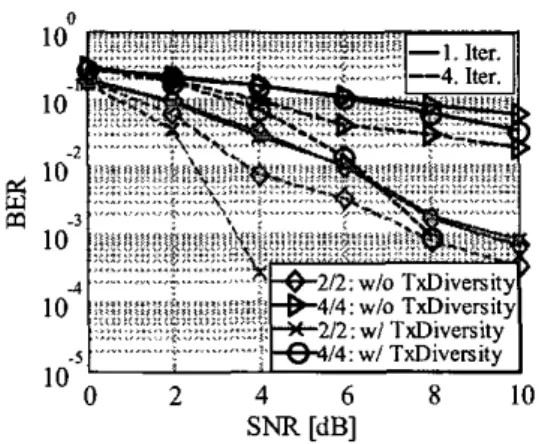
A simple change in the transmit signal processing for the P2P- MIMO setup, as described in section 11, introduces transmit diversity without increasing complexity and loss of throughput. In Fig. 11 the significant performance gain is illuminated. The link-level simulations have been performed in the same middle part of track “11” as before. Without the transmit diversity concept the typical iteration gain for the 212 TME and the 4/4 TME is not observable - the mean performance is rather poor, due to the potential lack of multipath diversity. Using the simple change in the transmit concept leads to impressive gains for the 4th iteration in both systems. For the 212 TME an improvement of around 4 dB at a BER of IO” can be remarked. The first iteration shows no difference between systems with and without the transmit diversity approach. It seems that the iterative turbo MIMO equalization can significantly benefit with higher iteration numbers from additional diversity. The lack of spatial- temporal multipath diversity, which is essential for broadband MIMO communications, can he partially compensated through introducing another form of diversity - the transmit
diversity.
V. CONCLUSIONS
The potential performance of broadband MIMO communication systems strongly depends on the offered spatial as well as the temporal radio channel diversity. MIMO measurement trials combined with bigb-resolution channel characterization provide detailed insights into the physical propagation conditions in different real world scenarios. Using these methods the performance of the P2P-TME concept can he realistically evaluated and interpreted.
Reasonable and robust results can be gained for the P2P-TME in NLOS scenarios with a high degree of spatial and temporal
diversity - indicated by azimuth and delay spreads. In contrast to that, LOS or even NLOS channels with a low degree of
multipath diversity show poor MIMO system performances. A simple extension of the P2P-TME concept towards introducing a form of transmit diversity leads to remarkable performance gains for 2/2 and even for 414 TME‘s.
Furthermore, a MlMO antenna subset selection test illuminates an enormous influence on the simulation results.
‘ “ 0 2 4
6
8 10SNR [dB]
Figure I 1. BER cuwes far 2R, 414 TME, wl and wlo transmit diversity
Adaptive space-time algorithms for the transmitter as well as for the receiver seem to be essential. The optimization and enhancement of MIMO algorithms with respect to application and deployment issues will play an important role for future research work.
ACKNOWLEDGMENT
This work was partly supported by the German Federal Ministry of Education, Science Research and Technology under the HyEff project line. The authors wish to thank MEDAV GmbH for supporting their RUSK MIMO channel sounder and the colleagues at the Technische UniversiM Ilmenau for performing the measurements and supporting the data analysis.
REFERENCES
[I] 0 . 1. Foschini and M. 1. Gans, “On the limits of wireless communications in a fading environment when using multiple antennas,” Wireless Personal Communications, vol. 6, no. 3, March
1998, p. 31 I .
121 T. Abe and T. Matmnoto, Space-Time Turba Equalization and Symbol Detection in Frequency Selective MlMO Channels,” IEEE Vehicular Technology Cont. Atlantic Cily, NI, Oct. 2001.
[3] R. S. Thomil, D. Hampickc, M. Landmann, G . Sommerkom, A. Richter, “MIMO Measurement for Double-Directional Channel Modeling”, IEE Technical Seminar on “MIMO Communication Systems,” London, December 2001.
R S. Thomil, D. Hampieke, A. Richter, 0. Sommerlrom, U. Trautwcin, “MIMO Vector Channel Sounder Measurement for Sman Antenna System Evaluation”, European Trans. an Telecomm., ETT Vol. 12, No.
[6] U. Tramvein. T. Matsumoto, C. Schneider, R. Thoma, “Exploring the
Performance of Turbo MlMO Equalization in Real Field Scenarios”, Fiflh International Symposium on Wireless Personal Multimedia Comunicatiom ( W M C ’2002), Honolulu, Hawaii, Oct. 2002. [71 D. A. Gore and A. I. Paulraj, “MIMO Antenna Subset Selection With
Space-Time Coding”, IEEE Transactions on Signal Procasing. Vol. SO.
XO. i n , October 2 w 2
[4] h n p : / / ~ . c h a n n e l s o u n d ~ ~ . d e
[SI