The
Nonstationary
lnfinite
Horizon
Production-inventory
Problem
with
Uncertain
Capacity and
Uncertain
Demand
Department of Industrial Engineering and Management, Tokyo Institute of Technology,
TetsuoIida
東京工業大学経営工学専攻 飯田哲夫
1
Introduction
In this paper we consider
a
non-stationary periodic review dynamic production-inventorymodel with uncertain production capacity and uncertain demand. The demands occur
inde-pendently,but they
are
not necessarily identically distributed. Also, themaximumproductioncapacityvaries stochastically. This is because of uncertainties in production processes. for
in-stance, unexpected breakdown and unplanned maintenance (Ciarallo, Akella and $\mathrm{M}\mathrm{o}\mathrm{r}\mathrm{t}\mathrm{o}\mathrm{n}[3]$).
Therefore, if the realized production capacity is below the planned production quantity, only
part ofit can be produced.
The non-stationarystochasticperiodicreviewinventorymodels havebeenstudiedbynany
researchers; see$\mathrm{K}\mathrm{a}\mathrm{r}\mathrm{l}\mathrm{i}\mathrm{n}[11,12],$ $\mathrm{v}\mathrm{e}\mathrm{i}\mathrm{n}\mathrm{o}\mathrm{t}\mathrm{t}[16, ?],$ $\mathrm{M}\mathrm{o}\mathrm{r}\mathrm{t}\mathrm{o}\mathrm{n}[14],$$\mathrm{Z}\mathrm{i}_{\mathrm{P}}\mathrm{k}\mathrm{i}\mathrm{n}[19]$, Morton and$\mathrm{P}\mathrm{e}\mathrm{n}\mathrm{t}\mathrm{i}\mathrm{C}\mathrm{o}[15]$,
and$\mathrm{I}\mathrm{i}\mathrm{d}\mathrm{a}[9]$
.
However all of theses literature do not consider the productioncapacityconstraint.The stationary models with the production capacity constrainthave been studied
(Feder-gruen and $\mathrm{Z}\mathrm{i}\mathrm{p}\mathrm{k}\mathrm{i}\mathrm{n}[4,5]$, Ciarallo, Akella and $\mathrm{M}\mathrm{o}\mathrm{r}\mathrm{t}\mathrm{o}\mathrm{n}[3],$ $\mathrm{G}\ddot{\mathrm{u}}1\mathrm{l}\ddot{\mathrm{u}}[8])$
.
A multi-stage model withthe production capacity constraint has been studied (Glasserman and $\mathrm{T}\mathrm{a}\mathrm{y}\mathrm{u}\mathrm{r}[6,7]$). A
peri-odic(cyclic) demand model with the productioncapacity constraint is studiedin Kapu\’{s}citski
and $\mathrm{T}\mathrm{a}\mathrm{y}\mathrm{u}\mathrm{r}[13]$
.
The stationary models with random yields have been studied (Yano and$\overline{\mathrm{L}}\mathrm{e}\mathrm{e}[18]$, Wang and $\mathrm{G}\mathrm{e}\mathrm{r}\mathrm{c}\mathrm{h}\mathrm{a}\mathrm{k}[17])$
.
It is known that myopic (or
near
myopic) policies are nearly optimal for the inventoryproblems without the production capacity. However, it has not been known whether the
near myopic policies are still nearly optimal for the production-inventory problems with the
production capacity. In this paperweshow that the similar result holds for theproblemswith
the productioncapacity.
We considera single-stage non-stationary production-inventory model withuncertain
pro-duction capacity and uncertain demand. Theobjective ofour model is to minimize thetotal
discounted expected costs which include production, inventory holding and penalty costs.
Production, inventory holding and penalty costs
are
assumed to be linear respectively. Wedeal with both finite horizon problems and infinite horizon problems for which order up-to
(or base-stock, critical number) policies are optimal, and obtain upper and lower bounds of
optimal order up-to levels. Furthermore
we
show that for an infinite horizon problem theupper and the lower bounds of optimal order up-to levels for the finite horizon counterparts
convergerespectively asthe plaming horizons considered become longer. Furthermore, under
mild conditions the differences between theupperand the lower bounds of optimal order up-to
We first formulate the finite horizonproblem as adynamic programalong standard steps,
and then introduce
a new
problem which is equivalent to the original problem with respectto the optimal expected cost and the optimal ordering policies. Then we obtain upper and
lower bounds of the optimal order up-to levels for the finite horizon problem. For the infinite
horizon problem, the convergence results ofthe upper and the lower bounds of the optimal
order up-tolevelsforthe finite horizon counterpartsareshown. Numerical examples illustrate
computation of the bounds and
convergence.
The paper is organized
as
follows. Section 2 presents the problem considered in thispaper and introduce anequivalent problem. Section 3 explores the infinite horizon problem:
we
develop upper and lower bounds of optimal order up-to levels and show the convergenceresults. Section 4 presents numerical examples. Section 5 concludes this
paper:
All proofs of propositions and lemmas in this paper are shown in [10].
2
Problem Formulation
We consider
a
periodicreviewdynamic production-inventory model with uncertainproductioncapacity and uncertaindemand. The demands and the production capacities are assumed to
be independent but not necessarily be identical. Leadtime is
zero
and unsatisfied demandsare
backlogged. The objective of the problem is to minimize the total discounted expectedcosts which include three types of costs: production, inventory holding and backlog penalty
costs. The costs
are
assumed to be linear respectively.The activities take place in the following manner: at the beginning of a period a new
ordering decision ismade, duringtheperiodtheproductioncapacity realizes and the customer
demand occurs, and at the end of the period inventory holding and backlog penalty costs
are
charged.
We define
$Z_{t}$ : customer demand at period $t$,
$Q_{t}(z),$ $q_{t}(Z)$
:
cumulative distribution and density functions for $Z_{t}$,$A_{t}$ : $\mathrm{p}\mathrm{r}\mathrm{o}\mathrm{d}\mathrm{u}\mathrm{C}\mathrm{t}\mathrm{i}_{\dot{\mathrm{O}}}\mathrm{n}$ capacity at period $t$,
$F_{t}(a),$ $f_{t}(a)$ : cumulative distribution and density functions for $A_{t}$,
$x_{t}$
:
inventory position at the beginning of period$t$ before ordering,$u_{t}$ : planned production quantity at period $t$,
$c_{t},$ $h_{t,pt}$ : unit production, hol,ding and penalty costs at period $t(h_{t},$ $p_{t}>0,$ $c_{t}\geq 0$ and $p_{t}>c_{t})$
.
Weassume
that the unit holding, penalty and production costs are bounded, thatis, $p_{t}<p<\infty,$ $h_{t}<h<\infty$ and $0\leq\underline{c}<c_{t}<\overline{c}<\infty$ for all $t$
.
2.1
DynamicProgramming Formulation
We first consider the expected one-period cost. The production cost is determined by the
actual production quantity which is limited by the production capacity $A_{t}$
.
If the plannedproduction quantityis$u_{t}$and the realized productioncapacityis$a_{t}$, then the actualproduction
quantity is $\min$
{
$u_{t}$,
at}.
The inventory holding and backlog penalty costs are determined bythe inventory position at the end of the period whichdepends
on
therealized customer demand$Z_{t}$
.
Thus the one-period expected cost $g_{t}(x, u)$,
wherethe inventory position at thebeginningof period $t$before ordering is $x$ and the planned production quantity is $u$, is
as
follows,For an $n$-period problem, we minimize the total discounted expected cost. Let $\alpha<1$ be
the discount factor perperiod. Theperiods are numbered 1, 2,
...
,$n$.
Let $G_{t,n}(x)$ denote thetotal discounted expected cost from period $t$ through$n$ using optimal policies, given that the
inventory position at the beginning ofperiod $t$ before ordering is $x$
.
Then, $G_{t,n}(x)$ satisfiesthe following recursive equation,
$G_{t,n}(x)= \min_{u\geq 0}\{gt(x, u)+\alpha EG_{t+1,n}(X+\min\{u, A_{t}\}-z_{t})\}$, for $t=1,2,$$\ldots$ ,$n$,
where $G_{n+1,n}(X)\equiv 0$. In the above recursive equation the expectation is taken with respect
to the random variables $A_{t}$ and $Z_{t}$
.
We shall hereafterassume that all relevant functions aredifferentiable. We define
$H_{t,n}(x, u)$ $=$ $g_{t}(x, u)+ \alpha EG_{t+1},n(X+\min\{u, A_{t}\}-^{z}t)$ (1) $=$ $g_{t}(x, u)+ \alpha\int_{0}^{u}\int_{0}^{\infty}ct+1,n(x+a-Z)ft(a)qt(z)dadz$
$+ \alpha(1-F(u))\int_{0}^{\infty}G_{t}+1,n(X+u-z)q_{t}(z)d_{Z}$
.
Nowwe denote the solutionof the following equation by $x_{t,n}^{*}$,
$(h_{t}+p_{t})Q_{t}(X)+ \alpha\int_{0}^{\infty}G_{t1}’(x-Z)dQ_{t(}Z)+,n-(pt-_{C}t)=0$,
and define abase-stock ordering policy $u_{t,n}^{*}(x)$ using $x_{t,n}^{*}$ as follows,
$u_{t,n}^{*}(_{X})=\{$
$x_{t,n}^{*}-x$ if $x\leq x_{t,n}^{*}$,
$0$ if $x>x_{t,n}^{*}$
.
Then thefollowing proposition$\mathrm{h}\mathrm{o}\mathrm{l}\mathrm{d}_{\mathrm{S}}$(Ciarallo, Akella and
$\mathrm{M}\mathrm{o}\mathrm{r}\mathrm{t}\mathrm{o}\mathrm{n}[3]$, Wang and$\mathrm{G}\mathrm{e}\mathrm{r}\mathrm{c}\mathrm{h}\mathrm{a}\mathrm{k}[17]$).
Proposition 1 1. $G_{t,n}(x)$ is convex.
2. $G_{t,n}(x)=\{$ $H_{t,n}(x, u_{t}^{*},(nx))$ when
$x\leq x_{t,n}^{*}$, $H_{t,n}(x, \mathrm{o})$ when $x>x_{t,n}^{*}$
.
3. The base-stock policy $u_{t,n}^{*}(x)$ minimizes (1).
2.2
An Equivalent Problem
We consider aproblem equivalent to the original problem defined in the previous subsection.
Inthe original problem the available production capacity realizes after ordering, thereforewe
have to make a production order considering the uncertainty ofthe production capacity. We
here consideraproblem in which the availableproduction capacity realizesbefore ordering
so
that
we can
makea
production order with the deterministic production capacity constraint.We will find that this problem is equivalent to the originalone with respect to both optimal
ordering policies and optimalexpected costs, and as aresult of this modification the analysis
of the problem becomes simpler than that of the originalone. We denote the original problem
by Pl and the new one by P2.
In problem P2 the activities in
a
period take place in the followingmanner:
at theat the end of the period penalty and holding costs are
charged.
We denote the inventory position after ordering by $y_{t}$
.
Since the production capacity isrealized before ordering, we candetermine $y_{t}$ explicitly whenwe make
an
order. We considerthe expected one-periodcostwhere theinventoryposition at the beginning of the period after
ordering is$y(y=x+u)$
.
Let$L_{t}(y)=E[h_{t}(y-zt)++pt(y-Z_{t})-]$.
Note that $L_{t}(y)$ is a convexfunction. Then the expected one-period cost where the inventory
positionat the beginning of the period after ordering is $y$ is $c_{t}(y-X_{t})+L_{t}(y)$
.
Nextwe consideran$n$-period problem. Since the ordering decision in P2 is limited by the
realized production capacity $a_{t}$,
we
considera
pair of the inventory position at the beginningofa period before ordering and the realized production capacity
as a
state, that is, $(x_{t}, a_{t})$.
Let$I_{t,n}(x, a)$ denote the total discountedexpectedcost from period $t$ through$n$ usingoptimal
policies, given that the inventory position at the beginning ofperiod $t$ before ordering is $x$
and the realized production capacity in period $t$ is $a$
.
We also define$I_{t,n}(x)=EI_{t,n}(x, A_{t})$. (2)
Then $I_{t,n}(x, a)$ satisfies the followingrecursive equation,
$I_{t,n}(x, a)= \min_{x\leq y\leq x+a}\{Ct(y-x)+L_{t}(y)+\alpha EI_{t+1,n}(y-Z_{t})\}$, (3)
where $I_{n+1,n+1()}x\equiv 0$
.
We define additional functions $J_{t,n}$ as follows,$J_{t,n}(y)=C_{ty+}Lt(y)+\alpha EIt+1,n(y-Z_{t})$
.
Then $I_{t,n}(x, a)=-c_{t}x+ \min_{x\leq y\leq t,n}x+aJ(y)$, and the following proposition holds.
Proposition 2 $J_{t,n}(y)$ is convex.
From the convexity of$J_{t,n}(y)$ an order up-topolicy is optimal. We call$y_{t,n}^{*}$ optimal order
up-to level. It is shown in the proof that $y_{t,n}^{*}$ solves the following equation,
$J_{t,n}’(y)\equiv(h_{t}+p_{t}).Qt(y)-(pt-c_{t})+\alpha EI_{t1,n}’(+y-Zt)=0$
.
This
means
that the optimal order up-to levels are same for all$a$.Next we come to the main result of this section. The following proposition allows us to
investigate problem P2 instead ofproblem Pl.
Proposition 3 Problems$P1$ and$P2$ are equivalentwith respectto both the optimal ordering
policies and the optimal expected costs.
In order to derive upper and lower bounds of the optimal order up-to levels in the next
section, we now make a cost transformation, whichwas used in Morton and $\mathrm{P}\mathrm{e}\mathrm{n}\mathrm{t}\mathrm{i}_{\mathrm{C}\mathrm{O}}[15]$
.
Let$\tilde{I}_{t,n}(x, a)=c_{t}x+I_{t,n}(x, a)$ and$\tilde{I}_{t,n}(x)=c_{t}x+I_{t,n}(x)$
.
Thenwe
obtainthe followingrecursiveequations for $\tilde{I}_{t,n}(x,a)$ and $\tilde{I}_{t,n}(x)$,
and
$\tilde{I}_{t,n}(x, a)=\min_{x\leq y\leq x+a}\{\tilde{L}_{t}(y)+\alpha E\tilde{I}_{t1,n}+(y-^{z_{t})}\}$ (5)
where transformed
one
period cost function $\tilde{L}_{t}$ and cost parameters are defined as follows,$\tilde{L}_{t}(y)=\tilde{h}_{t}E(y-^{z_{t})}++\tilde{p}_{t}E(y-z_{t})-+c_{t}E[z_{t}]$
and
$\tilde{h}_{t}=h_{t}+c_{t}-\alpha C_{t1}+$ and $\tilde{p}_{t}=p_{t}-c_{t}+\alpha c_{t+1}$
.
Note that equations (4) and (5) are identical to equations (2) and (3). Therefore optimal
order up-to levels $y_{t,n}^{*}$
are
same. We define additional functions $\tilde{J}_{t,n}(y)$as
follows,$\tilde{J}_{t,n}(y)=\tilde{L}_{t}(y)+\alpha E\tilde{I}_{t}+1,n(y-z_{t})$
.
Also, let $\tilde{h}=h+\overline{c}-\alpha\underline{\mathrm{c}}$and
$\tilde{p}=p-\underline{\mathrm{c}}+\alpha\overline{c}$. Then$\tilde{p}_{t}<\tilde{p}$ and $\tilde{h}_{t}<\tilde{h}$
.
3
The Infinite
Horizon
Problem
3.1 Upper
and Lower
Boundsof
the Optimal Order Up-toLevels
We first consider upper and lower bounds of the optimal order up-to levels for
an
n-periodproblem. We providealemma which shows monotonicity of derivatives of the optimal expected
costsand the optimal order up-to levels. The shorthand$f_{\star^{1}}$is used to meanthat the function
$f$ is everywhere decreased, and $f\uparrow \mathrm{i}\mathrm{s}$ similar.
Lemma 4 $\tilde{J}_{t,n}’\downarrow\Rightarrow\tilde{I}_{t,n}’\downarrow$, $y_{t,n}^{*}\uparrow and\tilde{J}_{t-}^{J}\downarrow 1,n$.
All results remain true if all
arrows are
inverted. Recall that $-(\tilde{p}-\alpha\underline{\mathrm{c}})\leq\tilde{J}_{n,n}’(y)\leq\tilde{h}+\alpha\overline{c}$.
We
now
define$\tilde{I}_{n+1,n}^{U}(x)\equiv-\frac{\tilde{p}x}{1-\alpha}$ and $\tilde{I}_{n+1,n}^{L}(x)\equiv\frac{\tilde{h}x}{1-\alpha}$.
Let$\tilde{I}_{t,n}^{U}$and$\tilde{I}_{t,n}^{L}$ denote the corresponding additional functions derived from$\tilde{I}_{n+1,n}^{U}$ and$\tilde{I}_{n+1,n}^{L}$,
respectively. Similarly
we
define $\tilde{J}_{t,n}^{U},\tilde{J}_{t,n}^{L},$ $y_{t,n}^{U*}$ and $y_{t,n}^{L*}$. Then the folowing proposition isshown byusing Lemma 4.
Proposition 5 1. $\tilde{J}_{t,n}^{U\prime}(y)\leq\tilde{J}_{t,n}^{U;}(+1y)$
for
all$y$.
2. $\tilde{I}_{t,n}^{U/}(X)\leq\tilde{I}_{t,n}^{U\prime}+1(x)$
for
all$x$.
3. $y_{t,n+1}^{U}*\leq y_{t,n}^{U*}$
.
The results for the lower bounds also hold similarly. Thenwe can define
$\lim_{narrow\infty}y_{t},nU*=y_{t}^{U*}$ and $\lim_{narrow\infty}y^{L*}t,n=y^{L*}t$
’
since a bounded monotonic sequence converges to a point. Thus from proposition 5 the
Proposition 6 For any and$t<n$
.
Remark The inventory problem considered here
can
be formulatedas
a
non-homogeneousMarkov decision process. $\cdot$
Under the conditions that the demands
are
integral, themeans
of the demands
are
bounded from above and the inventory position is limited, it is shownfrom the theory of non-homogeneous Markov decision processes that
a
set ofoptimalorderingpolicies foran infinite horizonproblem includes the limiting policy of theoptimalpolicies for
the finite horizon counterparts (Bes and $\mathrm{S}\mathrm{e}\mathrm{t}\mathrm{h}\mathrm{i}[2]$ and Bean, Smith and $\mathrm{L}\mathrm{a}\mathrm{s}\mathrm{S}\mathrm{e}\mathrm{r}\mathrm{r}\mathrm{e}[1]$).
Hereafter
we
consider the limiting policy of the optimal policies for the finite horizoncounterparts as
the.optimal
policy for the infinite horizon problem.3.2
TheDifference
between
the Upper and the Lower BoundsIn this subsection we investigate the conditions under which a sequence of the differences
between the upper and the lower bounds of the optimal order up-to levels for the finite
horizon counterparts converges to
zero.
We first consider the relations among the secondderivatives of$\tilde{L}_{t},\tilde{J}_{t,n},\tilde{J}_{t,n}^{U}$ and so on. Let $0 \leq m_{t}\equiv\inf_{y}\tilde{L}_{t}^{\prime/}(y)$
.
and$\triangle\tilde{J}_{t}’\equiv\tilde{J}_{t}^{L}’-\tilde{J}_{t}U’$
.
Similarly, $\Delta\tilde{I}_{t}’,$ $\triangle y_{t}^{*}$ and
so
on are defined. Next, we show the results for the relation among$m_{t},$ $\triangle\tilde{J}_{t,n}’$ and
so
on.
Lemma 7 1. $\Delta\tilde{I}_{t,n}’(X)\leq\max_{y}\Delta\tilde{J}_{t}’,n(y)$
.
2. $m_{t} \triangle y_{t}^{*}\leq\max_{y}\Delta\tilde{J}_{t}’,(ny)$
.
Then thefollowing proposition isshown by using Lemma
7.
Proposition 8 $\triangle\tilde{J}_{t,n}’(y)\leq\alpha^{n-t+1}(\tilde{h}+\tilde{p})/(1-\alpha)$ .
Cororally 9
If
$m_{t}>0,$ $\triangle y_{t,n}^{*}$ converges to zero as $narrow\infty$.
The convergence rate of $\triangle y_{t,n}^{*}$ to zero is $O(\alpha^{n-t+1})$. Therefore we may expect that the
convergence is rapid for most problems. In the next section
we
investigate the speed of theconvergence with numerical examples.
4
Numerical
E.xamples
In thissection we illustrate the upper and the lower bounds of the optimal order up-to levels
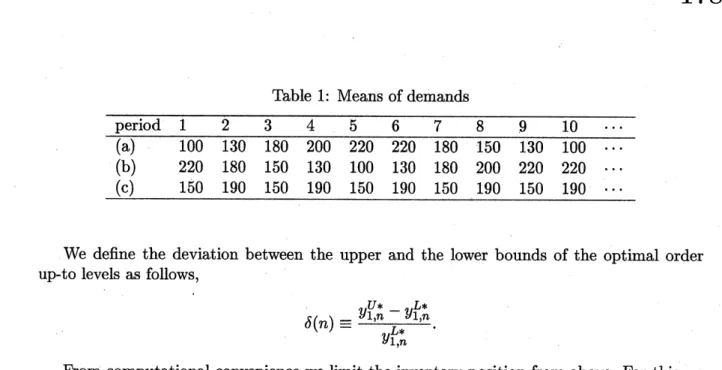
and the convergence results with numerical examples. The examples include three types of
demand pattern: (a) increasing-decreasing, (b) decreasing-increasing and (c) almost stable.
Let the distributions of the demands be the normal distributions which are truncated to
become non-negative. The
means
of the demands for the three types ofdemandpatternare
shown in Table 1. Let the standard deviation of the demand at each period be half of the
mean of the demand. Let the distributions of the production capacity be also the normal
distributions, and their standard deviation be 10. We change the
mean
of the productioncapacity amongseveral values.
Let each parameter of the model like
below:
$c_{t}=\underline{\mathrm{c}}=\overline{c}=\mathrm{p}\mathrm{r}\mathrm{o}\mathrm{d}\mathrm{u}\mathrm{c}\mathrm{t}\mathrm{i}_{0\mathrm{n}}$cost $=30,$ $h_{t}=h=$Table 1: Means of demands
$\overline{\frac{\mathrm{P}^{\mathrm{e}\mathrm{r}\mathrm{i}_{0}\mathrm{d}1234}5678910}{(\mathrm{a})100130180200220220180150130100}..\cdot..\cdot}$
(b) 220 180 150 130 100 130 180 200 220 220
.
.
.
(c) 150 190 150 190 150 190 150 190 150 190
.
.
.
We define the deviation between the upper and the lower bounds of the optimal order
up-to levels as follows,
$\delta(n)\equiv\frac{y_{1,n}^{U*}-y1,nL*}{y_{1,n}^{L*}}$
.
From computational convenience
we
limit the inventory position from above. For this weassume
the following.Assumption 1 The optimal order up-to levels$y_{t,n}^{*}$ are bounded, that is, there $exi\mathit{8}i\mathit{8}\overline{y}_{Su}ch$
that$y_{t,n}^{*}<\overline{y}$
for
all $n$ and$t<n$.
We define
$\tilde{I}_{n+1,n}^{U}(_{X})=\{$
$0$ when $x>\overline{y}$,
$-\tilde{p}x/(1-\alpha)$ when $x\leq\overline{y}$
.
Then the following proposition holds.
Proposition 10 Under assumption 1 and using new $\tilde{I}_{n+1,n}^{U}(x)$
1. $y_{t,n}^{U*}\geq y_{t_{)}n}^{*}$
.
2. $y_{t,n}^{U*}\geq y_{t,n+1}^{U}*$.
Let $\overline{y}=300$ for the numerical examples. Table 2 shows the minimumplanning horizons
for which $\delta(n)$ is less than 0.05. From Table 2 we find that for the case that the demand
patternis increasing-decreasing and the production capacity constraint istight, the minimum
planning horizon gets longer than
ones
for othercases.
Thismeans
that for theincreasing-decreasing demand
case we
have to consider the demands in much further future because ofthe possibility that shortages may occur. On the otherhand, when the production capacity
constraint is not tight, the minimum planninghorizon for the increasing-decreasing demand
case
gets shorter. This is consistent with the results of $\mathrm{V}\mathrm{e}\mathrm{i}\mathrm{n}\mathrm{o}\mathrm{t}\mathrm{t}[?]$ for the inventory modelwithout the production capacity. The minimum planning horizons for the
cases
of the tightproduction capacity constraint become longer than
ones
for other cases. This reflects theeffect that the sufficient production capacity contributes to reducing the influence of future
uncertainties ontheoptimal ordering policy.
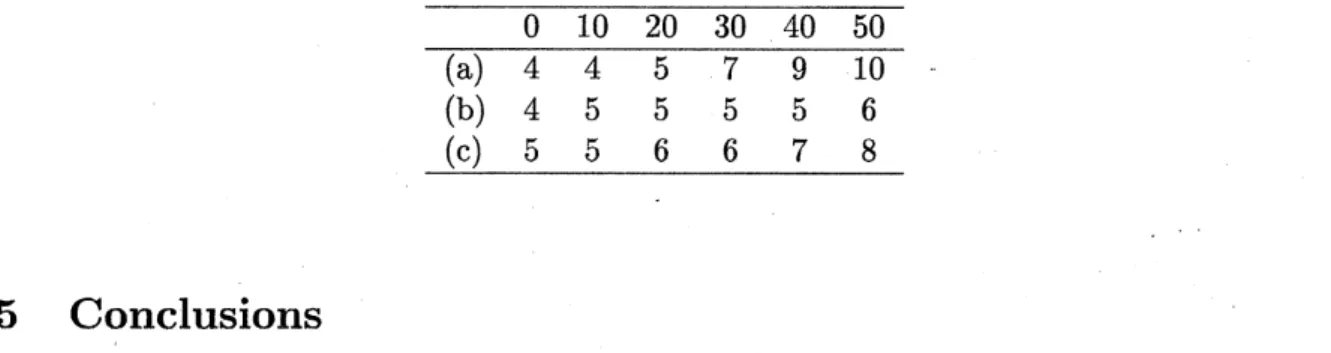
Next
we
investigate the effects of variance of the production capacity on the minimumplanning horizons. Table 3 shows the minimum planning horizons for several variances of
the production capacity. Let the
mean
of the production capacity be 220. From Table 3 wefind that as the variance of the production capacity becomes larger, the minimum planning
Table 2: Minimumplanninghorizons corresponding to several values ofmeanof production capacity
$\frac{200210220230240\cdots\infty}{(\mathrm{a})107433\cdots 2}$
(b) 5 5 5 4 4
...
3(c) 8 6 5 4 4
...
3makes the minimumplanning horizon much longer. However the effects of the variance of the
production capacity on the lengths of the minimum planning horizons are sufficiently small
when the variance is not large.
Table 3: Minimumplanning horizons corresponding to several values of standard deviation of production
capacity
$\frac{01020304050}{(\mathrm{a})4457910}$
(b) 4 5 5 5 5 6
(c) 5 5 6 6 7 8
5
Conclusions
In this paper
we
developedan
equivalent formulation of the original production-inventoryproblemwithuncertainproductioncapacity and uncertain demand. From the$\mathrm{f}o$rmulation the
upperand the lowerbounds ofthe optimal order up-to levelswerederived. Thenitwasshown
that the upper and the lower bounds of theoptimal order up-to levels converge respectively,
and under mild conditions the differences between the upper and the lower bounds converge
exponentiallyto zero.
Extensions to convex holding and penalty costs with bounded derivatives and fixed
lead-time are possible. Since the results in this paper depend on the convexity of cost functions
and the boundedness of their derivatives, the model can be extended to
convex
holding andpenalty costs with bounded derivatives. Also since the equivalent formulation developed in
this paper
uses
the inventory position as state, fixed leadtime can be incorporated into the model along the standard way.References
[1] Bean,J. Smith,R. and Lasserre,J., ”Denumerablestate nonhomogeneous Markov decision
processes”, Journal ofMathematical Analysis and Application 153 (1990) 64-77.
[2] Bes,C. and Sethi,S.,”Concepts of forecast and decision horizons: applicationsto dynamic
stochastic optimization problems”, Mathematics of Operations Research 13 No.2 (1984)
295-310.
[3] Ciarallo,F.W., Akella,R. and Morton,T.E., ”A periodic review, production planning
model with uncertain capacity and uncertain demand–optimality of extended myopic
[4] Federgruen,A. and Zipkin,P., ”An inventory model with limited production capacity and
uncertain demands I. The average-cost criterion”, Mathematics of Operations Research
11 No.2 (1986) 193-207.
[5] Federgruen,A. and Zipkin,P., ”An inventory model with limitedproduction capacity and
uncertain demands II. The discounted-cost criterion”, Mathematics of Operations
Re-search 11 No.2 (1986) 208-215.
[6] Glasserman,P. and Tayur,S., ”Sensitivity analysis for base-stock levels in multi-echelon
production-inventory systems”, Management Science41 No.2 (1995) 263-281.
[7] Glasserman,P. and Tayur,S., ”A simple approximation for multi-stage capacitated
production-inventory system”, Naval Research Logistics43 No.l (1996) 41-58.
[8] G\"ull\"u,R., ”Base stock policies for$\mathrm{p}\mathrm{r}\mathrm{o}\mathrm{d}\mathrm{u}\mathrm{C}\mathrm{t}\mathrm{i}_{0}\mathrm{n}/\mathrm{i}\mathrm{n}\mathrm{v}\mathrm{e}\mathrm{n}\mathrm{t}\mathrm{o}\mathrm{r}\mathrm{y}$ problems withuncertain capacity
levels”, European Journal of Operational Research 105 (1998) 43-51.
[9] Iida,T., ”The infinite horizon non-stationary stochastic inventory problem:
near
myopicpolicies and weak ergodicity”, European Journal of Operational Research 116 (1999)
405-422.
[10] Iida,T., ”The Nonstationary Infinite Horizon Production-inventory Problem with
Un-certain Capacity and Uncertain Demand”, Technical Report, Department of Industrial
Engineering and Management, TokyoInstitute of Technology (1999).
[11] Karlin,S., ”Dynamic inventory policy with varying stochastic demands”, Management
Science 6 No.3 (1960) 231-258.
[12] Karlin,S., ”Optimal policy for dynamic inventory process with stochastic demands
sub-ject to seasonal variations”, JournalofSIAM8 No.4 (1960) 611-629.
[13] Kapu\’{s}citski,R. and Tayur,S., ”A capacitated production-inventory model with periodic
demand”, Operations Research 46 No.6 (1998) 899-911.
[14] $\mathrm{M}\mathrm{o}\mathrm{r}\mathrm{t}0\mathrm{n}:^{\mathrm{T}.\mathrm{E}}.$, ”The nonstationary infinite horizon inventoryproblem”, Management
Sci-ence
24No.14 (1978) 1474-1482.[15] Morton,T.E. and Pentico,D.W., ”The finite horizon nonstationary stochastic inventory
problem: near-myopic bounds, heuristics, testing”, Management Science 41 No.2 (1995)
334-343.
[16] Veinott,A.F.,Jr., ”Optimal stockage policies with non-stationary stochastic demands”,
in: H.Scarf,D.GilfordandM.Shelly (eds.), Multistage InventoryModelsand Techniques,
Stanford University Press, Stanford, CA, 1963.
[17] Wang,Y. and Gerchak,Y., ”Periodic review production models with variable capacity,
random yield, and uncertain demand”, Management Science 42 No.l (1996) 130-137.
[18] Yano,C.A. and Lee,H.L.,”Lotsizing with random yields: areview”, Operations Research
43 No.2 (1995) 311-334.
[19] Zipkin,P., ”Critical number policies for inventory models with periodic data”