Completeness
Proofs for
Linear Logic
Based
on
the
Proof
$\mathrm{s}_{\mathrm{e}\mathrm{a}1^{\sim}}\mathrm{C}\mathrm{h}$
Method
(
$\mathrm{P}\mathrm{r}\mathrm{e}\mathrm{l}\mathrm{i}_{1}\mathrm{n}\mathrm{i}\mathrm{n}\mathrm{a}\mathrm{r}\mathrm{y}$Report)
Mitsuhiro Okada
Kazushige
TeruiDepartment of
Philosophy,
Keio UniversityAbstract
The proof search methodis a traditionally established way to prove the completeness
theoremfor various logics. Thepurpose of thispaper is to showthat this methodcan be
adapted to linear logic.
First we prove the completeness theorem for a certainfragment ofintuitionisticlinear
logic,called naive linear logic, with respect to naive phase semantics,i.e.,phasesemantics
without any closure condition,usingthe proof search method inacertainlabelled sequent
system. Thenthe completeness of the (rudimentary)classicallinearlogic can be obtained
as a direct corollary by a Kolmogorov-G\"odelstyle double negationinterpretation.
To apply the proof searchmethod for the full system of linear logic, we generalize the
notionof branchinthe standard proof search methodto that of OR-iree, andgive aproof
ofthe completeness theorem forintuitionistic (classical, resp.) linear logic with respect to
intuitionistic (classical, resp.) phase semantics, based on a generalized form of$\mathrm{t}1_{1}\mathrm{e}$proof
search method.
1
Introduction
The proof search method is considered to be one of the most natural completeness proof methods and successfully applied to prove the completeness theorems forvarious logics, typi-cally forclassical logic, intuitionistic logic and someof modal logics (cf. $\mathrm{K}\mathrm{l}\mathrm{e}\mathrm{e}\mathrm{n}\mathrm{e}[5],$ $\mathrm{S}\mathrm{c}\mathrm{h}\ddot{\mathrm{u}}\mathrm{t}\mathrm{t}\mathrm{e}[9]$,
$\mathrm{T}\mathrm{a}\mathrm{k}\mathrm{e}\mathrm{u}\mathrm{t}\mathrm{i}[10])$.
This method consists of the following two steps; (i) to prove that for any unprovable formula there exists such a branch in a proof search tree that does not reach an axiom and that contains enough
information
to refute the formula (called an open branch), and (ii) to show the construction of a countermodel of the formula from the open branch obtained by (i). This method could be viewed as a specific way of the Henkin model construction in the classical logic case since the proof search procedure gives a process of construction of a maximal consistent set of formulas.Theusual proof search method usesthe structural rules (weakening and contraction) very essentially. Henceit has not been known ifor not this method is adaptable to linear logic in which thelack of the structural rules is one of the main features. The purpose of this paper is to give an affirmative answerto this question.
To see how structural rules are essential in the case of the proof search method for tra-ditional logics, let us suppose that we would like to refute (i.e., to find a countermodel of)
$\Gamma\vdash A\vee B$ in classical logic. Our task is to find an open branch in a proof search tree tllat
contains enough information to make every formula in $\Gamma$ true a,nd both $A$ and $B$ false. A
proof search tree ofagiven sequent is constructed by successively applying the inference rules of classical logic in a bottom-up manner. However, if we use the usual inference rules for ${ }$-right, that is,
$\frac{\Gamma\vdash A}{\Gamma\vdash A\vee B}$
and $\frac{\Gamma\vdash B}{\Gamma\vdash A\vee B}$ ,
welose one of$A$ and $B$ (when read bottom-up), hence branches in the resulting proof search
treeretain too little information to refute $\Gamma\vdash AB$. The essential trick here is to consider
the following derived rule in classical logic which is equivalent to the above two rules, due to weakening and contraction;
$\frac{\Gamma\vdash A,B}{\Gamma\vdash A\vee B}$
.
Thanks to using this equivalent rule we can preserve the information on both $A$ and $B$
.
Thistrick is a part of the reason why an open branch in cla,ssical logic suffices to construct a
countermodel. One could consider the same trick for intuitionisticlogic, which leads to the completeness with respect to the $\mathrm{I}C\mathrm{r}\mathrm{i}_{\mathrm{P}}\mathrm{k}\mathrm{e}$ models (cf.
$\mathrm{e}\mathrm{g}$. $\mathrm{T}\mathrm{a}\mathrm{k}\mathrm{e}\mathrm{u}\mathrm{t}\mathrm{i}[10]$, CH 1,
\S 8).
Inlinear logic, however,wecalmotuseany trick like above because of the lack of structural rules;
$\bullet$ We cannot replace $\mathrm{t}\mathrm{w}\mathrm{o}\oplus$-right rules by a single rule, contrary to the $\vee$-right case of
classical logic.
$\bullet$ We must take all possible context partitions into account when we
$\mathrm{a}\mathrm{p}\mathrm{p}\mathrm{l}\mathrm{y}\otimes$-right and
$-0$-left rules. For example, $\alpha,$$\beta\vdash\alpha\otimes\gamma$ has only one non-atomic formula, but we must
consider four possibilities whenwe $\mathrm{a}\mathrm{p}\mathrm{p}\mathrm{l}\mathrm{y}\otimes$-right rule;
$\vdash\alpha$
$\alpha,\beta\vdash\gamma$ $\alpha\vdash\alpha$ $\beta\vdash\gamma$ $\beta\vdash\alpha$ $\alpha\vdash\gamma$ $\alpha,\beta\vdash\alpha$ $\vdash\gamma$
$\alpha,\beta\vdash\alpha\otimes\gamma$ $\alpha,\beta\vdash a\otimes\gamma$ $a,$$\beta\vdash a\otimes\gamma$ $\alpha,\beta\vdash\alpha\otimes\gamma$ .
As aconsequence, the stalldard construction of a countermodel from one open branch is not
possible for linear logic. In this paper, wepropose two solutions to overcome this difficulty.
1. To introduce labels; we consider a sort of labelled system for the proof search method in whichresourceinformationisexpressed notin terms of number of formulaoccurrences in a se-quent,but in terms of labels attached to formulas. In the system, structural rulescanbe used freely, hence
we
can accommodate the standard proof search method to this system. In thisway, we prove that acertain fragment ofintuitionistic linear logic, whichwe call naive linear
logic (NLL), is complete with respect to naivephase semantics, i.e., phase semantics without any closure condition. Then we show that the multiplicative additive fragment of classical linear logic (MALL), sometimes called rudimentary linear logic, is encoded into NLL via
the $\mathrm{K}\mathrm{o}\mathrm{l}\mathrm{m}\mathrm{o}\mathrm{g}_{\mathrm{o}\mathrm{r}}\mathrm{o}\mathrm{V}$-G\"odelstyle double negation translation. Hence, as a direct corollary, wealso
have a completeness proof of MALL based on the proof search method, since the classical
phase semantics (in the sense of $\mathrm{G}\mathrm{i}\mathrm{r}\mathrm{a}\mathrm{r}\mathrm{d}[3]$) is also obtained by the double-negation closure
propertyfrom our naive phase semantics. The labelling method has been investigated under Gabbay’s general framework of Labelled Deductive Systems $(LDS)[2]$. Our method could be
viewed as an application of LDS (see $\mathrm{K}\mathrm{u}\mathrm{r}\mathrm{t}_{0}\mathrm{n}\mathrm{i}\mathrm{n}\mathrm{a}[6],$ $\mathrm{V}\mathrm{e}\mathrm{n}\mathrm{e}\mathrm{m}\mathrm{a}[12]$ for other applications of LDS to substructural logics).
2. To generalize the notion
of
open branch; We generalize the notion of branch in a proof searchtree to the notion of OR-branching treeor simply OR-tree,and show thatgiven an un-provable sequent $\Gamma\vdash C$, one can construct an open OR-tree whichretainsenough informationto refute the sequent. Then we describe howto construct a,n intuitionistic phase model from
an open OR-tree of full intuitionistic linear logic (ILL), and a classical phase model from that of full classical linear logic $(\mathrm{L}\mathrm{L})$. In both cases, the closure condition of phase semantics plays an essential role. This gives a $\mathrm{c}\mathrm{o}\mathrm{m}_{\mathrm{P}}1\mathrm{e}\mathrm{t}\mathrm{e}11\mathrm{e}\mathrm{S}\mathrm{S}$ proof based on a generalized form of the
proofsearch method both for ILL and for$\mathrm{L}\mathrm{L}$. We also obtain the cut-elimination theorem as
a corollary, since we donot use the cut rule during the construction of the required OR-tree and the corresponding countermodel.
In section 2, first we give the definitions of intuitionistic and classical phase semantics. Then naive phase semantics is obtained by dropping the closure condition from intuitionistic
phase semantics. In section 3, we define naive linear logic (NLL), which consists of
connec-tives $(\otimes, \oplus, -0)$ where $-0$ is restricted to the form $A-\mathrm{o}a$ (for any atomic formula $\alpha$). In
order to incorporate with the standard proof search method, we also introduce an alterna-tive formulation of NLL using labels, called labelled naive linear logic (LNLL), and prove
the completeness of NLL with respect to naive phase semantics. Section 4 is devoted to a
completeness proof of both ILL alld LL based on the open OR-branching tree construction. We give the definitions ofintuitionistic linear logic and classical (left one-sided) linear logic
in Appendix A and $\mathrm{B}$, respectively.
2
Intuitionistic, Classical
and
Naive
Phase
Semantics
In this section,wedefineintuitionisticphasesemantics(cf.$\mathrm{A}\mathrm{b}\mathrm{r}\mathrm{u}\mathrm{S}\mathrm{C}\mathrm{i}[1],$$\mathrm{T}\mathrm{r}\mathrm{o}\mathrm{e}\mathrm{l}\mathrm{S}\mathrm{t}\mathrm{r}\mathrm{a}[11],$ $\mathrm{o}\mathrm{k}\mathrm{a}\mathrm{d}\mathrm{a}[8]$),
classical phase semantics (cf. $\mathrm{G}\mathrm{i}_{\Gamma \mathrm{a}\mathrm{r}}\mathrm{d}[3][4]$ and $\mathrm{L}\mathrm{a}\mathrm{f}\mathrm{o}\mathrm{n}\mathrm{t}[7]$), and naive phase semantics.
Definition 1 An intuitionistic $\mathrm{p}\mathrm{h}\mathrm{a}$,se space $(\lambda f, Cl)$ consists of a commutative monoid $\lambda f$
and a function $Cl$ : $\mathcal{P}(M)-arrow P(\lambda f)$, called a closure operator, satisfying the following;
(C1) $X\subseteq cl(x)$;
(C2) $X\subseteq Y$implies $Ct(X)\subseteq Cl(Y)$;
(C3) $Cl(X)=Cl(Cl(X))$;
(C4) $Cl(X)Cl(Y)\subseteq Cl(XY)$;
where $XY$ is defined by $\{xy|x\in X, y\in Y\}$. A set $X\subseteq M$ that satisfies $X=Cl(X)$is called
a
fact.
Then, wecan define $1=Cl(\{1\})$ ($1$ standsfor theunit element of$\lambda f$), $\mathrm{T}=M,$ $0=Cl(\emptyset)$,
and for anyfacts $X,Y$,
$\bullet$ $X-\mathrm{o}Y=\{y|\forall x\in^{x_{X}}y\in l^{\Gamma}\}$
$\bullet$ X&Y $.=X\cap \mathrm{Y}$;
$\bullet X\oplus \mathrm{Y}=cl(X\cup l’)$.
As easily seen, each constant above is afact and each operation above produces a fact
when-ever facts $X$ and $\mathrm{Y}$ are given.
If$M$ is an intuitionistic phase space, then $J(\lambda f)=\{x\in 1|x\in Cl(\{xx\})\}$ is a submonoid
of$M$. An enrichedintuitionisticphase space is anintuitionistic phase space $M$endowed with
a submonoid $K$ of$J(M)$ (not necessary to be afact).
For anyfact $X$ ofintuitionistic phase space, define $\bullet!X=Cl(X\cap K)$.
An intuitionistic phase model $M=(M, Ct, K, v)$ isgiven by an intuitionistic phase space
$M=(M, Cl, K)$ and an interpretation$v$ which maps each atomic formula $\alpha$ to a fact $v(\alpha)$ of
$\lambda \mathit{4}$, which is also denoted by $\alpha^{*}$. Then each formula $A$ is interpreted by a fact $A^{*}$ along the
above definitions, and $\Gamma\equiv A_{1},$
$\ldots,$$A_{n}$ is interpreted by $\Gamma^{*}=A_{1}^{*}\otimes\cdots\otimes A_{n}^{*}$. We say that $A$
is
satisfied
in $\lambda \mathit{4}$ if $1\in A^{*}$, and that $\Gamma\vdash C$ issatisfied
in $\lambda \mathit{4}$ if $\Gamma^{*}\subseteq C^{*}$.Aclassical phase space (A4,$\perp,$$I\zeta$)is anintuitionisticphasespace (A4,$Cl,K$) witha subset $\perp \mathrm{o}\mathrm{f}M$in which the closure operator $Cl$is defined bv double negation,i.e., $Cl(X)=X^{\perp\perp}=$ $(x-\circ\perp)-\mathrm{O}\perp$. In classical phase spaces, we have two additional operations;
$\bullet X\eta \mathrm{Y}=(X^{\perp_{\mathrm{Y}}}\perp)\perp$;
$\bullet?X=(X^{\perp_{\mathrm{n}}}K)^{\perp}$.
A naive phase space $\lambda \mathit{4}$ is an intuitionistic phase space $(M, Cl)$ where $Cl$ is the identity
function. In a naive phase space$M$, any subset of$\lambda\ell$is a fact, $X\otimes Y=XY$ and$X\oplus Y=X\cup Y$.
Since $J(\lambda I)$ is degenerate $(=\{1\})$, we do not consider enriched naive phase spaces at all.
The following examples indicate that naive phase semantics is a natural generalization of traditional semantics such as classical 2-valued semantics and Kripke semantics.
1. Consider a naive phase model whose underlying monoid is the singleton
{1}.
Write$F,T$ to denote $\phi,$$\{1\}$, respectively. Then $A^{*}\otimes B^{*}=T$ iff$A^{*}\ 7$$B^{*}=T$ iff$A^{*}=T$ and $B^{*}=T;A^{*}\oplus B^{*}=T$ iff$A^{*}=T$ or $B^{*}=T$; and $A^{*}-\mathrm{o}B^{*}=T$ iff$A^{*}=T$ implies
$B^{*}=T$
.
Hence, this modelis a usual 2-valued model for classical logic.2. Consider $(\lambda \mathit{4}, v)$ where A4 is idempotent, i.e.,
$xx=x$ for any $x\in$ J4 and $v$ maps each
atom to an ideal of $\lambda I$, i.e. a subset satisfying $XM\subseteq X.$ $\lambda I$ can be seen as the set
of possible worlds with accessibility relation $\leq$ defined by $x\leq y\Leftrightarrow y=xz$ for some
$z\in\lambda f$. Write $x|=A$ if$x\in A^{*}$. Then $x|=A\otimes B$ iff$x|=A\ B$ iff$x|=A$ and $x|=B$; $x|=A\oplus B$ iff $x|=A$ or $x\models B$; and $x|=A-\circ B$ iff for every $y\geq x,$ $y|=A$ implies
$y|=B$
.
Hence, (J4,$v$) is a usual Kripke model for intuitionisticlogic.3
Naive Linear
Logic
and
its
Completeness
with
respect
to
Naive
Phase
Semantics
Naive linear logic (NLL) is a fragment ofintuitionisticlinear logic with connectives$(\otimes, -0,\oplus)$
such that $-0$ is restricted to the form $X-0\alpha$. More precisely, given aset $V$ of propositional
$L::=V|L\otimes L|L\oplus L|L-\mathrm{o}V$.
NLL does not have anyconstant. However, wewillsee in the end of this section that the multiplicative additivefragment of classical linear logic (MALL) including constants 1 and
$\perp \mathrm{c}\mathrm{a}\mathrm{n}$ be encoded into this simple fragment.
Now we introduce labelled naive linear logic (LNLL). $\backslash \mathrm{V}e$ presuppose that a countable
alphabet $\Sigma$ is given. The free commutative monoid generated by $\Sigma$ is denoted by $c_{om}(\Sigma)$.
$a,$$b,$$c,$$\ldots\in Com(\Sigma)$ are called labels and in particular $x,$ $y,$ $z,$$\ldots\in\Sigma$ are called simple labels.
A label $a$ is said to be linear if it containsno repetition; for example, $xyx$ is not linear while
$xyz$ is linear where $x,$$y,$$z\in\Sigma$. The set of linear labels is denoted by $Lin(\Sigma)$. In particular,
the unit 1 of$Com(\Sigma)$ is in $Lin(\Sigma)$. We write $a\leq b$if$b=ac$ for some $c\in c_{om}(\Sigma)$. A labelled
formula
is of the form $a:$$A$ where $a$is a linear label and $A$ is a formula of NLL. A labelledsequentis of the form $\Gamma\vdash\triangle$, where $\Gamma$ and $\Delta$ are finite multisets of labelled formulas. Let $\Gamma$
be
{
$a_{1}$:$A_{1,\ldots,}$a :$A_{n}$}.
Then we also write $a_{1}\cdots a_{n}$:$\Gamma\vdash\triangle$ to indicate the total amount oflabels occuringin $\Gamma$ (in particular, we write $1:\Gamma’\vdash\Delta$if$\Gamma’=\phi$). We say that $b$ occursin $\Gamma$ if
$b\leq a_{i}$ for some $i$, and also say that $b$ is unique in $\Gamma$ if$b$ occurs in $\{a_{i} : A_{i}\}$ for exactlyone $i$. The similar conventions also apply to $\Delta$.
A labelled sequent $a_{1}$:$A_{1},$
$\ldots,$$a_{nn}$:$A\vdash c:C$ is said to be strict if$c=a_{1}\cdots a_{n}$ and $a_{i}\neq 1$
for
any.
$i$. In particular, a sequent of the $\mathrm{f}\mathrm{o}\mathrm{r}\mathrm{m}\vdash c:C$is strict iff$c=1$.The formulas and the $\mathrm{s}\mathrm{e}\mathrm{q}\mathrm{u}\mathrm{e}\mathrm{n}\tilde{\mathrm{t}}\mathrm{S}$ of LNLL are $1\dot{\mathrm{a}}$
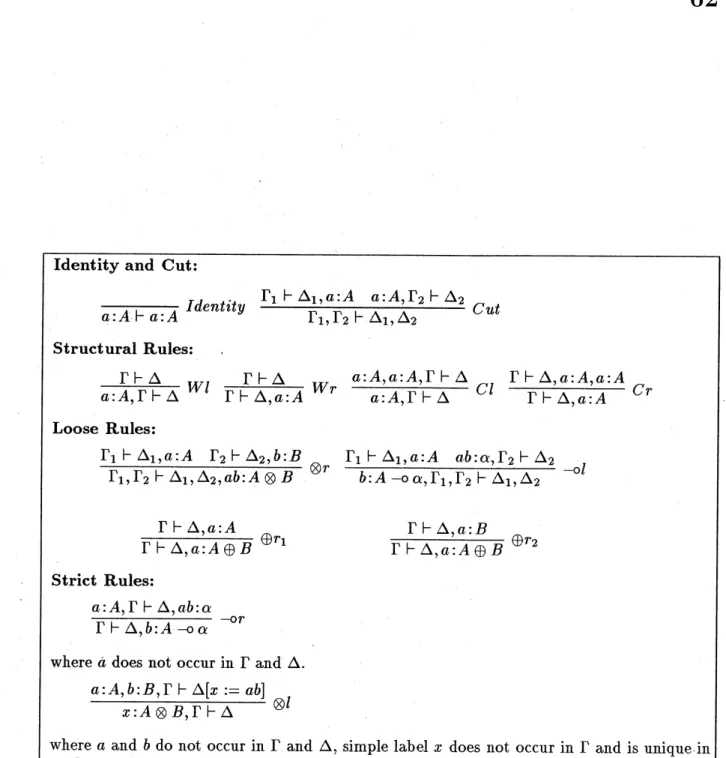
belled formulas and labelled sequents, respectively. The inference rules of LNLL are those in Figure 1.
It is assumed that each inference rule should preserve the linearity of the labels; for example, the following inference is not allowedin LNLL;
$\frac{\Gamma_{1}\vdash a.A\mathrm{r}_{2}\vdash a\cdot B}{\Gamma_{1},\Gamma_{2}\vdash aa\cdot A\otimes B}..\cdot$
Lemma 1 Given a proof$\pi$
of
LNLL sequent $\Gamma\vdash\triangle$, one can construct a proof$\pi’$of
strictLNLL sequent $c:\Gamma_{0}\vdash c:C_{0}$, where $c:\Gamma_{0}\subseteq\Gamma$ and $c:C_{0}\in\triangle$, such that each sequentoccuring
in $\pi’$ is strict.
Proof. By induction on the length of$\pi$. $\blacksquare$
Proposition 1
If
a strict LNLL sequent $c:\Gamma\vdash c:C$ is provable in LNLL, then $\Gamma\vdash C$ isprovable in NLL.
Proof. Given a proof $\tau\downarrow$ ofstrict LNLL sequent $c:\Gamma\vdash c:C$, we can obtain another proof
$\pi’$ of the same sequent in which each sequent is strict by Lemma 1. Such a proof is
$\mathrm{e}\mathrm{a}\mathrm{s}\mathrm{i}\mathrm{l}\mathrm{y}-$
transformed into a proof of$\Gamma\vdash C$ in NLL by dropping all the labels occurringin it.
Next, we enrich the labelled sequents with tags which express additional information
needed to define a suitable proof search procedure. A tagged sequent is of the form $<(\Gamma\vdash$
$\triangle),$$\Sigma^{1},$$\Sigma^{2},$$\Sigma^{3}>\mathrm{w}\mathrm{h}\mathrm{e}\Gamma \mathrm{e}\Gamma\vdash\Delta$is a labelled sequent, $\Sigma^{1}$ is afinite multiset of atomic labelled
formulas such that $\Sigma^{1}\subseteq\Gamma$, and $\Sigma^{2}$ and $\Sigma^{3}$ are finite multisets of labelled formulas.
$<(\Gamma\vdash$
$\triangle),$$\Sigma^{1},$$\Sigma^{2},$$\Sigma^{3}>\mathrm{i}\mathrm{s}$ often denoted by $<(\Gamma\vdash\triangle),\underline{\overline{\nabla}}>$
.
If II is a multiset of labelled formulas such that $\Sigma^{1}\subseteq \mathrm{I}\mathrm{I}$, the difference of II and $\Sigma^{1}$ is denoted by $\mathrm{I}\mathrm{I}^{-}$.
$(\theta 1)$ For each $a:\alpha\in\Sigma^{1}$, there are
$a_{1}$:$A\in\Sigma^{2}$ and $a_{2}$:$A-0\alpha\in\Gamma^{-}$ such that $a=a_{1}a_{2}$.
$(\theta 2)$ Each formulain $\Gamma^{-}$ is labelled with a simple label distinct from each other.
$(\theta 3)$ If$\Gamma$ contains a formula of the form
$a:A\otimes B$ or $a:A\oplus B$, then $a$is unique in $\Gamma$ and also
unique in $\triangle$.
$(\theta 4)\Gamma^{-}\vdash\Delta,$$c:C$is provable for any $c:C\in\Sigma^{2}$.
Lemma 2 $Let<(\Gamma\vdash\triangle),$$\Sigma^{1},$$\Sigma^{2},$ $\Sigma^{3}>be$ a regular tagged
sequent. Then$\Gamma^{-}\vdash\triangle$ is derivable
from
$\Gamma\vdash\triangle$.
Proof. $\Gamma\vdash\Delta$ is of the form $\Sigma^{1},$$\Gamma^{-}\vdash\Delta$ and $\Sigma^{1}=\{a_{1} : \alpha_{1}, \ldots, a_{n} : \alpha_{n}\}$. By
$(\theta 1)$, there are $a_{11}$ : $A_{1}\in\Sigma^{2}$ and $a_{12}$ :$A_{1}-\mathrm{o}a_{1}\in\Gamma^{-}$ such $\mathrm{t}1_{1}\mathrm{a}\mathrm{t}a_{1}=a_{11}a_{12}.$ By $(\theta 4),$ $\Gamma^{-}\vdash\triangle,$
$a_{11}$ : $A_{1}$ is
provable. Hence,
$. \cdot\frac{\frac{\Gamma^{-}\vdash\triangle,a_{11}.\cdot A1...a1\cdot\alpha 1\cdot..\cdot,a_{n\cdot n}\alpha,\Gamma-\vdash\triangle}{a_{12}\cdot A_{1}-\mathrm{o}a_{1.’2}a\underline{a2,\ldots,a_{n}\cdot a_{n},\mathrm{r}-,\Gamma-\vdash\Delta,\triangle}}}{a_{2}a_{2},..,a_{n\cdot n}\alpha,\Gamma-\vdash\triangle}..’$ .
By repeating this process $n$ times, we can eliminate all $a_{i}$:$\alpha_{i}’ \mathrm{s}$
.
$\blacksquare$Definition 2 We assume a fixed well-ordering $\prec_{L}$ on the labels and also assume a fixed
$\mathrm{w}\mathrm{e}\mathrm{l}1_{-}\mathrm{o}\mathrm{r}\mathrm{d}\mathrm{e}\mathrm{r}\mathrm{i}\mathrm{n}\mathrm{g}\prec_{F}$ on the labelled formulas. A labelled formula of the form
$a:A-0$$a$ is called
$\mathrm{a}-\circ$
-formula.
$\otimes$-formulas
and $\oplus$-formulas
$\mathrm{a}‘ \mathrm{r}e$ defined similarly.Let $\sigma$ be a function which maps a tagged sequent to either afinite
set of taggedsequents or $\mathrm{s}\mathrm{y}\mathrm{m}\mathrm{b}_{\mathrm{o}1}*$, defined as follows;
(i) If $<S,\overline{\Sigma}>$ is irregular, then $\sigma(<S,\overline{\Sigma}>)=*$;
(ii) else if $S\equiv a:A,\Gamma\vdash\triangle,a:A$, then $\sigma(<S,\overline{\Sigma}>)=*$;
(iii) else if$S\equiv\Gamma\vdash\Delta,d:A-0\alpha$ and$\mathrm{n}\mathrm{o}-0- \mathrm{f}_{0}\mathrm{r}\mathrm{m}\mathrm{u}\mathrm{l}\mathrm{a}\prec_{F}$-smaller than $d:A-0$
$a$ is in $\triangle$, then
$\sigma(<S,\overline{\Sigma}>)=\{<(x:A, \mathrm{r}\vdash\Delta, xd:a),\overline{\Sigma}>\}$ , where $x$ is $\mathrm{t}\mathrm{h}\mathrm{e}\prec_{L}$-smallest simple label not occuring in $\Gamma$ and $\triangle$;
(iv) else if $S\equiv d:A\otimes B,$$\Gamma\vdash\Delta$ and $\mathrm{n}\mathrm{o}\otimes- \mathrm{f}\mathrm{o}\mathrm{r}\mathrm{m}\mathrm{u}\mathrm{l}\mathrm{a}\prec_{F}$-smaller than $d:A\otimes B$ is in $\Gamma$, then
$d$is simple (otherwise $<S,\overline{\Sigma}>$ wouldbe irregular by $(\theta 3)$), so let
$\sigma(<S,$$\Sigma^{1},$$\Sigma^{2},$$\Sigma^{3}>$ $)=\{<(x:A,y:B, \mathrm{r}\vdash\Delta[d:=xy]), \Sigma^{1}, \Sigma^{2}, \Sigma 3[d:=xy]>\}$, where $x$ and $y$ are the two
$\prec_{L}$-smallest simple labels not occurring in $\Gamma$ and $\Delta$;
(v) else if $S\equiv a:A\oplus B,$$\Gamma\vdash\triangle$ and $\mathrm{n}\mathrm{o}\oplus- \mathrm{f}_{0}\mathrm{r}\mathrm{m}\mathrm{u}\mathrm{l}\mathrm{a}\prec_{F}$-smaller than $a:A\oplus B$ is in $\Gamma$, then
$\sigma(<S,\overline{\Sigma}>)=\{<(a:A, \Gamma\vdash\triangle),\overline{\Sigma}>, <(a:B, \Gamma\vdash\triangle),\overline{\Sigma}>\}$ ;
(vi) else if (1) $S\equiv d:A-0\alpha,$$\Gamma\vdash\triangle,$ (2) $ad$ occurs in $\Delta,$ (3) $ad:\alpha\not\in\Gamma$ and $a:A\not\in\Sigma^{3}$,
and $(d:A-0\alpha, a)$ is the smallest pair (according to $\prec_{F}$ a,nd $\prec_{L}$) satisfying conditions
(1)$-(3)$, then
$\sigma(<S, \Sigma^{1}, \Sigma 2, \Sigma^{3}>)$ $=$ $\{<(d:A-\triangleleft\alpha,\Gamma\vdash\triangle,a:A),$ $\Sigma 1,$ $\Sigma^{2},$$\Sigma \mathrm{s}\cup\{a:A\}>$,
(vii) else if (1) $S\equiv\Gamma\vdash\Delta,d:A\otimes B,$ (2) $d=ab,$ (3) $a:A\not\in\Sigma^{3}$ and $b:B\not\in\Sigma^{3}$, and $(d:A\otimes B$, $a)$ is the smallest pair (according $\mathrm{t}\mathrm{o}\prec_{F}\mathrm{a}\mathrm{n}\mathrm{d}\prec_{L}$) satisfying conditions (1)$-(3)$, then
$\sigma(<S, \Sigma.1, \Sigma 2, \underline{\nabla}3->)$
.
$=$ $\mathrm{t}<(\Gamma\vdash\triangle, ab: A\otimes B,a:A)_{:}\Sigma^{1},$$\Sigma^{2},$ $\Sigma^{3}\cup\{a:A\}>$, $<$ ($\Gamma\vdash\triangle$, ab:$A\otimes B,$$b:B$),$\Sigma^{1},$$\Sigma 2,$ $\Sigma^{3}\cup\{b:B\}>\}$;
(viii) else if $S\equiv\Gamma\vdash\triangle,a:A\oplus B$ and $\mathrm{n}\mathrm{o}\oplus- \mathrm{f}\mathrm{o}\mathrm{r}\mathrm{m}\mathrm{u}\mathrm{l}\mathrm{a}\prec_{L}$-smaller than $a:A\oplus B$ is in $\triangle$, then
$\sigma(<S,\overline{\Sigma}>)=\{<(\Gamma\vdash\triangle, a:A, a:B),\overline{\Sigma}>\}$;
(ix) else $\sigma(<S,\overline{\Sigma}>)=\phi$
.
For any $<S_{0},\overline{\Sigma_{0}}>,$ $\sigma$ induces a rooted tree $\mathcal{T}_{\sigma}(<S_{0},\overline{\Sigma_{0}}>)$ (called a proof search tree) each node of which is labelled with a tagged sequent, constructed asfollows;
1. The root of $\mathcal{T}_{\sigma}(<S_{0},\overline{\Sigma_{0}}>)$is labelled with $<S_{0},\overline{\Sigma_{0}}>$;
2. If a node $x$ is labelled with $<S,\overline{\Sigma}>$ and $\sigma(<S,\overline{\Sigma}>)=*$, then $x$ has a child node
which is labelled $\mathrm{w}\mathrm{i}\mathrm{t}\mathrm{h}*\mathrm{a}\mathrm{n}\mathrm{d}$ is a leaf of$\mathcal{I}_{\sigma}(<S_{0},\overline{\Sigma_{0}}>)$;
3. If a node $x$is labelled with $<S,\overline{\Sigma}>$ and $\sigma(<S,\overline{\Sigma}>)=\{<S_{1},\overline{\Sigma^{1}}>, \ldots, <S_{k},\overline{\Sigma_{k}}>\}$
(where $k$ is $0$ or 1 or 2), then $x$ has $k$ children nodes $x_{1},$
$\ldots,$$x_{k}$ and each $x_{i}$ is labelled with $<S_{i},\overline{\Sigma_{i}}>$ (in particular, $x$ is a leaf of$\mathcal{T}_{\sigma}(<S_{0},\overline{\Sigma_{0}}>)$if$k=0$).
A branch of a proof search tree is either a path from the root to a leaf or an infinite sequence of nodes in the tree such that every initial segment of it is a path from $\mathrm{t}1_{1}\mathrm{e}$ root.
A branch ofa proof search tree is said to be closed if it is a finite path $x_{0},$$\ldots,x_{n}$ and $x_{n}$ is
labelled $\mathrm{w}\mathrm{i}\mathrm{t}\mathrm{h}*$; otherwise a branch is said tobe open.
Lemma 3 $\mathcal{T}_{\sigma}(<S_{0},\overline{\Sigma_{0}}>)$ is
finite for
$any<S_{0},\overline{\Sigma_{0}}>$.
Lemma 4 $Let<S_{0},\overline{\Sigma_{0}}>be$ regular.
If
$S_{0}$ is unprovable, then $T_{\sigma}(<S_{0},\overline{\Sigma_{0}}>)$ has an openbranch.
Proof. Let $S$ be unprovable and $<S,\overline{\Sigma}>$ be regular. Then $\sigma(<S,\overline{\Sigma}>)\neq*$. Hence it
suffices to show that if $\sigma(<S,\overline{\Sigma}>)=\{<S_{1},\overline{\Sigma 1}>, \ldots, <S_{k},\overline{\Sigma_{k}}>\}$ , then $<S_{i},\overline{\Sigma_{i}}>$ is
regular and $S_{i}$ is unprovable for some $i$.
It is easily shown that $(\theta 1)^{-}(\theta 3)$ hold for every $<S_{i,\simeq i}\overline{\nabla}>$. Hence it suffices toshow that $<\dot{S}_{i},\overline{\Sigma_{i}}>$ satisfies $(\theta 4)$ and $S_{i}$ is unprovable for some $i$. We only prove the two essential
cases;
(v) $S\equiv a:A\oplus B,\Gamma\vdash\Delta$ and$\sigma(<S,\overline{\Sigma}>)=\{<S_{1},\overline{\Sigma}>, <S_{2},\overline{\Sigma}>\}$, where $S_{1}\equiv a:A,$$\Gamma\vdash\Delta$ and $S_{2}\equiv a:B,\Gamma\vdash\Delta$
.
First weprove$\mathrm{t}\mathrm{h}\mathrm{a},\mathrm{t}$ both $<S_{1},\overline{\Sigma}>\mathrm{a}\mathrm{n}\mathrm{d}<S_{2},\overline{\Sigma}>\mathrm{s}\mathrm{a}\mathrm{t}\mathrm{i}\mathrm{s}\mathrm{f}\mathrm{i}\mathrm{e}\mathrm{S}(\theta 4)$.
Let $c:C\in\Sigma^{2}$. Then by the assumption $a:A\oplus B,$$\Gamma^{-}\vdash\Delta,c:C$ is provable. Hence, $\frac{a.A\vdash.}{a.A\vdash a.A\oplus B}$
a:$A\oplus B\Gamma^{-}\vdash\triangle c:C$
$\overline{a.\cdot A,\mathrm{r}^{-}\vdash\Delta,c.\cdot}’ c$
’
The same holds for $a:B,$$\Gamma^{-}\vdash\triangle,$$c:C$
.
Hence both $<S_{1},\overline{\Sigma}>$ and $<S_{2},\overline{\Sigma}>$ areregular.
Now we prove that either $S_{1}$ or $S_{2}$ is unprovable. Suppose that both $S_{1}$ and $S_{2}$ are
$. \cdot.\frac{\frac\frac{\underline{a.B,\Gamma\vdash\triangle}}{a.B,\mathrm{r}^{-}\vdash\triangle\Gamma^{-}\vdash\triangle}a\cdot A,\Gamma^{-\vdash\triangle}\underline{a.A,\Gamma\vdash\triangle}}{a.A\oplus B},\cdot$
.
$a:A\oplus B,\Gamma\vdash\Delta$
which contradicts the assumption. (vi) $S\equiv d:A-0\alpha,$$\Gamma\vdash\triangle$ and
$\sigma(<S, \Sigma^{1}, \Sigma^{2}, \Sigma^{3}>)$ $=$ $\{<S_{1},$$\Sigma^{1},$ $\Sigma^{2},$$\Sigma^{3}\cup\{a:A\}>$,
$<S_{2},$$\Sigma^{1_{\cup}}\{ad:\alpha\},$$\Sigma 2\cup\{a:A\},$$\Sigma^{3}>\}$,
where $S_{1}\equiv d:A-\circ a,\mathrm{r}\vdash\triangle,$$a:$$A$ and $S_{2}\equiv ad:\alpha,d:A-\circ\alpha,\mathrm{r}\vdash\Delta$
.
$<S_{1},$$\Sigma^{1},$$\Sigma^{2},$$\Sigma^{3}\cup\{a_{-}A\}>$ satisfies $(\theta 4)$ by $Wr$ rule. Hence if $S_{1}$ is unprovable, our claim holds. Suppose that $S_{1}$ is provable. Then $S_{2}$ should be unprovable by the
assumption, $-\mathrm{o}l$ rule and $Cl$ rule. Moreover, $<S_{2},$$\Sigma^{1}\cup\{ad:a\},$ $\Sigma^{2}\cup\{a:A\},$$\Sigma^{3}>$
$d.\cdot A-\circ a,\Gamma^{-\vdash\triangle,\cdot A}\mathrm{s}\mathrm{a}\mathrm{t}\mathrm{i}\mathrm{S}\mathrm{f}\mathrm{i}\mathrm{e}\mathrm{s}(\theta 4);d.\cdot A-\mathrm{O}\alpha,\mathrm{r}^{-\vdash\triangle,\cdot c}C.\mathrm{i}\mathrm{s}\mathrm{p}\mathrm{r}\mathrm{o}\mathrm{v}\mathrm{a}\mathrm{b}1\mathrm{e}_{1}\mathrm{b}.\mathrm{y}\mathrm{t}\mathrm{h}\mathrm{e}_{\mathrm{V}}\mathrm{a}\mathrm{s}\mathrm{s}_{1\mathrm{n}}\mathrm{u}\mathrm{m}\mathrm{p}\mathrm{t}\mathrm{i}\mathrm{o}\mathrm{n}a.\mathrm{i}\mathrm{S}\mathrm{a}1_{\mathrm{S}}\mathrm{o}\mathrm{p}\mathrm{r}\mathrm{o}\mathrm{V}\mathrm{a}\mathrm{b}\mathrm{l}\mathrm{e}\mathrm{b}\mathrm{e}\mathrm{c}\mathrm{a}\mathrm{u}\mathrm{s}\mathrm{e}s\mathrm{i}\mathrm{s}\mathrm{p}\mathrm{r}\mathrm{o}\mathrm{a}\mathrm{b}\mathrm{e}\mathrm{a}\mathrm{d}<S_{1}\mathrm{f}\mathrm{o}\mathrm{r},c.\cdot,C\in\Sigma^{2},$
$\mathrm{a}\mathrm{n}\Sigma 1\Sigma^{2},$$\Sigma 3_{\cup}\{a\mathrm{d}.$ . $A\}>\mathrm{i}\mathrm{s}$regular, hence
$d:A-\circ a,\mathrm{r}\vdash\triangle,a:A$
$d:A-\mathrm{o}a,$$\mathrm{r}-\vdash\Delta,a:A$
by Lemma 2.
$\blacksquare$
Let $\mathcal{R}$ be a open branch. By Lemma 3, $\mathcal{R}$ is a finite path, say, of length $n$
.
$\mathcal{R}$ can berepresented as;
$\mathcal{R}\equiv<S0,$$\Sigma 1\Sigma 2\Sigma^{3}<s_{1},$$\Sigma_{1}^{2}00$$\Sigma^{1}$,
” $0^{>}’ 1’\Sigma_{1}3>,$$\ldots,$$<S_{n},$
$\Sigma_{n’ n}^{12}\Sigma,$$\Sigma_{n}^{3}>$
.
From now on, we will not use the second and the third component ($\Sigma_{i}^{1}$ and $\Sigma_{i}^{2}$) of each tagged
sequent (the fourth component $\Sigma_{i}^{3}$will be usedto prove the next lemma). Hence weconsider
the following sequence
$\mathcal{R}’=<(\mathrm{r}_{0}\vdash\Delta 0),$$\Sigma 0>,$$<(\mathrm{r}_{1}\vdash\Delta_{1}),$$\Sigma_{1}>,$
$\ldots,$$<(\Gamma_{nn}\vdash\triangle),$ $\Sigma_{n}>$,
where $\Gamma_{i}\vdash\triangle_{i}\equiv S_{i}$ and $\Sigma_{i}\equiv\Sigma_{i}^{3}$
.
$\mathcal{R}’$may contain the following subsequence;
. .
.$,$$<(Z:A\otimes B,\Gamma\vdash\triangle),$ $\Sigma>,$$<(_{X:}A, y:B,\Gamma\vdash\Delta[_{Z:}=xy]),$ $\Sigma[_{Z}:=Xy|>,$$\ldots$
.
Tocorrelat$e$theresourceinformation in the first tagged sequent above with that in the second
one, wewould like to makea$\mathrm{r}\mathrm{e}\mathrm{l}\mathrm{a}\mathrm{b}\mathrm{e}\mathrm{l}\mathrm{l}\mathrm{i}\mathrm{n}\mathrm{g}$
. operation on thelabels occurring in
$\mathcal{R}’$ to obtain the
followingsequence;
.
. $.,$$<(xy:A\otimes B,\Gamma\vdash\triangle[z:=xy]),$$\Sigma[Z:=Xy]>,$$<(x:A, y:B, \mathrm{r}\vdash\triangle[Z:=xy]),$ $\Sigma[_{Z}:=xy]>$The process of relabellingis described below.
For each $0\leq j\leq n$, we define a finite sequence $\mathcal{R}^{j}$
ofthe form $<(\Gamma_{0}^{j}\vdash\Delta_{0}^{j}),$$\Sigma^{j}0>,$
$\ldots,$$<$
$(\Gamma_{j}^{j}\vdash\Delta_{j}^{j}),$$\Sigma_{j}^{j}>\mathrm{o}\mathrm{f}$length $j+1$, as follows;
$\bullet \mathcal{R}^{0_{\equiv<}}(\Gamma 0\vdash\triangle 0),$ $\Sigma 0>$;
$\bullet$ If$S_{j}\equiv z:A\otimes B,$$\Gamma\vdash\Delta$ and
$S_{j+1}.\equiv a:A,$$b:B\vdash\Delta[z:=xy],$ .then
$\mathcal{R}^{j+1}\equiv<(\mathrm{r}_{0}^{j}\vdash\Delta^{j}[0Z:=Xy]),$ $\Sigma J[_{Z:=}0yX]>,$
$\ldots,$$<(\Gamma_{j}j\vdash\triangle_{j}J[_{Z}:=Xy]),$$\Sigma jj[Z:=xy]>,$ $<$ $(\Gamma_{j+1}\vdash\triangle_{\mathrm{j}+1}),\Sigma_{j+}1>$;
$\bullet$ otherwise $\mathcal{R}^{j+1}\equiv<(\Gamma_{0}^{j}\vdash\Delta_{0}^{\mathrm{j}}),$$\Sigma^{j}0>,$
$\ldots,$$<(\Gamma_{j}^{j}\vdash\triangle_{j}^{j}),\Sigma_{j}^{j}>,$$<(\Gamma_{j+1}\vdash\Delta_{j+1}),$ $\Sigma_{j}+1>$
.
Nowwehave sequence$\prime \mathcal{R}^{n}$ oflength
$n$. Let $\Gamma_{\mathcal{R}}$be
$\bigcup_{0\leq j\leq nj}\mathrm{r}^{n}$ and $\triangle_{\mathcal{R}}$ be
$\bigcup_{0\leq j\leq n}\triangle_{j}^{n}$. The following lemma is checked by induction on the construction of$\mathcal{R}^{j}$
; Lemma 5
(1) $\Gamma_{\mathcal{R}}$ and $\Delta_{\mathcal{R}}$ are disjoint;
(2)
If
a: $A\otimes B\in\Gamma_{R}$, then there are some $b,$$c$ such that $b:A\in\Gamma_{\mathcal{R}}$ and $c:B\in\Gamma_{\mathcal{R}}$ and $a=bc_{j}$(3)
If
a:$A\otimes B\in\Delta_{R}$, thenfor
any $b,c$ such that $a=bc$, either $b:A\in\triangle_{\mathcal{R}}$ or $c:B\in\Delta_{\mathcal{R}j}$(4)
If
a: $A-\mathrm{o}a\in\Gamma_{\mathcal{R}}$, thenfor
any $b$ such that ab occurs in $\triangle_{\mathcal{R}}$, either $b:A\in\triangle_{\mathcal{R}}$ orab:$a\in\Gamma_{R;}$
(5)
If
a:$A-0\alpha\in\triangle_{\mathcal{R}}$, then there is $b$ such that$b:A\in\Gamma_{\mathcal{R}}$ and ab:$\alpha\in\triangle_{\mathcal{R};}$(6)
If
a:$A\oplus B\in\Gamma_{R}$, then either a:$A\in\Gamma_{\mathcal{R}}$ ora:$B\in\Gamma_{\mathcal{R}i}$(7)
If
a:$A\oplus B\in\triangle n$, then $a:A\in\Delta_{\mathcal{R}}$ and a:$B\in\triangle_{\mathcal{R}}$.
We define naive phase model $\mathcal{M}_{\mathcal{R}}=(\lambda f, v)$by $\bullet M=C_{om}(\Sigma)$;$\bullet v(a)=\{a|a:\alpha\not\in\Delta_{\mathcal{R}}\}$
.
Proposition 2 For any NLL
formula
$A$, the following hold;$(a)$
If
a:$A\in\Gamma_{\mathcal{R}}$, then$a\in A^{*}$ in $\lambda 4_{R;}$$(b)$
If
a:$A\in\Delta_{\mathcal{R}}$, then$a\not\in A^{*}$ in$\mathcal{M}_{\mathcal{R}}$.
Proof. By induction on the complexity of $A$.
(Case 1) $A$isan atomic formula$\alpha$
.
$(\mathrm{b})$ is by definition. As for (a), suppose that $a:\alpha\in\Gamma_{R}$and $a\not\in a^{*}$
.
The lattermeans that $a:\alpha\in\Delta_{\mathcal{R}}$, which is impossible by Lemma 5(1).(Case 2) $A$ is of the form $B\otimes C$
.
To show (a), suppose that $a:B\otimes C\in\Gamma_{R}$.
Then forsome $b$ and
$c,$ $b:B\in\Gamma_{R}$ and $c:C\in\Gamma_{R}$ and $a=bc$ by Lemma 5(2), hence by$\mathrm{I}\mathrm{H},$ $b\in B^{*}$ and
$c\in C^{*}$, thus $a=bc\in B^{*}\otimes C^{*}$
.
As for (b), note that $a\not\in B^{*}\otimes C^{*}$ iff for any $b$ and $c$ such that $bc=a$, either $b\not\in B^{*}$ or
Lemma 5(3). Hence by $\mathrm{I}\mathrm{H}$, either
$b\not\in B^{*}$ or $c\not\in C^{*}$, so the claim holds.
(Case 3) $A$ is of the form $B-\mathrm{o}a$. To show (a), suppose that $a:B-\mathrm{o}a\in\Gamma_{R}$ and $b\in B^{*}$
.
If $ab$ does not occur in $\triangle_{R}$, then $ab\in\alpha^{*}$ by definition. Otherwise, $ab$ occurs in $\Delta_{R}$ and by Lemma 5(4), either $b:B\in\triangle_{\mathcal{R}}$ or ab:$\alpha\in\Gamma_{R}$. However, the former is impossible by IH(b),
hence $ab\in a^{*}$, so the claim holds.
As for (b), if$a:B-\mathrm{o}a\in\Delta_{R}$then $b:B\in\Gamma_{\mathcal{R}}$ and ab:$\alpha\in\triangle_{\mathcal{R}}$ for some $b$ by Lemma 5(5).
By $\mathrm{I}\mathrm{H},$ $b\in B^{*}$ and $ab\not\in\alpha^{*}$. Therefore, $a\not\in B^{*}-0\alpha^{*}$.
(Case4) $A$ is of the form $B\oplus C$. Similarly shownusing Lemma 5(6) and (7). $\blacksquare$
Theorem 1 Forany NLL sequent$\Gamma\vdash C$, the following are equivalent;
1. $\Gamma\vdash C$ is provable in NLL;
2. $\Gamma\vdash C$ is
satisfied
in all naive phase models;3. $a:\Gamma\vdash a:C$ is provable in LNLL
for
some linear label a.Proof. 1 implies 2 by the usual soundness argument. 3 implies 1 by Proposition 1. To show that 2 implies 3, suppose that $a_{1}$ : $A_{1},$$\ldots,$$a_{l}$ :$A_{l}\vdash a_{1^{\mathrm{r}}}$
.
.$a_{l}$ :$C$ is unprovable for any$a_{1},$$\ldots,$$a_{l}$ where $\Gamma\equiv A_{1},$. .-,$A_{l}$. Let $x_{1},$$\ldots,$$x_{l}$ be distinct simple labels. Then $S_{0}\equiv x_{1}$ :
$A_{1},$ $\ldots,x_{l}$: $A_{n}\vdash x_{1}\cdots x_{l}$:$C$ is unprovable and $<S_{0},$$\phi,$$\phi,$$\phi>$ is regular. Hence by Lemma
4, $T_{\sigma}(<S_{0}, \phi, \phi, \phi>)$ has an open branch $\mathcal{R}$
.
By the construction described before, we getsequence
$\mathcal{R}^{n}\equiv<$ $(b_{1} : A_{1}, \ldots,b_{l} : A_{l}\vdash b_{1}\cdots b_{l} : c),$ $\Sigma 0n>,$ $\ldots$,
from which naive phase model $\mathcal{M}_{\mathcal{R}}$ is constructed. By Proposition 2, $b_{i}\in A_{i}^{*}$ for
$1\leq i\leq.l$
and $b_{1}\cdots b_{t}\not\in C^{*}$, i.e., $\Gamma\vdash C$ is not satisfied in $\mathcal{M}_{\mathcal{R}}$, that contradicts 2.
The multiplicativeadditivefragment of classical linear logic (MALL) can be encoded into
NLL by thefollowing Kolmogorov-G\"odel style double negation interpretation.
Definition 3
1. Let us fix an atomic formula$\alpha_{0}$ alld assumethat no MALL formula contains$a_{0}$. Then,
given an MALL formula$A,$ all NLL formula $A^{\mathrm{o}}$ is defined as follows;
$1^{\mathrm{o}}$ $=$ $\alpha_{0}$ $\perp^{\mathrm{o}}$ $=$ $\alpha_{0}-\mathrm{o}a0$ $\beta^{\mathrm{o}}$ $=$ $\beta-0\alpha_{0}$ $(\beta^{\perp})^{\mathrm{o}}$ $=$ $\beta$
$(B\otimes C)\circ$ $=$ $((B^{\mathrm{O}}-\circ a\mathrm{o})\otimes(C\mathrm{o}-0\alpha 0))-0\alpha 0$ $(B\eta c)\mathrm{O}$ $=$ $B^{\mathrm{o}}\otimes C^{\mathrm{o}}$
$(B\oplus C)\circ$ $=$ $((B^{\mathrm{o}}-\circ\alpha 0)\oplus(C^{\circ}-\circ\alpha 0))-\mathrm{o}a0$
(B&7C)O $=$ $B^{\mathrm{o}}\oplus C^{\mathrm{o}}$ 2. $A^{\cdot}$ is defined to be $A^{\mathrm{o}}-\circ\alpha 0$.
Proposition 3 $A$ isprovable in MALL
iff
$A^{\cdot}$ isprovable in NLL.Proof. The Only-if-part is shown by induction on the length of proof. The If-part is $\mathrm{b}\mathrm{y}\backslash$
.
in..d
uction on the complexity of $A$.
Classical phase models areobtained from naive phase models by the double negation
clo-surecondition,which$\mathrm{p}\mathrm{r}e$cisely correspondstothe above syntactic double negation translation.
Hence the following proposition is almost immediate.
Proposition 4 $A$ is
satisfied
in all classical phase modelsiff
$A^{\cdot}$ issatisfied
in all naive phasemodels.
As a direct corollary of Theorem 1, Proposition 3 and Proposition4, wehave Corollary 1 MALL is complete with respect to classical phase models.
4
A
Completeness
Proof
for Full
Intuitionistic
and
Classical
Linear Logics
Based
on
the
Proof
Search Method
Now we move on to the problem if or not the proof search method can be extended to the
full systems ofintuitionisticlinearlogic (ILL) and classical linear logic $(\mathrm{L}\mathrm{L})$. As discussed in
section 1, the standard countermodel construction from one open branch does not work for ILL and $\mathrm{L}\mathrm{L}$
.
Hence, in thissection, we generalize the notion of branch in a proofsea,rch treeto the notion of OR-branching tree or simply OR-tree, and show that given an unprovable sequent $\Gamma\vdash C$, one can $\mathrm{a}\mathrm{l}\mathrm{w}$.ays find an openOR-tree, which is considered to retain enough
informationtorefut$e$the sequent (in
\S 4.1).
Then we describe how to constructan intuitionisticphase model from an open OR-tree of ILL (in
\S 4.2)
and a classical phase model from that of LL (in\S 4.3).
These countermod$e1$ constructions give the completeness theorem (and thecut-elilnination theorem as acorollary) both for ILL and for $\mathrm{L}\mathrm{L}$
.
In both cases, the closurecondition of phase semantics plays an essential role.
4.1
OR-branching
trees
Let $\mathrm{L}$ be an arbitrary sequent-based inference syst$e\mathrm{m}$ of a logic, and $S_{0}$ be an L-sequent.
An OR-branching tree (or, simply OR-tree) of $S_{0}$ in $\mathrm{L}$ is arooted tree each node of which is
labelled with an $\mathrm{L}$-sequent, satisfying the following;
(1) The root is labelled with $S_{0}$;
(2) Ifanode $x$ is labelled with $S$, and
(i) ifno rule canbe applied (bottom-up) to $S$, then $x$ is aleaf of 72;
(ii) otherwise, let
$\frac{S_{1}^{1},\ldots,S_{m_{1}}^{1}}{S}.,\frac{s_{1}^{2},\ldots,s_{m}^{2}2}{S},$$\ldots,s_{1}^{i},$
$\ldots,$ $s_{m;}si,$
$\ldots$.
be the enumeration of all instances of inference rules of $\mathrm{L}$ that can be applied
(bottom-up) to $S$
.
Then, $x$ has children nodes $x^{1},x^{2},$$\ldots$ and each$x^{i}$ is labelled with $S_{j}^{i}$ for some $1\leq j\leq m_{i}$.
An OR-tree is open if no node in it is labelled with an axiom.
Proposition 5 $S_{0}$ is provable in$\mathrm{L}$
if
and onlyif
there is no open OR-treeof
$S_{0}$.
Proof. Assume that $S_{0}$ has a proof $\pi$ in L. We show that if $\mathcal{R}$ isan OR-tree of$S_{0}$, then$\mathcal{P}_{\mathrm{t}}$
contains at least one axiom by induction on length of$\pi$
.
If$S_{0}$ is an axiom, then the claim istrivial. Suppose that the last part of$\pi$ is of the form
$\frac{S_{1},\ldots,S_{n}}{S_{0}}$ $(n\geq 1)$
.
Since $\mathcal{R}$is an OR-tree, 72 should containsome $S_{i}(1\leq i\leq n)$ as a child of $S_{0}$
.
But by IH thesub-OR-tree $\mathcal{R}$’ ofwhich the root is $S_{i}$ contains an axiom, hence so does $\mathcal{R}$
.
To show the reverse, observe that if $S’$ is not provable in $\mathrm{L}$ and
$\frac{S_{1},\ldots,S_{n}}{S’}$ $(n\geq 1)$
is an instance of an inference rule of $\mathrm{L}$, then at least one of $S_{i}(1\leq i\leq n)$ is unprovable.
Therefore, by choosing such an unprovable sequent at each stage of OR-tree construction
$(2\mathrm{i}\mathrm{i})$, we can obtain an OR-tree in which each node is labelled with an unprovable sequ
$e\mathrm{n}\mathrm{t}$.
In particular, such an OR-tree contains no axiom. $\blacksquare$
If $\mathcal{R}$ is an OR-tree, let $|\mathcal{R}|$ be the set
{
$S|S$ is a label of a node in$\mathcal{R}$
},
and$\mathcal{R}_{l}^{*}$ be
{
$\triangle|\triangle,$$\mathrm{I}\mathrm{I}\vdash C\in|\mathcal{R}|$forsome II and $C$}.
4.2
Countermodel Construction
forIntuitionistic
Linear Logic
In this subsection, we consider the case of ILL and describe how to construct a intuitionistic
phas$e$ model from a given open OR-tree.
Let $\mathcal{P}_{\vee}$be an open OR-tree in
cut-free
ILL. Based on $\mathcal{R}$, we define anintuitionistic phasemod$e1\mathcal{M}_{\mathcal{R}}=(M, Cl,K, v)$ as follows.
$\bullet$ $M=\mathcal{R}_{l}^{*}\cup\{\sqrt\}$, where $\sqrt \mathrm{i}\mathrm{s}$ a distinguished formulanot occurring in 72. Note that the
empty sequence $\emptyset$ is alwaysin $\lambda \mathit{4}$
.
$\bullet$ For each $\Gamma\in\lambda \mathit{4}$ and $\Delta\in M$,
$\Gamma\cdot\triangle=\{$
In partic
$\Gamma,$$\Delta$ if$\Gamma,$$\triangle\in \mathcal{R}_{l}^{*}$
$\sqrt$ otherwise.
ular, $\sqrt\cdot\Gamma=\sqrt \mathrm{f}\mathrm{o}\mathrm{r}$ any $\Gamma\in\lambda \mathit{4}$. It is immediate that $<\lambda \mathit{4},$$\cdot,\emptyset>$ forms a
commutativemonoid.
$\bullet$ Let [$\Gamma\vdash C\mathrm{J}$ be $\{\Sigma\in M|\Sigma, \Gamma\vdash C\not\in|\mathcal{R}|\}$
.
$\backslash \mathrm{V}\mathrm{e}$write [CI to denote $[\vdash c\mathrm{I}\cdot$
$\bullet$ For $X\subseteq\lambda \mathit{4},$ $Cl(X)=\cap$
{
$[\Gamma\vdash C\mathrm{J}$I
$X\subseteq[\Gamma\vdash c\mathrm{I},$ $\Gamma\vdash C$ is asequ$e\mathrm{n}\mathrm{t}$ ofILL}.
Thenclearly $Cl(\mathbb{I}\Gamma\vdash c\mathrm{I})=[\Gamma\vdash c\mathrm{I}\cdot$ These facts are called base
facts
of $\mathcal{M}_{\mathcal{R}}$.
$\bullet I\iota’=\{!\triangle|!\Delta\in M\}\cup\{\emptyset, \sqrt\}$.
Lemma 6 TThhe opemtor$Cl$
defined
above is actually a closure operator.Lemma 7 Each
fact
$X=Cl(X)$satisfies
thefollwingproperties;$(i)\sqrt\in X$;
(ii)
if
$A,$$B,$$\Gamma\in X$ and $A\otimes B,\Gamma\in\lambda \mathit{4}$, then$A\otimes B,$ $\Gamma\in X$;(iii)
if
$A,\Gamma\in X,$ $B,$$\Gamma\in X$, and $A\oplus B,\Gamma\in M$, then$A\oplus B,$$\Gamma\in X_{j}$$(iii)$’
if
$A,$$\Gamma\in X,$ $B,$$\Gamma\not\in\lambda \mathit{4}$, and $A\oplus B,$$\Gamma\in M$, then $A\oplus B,$$\Gamma\in X$;$(iii)$”
if
$A,$$\Gamma\not\in M,$ $B,\Gamma\in X$, and $A\oplus B,\Gamma\in M$, then $A\oplus B,\Gamma\in X_{j}$(iv)
if
either $A,\Gamma\in X$ or $B,$$\Gamma\in X$, and A&B,$\Gamma\in M$, then A&B,$\Gamma\in X_{j}$(v)
if
$B,\Gamma\in X,$ $\triangle\vdash A\cdot\not\in|\mathcal{R}|$, and $\triangle,$$A-\mathrm{o}B,$ $\Gamma\in M$, then$\triangle,$$A-\mathrm{o}B,\Gamma\in X,\cdot$(vi)
if
$A,\Gamma\in X$ and$!A,$$\Gamma\in\lambda \mathit{4}$, then $!A,\Gamma\in X$;(vii)
if
$!A,$ $!A,$$\Gamma\in X$, then $!A,$$\Gamma\in X$;(viii)
if
$\Gamma\in X$ and $!A,\Gamma\in M_{f}$ then $!A,$$\Gamma\in X$.
Proof. It suffices to show that the properties hold for each base fact [$\triangle\vdash C\mathrm{J}$, since the above properties are preserved by arbitraryintersection.
As for (ii), for example, suppose $A,$$B,$$\Gamma\in[\Delta\vdash c\mathrm{I}$, that means $A,$$B,$$\Gamma,$$\triangle\vdash C\not\in|\mathcal{R}|$.
Since
$\frac{A,B,\Gamma,\triangle\vdash C}{A\otimes B,\Gamma,\Delta\vdash C}$
is an instance of an inference rule of
cut-free
ILL, $A\otimes B,$$\Gamma,$$\triangle\vdash C$ is not in $|\mathcal{R}|$ by thedefinition of OR-trees, hence$A\otimes B,\Gamma\in[\triangle\vdash C\mathrm{J}$. Theotherproperties are shown $\mathrm{s}\mathrm{i}\mathrm{m}\mathrm{i}\mathrm{l}\mathrm{a}\mathrm{r}\mathrm{l}\mathrm{y}.\blacksquare$
Proposition 6 In $\Lambda 4_{\mathcal{R}\prime}$ the following hold;
$(a)$
if
$A$ is in$\mathcal{R}_{l}^{*}$, then $A\in A^{*}j$$(b)$
if
$\Gamma\vdash A\in|\mathcal{R}|$, then$\Gamma\not\in A^{*}$.
Proof. We prove the following equivalent form $(\mathrm{b}’)$ instead of (b);
$(b’)$
for
any $A,$ $A^{*}\subseteq \mathrm{I}A\mathrm{J}$.The proofis carried out by induction on the complexity of $A$.
(Case 1) $A$ is an atomic formula. $A\in[A\mathrm{J}=A^{*}$ since $|\mathcal{R}|$ contains no axiom. $(\mathrm{b}’)$ is by
definition.
(Case 2) $A$ is of the form $B\otimes C$. As for (a), $B\in B^{*}$ and $C\in C^{*}$ by IH (induction
hypotheses). Hence $B,$$C\in B^{*}C^{*}$
.
Therefore, by Lemma $7(\mathrm{i}\mathrm{i}),$ $B\otimes C\in B^{*}\otimes C^{*}$.
As for $(\mathrm{b}’),$ $B^{*}\subseteq[B\mathrm{I}$ and $C^{*}\subseteq[C\mathrm{I}$ by $\mathrm{I}\mathrm{H}$, hence $B^{*}C^{*}\subseteq[B\mathrm{J}[c\mathrm{I}\cdot$ To show $[B\mathrm{J}\beta C\mathrm{I}\subseteq$ [$B\otimes c\mathrm{I}$, suppose that $\Gamma_{1}\in[B\mathrm{J}$ and $\Gamma_{2}\in[C\mathrm{I},$ that mean $\Gamma_{1}\vdash B\not\in|\mathcal{R}|$ and $\Gamma_{2}\vdash C\not\in|\mathcal{R}|$
.
$\Gamma_{1}\vdash B$ $\Gamma_{2}\vdash C$
$\Gamma_{1},$$\Gamma_{2}\vdash B\otimes C$
is an instance $\mathrm{o}\mathrm{f}\otimes r$ rule of
cut-free
ILL, $\Gamma_{1},$$\Gamma_{2}\vdash B\otimes C\not\in|\mathcal{R}|$ by the $\mathrm{d}\mathrm{e}\mathrm{f}\mathrm{i}\mathrm{n}\mathrm{i}\mathrm{t}\mathrm{i}_{0}11$of theOR-trees. Consequently, $B^{*}C^{*}\subseteq[B\otimes C\mathrm{J}$ and we conclude that $B^{*}\otimes C^{*}=Cl(B^{*}C^{*})\subseteq \mathbb{I}B\otimes C\mathrm{J}$
.
(Case 3) $A$ is of the form $B-\triangleleft C$. As for (a), it suffices to show that for any $\Delta\in B^{*}$,
$\triangle\cdot B-\circ C\in C^{*}$. If $\triangle\cdot B-\circ C=\sqrt$, then $\sqrt\in C^{*}$ by Lemma $7(\mathrm{i})$. Hence we may assume that $\triangle,$$B-\mathrm{o}C$ isin $\mathcal{R}_{t}^{*}$, i.e., $\triangle,$$B-\circ C,$$\Gamma \mathrm{I}\vdash E\in|\mathcal{R}|$ for some II and $E$. Since
$\triangle\vdash B$ $C,$$\Pi\vdash E$ $\triangle,B-\circ C,$ $\Pi\vdash E$
is an instance $\mathrm{o}\mathrm{f}-\mathrm{o}l$ rule of
cut-free
ILL, either $\triangle\vdash B\in|\mathcal{R}|$ or $C,$$\Pi\vdash E\in|\mathcal{R}|$. However,the formeris impossible by IH(b’). Hence the latter holds, and byIH(a), $C\in C^{*}$. Therefore
by Lemma $7(\mathrm{v}),$ $\triangle,$$B-\mathrm{o}C\in C^{*}$.
As for $(\mathrm{b}’)$, assume that $\Gamma\in B^{*}-\mathrm{o}C^{*}$. It suffices to show that $\Gamma\vdash B-\mathrm{o}C\not\in|\mathcal{R}|$. If $\Gamma\vdash B-\circ C\in|\mathcal{R}|$, then $\Gamma,$$B\vdash C$ would be also in $|\mathcal{P}_{\mathrm{L}}|$, thus $\Gamma,$$B\not\in[C\mathrm{J}$. But it is impossible
because $B\in B^{*}$ by IH(a), $\Gamma\in B^{*}-\mathrm{o}C^{*}$ by assumption, and $C^{*}\subseteq \mathbb{I}C\mathrm{J}$ by IH(b’). Hence
$\Gamma\vdash B-\circ C\not\in|\mathcal{R}|$.
(Case 4) $A$ is of the form B&C. As for (a), since both $B$ and $C$ are in $\mathcal{R}_{l}^{*},$ $B\in B^{*}$ and
$C\in C^{*}$ by $\mathrm{I}\mathrm{H}$. Hence B&\tau$C\in B^{*}$ and B&r$C\in C^{*}$ by Lemma
$7(\mathrm{i}\mathrm{v})$. Thus B&r$C\in B^{*}\ r$$C^{*}$.
As for $(\mathrm{b}’)$, assume that \Gamma \in A*&B*. Then $\Gamma\in \mathbb{I}^{B}\mathrm{I}$ and $\Gamma\in[C\mathrm{J}$ by $\mathrm{I}\mathrm{H}$. It is immediate
from the definition of the OR-trees that F\vdash B&\mbox{\boldmath $\gamma$}$C\not\in|\mathcal{R}|$.
(Case 5) $A$ is of the form $B\oplus C$. This is essentially the reverseof (Case 4). (a) is shown
by using (iii), $(\mathrm{i}\mathrm{i}\mathrm{i})$
’ and
$(\mathrm{i}\mathrm{i}\mathrm{i})$
” of Lemma 7. As for
$(\mathrm{b}’)$, show that $A^{*}\cup B^{*}\subseteq[A\oplus B\mathrm{I}\cdot$
(Case 6) $A$ is of the form $!B$. As for (a), $B\in B^{*}$ byIH (since$B\in \mathcal{R}_{t}^{*}$),hence $!B\in B^{*}$ by
Lemma $7(\mathrm{v}\mathrm{i})$. On the other hand, $!B\in K$ by definition. Therefore $!B\in Cl(B^{*}\cap I\iota^{\nearrow})=!B^{*}$. As for $(\mathrm{b}’)$, we show that $B^{*}\cap Ii^{r}\subseteq \mathrm{I}!B\mathrm{J}$. Assume that $\Gamma\in B^{*}\cap I\zeta$
.
If $\Gamma\equiv\sqrt$, then byLemma $7(\mathrm{i})$. Otherwise $\Gamma$ is of the form $!\Delta$ (the case that $\Gamma$ is the empty sequece is shown
in the same way). If $!\Delta\vdash!B\in|\mathcal{R}|$, then $!\triangle\vdash B$ would be also in $|\mathcal{R}|$. But it is impossible
because $!\Delta\in \mathrm{I}B\mathrm{J}$by $\mathrm{I}\mathrm{H}$. Therefore $!\Delta\vdash!B\not\in|\mathcal{R}|$, and
$!\triangle\in \mathbb{I}!B\mathrm{J}$
.
(Case 7) $A$ is a logical constant. Immedia,$\mathrm{t}\mathrm{e}$
.
$\blacksquare$Theorem 2 (Completeness and Cut-Elimination) Let $S_{0}$ be a sequent
of
ILL. Thenthefollowing are equivalent;
1. $S_{0}$ is
satisfied
in every intuitionistic phase model;2. $S_{0}$ is
cut-free
provable inILL;3. $S_{0}$ is provable in ILL.
Proof. 2 implies 3 trivially. 3 implies 1 by the usual soundness argument. Here we prove that 1 implies 2.
Suppose that $S_{0}\equiv A_{1},$$\ldots,A_{n}\vdash B$ is not provable in
cut-free
ILL. Then by Proposition5, there is an open OR-tree 72 of $S_{0}$, from which we can construct an intuitionistic phase
model $\mathcal{M}_{\mathcal{R}}$. By Proposition 6, $A_{i}\in A_{i}^{*}$ for $e$ach $1\leq i\leq n$ and $A_{1},$$\ldots,A_{n}\not\in B^{*}$ in $\mathcal{M}_{\mathcal{R}}$.
Hence $A_{1}^{*}\otimes\cdots\otimes A_{n}^{*}\not\subset B^{*}$. Thus $A4_{\mathcal{R}}$ is a countermod$e1$ of $S_{0}$, but it is impossible by the
assumption. $\blacksquare$
$4.3$
Countermodel Construction
forClassical Linear Logic
In this subsection, we sketch the countermodel construction in the cas$e$ of classical logic.
For technical $\mathrm{r}e$asons, we employ the left one-sided formulation of classical linear logic (see
Appendix B). $\Gamma\vdash \mathrm{i}\mathrm{s}$
satisfied
in a classical phase model $(M, \perp,I\iota^{7}, v)$ if$\Gamma^{*}\subseteq\perp$. Note that$\bullet$
$\Gamma\vdash \mathrm{i}\mathrm{s}$provable in left one-sidedlinear logic $\mathrm{i}\mathrm{f}\mathrm{f}\vdash\Gamma^{\perp}$ is provable in right one-sided linear
logic, where $\Gamma^{\perp}$
denotes $A_{1}^{\perp},$$\ldots,A^{\perp}n$ when $\mathrm{r}\equiv A_{1},$$\ldots,A_{n}$; $\bullet\Gamma^{*}\subseteq\perp \mathrm{i}\mathrm{f}\mathrm{f}1\in^{\mathrm{r}*\perp}$ .
Let $\mathcal{R}$ be an open OR-tree in
cut-free
$\mathrm{L}\mathrm{L}$.
Based on $\mathcal{R}$, we define an enriched classicalphase model $\mathcal{M}_{\mathcal{R}}=(\lambda\ell, \perp,I\zeta, v)$ as follows;
$\bullet$ $M$ is defined by $\mathcal{R}_{l}^{*}\cup\{\sqrt\}$ as before.
$\bullet\perp=\{\Sigma\in M|\Sigma\vdash\not\in|\mathcal{R}|\}$.
$\bullet I\iota’=\{!\Delta|!\triangle\in M\}\cup\{\emptyset, \sqrt\}$.
$\bullet v(a)=\{\alpha^{\perp}\}\perp=\{\Sigma\in M|\Sigma,\alpha\vdash\not\in|\mathcal{R}|\}$
.
Proposition 7 In $\mathcal{M}_{\mathcal{R}}$,
if
$A$ is in$\mathcal{R}_{l}^{*}$, then $A\in A^{*}$.
Proof. Byinduction on the complexity of $A$. $\blacksquare$
Theorem 3 (Completeness and Cut-Elimination) Let$S_{0}$ be asequent
of
$\mathrm{L}\mathrm{L}$.
Then thefollowing are equivalent;
1. $S_{0}$ is
satisfied
in every classical phase model;2. $S_{0}$ is
cut-free
provable in$\mathrm{L}\mathrm{L}_{j}$3. $S_{0}$ is provable in $\mathrm{L}\mathrm{L}$
.
Proof. Similar to Theorem 2, using Proposition 7. $\blacksquare$
References
[1] V. Michele Abrusci. Non-commutative intuitionisticlinear propositional logic.
Zeitschrift
f\"ur
Mathematische Logik und Grundlagen der Mathematik, Vol. 36, pp. 297-318, 1990.[2] D. M. Gabbay. Labelled Deductive Systems –Part I. Oxford: Oxford University Press, to appear.
[3] Jean-Yves Girard. Linear logic. Theoretical Computer Science, Vol. 50, pp. 1-102, 1987.
[4] Jeall-Yves Girard. Linear logic: Its syntax and semantics. In J.-Y. Girard, Y. Lafont, and L. Regnier,editors,Advances in Linear Logic, pp. 1-42. Cambridge University Press, 1995. Proceedings of the Workshop on Linear Logic, Ithaca, New York, June 1993. [5] S. C. Kleene. Mathematical Logic. John Wiley&Sons, 1968.
[6] Natasha Kurtonina. The Lambek calculus: Relational semantics and the method of labelling. ILLC research report and teclmical notes series $\mathrm{L}\mathrm{P}^{-}94^{-}05$, Institute for Logic, Language and Computation, University of Amsterdam, 1994. to appear in Studia Logica.
[7] Yves Lafont. The finite model property for various fragments of linear logic. Jour-nal
of
Symbolic Logic, to appear. Available by ftp anonymous on iml.univ-mrs.fr, in$/\mathrm{p}\mathrm{u}\mathrm{b}/\mathrm{l}\mathrm{a}\mathrm{f}\mathrm{o}\mathrm{n}\mathrm{t}$.
[8] Mitsuhiro Okada. Phase semantics for higher order completeness, cut-elimination and normalization proofs (extended abstract). In J.-Y. Girard, M. Okada, and A. Scedrov,
editors, ENTCS (Electronic Notes in Theoretical Computer Science) Vol.3: A Special
Issue on the Linear Logic 96, Tokyo Meeting. Elsevier-ENTCS, 1996. An earlier version
is availablebyftp anonymous on iml.univ-mrs.fr,in $\mathrm{p}\mathrm{u}\mathrm{b}/\mathrm{o}\mathrm{k}\mathrm{a}\mathrm{d}\mathrm{a}$.
[9] $\mathrm{I}\{\mathrm{u}\mathrm{r}\mathrm{t}$ Sch\"utte. $Voll_{St}\ddot{a}ndige$ Systeme modaler und intuitionistischer Logic.
Springer-Verlag, 1968.
[10] G. Takeuti.
Proof
Theory. North Holland, the second edition, 1987.[11] Anne S. Troelstra. Lectures on Linear Logic. CSLI Lecture Notes 29, Center for the Studyof Language and Information, Stanford, California, 1992.
[12] Yde Venema. Tree models and (labeled) categorialgrammar. Journal
of
Logic, Language, and Information, Vol. 5, pp. 253-277, 1996.A
Syntax of
Intuitionistic Linear
Logic
Roman capitals A, B,\ldots stand for formulas. The constants and the connectives of intuition-istic linear logic are classified into three groups;
\bullet Multiplicatives: 1, $A\otimes B,$ A $-\circ B$;
$\bullet$ Additives: $\mathrm{T},$ $0$, A&B, $A\oplus B$;
$\bullet$ Modality (Exponential): $!A$
.
Greek capitals $\Gamma_{1},\Gamma_{2},$$\triangle,$
$\ldots$ stand for finite multisets of formulas. A sequent
of.ILL
isof the form $\Gamma\vdash C$.
The inference rules of ILL are as follows;Identity and Cut: $\overline{A\vdash A}$ Identity
Multiplicatives:
$\frac{A,B,\Gamma\vdash C}{A\otimes B,\Gamma\vdash C}\otimes l$ $\frac{\Gamma\vdash A\Delta\vdash B}{\Gamma,\Delta\vdash A\otimes B}\otimes r$ $\frac{\Gamma\vdash C}{1,\Gamma\vdash C}1l$
$\overline{\vdash 1}1r$
$\frac{\Gamma\vdash AB,\Delta\vdash C}{\Gamma,A-\circ B,\Delta\vdash C}-\mathrm{o}l$ $\frac{A,\Gamma\vdash B}{\Gamma\vdash A-\mathrm{o}B}-\mathrm{o}r$
Additives:
$\frac{A,\Gamma\vdash CB,\Gamma\vdash C}{A\oplus B,\Gamma\vdash C}\oplus t$ $\frac{\Gamma\vdash A}{\Gamma\vdash A\oplus B}\oplus r_{1}$ $\frac{\Gamma\vdash B}{\Gamma\vdash A\oplus B}\oplus r_{2}$
$\overline{0,\Gamma\vdash c}0l$
$\frac{A,\Gamma\vdash C}{A\ \gamma B,\Gamma\vdash c}\ t_{1}$ $\frac{B,\Gamma\vdash C}{A\ B,\Gamma\vdash C}\ l_{2}$ $\frac{\Gamma\vdash A\Gamma\vdash B}{\Gamma\vdash A\ \gamma B}$ &\mbox{\boldmath$\gamma$}r
$\overline{\Gamma\vdash \mathrm{T}}\mathrm{T}r$
Modality (Exponential):
$\frac{A,\Gamma\vdash C}{!A,\Gamma\vdash C}!D$ $\frac{!A,!A,\Gamma\vdash c}{!A,\Gamma\vdash C}!C$ $\frac{\Gamma\vdash C}{!A,\Gamma\vdash C}!W$ $. \frac{\Gamma\vdash A}{\Gamma\vdash!A}!!r$
Here $!\Gamma$ stands for a multiset of the form $!A_{1},$
$\ldots,$$!A_{n}$.
$\mathrm{B}$
Syntax
of Left
One-sided Classical Linear Logic
Each atomic formula of classical linear logic $(\mathrm{L}\mathrm{L})$ is either a positive literal $a$ or a negative
literal $a^{\perp}$
.
The connectives and constants ofLL are as follows;
$\bullet$ Multiplicatives: $1,$ $\perp,$ $A\otimes B,$ $A$ $$B$;
$\bullet$ Additives: $\mathrm{T},$ $0,$ A&r$B,$ $A\oplus B$;
$\bullet$ Exponentials: $!A,$ $?A$.
Thenegation $A^{\perp}$ ofa formula $A$ is defined as follows;
$\bullet(\alpha)^{\perp}=\alpha^{\perp};$ $(\alpha)\perp\perp=a$; $\bullet(1)^{\perp}=\perp;(\perp)^{\perp}=1$;
$\bullet$ $(A\otimes B)^{\perp}=A^{\perp}\eta B^{\perp};$ $(A \eta B)^{\perp}=A^{\perp}\otimes B^{\perp}$;
$\bullet(\mathrm{T})^{\perp}=0;(0)^{\perp}=\mathrm{T}$;
$\bullet$ $(A\ B)^{\perp}=A^{\perp}\oplus B^{\perp};$ $(A\oplus B)^{\perp}=A^{\perp}\ B^{\perp};$
$\bullet(!A)^{\perp}=?(A\perp);(?A)^{\perp}=!(A^{\perp})$.
A sequ$e\mathrm{n}\mathrm{t}$ of left one-sided LL is of the form $\Gamma\vdash \mathrm{w}\mathrm{h}e\mathrm{r}\mathrm{e}\Gamma$ isamultiset of LL formulas. Listed
$\mathrm{b}$elow arethe inference rules of left one-sided
$\overline{A,A^{\perp}\vdash}$ Identity
$\frac{\Gamma_{\backslash }A\vdash A^{\perp},\Delta\vdash}{\Gamma,\Delta\vdash}Cut$
$\frac{A,B,\Gamma\vdash}{A\otimes B,\Gamma\vdash}\otimes$ $\frac{\Gamma,A\vdash B,\Delta\vdash}{\Gamma,A\eta B,\triangle\vdash}\eta$
$\frac{\Gamma\vdash}{1,\Gamma\vdash}1$
$\overline{\perp\vdash}\perp$
$\frac{A,\Gamma\vdash B,\mathrm{r}\vdash}{A\oplus B,\Gamma\vdash}\oplus$ $\frac{A,\Gamma\vdash}{A\ \gamma B,\Gamma\vdash}\ 1$ $\frac{B,\Gamma\vdash}{A\ B,\Gamma\vdash}\ 2$
$\overline{0,\Gamma\vdash}0$
$\frac{A,\Gamma\vdash}{!A,\Gamma\vdash}!D$ $\frac{!A,!A,\Gamma\vdash}{!A,\Gamma\vdash}!C$