
JAIST Repository: ベトナムの成功な起業について
130
0
0
全文
(2) Master Thesis. Successful Software Entrepreneurship in Vietnam A Knowledge Management Perspective. Supervisor: Prof. Dr. Katsuhiro Umemoto. School of Knowledge Science Japan Advanced Institute of Science and Technology. 0550202. Nguyen Thu Huong. Review Committee: Professor Katsuhiro UMEMOTO (Chief) Professor Shyuji KONDO Professor Yasuo IKAWA Associate Professor Yasunobu ITO. February 2008 Copyright Ⓒ 2008 by Nguyen Thu Huong.
(3) Table of Contents Abstract ............................................................................................................................. i Table of Contents .............................................................................................................. iii List of Figures ................................................................................................................... v List of Tables..................................................................................................................... vi Chapter 1: Introduction ................................................................................................. 1 1.1 Background and Problems setting.............................................................................. 1 1.1.1 The Growing importance of Software entrepreneurship................................ 1 1.1.2 Knowledge Management in Technology Ventures........................................ 2 1.1.3 The case of Vietnam ...................................................................................... 2 1.1.4 Problems setting ............................................................................................. 7 1.2 Objective and Research Questions............................................................................. 7 1.3 Methodology of the study .......................................................................................... 7 1.4 Organization of the study ........................................................................................... 8. Chapter 2: Literature Review ........................................................................................ 9. 2.1 Introduction ................................................................................................................ 9 2.2 Entrepreneurial Process Model .................................................................................. 9 2.3.1 Entrepreneurial process model....................................................................... 9 2.3.2 The phase opportunities recognition .............................................................. 13 2.3.3 The phase Assembling the resources ............................................................. 15 2.3.4 The phase Launching a new venture.............................................................. 16 2.3.5 Knowledge Based Entrepreneurship ............................................................ 16 2.3 Software Entrepreneurship......................................................................................... 20 2.3.1 Characteristics of Software Entrepreneurship................................................ 20 2.3.2 Software as technology and business............................................................. 23 2.4 IT and software industry in Vietnam ......................................................................... 25 2.4.1 ICI industry in Vietnam ................................................................................. 25 2.4.2 Software outsourcing industry in Vietnam .................................................... 26 2.4 Summary of Literature Review.................................................................................. 28.
(4) Chapter 3: Cases Analysis ............................................................................................ 30 3.1 Introduction ................................................................................................................ 30 3.2 Case Study 1: FSOFT and Nguyen Thanh Nam ........................................................ 30 3.3 Case Study 2: TVO and Nguyen Son Tung ............................................................... 41 3.4 Case Study 3: CMC Soft and Ha The Minh............................................................... 48 3.5 Summary of the Chapter ............................................................................................ 54. Chapter 4: Conclusion .................................................................................................... 55 4.1 Introduction ................................................................................................................ 55 4.2 Answers to research questions ................................................................................... 55 SRQ1: How have software entrepreneurs identified and evaluated opportunities? SRQ2: How have knowledge been shared in software enterprises? SRQ3: How have knowledge been utilized in software enterprises? MRQ: How have successful Vietnamese software entrepreneurs emerged? 4.3 Theoretical Implications: A model of knowledge based entrepreneurship................ 58 4.4 Practical implications ................................................................................................. 60 4.5 Suggestions for future research.................................................................................. 61. References ........................................................................................................................ 62 Appendix.......................................................................................................................... 67 Acknowledgements ......................................................................................................... 86.
(5) List of Figures. Figure 2.1: The Timmons Model of the Entrepreneurial Process................11 Figure 2.2: A model of the entrepreneurial process .....................................12 Figure 2.3: A model of the entrepreneurial process of Baron......................13 Figure 2.4: Wages for Software Professionals (Annual, USD) ...................28 Figure 3.1: Staff Growth in FSOFT .............................................................33 Figure 3.2: Workforce in FSOFT by Level..................................................34 Figure 3.3: Workforce in FSOFT by Region ...............................................35 Figure 3.4: FSOFT’s Revenue Growth ........................................................37 Figure 3.5: FSOFT’s Revenue by Region....................................................38 Figure 3.6: CMC Soft Human resource structure ......................................50 Figure 3.7: CMC Soft’s Software Development Life Cycle........................50 Figure 4.1: The Model of Knowledge based entrepreneurial process .........59.
(6) List of Tables. Table 1.1: Vietnam’s GDP by economic sectors from 1995 to 2006.............3 Table 1.2: Vietnam's FDI from 1987 to 2006 by sector ................................4 Table 1.3: Countries with registered capital of more than US$1 billion as of 2006 .....................................................................................................5 Table 2.1: Managing knowledge in a technology venture ...........................20 Table 3.1: Organization Map of FPT Corporation.......................................31 Table 3.2: Milestones of FSOFT..................................................................32 Table 3.3: Foreign Language Skill of FSOFT Staffs ...................................36 Table 3.4: Milestones of CMC Soft .............................................................49.
(7) Chapter 1: Introduction 1.1 Background and problem setting 1.1.1 The Growing importance of Software entrepreneurship The Software industry has been paid special attention and consideration recently. The reason is that software has now become a core competency and general-purpose technology that is critical to the global competitiveness of most industries (all companies have the same hardware – they compete with software) and to the effective deployment of government services (beyond the basis of data processing) in every country, regardless of its level of economic development. Not only is software a critical part of modern industrial infrastructure and an important industry in its own right, but it is also the vehicle for implementing the other key elements of a knowledge economy: responsive and transparent government, a supportive effective social programs. Software is a fundamental capability that is deployed across almost all sectors of an economy. Moreover, as a nascent industry and fast-changing set of technologies, market forces alone are often inadequate to harness the industry’s potential to address public services and social priorities and to serve the needs of the poor, rural areas, small and medium enterprises (SMEs), and non-government organizations (NGOs). In a knowledge-based economy, the creation of wealth becomes synonymous with creating products and services with large software content (Hagel and Armstrong, 1997). Software is the ubiquitous technology that powers everything in the Information Age, embedded in everything from automobiles to electric can openers. The knowledge encapsulated in software will increasingly define the economic value of the intellectual capital it represents. Speaking of the importance of this new kind of capital, Stewart (1997) declares: ‘‘ . . . for a new Information Age economy, whose fundamental sources of wealth are knowledge and communication rather than natural resources and physical labor.’’ At the heart of this new economy lies the software industry, providing the enabling tools and infrastructure to IT professionals in virtually all other industries. The impact of software cuts across all sectors of the economy, and the progress of other sectors will, in turn, spur further growth of the software industry. Strength in software (i.e., both knowledgeable software professionals and a software-literate workforce) has become an important factor in foreign direct.
(8) investment. It is also now a major component of modern industrial and commercial infrastructure and government administration. Finally, software is the implementation vehicle for major social programs such as distance learning, telemedicine, and on-line cultural offerings. Software is a relatively low-investment, environmentally friendly, high-growth global industry - a good target growth industry for many countries. But it has also become the most critical and expensive element of the government and business systems that every nation must build for itself.. 1.1.2 Knowledge Management in Technology Ventures Knowledge is power. Knowledge assets and intellectual capital are potential sources of wealth. The creation and management of knowledge can lead to new, novel applications and products. Sharing knowledge throughout a firm can enhance the firm’s processes and core competences, thus making the firm more innovative and competitive. Most technology ventures are based on knowledge and intellectual property that must be enhanced and managed. A learning organization is skilled at creating and sharing new knowledge and uses this knowledge to do a better job. In technology ventures, especially software venture, knowledge can be seen as a source of innovation and change leading to action. Also, knowledge provides a firm with the potential for novel action and the creation of new ventures. Knowledge creates real wealth for a new venture through multiple applications. Knowledge applications have breadth across an organization and length in time of use. The knowledge represented by patented inventions, software, marketing programs, and skillful employees comprises 70 to 90 percent of the assets held by corporations like Microsoft, Amgen and Intel. A technology venture creates and acquires knowledge and shares this knowledge among its people. As a result of this new knowledge , the organization adapts its actions and behavior. Knowledge is stored in documents, databases, and people’s knowledge. Knowledge created in learning process is social process that leads to increasing knowledge. Knowledge is shared by people and embedded within the business processes of the firm. As the firm learns and creates new knowledge, new innovation is created..
(9) 1.1.3 The case of Vietnam The attractiveness of Vietnam economy In 1986, Vietnam started its transition from planned economy to market-oriented economy, which had a significant impact on the economic development of the country. The transition made Vietnam become the world’s second-fastest growing economy, with 8% annual GDP growth between 1990 and 1997, around 7 - 8 % between 2000 and 2006.. Table 1.1: Vietnam’s GDP by economic sectors from 1995 to 2006. GDP. 1995. 1997. 1999. 2001. 2002. 2003. 2004. 2005. 2006. 9.45. 8.15. 4.77. 6.89. 7.04. 7.24. 7.69. 8.44. 8.17. 4.8. 4.3. 5.2. 3.0. 4.1. 3.2. 3.5. 4. 3.4. 12.6. 7.7. 10.3. 9.4. 10.3. 10.2. 10.6. 10.37. 7.1. 2.3. 6.1. 6.5. 6.6. 7.5. 8.5. 8.29. Growth Agriculture, Forestry and Fishing Industry and 13.6 Construction Services. 9.8. Source: General Statistics Office, 2007 Vietnam has involved some important events promising a series of new success. Vietnam has recently become the 150th member of the World Trade Organization (WTO) after a long and sometimes fraught discussion process. The greatest benefit from joining the WTO is to be able to gain increased access to the.
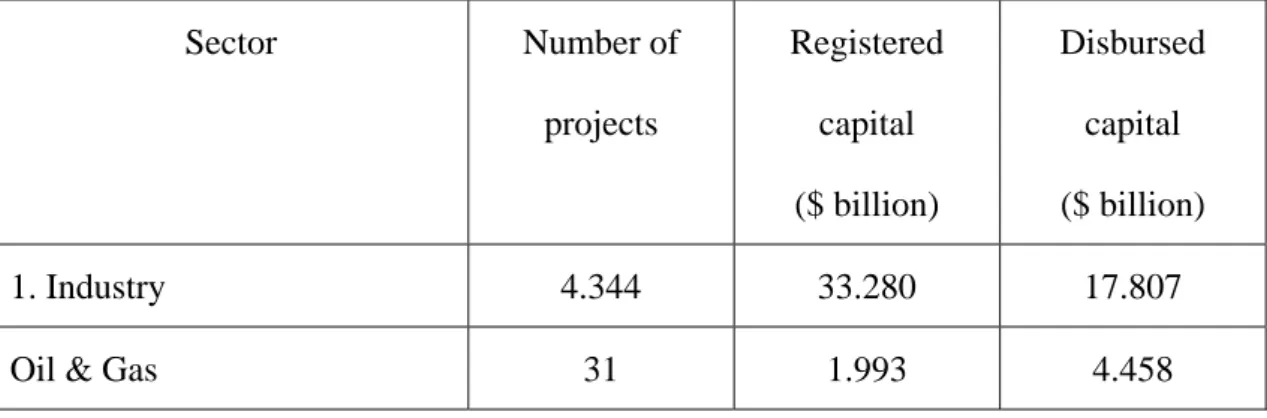
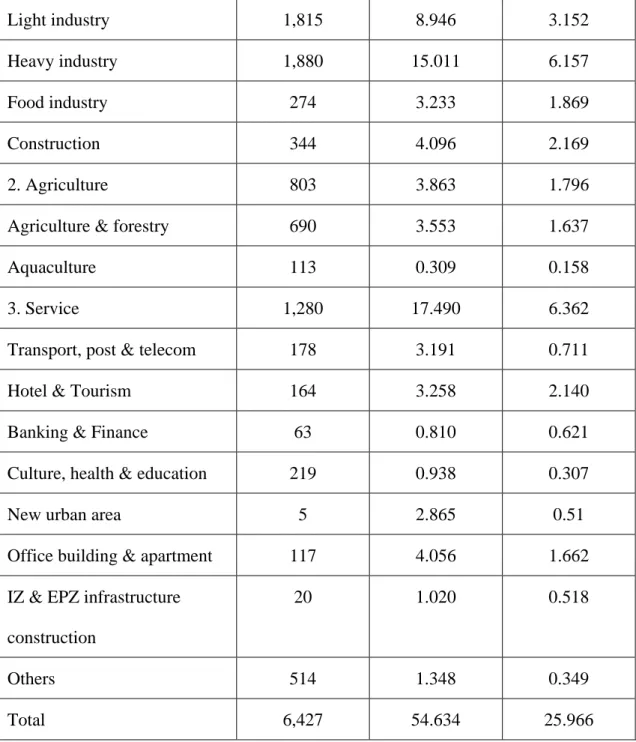
(10) global market to push up economic growth and expand export turnover of Vietnam. WTO accession brings change for Vietnam’s competitive industries and also attract more foreign investment. Besides, Japanese BRICs Research Institute has just come up with a new definition – VISTA, a group of prospective countries, including Vietnam, Indonesia, South America, Turkey and Argentina. There countries are new emerging economies with a high economic growth rate, rich natural resources, labor resources, stable politics and capability to attract foreign investment. In the future, labor resources aged 14 to 64 years will strongly increase in these countries and be appreciated as an important motivation for economic growth. And Vietnam is considered the most potential country among these. (BRICs Research Institute). The increasing flow of foreign direct investment (FDI) to Vietnam After 20 years of the economic reform, the foreign sector has become an organic component of Vietnam's economy and contributed a lot to the economic growth. In comparison with other countries and regions, Vietnam has achieved a positive growth.. Table 1.2: Vietnam's FDI from 1987 to 2006 by sector. Sector. Number of. Registered. Disbursed. projects. capital. capital. ($ billion). ($ billion). 1. Industry. 4.344. 33.280. 17.807. Oil & Gas. 31. 1.993. 4.458.
(11) Light industry. 1,815. 8.946. 3.152. Heavy industry. 1,880. 15.011. 6.157. Food industry. 274. 3.233. 1.869. Construction. 344. 4.096. 2.169. 2. Agriculture. 803. 3.863. 1.796. Agriculture & forestry. 690. 3.553. 1.637. Aquaculture. 113. 0.309. 0.158. 1,280. 17.490. 6.362. Transport, post & telecom. 178. 3.191. 0.711. Hotel & Tourism. 164. 3.258. 2.140. Banking & Finance. 63. 0.810. 0.621. Culture, health & education. 219. 0.938. 0.307. 5. 2.865. 0.51. Office building & apartment. 117. 4.056. 1.662. IZ & EPZ infrastructure. 20. 1.020. 0.518. Others. 514. 1.348. 0.349. Total. 6,427. 54.634. 25.966. 3. Service. New urban area. construction. Source: Vietnam Investment Review, Aug 14-20, 2006, p.20. Table 1.2 indicate that foreign direct investment has been focused mainly on manufacturing and construction with 4,344 projects and total registered capital of US$ 33.28 billion, accounting for 60.91% of the country's total FDI capital; service having 1,280 projects and total registered capital of US$ 17.47 billion, or 32% of the.
(12) country's total FDI capital attraction. At present, the preferred agriculture, forestry, fishery attracted only 803 projects, most of which were of small size, so their registered capital only estimated US$ 3.8 billion, accounting for 6.95% of country's FDI capital. After eighteen years of implementing the Law on Foreign Investment in Vietnam since 1987, as many as 64 countries and territories has poured their capital in Vietnam. Among them, Asian investors account for 76.3% (4,909 projects) of total projects and 69% of total registered capital (US$ 37 billion). EU investors implement some 8.8% of total projects (566 projects) and 14.6% of registered capital ($US 8 billion); the United State of American takes 4.5% of projects (289 projects) and 3.6% of total registered capital ($US 1.99 billion). There are 12 countries and territories having registered investment capital of more than one billion USD each. Seven come from Asian countries, 4 from the Europe. (Table 1.3). Table 1.3: Countries with registered capital of more than US$1 billion as of 2006. Countries. &. Number of. Registered capital. Disbursed capital. Projects. ($ billion). ($ billion). 1,484. 8.027. 2.830. Singapore. 424. 7.732. 3.474. Japan. 673. 6.825. 4.255. South Korea. 1,166. 5.865. 2.407. Hong Kong. 367. 4.392. 1.904. British Virgin Islands. 268. 3.091. 1.279. territories Taiwan.
(13) France. 171. 2.183. 1.045. Netherlands. 69. 2.100. 1.748. US. 289. 1.994. 0.730. Malaysia. 194. 1.610. 0.843. Thailand. 132. 1.469. 0.682. UK. 74. 1.307. 0.639. Source: Vietnam Investment Review, Aug 14-20, 2006, p.20. The growth of domestic ventures Vietnam have experienced dramatic social, economic and political changes, from the French war of independence (1946–54) and the American war (1963–75), to the reunification of North and South Vietnam in 1975. Since then, the country has come under the continuous rule of the Vietnamese Communist Party (VCP). Following reunification, the VCP introduced to the South the socialist model of central planning that had been adopted in 1954 by North Vietnam (the then Democratic Republic of Vietnam). This socialist development strategy featured central economic planning, with state ownership of the means of production, agriculture organised into state farms and collectives that served both as production and social units, and economic development based on large heavy industry (Ronnas and Sjoberg, 1991). However, combined with a staunch American embargo, border conflicts with China in 1979, the occupation of Cambodia from 1979 to 1989 and a gradual weakening of the USSR’s economy, it soon led to “very serious macroeconomic imbalances” (Irvin, 1995, p. 726), causing macroeconomic instability, hyperinflation and budget deficits, together with chronic food shortages.
(14) and widespread poverty. By the mid 1980s, Vietnam was literally on the verge of bankruptcy, forcing the Communist Party to admit its ‘errors and illusions’ and subsequently, in 1986, to introduce a range of reform measures known as doi moi. Doi Moi means “economic renewal” includes opening doors to the world economy and liberalizing domestic trade, reforming state-owned enterprises, diversifying ownership and entrepreneurial development, reforming Vietnam’s financial system with an orientation to a market based system; and attracting foreign investment as essential to foster the country’s economic growth. In 1990, Vietnam adopted for the first time its Company Law and Law on Private Enterprise. These laws were the first step in the creation of a new environment for entrepreneurship. Thus, for 8 years after the implementation of these laws, more than 35,000 enterprises was established, 61 percent during the period of economic boom in 1993, 1994 and 1995 (Phuong, 2003). After 1997, the regional financial crisis affected the country’s economy, resulting in a declining growth rate for startup enterprises. Also, calls from within Vietnam’s government for equal treatment of private, collective, state-owned and foreign-invested enterprises resulted in the need to revise the Company Law and Law on Private Enterprise. In response, the Enterprise Law, was adopted in 1999. Recently, the law has been revised once more in 2005 to match with the new context of Vietnam. The new enterprise Law fosters entrepreneurial spirit in the country. The number of non-state companies has been increasing by years. In 1991 there were only 414 enterprises but in 1995, this number was 15276. It increased twice in 2000 to 30004 enterprises and 105169 enterprises in 2005 (General Statistic Office, 2007). Among non-state companies, private companies occupy the important.
(15) percentage with nearly 70%. This sector attract a huge amount of investment capital, spread to all business fields. Private enterprises have played an increasing important role in job creation, investment structure, export and contribution to state budget and GDP, attract investment capital, create business environment and promote integration process during past decade.. 1.1.4 Problem setting Following this contextualization, we are able to frame the problem that motivates this study. In short, we focus our research on the success of entrepreneurs in the new context of Vietnam. We mainly discuss on the case of software ventures which have young entrepreneurs but successful with high growth rate of profit. We study on why software entrepreneurs can get success while they are still very young with the hope that other entrepreneurs can reference their successful model.. 1.2 Objectives and research questions Our objective is to propose a theoretical model to explain the knowledge-based entrepreneurial process. Besides, we would like to contribute a greater understanding of software ventures in Vietnam (especially outsourcing ventures) and to make recommendations for software entrepreneurs and policy makers. The research questions that guide our study are stated as follows. Major research question How have successful Vietnamese software entrepreneurs emerged? Subsidiary research questions SRQ1: How have software entrepreneurs identified and evaluated opportunities? SRQ2: How have knowledge been shared in software enterprises? SRQ3: How have knowledge been utilized in software enterprises?.
(16) 1.3 Methodology of the study Case study as our main research strategy. 03 Vietnamese IT ventures are chosen to conduct the research mainly on software field. They are • • •. FPT Software Corporation (FSOFT) Tinh Van Outsourcing Corporation (TVO) CMC Software Corporation (CMC Soft). All of them are successful, innovative, and leading companies in ICT field of Vietnam. The main data collection method has been qualitative consisting of interviews with the founders, key persons of these ventures and also through official documents analysis and observation. We conducted interview from August, 2006 to December, 2007 with founders, project managers and staffs of these ventures. There are three main kinds of companies in Vietnam: state, non-state and foreign ventures. Our research concentrate to analyze non-state ventures including private ventures, joint ventures, limited ventures and partnerships mainly focusing on private companies.. 1.4 Organization of the study This thesis composes four chapters. In chapter 2, the literature related to this study is reviewed. We first review studies on models and phases in entrepreneurial process. We then present literature review on knowledge based entrepreneurship. Finally, we concentrate to discuss on software entrepreneurship, focusing on IT and software entrepreneurship in Vietnam. In chapter 3, three cases are analyzed in order to find the answer for the main research question: “How have successful Vietnamese software entrepreneurs emerged?”. With each case, we firstly present on their outline, history and core value..
(17) We then focus our analysis on opportunities recognition process of founders, knowledge sharing activities.. Finally, Chapter 4 is general conclusions from this study. We provide a summary of major findings by answering the research questions, propose theoretical and practical implications and make suggestions for future research..
(18) Chapter 2: Literature Review 2.1. Introduction The literature review chapter summarized the arguments for the role of. entrepreneurship process. We also discussed on the importance of knowledge-based entrepreneurship mainly in IT and software industry of Vietnam, an emerging potential economy, a “new Asian tiger”. The purpose of this chapter is to review existing literature concerning our topic. We first review studies on models and phases in entrepreneurial process. We then present literature review on knowledge based entrepreneurship. Finally, we concentrate to discuss on software entrepreneurship, focusing on IT and software entrepreneurship in Vietnam.. 2.2 Entrepreneurial process model 2.2.1 Entrepreneurial process model The understanding of entrepreneurship owes much to the work of economist Joseph Schumpeter and the Austrian economists such as Ludwig von Mises and von Hayek. According to Schumpeter, an entrepreneur is a person who is willing and able to convert a new idea or invention into a successful innovation. Entrepreneurship forces "creative destruction" across markets and industries, simultaneously creating new products and business models (Schumpeter, 1950). With this analysis, business models is one of two essential output of entrepreneurs..
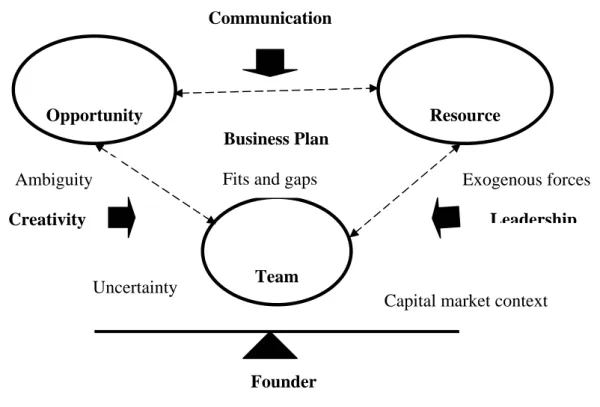
(19) By giving the definition of “business model” 1 , Osterwalder, Pigneur and Tucci (2005) have shown the important role of business model in enterprises. Among business models studies are studies on entrepreneurial process models which are to integrate certain sub-processes that have been well studied such as description on “opportunity recognition” of Stevenson and Bygrave (1987), Timmons (2003), Gartner et al. (2004).. “The entrepreneurial process involves all the functions, activities, and actions associated with perceiving opportunities and creating organizations to pursue them.”. (Bygrave , 2004, p.2). Since Entrepreneurship was first recognized and paid attention in 17th century by Cantillon, there are a lot scholars mentioned about process models. But we concentrate our review on some recent significant scholars (Timmons, Bygrave and Baron). The Timmons model 2 has three crucial components for a successful new business: the Opportunity, the Resources needed to start the company and make it grow and the Entrepreneurs (the management team, if it’s a high potential venture). At the center of the framework is a business plan, in which the three basic. 1. Osterwalder, Pigneur and Tucci defined “A business model is a conceptual tool that contains a big set of elements and their relationships and allows expressing the business logic of a specific firm. It is a description of the value a company offers to one or several segments of customers and of the architecture of the firm and its network of partners for creating, marketing, and delivering this value and relationship capital, to generate profitable and sustainable revenue streams.” (Osterwalder, Pigneur and Tucci, 2005, p.5) 2 The Timmons Model originally evolved from doctoral dissertation research of Timmons at the Harvard Business School, about new and growing ventures. Over nearly three decades, the model has evolved and been enhanced by ongoing research, case development, teaching, and experience in high potential ventures and venture capital funds. (Timmons and Spinelli, 2003).
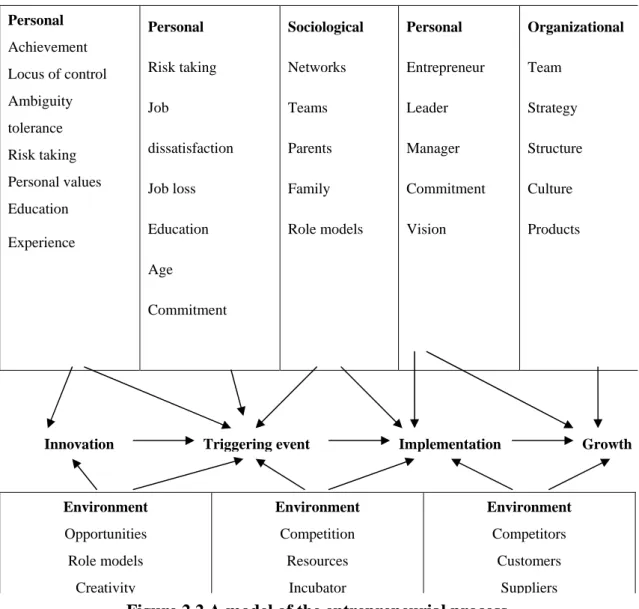
(20) components are integrated into a complete strategic plan for the new business. The parts must fit together well. Explaining about the importance of opportunity, he noted that the greater the growth, size, durability, and robustness of the gross and net margins and free cash flow, the greater the opportunity. The more imperfect the market, the greater the opportunity. The greater rate of change, the discontinuities, and the chaos, the greater is the opportunity. Main resources have been mentioned are financial resources, assets, people and business plan. He emphasized thinking money first is a big mistake and concluded that one of the worst things that can happen to an entrepreneur is to have too much money to early. And the third components, an entrepreneurial team, is a critical ingredient for success. Rounding out the model of the three driving forces is the concept of Fit and Balance between and among these forces. And also in Timmons model, we could see the team is positioned at the bottom of the triangle, especially, the entrepreneurial leader of the venture, standing on a large ball, balancing the triangle over his head. The entrepreneurial process model of Bygrave includes the personal, sociological, and environmental factors that give birth to a new enterprise (Figure 2.1). We found that this model is more complete and specific than Timmon’s model. Bygrave’s model includes all factors mentioned in Timmon’s model, and also share entrepreneurial process model into phases from Innovation to Growth phase. He listed personal, sociological, and environmental factors that influence to entrepreneurial process and explained that a person gets an idea for a new business either through a deliberate search or a chance encounter. Whether or not he decides.
(21) to pursue that idea depends on factors such as his alternative career prospects, family, friends, role models, the state of the economy, and the availability of resource. There are four main phases in Bygrave’s model: Innovation, Triggering event, Implementation and Growth. Bygrave stated that as with most human behavior, entrepreneurial traits are shaped by personal attributes and environment. It turns out that a person who rises to the top of any occupation, whether it be an entrepreneur or an administrator, is an achiever. Granted, any would-be entrepreneur must have a need to achieve, but so must anyone else with ambitions to be successful. It does appear that entrepreneurs have a higher locus of control than nonentrepreneurs, which means that they have a higher desire to be in control of their own fate. This has been confirmed by many surveys which have found that entrepreneurs say that independence is their main reason for starting their businesses. Perhaps as important as personal attributes are the external influences on a would-be entrepreneur. It’s no accident that some parts of the world are more entrepreneurial than others. The most famous region of high-tech entrepreneurship is Silicon Valley. Because everyone in Silicon Valley knows someone who has made it big as an entrepreneur, role models abound. “Role models are very important because knowing successful entrepreneurs makes the act of becoming one yourself seem much more credible.” (Bygrave , 2004, p.7).
(22) Communication. Opportunity. Resource Business Plan. Ambiguity. Fits and gaps. Creativity. Exogenous forces Leadership. Uncertainty. Team Capital market context. Founder. Figure 2.1 The Timmons Model of the Entrepreneurial Process Source: Timmons and Spinelli, 2007, p.57. Besides role models, entrepreneurs are influenced by other sociological factors. Family responsibilities play an important role in the decision whether to start a company. It is, relatively speaking, an easy career decision to start a business when a person is 25 years old, single, and without many personal assets and dependents. It is a much harder decision when a person is 45 and married, has teenage children preparing to go to college, a hefty mortgage, car payments, and a secure, well-paying job. When they actually start a business, entrepreneurs need a host of contacts, including customers, suppliers, investors, bankers, accountants, and lawyers. So it is important to understand where to find help before embarking on a new venture. A network of friends and business associates can be of immeasurable help in building.
(23) the contacts an entrepreneur will need. They can also provide human contact because opening a business can be a lonely experience for anyone who has worked in an organization with many fellow employees. Personal. Personal. Sociological. Personal. Organizational. Locus of control. Risk taking. Networks. Entrepreneur. Team. Ambiguity. Job. Teams. Leader. Strategy. Risk taking. dissatisfaction. Parents. Manager. Structure. Personal values. Job loss. Family. Commitment. Culture. Education. Role models. Vision. Products. Achievement. tolerance. Education Experience. Age Commitment. Innovation. Triggering event. Implementation. Environment. Environment. Environment. Opportunities. Competition. Competitors. Role models. Resources. Customers. Creativity. Incubator. Suppliers. Growth. Figure 2.2 A model of the entrepreneurial process Although Bygrave’s model have a lot of progressive points comparing with Timmons’ model, we recognized that it’s rather complicated. Reviewing the entrepreneurial process model of Baron, we found that this mentioned to all factors and phases of entrepreneurial process but cleared than two previous models..
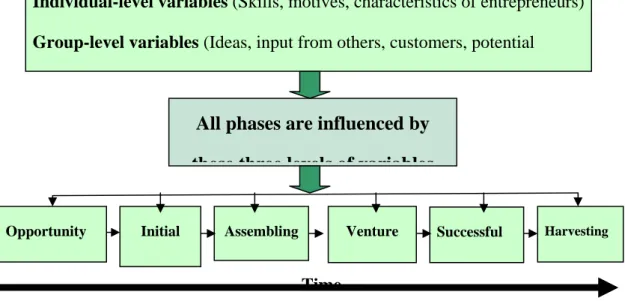
(24) Individual-level variables (Skills, motives, characteristics of entrepreneurs) Group-level variables (Ideas, input from others, customers, potential. All phases are influenced by these three levels of variables. Opportunity. Initial. Assembling. Venture. Successful. Harvesting. Time Figure 2.3. A model of the entrepreneurial process of Baron. Baron’s entrepreneurial process unfolds over time and moves through a number of different phases from opportunity recognition phases to harvesting the rewards phase which is stated in the Figure 2.3. Events and outcomes during each phase are affected by many individual-level, group-level, and societal-level factors. Baron viewed entrepreneurship in this manner offers several benefits. First, it helps avoid a static view of entrepreneurship - one that sees entrepreneurship as a specific act (launching of a new venture) that occurs and is then complete. Such a view ignores the fact that entrepreneurs face an everchanging array of tasks and challenges, and that they often think and feel differently about them as they change and unfold. Second, viewing entrepreneurship as an ongoing process draws attention to the key activities entrepreneurs must perform as they proceed with their efforts to convert ideas for new products or services into successful business. It has long been recognized that how well entrepreneurs perform these activities is often more central to their success than their personal characteristics or background. Attention to.
(25) entrepreneurs’ tasks, in turn, gives us a good handle on identifying the skills, knowledge, and characteristics they need to function effectively in this role.. 2.2.2 The phase opportunity recognition: Opportunity recognition has been cited as a central and unique component of entrepreneurship (Christensen et al. 1994; Gaglio 1997; Gaglio and Katz 2001; Gartner et al. 2001; Kirzner 1997; Shane and Venkataraman 2000), as well as being the first stage of the entrepreneurial process (Christensen et al.; Hills 1995; Timmons et al. 1987). Hills and Singh 3 (2004) defined:. “Opportunity recognition as perceiving a possibility for new profit potential through (a) the founding and formation of a new venture or (b) the significant improvement of an existing venture”(p. 260).. From this definition, opportunity recognition can be conceived as an activity that can occur both prior to firm founding and after firm founding throughout the life of the firm. Baron and Shane (2005) pointed out that opportunity recognition is a key step in the entrepreneurial process. Besides, some researchers have developed conceptual models of the opportunity recognition process 4 . One of the earliest models to appear in the literature was developed by Long and McMullan (1984). Developing their model they make the assumption that opportunity recognition is a process, under personal control (at least partly), which becomes realizable after. 3. The definition of Hills and Singh based on the definition offered by Christensen and Peterson (1990). 4. e.g., Bhave, 1994; Christensen et al., 1994; Singh, 2000.
(26) substantial preparatory work, therefore personalizing and making it inaccessible to others. They also note that the process described in the model is not linear and may take considerable time. The model they developed was presented as a 4-step process: 1) 2) 3) 4). Pre-vision; Point of Vision; Opportunity Elaboration; Decision to Proceed. The Lumpkin, Hills, & Shrader (2004) model was explicitly developed on. the creativity process and parallels the Long and McMullan model in a 5-step process: 1) 2) 3) 4) 5). Preparation; Incubation; Insight; Evaluation; Elaboration. Another stream of research has focused on opportunity recognition as an. innate skill or cognitive process (Gaglio, 1997; Gaglio and Taub, 1992; Kaish and Gilad, 1991) that has evolved out of Kirzner’s work (1973, 1979). He introduced the idea of entrepreneurial alertness – “the ability to notice without search opportunities that have hitherto been overlooked.” In his view, opportunity recognition is experienced as a flash of insight, the “aha” experience (Point of Vision and Insight).. 2.2.3 The phase assembling the resources Burley (1987) stated that the process of assembling the resources necessary to begin trading. Creating a business is about assembling resources - people, premises, equipment, customers, suppliers, money. Unfortunately, only the very rich entrepreneurs are able to assemble an ideal shopping list, and to make swift and.
(27) satisfactory purchases. Indeed, if this were the case, many more badly conceived and executed businesses would be born than is currently the case. The process of assembling the resources is critical. Having an idea for a new product or service or recognizing an opportunity is only, of course, the first step in the process. At that point, an initial decision to proceed - to do something active about the idea or opportunity – is required. As Shane et al. (2002) suggest, the entrepreneurial process occurs because specific persons make this decision and act upon it. In their view, understanding entrepreneurs’ motives is crucial to comprehending the entire process. Deciding to start a business is one thing, actually doing so is quite another. Would-be entrepreneurs quickly discover that they must assemble a wide array of required resources including: 1) Basic information (about markets, environmental and legal issues) 2) Human resources (partners, initial employees) 3) Finance resources Baron and Shane (2005) stated that gathering these resources is one of the most crucial phases of the entrepreneurial process, and unless it is completed successfully, opportunities – no matter how good – come to naught. It is at this stage, and especially when seeking financial backing, that entrepreneurs typically prepare a formal business plan – a detailed description of how they plan to develop their new venture. There are also some scholars combine the phase preparing business plan and the phase assembling the resources into one like the case of Hisrich et al. (2005). Their process model has four distinct phases: (1) identification and evaluation of the opportunity, (2) development of the business plan, (3) determination of the required.
(28) resources, and (4) management of the resulting enterprise. Among these phases, the resources are needed for addressing the opportunity. This process starts with an appraisal of the entrepreneur’s present resources. Any resources that are critical need to be differentiated from those that are just helpful. Care must be taken not to underestimate the amount of variety of resources needed. The downside risks associated with insufficient or inappropriate resources should also be assessed. Acquiring the needed resources in a timely manner while giving up as little control as possible is the next step in the entrepreneurial process. An entrepreneur should strive to maintain as large an ownership position as possible, particularly in the start-up stage. As the business develops, more funds will probably be needed to finance the growth of the venture, requiring more ownership to be relinquished. Alternative suppliers of these resources, along with their needs and desires, need to be identified. By understanding resource supplier needs, the entrepreneur can structure a deal that enables the recourses to be acquired at the lowest possible cost and the least loss of control.. 2.2.4 The phase Launching a new venture: Once the required resources are assembled, the new venture can actually be started up. Doing so involves a wide range of actions and decisions: choosing the legal form the new venture, developing new product or service, establishing the roles of the top management team, etc. The simplest legal form of business ownership is Sole proprietorships (ownership by one person). Besides, there are another forms like Partnerships, Corporations, Joint ventures etc.. After developing new product, entrepreneurs set the prices of their new products by considering several things: their.
(29) cost structure, the supply and demand conditions in the market in which they operate, customer trade-offs between product attributes and price, and hidden costs and discounts (Shane and Baron, 2005).. 2.3 Knowledge Based Entrepreneurship The focus of this research is the Knowledge Based Entrepreneurship (KBE) 5 . We begin with some classical views mainly on the work of Kirzner and Schumpeter, and then continue with some modern views on KBE. The Austrian theory of entrepreneurship is considered in the light of the generation of knowledge (Butos, 2003). It is suggested that learning involving more than the discovery of profit opportunities provides a way to endogennize knowledge and to expand the scope of entrepreneurial activity. Any Austrian perspective in entrepreneurial studies must proceed from the body of work that Kirzner has produced. His theory on entrepreneurship concentrate on alertness, discovery, and the elimination of error, abstracts from certain kinds of real world activity arguably associated with entrepreneurial activity. Kirzner’s argument. that people are likely. to take notice of what they are interested in is a corollary of Smith’s theory of economic development; since anyone requires some prior knowledge in order to identify any opportunity, it is reasonably to conclude that alertness, like knowledge, will be highly differentiated, and the finer the differentiation, the more sensitive an individual is likely to be to potentially significant detail which would escape the. 5. In this research, using the phase KBE, we mention to start-up ventures that to a considerable extent are based on advanced technical specialist knowledge. They thrive on research results and close relations to universities, research institutions and major knowledge based industries. They are often started by teams of highly skilled academics and business people, and occasionally they create stunning values to their owners, customers and employees..
(30) notice of almost everyone else. Besides, Butos also pointed out that “Kizner’s theory of entrepreneurship provides an account of a crucially important aspect of the market process.” This can be seen in Kizner’s (2000) discussion of the horse-drawn carriage and automobile industries. The market process involves agents who have the capacity to both discover and generate individual knowledge, their interactions, and the generation of the market level by products stemming from those interactions. The process involves complex feedback loops operating at all levels and learning, both in the sense of correcting mistakes and of producing new knowledge. In a process of this kind, “market equilibrium” refers to the logical implications of a particular model without endogenous knowledge. The knowledge-generating perspective discussed here provides scope for introducing endogenous knowledge that may allow for a fuller treatment of the complexities associated with the market process and a basis to empirically support a more complete range of behaviors ordinarily associated with entrepreneurial activity. Where knowledge is not only dispersed and incomplete but also changing, there is scope for those who are capable of combining together the power of the most distance and dissimilar objects. Making new combinations is the characteristic role of Schumpeter’s entrepreneurs. Schumpeter (1934) makes a sharp distinction between entrepreneurship and management, but later appears to reverse his position and claims that ‘innovation itself is being reduced to routine’ (Schumpeter, 1943). Langlois (1987) noted that the reutilization of entrepreneurship is foreshadowed in Schumpeter’s earlier work, as a direct consequence of the increase in human knowledge: “the more accurately, however, we learn to know the nature and social world, the more perfect our control of facts becomes; and the greater the.
(31) extent…within which things can be simply calculated…the more significance of this entrepreneurial function decreases’ (Schumpeter, 1934, p.15). Having been located within an empiricist theory of knowledge, the entrepreneur is progressively squeezed out an increasingly rational theory. This version of Schumpeter’s theory accommodates the views of those who believe that all knowledge is potentially codifiable and therefore, it appears, potentially completable. Butos (2003) on “Entrepreneurship and the generation of knowledge” noted that recognized entrepreneurship as knowledge-generating activity that can usefully extend Kirzner’s insights. He proposed a market process approach in which entrepreneurs not only discover existing knowledge but also generate new knowledge, in terms of both their own understanding of reality and of changes their actions induce in the market. His discussion so far has suggested that the problem of the division of knowledge and the mechanisms for the transmission of knowledge, so famously associated with Hayek and Kirzner, constitutes one side of the significance of knowledge for economics. If it is indeed useful to explore the economics aspects of the generation of knowledge, part of that exploration would seem to suggest broadening the scope of the role of the entrepreneur in the market process beyond alertness to price differentials. One implication of a knowledge-generating perspective is that the discovery and elimination of error no longer constitutes the only relevant aspect of entrepreneurial activity. Instead, the theory of entrepreneurship also refers to the inherent capacity of individuals to create knowledge – Hayekian interpretations or Popperian conjectures – about their environment as it was, as it is, and also as it might be..
(32) Besides, Groen (2005) mentioned the phase “Knowledge intensive entrepreneurship”. He supposed that entrepreneurial processes can be defined as processes, in which an entrepreneur sees business opportunity, develops it to a business concept and bring it into exploitation. And he called knowledge intensive entrepreneurial process when these processes are to a great extent based on relatively new (mostly academically derived) knowledge or technology. He continued to explain that the development and introduction of new technology offers opportunities for knowledge intensive entrepreneurship. Entrepreneurship is defined as a context dependent process, through which individuals and teams create wealth by bringing together unique packages of resources to exploit market place opportunities (Lyon et al., 2000; Ireland et al., 2001; Brush et al., 2001) New knowledge which shapes and supports technological advance continually emerges in the academic institutions. It is a result of publicly financed, scientific problem solving. As such, its generation is not (primarily) guided by application interests. However, such knowledge usually carries some commercial business potential. In recent years, one question has therefore attracted increasing interest both in economic research and in politics (Nelson, 1993; Edquist and McKelvey, 2000; Salter and Martin, 2001). How does new knowledge from scientific research find its way into the commercial part of the innovation system? How does it support technological advance? Witt and Zellner (2006) argued that the transfer is essentially an entrepreneurial process. On the other hand, to understand the process, it is necessary to recognize the kind of actions and services involved in the entrepreneurial reshaping of the division of labor. In general, entrepreneurship requires command over suitable resources. In the case of knowledge based.
(33) entrepreneurship, there are, in particular, resources enabling the access to, and the exploitation of, new technological knowledge (Witt and Zellner). Therefore, an essential of entrepreneurial activity here is the organization of the knowledge transfer from academic research to commercial production and marketing activities. Esspecially, Witt and Zellner emphasized that the transfer does not happen unless someone conceives of business opportunities in new scientific knowledge in the first place. Then these imaginings have to be transformed into conceptions of how to run a business firms. On that basis, resources – foremost the necessary knowledge resources – have to be attracted and coordinated. Where business organizations already exist, the new knowledge resources must, furthermore, be integrated with the organization’s expertise and capabilities to yield a coherent business conception. It has been argued that each of these services is a core element of knowledge based entrepreneurship. One sub topic that a lot of scholars have paid attention to is “Knowledge as a source of entrepreneurial opportunities”. Entrepreneurship necessarily involves individuals and their response to economic opportunities (Shane and Eckhardt, 2003). Not only is the source of opportunities important, but the nature of the individual recognizing and commercializing these opportunities. Studies have shown that entrepreneurial opportunities are not exogenously given but rather endogenously and systematically created under certain conditions. They are the outcome of investments in new knowledge and ideas (Schumpeter, 1942) on the one hand, and the accumulation of knowledge in individuals (Shane 2000) and firms (Cohen and Levinthal, 1989; 1990). Prior knowledge enables certain entrepreneurs to be alert to new opportunities (Shane 2000; Kirzner 1973). There has been much empirical.
(34) research showing that firms located near knowledge sources introduce innovations at a faster rate than rival firms located elsewhere. These studies frequently invoke the existence of localized knowledge spillovers as an explanation for this correlation. Economists have termed this non-rival characteristic of knowledge ‘knowledge spillovers’ (Arrow 1962; Nelson 1959). Knowledge spillovers have been defined as: “any original, valuable knowledge generated somewhere that becomes accessible to external agents, whether it be knowledge fully characterizing an innovation or knowledge of a more intermediate sort. This knowledge is absorbed by an individual or group other than the originator” (Foray (2004, p. 91).. Besides, empirical studies also concentrate on finding the answer for the research question: “How does the creation of new knowledge stimulate high tech enterprise?”. Two different mechanisms are found to be relevant for high-growth technology-based start-ups: research and human capital (Audretsch, et al. 2005; Audretsch and Lehmann, 2005b). The latter mechanism involves embodied knowledge flows via highly educated entrepreneurs (Colombo and Delmastro, 2002) and the recruitment of students (Mian, 1996). Research excellence is a critical factor for high-growth technology based firms. Technical universities are not necessarily more successful in facilitating the spillover and commercialization of knowledge (Audretsch and Lehmann, 2005a). Heeboll (2007) devise knowledge based entrepreneurship into types including a division into biotech, life sciences, information technology, communication and industry, since the capital requirements and the investors in the.
(35) venture capital market reflect this kind of mapping. For the limitation of time and resources, this research concentrate to analyze startup enterprises in information technology industry mainly focus on software business enterprises.. 2.4 Software business Entrepreneurship 2.4.1 Characteristics of Software Entrepreneurship The technology sector represents a significant portion of the economy of every industrialized nation. In the United States, more than one third of the gross national product and about half of private sector spending on capital goods are related to technology. It is clear that economic growth depends on the health and contributions of technology businesses. Dorf and Byers (2005) pointed out that “technology has become ubiquitous in modern society” (p.15). Note the proliferation of cell phones, personal computers, and the Internet in the past decade and their subsequent integration into everyday commerce and our personal lives. They emphasized that most technology ventures are based on knowledge and intellectual property that must be enhanced and managed. Explaining about the importance of this, they gave a table of managing knowledge in a technology venture with four steps (as Table 2.1) Table 2.1 Managing knowledge in a technology venture. 1. Role: Identify and evaluate the role of knowledge in the firm 2. Value: Identify the expertise, capabilities, and intellectual capital that creates value in the form of products and services. 3. Plan: Create a plan for investing in the firm’s intellectual capital and exploiting its value while protecting it from leakage to competitors. 4. Improve: Improve the knowledge creation and sharing process within the new venture.
(36) Though knowledge is one of the few assets that grows when shared, the new venture needs to carefully determine what knowledge to share and what knowledge should be protected and keep secret. This is particularly true for technology ventures for which intellectual property is usually their key asset. Most professionals are unable to keep up with all they need to know. One method of knowledge access is to embed knowledge into the technologies used by the professionals. For example, when designing a product, the data bases required can be linked directly to the design tools (Davenport and Glaser, 2002). More focus on high-technology entrepreneurship, Bernasconi et al. (2006) concentrate to analyze managing innovation, variety and uncertainty in high-tech enterprises. They supposed that High-tech entrepreneurship is the creation of value from technical innovation through success in business (p.2). It is not a person, nor is it an idea; rather, it is a process. It is a process of building new companies based on technologies. It is not the only way to innovate, and is not necessary best way to innovate, but a way that is well adapted to complex situations. Their study leads us to see each high-tech entrepreneurial context to be at least highly but complexity that itself differs from manager and from management situation to management situation. Besides, management in high-technology entrepreneurial contexts has, however, one other dominant trait: uncertainty. This includes risk, differences between contexts, and evaluation of the unknowable. Uncertainty and complexity, innovation and advanced technology is what makes it difficult to use the usual linear business economic models and planning, and makes it necessary to reflect on how to cope with management under these entrepreneurial conditions. In a knowledge-based economy, the creation of wealth becomes synonymous with creating products and services with large software content (Hagel and Armstrong, 1997). Software is the ubiquitous technology that powers everything in the Information Age, embedded in everything from automobiles to electric can openers. The knowledge encapsulated in software will increasingly define the economic value of the intellectual capital it represents. Speaking of the importance of this new kind of capital, Stewart (1997) declares: ‘‘ . . . for a new Information Age economy, whose fundamental sources of wealth are knowledge and communication rather than natural resources and physical labor.’’ At the heart of this new economy lies the software industry, providing the enabling tools and infrastructure to IT professionals in virtually all other industries. A key characteristic of the software.
(37) industry is that, despite a few major players, as a whole it is fragmented and consists mainly of small, niche market entrepreneurial ventures. Software is a relatively low-investment, environmentally friendly, high-growth global industry – a good target growth industry for many countries. But it has also become the most critical and expensive element of the government and business systems that every nation must build for itself (Tessler et al., 2003, p.2). In their study, they also contributed several unique characteristics of the software industry. They are: - The different segments of the software industry (shrink-wrapped products, enterprise products, software services, embedded systems, technology licensing, etc.), each with its own methodologies and its own global marketplace with established players, business methods, and barriers to entry; - The different kinds of talent and skills that make up software teams in different parts of the industry. There is a wide range of technical skill categories, and other skill areas, like project management, technical hiring, and product marketing, that are just as important to successful industry growth; - The key role of innovative startup companies in the industry, the importance of entrepreneurship, venture capital, the developmental stages of a software startup, and the special supportive habitat required by small technology companies; - The need to build new software on top of layers of existing, “base-level” software infrastructure, which demands that domestic systems use industry-standard architectures so that customers are comfortable with domestic providers and so that local innovations can be directly exported; and - The absence of a manufacturing phase in software product development, which makes the software publishing industry especially fluid. Product specifications, technology platforms, marketing partnership, etc. are usually volatile. This makes planning difficult and introduces additional risk. Besides, Tessler et al., also explained why software industries requires special attention and consideration. The reason is that software has now become a core competency and general-purpose technology that is critical to the global competitiveness of most industries (all companies have the same hardware – they compete with software) and to the effective deployment of government services (beyond the basis of data processing) in every country, regardless of its level of economic development. Not only is software a critical part of modern industrial infrastructure and an important industry in its own right, but it is also the vehicle for implementing the other key elements of a knowledge economy: responsive and.
(38) transparent government, a supportive effective social programs. Software is a fundamental capability that is deployed across almost all sectors of an economy. Moreover, as a nascent industry and fast-changing set of technologies, market forces alone are often inadequate to harness the industry’s potential to address public services and social priorities and to serve the needs of the poor, rural areas, small and medium enterprises (SMEs), and non-government organizations (NGOs). They conclude that the impact of software cuts across all sectors of the economy, and the progress of other sectors will, in turn, spur further growth of the software industry. Strength in software (i.e., both knowledgeable software professionals and a software-literate workforce) has become an important factor in foreign direct investment. It is also now a major component of modern industrial and commercial infrastructure and government administration. Finally, software is the implementation vehicle for major social programs such as distance learning, telemedicine, and on-line cultural offerings.. 2.4.2 Software - technology and business Software has special characteristics as a technology and as a business. Understanding these characteristics is essential for an entrepreneur to succeed in the software business (Cusumano, 1998). First, the technology consists of computer code -- instructions written in one of many programming languages -- running on computer hardware and over networks. There is no bending of metal or molding of plastic to create software products. But products can be large and extremely complex in terms of the number of components and their potential interactions. (Microsoft's Windows 95 operating system, for example, totaled about 11 million lines of code and took a team of about 400 developers and testers nearly 3 years to create.) This is truly a "knowledge" industry, where products consist of ideas and the key assets of a company are well-trained people -- often very young people. Product distribution is also increasingly "electronic" and "instantaneous" over telephone and cable-TV networks. Another characteristic of software relates to what Cusumano call the mythical man-month syndrome. Managing software projects is notoriously difficult (there is something like a 10 or 20 to 1 difference in productivity between the best and worst programmers on a typical team). How long it will take to build a product is extremely difficult to predict because of the variance in individual performance as well as the uncertainty of the technology (programmers often have to "invent" functions as they go along). And people and months are not interchangeable;.
(39) companies usually cannot speed up late projects by just adding more people, because the new people take time to learn what has been done and existing team member must stop and teach them what to do. Larger teams also create communications and coordination problems. Then testing software products -- finding and removing bugs -- is also incredibly difficult due to the huge number of combinations of software and hardware products and user scenarios. Yet shipping at least "good enough" products in a timely fashion can be critical to success. Not surprisingly, software programmers have created a special culture: The companies they prefer to establish and work in are notoriously non-bureaucratic, informal, and laid-back, but very hard-working. Then there is the rapid pace of change. Since the beginning of the software industry in the 1950s, the hardware technology and software programs have evolved with astounding speed. The industry is particularly fast-paced in certain segments where the hardware changes the fastest, such as PC software and Internet platforms and applications. This pace is due not only to the rapid evolution of hardware, driven mainly by Intel for personal computers, but also the pliability of the technology, and the ability of even individuals in garages to come out with significant product and technological innovations. The pace of change means that the future is uncertain. Managers in the PC software business do not know precisely what their products and markets beyond a year or so in advance. Hardware evolution is a bit more predictable (it is guided more by the "laws" of physics). But how far and fast the software side will evolve, and when and how users will react to innovations, is usually guesswork. This means that entrepreneurs and managers in this business must be able to live with great uncertainty and constantly make educated guesses -- which is why having a deep understanding of the technology is often critical. Another peculiar characteristic of software is the important role of technical standards and network externalities. Simply having a great product is not enough, in hardware or software. Software must work on computer hardware and systems software platforms, and different software programs must be able to work together. As a result, software companies have raced to establish a large enough presence to create a "standard," or they have struggled to be "compatible" with existing standards created by others. What becomes the software standard also depends in large part on hardware standards and sales of hardware platforms. The term "network externality" comes into play here in that the value of a software product is often less dependent on the price or functionality of the product itself than it is on whether or not the.
(40) product is compatible with the existing standard. This is "external" to the product itself. And the more computer systems that are sold which are compatible with the standard your product supports -- in other words, the greater the network of users for that standard -- then the more valuable your product and the standard become. Therefore, an essential part of being a successful software entrepreneur is to understand market dynamics and how to use customer and competitor behavior to your advantage. Finally, another characteristic of software is the tremendous opportunities the business presents to make money and have fun. The software industry has produced a remarkable number of millionaires and several billionaires, even though most programmers say they are not motivated by money. And the market is only beginning to grow. There are 5 billion-plus people in the world, and perhaps 250 million users of PC and Mac personal computers. Furthermore, constant evolution of hardware capabilities means that software users, like it or not, are frequent repeat customers -- probably for life.. 2.5 ICT and software industry in Vietnam 2.5.1 ICT Industry in Vietnam Several developing economies (e.g., India, Philippines) have benefited from the ICT outsourcing trend starting by Kodak in the early 1990s 6 , spurring others to follow. Vietnam, a socialist country with “China -like” aspirations is one of the newer entrants in the global ICT business. In recent years, ICT development has been established as a high national priority by the Government of Vietnam: “Information technology is one of the most important driving forces for development. IT strengthens our material, intellectual and spiritual growth…promotes the reform process, speeds the modernization of economic sectors, and empowers the competitiveness of business”. 7 Information and communication technologies (ICT) offer enormous opportunities for trade, job growth, efficiency improvement and economic development. ICT provide a platform for building and applying knowledge, facilitating participation in trade for isolated communities, small and medium enterprises and large corporations, improving national competitiveness, increasing. 6. The multinational firm Kodak sparked the ICT outsourcing trend with its much publicized contracts with IBM, Digital Equipment Corp. and BusinessLand Inc worth $250 million. (As reported by International Data Corp.) 7 Stated from the Directive No.58-CT-TW, Oct.17th, 2000 issued by the Central Committee of Socialist Republic of Vietnam.
(41) human resource skills, and improving the delivery of public and private services. (Smith et al, 2003). Total IT spending in 2005 (for both locally produced and imported products) stood at $828 million, up 20.9 per cent from the year earlier. $630 million came from hardware, up 15.6 per cent, and $198 million from software and services, up 41.1 per cent. Growth in 2005 was lower than in 2004 (at 33 per cent). Despite the fact that the growth rate was lower than the previous year, these figures are still impressive in the context of average IT spending around the world being at 7.1 per cent (HCA, 2007). Spending on IT equipment imports leapt 30 per cent to $1.24 billion, with local companies contributing $525 million, up 13.6 per cent, and foreign invested enterprises accounting for the remainder. Exports brought in $1.42 billion, up 59 per cent, with two Japanese-invested companies, Fujitsu and Canon, contributing the most. Fujitsu exported $515 million worth of motherboards while Canon earned $450 million from printer shipments and $100 million from PC components. As regards the local IT industry (based on locally produced and sold products plus exported products), value reached $1.4 billion, an increase of 49.6 per cent. The IT and software services segments saw revenue grow 47 per cent, to $250 million, of which $180 million was from the local market and the remainder from software outsourcing contracts with foreign companies. The strong development of the IT industry in recent years to improved Internet infrastructure. The Internet transmission capacity expanded twice to reach 4,080 Mbps as at May this year. The number of Internet subscribers increased by 86 per cent and Internet users by 80 per cent, to reach a combined 12.9 million people as at May. Internet users now account for 13.5 per cent of the country’s population. The position of Vietnam on the global ICT map is brighter than in 2006, with many higher ratings. Specifically, four out of seven indexes are higher while three are lower (HCA, 2007). Innovation + Education + ICT, ICT opportunity, E-readiness are some indexes higher than last year. However, the IT and software industry is still at a nascent stage in Vietnam, although progress has been made in certifying a few software firms, and ambitious plans are in place. There is a fact that the Vietnamese ICT sector is relatively small compared even to countries like the Philippines or Indonesia. (Chidamber, 2003). Software is a small but growing segment of the ICT sector totaling approximately 25$ million in annual revenues. Vietnam's emerging software industry has mushroomed from just a few scattered firms in 1998 to approximately 700 companies in 2006. With infrastructure improvements happening virtually every day,.
(42) Vietnam's software outsourcing industry is poised to evolve into a major player in the global arena. As foreign customers, Japan continues to be the biggest importer of Vietnam’s IT products, buying $416 million worth, followed by Singapore with $348 million, Hong Kong $105 million, China $83 million, Malaysia $61 million and the US and Taiwan $59 million each.. 2.5.2 Software outsourcing industry in Vietnam The world software outsourcing industry needs skilled, low-cost labour, and Vietnam is on its way to providing it – assuming the country can make a few key changes. The nation’s fledgling software outsourcing industry has grown by more than 50 per cent annually over the past three years 8 . But 2006 software outsourcing revenues of US$90 million may be just the beginning. Software companies in the US, EU and Japan are likely to spend $27 billion on outsourcing this year, and India, the world’s go-to country for outsourcers, only has the capacity to satisfy half of the predicted demand. That leaves the door wide open for Viet Nam and the 20,000 information technology (IT) engineers earning degrees here each year. Domestic involvement in the software outsourcing industry began about 10 years ago, but development has especially taken flight in the past five. Overseas Vietnamese and local software companies jumped at the opportunities presented in the mid-90s when companies in developed countries began large-scale "outsourcing", using subcontractors in developing countries to meet the need for IT human resources. At the time, Vietnamese software enterprises were relatively small, and the country had yet to develop a reputation for IT-trained labor. The crisis that struck the global IT industry in 2000 and 2001 weeded out the weakest domestic software companies and helped the superior enterprises tweak their strategies. Since 2002, with the recovery and stable growth of the world IT sector, Vietnamese software outsourcing firms have been steadily developing and solidifying Viet Nam’s place on the global software outsourcing map. As India and China have fallen short of the. 8. This is cited from the annual report on software technology industry in 2006 published by HCM City Computer Association.
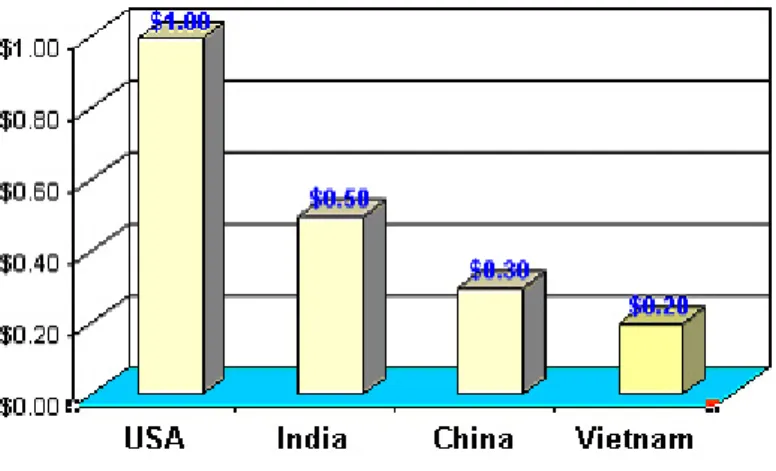
(43) voracious demand for IT labour, multinational firms have started to pay attention to Viet Nam as a potential software outsourcing destination. Many foreign companies have come to Viet Nam looking to set up branches and recruit IT engineers from the abundant low-cost workforce. Software giants including Microsoft, Nortel, Alcatel-Lucal, IBM, Oracle, Hitachi and NEC are among the companies that have outsourced to Viet Nam, he says. Customers, especially in Japan, are looking to Viet Nam for an alternative to India and China. Japanese companies have taken an interest in Viet Nam’s potential for software outsourcing. Big-name companies like Hitachi, NEC, Sanyo, Nissen and NTT have already begun outsourcing to Viet Nam. Likewise, Japan represents a particularly attractive market for Vietnamese software outsourcers (Binh, 07) 9 Vietnamese programmers charge less than half of what their counterparts in India make. Including overhead charges, corporate customers pay approximately $20,000 per person per year in Vietnam, compared to $30,000 in Russia or Romania and $40,000 in India. With approximately 60% of the country under the age of 26, the pool of talent is growing and ensures that local software firms will continue accessing high skills at competitively lower wages for decades to come. Besides, Vietnamese education system, which emphasizes rote learning, mathematics and logic, creates good programmers.. 9. Binh, Truong Gia is General Director of Vietnam’s leading IT firm, FPT, Chairman of Vietnam Association of Young entrepreneurs, Chairman of Vietnam Software Association (VINASA).
(44) Figure 2.4: Wages for Software Professionals (Annual, USD) In recent years, accessing to quality IT education has expanded greatly in Vietnam. A number of Western and Indian IT training companies have opened state-of-the-art training centers in Vietnam providing up-to-date IT education. In Vietnam a high degree of importance is placed on education making Vietnamese students voracious learners, diligent and receptive to this advanced training. Besides, IT companies in Vietnam retain key staff and keep project teams together for months at a time. Low rates of attrition in comparison to Indian and U.S. onshore development ensure continuity and that familiarity grows between client and contractor. Finally, foreign investors choose Vietnam as the Vietnamese software industry is in its infancy, companies are eager to form long-term alliances. Software firms in Vietnam understand the importance of strong relationships which is why we provide excellent customer service which ultimately fosters long-standing and mutually beneficial alliances.. 2.5 Summary of the Literature Review: In this chapter, we have reviewed existing literature concerning the entrepreneurial process especially knowledge based entrepreneurship, focusing on software entrepreneurship that are relevant to our study. We begun with a discussion of previous analysis on models of entrepreneurial process..
図


+7


関連したドキュメント
In this regard, a test bed was set up in the Hydraulic Laboratory of our department that essentially consists of a closed hydraulic circuit, complete with valves and
As a multidisciplinary field, financial engineering is becom- ing increasingly important in today’s economic and financial world, especially in areas such as portfolio management,
The main observation is that each one of the above classes of categories can be obtained as the class of finitely complete categories (or pointed categories) with M-closed
In order to prove these theorems, we need rather technical results on local uniqueness and nonuniqueness (and existence, as well) of solutions to the initial value problem for
We have formulated and discussed our main results for scalar equations where the solutions remain of a single sign. This restriction has enabled us to achieve sharp results on
This paper is a sequel to [1] where the existence of homoclinic solutions was proved for a family of singular Hamiltonian systems which were subjected to almost periodic forcing...
The idea of applying (implicit) Runge-Kutta methods to a reformulated form instead of DAEs of standard form was first proposed in [11, 12], and it is shown that the
John Baez, University of California, Riverside: [email protected] Michael Barr, McGill University: [email protected] Lawrence Breen, Universit´ e de Paris
