Gromov-Witten
Invariants
and
Moduli of Sheaves
Atsushi Takahashi
Research Institute for Mathematical
Sciences,
Kyoto University,
Kyoto
606-8502,
Japan
[email protected]
AbstractIn this PaPer, we shall outline amathematical attempt to
under-stand the Gopakumar-Vafa conjecture [GV]. Weshall explain
amath-ematical defintion of BPS invariant, anew invariant of Calabi-Yau
3-folds from stable sheaves of dimension one. Some evidences for the
Gopakumar-Vafa conjecture as an equivalence of the Gromov-Witten
invariants and BPS invariants are given.
1Gopakumar-Vafa
Conjecture
Let $X$ be
aCalabi-Yau 3-fold
$(\pi_{1}(X)=\{1\})$ and let us fix an ample linebundle
$\mathcal{O}_{X}(1)$ on $X$.
Wedenote
Gromov-Witten invariants
by$N_{g}(\beta):=[\overline{\mathcal{M}_{g,0}}(X, \beta)]^{v}:_{\Gamma t}\in A_{0}(\overline{\mathcal{M}_{g,0}}(X, \beta))\simeq \mathbb{Q}$,
and their generating functions by
$F_{g}^{X}:= \sum_{\beta\in H_{2}(X,\mathbb{Z})}N_{g}(\beta)q^{\beta}$
.
Based on the string duality between Type IIA and $\mathrm{M}$-theory, physicists
Gopakumar and
Vafa [GV]introduced
thefollowing remarkable
formula forthe generating function of
Gromov-Witten
invariants数理解析研究所講究録 1232 巻 2001 年 160-173
Conjecture 1.1. $([GV])$
(i) There should exist
integers
$n_{h}(\beta)$ called BPSinvariants
such that$\sum_{g\geq 0}F_{g}^{X}\lambda^{2g-2}=\sum_{k>0,h\geq 0,\beta\in H_{2}(X,\mathbb{Z})}n_{h}(\beta)\frac{1}{k}(2\sin(\frac{k\lambda}{2}))^{2h-2}q^{k\beta}$
.
(1)(ii) Let $M_{\beta}$ be moduli
of
$M\mathit{2}$-branes wrapped around the curves in X. Thenthere exist support map $\pi\beta$ : $M_{\beta}arrow S_{\beta_{f}}$ where $S_{\beta}$ is a suitable moduli
space parameterizing the
deformation of
curves{support
of
D-branes) in $X$.(iii) $n_{h}(\beta)$ should be
defined
by the spin contentsof
the $BPS$ states. More precisely, there exists $(sl_{2})_{L}\cross(sl_{2})_{R}$-action on some suitable cohomologygroup $H^{*}(M_{\beta})$ and $n_{h}(\beta)$ are
defined
by the followingformula:
$n_{h}(\beta):=Tr_{R_{h}(\beta)}(-1)^{2H_{R}}$,
$H^{*}(M_{\beta})= \oplus h\geq 0[(\frac{1}{2})_{L}\oplus 2(0)_{L}]^{\otimes h}\otimes R_{h}(\beta)$ .
One can always define conjectual $BPS$ invariants $n_{h}^{conj}(\beta)\in \mathbb{Q}$ recursively in terms of
Gromov-Witten
invariants $N_{g}(\beta)$ by the GV formula(l). In this approach, it is the problem to prove that $n_{h}^{conj}(\beta)\in \mathbb{Z}$. In [BP], Bryan and Pandharipande proved for some super-rigid curves in aCalabi-Yau 3-f0ld.Also, we are informed that Fukaya-Ono [FO] proved the genus 0part ofthis
conjecture in the symplectic category.
What we would like to do is to define BPS invariants of Calabi-Yau
3-folds independently by the moduli space of sheaves and to formulate GV
conjecture as an equivalence of GW and BPS invariants. For this purpose,
we have to
(i) define the moduli space of D-branes,
(ii) prove the existence of $(sl_{2})_{L}\cross(sl_{2})_{R}$-action on asuitable
cohomology
on the above moduli space,
(iii) prove the Gopakumar-Vafa formula.
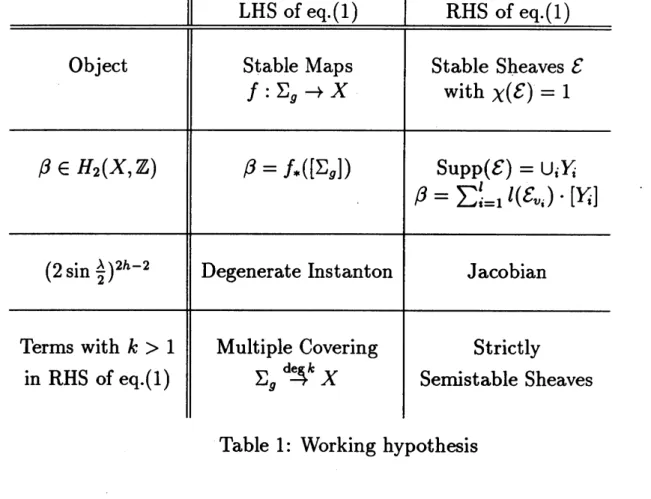
In this paper we present the idea of the first two steps based on our
work-ing hypothesis (table 1) and give nontrivial evidences for Gopakumar-Vafa
conjecture. Amathematical definition of BPS invariants is given in section 2
and evidences are given in section
3.
Especially, we can provide the answerof the problem (ii) using the intersection cohomology of the $\mathrm{D}$-brane moduli
spaces and the decomposition theorem due to [BBD]. This paper is akind
of survey article and the details can be found in [HSTl][HST2][Ta].
Table 1: Working hypothesis
Acknowledgement
Iwould like to express my gratitude to Professor Kyoji
Saito
for valuableadvices. Iwould like to
thank
ProfessorsShinobu
Hosono and ProfessorMasahiko
Saito
who allowedme
to talk aboutour
results. Ialso would liketo thank Professors Jim Bryan, Ron Donagi, Toshiya Kawai, Kota Yoshioka
for useful discussions. Iam grateful to the organizers of Workshop “Algebraic
Geometry and Integrable Systems Related to
String
Theory”. This work waspartly supported by
Grand-in
Aid forScientific
Research of the Ministry ofEducation,
Science
andCulture
in Japan2Moduli
Space
of D-branes
2.1
“$\mathrm{D}$-brane wrapped around the cycle”
What is the mathematical definition of the “$\mathrm{D}$-brane wrapped around
the cycle” and the moduli space of them? Usually one may think “D-brane
wrapped around the cycle” as cycles with flat $U(1)$ bundle This
trans-lation is sufficient in many cases, but since the cycles may have
singulari-ties, it is more useful for our purpose to regard $\mathrm{D}$-branes as stable sheaves
(Narasimhan-Seshadri theorem, Kobayashi-Hitchin correspondence). Let us first recall the notion of stability.
Definition 2.1. Acoherent sheaf $\mathcal{E}$ on ascheme $X$ is pure of dimension $k$
if $\dim_{\mathbb{C}}$Supp( F) $=k$ for any
iiontrivial
coherent subsheaf $F$ $\subset \mathcal{E}$.
Definition 2.2. Let $\mathcal{E}$ be acoherent sheaf which is pure of dimension $d$ on
aprojective scheme $X$ and let
$P( \mathcal{E}, m):=\chi(X, \mathcal{E}(m))=\sum_{i=0}^{d}\alpha_{i}(\mathcal{E})\frac{m^{i}}{i!}$
be the Hilbert polynomial of $\mathcal{E}$. Then
$p(\mathcal{E}, m):=P(\mathcal{E}, m)/\alpha_{d}(\mathcal{E})$ is called a
reduced Hilbert polynomial of $\mathcal{E}$
.
Definition 2.3. (Stability)
Let $\mathcal{E}$ be acoherent sheaf which is pure of dimension $d$on aprojective scheme
X. $\mathcal{E}$ is stable (resp. semistable) if for any proper subsheaf $F$,
$p(F, m)<p(\mathcal{E}, m)$, for $m>>0$
.
(resp. $p$($F$,$m)\leq p(\mathcal{E},$ $m)$, for $m>>0$).
One can define the moduli spaces of semistable sheaves by the Simpson’s construction (see, for example [HL]):
Definition 2.4. Let $X$ be aCalabi-Yau 3-fold and let us fix an ample line
bundle $L$ on $X$
.
Let $M_{d,\chi}(X)$ be the moduli space of semistable sheaves $\mathcal{E}$on $X$ with Hilbert polynomial
$P(\mathcal{E}, m)=dm+\chi$.
It is known that $M_{d,\chi}(X)$ is aprojective scheme (Theorem 4.3.4 [HL])
2.2
Support morphism
We must take extra care if we consider the fiber space structure of the
moduli spaces, i.e., if we consider the
deformation
spaces of the support ofthe sheaves in addition. For example, let us consider the following case:
(i) $n$ copies of $\mathrm{D}$-branes wrapped around
the cycle $C$ once,
(ii) Large single $\mathrm{D}$-brane wrapped around the cycle $C$
n-times.
Mathematically, the first one corresponds to asheaf of rank $n$ on $C$ and the
second one corresponds to asheafof rank 1on non-reduced scheme with the
same topological space $C$ (but multiplicity along $C$ is $n$).
Sometimes
theabove two objects have the
same
Hilbert polynomial and hence they definepoints of the same moduli space.
Such.asituation
makes it very difficult todeal the support map of the moduli space of stable sheaves of
dimension
oneon aCalabi-Yau 3-fold. In fact, in the above example there exist at least
two natural scheme structures $C$ and $nC$ on their topological space $C$. Thus
it is very difficult problem to define asuitable “support morphism” since the
subscheme structure of the support of coherent sheaves are not unique.
Our
solution to this problem is to use the Chow variety Chow(X)param-eterizing algebraic cycles on $X$
.
It is known that Chow(X) is aprojectivescheme.
Let $X$ be asmooth projective scheme over $\mathbb{C}$ and $\mathcal{E}$ be acoherent sheaf
on
$X$ pure of dimension 1. Let Supp(f) be the support of $\mathcal{E}$, $\mathrm{Y}_{1}$
,
$\cdots$ , $\mathrm{Y}_{l}$ be theirreducible components of Supp(f) and $v$
:be
the generic point ofY.
$\cdot$.
Thenthe stalk $\mathcal{E}_{v}.\cdot=\mathcal{E}\otimes 0_{X}\mathcal{O}_{X,v:}$ is an Artinian module of finite length $l(\mathcal{E}_{v:})$
.
Onecan define an algebraic cycle $s(\mathcal{E})$ by
$s( \mathcal{E}):=\sum_{i=1}^{l}l(\mathcal{E}_{v}.\cdot)$
.
Y.
$\cdot$.
(2)Definition
2.5. Let $M_{\beta}(X)$ be subspace of $M_{d,1}(X)$ with $[s(\mathcal{E})]=\beta\in$$H_{2}(X,\mathbb{Z})$, $d= \int_{\beta}c_{1}(L)$
.
Let us
assume
that $M_{\beta}(X)$ is normal (In general,we
take thenormaliza-tion $0^{\cdot}\mathrm{f}M_{\beta}(X)$ and denote it by $M_{\beta}(X)$ again.).
Proposition 2.1. $([HST\mathit{2}])$
The natural map
$\pi\beta$ :
$M_{\beta}(X)\mathcal{E}$ $\mapstoarrow$
Chow(X).
(3)
$s(\mathcal{E})$
becomes a morphism
of
projective schemes. $\square$Let us denote by $S_{p}(X)$ the normalization of the image of $M_{\beta}(X)$ in
Chow(X). Since $M_{ii}(X)$ is normal, the morphism factors through Sp(X)
from the univesal property of the normalization, ahd we obtain the natural
morphism
$\pi_{\beta}$ : $M_{\beta}(X)arrow S_{\beta}(X)$
.
(4)Note that $\pi_{\beta}$ is projective since $M_{\beta}(X)$ and $S_{\beta}(X)$ are projective.
Remark. If $X$ is asmooth projective surface, then $\pi_{\beta}$ coincides with the
support morphism given by Le Portier $[\mathrm{L}\mathrm{e}\mathrm{P}]$
.
2.3
BPS
Invariants
We can prove the following theorem and give mathematical definition of
$\mathrm{B}\mathrm{P}\mathrm{S}$ invariants.
Theorem 2.2. $([HST\mathit{2}])$
Let $\pi_{\beta}$ : $M_{\beta}(X)arrow S_{\beta}(X)$ be the projective morphism
defined
in (4). Let usfix
a relative ample line bundle $L_{1}$ on $M_{\beta}(X)$ and an ample line bundle $L_{2}$on $S_{\beta}(X)$ respectively.
Then $IH^{*}(M_{\beta}(X))$ is a representation
of
an $(sl_{2})_{L}\cross(sl_{2})_{R}$defined
by therelative
Lefschetz
operator $\omega_{L}$ and by theLefschetz
operator$\omega_{R}$of
the base.I$H^{*}(M_{\beta}(X))$ is decomposed as an $(sl_{2})_{L}\cross(sl_{2})_{R}$-representation as
follows:
I$H^{*}(M_{\beta}(X))=\oplus N_{j_{1},j_{2}}(j_{1})_{L}\otimes(j_{2})_{R}j_{1},j_{2}$ (5)
$= \oplus h\geq 0[(\frac{1}{2})_{L}\oplus 2(0)_{L}]^{\otimes h}\otimes R_{h}(\beta)$
.
(6)where we denote by $(j)_{L}$ the spin-j representation
of
the relativeLefschetz
$(sl_{2})_{L}$-action and by$R_{h}(\beta)a$ (virtual) representation
of
the $(sl_{2})_{R}$ action. $\square$Definition 2.6. (BPS invariants)
By using the decomposition (5), we can define integers $n_{h}(\beta)$ by thefollowing formula:
$n_{h}(\beta):=Tr_{R_{h}(\beta)}(-1)^{2H_{R}}$. (7)
$n_{h}(\beta)$ will be called $BPS$ invariants.
Conjecture 2.1. Integers $n_{h}(\beta)$
defined
in (7) should bedefor
mationin-variants satisfying the Gopakumar-Vafa
formula
(1). In particular, $n_{0}(\beta)$ should be the holomorphic Casson invariantsdefined
by Thomas [Th]Since neither $M_{\beta}(X)$ nor the morphism $\pi_{\beta}$ may not be smooth in
gen-eral, we cannot prove the existence of such an action on $H^{*}(M_{\beta}(X), \mathbb{C})$ by
the usual Leray’s spectral sequence. However, the “perverse” Leray spectral
sequence tells us the origin of the $(sl_{2})_{L}\cross(sl_{2})_{R}$-action on
intersection
c0-homology I$H^{*}(M\beta(X))$
.
Not only physics but also mathematics can explain$(sl_{2})_{L}\cross(sl_{2})_{R}$ quite naturally!
Let us give asketch of the above theorem. Let $M$ be anormal algebraic
variety. We use the theory of perverse sheaves to show the existence of
$(sl_{2})_{L}\cross(sl_{2})_{R}$-action on intersection cohomology $IH^{*}(M\beta(X))$
.
First of all,let us recall some definitions.
Definition 2.7. (Constructible Sheaves)
A $\mathbb{C}_{M}$-module $F$ is called constructible if there exists astratification $M=$
$\prod_{=1}^{\gamma}\dot{.}M_{i}$ such that restrictions $\mathcal{F}|_{M_{i}}$ are local systems on $M_{i}$
.
We denote by $D_{c}^{b}(\mathbb{C}_{M})$ the derived category of bounded complexes of
$\mathbb{C}_{M}$-modules with constructible cohomology sheaves.
Definition 2.8. (Perverse Sheaves)
Aperverse $\mathbb{C}_{M}$-module is an object $K$
.
$\in D_{c}^{b}(\mathbb{C}_{M})$ such that the followingconditions are satisfied:
(i) (Support condition)
dirr $\mathrm{s}\mathrm{u}\mathrm{p}\mathrm{p}H:(K^{\cdot})\leq-i$, $i\in \mathbb{Z}$
.
(ii) (Support condition for Verdier Dual)
$\dim_{\mathbb{C}}\mathrm{s}\mathrm{u}\mathrm{p}\mathrm{p}H:(\mathrm{D}_{M}K^{\cdot})\leq-i$, $i\in \mathbb{Z}$
,
where$\mathrm{D}_{M}$ is aVerdier dualizing functor. Let $pD^{\leq 0}(\mathbb{C}_{M})(^{p}D^{\geq 0}(\mathbb{C}_{M}))$ be
the subcategory of$D_{c}^{b}(\mathbb{C}_{M})$ whose objects
are
complexes $K$.
$\in D_{c}^{b}(\mathbb{C}_{M})$satisfying the support condition (Support condition for Verdier Dual),
respectively. Let us set
$Perv(\mathbb{C}_{M}):=^{p}D^{\leq 0}(\mathbb{C}_{M})\cap^{p}D^{\geq 0}(\mathbb{C}_{M})$
.
The category of perverse $\mathbb{C}_{M}$-modules is
an
abelian category which isboth Artinian and Noetherian. The simple objects are of the form
$\iota\prime_{*}.L[\dim_{\mathbb{C}}V]:={\rm Im}(\iota_{!}Larrow\iota_{*}L)[\dim_{\mathbb{C}}V]$
,
where $V\llcornerarrow M$ is the immersion of locally closed subvariety of $M$ and $L$ is a
local system on $V$
.
Theorem 2.3. (Th\’eor\‘eme 1.3.6 [BBD])
Inclusion $pD^{\leq 0}(\mathbb{C}_{M})\llcornerarrow tD_{c}^{b}(\mathbb{C}_{M})(^{p}D^{\geq 0}(\mathbb{C}_{M})\mathrm{c}arrow D_{c}^{b}(\mathbb{C}_{M}))$ gives a right (left)
adjoint
functor
$\tau\leq 0(\tau\geq 0)$.$pH^{0}:=\tau_{\geq 0}\tau_{\leq 0}$ : $D_{c}^{b}(\mathbb{C}_{M})arrow Perv(\mathbb{C}_{M})$
is a cohomology
functor.
$pH^{0}$ is called a perverse cohomologyfunctor.
$\square$Definition 2.9. (Perverse Derived Functor)
Let $\pi$ : $M$ $arrow S$ be amorphism of normal algebraic varieties.
$pR^{k}f_{*}:$ $Perv(\mathbb{C}_{M})arrow Perv(\mathbb{C}_{M})$, $K^{\cdot}-+pR^{k}f_{*}K^{\cdot}:=H^{0}p(Rf_{*}K^{\cdot}[-k])$
.
Definition 2.10. (Intersection Cohomology)
Let us set $IC_{\dot{M}}:=\iota\prime_{*}.\mathbb{C}_{M^{\mathrm{e}mooth}}\vee\cdot$ The intersection cohomology is defined by
$IH^{i}(M):=\mathbb{H}^{i}$($M,$ I$C_{M}^{\cdot}$) $=R^{i}p\Gamma_{*}IC_{M}^{\cdot}$, $i\in \mathbb{Z}$.
The key is the following two main theorems of the theory of perverse sheaves by Beilinson-Bernstein-Deligne.
Theorem 2.4. (Decomposition Theorem (Theor\’em\‘e 6.2.5 [BBD])) Let $\pi$ : $Marrow S$ be a proper morphism and $K^{\cdot}\in Perv(CM)$ be a simple
object. Then
$R\pi_{*}K^{\cdot}\sim-\oplus_{k}^{p}R^{k}\pi_{*}K^{\cdot}[-k]$
.
(8)$\square$
Theorem 2.5. (Relative hard Lefschetz theorem (Theor\’em\‘e 6.2.10
[BBD]$))$
Let $\omega$ be the
first
Chem classof
the relative ample line bundlefor
the
prO-jective morphism $\pi$ : $Marrow S$. Then
for
$k\geq 0_{f}$ we have$\omega^{k}\wedge:R^{-k}p\pi_{*}K^{\cdot}-\sim pR^{k}\pi_{*}K^{\cdot}$
.
(9) El There is aspectral sequence$E_{2}^{r,s}=H^{f}(S,pR^{S}\pi_{*}IC_{M_{\beta}(X)}^{\cdot})\Rightarrow IH^{\mathrm{r}+s}(M\beta(X), \mathbb{C})$, (10)
which degenerates at $E_{2}$-term because of the decomposition theorem. By
applying the relative hard Lefschetz theorem to projective morphisms $\pi$ :
$M_{\beta}(X)arrow S_{\beta}(X)$ and $S_{\beta}(X)arrow \mathrm{S}\mathrm{p}\mathrm{e}\mathrm{c}\mathrm{C}$, we have two $sl_{2}$ action
$\omega_{L}^{s}\Lambda$ : $E_{2}^{\mathrm{r},-s}-\sim E_{2}^{r,s}$,
and
$\omega_{R}^{f}\wedge:E_{2}^{-t,\mathrm{S}}\simeq E_{2}^{\Gamma,S}$,
which give the $(sl_{2})_{L}\cross(sl_{2})_{R}$ action on $IH^{\mathrm{r}+s}(M_{\beta}(X), \mathbb{C})=\oplus_{\mathrm{r},s}E_{2}^{\mathrm{r},s}$
3Evidences
In this section we shall give evidences for Conjecture 2.1. For details,
please see [HST$\mathrm{I}$][HST2] [Ta] for example.
3.1
Contractable smooth
$\mathrm{P}^{1}$in
$X$Let us consider asmooth rational curve $C\in X$ with $N_{C/X}=\mathcal{O}_{C}(-1)\oplus$
$\mathcal{O}c(-1)$
.
One
can calculate the local contribution ofGromov-Witten
invari-ants which counts the number of maps whose images are $C$
.
The relevantlocal
Gromov-Witten invariants
are given by$N_{g}(n\cdot C):=\mathit{1}_{[\overline{\mathcal{M}}_{g,0}(\mathrm{P}^{1},n\mathrm{P}^{1}1)]^{v}}:r\iota$ $c_{\mathrm{t}\mathrm{o}\mathrm{p}}(R^{1}\pi_{*}\mu^{*}N_{C/X})$, $n\geq 0$,
where
$\pi$ : $\overline{\mathcal{M}}_{g,1}(\mathrm{P}^{1},n[\mathrm{P}^{1}])arrow\overline{\mathcal{M}}_{g,0}(\mathrm{P}^{1}, n[\mathrm{P}^{1}])$
is auniversal family,
$\mu$
’
: $\overline{\mathcal{M}}_{g,1}(\mathrm{P}^{1}, n[\mathrm{P}^{1}])arrow \mathrm{P}^{1}$
,
$(f : \Sigma_{g}arrow \mathrm{P}^{1}, x\in\Sigma_{g})\vdasharrow f(x)\in \mathrm{P}^{1}$is an evaluation map.
Faber and Pandharipande proved the following theorem for the generating
function of local
Gromov-Witten invariants
$N_{g}(n\cdot C)$:Theorem 3.1. $([FP])$
$\sum_{g\geq 0,n\geq 1}N_{g}(n\cdot C)q^{n}\lambda^{2g-2}=\sum_{k\geq 1}\frac{1}{k}(2\sin(\frac{k\lambda}{2}))^{-2}q^{k}$
.
El
One
candefine
the conjectural local $BPS$ invariants $n_{g}^{conj}(d\cdot C)\in \mathbb{Q}$ byGopakummar-Vafa formula (1)
$’ \sum_{g\geq 0,n\geq 0}N_{g}(n\cdot C)q^{n}\lambda^{2g-2}=\sum_{k>0,h\geq 0,n\geq 0}n_{h}^{conj}(n\cdot C)\frac{1}{k}(2\sin(\frac{k\lambda}{2}))^{2h-2}q^{kn}$
.
(1)
iFrom
this formula, the conjectural localBPS invariants
$n_{g}^{conj}(n\cdot \mathrm{P}^{1})$ can begiven by
$n_{h}^{conj}(n\cdot \mathrm{P}^{1})=\{$ 1for
$h=0$ and $n=1$
(12)
0otherwise.
Thegeneralization of Theorem
3.1
to acontractable smooth rational curve$C$ are given in [BKL], First we recall the notion of Koll\’ar’s
length
Definition 3.1. (Ifoll\’ar’s length)
Let $C$ be asmooth rational curve in Calabi-Yau 3-fold $X$ and suppose that
there exists abirational morphism $f$ : $Xarrow \mathrm{Y}$ with $f(C)=p\in \mathrm{Y}$
.
Kollir’s length $l$ is defined to be the length at the generic point of $C$ of the sheaf$\mathcal{O}_{X}/f^{-1}m_{\mathrm{Y},p}$ where the
$m_{\mathrm{Y},p}$ is the maximal ideal sheaf of $p\in \mathrm{Y}$
.
It is known that $p\in \mathrm{Y}$ is acompound DuVal singularity and $N_{C/X}$ is $\mathcal{O}_{C}(-1)\oplus \mathcal{O}_{C}(-1)$, $\mathcal{O}_{C}\oplus \mathcal{O}_{C}(-2)$ or $\mathcal{O}_{C}(1)\oplus \mathcal{O}_{C}(-3)$
.
Let $\mathrm{Y}_{0}$ be ageneric hyperplarie section and let $X_{0}$ be the proper transform
of $\mathrm{Y}_{0}$. By Reid’s result, the
minimal
resolution $Z_{0}$ of $\mathrm{Y}_{0}$ factors through $X_{0}$.
Hence the length $l$ can be computed by the length of $\mathcal{O}_{X_{0}}/f^{-1}|_{X_{0}}(m_{\mathrm{Y}_{0,\mathrm{P}}})$and coincides with the multiplicity of $C$ in the fundumental cycle of the
corresponding ADE singularity.
Let $C_{n}\subset X_{0}$ be
stibschemes
defined by the symbolic power $I_{C}^{(n)}$ of theideal $I_{C}$ defining $C\subset X_{0}$, and let $k_{n}$ be the multiplicities of $C_{n}$ in Hilbert
scheme. The theorem by [BKL] gives the following conjectual local BPS
invariants.
Theorem 3.2. $([BKL])$
Let $C$ is a contractable smooth rational curve in a Calab$i-\mathrm{Y}au3$
-fold
X. $C_{n}$deforms
to $k_{n}$ super-rigid rational curves with homology class $n[C]$ under$a$
generic
deformation
of
X. Since Gromov-Witten invariants aredeformation
invariants, conjectual local $BPS$ invariants are given by$n_{h}^{conj}(n\cdot C)=\{\begin{array}{l}k_{i}forh=0,n=\mathrm{l},2,\ldots,l0otherwise\end{array}$ (13)
ta Let us calculate local BPS invariants $n_{h}(n\cdot C)$ defined by (7) and compare $n_{h}(n\cdot C)$ with $n_{h}^{conj}(n\cdot C)$. In order to have the local BPS invariant $n_{g}(d\cdot C)$,
let us consider the subset $M_{n}.c(X)$ (or more explicitly the subfunctor) of $M_{n[C]}(X)$ defined by
$M_{n}.c(X):=\{\mathcal{E}\in M_{n[C]}(X)|s(\mathcal{E})=n\cdot C\}\subset \mathrm{M}\mathrm{n}[\mathrm{C}](\mathrm{X})$ .
Theorem 3.3. Let $C\subset X$ be a contractable smooth rational curve on $a$
$Calabi-Yau$ $3$
-fold
$X$ and let I be the Kolidr’s lengthfor
C. Then Mn.c isisomorphic to the component
of
Hilb(X) containing $n\cdot$ $C$ and our local $BPS$invariants coincides with conjectual $BPS$ invariants:
$n_{h}(n\cdot C)=\{$ $k_{i}$
for
$h=0$,$n=1,2$, $\ldots$ , $l$ 0otherwise. (14)169
The proof of this theorem is given in [HSTI] when $N_{C/X}\simeq \mathcal{O}_{C}(-1)\oplus$
$\mathcal{O}c(-1)$ and in [Ta] for general cases. The key facts to prove this theorem are
that there exists anontrivial homomorphism $\mathcal{O}_{X}arrow \mathcal{E}$ for $\mathcal{E}\in M_{n\cdot C}$ by the
condition $\chi(\mathcal{E})=1$, $\mathcal{E}\simeq \mathcal{O}c_{n}$ for all $\mathcal{E}\in M_{n}.c$ by stability condition and one
can prove that $M_{n\cdot C}$ is isomorphic to the component of Hilb(X) containing
$C_{n}$ by the construction of Simpson’s moduli space.
3.2
Super-rigid
elliptic
curve in
$X$Let $E\subset X$ be asuper-rigid elliptic curve, i.e., asmooth elliptic curve $E\in X$
with the normal bundle $N\simeq L\oplus L^{-1}$ where $L$ is anon-torsion element of
the Picard
group
of $E$.
Pandharipande [P] showed the following:
Theorem 3.4. $([P])$
$N_{g}(n\cdot E)=\{$
$\frac{\sigma(n)}{n}=\sum_{:|n}\frac{1}{}\dot{.}$
for
$g=1,n\geq 1$(15)
0otherwise.
Therefore
$n_{h}^{conj}(n\cdot E)=\{$
1for
$h=1$,
$n\geq 1$
0otherwise. (16)
$\square$ $M_{n\cdot E}$ and local
BPS
invariants $n_{h}(n\cdot E)$ are given as follows:Theorem 3.5. $([HST\mathit{2}])$
$M_{n\cdot E}\simeq E$
.
Thus we have
$n_{h}(n\cdot E)=\{$
1for
$h=1$,
$n\geq 1$
(17)
0otherwise.
$\square$
More precisely, we have proved that the moduli $M_{n\cdot E}$ of stable sheaf on
$X$ with $\chi=1$ and support $E$ coincides with the moduli of stable sheaf on
$E$ of rank $d$ with $\chi=1$
.
The latter moduli space is well-understood by thework ofAtiyah and elements are of the form $W_{n}\otimes L$ where $L$ is aline bundle
of degree 0and $W_{n}$ are stable bundles of degree 1defined recursively by the
unique nontrivial extension
$0arrow \mathcal{O}_{E}arrow W_{n}arrow W_{n-1}arrow 0$, $W_{1}:=\mathcal{O}_{E}(p_{0})$
.
(18)170
3.3
Rational elliptic surface
in
aCalabi-Yau 3-f0ld
Let $\pi$ : $Sarrow \mathrm{P}^{1}$ be arational elliptic surface, and let $\sigma$ and $F$ be asection
and fiber of $p$, respectively. Theorem 3.6. ([HSTI][HST2])
$\sum_{g\geq 0,r\geq 0}n_{f}$(a $+gF$)
$(2 \sin\frac{\lambda}{2})^{2r-2}q^{g}$
$= \frac{1}{(e^{-\sqrt{-1}\lambda/2}-e^{\sqrt{-1}\lambda/2})^{2}}\prod_{n\geq 1}\frac{1}{(1-e^{-\sqrt{-1}\lambda}q^{n})^{2}(1-e^{\sqrt{-1}\lambda}q^{n})^{2}(1-q^{n})^{8}}$
.
(19)$\square$
Remark. It is important that our theorem also holds for other elliptic sur-faces in aCalabi-Yau manifold. In particular, if we consider the case ofK3
surface, we have the same results as that of Kawai-Yoshioka [KY], i.e., the
both generating functions ofBPS states become $\chi_{10,1}(\tau, \nu)$. They considered
the Abel-Jacobi map and counted the number of BPS states from DO-D2
system. On the other hand, we use the relative Lefshetz action on the rela-tive Jacobian and counted the spin contents of BPS states from M2 brane. The coincidence of these results is very natural since the original physical theory should be equivalent.
If we allow some physical arguments (holomorphic anomaly equation), we have the nontrivial evidence for Gopakumar-Vafa conjecture. Let us write
the generating functions of Gromov-Witten invariants as
$Z_{g;n}(q):= \sum_{d}N_{g,d;n}q^{d}$, $N_{g,d;n}:= \sum_{(\beta,\sigma)=d,(\beta,F)=n}N_{g}(\beta)$,
$n\geq \mathrm{I}$, (20)
where $N_{g}(\beta)\in \mathbb{Q}$ are genus $g$ Gromov-Witten invariant$\mathrm{s}$ for $\beta\in H_{2}(S,\mathbb{Z})$
defined by
$N_{\mathit{9}}( \beta):=\int_{[\overline{\mathcal{M}}_{\mathit{9}},\mathrm{o}(S,\beta)]^{v*rt}}c_{\mathrm{t}\mathrm{o}\mathrm{p}}(R^{1}\pi_{*}\mu^{*}N_{S/X})$. (21)
Especially, $Z_{0;1}(q)$ is given by
$Z_{0;1}(q)=E_{4}(q) \prod_{k\geq 1}\frac{1}{(1-q^{k})^{12}}$. (22)
Proposition 3.7. (Holomorphic anomaly equation [HSTI]
(i) $Z_{g;n}(q)$ has the following expression
$Z_{g;n}(q)= \frac{P_{2g+6n-2}(E_{2}(q),E_{4}(q),E_{6}(q))}{\prod_{k\geq 1}(1-q^{k})^{12n}}$, (23)
where $P_{2g+6n-2}(E_{2}(q), E_{4}(q)$, $E_{6}(q))$ is a homogeneous polynomial
of
weight $2g+6n-2$ and $E_{*}(q)$ are Eisenstein series
of
$weight*$.(ii) $P_{2g+6n-2}(E_{2}, E_{4}, E_{6})$
satisfies
the following equation: $\frac{\partial P_{2g+6n-2}}{\partial E_{2}}=\frac{1}{24}\sum_{g=g’+g’}$, $\sum_{s=1}^{n-1}s(n-s)P_{2g’}{}_{+6s-2}P_{2g’+6(n-s)-2}$
十 –$n(n+1)_{P_{2(g-}}2\mathit{4}$
。$+6n-2$
.
(24)口
If $n=1$, we can solve the holomorphic anomaly equation easily and the
generating function of $Z_{gj1}(q)$ is expressed as
$\sum_{g\geq 0}Z_{g;1}(q)\lambda^{2g}=Z_{0;1}(q)\exp(2\sum_{k\geq 1}\frac{\zeta(2k)}{k}E_{2k}(q)(\frac{\lambda}{2\pi})^{2k})$
.
(25)By the famous Jacobi’s triple product formula, we have
$\lambda^{-2}\exp(2\sum_{k\geq 1}\frac{\zeta(2k)}{k}E_{2k}(q)(\frac{\lambda}{2\pi})^{2k})$
1 $\tau\tau$ $(1-q^{n})^{4}$
$\frac{1}{(e^{-\sqrt{-1}\lambda/2}-e^{\sqrt{-1}\lambda/2})^{2}}-,>1\prod_{\backslash }\frac{\backslash [perp]-\forall/}{(1-e^{\sqrt{-1}\lambda}q^{n})^{2}(1-e^{-\sqrt{-1}\lambda}q^{n})^{2}}$
.
(26)$\backslash ^{-}$ / $n\geq 1\backslash -$ -$\mathrm{Z}/$ $\backslash ^{-}$ -$\mathrm{z}$ ’
Multiplying $Z_{0;1}(q)$ both sides, we can easily verify the Gopakumar-Vafa
conjecture, which was given in [HSTI] where $n_{h}(\sigma+gF)$ are obtained with
some intuitions (of course
we
had no mathematical proof of $(sl_{2})_{L}\cross(sl_{2})_{R}$decomposition).
References
[BBD] A. Beilinson, J. Bernstein, P. Deligne, Faisceaux pervers, Asterisque
No.
100
(1982)3-17
[BKL] J. Bryan, S. Katz, N. Leung Multiple covers and the integrality con-jecture
for
rational curves in Calabi-Yau threefolds, J. AlgebraicGeom. 10 (2001), no. \yen $\mathrm{m}\mathrm{a}\mathrm{t}\mathrm{h}.\mathrm{A}\mathrm{G}/9911056$
[BP] J. Bryan, R. Pandharipande, BPS states
of
curves in Calabi-Yau3-folds, Geometry and Topology, Vol. 5(2001) Paper no. 9, 287-318,
$\mathrm{m}\mathrm{a}\mathrm{t}\mathrm{h}.\mathrm{A}\mathrm{G}/0009025$
[FP] C. Faber, R. Pandharipande, Hodge Integrals and Gromov-Witten
Theory, Invent. Math. 139 (2000), no. 1,
173-199.
$\mathrm{m}\mathrm{a}\mathrm{t}\mathrm{h}.\mathrm{A}\mathrm{G}/9810173$.[FO] K. Fukaya, K. Ono, Gromov-Witten invariants over $\mathbb{Z}$
of
general symplectic manifolds, (a summary), in Proceedings of Taniguchi Symposium, 1999, Nara.[GV] R. Gopakumar, C. Vafa, $\mathrm{M}$-Theory and Topological Strings-II,
hep-$\mathrm{t}\mathrm{h}/9812127$.
[HL] D. Huybrechts, M. Lehn, The Geometry
of
Moduli Spacesof
Sheaves, Aspects of Mathematics, Vol E31, Vieweg.[HSTI] S. Hosono, M.-H. Saito, A. Takahashi, Holomorphic Anomaly
Equa-tion andBPS State Counting
of
RationalElliptic Surface, Adv.The-oret. Math. Phys. 3(1999) 177-208.
[HST2] S. Hosono, M.-H. Saito, A. Takahashi, Relative
Lefschetz
Action andBPS State Couting, Internat. Math. ${\rm Res}$. Notices 2001, no.
15783-816. $\mathrm{m}\mathrm{a}\mathrm{t}\mathrm{h}.\mathrm{A}\mathrm{G}/0105148$
[KY] T. Kawai, K. Yoshioka, String Partition Functions and
Infinite
Products, Adv. Theor. Math. Physics. 4, (2000), 397-485,hep-$\mathrm{t}\mathrm{h}/0002169$
.
[LeP] Le Portier, Syst\‘emes Coh\’erents et Structures de Niveau, Ast\’erisque
214 (1993).
[P] R. Pandharipande, Hodge integrals and degenerate contributions
Comm. Math. Phys. 208 (1999), no. 2, 489-506. math AG/98垣垣0.
[Ta] A. Takahashi, in preparation.
[Th] R. Thomas, A holomorphic Casson invariant
for
Calabi-Yau 3-f0lds, and bundles on $I\acute{\acute{\iota}}\mathit{3}$ fibrations, J. Differential Geom. 54 (2000), no.2,