Prioritization of Policies: A Prototype Model
of a Flowchart Method
著者
Kuchiki Akifumi
権利
Copyrights 日本貿易振興機構(ジェトロ)アジア
経済研究所 / Institute of Developing
Economies, Japan External Trade Organization
(IDE-JETRO) http://www.ide.go.jp
journal or
publication title
IDE Discussion Paper
volume
10
year
2004-09-01
INSTITUTE OF DEVELOPING ECONOMIES
Discussion Papers are preliminary materials circulated
to stimulate discussions and critical comments
DISCUSSION PAPER No. 10
Prioritization of Policies:
A Prototype Model of a Flowchart
Method
Akifumi KUCHIKI*
September 2004
Abstract
This paper builds a prototype model of how to prioritize policies by using a flowchart. We presented the following six steps to decide priorities of policies: Step 1 is to attain the social subsistence level (primary education, health care, and food sufficiency); Step 2 is to attain macroeconomic stability; Step 3 is to liberalize the economy by structural adjustment programs; Step 4 is capacity building specific to a growth strategy by facilitating sufficient infrastructure (physical infrastructure and institutions); Step 5 is to initiate a growth strategy; and Step 6 is to narrow income inequalities. We illustrated the effectiveness of our “flowchart method” in case studies of Morocco, Laos, Vietnam, and China. The first priority of reforms in Morocco was given to social sectors of primary education and health care, particularly in the rural areas at Step 1. Laos should not put much emphasis on growth strategy before educational reform, attainment of macroeconomic stability, and institutional capacity building at Steps 1, 2, and 3. Vietnam can focus on reforming the state-run enterprises and developing the stock markets at Step 5 of growth strategies. We found that we should apply our flowchart method to China not nation-wide but province-wide.
Keywords: prioritization, flowchart, policies
JEL classification: O21, P41
The Institute of Developing Economies (IDE) is a semigovernmental,
nonpartisan, nonprofit research institute, founded in 1958. The Institute
merged with the Japan External Trade Organization (JETRO) on July 1, 1998.
The Institute conducts basic and comprehensive studies on economic and
related affairs in all developing countries and regions, including Asia, Middle
East, Africa, Latin America, Oceania, and East Europe.
The views expressed in this publication are those of the author(s). Publication does not imply endorsement by the Institute of Developing Economies of any of the views expressed.
INSTITUTE OF DEVELOPING ECONOMIES (IDE), JETRO 3-2-2, WAKABA,MIHAMA-KU,CHIBA-SHI
CHIBA 261-8545, JAPAN
1. Introduction
Wolfensohn [1999] proposed a comprehensive development framework (CDF) that all the requirements within a holistic framework must be addressed if there is to be stable, equitable, and sustainable development. The CDF emphasizes the importance of prioritizing policies since it is holistic. PRSPs (Poverty Reduction Strategy Papers) (CDF [2001]) were initiated by the International Monetary Fund and the World Bank in 1999 and are to be lead by ownership of developing countries which receive official development assistance (ODA). The principles of the CDF are almost the same as those of PRSPs. One of the core principles of PRSPs is to prioritize policies.
Each recipient country of ODA has a number of choices in prioritizing policies. There are many approaches to determine a country’s development strategy. Japan takes a “country approach” to its official development assistance policy (Nakano [1998]). The country approach will design the development strategy of recipient countries by determining projects and programs. The US, Canada, the UK, and Germany also take the country approach (see Appendix 1). So developing countries must select one of the policy priorities.
Each country has so many required reforms covering social sectors such as education and health care, physical infrastructure, institutional building, growth strategy and poverty reduction, though budgets of countries are limited. We have no other choice but to prioritize policies under budget constraints.
The Tinbergen [1952] principle told us that the number of policy measures should be equal to the number of policy objectives for policies to be successfully implemented. But it is usual that the numbers of policy measures and objectives are not so clear in reality. The World Development Report [1991] discussed shock therapy and sequencing policies when so many planned economies were in transition to market economies in the early 1990s. Some studies found criteria for sequencing reforms even though it is difficult. Collier [2000] found that
political stability is a precondition to economic reforms. The World Bank [1998] showed that aid is effective in developing countries with sound policies. That is, macroeconomic stabilization is the first priority in sequencing policies. The World Bank [2000] and [2001] emphasized institutional reforms. Social sectors such as education and health care play crucial roles in PRSPs. Stiglitz [1999] recommended control over short-term capital movements in developing countries whose financial markets are not developed sufficiently. We reached a tentative conclusion that developing economies with underdeveloped financial markets may strategize the sequencing of economic reforms.
But there are differences in budget allocation between sequencing and prioritization of policies (see Appendix 1). We propose that governments should allocate budgets according to the priorities of policies since both the shock therapy and the sequencing are not realistic. However, no paper has proposed how to decide prioritizing institutional reforms, social sector reforms, and other reforms.
The purpose of this paper is to propose a flowchart method of prioritizing policies of developing countries as objectively as possible by using data. We propose the following six steps for prioritizing policies; Step 1: Attaining the social subsistence level (education and health care, and agriculture); Step 2: Macroeconomic stabilization; Step 3: Structural adjustment programs; Step 4: Capacity building for economic growth (physical infrastructure and institutions); Step 5: Growth strategies; and Step 6: Narrowing income inequalities.
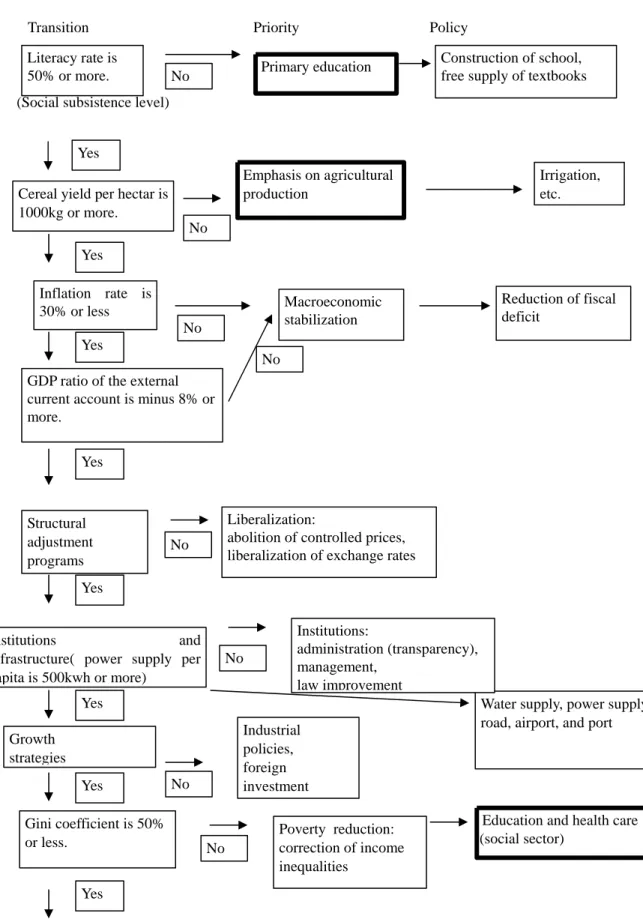
For example, education is the highest priority of policies in developing countries if their literacy rate less than 50 %. A country enters into the flowchart from Step 1 of primary education in Figure 1 to decide what its priorities are. The flowchart is helpful to decide prioritizing economic policies in developing countries.
Though this paper a priori gives values of criteria in deciding at each step whether we go to the next step, there are other values of criteria we can adopt. So this paper proposes a prototype
model to discuss other criteria. We will apply the flowchart method to Morocco, Laos, Vietnam, and China, finding objective policy proposals for the countries to make clear the effectiveness of the method.
The rest of the chapter is organized as follows. Section 2 proposes a prototype model of prioritizing policies and reforms according to a flowchart. Section 3 quantitatively examines which ordering is the best of all combinations of the six steps, that is, attaining the social subsistence level, macroeconomic stabilization, structural adjustment programs, capacity building for economic growth, growth strategies, or narrowing income inequalities. Section 4 clarifies the characteristics in each region of the world by using the flowchart. Section 5 applies the flowchart method of prioritizing reforms to Morocco, Laos, China and Vietnam. We present a summary in Section 6.
2. Prioritization of policies
It is best to implement all reforms at once as a package if the budget is unlimited. But every government needs to prioritize its reforms since policies require change in the government’s budget allocations due to budget constraints. This section will propose a prototype model of a way of prioritizing reforms. Here we assume political stability as a precondition to all policies and reforms. We will a priori give order of reforms to a flowchart in Figure 1 based on experiences of developing countries as a prototype model in the following six steps.
Step 1: to attain the social subsistence level of living: enhancement of the literacy rate (primary education and health care) and agricultural reform (increase of agricultural productivity),
Step 2: macroeconomic stabilization (stabilization of prices and stabilization of balance of international payments), stabilization of the financial system,
liberalization, and liberalization of interest rates), deregulation, and development of markets, Step 4: capacity building for economic growth: improvement of physical infrastructure (road, port, airport, power, and communication) and institutions closely related to growth strategy,
Step 5: growth strategy,
Step 6: reducing income inequalities.
This paper claims the following two points concerning order of the steps in Figure 1. The first point is that Step 1, the reform of primary education and agriculture to attain the social subsistence level of living is required for some countries at the stage before both Step 2, macroeconomic stabilization and Step 3, structural adjustment programs. The second point is that Step 4, the improvement of physical infrastructure and institutional reforms are preconditions to Step 5, the economic growth strategies. The reasons why we propose to order the six following steps of these reforms are explained below.
Step 1: As is indicated in the United Nation Development Plan (UNDP), the ultimate purpose of economic growth is not growth itself, but human development. Independent variables that determine the standard of human development are an education standard and a health standard. UNDP [2002] insists that the objective of human beings is to maximize the welfare of life such as education and health care. Therefore, to achieve the social minimum standard of living, primary education is the bottom line. In a country with a literacy rate of less than 50 %, there will be no question in giving the first priority to primary education. So the social subsistence level comes on the top of our flowchart in Figure 1.
UNDP [2002] put a critical value of 50 % of human development index between the low and the high. Here we a priori give a critical value of 50 % of the literacy rate at Step 1. In deciding whether we take a route to yes or no at Step 1, we may refer to values of life expectancy and per capita income since the critical value of literacy rate is groundless. It is noted that this paper will not discuss whether the critical value of 50 % is reasonable.
Two reasons why agricultural reform is necessary for a country with a low rate of self-sufficiency of food production are described in the following. First, a theory says that improvement in efficiency of agricultural production is necessary for a developing country to transform into the market economy from the dual economy where there is a gap in productivity between the agricultural sector and the industrial sector. Wages in a developing country cannot exceed the social subsistence level until its agricultural productivity exceeds the turning point of the theory. This is so called the “theory of the turning point” by Lewis [1955]. Second, Myint [1965] explained the need for agricultural reform in economic development to increase agricultural productivity. The three roles of agriculture are to supply food sufficiently, to supply labor to non-agricultural (industrial) labor, and to create demand for industrial products.
Governments should try to maximize food self-sufficiency to reduce constraints of both the fiscal account and the external current account of its international balance of payments. A desert country cannot produce agricultural products. A county like Japan, which earns foreign currency by exporting manufacturing goods and imports food, need not attain self-sufficiency of food. But most of the developing countries face both fiscal deficits and external current account deficits that will bring macroeconomic instability. We can skip this step if a country has no problem with its budget or foreign reserve without increasing self-sufficiency of food. Here we also take Myint's hypothesis and set the agricultural reform to Step 1 in the flowchart of prioritizing policies in Figure 1. It is noticed that we must justify the order and critical values of reforms in Figure 1 by further discussing whether they are reasonable.
We can illustrate that developing countries took off by increasing its agricultural productivity (Kuchiki [1994]). The Asian countries such as China, Laos, and Vietnam after the 1980s implemented agricultural reform prior to structural adjustment programs of Step 2. For instance, the Chinese government introduced a farmer production contract system at almost the same time when its open door policies of liberalization were introduced in 1979 to give incentives
to farmers. As a result, food production was increased dramatically, and this reduced direct and indirect subsidies to agriculture, thereby contributing to achieving macroeconomic stabilization by restoring its fiscal discipline. The policy of the farmer production contract system was successfully applied to other Asian socialist countries during the transition period from the planned economy to the market economy. For instance, a similar incentive policy to farmers was implemented in Vietnam and Laos. We could find a counter example in Russia that the structural adjustment programs had an adverse effect at least in the 1990s because its agricultural reform might not be implemented sufficiently in advance of Step 2.
Thailand took agricultural policy in the 1950s and 1960s to increase its productivity of rice. Rice was important to Thailand in the post-WWII period to earn foreign currency since taxes on rice exports constituted 32% of budget revenue in 1953 (MacIntyre [2001]). Malaysia formulated a policy of shifting rubber production to oil palm production in the 1970s, and emphasized fostering natural resource-based industries such as petroleum, tin, and palm oil to improve the value-added in the 1980s. The Ministry of Primary Industries was established in 1972 to play an important role in the national economy in the 1970s by contributing some 70 per cent of total export (ESCAP [1999]). Japan developed an agricultural policy to increase foreign currency by exporting silk and tea in the 1890s (Kawamura [2002]). We assume that agricultural reform is a key to attain macroeconomic stability in many countries.
Step 2: From the 1980s, the World Bank and IMF started to implement structural adjustment programs as a package of reforms. Here we will explain the reasons why we have given the order of Steps 2 and 3 mentioned above. The IMF imposes the conditionality of macroeconomic stabilization to recipient countries as a pre-condition for World Bank’s loans. Then, the World Bank imposed conditionality of implementing economic liberalization in both the 1980s and the 1990s through structural adjustment programs. We think that these two steps are pre-conditions to introduce economic growth strategy.
Step 3: Burnside and Dollar [2000] found the order successful in the cases of many developing countries in the latter half of the 1980s and former half of the 1990s by showing that aid is effective in developing countries with sound policies of macroeconomic stabilization. That is the reason why we adopt the order of Step 2 and Step3. We think that the order of reforms should be as objective as possible.
Structural adjustment programs include many reforms such as trade liberalization, abolition of controlled prices, and capital liberalization. The World Bank requested recipient countries to implement these reforms concurrently as one package particularly in the 1980s and in the former half of the 1990s. Based on experiences of the Asian currency crisis which occurred in 1997, some economists concluded that a rapid inflow of short-term capital to countries such as Thailand and Malaysia generated bubble economies due to liberalization of movements of short-term capital so that an outflow of the capital caused the Asian currency crisis (Stiglitz [1999]). They insisted that short-term capital liberalization should be restricted in developing countries at the early stage of development. It is noticed that, in the future, we need to reexamine whether we should prioritize liberalization of long-term capital at Step 3 of structural adjustment programs (Ito [2001]) in advance of liberalization of short-term capital.
Step 4: Physical infrastructure and institutions required for growth strategy should be facilitated at Step 4 before Step 5. For example, growth strategy in the manufacturing sector is closely related to how sufficiently the transport sector such as roads, ports and airports should be addressed at Step 4.
We divide physical infrastructure into the following two: what relates to basic human needs and what relates to growth strategy. The former example is water services for human life and the latter is ports and highways for growth strategy. We must prepare for the latter`s physical infrastructure for growth strategy at Step 4. We can limit physical infrastructure related to growth strategies to facilitate at Step 4. In cases of the ASEAN countries in the 1980s, such
physical infrastructure as the construction of ports, electricity, and roads were limited to their industrial zones to invite foreign direct investment (Kuchiki [1997]). We can name the physical infrastructure, “ economic infrastructure”.
Each country has so many institutions to be reformed. We can illustrate an analysis on Morocco’s reforms in section 5. Research on institutions is crucial to implementing reforms successfully. It is usual that each step has its own institutional reforms. Here we limit our focus of institutional reforms at Step 4 on reducing corruption and preparing the investment climate for growth strategy at Step 5.
Step 5: There is an argument as to whether governments’ selective interventions are needed to implement economic growth (World Bank [1993]). We assume that we can proceed to take growth strategy if their preconditions mentioned above hold. In short, we give priorities next to Step 1 as follows: Step 2 the stabilization of macro economy, Step 3 the structural adjustment programs, Step 4 the improvement of infrastructure and institutions, and Step 5 economic growth strategy.
After completion of Step 4, the improvement of physical infrastructure and institutions, governments can play an important role in implementing Step 5 the economic growth strategy. We can illustrate the strategies by developing a private sector and promoting introduction of foreign direct investment.
It is especially difficult to make a plan of industrialization at Step 5, the growth strategy. The industrialization strategy will depend on the stage of economic development of a country. We will show that we must identify “economic agents” and establish “institutions” for the strategy in each developing country. The strategies of Morocco are illustrated in Figure 2. We will explain them below.
(1) Consider a country whose key products are primary commodities. Then its strategies may take forms of agro-based industrialization, resource-based industrialization, and export of primary
commodities. This strategy in cocoa, palm oil, and petroleum was successfully taken in Malaysia in the early1980s, and succeeded by export-led growth in the electronics industry in the latter half of the 1880s.
(2) The following are candidates of economic agents to implement growth strategy: (i) traditional industries, (ii) state-owned enterprises, (iii) export industries of nontraditional goods, and (iv) small and medium-sized enterprises.
(3) Introduction of foreign direct investment (FDI) into East Asia was the most popular and successful strategy particularly after the 1980s all over the world. There are two types of industries of FDI, that is, industries of import substitution and industries of export-oriented. East Asian countries successfully introduced export-oriented industries in the latter half of the 1980s and former half of the 1990s.
(4) A regional development strategy is to establish export processing zones and/or industrial zones with preferential treatments such as tax reductions or exemptions to invite FDI. The export-led strategy by FDI was taken in East Asia. This was realized by a method of developing export processing zones (EPZ) contributing to economic growth in East Asia until the occurrence of the Asian crisis in 1997.
(5) The tourism industry can be useful to earn foreign currencies to import raw materials for the manufacturing industry if a country has the resources for tourism.
Step 6: We usually find income inequalities between the rich and the poor after a country has attained high rates of economic growth at Step 5, and must take policies to narrow the gap at Step 6.
On one hand, Kuznets [1955] found a hypothesis of inverted U-curve, that is, the conjecture that inequality would first rise and then fall with economic development. On the other hand, Deininger and Squire [1996] found no empirical support for the Kuznets hypothesis. Here we assume the Kuznets hypothesis, so that growth strategy is at Step 5 and narrowing the gap is
at Step 6. A country usually becomes unstable in politics as income inequalities become wider. The inequalities might bring social unrest. We cannot avoid this step when a country faces political instability due to this gap.
3. Prioritization of Policies
Positive analyses of this section support the order of the flowchart in the previous section. We illustrate how to prioritize policies in the case of Appendix Table 1. Consider three countries of A, B, and C, and three policies of agriculture, macroeconomic stabilization, and electricity supply. Country A has a problem of electricity supply shortage, country B has problems of electricity supply shortage and macroeconomic instability, and country C has three problems of electricity supply shortage, macroeconomic instability, and low agricultural productivity. Economic growth rates of counties A, B, and C are 9%, 5%, and 2%, respectively.
This paper considers how to give weight to each of the three problems in order to maximize economic growth rates, and examines how to allocate our budget to each policy to raise economic growth rates. Here we illustrate three cases of giving weight to each policy: Plan 1 is to give a weight of 5 to agriculture, 3 to macroeconomic instability, and 1 to electricity supply; Plan 2 is to give a weight of 1 to agriculture, 3 to macroeconomic instability, and 5 to electricity supply; Plan 3 is to give a weight of 3 to agriculture, 5 to macroeconomic instability, and 1 to electricity supply. Plan 1 gives 1 point to country A due to electricity supply shortage, 4 points to country B due to electricity supply shortage and macroeconomic instability, and 9 points to country C due to electricity supply shortage, macroeconomic instability, and low agricultural productivity. Plan 2 gives 5 points to country A due to electricity supply shortage, 8 points to country B due to electricity supply shortage and macroeconomic instability, and 9 points to country C due to electricity supply shortage, macroeconomic instability, and low agricultural productivity. Plan 3
gives 1 point to country A due to electricity supply shortage, 6 points to country B due to electricity supply shortage and macroeconomic instability, and 9 points to country C due to electricity supply shortage, macroeconomic instability, and low agricultural productivity.
We apply a regression method to find the relationship between economic growth rates and total points of countries A, B, and C. That is, the growth rates are 9%, 5%, and 2%, and the total points are 1, 4, and 9 of country A, B, and C, respectively. The total points are independent variables and the growth rates are dependent variables. The adjusted R-square is 0.899, and the T value of the coefficient is 8.35 in the case of Plan 1. Plan 3 is the best of three plans in both the coefficient of determination and T value. The prioritization of plan 3 is macroeconomic stability, agriculture, and electricity supply. We illustrated a simple case of how to prioritize policies.
We apply the method to Appendix Table 2 to consider the relationship between economic growth rates and policies of education, agriculture, macroeconomic instability, electricity supply, and income distribution. Plan ① gives points 5, 4, 3, 2, and 1 to education, agriculture, macroeconomic stability, electricity supply, and income distribution, respectively. We consider the following four cases of electricity supply shortage: [I] We suppose that a country has an electrical supply shortage with less than 300 kilowatt hours; [II] We suppose that a country has an electrical supply problem with more than 100 and less than 300 kilowatt hours; [III] We suppose that a country has a problem in the supply of electricity with less than 500 kilowatt hours; [IV] We suppose that a country has a problem in the supply of electricity with more than 100 and less than 500 kilowatt hours. We find that case [II] is the best among the four cases to relate the region of a country's electricity supply shortage to economic growth rates. The coefficient of determination in the case of [I] in plan ① is 0.237. Those values in the cases of [II], [III], and [IV] are 0.346, 0.096, and 0.153, respectively.
Appendix Table 2 considers 16 ways of prioritization of policies to show that correlation coefficients are higher in the cases of plans ③, ⑦, ⑫, and ⑭. Prioritization of plan ③ is education, agriculture, electricity supply, income distribution, and macroeconomic instability in order. We find the following three characteristics in plans of ③, ⑦, ⑫, ⑭, ⑯: first, the macroeconomic instability is the lowest among the policies in priority; second, electricity supply is the highest in the cases of plans ③ and ⑫; third, the education is the highest in the cases of plans ③ and ⑦ (see the original data in Appendix Table 3).
Our statistical analyses in this section show that priorities of the policies are education, electricity supply, agriculture, income distribution and macroeconomic instability in order. We conclude that the statistical analyses do not contradict the order of priorities of the flowchart in Figure 1 of section 2 except electricity supply and macroeconomic instability. So we will use the order of the flowchart in the sections below.
4. Region-wise characteristics
This section applies our flowchart method of prioritizing policies to developing countries from 1993-95 and in 1999 to show that our method is effective in finding characteristics of regions of the world. We will find policies that governments should give the first priority to.
We will illustrate characteristics of each region of the world by using data of Tables 1-9. The characteristics could be classified in the following. The first priority of the Sub-Saharan African countries was given Step 1 of primary education. In South America, Step 1, improvement of food self-sufficiency, was emphasized. In East Europe and Central Asia, Step 2, stabilization of inflation, was necessary from 1990 to 1995. Countries with comparatively high incomes in Middle East must take Step 2 of the external balances of a current account. South America is under the pressure of Step 6, correction of income inequalities. These conclusions can be
derived by our flowchart method of prioritizing policies in Figure 1 together with data of Tables 1-9.
Step 1: Primary education is the first priority if there is a literacy rate of 50% or less. Improvement of literacy rates is needed in such countries that income per capita is 600 dollars or less and that the average life span is 50 years or less. These are the Sub-Saharan African countries such as Mozambique, Ethiopia, Burundi, Chad, Mali, Gambia, and Benin (Table 1). Though this paper a priori gives a 50 % value of a criterion for deciding at this step whether we go to the next step, there are other values of the criterion we can adopt. So this paper proposes a prototype model to be further discussed to determine whether the value of 50 % is reasonable.
Improvement of food self-sufficiency is a prerequisite for macroeconomic stabilization policy. In a country that can produce agricultural products with low productivity, its agricultural productivity must be improved. A country whose cereal yield per hectare is less than 1000 kilograms falls into this category. Countries in this category are Algeria, Morocco, and Libya in North Africa, and Botswana, Central Africa, Sudan in Saharan African countries. Many Sub-Saharan African countries were in this category in both 1995 and 2000 (Table 2).
Step 2: All of the countries must achieve macroeconomic stability as a prerequisite to introduce growth strategy. The macroeconomic stability means stabilization of inflation, an external balance of the current account of international balance of payments, and a balance of the fiscal account. Countries where stabilization of a balance of current account was required were Jordan, Lebanon, Oman, and Saudi Arabia in Middle Eastern countries (Table 3). Many East European and Central Asian countries must stabilize inflation in the former half of the 1990s. These countries included Albania, Azerbaijan, Belarus, Croatia, Estonia, Latvia, Lithuania, Macedonia, Poland, Rumania, Slovakia, and Ukraine (Table 4). Countries with relatively high incomes are required to stabilize a balance of the fiscal account. They were Finland, Greece, Italy, Russia, and Sweden (Table 5).
Step 4: One of prerequisites to growth strategy is the improvement of physical infrastructure and institutions. Improvement of power supply is the first priority among the prerequisites. Some Asian countries required an improvement of power supply. They were India, Indonesia, Pakistan, Philippines, Sri Lanka, and Vietnam (Table 6). It is noticed that power supply is provided by not the public sector, but the private sector if it is expected to be profitable. The role of governments is to prepare an investment climate for both domestic and foreign investors in the private sector to invest in electricity services.
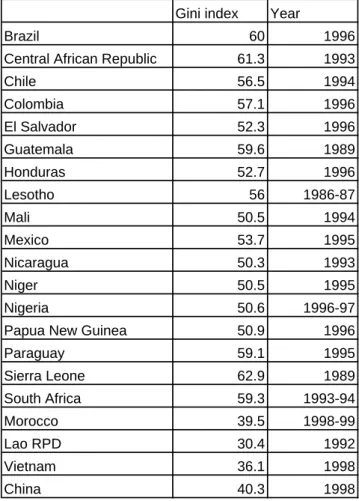
Step 6: We illustrated countries with large income inequalities in South America such as Brazil, Chile, Colombia, Dominica, Guatemala, Honduras, Mexico, Nicaragua, Panama, and Venezuela (Table 7).
Here we will not discuss Steps 3 and 5 since we do not have data related to the steps.
5. An application of the prioritization method to Morocco, Laos, Vietnam, and
China
(1) Morocco
Now we will apply our prioritization method to Morocco. At first we outlined the Moroccan economy by Tables 1-11. The income per capita exceeds 1,000 dollars and the average life is 67 span years old (Table 1). However, Morocco is an unusual country among the countries whose literacy rate did not exceed 50%. So an increase in the literacy rate is the highest priority.
Table 2 lists countries whose cereal yield per hectare is 1000 kg or less. Cereal yield per hectare in Morocco is 471 kg in 2000, which belongs to a group with a low production. It is said that food must be self-sufficiently supplied as much as possible to attain macroeconomic stability as we mentioned above; if much food is imported, then the balance of payments deteriorates, which means macroeconomic instability.
We will compare Morocco’s economy with those of other countries. Its ratio of the external current account deficit to GDP is 3.3%, which is not relatively bad compared with those of other countries (Table 3). Table 4 lists countries whose inflation rate exceeded 30%, while Morocco's inflation rate is less than 10%. Table 5 lists countries whose ratio of fiscal deficit to GDP is 8% or more, while that of Morocco is only 1.4%. International comparison shows that Morocco attained its macroeconomic stability.
Countries whose energy production per capita is between 100 kilowatt-hours and 500 kilowatt-hours were listed in Table 6. Morocco's energy production is almost at the same level as that of Pakistan, which belongs to the group requiring an increase in energy production.
Table 7 illustrates countries with 50 and more of the Gini coefficient, which is one of the indexes that indicate income differentials. Morocco's Gini coefficient is 39.5, which means that its income inequalities are relatively low compared with countries with high Gini coefficients. Morocco belongs to a group of countries whose debt service ratio (ratio of debt payments to exports per year) exceeds 30%, which has a negative effect on the balance of payments. This is the cause of its macroeconomic instability (Table 8). Table 9 lists the countries whose saving rate exceeds 25%. Morocco’s saving rate of less than 25% is lower than the value of our criterion for the saving rate.
We will illustrate the effectiveness of our flowchart by giving the order of priorities to Morocco’s reforms according to the flowchart shown in Figure 1.
Step 1: The flowchart in Figure 1 made clear the problem of its low literacy rate. Its primary education is insufficient for human development to attain the social subsistence level of living. In a country whose literacy rate does not exceed 50%, there is no question in setting the first priority to primary education. Morocco falls into this category.
A country with low agricultural productivity must improve agricultural production to soften a constraint of both a fiscal balance of account and a balance of payments. Morocco’s cereal
production is insufficient in the international standard. Therefore, the second priority is given to improvement of irrigation to increase its agricultural productivity by taking Morocco’s deserts into consideration.
Step 2: Its macroeconomic stability is examined. We concluded that the Moroccan economic reform attained macroeconomic stability in 1997. The consumer price index rose by 1% and the ratio of the external current account to GDP was minus 1.7% in 1997. The ratio of the fiscal balance to GDP was reduced to minus 3.2%. The foreign reserves cover imports for 6.5 months, which was sufficiently higher than 3 months required by the IMF (International Monetary Fund). However, the debt service ratio exceeded the critical value of 30% suggested the IMF.
It is noticed that the IMF also suggests that, to attain macroeconomic stability, a ratio of external debt to GDP had to be less than 50% (1997). For that purpose Morocco needs to reduce its outstanding debt. Two technical methods were available to reduce its debt. One method was the conversion of the external debt into investment and the other was the switchover of the debt from high-interest loans to low interest loans. The negotiations on the debt reduction with France and Spain played important roles in reducing the outstanding debt. The Central Bank and the Ministry of Finance, which were in charge of macroeconomic management, were cautious about increasing its external loans so as not to increase its outstanding debt.
Step 3: Structural adjustment programs had good performance in Morocco. Its institutional reforms of administration, management and legal improvements were behind schedule. For example, there is a transparency problem in administrative reform.
Step 4: The private sector developed infrastructure such as water services and electricity supply in this period.
Step 6: The Moroccan GDP per capita in 1995 was 1110 dollars. The GDP per capita of 1000 dollars was referred to as the turning point for an economy to take off. It is usual that
income inequalities become large when the economy keeps growing at high rates for several years at this stage of economic development. We can find Morocco’s income inequalities between the urban region and the rural region. In particular its female literacy rate in the rural region is extremely low.
Table 10 summarizes the case of Morocco as follows. The first priority of reforms in Morocco was given to social sectors of primary education and health care particularly in the rural areas at Step 1. Primary education of the social sectors is the most serious. Development of electricity supply and water services to the rural regions is required to reduce the children's labor hours to bring water from rivers to their houses so that they can go to school.
(2) Laos
Laos's government gave priority to improvement of infrastructure, state-run enterprises reform, introduction of foreign direct investment, development of small- and medium-sized enterprises, and development of the traditional industry, the tourism industry, the processing industry of primary goods, and the farming industry.
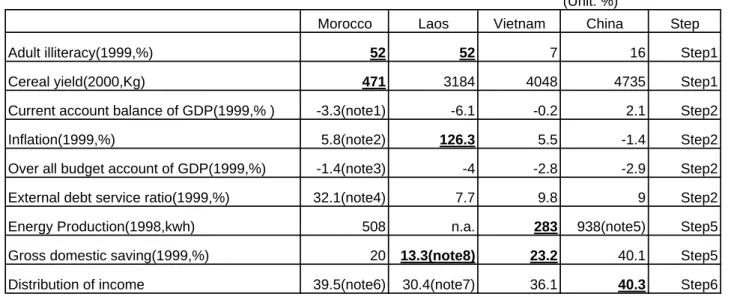
Now we apply the flowchart method to cases of Laos by using Tables 1–9 and a summary of Table 11. It is clear that Laos should give the first priority to primary education since its literacy rate is 48 % (that is, its illiteracy rate is 52 %). Laos’ slash-and-burn farming is preventing the diffusion of education. Its children cannot go to school everyday since they are not staying in one place. So the farming method should be changed in advance of its educational reform. Construction of infrastructure such as roads is necessary for its growth strategy. Laos’ cereal yield per hectare will satisfy the criterion on agricultural production of more than 1000 kilogram per hectare. But its economy should attain macroeconomic stability since its inflation rate is higher than our criterion of 30 %. It is noticed that the ratios of both its external current account and overall budget deficit to GDP are exceed our criteria at more than 8%. Institutional capacity building to improve transparency and reduce corruption is required at Step 4. Research on
problems of its institutional building is required as a first step under the current political system. We can conclude that Laos should not put much emphasis on growth strategy before educational reform, attainment of macroeconomic stability, and institutional capacity building at Steps 1, 2, and 3.
(3) Vietnam
Vietnam can focus its policies on growth strategy different from Laos since it satisfies the criteria of the literacy rate, cereal yield, inflation rate, and external current account. Institutional improvement is required though structural adjustment programs are in progress. Vietnam took growth strategy of fostering three districts by establishing industrial zones in the 1990s (Kuchiki [1995]). The districts are the northern district of Hanoi, Haiphong, and Quang Ninh, the central district of Danang, Hue, and the southern district of Hochimin, Bien Hao, and Vung Tau. Some of the industrial zones changed into export processing zones, and succeeded in attracting foreign investors. But inflows of foreign direct investment into Vietnam stagnated in the middle of the 1990s partly because the government took social policy in addition to the policy of inviting foreign investors. The social policy emphasized more equity than efficiency to mitigate a gap between the rich in the urban areas and the poor in the rural areas. The government directed introducing the Korean way of fostering big business groups (Cheabols) as industrial policy before the Asian currency crisis in 1997 happened, but was forced to change the policy since it became clear that the Korean Cheabols had problems of management. Vietnam can focus on reforming the state-run enterprises and developing the stock markets at Step 5 of growth strategy.
(4) China
China's government gave priority to two major reforms of the state-owned enterprises and banking sector. The Chinese tenth five year plan in 2001 proposed to resolve the development of core industries to lead the national economy, narrow the gap of income inequalities, and solve environment problems. The reforms were the most urgent in China in the 1990s. However, the
budget of each country was limited. So these reforms must be prioritized in order.
China is the best among the four nations analyzed in this section as Table 11 shows. China satisfies every criterion except that the Gini coefficient is nearly 50 % (see Table 11). It is well known that China is unequal in incomes between the coastal area and the inland area. So China can focus on growth strategy together with reducing poverty in the western region. The Chinese policies in the 2000s are consistent with our analysis. Then Table 11 tells us that China is recommended to emphasize policies of [F] institutional reforms, [H] environmental problems, and [G] growth strategy.
Table 12 is the result of the flowchart method to China not nation-wide but province-wide to show that there are such poor provinces in inland China as Xizang and Qinghai. Primary education is the first priority for their provinces. The table also makes clear that some provinces have a surplus in electricity supply while others have a deficit so that reallocation of electricity between the provinces is desirable. We can reconfirm China has no problem of grain production and energy production by the province-wide analysis of the flowchart method.
Now we focus our analysis on policies of [F] institutional reforms, [H] environmental problems, and [G] growth strategy. Indices of marketization in Table 12 represent levels of [F] institutional reforms. Three indices of wastewater, air pollution, and industrial solid waste represent levels of [H] environmental problems. The number of schools and graduates as indices of higher education in Table 12 represent levels of [G] growth strategy. Both the index of marketization and the index of market-intermediate organizations and laws in Table 12 represent levels of marketization of a country. Our criterion for provinces to be marketized is that each index is less than the average of each index. Three provinces of Guizhou, Gansu and Yunnan need to be marketized according to this criterion.
Table 12 illustrates provinces of which each index on environment is more than the average of each index of the three environmental indices mentioned above. The provinces of Gansu,
Ningxia and Liaoning are to be given priority for improving their environment. We picked out provinces that should emphasize higher education. One index of higher education is the number of schools and another is number of graduates in Table 12. The criterion for provinces to emphasize higher education is that we choose 11 provinces excluding both ten provinces from the top and ten provinces from the bottom from each index of the two indices. We chose provinces by applying the criterion of the two indices. Fujian, Shaanxi, Jiangxi, Heilongjiang, Shanghai, Jilin, Guangxi and Zhejiang need to emphasize higher education as growth strategy. It is noted that our criterion is not objective but arbitrary to be examined by further studies.
6. Summary and Conclusions
This paper builds a prototype model of how to prioritize policies by using a flowchart. We presented the following six steps for deciding the priorities of policies: Step 1 is to attain the social subsistence level (primary education, health care, and food sufficiency); Step 2 is to attain macroeconomic stability; Step 3 is to liberalize the economy (trade, investment, and finance) by structural adjustment programs; Step 4 is capacity building specific to growth strategies by facilitating sufficient infrastructure (physical infrastructure and institutions); Step 5 is a growth strategy; and Step 6 is to narrow income inequalities.
We applied the flowchart method to Morocco’s reforms and tried to illustrate the effectiveness of the flowchart in prioritizing reforms. The priorities of Morocco’s policies are given to primary education at the first, the expansion of irrigation facility at the second, and its increase in energy production at the third. Its increase in electricity supply, water services and saving are also needed to enhance economic growth.
We illustrated the effectiveness of our flowchart method on case studies of Lao, Vietnam, and China. Lao should not put much emphasis on growth strategy before educational reform,
attainment of macroeconomic stability, and institutional capacity building of Steps 1, 2, and 3. Vietnam can focus on problems of reforming the state-run enterprises and developing the stock markets at Step 5 of growth strategy. We found that we should apply our flowchart method to China not nation-wide but province-wide.
<References>
Burnside, C. and D. Dollar, “Aid, Growth, and Poverty Reduction,” Chapter 8 in L. G. Christopher and D. Vines eds., the World Bank: Structure and Policies, Cambridge University Press, Cambridge, 2001.
CDF of Secretariat of World Bank, Meeting the Promise?, Secretariat of World Bank, September 17, 2001.
Collier, P., ‘Conditionality, Dependence and Coordination’, Chapter12 in L. G. Christopher and D. Vines (eds.), the World Bank: Structure and Policies, Cambridge University Press, Cambridge, 2001.
Deininger, K., and L. Squire, “New Ways of Looking at Old Issues: Inequality and Growth,” World Bank, Policy Research Department, Washington, DC, 1996.
ESCAP, Integrating Environmental Considerations into Economic Policy Making Processes, ESCAP, 1999.
Furman, J. and J. Stiglitz, ‘Economic Crises: Evidence and Insights from East Asia’, Brookings
Papers on Economic Activity (Macroeconomics), 2, Brookings Institution, Washington, DC, 1998.
Ito, T., “Growth, Crisis, and the Future of Economic Recovery in East Asia,” Chapter 2 in J.E. Stiglitz and S. Yusuf (eds.), Rethinking the East Asian Miracle, the World Bank and Oxford University Press, 2001.
Kuchiki, A., “Market Mechanism and the Role of Government in the Process of Economic Development, Economic Planning Agency, The Economic Analysis, No. 137, 1994, pp. 11-16. Kuchiki, A., “Promotion of Industrialization and the Golden Triangle’s Development,” Dynamic
Vietnam, Institute of Developing Economies, Tokyo, 1995.
Kuznets, S., “Economic Growth and Income Inequality,” American Economic Review, Vol. 45, 1955, pp. 1-28.
Lewis, W. Arthur, The Theory of Economic Growth, Allen and Unwin, London, 1955.
MacIntyre, A., “Rethinking the Politics of Agricultural Policy Making,” A. Siamwalla ed., The
Evolving Roles of State, Private, and Local Actors in Asian Rural Development, Oxford
University Press, Hong Kong, 2001, pp.243-270.
Myint, H., The Economics of Developing Countries, Praeger, New York, 1965.
Stiglitz, J., ‘Must Financial Crises be This Frequent and This Painful?’, chapter 12 in P. R. Agenor, M. Miller, D. Vines and A. Weber (eds.), The Asian Financial Crisis, Cambridge University Press, Cambridge, 1999.
Takeshi Nakano, "Aid Requestism and National Approach", International Development Research
Course Workshop, Nagoya University International Cooperation by Japan during the
Transposition Period, March 2, 1998.
UNDP, Human Development Report 2002, UNDP, 2002.
Wolfensohn, J., A Proposal for a Comprehensive Development Framework, http://www.worldbank.org, World Bank January, 1999.
World Bank, The Asian Miracle, World Bank, Washington, DC, 1993. World Bank, Assessing Aid, Oxford University Press, Oxford, 1998.
World Bank, World Development Report 1991, Oxford University Press for the World Bank. World Bank, World Development Report 2000, Oxford University Press, New York, 2000.
Trial, “L. Emmerij, ed., Economic and Social Development into the 21st Century, The Johns
Hopkins University Press, Washington D.C., 1997.
Appendix 1: Priorities of Policies of Donors and Recipient Countries
Each donor has its own order of priorities to a recipient country’s policies according to the donor’s preference. Each developing country cannot implement several reforms without prioritizing them at the same time within its limited budget. Here we will illustrate a Japanese case of a country approach to understand why prioritization of economic reforms is avoidable. The purpose of a “country approach” is to achieve the maximum effect of the aid for the growth of a particular recipient country. However, there may be other purposes for the Japanese aid. One purpose may be to secure natural resources of developing countries such as oil for the Japanese economy. It is expected that the Japanese aid should contribute to Japanese industries’ profit. The other purpose may be to obtain support of developing countries for Japan in the United Nations. Each purpose can result in a different allocation of the Japanese aid. Therefore, a criterion for prioritizing reforms can decide aid allocation for reforms of recipient countries.
If a developing country receiving ODA introduces a country approach, priorities vary greatly according to criteria determined by the purposes of the reforms. When we prioritize reforms, targeted sectors to reduce poverty and maximize growth are more diversified than before. It is usual that a developing country definitely emphasizes development to maximize its growth. However, since the 1990s, social sector has become more important than before. The social sector includes sectors of education and health care. The World Bank may collectively refer to this as investment in humanity. As an economy is industrialized and grows, environmental issues will become more and more serious. For instance, in India, air pollution was reported as a health hazard. The same problem was indicated in China, too. In addition, high priority is given to consideration to the disadvantaged, of which gender is a good example. There are so many
variations of prioritizing reforms. So we need an objective way of prioritizing policies.
Appendix 2: Shock Therapy, Sequencing, and Prioritization
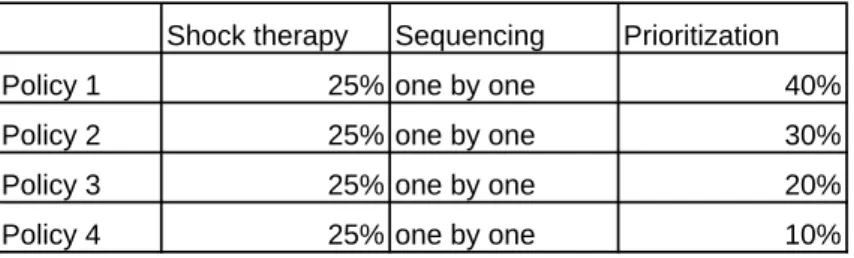
Governments may allocate budgets based on priorities decided by our flowchart method. We cannot build a general theory of how to decide the share of the budget for each policy, and will explain the differences between shock therapy, sequencing, and prioritization as a model case. Here we distinguish prioritization from sequencing and shock therapy by using Table 13. That is, the prioritization means that policies are implemented as a package by giving weight to each policy while the sequencing means that policies are implemented one by one based on their degrees of importance. Shock therapy gives the same weight to all policies. Priorities of policies are different from country to country and region to region. It is crucial for success in implementing policies to find how to prioritize policies instead of shock therapy and sequencing.
In the former half of the 1990s, economists discussed whether developing countries, particularly in transition from the planned economies to the market economies, should either implement a package of policies as shock therapy, or sequence economic reforms. On the one hand, China and Vietnam took the latter strategy of sequencing their economic policies, and succeeded in their economic reforms. On the other hand, Eastern European countries such as Poland and Hungry in the former half of the 1990s were confronted with macroeconomic instability so that both inflation and unemployment were high due to the shock therapy. But Eastern European countries also attained their macroeconomic stability in around 1995. Consequently, shock therapy was also justified as an acceptable approach of reforms.
When the Asian Currency Crisis occurred in 1997, some economists such as Furman and Stiglitz [1998] again questioned which approach is better, shock therapy or sequencing. Most Asian countries, such as Thailand and Malaysia excluding China and Vietnam, went into financial turmoil and economic recession in 1997 and 1998. Former Prime Minister Mahatir of Malaysia
insisted that short-term capital should be restricted to move freely to avoid currency crises. China, which restricted movements of short-term capital, attained its target of the rate of economic growth of 8% in 1998, contributing to the economic recovery of the other Asian countries from the Asian Currency Crisis.
Figure 1 Flowchart of Prioritization Method
Transition Priority Policy
(Social subsistence level)
Return to the top = Feedback
Institutions and infrastructure( power supply per
capita is 500kwh or more) Literacy rate is 50% or more. Structural adjustment programs Irrigation, etc. Cereal yield per hectar is
1000kg or more.
Growth strategies
Primary education
Water supply, power supply, road, airport, and port Industrial
policies, foreign investment
Construction of school, free supply of textbooks
Education and health care (social sector)
Emphasis on agricultural production
Liberalization:
abolition of controlled prices, liberalization of exchange rates
Institutions: administration (transparency), management, law improvement Poverty reduction: correction of income inequalities Gini coefficient is 50% or less. Yes Yes Yes Yes Yes Yes No No No No No No Inflation rate is 30% or less
GDP ratio of the external current account is minus 8% or more. Macroeconomic stabilization Reduction of fiscal deficit No Yes Yes No
Figure 2. Economic agents for “growth strategies” of Morocco
Note: FDI: foreign direct investment.
Source: Prepared by the author (Figures 1 and 2) Development of private sector Introduction of FDI Natural resource- based industries Emphasis on small and medium-sized enterprises state-owned enterprises The tourism industry Implementation of preferential treatments for FDI Information Technology industry (Agriculture, mining, and fishery) Leading role in a transitional period (Experience of ASEAN)
Emphasis on quality & technical innovations
Sale of highly profitable
enterprises Free trade zone
with infrastructure Creation of master plan Increase in the value-added of products Upgrading, financing Privatization Short of labor
supply Development of the Slow progress component & parts
industry and machine industry Utilization of tourism resources Low prospect Leading role of economic growth
Table 1. Life expectancy and adult illiteracy
GDP per capita Life expectancy Adult illiteracy(%) 1999 1999 1995 1999 Afghanistan n.a. 46 67 64 Bangladesh PR 361 60 61 59 Benin R 402 53 66 61 Burundi R 142 42 57 53 Central Africa R 346 44 60 54 Kingdom of Cambodia 285 53 65 61 Chad R 220 48 59 59 Cote d'lvoire R 787 46 67 54 Ethiopia FDR 112 42 69 62 Gambia R 365 53 66 64 Guinea-Bissau R 183 43 55 62 Haiti R 370 53 57 51 Mali R 281 42 66 60 Lao PRD 441 54 60 52 Mauritania 483 53 60 58 Kigdom of Morocco 1359 67 56 52 Mozambique R 190 43 61 56 Kingdom of Nepal 222 58 64 59 Niger R 209 45 86 84 Vietnam SR 341 68 8 7 China PR 840(2000) 70(2000) 19 16
Note: Data of countries with more than 50% of adult illiteracy. Tables 1-9 include data of Morocco, Lao, Vietnam, and China. Source: World Bank, SIMA Query, 2001.
Table 2. Cereal yield (Kg per hectar) 1995 2000 Algeria PRD 397 619 Botswana R 206 203 Burkina Faso 782 887 Cape Verde R 262 312 Central Africa R 868 1111 Chad R 586 626 Congo DR 826 774 Congor R 826 686 State of Eritrea 516 703 Grenada 983 1000 Haiti 921 913 Iraq R 800 284 Jordan 997 891 Kazakhstan R 578 1060 Kingdom of Lesotho 774 988 Libya 677 727 Mali 806 1170 Mauritania 771 1010 Mongolia 737 956 Kingdom of Morocco 446 471 Mozambique R 652 948 Namibia R 194 473 Niger R 291 368 Senegal R 873 745 Somalia DR 471 488 Sudan R 424 529 Tajikistan R 961 1290 Togo R 790 953 Vanuatu R 538 538 Lao RPD 2492 3184 Vietnam SR 3569 4048 China PR 4663 4735
Note: Countries with less than 1000 Kg. Source: The same as Table 1.
Table 3. Current account balance( % of GDP) 1993-95 1999 Congo -30.9 Armenia -16.6 Guinea-Biassau -21.4 Azerbaijan -24.5 Honduras -8 Bahamas -14.8 Hungary -8.9 Belize -8.9 Jordan -16 Bhutan -19.7
Lao PDR -13.7 Burkina Faso -12.1
Lebanon -44.7 Cape Verde -17.3
Madagascar -8.5 Chad -10.2 Malawi -19.5 Dominica -9.4 Mali -8.6 Eritrea -43.4 Mauritania -9.3 Gambia -11.7 Nicaragua -37.4 Ghana -9.8 Omen -9.2 Kyrgyz -14.8 Praguay -14.9 Latvia -9.7
Saudi Arabia -9.9 Lebanon -34.1
Tanzania -19.4 Lesotho -23 Togo -9 Maldives -17.8 Uganda -9.1 Nicaragua -26.5 Vietnam -8.6 Niger -8.6 China -0.4 Panama -14.3 Morocco -3.3 Poland -8 Portugal -8.5 Seychelles -16.8 St. Kitts -36.4 St.Lucia -10.8 St. Vincent -16.2 Togo -9 Turkmenistan -17.2 Uganda -11.6 Lao RPD -6.1 China 2.1 Vietnam -0.2
Note: more than -8%.
Table 4. Inflation (Consumer prices:%) 1990-95 1999 Albania 64.2 Angola 559.7 Azerbaijan 1005.5 Belarus 322 Belarus 1247.2 Ecuador 61.9 Brazil 1044.8 Equatorial 38.3 Croatia 328 Kyrgyz 37.5 Ecuador 40 Lao PRD 126.3 Estonia 52.8 Malawi 42.1 Guinea-Bissau 45.1 Russia 64.6 Jamaica 39.9 Suriname 180.1 Latvia 83.1 Turkey 56.2 Lebanon 36.8 Uzbekistan 43.9 Lithuania 124.1 Zimbabwe 48.1
Macedonia, FYR 397.9 Morocco 0.9
Mozambique 47.8 China -1.4
Nicaragua 85.2 Vietnam 5.5
Nigeria 49.1
Peru 69 Note: more than 30%. Poland 41.5 Source: the same as Table 1.
Romania 151.5 Russian Federation 381.6 Sirra Leone 41.9 Slovenia 62.1 Sudan 114.3 Turkey 79.3 Ukraine 1180.4 Uruguay 59.3 Venezuela 43.8 Zaire 3558.3 Zambia 112.5 China 11.4 Morocco 5.8
Table 5. Overall budget deficit (including grants) (% of GDP) 1994 1999 Ethiopia -8.5 Columbia -7 Finland -13.5 Guinea -7.1 Greece -15.7 Lithuania -7 Italy -10.5 Maldives -9.3 Oman -11.2 Mongolia -10.4
Russian Federation -10.5 Sri Lanka -7.4
Sri Lanka -8.5 St. Vincent -7.3
Sweden -12.8 Thailand -11.1
Yemen, Rep -17.3 Turkey -13
China -1.8 Morocco -1.4
Morocco -1.4 China -2.9
Note: less than -8.0%. Lao RPD -4 Vietnam -2.8 Note: less than -7.0%. Source: the same as Table 1.
Data of Lao RPD and Vietnam are from "Asian Development Outlook 2001" by Asian Development Bank.
Table 6-1. Energy Production 1994 Table 6-2. Energy Production 1998 (kwh per capita) 1994 1998 Bolivia 390 Bangladesh 102 Cameroon 212 Bolivia 466 Congo 172 Cameroon 229
Cote d'Ivoire 170 Congo, Dem. Rep. 117
Ghana 368 Congo, Rep. 123
Guatemala 306 Ghana 394 Honduras 464 Guatemala 412 India 423 India 504 Indonesia 281 Indonesia 382 Kenya 136 Kenya 166 Morocco 426 Morocco 508 Nicaragua 398 Mozambique 404 Nigeria 144 Myanmar 102 Pakistan 463 Nicaragua 472 Philippines 404 Nigeria 130 Senegal 121 Senegal 142
Sri Lanka 246 Sri Lanka 302
Vietnam 170 Vietnam 283
Yemen, Rep. 146 Yemen 151
China 778 Lao RPD n.a.
China 938
Note: between 100 kwh and 500 kwh. Source: the same as Table 1.
Table 7. Distribution of income or consumption
(Various years)
Gini index Year
Brazil 60 1996
Central African Republic 61.3 1993
Chile 56.5 1994 Colombia 57.1 1996 El Salvador 52.3 1996 Guatemala 59.6 1989 Honduras 52.7 1996 Lesotho 56 1986-87 Mali 50.5 1994 Mexico 53.7 1995 Nicaragua 50.3 1993 Niger 50.5 1995 Nigeria 50.6 1996-97
Papua New Guinea 50.9 1996
Paraguay 59.1 1995 Sierra Leone 62.9 1989 South Africa 59.3 1993-94 Morocco 39.5 1998-99 Lao RPD 30.4 1992 Vietnam 36.1 1998 China 40.3 1998
Note: more than 50.
Table 8-1. External debt (% of GNI) and debt service (% of exports)
External debt 1995 Debt service 1995
Mozambique 443.6 35.3 Sirrra Leone 159.7 60.3 Guinea-Bissau 353.7 66.9 Haiti 39.8 45.2 Nicaragua 589.7 38.7 Zambia 191.3 174.4 Pakistan 49.5 35.3 Honduras 124.6 31 Indonesia 56.9 30.9 Morocco 71 32.1 Algeria 83.1 38.7 Brazil 121.6 37.9 Hungary 72.8 39.1 Argentina 33.1 34.7 China 17.1(1996) 9.8
Note: more than 30 % of debt service.
Table 8-2. External debt (% of GNI) and debt service (% of exports)
External debt 1999 Debt service 1999
Algeria 198 37.8 Argentina 436 75.9 Bolivia 399 32 Burundi 1791 45.6 Chile 184 25.4 Columbia 223 42.8 Cote d'Ivoire 238 26.2 Hungary 102 26.6 Indonesia 255 30.3 Lebanon 413 49.4 Macedonia 93 29.8 Mauritania 681 28.4 Mexico 105 25.1 Pakistan 342 28.2 Peru 358 32.6 Morocco n.a. 24.3 Lao RPD 527 7.7 Vietnam 162 9.8 China 16 9
Table 9. Gross domestic savings (% of GDP) 1993-95 1999 Algeria 27.9 Algeria 31.8 Angola 35.2 Belgium 25.1 Austria 25.7 China 40.1
Chile 28 Congo, Rep. 29.7
China 41.5 Czech 26.7
Gabon 43.7 Equatorial 57.8
Hong Kong 33.6 Finland 27.7
Indonesia 35.6 Gabon 34.8
Iran 30.3 Hong Kong 30.5
Ireland 27.6 Hungary 26.3
Japan 31.1 Ireland 37
Korea, Rep. 35.6 Japan 27.7
Malaysia 36.7 Korea, Rep. 33.6
Morocco 14.9 Macao 45.1
Netherland 26.2 Malaysia 46.8
Oman 26.4 Netherland 26.7
Papua New Guinea 33.8 Norway 30.3
Russian Federation 29.9 Russia 31.5
Saudi Arabia 28.5 Singapore 51.7
Slovak Republic 26.9 Slovak 26.5
Switerland 27.4 Taiwan 26.1
Thailand 36.2 Thailand 32.5
United Arab Emirates 32.6 Trinidad 26.6 Turkmenistan 26
Morocco 20
Lao RPD 13.3 (1998) Vietnam 23.2
Note: more than 25%. Source: the same as Table 1.
Table 10. Economic problems in Morocco
1. Education:
Is education sufficient to narrow income inequalities? Primary education, female education in
particular
Should supply of power and water be improved prior to improvement of primary education? It is
necessary that children can attend school.
Is higher education sufficient? Users’ charge system for higher education is recommended.
Are there income differences between urban regions and rural regions? People in rural regions are
poorer than people in urban regions.
Is infrastructure constructed by not the public sector but the private sector? Yes. For example, build-operate-transfer (BOT).
2. Agriculture:
Problems of economic fluctuations : Self-sufficiency in food is crucial to the problem. Irrigation is
needed:
(Economic structure problem) Emphasize small-scale irrigation rather than large-scale irrigation. - Liberalization of agriculture
(Price liberalization, abolition of subsidy, expense burden)
Is users’ charge system acceptable? Dam construction must be treated differently. Are only liberalization polices sufficient? No. Agricultural education is recommended.
3. Liberalization:
Is Morocco behind schedule on privatization? Yes.
Almost all the profitable state-owned enterprises have been privatized. Is bank reform progressing?
Bank reform is progressing smoothly.
Is there any incentive for raising the saving rate? The real interest rate is positive Is bank reform related to it? Yes. There is competition among banks.
Is skilled labor available to foreign investors?
University graduate, postgraduate, and traditional craftsmen. Are there any incentives? Preferential measures such as tax exemption.
To which market the products are exported, EU, Middle East, MAGREV, and African markets?
4. Environmental problem:
What is the most serious problem? Shortage in rubbish and sewage is.
Table 11. Data on Morocco, Laos, China, and Vietnam
(Unit: %)
Morocco Laos Vietnam China Step
Adult illiteracy(1999,%) 52 52 7 16 Step1
Cereal yield(2000,Kg) 471 3184 4048 4735 Step1 Current account balance of GDP(1999,% ) -3.3(note1) -6.1 -0.2 2.1 Step2 Inflation(1999,%) 5.8(note2) 126.3 5.5 -1.4 Step2 Over all budget account of GDP(1999,%) -1.4(note3) -4 -2.8 -2.9 Step2 External debt service ratio(1999,%) 32.1(note4) 7.7 9.8 9 Step2 Energy Production(1998,kwh) 508 n.a. 283 938(note5) Step5 Gross domestic saving(1999,%) 20 13.3(note8) 23.2 40.1 Step5 Distribution of income 39.5(note6) 30.4(note7) 36.1 40.3 Step6
Notes:(1)1993-95,(2)1990-95,(3)1994,(4)1995,(5)1998,(6)1998-99,(7)1992,(8)1998. Source: Tables 1-9.
Table 12. Data on Provinces Condition of Higher Education (Year 2000) Amount of Waste Water Discharge By Region Amount of Waste Water Discharge By Region /GDP Amout of Polluted Air Discharge By Region Amout of Polluted Air Discharge By Region/GDP Amount of Industrial Solid Waste By Region Amount of Industrial Solid Waste By Region /GDP Market Index: Total Index (1999) Market Index: Market Broker And Law Preparation Index Adult Illiteracy Rate Amount of Grain Production per Unit Area Energy Production Number of School Number of Graduate Unit (10 thousand ton) Unit (100 million cubic Unit (10 thousand ton) (%) (kg/Hectare) (100 million kwh) Xizang 4 764 1006 7.3 15 0.11 17.1 0.1 − − 47.25 5,044 Qinghai 7 2202 4661 15.5 607 2.02 336.7 1.12 2.00 2.37 25.44 3,361 111.90 Guizhou 23 13739 20598 19.0 3882 3.58 2271.8 2.09 3.86 1.59 19.85 4,236 335.19 Gansu 18 14255 23795 22.2 2800 2.61 1703.8 1.59 4.02 2.3 19.68 2,905 306.09 Ningxia 6 3154 10942 36.7 1445 4.84 478.7 1.60 2.69 3.24 15.72 4,044 151.81 Yunnan 24 18573 35117 16.9 2749 1.33 3187.4 1.54 3.39 2.16 15.44 3,923 320.75 Anhui 42 29830 63106 19.2 3945 1.20 2815.1 0.86 5.4 1.69 13.43 4,829 359.59 Neimenggu 18 12218 21844 14.1 4768 3.08 2375.6 1.54 6.45 2.74 11.59 3,854 280.89 Shandong 47 58355 110324 11.7 12179 1.29 5407.3 0.57 6.22 2.84 10.75 5,268 1,104.53 Sichuan 42 42672 116979 26.5 4779 1.08 4714.2 1.07 5.29 2.49 9.87 4,759 589.57 Shaanxi 39 36587 30903 16.8 2379 1.29 2625.0 1.42 4.48 3.4 9.82 3,095 321.54 Hainan 5 4021 7064 12.9 434 0.79 94.9 0.17 5.65 2.28 9.72 4,169 42.96 Fujian 28 24307 57617 13.5 2828 0.66 2190.5 0.51 7.28 2.7 9.68 5,089 439.19 Hubei 54 56566 106733 22.9 5674 1.22 2817.8 0.60 5.53 2.65 9.31 5,885 526.02 Chongqing 22 22187 84344 48.2 1908 1.09 1304.8 0.75 5.57 2.86 8.90 4,448 220.54 Hebei 51 43473 89600 15.5 9858 1.71 7027.9 1.22 6.7 1.96 8.59 4,025 867.55 Zhejiang 35 32477 136433 20.2 6509 0.96 1385.7 0.21 8.24 3.27 8.55 6,082 848.40 Henan 52 45709 109210 19.4 7436 1.32 3625.0 0.64 6.0 1.96 7.91 4,907 808.41 Jiangsu 69 75643 201923 21.2 9078 0.95 3038.2 0.32 7.04 2.78 7.88 6,302 1,078.44 Xinjiang 16 13774 15365 10.3 1944 1.31 718.2 0.48 2.9 3.74 7.72 5,771 197.92 Jiangxi 32 25903 41956 19.3 2220 1.02 4796.2 2.20 5.12 1.89 6.98 5,233 222.28 Tianjin 21 20112 17604 9.6 1749 0.95 469.8 0.26 6.58 5.33 6.47 4,820 247.94 Heilongjiang 35 35180 52644 14.8 4326 1.21 2693.7 0.76 3.97 3.53 6.33 4,512 456.86 Sanghai 37 40929 72446 14.6 5755 1.16 1354.7 0.27 6.59 6.25 6.21 7,320 592.98 Hunan 52 47426 112563 28.3 3569 0.90 2354.6 0.59 5.99 2.3 5.99 6,015 439.78 Liaoning 64 53353 109044 21.7 9432 1.87 7562.5 1.50 5.6 4.06 5.79 4,891 764.77 Jilin 34 30480 37386 18.4 3082 1.52 1604.4 0.79 4.51 3.22 5.74 5,125 295.08 Shanxi 24 20657 32406 18.2 6635 3.73 7694.5 4.32 4.57 3.72 5.68 2,806 557.58 Guangxi 30 21858 81571 36.6 4607 2.06 2108.1 0.94 5.28 2.32 5.30 4,656 331.92 Guangdong 52 51432 114055 10.7 8326 0.78 1694.3 0.16 8.33 4.93 5.17 5,360 1,458.42
Table 13. Differences between Shock Therapy, Sequencing, and Prioritization
Shock therapy Sequencing Prioritization Policy 1 25% one by one 40% Policy 2 25% one by one 30% Policy 3 25% one by one 20% Policy 4 25% one by one 10%
Appendix Table 1-1. Correlation Between Weight of Budget Allocation and Growth Rates Economic Growth Rate Distribution Method 1 Distribution Method 2 Distribution Method 3 Country A 9 Energy 1 5 1
Country B 5 Economy Energy 4 8 6
Country C 2 Agriculture Economy Energy 9 9 9
Adujusted R2 0.899 0.922 0.993
Coefficient of
T-ratio 8.35 6.96 29.6
Appendix Table. 1-2. Points by Differences of Distribution Method Under Problems Distribution
Method Economy Agriculture Energy Distribution Method 1 3 5 1 Distribution Method 2 3 1 5 Distribution Method 3 5 3 1
Conclusion: Distribution method 3 is the best correlated with the economic growth. In this case, the order of priority is energy, agriculture and macroeconomics. Note: Economy, Agriculture, and Energy denote macroeconomic instability, low agricultural productivity, and energy shortage, respectively.
Appendix Table 2. Resuts of prioritization of policies
① ② ③ ④ ⑤ ⑥ ⑦ ⑧ ⑨ ⑩ ⑪ ⑫ ⑬ ⑭ ⑮ ⑯
Edu. Edu. Edu. Edu. Edu. Edu. Edu. yEconom Distri. Distri. Edu. Energy Energy Energy Agri. Agri. Agri. Agri. Agri. Agri. Agri. Agri. Energy Edu. Edu. Energy Economy Edu. Edu. Edu. Edu. Edu. Economy Economy Energy Energy Distri. Distri. Distri. Agri. Agri. Edu. Agri. Distri. Agri. Agri. Energy Energy Energy Distri. Distri. Economy Energy Economy Agri. Energy Economy Agri. Energy Agri. Economy Distri. Distri. Economy Distri. Energy Economy Distri. Economy Energy Economy Distri. Energy Economy Distri. Economy Distri. Economy Economy Distri. [Ⅰ] Energy 0.237 0.199 0.344 0.303 0.245 0.326 0.390 0.089 0.112 0.254 0.184 0.368 0.312 0.346 0.307 0.269 Under 300(kwh) 3.063 2.779 3.900 3.575 3.126 3.750 4.277 1.910 2.100 3.193 2.663 4.095 3.643 3.912 3.603 3.310 [Ⅱ] Energy 0.346 0.291 0.529 0.456 0.496 0.364 0.557 0.125 0.004 0.459 0.193 0.531 0.462 0.521 0.505 0.431 Under 100 to 300kwh 3.776 3.359 5.395 4.693 5.062 3.914 5.704 2.144 1.059 4.720 2.645 5.416 4.748 5.311 5.153 4.469 [Ⅲ] Energy 0.096 0.050 0.204 0.165 0.159 0.071 0.244 0.018 0.007 0.161 0.053 0.253 0.189 0.236 0.181 0.145 Under 500kwh 2.076 1.629 2.996 2.675 2.620 1.838 3.325 1.264 1.105 2.638 1.661 3.394 2.874 3.256 2.809 2.504 [Ⅳ] Energy 0.153 0.092 0.317 0.251 0.257 0.126 0.346 0.015 0.006 0.228 0.087 0.348 0.263 0.335 0.300 0.233 Under 100 to 500kwh 2.501 1.989 3.804 3.279 3.328 2.278 4.047 1.206 1.092 3.097 1.944 4.066 3.375 3.953 3.666 3.135
Note: Agri., Edu., Distri., Economy denote agricultural reform, educational reform, improving income inequalities, and macroeconomic stabilization, respectively.