Fate, fear or fight : aspirations and
educational poverty traps across generations
著者
Jing You
権利
Copyrights 日本貿易振興機構(ジェトロ)アジア
経済研究所 / Institute of Developing
Economies, Japan External Trade Organization
(IDE-JETRO) http://www.ide.go.jp
journal or
publication title
VRF Series
volume
500
year
2017-09
URL
http://hdl.handle.net/2344/00049467
Fate, Fear or Fight:
Aspirations and Educational Poverty Traps across Generations
Jing You
日本貿易振興機構 アジア経済研究所
INSTITUTE OF DEVELOPING ECONOMIES, JAPAN EXTERNAL TRADE ORGANIZATION
部分を引用して読者の注意を引いたり このスペースを使って注目ポイントを強調したりしましょう この
No. 500
Sep. 2017Visiting Research Fellow Monograph Series
This series aim at disseminating the results of research done by Visiting Research Fellows at the Institute of Developing Economies.
However, no part of this paper may be quoted without the permission of the author, since some of the results may be preliminary.
Further, the findings, interpretations and conclusions expressed in this paper are entirely those of the author(s). Paper does not imply endorsement by the Institute of Developing Economies of any of the facts, figures, and views expressed. The Institute of Developing Economies does not guarantee the accuracy of the date included in this paper and accepts no responsibility whatsoever for any consequence of their use.
Acknowledgements
This research is supported by the Visiting Research Fellow (VRF) program at the Institute of Development Economies (IDE) and is conducted over the period 20 December 2016 and 19 March 2017 at the IDE. The last three months have been a period of intense work and excellent research experience. To only some of whom it is possible to give particular mention here.
Above all, I would like to express my deepest appreciation and thanks to Dr Nanae Yamada for hosting my visit, giving invaluable help and coordinating everything between Dr Satoru Shimokawa and me.
In addition to this research project, I have benefited from extensive and interesting discussion with Dr Kenmei Tsubota, Dr Tomohiro Machikita, Dr Momoe Makino and Dr Yuya Kudo. I very much appreciate the opportunity of giving an Ajiken Power Lunch (APL) Seminar at the IDE, introduced and chaired by Dr Tomohiro Machikita, and of giving a monthly seminar presentation at the National Graduate Institute for Policy Studies (GRIPS) introduced by Dr Yuya Kudo. Special thanks go to Dr Momoe Makino who recommended me theoretical papers after the APL seminar, completely solving the problem of lack of theoretical foundations in my paper. All these helps are beyond what I can express here.
I am deeply grateful to Mr. Takeo Masuda, Ms. Atsuko Hirakata and Ms. Kumi Manda at the International Exchange and Training Department. It would not have been possible to complete this paper without their support and patience at all times.
Table of Contents
Acknowledgements ... i
List of Figures and Tables ... iii
Abbreviations ... iv Abstract ... v 1. Introduction ... 1 2. Literature review ... 5 3. Model ... 6 4. Data ... 9 4.1. Data source ... 9
4.2. Descriptive statistics of sample individuals ... 10
4.3. Descriptive statistics of excluded instruments ... 12
4.4. Measurement and descriptive statistics of individual aspirations ... 14
5. Estimation results ... 17
6. Conclusion ... 22
References ... 22
About the Author ... 26
List of Figures and Tables
Figures:
Figure 1: Chinese poverty profile (1989-2009)……….…1
Figure 2: Mechanisms of behavioural poverty traps………..7
Figure 3: Age distribution………10
Figure 4: Death rates in the Great Famine (1959)……….………...13
Figure 5: Grain yield per capita in the Great Famine (1959)………...14
Figure 6: Intergenerational associations of aspirations………....15
Figure 7: Relationship between intergenerational educational mobility and parental aspirations….………16
Tables: Table 1: Chinese official poverty profile (2010-2015)………..…...1
Table 2: Intergenerational educational attainments………..…10
Table 3: Cross-comparison of poverty rates among four Chinese household surveys……….……...11
Table 4: Intergenerational poverty status………..……....11
Table 5: Experiences in political events………..……….…12
Table 6: Distribution of the family’s “class rank” in the Cultural Revolution…..…...12
Table 7: Estimation results of educational aspirations………..…...17
Abbreviations
NBS National Bureau of Statistics of China CFPS China Family Panel Studies
CHNS China Health and Nutrition Survey CHIP China Household Income Project RCT Randomised control trials
CPAD State Council Leading Group Office of Poverty Alleviation and Development
Abstract
This paper tests empirically the behavioural educational poverty traps persisting across generations through aspirations failure. Chinese natural experiments since the 1950s help identify aspirations for different generations, including parental sufferings during the Great Famine, their social class and experiences in the “(Up to the Mountains and) Down to the Countryside” movement during the Cultural Revolution, and filial in utero exposure to the Great Famine and compliance to the One-Child Policy. Exploiting nationally representative household data, we find that aspirations and educational attainments are transmitted across generations. Historically political campaigns decrease parental educational aspirations, and in utero exposure to severe undernutrition enhances fatalism. Aspirations failure in terms of less perceived importance of education in future life and fatalism that are transmitted from parents tends to decrease filial educational attainments, underlying intergenerational educational poverty traps.
1. Introduction
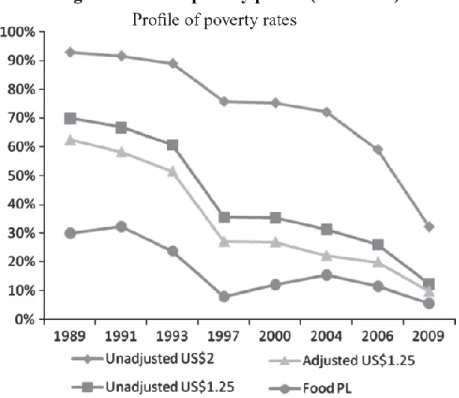
China has achieved huge success in eliminating extreme poverty over the past four decades. As shown in Figure 1, poverty rates have declined at any poverty line. If applying the current official poverty line – 2,300 yuan a year – to 1978, there were 770.39 million living under income poverty. There has been reduction of 714.64 million in population of income poverty between 1978 and 2015.
Figure 1 Chinese poverty profile (1989-2009)
Note: Poverty is defined as less household per capita net income per annum than various poverty lines. Food poverty is defined as less per capita daily nutrient intake (in calories) than 2,100 kcal.
Source: Author’s calculation based on the China Health and Nutrition Surveys (CHNS, 1989-2009).
Despite of huge reduction in the aggregated number of poor population, poverty has been concentrated and persistent for some households. According to the Chinse official poverty statistics in Table 1, about one tenth of total population lived below the national income poverty line in 2011 when the 12th “Five-year Plan” began, and they lived in 14 ultra-poor clusters designated by the State Council. Poverty alleviation programmes have been mainly provided at the county level and only until 2014/15 have poor villages been targeted. These programmes are basically for infrastructure construction rather than household-level interventions.
Table 1 Chinese official poverty profile (2010-2015)
Year Population in income poverty Poverty incidence
2010 165.66 million 17.3%
2011 122.38 million 12.7%
2013 82.49 million 8.5%
2014 70.17 million 7.2%
2015 55.75 million 5.7%
Source: Years except 2011 and 2015: Annual Statistical Report of National Economy and Social Development from the National Bureau of Statistics of China (国民经济和 社会发展统计公报). 2011 and 2015: The report and news on the web of State Council Leading Group Office of Poverty Alleviation and Development (CPAD). The government’s poverty alleviation programmes have not been entirely successful at the micro-level. According to the National Bureau of Statistics by the end of 2014, there are 70.17 million people lived in chronic and extreme poverty concentrating in 14 “clustered ultra-poor areas” listed by the State Council: that is, these people remain poor for all of their lives with daily livelihood below 2,300 yuan per capita annual income at the 2010 price level (equivalent to US$0.98 per person per day) and their children are likely to inherit their poverty as well. Despite income growth at the county level in the mid to late 1990s (Meng, 2013), poverty has haunted persistently individuals in “nationally designated poor counties” (Park and Wang, 2010). In the recent panel survey (2010-2014) supported by the State Council in 5 provinces hosting most of the listed “clustered ultra-poor areas”, the income poverty rate was 63% based on the US$1.25-a-day line was in 2010 (You et al., 2015c), which was equivalent to Tanzania (68%), and remained as high as 48% in 2014.
A number of studies argue that such persistent poverty is driven by inefficient targeting of the community-based poverty alleviation projects (World Bank, 2009), credit market imperfections (Li et al., 2011), uninsured risk and shocks (You and Ozanne, 2015) and these induced asset accumulation (You, 2014a,b), insufficient or inefficient infrastructure/services in education (Knight et al., 2010; You and Annim, 2013) and health (Hou et al., 2014; You, 2016), less access to domestic and international markets (Emran and Hou, 2013), geography (Jalan and Ravallion, 2002) or the family livelihood strategies (Imai and You, 2014).
While offering useful insights into poverty issues in China, there are three limitations in the existing literature. First, the aforementioned studies have focused on various constraints that are external to the individual. An alternative and multidisciplinary view highlights the role of internal constraints in perpetuating poverty traps. Behavioural biases or internal constraints such as psychology, stress, affect, myopia, lack of willpower and lack of aspirations are often cited as (unobserved) traits that the poor likely suffer from. In an influential contribution, anthropologist Arjun Appadurai argued that the poor may lack the capacity to aspire and that policies that strengthen this capacity could help them to “contest and alter the conditions of their poverty” (Appadurai, 2004, pp. 59). Unlike external constraints, it is not clear whether and to what extent such internal constraints are the cause of poverty – or its consequence. Do the poor become and remain poor because they lack aspirations – or, in the language of Bertrand et al. (2004, pp. 1), is it that “the poor may exhibit the same basic
weaknesses and biases as do people from other walks of life, except that in poverty […] the same behaviours […] lead to worse outcomes”? Indeed, it has been found that experiences in (chronic) poverty can exhaust the poor’s cognitive ability (Mani et al., 2013) and incur psychological adaptive behaviour such as quicker time discounting (myopia), stronger risk aversion, more stress and even depression (Haushofer and Fehr, 2014). The dynamic and multidimensional consequences of these in economic behaviour and livelihood would encumber escape from long-term impoverishment (Mani et al., 2013).
Second, the existing literature has focused on economic welfare proxied by income, consumption or asset (wealth), while poverty has been widely recognised as a multidimensional phenomenon covering other non-monetary dimensions such as malnutrition, ill health, lack of cognitive and non-cognitive skills accumulation, low levels of education, and even the above psychological outcomes. Human capital in terms of nutritional status and educational attainment, especially during the individual’s early life (childhood and adolescence), is crucial to various capacities building in the long-term such as earning potential, health status, fertility and labour supply in adulthood (UNICEF, 2011). The poor population in China faces multiple hardships beyond simply low income or consumption, typically nutrition and education which shape individual human capital.
Different household datasets all point to declining nutrient intake despite increasing income in China (You, 2014c; You et al., 2017b, 2016). A significant number of rural children do not have adequate access to micronutrients in rural China. 12.8% of rural children (<15 years old) in 7 central and eastern provinces are anaemic (Li et al., 2013). 65.3% of rural children aged 1–2 years in northern China have vitamin D deficiency, leading to a rickets prevalence of 41.6% (Strand et al., 2009). In a poor western province, Shaanxi, 38.3% of fourth-year primary school students suffer from iron deficiency, while educating parents with health knowledge does not appear to be effective (Luo et al., 2012).
Education is not unproblematic, either. The drop-out rate is over 40% in rural junior high schools and teenagers enter labour markets for the sake of high opportunity costs of secondary education (Yi et al., 2012), impeding their skills accumulation and benefiting from technological development for increases in lifetime income. Further, undernutrition causes low educational performance, interlocking multidimensional deprivations in human capital (Zhao and Glewwe, 2010). Micro-level multidimensional failures also sum up to macro-level challenges. According to Khor et al. (2014), in 2010 only 24% of China’s entire labour force (individuals 25-64 years of age) had ever attended upper secondary school. This rate is less than one-third of the average upper secondary attainment rate in OECD countries. China’s overall upper secondary attainment rate and the attainment rate of its youngest workers (25-34 year old workers) is also the lowest of all the BRICS countries (with the exception of India for which data were not available).
Third, besides cross-sectional multidimensional deprivations, parents’ wellbeing can be transfer to the next generation. You et al. (2015a) estimate an intergenerational correlation coefficient of 0.445 and identifies “glass-ceiling” effects of rural filial educational attainments due to fewer endowments and narrower opportunities than their urban counterparts’, as opposed to the “glass-flooring” effects enjoyed by those less capable urban offspring whose parents’ endowments can “insure” their educational attainment by direct endowment transfer regardless of their own capability. Nutritional problems further confound the intergenerational persistence of poverty in different dimensions beyond income or consumption (UNICEF, 2011). Overall, it remains incomplete understood exactly which psychological aspects of affect matters and whether they would also influence non-economic behaviour, in particular, decision making in nutrition and education which is relevant to children’s human capital accumulation. Considering the above limitations, this project plans to examine poverty in China from the views of internal constraints, multidimensionality and intergenerational transmission. Specifically, to understand the psychology of poverty and low aspirations, the project will study a behavioural bias (or “internal constraint”) that individuals, especially the poor, may suffer from in setting their aspirations: while they recognise that setting higher aspirations will spur greater effort, they fail to realise that the effort level they choose also influences their aspirations (via realised outcomes). As Aldous Huxley puts it: “every ceiling, when reached, becomes a floor”. In other words, individuals take aspirations as given, when in fact, aspirations and efforts are jointly determined and then, they intrigue multidimensional outcomes over time and even across generations. Given this, the proposed project aims to test whether aspirations failure would be a conduit translating not only children's undernutrition to their low educational attainment in current time period, but also intergenerational deprivations in multi dimensions of human capital accumulation.
The multidisciplinary nature of contents and analyses of this project hold much potential to offer new insights to not only development economics but also multiple disciplines in social sciences such as sociology, anthropology and development studies.
By exploiting a recent nationally representative survey in China, the present study will investigate what has been hitherto a relatively neglected subject in the literature on multidimensional deprivations and intergenerational inequality in the context of transition economies, albeit ones that are growing in importance over time and becoming the main cause of intergenerational persistence in other dimensions, namely the intergenerational transmission of human capital in terms of educational attainment and nutrition status and the underlying mechanism of this multidimensional persistence through the lens of aspirations failure among children and/or parents. The present study will extend understanding of multidimensionality and the
intergenerational dynamics of poverty and thus, better design development policy intervention in psychological and social perspectives as recently called for by World Development Report (2015).
The project will study both cross-sectional and intergenerational deprivations in education (together with income to indicate multidimensional deprivations) and the impact on them of aspirations failure. The following research questions will be addressed:
(i) identify the cross-sectional interdependence between education and aspirations failure;
(ii) estimate the impact of children and parents’ aspirations failure on intergenerational transmission of deprivations in education.
The answers to these questions will carry out socioeconomic policy implications in a number of ways. Typically, the results will inform whether nutritional or educational intervention would better be complemented by (compatible) psychological assistance in childhood and/or for parents as well, i.e., raising aspirations, to tackle poverty across different generations.
The reminder of this paper is structured as below. The next section reviews the literature. Section 3 constructs the empirical model. Section 4 describes the data, while results are discussed in Section 5 Section 6 concludes.
2. Literature review
Neuroscience has demonstrated “hard” evidence of subjective perception on objective welfare outcomes: human brain response to poverty and inequality perceptions (Takahashi et al., 2009). Experimental economics has also shown that persistent hardship erodes the individual’s cognitive stills, which in turn lowers the time discount rate and leads to repeatedly inefficient decision making. See Haushofer and Fehr (2014) for a recent review.
Both multidimensional deprivations and psychology of poverty have been under-researched in the context of China, while there are studies – albeit limited – in African, Latin American and South Asian countries.
Recent examples in a Chinese context include Labar and Bresson (2011), who study (cross-sectional) multi-dimensional poverty in rural China from 1991 to 2006, and Ray and Mishra (2012), who construct an aggregate index following Alkire and Foster (2011) and make comparisons between China, India and Vietnam. You et al. (2017a) reveal both static and dynamic interdependence between income, nutrition and energy consumption (including energy consumption and (firewood) production) in Gansu and Inner Mongolia. Using the same dataset, You et al. (2015b) further aggregate the per-period multidimensional deprivations to intertemporal ones (within one
generation) and investigate their correlates, while there have not been studies disentangling intergenerational association across different dimensions.
Pertaining to aspirations failure and its consequences in livelihood, Dercon and Sigh (2013) exploit the Young Lives (a retrospective panel survey in Ethiopia, India, Peru and Vietnam) and find that parents’ educational aspirations for their children at age 8 are transmitted to the aspirations of children at 12 and are transformed into gender gaps in test scores related to cognitive achievement and lower self-efficacy for girls at 15, despite relatively high enrolments. Based on the same dataset, Pasquier-Doumer and Brandon (2015) further show that aspiration failure serves as a channel of intergenerational persistence of educational inequality. Bernard et al. (2014), among the first, use field experiments in rural Ethiopia to illustrate high aspirations lead to forward-looking behaviour in terms of more work and more investment in children’s schooling and positive effects in sociology such as locus of control. Similar positive impact on savings is also documented in Pakistan (Kosec et al., 2012). Aspired young individuals are more likely to become entrepreneurs should they access to start-up capital (Fafchamps and Quinn, 2016). Thompson et al. (2015) find that, in rural Nepal, aspirations are driven by social factors, typically current status of others and the aspiration gap indeed suggests positive correlation with future-oriented behaviour. Although Lybbert and Wydick’s (2016) study, which tracks microfinance loans for 601 indigenous women in Oaxaca, Mexico, reveals increased aspirations and thus the hope index, but no impact on revenues or profits. Bernard and Taffesse (2014) summarise empirical measurement issues in studying aspires, while Dalton et al. (2016) develop a theoretical model describing the failure to aspire to one’s own potential as a consequence rather than a cause of poverty: poverty exacerbates the effects of the behavioural bias leading to aspirations failure and hence, a behavioural poverty trap. Under certain conditions (without relaxing conventional external constraints), they also demonstrate that raising aspirations alone is sufficient to get rid of poverty traps.
According to the above review, the existing literature utilises randomised control trials (RCT) with few follow-ups. Thus, they share drawbacks in trading off external validity for interval validity, no long-term impact assessment and limited covariates in experiments. To the best of my knowledge, there has no literature linking aspirations failure to intergenerational dynamics of multidimensional deprivations, nor is there any qualitative or quantitative research for China.
3. Model
The present study is based on the theoretical model developed by Dalton et al. (2016). It proofs poverty traps driven by aspirations failure. Figure 2 describes the mechanisms. The 1st generation’s poverty leads to their low aspirations which further result in low efforts. Under low efforts, poverty would be reproduced for the 2nd generation. Subsequently, the 2nd generation would again form low aspirations and
low efforts under this repeated hardship. At the same time, the 1st generation’s low aspirations might be directly transmitted to their children and thus, contribute to the 2nd generation’s low aspirations and finally poverty. Either way, poverty begets itself across generations.
Figure 2 Mechanisms of behavioural poverty traps
Source: Author’s compilation based on the theoretical model in Dalton et al. (2016). The present paper focuses on the educational dimension of poverty, i.e., low educational attainments across generations. The above process is expressed by the following equations. The individual i’s parents’ average aspiration is Ap . It is
determined by parental education (ef m, ) and other characteristics (Xp) including
parental average age and its square, parental average number of siblings, whether father or mother has any chronic diseases, whether father or mother belongs to ethnic minority groups, current residential place (if it is classified as being urban by the NBS) and the dummy variable indicating the province of parental birth place (
birth p D ):
(1) (1) (1) , , 1 birth p f m p p i A f e X Z D (1) 1Z is a set of (excluded) instruments accounting to exogenous variations in parental aspirations, but are irrelevant to filial generation’s aspirations and education. It includes parental original family’s “class rank” during the Cultural Revolution (1967-1977), parental experiences in three political campaigns during the Great Leap Forward Movement in the 1950s and 1960s – the (Up to the Mountains and) Down to the Countryside ((1955) 1968-1978), the May Seventh (May 7) Cadre School ((1966) 1968-1979), and the Production and Construction Corps ((1952) 1954-1975). Given that these political events mainly affected urban residents, Z also includes parental 1
experiences in the Great Famine (1959-1961), measured by the 3-year average death rate and grain yield per capita in the parental (i.e., the father’s) birth province during the famine, and the historical weather shocks, measured by the volatility of rainfall over 1470-1900 in the province where the father lived at 12-year old.1 It is suspected that these political campaigns might have discouraged parental generation to aspire and pursue their aims.
The individual i’s aspirations A is then expressed as below: i
(2) (2) (2) (2) (2) , , 1 2 2 childhood i f m p i p i A f e X A e Z D (2) where parental education (ef m, ) and other characteristics (Xp) are allowed toinfluence directly the filial i’s aspirations; there could be an intergenerational transmission of aspirations from parents’ (Ap) to the filial; the i’s education (e ) i
might also have a role in explaining his/her aspirations; i’s residential province when being 12 year-old (Dchildhoodp ) is also controlled as dummy variables. The vector Z 2
includes (excluded) instruments that account for i’s aspirations, but are irrelevant to his/her education and parental aspirations. Specifically, Z includes filial utero or 2
childhood (less than 8-year old) exposure to the Great Famine, parental depression scores, and the historical rainfall volatility in the province where i stayed at 12-year old.
As depicted by Figure 1, the filial generation’s (i.e., the individual i’s) education is finally determined by:
(3) (3) (3) (3) (3) , , , 1 2 3 childhood i f m p i p i e f e X A A Z D (3) where parental aspirations, education and other characteristics are all allowed to directly affect the filial education. The vector Z includes (excluded) instruments 3explaining filial education but being irrelevant to either parental or filial aspirations. In particular, it includes two natural experiments in Chinese education policy – expanded higher education (1999-2001) and merging rural primary schools (1997-2001) in order to increase educational quality rural kids.
Given the unobservables that affect both aspirations and education and are shared across generations, the model allows for jointly distributed disturbances:
(1) (2) (3)
| , , , , NID 0,
ε X A e ε ε ε Σ
(4) where the variance-covariance matrix is
12 12 12 12 12 12 12 12 1 Σ (5) and the correlation coefficient is
cov , | , , 0
ik i k ik
X A e (6)
The estimated coefficients are obtained by Maximum Simulated Likelihood (MSL) estimation for Eqs. (1)-(3) simultaneously. The log likelihood function evaluated by
the GHK algorithm:
1 1 , ; | , i N i h d
y β θ e X A ε ε (7) 4. Data 4.1. Data sourceThe present study uses the China Family Panel Studies (CFPS). The CFPS is a national longitudinal general social survey conducted by the Institute of Social Science Survey at Peking University and supported by the Chinese National Population and Family Planning Commission. Similar to the PSID in the US, the CFPS is nationally representative and interviews multidimensional aspects of life-style. It also implemented PPS with implicit stratification. Administrative units and socioeconomic status (SES) are used as the main stratification variables. Within the administrative unit, local GDP per capita was used as the ordering index for SES. If the GDP per capita in the administrative unit is not available, the proportion of non-agricultural population or population density is used. The sample of CFPS is drawn from 25 provinces excluding Hong Kong, Macao, Taiwan, Xinjiang, Qinghai, Inner Mongolia, Ningxia, and Hainan, covering 95% of Chinese total population. The sample provinces were first classified as large (5) and small (20) ones according to their population and regional representativeness. Then, the subsamples were obtained through the three stages within each of the two groups. In total, the CFPS selected 144 administrative counties and 32 towns as the first-stage PSU, 640 administrative communities as the second-stage SSU, and 19,986 households as the third-stage TSU. The baseline in 2010 interviewed 33,600 individuals from 14,960 households. There are separate questionnaires for children (aged less than 16-year old), adults (aged at 16-year old or above), families and communities.
In the Adult dataset, I selected individuals (the filial generation) who can be matched to their parents. There are 6,809 parent-filial pairs with either mother or father’s effective identification number. Of them, 4,441 pairs have both parents’ effective identification numbers, which means we can know both mother and father’s personal information. Then, I excluded households where the age gap between the parents and the eldest child is less than 15 or more than 50, as suggested by the CFPS User
Manual to minimise measurement errors. There are 6,789 mother- or father-filial pairs from 5,346 households in 641 communities spreading across 162 counties/cities out of 25 provinces. According to the classification of NBS, 45% (55%) of them lived in urban (rural) areas. 32% (68%) of filial were women (men).
4.2. Descriptive statistics of sample individuals
Figure 3 illustrates that about one third of parental generation was born in the 1930s and 1940s and thus was exposed to various political campaigns from the 1950s. The majority of filial generation was born after 1979, implying their compliance to the One-Child Policy.
Figure 3 Age distribution
Source: Author’s calculation based on the CFPS 2010.
Both rural and urban cohorts exhibit increasing trends of educational attainments from parental to filial generations (Table 2). Nevertheless, the rural population has consistently obtained less education than their urban counterparts in every generation.
Table 2 Intergenerational educational attainments
Generation Rural Urban
No. of obs. Mean S.D. No. of obs. Mean S.D. Filial 3,745 7.805 4.144 3,044 10.565 3.695 Mother 2,839 5.080 4.335 2,290 7.317 4.634 Father 3,305 2.634 3.790 2,783 5.685 4.866
Note: Educational attainment is measured by the number of years of completed formal education.
Source: Author’s calculation based on the CFPS 2010.
average annual net income was 16,688 yuan and 10,075 yuan for urban and rural samples, respectively, in 2010. This is equivalent to income poverty rates at 19.5% and 29.9% for urban and rural individuals, respectively, according to the government’s 2,300 yuan-a-year threshold (i.e., US$1.83/day). The parental generation earned slightly less than the filial, which was likely due to aging. The income poverty rates were 19% and 28.9% for urban and rural cohorts, respectively, in 2010. These figures are close to the official poverty rate in 2010 (17.3% in Table 1), indicating satisfactory representativeness of our selected samples. Zhang et al. (2014) also compare poverty rates across different nation-wide surveys including the CFPS. Table 3 shows that the CFPS yields moderate poverty incidence among the four mostly used Chinese household surveys.
Table 3 Cross-comparison of poverty rates among four Chinese household surveys
Source: Appendix Table 6 in Zhang et al. (2014).
As aforementioned in Section 1, poverty persists among some populations. Table 4 reports the extent of intergenerational persistence of income poverty. More than one third of rural population in 2010 inherited their parental low income status, as opposed to one fifth for urban population. Non-poverty status is also enhanced more in urban population (81%) than in rural population (72%). There appears to be social immobility both within and between rural and urban populations.
Table 4 Intergenerational poverty status (a) Rural residents
Filial Parent (Father)
Poor Non-poor
Poor 293 (34.35%) 589 (28.09%)
Non-poor 560 (65.65%) 1,508 (71.91%)
Total 853 (100%) 2,907 (100%)
(b) Urban residents
Poor Non-poor
Poor 91 (20.40%) 368 (19.32%)
Non-poor 355 (79.60%) 1,537 (80.68%)
Total 446 (100%) 1,905 (100%)
Note: Poverty is defined as less individual net income per annum than the nation Source: Author’s calculation based on the CFPS 2010.
4.3. Descriptive statistics of excluded instruments
Given the age structure, sample parental generation has experienced various political events between the 1950s and the 1970s. As shown in Table 5, about 10% of urban parental generation has ever been involved into at least one political campaign, as opposed to 2.27% among rural parents. As mentioned before, this is due to the contents and targets of these events were for urban residents and intellectuals.
Table 5 Experiences in political events
Political events Time Rural Urban
Down to the Countryside (1955) 1968-1978 41 (1.09%) 264 (8.67%) May 7 Cadre School (1966) 1968-1979 23 (0.61%) 24 (0.79%) Production and Construction Corps (1952) 1954-1975 32 (0.85%) 36 (1.18%) Any parent ever experienced one event 85 (2.27%) 308 (10.12%)
Total obs. 3,745 (100%) 3,044 (100%)
Source: Author’s calculation based on the CFPS 2010.
A wider influence was an individual’s “class origin” during the Cultural Revolution. It determined educational opportunities, job allocations, social networks and even marriage matching. Table 6 lists the distribution of sample individual’s family class rank during the Cultural Revolution, from the top class “impoverished farmer”, which was deemed as the “reddest” (i.e., the most communist) class, to the bottom class “capitalist”. The coverage of our samples seems to be wide, from the top to the bottom class.
Table 6 Distribution of the family’s “class rank” in the Cultural Revolution
Class rank Rural Urban
Impoverished farmer 2,451 (65.60%) 1,827 (48.90%) Worker 1 (0.03%) 271 (7.25%) Intermediate farmer 869 (23.26%) 553 (14.80%) Rich farmer 189 (5.06%) 110 (2.94%) Landlord 142 (3.80%) 96 (2.57%) Commercial 10 (0.27%) 61 (1.63%) Clerk 0 (0.00%) 47 (1.26%) Capitalist 2 (0.05%) 9 (0.24%) Others 72 (1.93) 50 (1.34%) Total obs. 3,736 (100%) 3,024 (100%)
For rural residents who were less affected by political campaigns because of their “red class” background, the present study relies on natural disasters to obtain exogenous variations in aspirations or education. As shown in Figures 4 and 5, there were wide variations in death rates and grain production across provinces during the Great Famine. The highest death rate appeared in Anhui province – 69 out of 1,000 died in 1960, while the lowest rate was only 7 out of 1,000 in Shanghai in the same year.
Figure 4 Death rates in the Great Famine (1959)
Note: Provincial death rates are defined as the number of death per thousand populations.
Source: Author’s calculation and compilation of data in Meng et al. (2015). Anhui Beijing Chongqing Fujian Fujian Fujian Fujian Fujian Fujian Fujian Gansu Guangdong Guangdong Guangdong Guangdong Guangdong Guangdong Guangdong Guangdong Guangxi Guizhou Hainan Hebei Hebei Heilongjiang Henan Hongkong Hubei Hunan Inner Mongol Jiangsu Jiangxi Jilin Liaoning Liaoning Liaoning Liaoning Liaoning Ningxia Qinghai Shaanxi Shandong Shandong Shanghai Shanghai Shanghai Shanxi Sichuan Taiwan Taiwan Taiwan Tianjin Tibet Xinjiang Yunnan Zhejiang Zhejiang Zhejiang Zhejiang Zhejiang Zhejiang Zhejiang Zhejiang Zhejiang Zhejiang Zhejiang (13.01,20.28] (11.8,13.01] (10.81,11.8] [7.8,10.81] No data
Figure 5 Grain yield per capita in the Great Famine (1959)
Note: Provincial grain yield per capita is calculated as the total grain yield (in kg) divided by the number of rural population.
Source: Author’s calculation and compilation of data in Meng et al. (2015). 4.4.Measurement and descriptive statistics of individual aspirations
According to the Oxford English Dictionary, 2017, an aspiration means “a hope or ambition of achieving something”. Bernard and Taffessee (2012, pp. 3) state that “aspirations summarise a subset of an individual’s beliefs, preferences, and capacities that are specifically relevant to behaviour regarding the future”. It has been agreed in the literature that aspirations particularly pertain to one’s perceptions about future. In empirics, there are direct and indirect ways to measure it.
Beaman et al.’s (2012) field experiment in West Bengal and Dercon and Singh’s (2013) panel survey, Young Lives, in India, Ethiopia, Peru and Vietnam ask directly respondents’ ideal level of education and type of occupation they wish to achieve and at which age. Similarly, Knight and Gunatilaka (2012) ask Chinese respondents’ income aspirations, by using questions developed by Stutzer (2004) in Switzerland: (i) What income would you indicate as good or bad in your circumstances? Please try to state what income per month (before taxes) for your entire household you consider to be sufficient; (ii) What household income per month would you consider an absolute minimum in order to make ends meet and without running into debt?
The indirect measure uses the locus of control and self-efficacy (e.g., Bernard et al., Anhui Beijing Chongqing Fujian Fujian Fujian Fujian Fujian Fujian Fujian Gansu Guangdong Guangdong Guangdong Guangdong Guangdong Guangdong Guangdong Guangdong Guangxi Guizhou Hainan Hebei Hebei Heilongjiang Henan Hongkong Hubei Hunan Inner Mongol Jiangsu Jiangxi Jilin Liaoning Liaoning Liaoning Liaoning Liaoning Ningxia Qinghai Shaanxi Shandong Shandong Shanghai Shanghai Shanghai Shanxi Sichuan Taiwan Taiwan Taiwan Tianjin Tibet Xinjiang Yunnan Zhejiang Zhejiang Zhejiang Zhejiang Zhejiang Zhejiang Zhejiang Zhejiang Zhejiang Zhejiang Zhejiang (411.513,943.9822] (327.2787,411.513] (289.3549,327.2787] [209.2519,289.3549] No data
2014, 2016) in rural Ethiopia, Mekonnen and Gerber, 2016). Typically, the respondents give their perceptions on which and to what extent factors matter in one’s future success.
Given data availability, the present study is line with the indirect measure. Specifically, the following questions are asked to both parental and filial generations: (i) To what extent the following factors are important for a person’s achievements in the future: education, talent, luck, hard work, family’s social networks and family’s wealth? (ii) To what extent are you confident about your future in general and career prospects, respectively? The respondents give 1 to 5 degrees to represent their increasingly stronger feelings or agreements. There is clearly positive intergenerational association of aspirations (Figure 6).
Figure 6 Intergenerational associations of aspirations
Source: Author’s calculation based on the CFPS 2010.
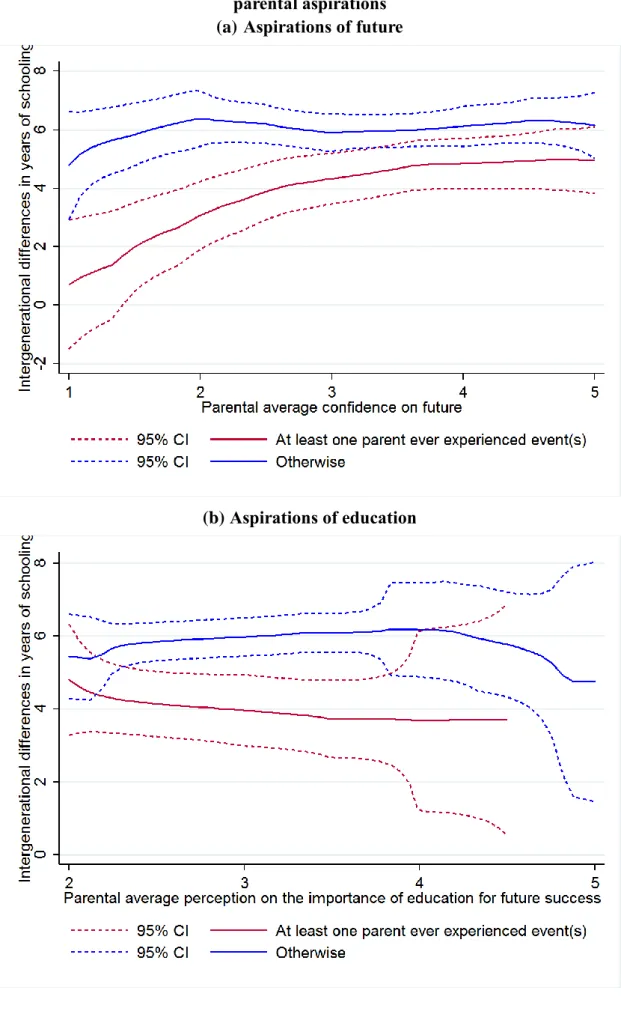
The educational outcomes appear to differ conditional on excluded instruments. Taking political campaigns for instance, Figure 7 illustrates clearly a downward shift of filial education compared to their parents’ should any parent ever experienced any of these campaigns, despite that the positive relationship between parental aspiration and filial educational attainments still holds.
Figure 7 Relationship between intergenerational educational mobility and parental aspirations
(a) Aspirations of future
Note: Samples used to draw these diagrams are urban parental generation who was born over the period 1950 and 1955.
Source: Author’s calculation based on the CFPS 2010.
Overall, the excluded instruments seem to be appropriate in generating exogenous variations to aspirations and the pattern of intergenerational educational mobility. 5. Estimation results
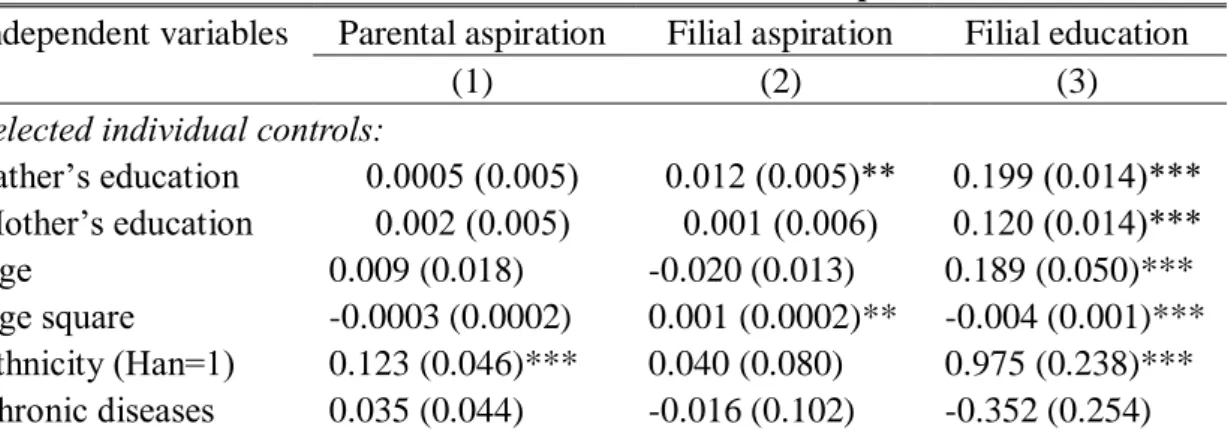
Table 7 reports the estimation results of Eqs. (1)-(3) when aspirations are defined as the importance of education for future success. Excluded instrumental variables work well. In particular, the “worse” the parental family background in the Cultural Revolution (i.e., richer or higher social class), the lower the educational aspirations held by the parental generation. Involvement of political campaigns also lowered parental educational aspirations. Such low aspirations per se can be transmitted to their children, as revealed by the positive estimate of parental aspirations on the filial (0.245 in Column 2 of Table 7). Both parents’ education strongly and positively relate to the filial educational attainments (Column 3 of Table 7), which is consistent with the existing literature on intergenerational transmission of education. Nevertheless, Columns 1 and 3 of Table 7 shows that neither parental nor filial educational aspirations exhibits direct impact on their own or their children’s educational attainments, but rather educational reforms in terms of expanded higher education and merging rural primary schools as a means of improving delivery of rural education help improve the filial education. It is also interesting to observe positive impact of the filial early exposure to the Great Famine on his/her later completed education. The magnitude appears to be large as well – 4.8 years in Column 3 of Table 7. It is suspected that those who survived in extreme undernutrition would be strong spiritually and/or make more efforts than their peers without such hardship experiences. Unfortunately, the dataset does not contain relevant information allowing us to test for them. That being said, the Great Famine indeed affects survivors’ certain aspirations. When using perceived importance of luck, talent and hard work for future success, the filial exposure to the Great Famine positively relates to the perceived importance of talent. This implies more fatalism held by survivors compared to those who have never experienced extreme undernutrition.
Table 7 Estimation results of educational aspirations
Independent variables Parental aspiration Filial aspiration Filial education
(1) (2) (3)
Selected individual controls:
Father’s education 0.0005 (0.005) 0.012 (0.005)** 0.199 (0.014)*** Mother’s education 0.002 (0.005) 0.001 (0.006) 0.120 (0.014)*** Age 0.009 (0.018) -0.020 (0.013) 0.189 (0.050)*** Age square -0.0003 (0.0002) 0.001 (0.0002)** -0.004 (0.001)*** Ethnicity (Han=1) 0.123 (0.046)*** 0.040 (0.080) 0.975 (0.238)*** Chronic diseases 0.035 (0.044) -0.016 (0.102) -0.352 (0.254)
(yes=1)
No. of siblings 0.0005 (0.012) 0.804 (1.481) 3.460 (4.495)
Birth order 0.027 (0.020) -0.178 (0.064)***
Gender (man=1) 0.012 (0.044) -0.627 (0.109)***
Highest parental EGP social class:
agricultural or manual labour
0.028 (0.085) -0.381 (0.185)**
Highest parental EGP social class:
non-manual labour
-0.026 (0.099) 0.087 (0.210)
Highest parental EGP social class:
self-employed
-0.224 (0.137)* -0.141 (0.260)
Highest parental EGP social class: high controllers 0.033 (0.113) 0.167 (0.241) Current urban residence -0.049 (0.040) -0.078 (0.047)* 0.691 (0.124)*** Urban household registration (Hukou) at 12-yr old -0.005 (0.063) 1.377 (0.170)*** Recursive components: Parental aspiration 0.245 (0.094)*** 0.074 (0.287) Filial aspiration 0.017 (0.057) Filial education 0.005 (0.006) Excluded instruments:
Family’s class rank in the Cultural
Revolution
-0.026 (0.015)*
Parents experienced any political events in Great Leap Forward
-0.146 (0.084)*
3-yr mean death rate in birth place in Grate Famine
0.032 (0.016)**
3-yr mean grain yield per capita in birth place in Grate Famine
0.001 (0.0006)*
Historical weather shocks in birth place
-0.577 (1.686)
Historical weather shocks in residential place at 12-yr old
Parental depression scores
-0.056 (0.025)**
Filial utero & childhood in Great Famine
0.210 (0.409) 4.813 (2.188)**
Filial utero & childhood in Great Famine x 3-year average death rate in birth place during the Grate Famine
-0.002 (0.010) -0.045 (0.078)
Filial utero & childhood in Great Famine x 3-year average grain yield per capita in birth place during the Grate Famine
-0.001 (0.001) -0.004 (0.003)
Expanded higher education
2.607 (0.298)***
Merging rural primary schools
0.330 (0.175)*
Province at birth Yes
Province at 12-yr old Yes Yes
No. of obs. 6,026
Log-likelihood -1.087e+09 Wald χ2 (p-value) 3,596.95 (0.000)
Note: ***, ** and * denote 1%, 5% and 10% significance levels in turn. Source: Author’s calculation based on the CFPS 2010.
Table 8 uses an alternative indicator for aspirations – the self-reported confidence of own future – and re-estimates the Eqs. (1)-(3). Intergenerational association of aspirations turns out again. Moreover, not only parental education is directly inherited by the filial, but also high filial aspirations push up their own and their children’s educational attainments (Columns 1 and 3 of Table 8). These corroborate the behavioural poverty traps set up in Figure 2. That is, low parental education pertains to low parental aspirations which can be transmitted to children; then, children’s low aspirations result in their low educational attainments again. Aspirations failure serves as a conduit transmitting low educational attainments between generations.
Table 8 Estimation results of aspirations of future
Independent variables Parental aspiration Filial aspiration Filial education
(1) (2) (3)
Selected individual controls:
Mother’s education 0.008 (0.005)* -0.005 (0.005) 0.119 (0.014)*** Age -0.035 (0.014)** -0.013 (0.011) 0.165 (0.045)*** Age square 0.0002 (0.0001)* -0.0005 (0.0002) -0.003 (0.001)*** Ethnicity (Han=1) 0.022 (0.044) -0.048 (0.067) 1.037 (0.226)*** Chronic diseases (yes=1) -0.096 (0.039)** -0.098 (0.089) -0.219 (0.239) No. of siblings 0.039 (0.011)*** -0.586 (1.384) 6.021 (4.293) Birth order -0.008 (0.020) -0.180 (0.060)*** Gender (man=1) 0.092 (0.039)** -0.565 (0.109)***
Highest parental EGP social class:
agricultural or manual labour
0.053 (0.072) -0.334 (0.185)*
Highest parental EGP social class:
non-manual labour
0.195 (0.085)** 0.110 (0.212)
Highest parental EGP social class:
self-employed
-0.023 (0.110) -0.110 (0.263)
Highest parental EGP social class: high controllers 0.084 (0.093) 0.228 (0.241) Current urban residence -0.116 (0.036)*** -0.122 (0.045)*** 0.794 (0.127)*** Urban household registration (Hukou) at 12-yr old 0.024 (0.058) 1.402 (0.166)*** Recursive components: Parental aspiration 0.213 (0.130)* 0.181 (0.339) Filial aspiration 0.241 (0.056)*** Filial education 0.005 (0.006) Excluded instruments:
Family’s class rank in the Cultural
Revolution
0.029 (0.013)**
Parents experienced any political events in Great Leap Forward
0.008 (0.076)
3-yr mean death rate in birth place in Grate Famine
0.010 (0.012)
3-yr mean grain yield per capita in birth place in Grate Famine
Historical weather shocks in birth place
-0.930 (1.266)
Historical weather shocks in residential place at 12-yr old
-4.025 (1.523)***
Parental depression scores
0.026 (0.021)
Filial utero & childhood in Great Famine
0.293 (0.417) 3.788 (1.963)*
Filial utero & childhood in Great Famine x 3-year average death rate in birth place during the Grate Famine
-0.023 (0.011)** -0.020 (0.066)
Filial utero & childhood in Great Famine x 3-year average grain yield per capita in birth place during the Grate Famine
0.0003 (0.001) -0.002 (0.003)
Expanded higher education
2.669 (0.289)***
Merging rural primary schools
0.303 (0.169)*
Province at birth Yes
Province at 12-yr old Yes Yes
No. of obs. 6,026
Log-likelihood -1.426e+09 Wald χ2 (p-value) 4,796.43 (0.000)
Note: ***, ** and * denote 1%, 5% and 10% significance levels in turn. Source: Author’s calculation based on the CFPS 2010.
Of other covariates, it is not surprising that urban household registration (Hukou) brings about more years of education, given various social benefits attached to it. Similarly, parental agricultural backgrounds are associated with lower filial educational attainments. Urban residents seem to be less “ambitious” than their rural counterparts. However, occupations are not necessarily relevant to aspirations, except those whose parents are self-employed – they tend to attach less importance to education for their future success.
6. Conclusion
The present study has tested empirically for the existence of behavioural poverty traps in the Chinese contexts. Exploiting a nationally representative household survey and various exogenously determined events and past history, this paper identifies causal impact of aspirations on education. Moreover, of various aspirations, one’s confidence on future can transmit educational attainment from one generation to another, constituting behavioural poverty traps.
References
Alkire, S. and Foster, J. (2011) Counting and multidimensional poverty measure.
Journal of Public Economics 95, 476-487.
Appadurai, A. (2004) The capacity to aspire. In V. Rao and M. Walton (eds.), Culture
and Public Action: The International Bank for Reconstruction and Development,
pp. 59-84, The World Bank: Washington, DC.
Beaman, L., Duflo, E., Pande, R. and Topalova, P. (2012) Female leadership raises aspirations and educational attainment for girls: A policy experiment in India.
Science 335(6068), 582-586.
Bernard, T., Dercon, S., Orkin, K. and Taffesse, A. S. (2014) The future in mind: Aspirations and forward-looking behaviour in rural Ethiopia. CSAE Working Paper, No. 16, University of Oxford.
Bernard, T., Dercon, S., Orkin, K. and Taffesse, A. S. (2015) Will video kill the radio star? Assessing the potential of targeted exposure to role models through video.
World Bank Economic Review 29(Suppl. 1), 226-237.
Bernard, T. and Taffesse, A. S. (2012) Measuring aspirations: Discussion and example from Ethiopia. IFRPRI Working Paper No. 47.
Bernard, T. and Taffesse, A. S. (2014) Aspirations: An approach to measurement with validation using Ethiopian data. Journal of African Economies 23, 189-224. Bertrand, M., Mullainathan, S. and Shafir, E. (2004) A behavioural economics view of
poverty. American Economic Review 94, 419-23.
Dalton, P. S., Ghosal, S. and Mani, A. (2016) Poverty and aspiration failure. Economic
Journal 126, 165-188.
Dercon, S. and Singh, A. (2013) From nutrition to aspirations and self-efficacy: Gender bias over time among children in four countries. World Development 45, 31-50.
Emran, M. S. and Hou, Z. (2013) Access to markets and rural poverty: Evidence from household consumption in China. Review of Economics and Statistics 95, 682-697.
Fafchamps, M. and Quinn, S. (2014) Aspire. CSAE Working Paper, No. 34, University of Oxford.
Haushofer, J. and Fehr, E. (2014) On the psychology of poverty. Science 344, 862-867.
Hou, Z., van de Peol, E., van Doorslaer, E., Yu, B. and Meng, Q. (2014) Effects of NCMS on access to care and financial protection in China. Health Economics 23, 917-934.
Jalan, J. and Ravallion, M. (2002) Geographic poverty traps? A micro model of consumption growth in rural China. Journal of Applied Econometrics 17, 329-346.
Khor, N, Pang, L., Liu, C., Chang, F., Mo, D., Loyalka, P. and Rozelle, S. (2014) China’s Looming Human Capital Crisis: Upper Secondary Educational Attainment Rates and the Middle Income Trap. Rural Education Action Project Working Paper 280, University of Stanford.
Knight, K. E., Ellis, C., Roark, J., Henry, K. L. and Huizinga, D. (2016) Testing the role of aspirations, future expectations, and train on the development of problem behaviors across young and middle adulthood. Deviant Behavior, early view DOI: DOI: 10.1080/01639625.2016.1206716.
Knight, J., Li, S. and Deng, Q. (2010) Education and the poverty trap in rural China: Closing the trap. Oxford Development Studies 38, 1-24.
Knight, J. and Gunatilaka, A. (2012) Income, aspirations and the hedonic treadmill in a poor society. Journal of Economic Behavior and Organization 82(1), 67-81. Kosec, K., Hameed, M. and Hausladen, S. (2012) Aspirations in rural Pakistan: An
empirical analysis. IFPRI Working Paper No. 009.
Labar, K. and Bresson, F. (2011) A multidimensional analysis of poverty in China from 1991 to 2006. China Economic Review 22, 646-668.
Li, L., Luo, R., Sylvia, S., Medina, A. and Rozelle, S. (2013) The prevalence of anemia in central and eastern China: Evidence from the China Health and Nutrition Survey. Rural Education Action Project Working Paper 257, University of Stanford.
Li, X., Gan, C. and Hu, B. (2011) The welfare impact of microcredit on rural households in China. Journal of Socio-Economics 40, 404-411.
Luo, R., Shi, Y., Zhang, L., Liu, C., Rozelle, S., Sharbono, B., Yue, A., Zhao, Q. and Martorell, R. (2012) Nutrition and educational performance in rural China’s elementary schools: Results of a randomized control trial in Shaanxi province.
Economic Development and Cultural Change 60, 735-772.
Lybbert, T. J. and Wydick, B. (2016) Hope as aspirations, agency, and pathways: Poverty dynamics and microfinance in Oaxaca, Mexico. NBER Working Paper No. 22661.
Mani, A., Mullainathan, S., Shafir, E. and Zhao, J. (2013) Poverty impedes cognitive function. Science 341, 976-980.
Mekonnen, D. A. and Gerber, N. (2016) Aspirations and income, food security and subjective well-being in rural Ethiopia. Available at SSRN: https://ssrn.com/abstract=2768191
Meng, L. (2013) Evaluating China’s poverty alleviation program: A regression discontinuity approach. Journal of Public Economics 101, 1-11.
Park, A. and Wang, S. (2010) Community-based development and poverty alleviation: An evaluation of China’s poor village investment program. Journal of Public
Economics 94, 790-799.
Pasquier-Doumer, L. and Brandon, F. R. (2015) Aspiration failure: A poverty trap for indigenous children in Peru? World Development 72, 208-223.
Ray, R. and Mishra, A. (2012) Multi-dimensional deprivation in the awakening giants: A comparison of China and India on micro data. Journal of Asian Economics 23, 454-465.
Strand, M.A., Perry, J., Zhao, J., Fischer, P.R., Yang, J. and Li, S. (2009) Severe vitamin D deficiency and the health of north China children. Maternal and Child
Health Journal 13, 144-150.
Stutzer, A. (2004) The role of income aspirations in individual happiness. Journal of
Takahashi, H., Kato, M., Matsuura, M., Mobbs, D., Suhara, T. and Okubo, Y. (2009) When your gain is my pain and your pain is my gain. Science 323, 937-939. Thompson, W. M., Janzen, S. A., Magnan, N. P. and Sharma, S. (2015) Social drivers
of aspirations formation and failure in rural Nepal. Mimeo. Paper presented in Agricultural & Applied Economics Association and Western Agricultural Economics Association Annual Meeting, San Francisco, CA, July 26-28, 2015. UNICEF (2011) The state of the world’s children 2011 – Adolescence: An age of
opportunity. UNICEF, Paris, France.
World Bank (2009) From poor areas to poor people: China’s evolving poverty reduction agenda. Poverty Reduction and Economic Management Department, East Asia and Pacific Region, The World Bank: Washington DC.
World Development Report (2015) Mind, society, and behaviour. The World Bank: Washington DC.
Yi, H., Zhang, L., Luo, R., Shi, Y., Mo, D., Chen, X., Brinton, C. and Rozelle, S. (2012) Dropping out: Why are students leaving junior high in China’s poor rural areas? International Journal of Educational Development 32, 555-563.
You, J. (2013) The role of microcredit in older children's nutrition: Quasi-experimental evidence from rural China. Food Policy 43, 167-179.
You, J. (2014a) Risk, under-investment in agricultural assets and dynamic asset poverty in rural China. China Economic Review 29, 27-45.
You, J. (2014b) Poverty dynamics in rural China revisied: Do assets matter? Journal
of Economic Policy Reform 17, 322-340.
You, J. (2014c). Dietary change, nutrient transition and food security in fast growing China. In: Raghav Gaiha, Raghbendra Jha and Anil B. Deolalikar (eds.), Handbook on Food: Demand, Supply, Sustainability and Security. Edward Elgar Publishing: Cheltenham, UK.
You, J. (2016) Lending to parents and insuring children: Is there a role for microcredit in complementing health insurance in rural China? Health Economics 5, 543-558. You, J. and Annim, S. (2014) The impact of microcredit on child education: Quasi-experimental evidence from rural China. Journal of Development Studies 50, 926-948.
You, J., Ding, X., Niño-Zarazúa, M. and Wang, S. (2015a) Lofty pine and clinging vine: The educational Great Gatsby Curvey and the role of house prices. Mimeo. Paper presented at the Annual Conference of the Chinese Economic Association (UK/Europe), 4-5 September 2015, University of Nottingham.
You, J. Imai, K., Gaiha, R. (2016) Declining nutrient intake in a growing China: Does household heterogeneity matter? World Development 77, 171-191.
You, J., Wang, S. and Wang, S. (2015c) Multidimensional adaptation to climate change: Dynamic discrete choice with unobserved heterogeneity. Mimeo.
You, J. and Ozanne, A. (2015) Volatility and inequality: Household vulnerability as uncertain welfare in rural China. European Journal of Development Research 27, 686-706.
You, J., Kontoleon, A. and Wang, S. (2017a) Identifying a sustainable pathway to household multi-dimensional poverty reduction in rural China. Journal of
Development Studies, forthcoming.
You, J., Wang, S. and Roope, L. (2017b) Intertemporal deprivation in rural China: Income and nutrition. Journal of Economic Inequality, forthcoming.
Zhang, C., Xu, Q., Zhou, X., Zhang, X. and Xie, Y. (2014) Are poverty rates underestimated in China? New evidence from four recent survey. China
Economic Review 31, 410-425.
Zhao, M. and Glewwe, P. (2010) What determines basic school attainment in developing countries? Evidence from rural China. Economics of Education
About the Author
Dr Jing You is an associate professor at the School of Agricultural Economics and Rural Development, Renmin University of China. Her research areas are in the fields of Development Economics and Applied Microeconomics. She has published studies in poverty and inequality, with a regional focus on China.
List of Major Works
You, J., Wang, S. G. and Roope, L. (2017) Intertemporal deprivation in rural China: Income and nutrition. Journal of Economic Inequality, forthcoming.
You, J. (2017) Asset-based poverty transition and persistence in rural China.
Agricultural Economics 48(2): 219-239.
You, J. (2016) Lending to parents and insuring children: Is there a role for microcredit in complementing health insurance in rural China? Health Economics 25(5): 543-558. You, J., Imai, K. and Gaiha, R. (2016) Declining nutrient intake in a growing China: Does household heterogeneity matter? World Development 77: 171-191.
You, J. and Annim, S. (2014) The impact of microcredit on child education: Quasi-experimental evidence from rural China. Journal of Development Studies 50(7): 926-948.
You, J. (2014) Risk, under-investment in agricultural assets and dynamic asset poverty in rural China. China Economic Review 29: 27-45.
Imai, K. and You, J. (2014) Poverty dynamics of households in rural China. Oxford
Bulletin of Economics & Statistics 76(6): 898-923.
You, J. (2013) The role of microcredit in older children's nutrition: Quasi-experimental evidence from rural China. Food Policy 43: 167-179.