Is the Vietnamese garment industry at a
turning point? : upgrading from the export to
the domestic market
著者
Goto Kenta
権利
Copyrights 日本貿易振興機構(ジェトロ)アジア
経済研究所 / Institute of Developing
Economies, Japan External Trade Organization
(IDE-JETRO) http://www.ide.go.jp
journal or
publication title
IDE Discussion Paper
volume
373
year
2012-12-01
INSTITUTE OF DEVELOPING ECONOMIES
IDE Discussion Papers are preliminary materials circulated to stimulate discussions and critical comments
Keywords: Vietnam, garment, global value chains, upgrading JEL classification: F63, L67, O14, O53
*Associate Professor, Faculty of Economics, Kansai University ([email protected])
IDE DISCUSSION PAPER No. 373
Is the Vietnamese Garment Industry
at a Turning Point?: Upgrading from
the Export to the Domestic Market
Kenta GOTO*
December, 2012
AbstractVietnam’s garment industry has been loosely characterized by the duality based on market orientation: export and domestic. Export-oriented garment suppliers were typically SOEs and foreign invested firms, while those producing for the domestic market have been mostly small, private companies. With a booming economy, other industrial sectors have emerged, and the garment industry is no longer the sector most favored by workers. Wage rates have been increasing, and a supplier’s ability to cope with this through successful upgrading has been the key determinant of whether it can further grow and flourish. Those who fail to cope are finding themselves in an increasingly difficult position. This paper looks at both the export- and domestic-oriented garment suppliers, and attempts to highlight how the industry can further develop by examining the bottlenecks that vary depending on the type of supplier. It suggests that in the long run, upgrading and value addition in the domestic market will be the key strategy.
The Institute of Developing Economies (IDE) is a semigovernmental, nonpartisan, nonprofit research institute, founded in 1958. The Institute
merged with the Japan External Trade Organization (JETRO) on July 1, 1998.
The Institute conducts basic and comprehensive studies on economic and related affairs in all developing countries and regions, including Asia, the Middle East, Africa, Latin America, Oceania, and Eastern Europe.
The views expressed in this publication are those of the author(s). Publication does not imply endorsement by the Institute of Developing Economies of any of the views expressed within.
INSTITUTE OF DEVELOPING ECONOMIES (IDE), JETRO
3-2-2, WAKABA,MIHAMA-KU,CHIBA-SHI
CHIBA 261-8545, JAPAN
©2012 by Institute of Developing Economies, JETRO
No part of this publication may be reproduced without the prior permission of the IDE-JETRO.
Is the Vietnamese Garment Industry at a Turning Point?
Upgrading from the Export to the Domestic Market
1Kenta Goto
2December, 2012
Abstract
Vietnam’s garment industry has been loosely characterized by the duality based on market orientation: export and domestic. Export-oriented garment suppliers were typically SOEs and foreign invested firms, while those producing for the domestic market have been mostly small, private companies.
With a booming economy, other industrial sectors have emerged, and the garment industry is no longer the sector most favored by workers. Wage rates have been increasing, and a supplier’s ability to cope with this through successful upgrading has been the key determinant of whether it can further grow and flourish. Those who fail to cope are finding themselves in an increasingly difficult position.
This paper looks at both the export- and domestic-oriented garment suppliers, and attempts to highlight how the industry can further develop by examining the bottlenecks that vary depending on the type of supplier. It suggests that in the long run, upgrading and value addition in the domestic market will be the key strategy.
Keywords: Vietnam, garment, global value chains, upgrading JEL Classification: F63, L67, O14, O53
1 Introduction
The termination of the Multifibre Arrangement (MFA) at the beginning of 2005 induced significant structural changes in the global garment trade. Countries whose exports to the US and EU markets had previously been “guaranteed” under the quota system faced
1
This paper has been produced under an IDE project “ Dynamics of the Garment Industry in Low-income Countries following the MFA Phase-out”. The author is grateful to the useful discussions with and advice from the research members of this project including Yoko Asuyama, Takahiro Fukunishi, Toshihiro Kudo, Momoe Makino and Tatsufumi Yamagata (all IDE), and to John Thoburn (University of East Anglia) for valuable comments on an earlier draft. All remaining errors are, of course, mine.
2
Associate professor, Faculty of Economics, Kansai University. (e-mail: [email protected]).
immense competition from more competitive suppliers that were restricted under the MFA regime. With this event, a large number of African suppliers had to strive in order to sustain their export shares whilst many of the Asian exporters recorded growth in exports. Vietnam is one such high-performing country whose growth has been
remarkable; its export value in 2011 was US$14 billion3, which more than tripled from
2004 (US$4.2 billion).
While Vietnam’s garment export growth has been impressive, the industry is facing challenges in its domestic economic environment, primarily due to acute labor shortages and rapidly rising wage rates. At the aggregate level, its garment industry is growing robustly, but at the enterprise level performance varies significantly. Garment suppliers which have been successful in process and product upgrading were able to attract more orders and could afford to pay higher wages, while the less successful ones had to struggle with filling their empty production lines, coping with deteriorating contractual terms (particularly in prices) and with retaining workers (Goto et al. 2011). However, process and product upgrading will eventually reach their limits, and further upgrading in function will become inevitable even for the most competitive export oriented suppliers. Functional upgrading and moving into higher value added functions has already become important for such suppliers.
On the other hand, Vietnam’s domestic garment market is currently catered by smaller private garment suppliers. Quite a number of these domestic-oriented suppliers undertake the more knowledge intensive functions including in-house design, branding and marketing, in which export suppliers have no experience. With the emergence of a dynamic middle-income class, particularly in its urban areas such as Hanoi and Ho Chi Minh City, the domestic garment sector is growing rapidly with promising prospects for businesses. New apparel retailers have evolved in the last decade, filling major commercial streets and shopping centers. Although this domestic-oriented industry has enormous potential, domestic suppliers lack the technical efficiency in the production processes that export suppliers have accumulated over the years by producing garments in value chains that are coordinated by foreign buyers.
3
Source: Vietnam customs database
(http://www.customs.gov.vn/English/Lists/SupportOnline/ThongKeHaiQuan.aspx), accessed on September 26, 2012.
This paper looks at both the export- and domestic-oriented aspects of the garment industry and attempts to highlight how the industry can further develop by looking at each of the bottlenecks that appear among different types of suppliers (export or domestic). The paper is organized as follows. The next section provides an outline of the Vietnamese garment industry. Section Three will attempt to look at whether upgrading has happened in the industry, categorize garment suppliers according to their market orientation, and compare their key attributes and differences in the functional modalities of garment production. Section Four will look at the possibilities of functional upgrading by looking at the domestic market. This will be followed by a discussion section, and the final section will present the conclusion.
2 Outline of the Vietnamese Garment Industry
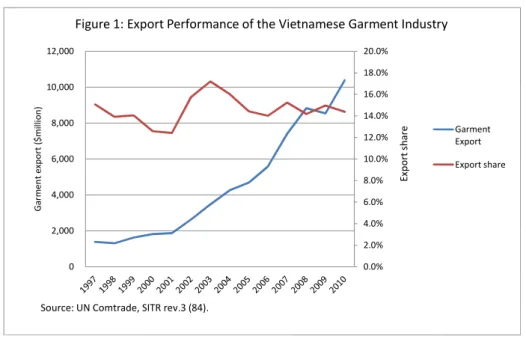
The garment industry has been Vietnam’s largest manufacturing-based export sector since its integration into the global economy in the early 1990s. Its growth has been rapid since, with an export volume of around US$ 10.3 billion in 2010, which is the largest export commodity and represents about 14.4 percent of all exports from Vietnam.
Despite the presence of a large domestic textile sector, Vietnam’s
export-oriented garment industry is highly import intensive as the local textile industry
0.0% 2.0% 4.0% 6.0% 8.0% 10.0% 12.0% 14.0% 16.0% 18.0% 20.0% 0 2,000 4,000 6,000 8,000 10,000 12,000 G ar m en te xp or t( $m ill io n)
Figure 1: Export Performance of the Vietnamese Garment Industry
Garment Export Export share Ex po rt sh ar e
is uncompetitive, particularly in terms of quality. Therefore, production for exports takes the contractual form often referred to as CMT, which stands for “cut, make and trim”. Under a CMT production modality, Vietnamese garment suppliers receive input materials free of charge from international buyers. The CMT modality is essentially an
international putting-out system in which Vietnamese garment suppliers are
compensated primarily for their labor costs, the functions of which are highly labor intensive and relatively low skill-intensity (Nadvi and Thoburn 2004; Goto et al. 2011). Other functions such as procurement of input materials, designing, branding, and marketing are all catered by international buyers (Goto 2007).
Coordination of production and distribution in global value chains are undertaken by such international buyers, which are typically trading companies and wholesalers. However, in some cases such coordinating roles are also undertaken directly by retailers and brand apparel companies. In the global value chain literature, these coordinators are key as they exercise power over decisions such as where to produce what and how. The international buyers are therefore important as they essentially control and determine entry of garment suppliers into the value chain (Goto et al. 2011).
When Vietnam opened up its economy to the West in the early 1990s, it had a large surplus of labor with one of the lowest wage levels in the region. As the attractiveness of a supplier under a CMT modality is highly dependent on wage levels, Vietnam’s strength in garment exports has grown significantly in terms of comparative advantage. Balassa’s concept of revealed comparative advantage (Balassa 1965) is
useful in looking at this trend, and here we use two different indices to measure this.4
The first index is the Relative Performance Index (RPI), which is calculated as
ܴܲܫ௧= ⎣ ⎢ ⎢ ⎢ ⎡ ܺ௧൘∑ ܺ ௧ ∑ ܺ ௧ ∑ ∑ ܺ ௧ ൘ ⎦ ⎥ ⎥ ⎥ ⎤ 4
where RPIijtis the Relative Performance Index for industry i of country j, year t; and Xijt
is the value of export of industry i of country j, year t. Therefore, ∑ ܺ ௧ is the total
exports of country j (all industries), year t; and ∑ ∑ ܺ ௧ is the total value of world
exports (all industries) of year t.
The RPI is an index that compares the export share of the Vietnamese garment industry with the world’s industry’s aggregate export share. Country j has comparative advantage in industry i if RPI > 1. As this index does not take into account the size of imports of that same industry, which could be large in some countries, we also look at the Relative Export-Import Ratio (REIR), which is defined as
ܴܧܫܴ௧= ⎣ ⎢ ⎢ ⎢ ⎡ ܺ௧൘ܯ௧ ∑ ܺ ௧ ∑ ܯ ௧ ൘ ⎦ ⎥ ⎥ ⎥ ⎤
where REIRijtis the Relative Export-Import Ratio for industry i of country j, year t; Mijt
is the value of imports of industry i of country j, year t; ∑ ܺ ௧ is the value of world
exports of industry i, year t; and ∑ ܯ ௧ is the value of world imports of industry i,
year t.
The REIR likewise reflects the country’s comparative advantage, given the tariff structures and other protection measures in year t. Figure 2 summarizes the results for the period during 2000 through 2010. The figure depicts a rapid increase in the international comparative advantage of the Vietnamese garment industry during the above period, which started in the early 1990s. Both the RPI and REIR are significantly larger than 1 (6.1 and 34.9, respectively, in 2010).
The increase of REIR is partially due to robust growth in garment exports; however, part of this also stems from an absolute decline in imports in the case of Vietnam. The import of garments dropped significantly from US$434 million in 2000 to US$154 million in 2007. Nevertheless, imports have risen steadily since, reaching US$289 million in 2010.
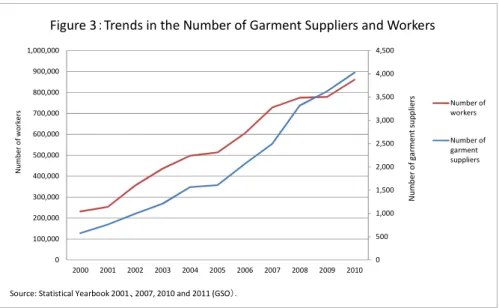
The industry is also significant in terms of the number of workers it employs, which in 2010 was about 861,000, which has grown 3.7 times the number in 2000 (232,000). Likewise, the increase in the number of garment suppliers in the last decade is also impressive, which grew almost seven-fold during the same decade, from 597 to 4030.
Within this, the industry has been undergoing some structural changes, one of which has to do with ownership. Table 1 describes the compositional change of output based on the different ownership categories of state-owned enterprises (SOEs),
43.4 46.3 29.4 30.0 37.0 26.0 16.9 15.4 21.2 20.4 28.9 0.0 5.0 10.0 15.0 20.0 25.0 30.0 35.0 40.0 45.0 50.0 0.0 1.0 2.0 3.0 4.0 5.0 6.0 7.0 2000 2001 2002 2003 2004 2005 2006 2007 2008 2009 2010 RC A
Figure 2: Revealed comparative advantage
Imports (US$million, RHS) RPI (LHS) REIR (RHS) RE IR /I m po rt (1 0 m ill io n U S$ ) Source: UNComtrade. 0 500 1,000 1,500 2,000 2,500 3,000 3,500 4,000 4,500 0 100,000 200,000 300,000 400,000 500,000 600,000 700,000 800,000 900,000 1,000,000 2000 2001 2002 2003 2004 2005 2006 2007 2008 2009 2010 N um be ro fw or ke rs
Figure 3:Trends in the Number of Garment Suppliers and Workers
Number of workers Number of garment suppliers
Source: Statistical Yearbook 2001、2007, 2010 and 2011 (GSO).
N um be ro fg ar m en ts up pl ie rs
non-SOEs (collective enterprises, private enterprises and household enterprises), and foreign-invested companies. In 1995, when Vietnam’s garment industry started producing and exporting to the “western” markets, most of the export-oriented garments were produced by SOEs and accounted for more than a third of its total output. Household enterprises (kinh te ca te), which are self-employed micro entities, often informal, occupy 35.7 percent of total output and are the largest ownership form of garment suppliers.
In 2011, however, the share of SOEs shrunk to 8.4 percent, while the foreign-invested companies (48.4%) have taken over the position of the dominant ownership form in the industry. While data for the output share of “private” and “household” enterprises are not available for 2011, they have been 24.5% and 12% in 2010 respectively, which suggests a large change in their importance in comparison to 1995. Nevertheless, it should be noted that, as a significant number of SOEs have undergone an “equitization” program and are being re-classified as either SOEs or private companies, it is highly likely that the former SOEs still play dominant roles particularly in the export of garments.
Table 2 summarizes the firm size distribution in the garment industry. Larger firms occupy a larger share in the garment industry in comparison to the overall economy; while the share of firms with more than 500 workers is 0.9 percent for “all industry”, it is 11.0 percent for the garment sector. It is worth mentioning that enterprise characteristics, particularly ownership and size, have a strong relationship with market
Table 1: Output Based on Ownership
1995 2000 2005 2006 2007 2008 2009 2010 2011
Output (Total, garment industry) 2,950 6,042 15,354 19,166 22,776 27,206 29,146 34,313 39,872
SOEs 1,025 1,926 3,823 3,939 3,001 2,723 2,422 2,810 3,365
34.8% 31.9% 24.9% 20.6% 13.2% 10.0% 8.3% 8.2% 8.4%
Non-SOEs 1,389 2,616 5,873 7,744 10,174 12,328 12,519 15,108 17,194
47.1% 43.3% 38.2% 40.4% 44.7% 45.3% 43.0% 44.0% 43.1%
Collective enterprises 9 45 69 59 60 74 39 39 na
(kinh te tap the) 0.3% 0.7% 0.4% 0.3% 0.3% 0.3% 0.1% 0.1% na
Private (2) 327 1,056 3,398 4,893 6,849 8,656 8,372 8,393 na (kinh te tu nhan) 11.1% 17.5% 22.1% 25.5% 30.1% 31.8% 28.7% 24.5% na Household 1,053 1,516 2,406 2,792 3,265 3,598 4,109 4,114 na (king te ca the) 35.7% 25.1% 15.7% 14.6% 14.3% 13.2% 14.1% 12.0% na Foreign invested 536 1,500 5,658 7,483 9,601 12,155 14,204 16,395 19,313 18.2% 24.8% 36.9% 39.0% 42.2% 44.7% 48.7% 47.8% 48.4%
Source: Statistical Yearbook 1999, 2000, 2001, 2003, 2007 and 2010(GSO).
Note 1: Upper rows denote output values in VND1 billion (1994 prices), and lower rows are shares. Note 2: The output figures for 1997, 1998 and 1999 are based on the author's calculation.
orientation, i.e., export or domestic. Most of the larger garment suppliers are SOEs (or equitized SOEs), which have been playing key roles in the export-oriented garment industry as they were able to enjoy preferential government support in connecting with foreign markets when Vietnam started integrating into the global economy in the early 1990s (Hill 2000, Goto 2003, Thomsen 2007). Such export-oriented suppliers are in general also better equipped with capital in comparison to smaller domestic garment suppliers. The smallest firms in the industry are primarily household enterprises, which cater mainly to the domestic market and are rarely connected to the export-oriented value chain.
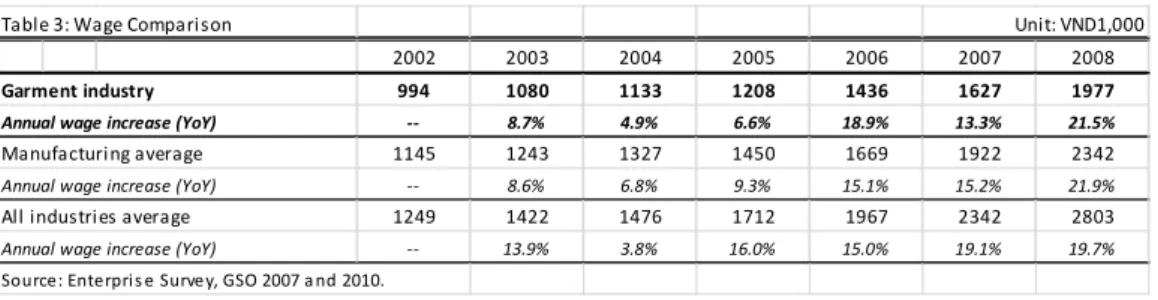
While the growth of Vietnam’s garment industry is remarkable, the recent increase in general wage levels has put serious pressures on garment suppliers. Table 3 summarizes average annual wages in the garment industry and compares them with the averages of manufacturing and all industries.
Wage levels in the garment industry have been increasing rapidly (the annual increase in 2008 was 21.5%); however, wage levels in other industries have increased at a similar or faster rate. As a result, wage rates in the garment industry have dropped well below the manufacturing and overall industry average.
Garment suppliers are therefore in a difficult position when it comes to Table 2: Firm Size Distribution (2010)
Less than 5 5-9 10-49 50-199 200-299 300-499 500-999 1000-4999 over 5000 Total
Number of enterprises
(garment industry) 458 771 1190 796 152 218 230 203 12 4030
Share 11.4% 19.1% 29.5% 19.8% 3.8% 5.4% 5.7% 5.0% 0.30% 100%
Number of enterprises (all
industry) 77933 100539 86723 18711 2562 2116 1564 1051 100 291299
Share 26.8% 34.5% 29.8% 6.4% 0.9% 0.7% 0.5% 0.4% 0.03% 100%
Source: Statistical Yearbook 2011.
Number of workers
Table 3: Wage Comparison Unit: VND1,000 2002 2003 2004 2005 2006 2007 2008
Garment industry 994 1080 1133 1208 1436 1627 1977
Annual wage increase (YoY) -- 8.7% 4.9% 6.6% 18.9% 13.3% 21.5% Manufacturing average 1145 1243 1327 1450 1669 1922 2342 Annual wage increase (YoY) -- 8.6% 6.8% 9.3% 15.1% 15.2% 21.9% All industries average 1249 1422 1476 1712 1967 2342 2803 Annual wage increase (YoY) -- 13.9% 3.8% 16.0% 15.0% 19.1% 19.7%
securing enough workers as labor demand in other sectors has increased along with the robustly growing economy, intensifying competition in the recruitment of workers. From field work in 2011 and 2012 in Hanoi and Ho Chi Minh City, the relative attractiveness of a job in the garment industry seems to be rapidly eroding with the decline in its relative wage levels, making this sector no longer among the most popular and attractive for workers in Vietnam. Suppliers’ ability to hire and retain workers depends on their ability to cope with the rapidly increasing wage level, and this in turn is dependent on whether upgrading in process, product or function has occurred. However, as there have been no significant shifts from CMT to other types of production modalities in the export sector (i.e., no functional upgrading), upgrading has been more or less confined to either process or products. Those who were successful in upgrading have been able to realize increased efficiency and attract workers with higher wages, while those who have failed have been shrinking and losing drastically (Goto et al. 2011).
3 Competitiveness, Value-added and Upgrading
As described earlier, the export sector has been dominated by large (former) SOEs and foreign-invested suppliers, and the relatively smaller private suppliers have been mainly domestic market-oriented. Typically, the export sector is coordinated by foreign buyers, and Vietnamese suppliers produce garments to the buyer’s specifications under a CMT contract. Under such a production modality, technology transfer in the production process has been significant, particularly for exports bound for Japan, as buyers for this market often send Japanese technical staff to Vietnamese garment suppliers on a relatively long-term basis. This is in practice a costly commitment for buyers. In addition, it is quite common for such buyers to provide advanced machineries to suppliers, enabling them to produce higher value-added products. Because these types of investments are de-facto context specific, buyers tend to prefer to establish a long-term, stable business relationship with Vietnamese suppliers, which has worked well both for buyers and suppliers (Goto et al. 2011).
For Vietnamese export oriented garment suppliers, competitive firms have been able to reap higher value-added due to their ability to upgrade within the changing
business environment. In this paper, we define process upgrading as any increases in the number of physical output per worker (operational-based physical productivity), and product upgrading as the increase in the per unit product value-added. The total value-added of a supplier is basically the product of operational-based physical
productivity, the number of workers, and per unit product value-added which can be
described as
ܸܣ =ܳܮ × ܮ×ܸܣܳ (1)
where VA is total value-added, Q is the total number of garments produced within a given period of time, and L is the total number of workers. We will get the value-added per worker by dividing (1) by L
ܸܣ ܮ = ܳ ܮ × ܸܣ ܳ (2)
Therefore, any changes in the value-added per worker
(or ∆ ), are a result of changes in ொ (or ∆ ொ ) and/or ொ (or ∆ ொ ). Note that ∆ ொ
refers to the degree of
process upgrading, and ∆
ொ to that of product upgrading. We will next attempt to look
at the Vietnamese garment industry in terms of these two different types of upgrading.
3-1 Product upgrading (∆ࢂ
ࡽ)
First, in order to see whether any upgrading in products has happened in the export sector, we will look at the changes in the unit export values between 2004 (before the end of the MFA) and 2010 for its three major export destinations including
the US, EU and Japan5. The US has been the largest export destination for the
5
It should be noted that unit prices do not necessarily imply value added, as these could just simply reflect the higher materials costs used in the production of the garments, which in the case of
Vietnam are mostly imported, and other product specific attributes such as specifications and designs, which are already embedded in each of the products. This is a particular attribute of a CMT based contract. Most of the “FOB” based contracts are the same as they essentially differ from the CMT
Vietnamese garment industry since 2001 when the Vietnam-US Bilateral Trade Agreement (USBTA) came into effect, occupying around half of all its garment exports. This is followed by EU and Japan. Country-wise, Japan is the second largest export destination for the Vietnamese garment industry. Unit product values is taken from HS import data which are disaggregated at the 10 digit level for the US, 8 for the EU and 9 for Japan for both 2004 and 2010, with which the averages weighted by quantity shares for each of the different categories are calculated and compared. The aggregate average
unit values (AUV) are calculated as follows. Let θi,t be the import share (based on
quantity) of product i at year t, and the unit import value of product i at year t be pi,t.
The AUV is described as
ܣܷܸ = ൫ߠ,௧൯൫,௧൯
,௧
The change of AUV during 2010 and 2004 is therefore
∆ܣܷܸ = ൛൫ߠ,ଶଵ൯൫,ଶଵ൯− ൫ߠ,ଶସ൯൫,ଶସ൯ൟ
As the changes in the aggregate averages for these unit values (∆ܣܷܸ) include both the
actual value changes within each of the product categories and the compositional
changes among product categories, these have to be decomposed. While positive
changes in both represent product upgrading, the implications are slightly different. A change in a particular product category (same HS code for both 2004 and 2010) is most likely a result of changes in product specifications and input materials, while compositional changes (shifts from one HS code to another) suggests inter-product reallocation of orders from the key buyers. For example, a buyer can decide to place orders for the same product category with increasingly complex product specification using more expensive fabrics, which would lead to higher value-added products. This will be reflected in an increase of the unit value within the product category. However,
based ones only on the point that garment suppliers “purchase” the input materials, which are pre-specified and designated by buyers. See Goto (2007) for a detailed discussion on this.
another buyer may decide to place more orders to product categories which are in general of higher value added; for instance, reallocating orders from shirts to suits. These changes will be reflected as a positive change in compositional changes. We will refer to the first effect as intra-product upgrading, and the second as inter-product
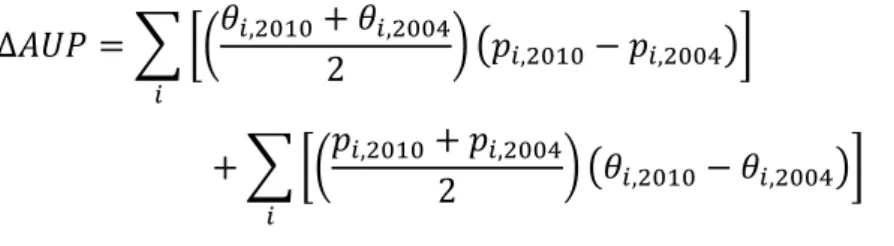
upgrading. These two effects are decomposed as follows (Griliches and Regev, 1995;
Asuyama et al., 2012).
∆ܣܷܲ = ൬ߠ,ଶଵ+ ߠ2 ,ଶସ൰൫,ଶଵ− ,ଶସ൯൨
+ ൬,ଶଵ+ 2 ,ଶସ൰൫ߠ,ଶଵ− ߠ,ଶସ൯൨
The first and the second term in the equation represent the intra-product upgrading and
inter-product upgrading, respectively. Table 4 summarizes the results.
As the import quantities for the HS product categories have been reported most of the times in both the number of products and weight, we have unified the unit of measurement in the number of products (dozens). However, as some of the product categories for the EU and Japan have only been reported in tons, these have been
separated out and the ∆ܣܷܸs for those product categories have been calculated and
Table 4: Weighted average unit prices and the decomposed sources
2004 2010 54.2 43.1 -11.1 -1.0 -10.1 -20.5% -1.8% -18.7% 49.9 75.9 26.0 15.7 10.3 52.2% 31.5% 20.6% 12.2 58.9 46.6 7.4 39.3 381.4% 60.2% 321.2% Japanese Yen 7,346.3 6,454.9 -891.4 -623.5 -267.9 -12.1% -8.5% -3.6%
Exchange rate (Yen per 1US$) 108.19 87.78
US Dollar 67.9 73.5 5.6 8.6 -3.0
8.3% 12.7% -4.4%
Japanese Yen 2,522.0 2,038.6 -483.4 -5,284.0 4,800.6
-19.2% -209.5% 190.4%
Exchange rate (1US$) 108.19 87.78
US Dollar 23.3 23.2 -0.1 -41.1 41.1
-0.4% -176.5% 176.1%
Sources: (1) data for US and EU are from World Trade Atlas, and Japan from the Ministry of Finance.
(2) Dollar-Yen exchange rate, US department of Commerce (http://www.mac.doc.gov/japan-korea/statistics/exchange.htm, accessed on September 28, 2012). Intra-product
upgrading
Inter-product upgrading
Note: The unit of measurement for most of the HS categories have been in the number of products (dozens or pieces), which have been converted into dozen in this table. However, there were some categories which are only reported in weight (tons) in the import statistics of EU and Japan. The ∆AUP for such categories have been calculated separately. It should be noted that for both EU and Japan such products occupy only a small share in terms of value in 2010 (8.7% and 0.5% respectively).
8.68%
Unit share
AUP
∆AUP
Total import value in 2010 from Vietnam (Million US$) 5,797.5 1,808.6 1,161.4 Japan Dozen 99.51% Tons 0.49% US Dozen 100% EU Dozen 91.32% Tons
presented separately in table 4. Nevertheless, as the share of such product categories has been quite small for both the EU and Japan (8.7% and 0.5% for EU and Japan,
respectively), we focus our analysis on the ∆ܣܷܸs that were either reported or
converted into dozens.
In 2004, the AUP for garments exported to the Japanese market was the highest, which was followed by the EU and US. In 2010 that for Japan and the EU were almost the same, while the US was very low. Garments exported to the EU and Japan both
indicate positive product upgrading during 2004 and 2010, while ∆ܣܷܸ has been
negative for US for the same period.
In more detail, garments exported to the EU market suggest that product upgrading has been most significant, which are the result of both intra- and
inter-product upgrading. Garments exported to the Japanese market are also of higher
value added (in dollar terms), which has been based mostly on intra-product upgrading. It should be noted, however, that for the positive changes in intra-product upgrading for the Japanese market is primarily due to the exchange rate effect. Garments for the US market, on the other hand, suggests both intra- and inter-product downgrading, where most of the reductions in unit prices come from inter-product downgrading.
Since the results differ significantly among the three major export destinations, we cannot say anything conclusive about the overall product upgrading performance of Vietnam’s export oriented garment industry. Considering that the export volume to the US is roughly three times larger than that to the EU and five times larger than to Japan, overall product upgrading in Vietnam may not as significant. However, this difference according to major destinations is what characterizes the Vietnamese garment industry, where inter-industrial enterprise performance varies to a significant degree, which is to some extent dependent on export orientation (Goto et al, 2011). Moreover, as garment suppliers in Vietnam have also changed their customer base, individual supplier’s product upgrading performance is also difficult to assess using such industry level statistics. For example, since the USBTA in 2001, orders for the Japanese market has constantly been crowded-out from their traditional suppliers’ production lines, and been overtaken in many cases by buyers who serve both EU and US markets.
3-2 Process upgrading (∆ࡽ
ࡸ)
Process upgrading is difficult to assess using only value-added or price data, as these do not necessarily reflect the changes in physical output per worker, or
operational-based physical productivity. When prices offered from buyers have been
decreasing while operational costs, particularly labor costs, are increasing, garment suppliers have no ways to survive other than to upgrade. As we have discussed in the previous section, while changes in average unit values for products for the EU market suggest significant upgrading both within and across product categories, there have been no convincing evidence indicating upgrading towards more higher value added products (inter-product upgrading) for exports for the US and Japanese markets; most buyers have either kept their orders in the same product category or shifted towards more lower value-added categories. Under such situations, however, garment suppliers can still survive by upgrading in terms of processes, which can be achieved by introducing new machineries and production technologies. These include the more intangible aspects of production processes such as managerial skills at both the shop-floor and management levels. While there are only a limited number of such studies, Goto et al (2011) report significant process upgrading in Vietnam’s export oriented garment industry serving for the EU and especially the Japanese market; an efficiency gain of around 30-50%. They also report that enterprise performance in process upgrading has been very unequal among suppliers, in which the degree of technological transfer from buyer to suppliers were important, which were determined by the supplier-buyer relationships.
The fact that international buyers played an important role in technological transfer, and thus process upgrading of export oriented suppliers, becomes more evident when they are compared with suppliers serving mainly the domestic market and where such transfer cannot be expected. Table 5 summarizes the key firm-specific attributes of the four different types of suppliers. In terms of the number of workers, export suppliers are the largest and domestic subcontractors the smallest. Domestic contractors and domestic original brand suppliers are in between, with similar firm sizes. Wages are highest for domestic original brand suppliers, followed by domestic contractors and export suppliers. The relative high wages at the domestic original brand suppliers may
have to do with what Fung et al (2007) refers to as capturing the “soft dollars”, which accrue in non-production related functions such as branding, designing, distribution and marketing. This is essentially a higher value-added function in comparison to the assembly process (CMT), and we will discuss this in more detail later. Wages at
domestic subcontractors are significantly lower than any other supplier type.6 Average
operational-based physical productivity is highest for export suppliers and domestic
contractors and is lowest for domestic original brand suppliers. In terms of shop floor production systems, the export suppliers and domestic contractors both apply a
progressive bundle system (PBS).7 Domestic original brand suppliers mostly apply an
individual production system (IPS), where one person performs all the processes and produces the entire garment without any division of labor in the process. However, most of the larger domestic original brand suppliers use the PBS.
Ideally the productivities of each garment suppliers should be evaluated and compared based on per worker value-added, however this has not been possible in our
6
While the relative difference remains similar, it should be noted that the wage data in Table 5 is from 2004 as comparative up-to-date data with a sample of more than two for each firm type is not available, and that the data is substantially lower than that in 2011 when field work for this paper was conducted.
7
The PBS is a system where the production process is divided among the number of operators in a particular production line and allocated along the production line so that each operator can finish their allocated work in the same amount of time. The semi-processed pieces are bundled together and passed onto the next process in the production line. Among the export-oriented suppliers, most still use the PBS; however, those with a large number of skilled operators have introduced the unit production system (UPS) where the semi-processed pieces are transported between operators by an automated overhead transport system. The introduction of this often leads to an increase in physical output per person; however, as it requires a substantially larger amount of investment, it does not pay off when wage levels are low (one manager we interviewed in 2011 said that wage rates must at least exceed VND3.5 million).
Table 5: Key Characteristics of Different Garment Suppliers
Export suppliers Domestic
subcontractors
Domestic contractors
Domestic original brand suppliers
Average number of workers 255.0 7.7 30.1 46.0
Average monthly wages 1016.9 577.4 1033.9 1325.0
Average productivity (pieces per operator, per day)(1) 15.36 10.44 14.89 6.19
Shop floor production system PBS(2) IPS PBS IPS/PBS
Number of observations 7 4 6 2
Note 1: Long-sleeve, woven men's shirt.
Note 2: PBS stands for "Progressive Bundle System". Source: Modified using Goto (2006 and 2011).
case as we do not have such supplier specific information that allows for consistent and statistically meaningful analyses. Nevertheless, in the case of an CMT based export oriented supplier, their value-added per worker should be highly correlated with this
operational-based physical productivity, as the CMT prices that global buyers are
willing to offer to those suppliers is very homogeneous across different suppliers within
the same product category8. This is most likely due to the competitive nature of the
garment industry. From our field work in both 2011 and 2012, a number of export oriented garment suppliers noted that buyers, particularly those serving the US market, are very sensitive to CMT prices in making sourcing decisions. For example, from interviews to two major Japanese buyers (trading companies) and a few Vietnamese suppliers, the CMT for a long-sleeved, men’s woven shirt for the Japanese market has been very stable over the last couple of years, floating at a rate between US$ 1.1 to 1.2. Likewise, the CMT for the same product is normally lower for the EU and US markets as buyers for these market offer an order with a larger quantity. While the CMT for these markets has also been quite stable, quite a few suppliers we visited in 2012 noted that their CMTs had been reduced since consumer demand in both markets had been stagnating, or in worse cases lost the orders they had in the previous years to other suppliers in other countries where wage levels were lower such as Bangladesh.
3-3 Functional upgrading
On the other hand, smaller private garment suppliers have evolved primarily around the domestic market, where product quality requirements are much less demanding. Most suppliers had no contact with foreign buyers, and thus there was literally no channel for technology transfer related to the production process. However,
these domestic market-oriented suppliers assumed from the outset more
knowledge-intensive functions such as product design, branding and marketing, and they have been accumulating experience in these functions through the local market.
8
If we can assume that a CMT based export suppliers’ income is solely derived from the CMT charges, then their total value added should be calculated as (total output) times (CMT) divided by the number of total workers. When the CMT charges are very homogeneous and inter-firm difference small for the same product categories, and the proportion of non-direct operators and direct operators are similar across suppliers, then the suppliers’ productivity should be roughly represented in the operational-based physical output. However, as we have no data to support this argument, this part should be treated with caution.
With an evolving middle-income class particularly in urban areas, Vietnam’s domestic-oriented garment sector is booming, providing good business prospects for these small private garment suppliers (Goto 2006).
Of course, not all domestic-oriented suppliers undertake such
knowledge-intensive functions, and this requires elaboration. In general,
domestic-oriented garment suppliers can be classified into the following three types. The first are private suppliers that produce low-quality products with simple specifications for the low-end volume zone (domestic contractors). They procure inputs from local markets and textile agents, and they produce garments which include imitations of foreign brand apparel. Most of the garments are highly homogeneous in terms of design and materials used. These products are typically distributed through local wholesale markets, where buyers are mostly small-scale secondary wholesalers and retailers for more remote markets. Such buyers make purchase decisions based on prices and other favorable business terms they can receive from suppliers, such as the provision of informal trade credit. The second are very small, micro suppliers who primarily undertake subcontracting orders from domestic contractors (domestic subcontractors). This second type of supplier functions just like CMT-based export garment suppliers, as input materials and specifications are all provided from the larger
contractors/buyers.9 Finally, the third type of supplier is those who have their own
branded apparel and produce products based on in-house design and specifications with a strong view to differentiate themselves from others (domestic original brand suppliers). Most have their brand names registered and their products are typically distributed through their own retail stores. “Domestic market-oriented suppliers” as used in this paper refers to this third type of supplier.
The dual structure based on market orientation was quite evident in the 1990s and early 2000s; however, this demarcation has been fading since the late 2000s. Large export-oriented garment suppliers were not actively pursuing business opportunities in the domestic market until the early 2000’s because of the relatively small size of the domestic market in comparison to the export market. However, quite a few have become interested in supplying the domestic markets and have started producing
9
in-house designed, branded items for the local market. As table 5 depicts, wage levels at domestic original brand suppliers has been the highest among the four different supplier categories, and it is possible that they have been able to capture the “soft dollars” as mentioned earlier, which in turn would work as a strong pull factor drawing in export suppliers into this market segment. However it should also be noted that there might be a significant difference in market conditions between export and domestic, where the former being much more competitive compared to the latter.
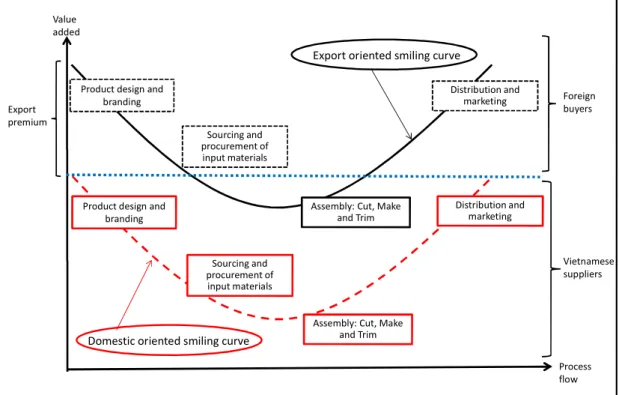
While export-oriented suppliers are much more advanced in terms of production technology, they lag behind in the more knowledge-intensive functions outside the CMT operation due to lack of experience. Figure 4 is a “garment smiling curve”, which describes the key functions in garment production and the associated relative value added along the process. The “product, design and branding” function and the “distribution and marketing” function are where market risks are mostly concentrated, and they are high value-added activities. They require knowledge that is intangible where experience becomes important. In contrast, the CMT function is lowest in terms of knowledge requirements and value added. The export suppliers and the domestic subcontractors have been engaged in this low value-added, relatively simple functional process.
The key functions in the marketing and distribution section embed significant risks that are primarily related to market uncertainty stemming from demand volatility. For instance, high levels of originality in product specification (design and materials used) that attract strong customer brand loyalty can differentiate products and avoid cost-based competition. On the other hand, when products with such distinctive specifications fail to attract consumer demand, they will become more difficult to sell and turn into non-performing inventory, which is very costly and results in significant loss. Suppliers catering primarily to the CMT functions face no such risks (Goto 2007). As such, one of the main challenges for export-oriented suppliers in moving up into these higher value-added functions lies in how to manage such uncertainties.
It should be noted, however, that the value added according to difference in functions are most likely different in relative terms, conditional to market orientation. For example, functions related to product specifications are of relatively higher value-added than the CMT function within the production flow serving the domestic
market, while it is difficult to compare that with the level of value-addition of a CMT function for the export oriented industry. As normally the quality requirements are more stringent for export oriented businesses than those for the local ones, it may well be the case that in fact a CMT function for the export market may embed more knowledge intensive functions and are therefore of higher value-added than the product specification functions for the local market (export premium).
4 Case Studies: Market Orientation and Differences in Functions
This section will describe three cases involving domestic original brand suppliers which have been successful in functional upgrading, followed with a discussion.
4.1 Case 1: Company A (domestic original brand supplier)
Company A was established in 1993 with about 30 workers and is headquartered in Ho Chi Minh City (HCMC). Before establishing the company, the president (Mr. N) worked for a knitted fabric manufacturing company and accumulated knowledge and
Distribution and marketing
Assembly: Cut, Make and Trim Sourcing and
procurement of input materials Product design and
branding Value
added
Process flow Source: Modified from Mudambi (2007) and Goto (2006 and 2011).
Figure 4. The Garment Smiling Curve: Functional hierarchy in the garment production-distribution flow
Distribution and marketing
Assembly: Cut, Make and Trim Sourcing and
procurement of input materials Product design and
branding Export premium Vietnamese suppliers Foreign buyers
Export oriented smiling curve
skills related to knitting and garment manufacturing. The total number of workers at Company A was 300 in 2011, of which 250 were line operators. It currently owns 14 retail shops which are located in HCMC, Da Nang and Can Tho.
Company A produces both knitted and woven fabric-based garments (50:50). In 1993, it started catering solely to the domestic market. Initially its operation was closer to that of a tailor, in that it produced products based on customers’ specifications. The company started exporting on a CMT basis in 2007 mainly for the EU and some to the Japanese market, and it currently exports about 30 percent of all production. It
attempted exporting under an FOB contract;10 however, this did not succeed, and the
company is now solely CMT based.
Its production is based on a PBS, and each production line includes about 20 operators. The average wage for an operator in 2011 was VND3 million (about US$150), and most workers are not from HCMC but from rural areas, particularly from the central region such as Nghe An Province. Most of the workers are in their thirties, and only few leave the company. However, as costs including wages and rental rates in HCMC are increasing very rapidly, Company A is now constructing a new plant in Long An Province with a view to relocating part or all of its production operation. Wage levels in Long An Province are lower than those in HCMC, but the supply of skilled workers is limited, which will present a bottleneck to expanding the supply capacity of the company in the future.
In terms of productivity, an average sewing operator produces about five
garments (long-sleeve, standard woven men’s shirt) per day.11 There were no
significant channels of technology transfer until the company started producing for the EU and the Japanese markets. While patterns and markers for domestic-oriented production are produced in-house, those for export are normally provided by buyers. Production for the export market requires higher levels of quality control and is more demanding.
10
An FOB (Free on Board) contract is a production modality where suppliers purchase input materials and thus payments include material costs. The FOB-type export is often regarded as having higher functionality and thus of high value added; however, as most of the fabrics and other input materials have been pre-selected and designated by buyers, in terms of functional contents it is often not substantially different from a CMT-based contract. See Goto (2003) and Goto (2007) for a detailed discussion on this.
11
In-house design and specification of domestic products are undertaken by designers who have graduated from design schools. As most of the products are sold through their own retail shops, designers and merchandisers actively seek feedback from the retail end on market information related to products and consumer preferences. This information is continuously used for the planning of product lines.
4.2 Case 2: Company B (domestic original brand supplier)
Company B was established in 1995 and its headquarters is located in HCMC. Prior to the establishment of this company, the president formerly operated a washing factory for denim cloths, and the experience he gained through this business was highly helpful in the production of garments.
Company B owns 10 production plants, of which 6 are in HCMC, 2 in Ben Tre, and 2 in Da Nang. The company is planning to further expand its production capacity by upgrading its Da Nang plant. These 10 plants employ a total of 2,000 workers, and each plant is relatively small with about 200 workers. The majority of the production is undertaken in-house, as quality control and monitoring of sub-contractors’ operations is difficult and time consuming. However, some of the simple and low value-added products are outsourced to small and micro garment suppliers on a piece-rate basis. Productivity in terms of output per operator varies according to the plant; the output per operator for high productivity plants (HCMC) is normally more than 10, while that for the less productive ones (Ben Tre and Da Nang) is somewhere between 5 and 7. PBS is the shop-floor production technology that is used in all plants.
Company B initially catered mainly to the export market (EU and eastern Europe), and it was not until 2002 that it started producing garments for the domestic market. Export businesses were coordinated by agents from Hong Kong and the overseas Vietnamese (Viet Kieu), and there was almost no technology transfer from these buyers. In 2011, almost all of Company B’s products are for the domestic market, and just under 5 percent are for the export market. The company president prefers to continue focusing on the domestic-oriented businesses as this market is more profitable and is growing at a rate higher than 20 percent per annum.
All of the company’s domestic-oriented products are distributed through its own retail stores. The number of retail stores has been expanding rapidly, with about 40
in 2006, 100 in 2009 and over 130 in 2011 (32 in HCMC, 21 in Hanoi and the northern region, 34 in the western region, 25 in the eastern and middle regions, and 21 in the Mekong delta region). As there are no local logistic service companies in Vietnam, the distribution of garments from plants to retail shops and between retails shops is directly undertaken by the supplier, Company B, with its own trucks.
The wage rate of an average operator in a plant in HCMC is about VND3 million (US$150). Wages for designers and merchandisers are higher, normally above VND5 million. Average wages in Da Nang and Ben Tre are lower by about 15 to 20 percent. Since the labor market in HCMC has become very competitive, the company has to continuously keep its wage levels comparable to the wages in other sectors; otherwise, the workers will quickly move to other companies or industries. Workers in Da Nang and Ben Tre are less mobile.
Company B currently runs six product lines, with different brand names. When it started producing in-house designed products in 2002, it recruited an Italian chief designer, who has been very valuable in establishing the current brand image. Currently all the designing and marketing functions are undertaken by Vietnamese merchandisers.
As a long term strategy, Company B is considering exporting original brand garments to neighboring countries including Cambodia and Laos, and eventually to Thailand and Singapore. However, its current focus is on the domestic market as demand growth has been robust and highly profitable.
4.3 Case C: Company C (export supplier)
Established in 1973, Company C is one of the largest and most competitive garment suppliers in Vietnam, and it formerly belonged to the state-owned Vietnam National Textile and Garment Corporation (VINATEX). It has been equitized and now is
officially a joint stock company.12
Company C is a typical export-oriented SOE, catering to Vietnam’s traditional exports markets including the US, EU and the Japanese market. This is one of the first SOEs that started exporting in the early 1990s with significant government support. Regarding its contractual modality, 80 percent of its output is produced based on a CMT
12
Even after equitization, it is quite common for the government (or VINATEX) to still own the majority of shares, with the rest owned by its employees.
contract, and the remaining 20 percent on an FOB contract. However, as almost all FOB-based production uses inputs which are designated by foreign buyers, in terms of functional contents this is almost equivalent to the CMT modality (Goto 2007). While the majority of its production is export-oriented, it nevertheless has catered a small portion (1-2%) of its production to the domestic market since 1988. Most of these products were residuals or defective items from an export order and were sold in their own retail outlets in major cities or through wholesalers/retailers with which Company C had distributorship agreements.
Company C’s headquarters is located in HCMC, and the total number of workers is about 20,000, of which 6,000 are workers in 100 percent owned plants and 14,000 in joint venture plants. The average wage of an operator is about VND4 million (US$200); however, this varies according to skill level.
There has been a significant increase in productivity in terms of physical output per worker (operation-based physical output); in the case of a standard long-sleeve men’s shirt, an average operator produced 35 to 40 shirts per day, which is the highest average in Vietnam. For some of the high value-added woven shirt production lines, the company has introduced the UPS (unit production system), which has further contributed to boosting productivity. Much of this process and product upgrading happened through production lines for the Japanese market. There is currently one resident Japanese technical adviser for the men’s suit product line. There is a clear difference in the quality requirements in the Japanese and the US markets; the CMT for a suit for the US market is around US$8.5 while that for the Japanese market is US$13. This difference stems from (1) larger orders for US market per style, and (2) more complicated specifications for Japanese orders. However, as it has become increasingly difficult to expand its operation and secure workers, Company C is planning to eventually shift its production functions to the middle region, around Da Nang.
As described earlier, Company C has been distributing and selling part of its export-oriented products to the domestic market; however, its main focus has been on the export businesses. This changed in 2008 as the management decided to actively pursue production and distribution for the domestic market. Because Company C had failed in the past with its in-house designed businesses and was left with a large amount of inventory, the company recruited several foreign designers, including a German
designer for its domestic men’s suit and a Swiss designer for the woven shirt production lines. The company’s current share of the domestic market is 12 percent (turnover base), and it is expected that this share will increase.
Nevertheless, Ms. D., chairwoman of Company C, notes that it is much easier to undertake CMT-based production for export because producing for the domestic market requires, in addition to the CMT function, different types of unconventional functions, particularly in design and marketing, in which Company C has only limited experience.
4.4 Discussion
The above-mentioned cases featuring two successful domestic original brand suppliers (A and B) and a competitive export supplier (C) highlight interesting attributes of different firm types. One of the characteristics that divide these two types is observed in their levels of operational-based physical productivity. While it is quite common to find domestic original brand suppliers utilizing an individual tailoring system, both A and B have a large number of workers and have been applying PBS. Export Supplier C mainly operates with PBS and some of its most advanced lines are equipped with a UPS.
Despite the fact that PBS is the dominant production system used, this
operational-based physical productivity level varies significantly in terms of the
physical output of long-sleeved men’s shirts, at 5 to 10 for a domestic original brand supplier and 35 to 40 for an export supplier. Neither domestic original brand supplier had received any technological transfer in the past.
Workers’ wages have been slightly higher at Supplier C; however, in general the difference among these two types of firms is not as evident as these cases may suggest; they seem to be determined more based on suppliers’ performance.
It is interesting to note that both companies A and B found it difficult to cope with CMT-based export businesses while Company C found a CMT-based contract much easier compared to the domestic market-oriented business where a full-package operation by the supplier was required. Both of the domestic original garment suppliers found it difficult to comply with foreign buyers’ requirements for quality, as transfer of technology and knowledge from their buyers was limited. Both have stagnated in terms of upgrading in process and products.
On the other hand, Company C has been attempting to change its business portfolio and produce more for the domestic market, but it was struggling to undertake the necessary functions that are knowledge intensive. For instance, materializing market information into product specification and design is one such important function. Collecting and processing raw market information into something intelligible require skills that are intangible and which are difficult to standardize and write usefully in manuals. Failure to produce marketable products will result in a much larger loss than a failure in an ordinary CMT operation. To overcome these issues, Company C recruited a few foreign designers specifically for its domestic market product lines, a strategy which has been observed in other similar export-oriented suppliers. Acquiring these types of skills requires experience gained primarily through experimentation in local markets, which is time consuming.
It would be important to note that the difference in market orientation (domestic or export) often play out quite significantly in terms of differences in product quality. Product qualities are determined by both the product specification and the production process; however, the degree to which the qualities prescribed in the specifications will be embedded in the actual product is almost entirely dependent on the technical level of the production process. The production technology of garments is such that substitutability of labor and capital is very limited, and mechanization of the process can only happen to a certain extent. In this context, what determines the quality of products stems from individual line operator’s skill levels, which are embedded not in machineries but in humans. These skill set are developed along with market demand, induced from foreign buyers in the case of the export oriented industry. Accumulation of such skills is also time consuming. Export oriented garment suppliers in Vietnam, particularly the competitive ones, have, through almost two decades of interaction with
the global value chains, already realized process efficiencies in terms of
operational-based physical productivity that are among the highest in the world.
While this certainly is impressive, these cases seem to suggest that Vietnam’s garment industry is at a turning point where it should advance into higher functions with initiatives originating internally. The next steps that are needed to sustain growth and development of the industry are much more challenging and different in nature. The industry will have to explore the possibilities for shifting its focus from the simple CMT
assembly type functions to more knowledge-intensive ones. Skills in human resources will become key. Moreover, a common bottleneck for domestic market-oriented businesses is that Vietnam’s domestic distribution system is still underdeveloped, which induces suppliers to establish their own retail networks. Division of labor in production and distribution is absent and is highly integrated, which tends to increase logistical costs as economies of scale cannot be achieved. Therefore, economic infrastructure such as well-functioning distribution systems will be needed to support development on this front. These issues are very much in line with the arguments on the “middle income trap”, which argues that middle income countries such as Vietnam should now shift from an externally guided development path under which they primarily undertake simple labor-intensive functions and refocus on how to enhance internal value creation (Ohno 2009).
5 Conclusion
The garment industry of Vietnam was formerly characterized by its duality based on market orientation, i.e., export and domestic. Export-oriented garment suppliers were typically SOEs and foreign-invested firms, while those for the domestic markets were mostly small, private companies.
Vietnam’s economy has been growing rapidly, particularly since the late 1990s, and the garment industry has been spearheading this growth as the country’s largest foreign currency earner in the manufacturing sector. The bilateral trade agreement signed with the US in December 2001 has further boosted Vietnam's exports, and the industry has boomed within value chains that are coordinated by foreign buyers. However, in the latter part of the 2000s, the industry began facing challenges primarily in terms of labor shortages. Enterprise performance started varying to a significant extent, and those who were successful in process and product upgrading grew robustly while those that were not were shrinking and/or getting wiped out of the market. In such conditions, a few export suppliers started looking into opportunities domestically.
With a booming economy and rapidly increasing income, Vietnam’s domestic market has become more lucrative. Traditionally, local demand for clothing was met by individual tailors; however, in the late 1990s, ready-made garments gained popularity.
While some domestic demand for ready-made garments was met by imported (smuggled) products from China, domestic private garment suppliers started producing garments for their local markets, and now there is significant agglomeration of such suppliers, particularly in HCMC. Some of the well-known apparel brands have established their own retail stores in major business districts and department stores, not just in HCMC and Hanoi but in other major cities across Vietnam.
For domestic suppliers, entry of new competitors (export suppliers) into the domestic market is a threat as they are more advanced in process technology and product quality. On the other hand, export suppliers are struggling to upgrade functionally and move into higher value-added functions which are knowledge intensive.
Vietnam is no longer a least developed country and has become a “middle-low income country” according to the World Bank’s classification, and so its domestic market potential for businesses, especially for commodities such as garments, has become increasingly attractive. With favorable demographic conditions where the relatively young age groups dominate, business potential in this market will continue to rise. In such a context, a major American apparel brand opened two retail shops in Ho Chi Minh City in November 2011, and another is being planned to open in Hanoi in
2012.13 This trend would be difficult to reverse, and as a result, competition will
increase. Whether Vietnamese garment suppliers can survive and continue to grow depends on their ability to address their bottlenecks in the different areas of upgrading as well as on whether value is created in the country’s domestic economy.
13
From
http://www.gapinc.com/content/gapinc/html/media/pressrelease/2011/med_pr_VietnamGuam.html, accessed on February 20, 2012.
References
Asuyama, Yoko; Chhun, Dalin; Fukunishi, Takahiro; Neou, Seiha and Tatsufumi Yamagata. 2012. “Firm dynamics in the Cambodian garment industry: firm turnover, productivity growth, and wage profile under trade liberalization.”
Journal of the Asia Pacific Economy. doi:10.1080/13547860.2012.742671
Fung, Victor K.; Fung, William K. and Yoram Wind. 2007. Competing in a flat world:
Building enterprises for a borderless world. New Jersey: Pearson.
General Statistics Office (GSO). Various years. Statistical Yearbook. Hanoi: Statistical Publishing House.
Goto, Kenta. 2003. “The textile and garment industry: an analysis of the underdeveloped distribution system.” In Vietnam’s industrialization strategy in
the age of globalization, edited by K. Ohno and N. Kawabata, 125–172 (in
Japanese). Tokyo: Nihon Hyoronsha Publishers.
________. 2006. “The organization of production and distribution in the ‘original brand’ apparel industry of Ho Chi Minh City: Knowledge-intensive functions and the internalization of production and distribution.” In The transformation of Vietnam’s
industry during the period of transition: Development led by the growth of domestic enterprises, edited by Mai Fujita, 105-136 (in Japanese). IDE Research
Series 552. Chiba: Institute of Developing Economies.
________. 2007. “The Development Strategy of the Vietnamese Export Oriented Garment Industry: Vertical Integration or Process and Product Upgrading?” Asian
Profile 35(5): 521-529.
________. 2011. “Starting Businesses through Reciprocal Informal Subcontracting: Evidence from the Informal Garment Industry in Ho Chi Minh City.” Journal of
International Development 23. doi:10.1002/jid.1780
Goto, Kenta; Natsuda, Kaoru; and John Thoburn. 2011. “Meeting the Challenge of China: The Vietnamese Garment Industry in the Post MFA Era.” Global Networks 11(3): 355-379.
Goto, Kenta, and Tamaki Endo. Forthcoming. “Upgrading, Relocating, or Going Informal? Local Survival Strategies in the Era of Globalisation: The case of the Thai garment industry.” Journal of Contemporary Asia.
Griliches, Zvi and Haim Regev. 1995. “Firm productivity in Israeli industry 1979–1988.”
Journal of Econometrics 65(1): 175-203.
Hill, Hal. 2000. “Export Success Against the Odds: A Vietnamese Case Study.” World
Development 28(2): 283-300.
Mudambi, Ram. 2007. “Offshoring: Economic geography and the multinational firm.”
Journal of International Business Studies 38(1): 206.
Nadvi, Khalid, and John Thoburn. 2004. “Vietnam in the Global Garment and Textile Value Chain: Impacts on firms and workers.” Journal of International
Development 16(1): 111-123.
Ohno, Kenichi. 2009. “Avoiding the Middle-Income Trap: Renovating Industrial Policy Formulation in Vietnam.” ASEAN Economic Bulletin 26(1): 25-43.