Enterprise promotion in the road construction
sector in a conflict-ridden area in Kenya : a
solution for the nexus of developmental
problems?
著者
Takahashi Motoki
権利
Copyrights 日本貿易振興機構(ジェトロ)アジア
経済研究所 / Institute of Developing
Economies, Japan External Trade Organization
(IDE-JETRO) http://www.ide.go.jp
journal or
publication title
IDE Discussion Paper
volume
670
year
2017-05
INSTITUTE OF DEVELOPING ECONOMIES
IDE Discussion Papers are preliminary materials circulated
to stimulate discussions and critical comments
Keywords:
micro and small enterprises, corporatization and formalization, socio-economic inequality, ethnic enmity and conflicts, the missing middle syndrome, stagnation of the industrial sector.JEL classification:
L74; M13; M14; N67; O14; O17*
Kyoto University/Kobe UniversityIDE DISCUSSION PAPER No. 670
Enterprise Promotion in the Road Construction Sector
in a Conflict-ridden Area in Kenya: a Solution for the
Nexus of Developmental Problems?
TAKAHASHI Motoki
*
May 2017
Abstract
Overcoming the missing middle syndrome by promoting growth of micro and small enterprises through training is a key to solve the nexus of problems including industrial stagnation, inequality, and ethnic confrontation in Africa. We focus on collaborative interventions by an international NGO and the Kenyan government to disseminate labor-based technology of road construction and strengthen managerial skills of youth self-help groups in a county ridden by an ethno-political conflict, called the Post-Election Violence. They tried to help groups formalize as corporations and develop their businesses through training. Our research reveals that ethnically homogenous groups might have better chances to obtain construction contracts but the reason would be trust among permanent members lowering internal transaction costs, rather than ethnicity itself. In conclusion, development of micro and small firms are to some extent determined by education of leaders and internal trust. Trainings could contribute in case groups are equipped with those conditions.
The Institute of Developing Economies (IDE) is a semigovernmental,
nonpartisan, nonprofit research institute, founded in 1958. The Institute
merged with the Japan External Trade Organization (JETRO) on July 1, 1998.
The Institute conducts basic and comprehensive studies on economic and
related affairs in all developing countries and regions, including Asia, the
Middle East, Africa, Latin America, Oceania, and Eastern Europe.
The views expressed in this publication are those of the author(s). Publication does not imply endorsement by the Institute of Developing Economies of any of the views expressed within.
INSTITUTE OF DEVELOPING ECONOMIES (IDE), JETRO 3-2-2, WAKABA,MIHAMA-KU,CHIBA-SHI
CHIBA 261-8545, JAPAN
©2017 by Institute of Developing Economies, JETRO
No part of this publication may be reproduced without the prior permission of the
IDE-JETRO.
1
Enterprise Promotion in the Road Construction Sector in a Conflict-ridden Area in Kenya: a Solution for the Nexus of Developmental Problems?
TAKAHASHI Motoki (Kyoto University/Kobe University)
Abstract Overcoming the missing middle syndrome by promoting growth of micro and small enterprises through training is a key to solve the nexus of problems including industrial stagnation, inequality, and ethnic confrontation in Africa. We focus on collaborative interventions by an international NGO and the Kenyan government to disseminate labor-based technology of road construction and strengthen managerial skills of youth self-help groups in a county ridden by an ethno-political conflict, called the Post-Election Violence. They tried to help groups formalize as corporations and develop their businesses through training. Our research reveals that ethnically
homogenous groups might have better chances to obtain construction contracts but the reason would be trust among permanent members lowering internal transaction costs, rather than ethnicity itself. In conclusion, development of micro and small firms are to some extent determined by education of leaders and internal trust. Trainings could contribute in case groups are equipped with those conditions.
Key words: micro and small enterprises, corporatization and formalization, socio-economic inequality, ethnic enmity and conflicts, the missing middle syndrome, stagnation of the industrial sector.
JEL: L74; M13; M14; N67; O14; O17
Introduction
Due to the drastic slow-down of African economic growth, various social, economic, and political problems concealed by high growth since the beginning of the 21st
century have once again started to garner keen attention. These include unemployment and underemployment (especially among youth), widening socio-economic inequality, de-industrialization or relative stagnation of the industrial sector, and destabilization associated with violence and conflicts often waged between ethnic groups.
It is important to recognize that these problems associated with growth in Africa are closely intertwined and this will be elaborated in the first section. The slow growth seen in the industrial sector, is apparently due to ‘the syndrome of the missing middle,’ where a small number of large formal enterprises and a few middle-sized formal ones co-exist with numerous informal micro and small enterprises which seldom grow in size, (see World Bank 1989; McCormick 1992, 1993, 1999; Sleuwaegen and Goedhuys 2002; Gelb et al. 2014)1. Large enterprises do not have very strong absorptive capacities for
labor, often due to their high capital-intensiveness (or imported-technology-intensiveness) whereas micro and small enterprises, which are mostly based on indigenous or easily acquired technologies, provide vast but unstable employment opportunities (Hart 1973). After the International Labour Organization (ILO) issued its revolutionary report on the informal sector in Africa in 1972 (ILO1972), views on the importance and vibrancy of the sector became well recognized. However, it remains true that informality continues to constrain the growth of micro and small enterprises since
2
legal protection for contracts with governments and private entities, and access to formal services such as credit from commercial banks and other service providers is limited (World Bank 1989). Moreover, the fact that numerous enterprises stay tiny and informal implies that they cannot exploit the merits of organized and thus efficient production to enjoy economies of scale. This missing middle syndrome is associated with income and asset inequality between stakeholders of large enterprises on the one hand, and those engaged in the micro and small enterprises and the unemployed and underemployed on the other hand. Such a situation is an important aspect in the stagnation of African industry. Overall, formalization, most often in the form of corporatization of micro and small enterprises leading to steady growth, is much desired. Nevertheless, we should take account of rationality of micro and small enterprises staying informal: procedures for formalization corporatization are too cumbersome (World Bank 1989); regulations and taxation seem to them too burdensome; investment in expansion and formalization will possibly carry too high risks (McCormick 1992 and 1993).
Compounding these difficulties are ethnic and other socio-cultural cleavages associated with the missing middle syndrome and overall income inequality. In some African countries, large firms are apparently controlled by particular ethnic groups, while other groups are often excluded. It seemingly leads to horizontal or inter-ethnic inequality, which has been indicated as a major cause for enmity and conflicts between ethnic groups (Stewart eds. 2008). Overall, the said difficult problems in Africa, socio-economic inequality and lack of employment, the missing middle syndrome and stagnation of industries, and inter-ethnic enmity and conflicts, are interrelated with each other, forming the nexus of the problems.
We, however, have to notice a new policy initiative and phenomenon connected with it in Africa. There have been efforts by governments, aid organizations, and some NGOs to strengthen human resources through vocational, skill, and managerial trainings and promote development and formalization (or corporatization) of micro and small industrial enterprises. What is an important fact is that these efforts are not totally abortive and have apparently resulted in successes, if not often. An example is the case in the Kenyan road construction sector. In the Kenyan case which this present paper discusses, some construction companies which have been newly corporatized companies equipped with members’ newly acquired skills originated from self-help groups under circumstances where multi-ethnic composition in each group has been encouraged after a large-scale inter-ethnic conflict called the Post-Election Violence (PEV). The case of those successfully developing construction companies would naturally induce us to expect they could be vehicles for a solution, even if small, for the above-mentioned nexus of the problems. Development of multi-ethnic corporations which have risen from grassroots, through filling the missing middle, could lead to not only reversal of de-industrialization but also reduction of socio-economic inequality and bridging between ethnic groups once opposing each other.
This paper aims at examining whether such expectations of ours are correct in the reality of the post-PEV Kenya. In this paper, the first section draws on relevant literature and explains the background related to a case of development and corporatization of small road construction firms in an area ridden by the PEV, namely, Uasin Gishu county2 (see Map 1). The situation in the county (then district) at the time
of the PEV was a typical example of the nexus of problems. On the basis of this background the section finally presents the research questions this study seeks to answer. In the second section, interventions undertaken by an international NGO and the Kenyan government are introduced. The NGO worked to transfer a modality of labor-based technology, called the Do-nou technology, and encouraging Kenyan beneficiaries to form multi-ethnic self-help groups after the PEV. Also, it technically and financially collaborated with a training institute of the Kenyan government to advance skills and
3
know-how of members of self-help groups and help them corporatize their groups as formal road construction firms. The section three presents methodologies and results of this author’s research based on interviews with beneficiaries of the NGO supports who experienced the training at the government institutes. The section four discusses whether our expectations are correct in the reality in Uasin Gishu. The final section (Conclusion) summarizes findings and arguments of the paper and presents future direction of studies required to complement limitations of the author’s research.
Map 1 Uasin Gishu county (district) in Kenya
Courtesy: Karte: NordNordWest, Lizenz: Creative Commons by-sa-3.0 de, CC BY-SA 3.0 de, https://commons.wikimedia.org/w/index.php?curid=38844206
1. Background of the Study: A Case of the Nexus of Problems in Uasin Gishu, Kenya 1.1. The nexus of problems in Africa
As Gelb et al. [2014] suggested with regard to ‘the missing middle’ syndrome, complex structural connections between various political, social, and economic problems in Africa are a result of Africa’s unique politico-economic history which includes the colonial period. While it may seem that the widening socio-economic inequalities in African countries were caused by the high economic growth which began at the beginning of the 21st century, inequality has long been a problem in a number of African countries.
Generally speaking, socio-economic inequalities are very likely connected with the following factors: distribution of production means (physical capital, land, etc.); access to resources from government, formal institutions, and foreign aid; human capital (knowledge, skills, and technology); geographical/climate advantages; and livelihoods or occupations.
In Sub-Saharan Africa, the state, for the most part, was exogenously formulated through colonial division. The governance structure of each colonial state was imposed by colonial rulers. In addition, though the situation varies from region to region, the market system was far less developed than on other continents largely due to adverse natural conditions and low population density. Market oriented activities such as cash crop production and manufacturing were often of limited scale, and services, therefore, were to a large extent introduced by colonial rulers. Thus, a larger proportion of economic and social interests were created or fostered by the colonial state. This led to the formulation of an economic structure in which highly productive enterprises, applying modern technology, coexist with numerous micro and small economic entities with conventional production technology. This is the historical origin of the missing middle
4 syndrome (Gelb et al. 2014).
After independence, state power was, in most cases, seized by a group of African elites. Of significance to our study is the fact that the ethnic composition of the new African elites was often very different from that of total population. During the colonial period certain ethnic groups were more educated, and developed closer contacts with the state and market economy than others. Therefore, they generated a larger number of political and economic elites than other groups. These first-generation elites, mostly educated in the language of the colonial rulers, eventually led the liberation movements and took the initiative in negotiations with colonial powers for independence. These liberation leaders, in many cases, became the ruling elite of the newly independent countries, and their ethnicity was often not proportionate to that of the general population. In many cases minority ethnic groups represented by their elites in the new independent governments, had more influence and access to economic interests previously created and controlled by the colonial state than others. While the new African elites, by means of their influence, sought to capture and increase their own interests, they also tended to favor their own ethnic groups through public resource distribution including the development of socio-economic infrastructure such as schools, roads, clinics, and so on.
In another way, this ethnically-biased elite capture of state resources led to collusion between the government and state-owned enterprises and heavily-protected large corporations, often affiliated with multi-national corporations. Biased advantages inclined to those large formal enterprises, leaving micro and small enterprises to engage in local economic activities which a number of ordinary people engaged in but stayed informal. Thus the dualist economic structure of colonial origin was maintained. The ethnically based elite-capture reinforced the missing middle syndrome. Subsidy and protection by the government seldom resulted in accelerated industrialization but rather caused inefficiency and said de-industrialization.
On the other hand the capture by elites led to aggravation of horizontal or inter-ethnic inequality and grudges on the side of disadvantaged inter-ethnic groups, resulting in inter-ethnic competition, enmity, and conflicts.
From this we can see the historical formulation process of the said nexus of problems in independent Africa: linkage between stagnation of industrialization, the missing middle syndrome, inter-ethnic inequality and rivalry.
1.2 Formulation of the nexus of problems in Kenya
Kenya, although a typical African country, has a nexus of problems but with some unique attributes. During the colonial period, a small population of European settlers seized fertile land from the African population, confiscating it and forcing them onto “native” reserves. After the initial settlement, market economic activities serving the European settlers’ interests very rapidly developed. At the time of independence in 1963, abundant commercial and economic interests over which they could exert influence were available to the new African political elites. An important factor of the political economy in this newly-born Kenya was that the Kikuyu ethnic group, through various channels, had a dominant influence over resource distribution. The Kikuyu people were the most populous of a many groups (roughly twenty percent), most educated (through missionary schools with some elites having acquired even post-graduate degrees in the West), most affected by persecution by the colonial government, and most exposed to the colonial market economy. All these factors contributed to the Kikuyu elites’ grip on state power after independence, clearly disproportionate to their share of total population.
The Kikuyu elites, led by the first president Jomo Kenyatta, obtained abundant resources such as business stakes in state-owned enterprises, and large-scale farms and ranches which European settlers leaving Kenya were only too willing to sell. It is said
5
that the Kenyatta family became the largest land-owner in the country while distributing other large land plots to henchmen and past political rivals to win them over. Though the beneficiaries of large land plots spread across different ethnic groups, the Kikuyu elites seemingly acquired a disproportionately large share.
Since the beginning of independence, the Kenyan government, controlled by political elites, has received abundant benefits from large formal firms taking advantage of political influence. On the other hand, in the informal sector, though vibrant economic activities were found as the famous ILO report indicated (ILO 1972), informal economic entities, either individuals or micro-enterprises were mostly ignored or sometimes oppressed by central and local governments and seldom developed into formal firms. Progress in Kenya suffered from the missing middle syndrome. The informal sector became a space that, to some extent, accommodated the unemployed and underemployed often immigrating from rural areas which faced increasing land shortage due to rapid population expansion.
Jomo Kenyatta and the Kikuyu elite surrounding him were faced with intra-ethnic pressure from ordinary people who had suffered persecution, land deprivation and shortages, and destitution in the colonial era to distribute resources more equitably (Berman and Lonsdale 1992). The Kikuyu elite attempted to broaden all-weather road networks which could help small farmers increase their cash crop production in the Central Province, the so-called Kikuyu land. Also, and this is very important to understand the Kenyan political and economic history of the time is that the Kikuyu elite strongly supported their co-ethnic landless people to migrate and settle in other provinces, especially the Rift Valley. Concretely speaking, the Kenyatta administration and the Kikuyu elite assisted would-be settlers through public financial schemes and private assistance to buy small land plots divided up from large former European land holdings (Throup 1987). While people from other land-thirsty ethnic groups, such as Luhya, Luo, and Kisii, facing high population density also joined the settlement schemes, the Kikuyu people benefitted most.
Kikuyu and other immigrant populations moving to settle in the Rift Valley rapidly increased from the 1960s to the 1970s. Uasin Gishu was one of the most attractive destinations because of its mild climate with adequate rainfall, fertile land, and relatively high availability of land plots open to purchase. Uasin Gishu had been attractive to European settlers and very large farms were established in the colonial days some of which became available after the withdrawal of Europeans following independence. As a result of immigration by people from various ethnic groups, Uasin Gishu became a multi-ethnic district as Table 1 shows. It is worthy to note that Kikuyu was the second largest ethnic group in terms of population and ‘immigrants’ accounted for nearly half of the population as early as 1969.
6
This massive inflow of immigrants of Kikuyu and others was a source of serious concern and fear for the people who had resided in the Rift Valley long before colonization, such as Kalenjin-speakers and Maasai. It is said that fear of marginalization and grudges against “immigrants,” especially Kikuyu, unified Kalenjin-speaking groups into one Kalenjin ‘Super-tribe’ from the eve of independence through the 1970s (see Lynch 2011). Despite this, the Jomo Kenyatta administration was successful in suppressing and placating the opposition of Kalenjin, Maasai, and others, the so-called “indigenes.” However, after Daniel arap Moi, belonging to Tugen, a sub-group of Kalenjin assumed the presidency succeeding Jomo Kenyatta’s death in 1978, he and Kalenjin elites supporting him attempted to push back the land acquired by other ‘immigrant’ groups (Branch 2011; Ogot 2012). From the 1980s on they mobilized measures, sometimes illicit and violent, to take back their ‘ancestral land.’ These attempts included forcible expulsion of “immigrants,” notably those without title deeds for their land plots (Branch 2011) as well asthe illegal transfer of public land to Kalenjin elites (GOK 2004). The whole of the Kalenjin community did not necessarily support this push back as ordinary people rarely benefitted from it (Klopp 2002; Lynch 2011).
The situation after independence described here was a formulation of the Kenyan version of the African nexus of problems. It led to a critical conflict which seriously jeopardized the existence of the Kenyan nation itself.
1.3 The road to the Post-Election Violence (PEV)
Tense inter-ethnic relations in the Rift Valley became apparent and far more serious when transition to multi-party democracy started in 1991. The Kalenjin population in total was not predominant in electorates even if allied groups such as Maasai were included. The Moi administration introduced a rule for presidential elections that said the winner must obtain 25 percent of the votes in five out of eight provinces. While it was effective to weaken other presidential candidates whose supports base was limited to each ethnic groups of his or hers, the Moi and his group had to be desperate to secure 25 percent votes in the Rift Valley, their ‘ancestral land’ which had become multi-ethnic. Moi and elites in his administration started to expel ‘immigrants’ or deter their voting. Violent attacks against Kikuyu, Luo, Luhya, or Kisii residents in the Rift Valley by organized gangsters, very likely from the Kalenjin and Maasai communities were initiated when the multi-party general election approached in 1992. It is believed that the gangs were instigated and supported by political elites close to Moi who were also either Kalenjin or Maasai. Some of the elites made outright claims that the Rift Valley was the Kalenjin or Maasai homeland and ‘immigrants’ did not have any entitlement rights to ownership. However, this claim was not fully embraced by the
7
whole Kalenjin community (Lynch 2011), but probably effective enough to attract thousands of land-thirsty unemployed youth to wage violence against their neighbors from other ethnic groups.
Starting with large-scale violence on the eve of the 1992 election, until the PEV in 2007-08, violent clashes intermittently occurred between ‘indigenes’ i.e. Kalenjin and Maasai on the one hand and ‘immigrants’ such as Kikuyu, Luhya, and Luo on the other. Some incidents were believed to have been planned by political elites, while others were rather more spontaneous. Thousands of people were killed, hundreds of thousands of ‘immigrants’ were displaced and a percentage of those displaced lost their land to ‘indigenes’ through forced sales at a very low price or just simply kicked out. But even so there were not many in the Kalenjin community who successfully obtained land and this led to frustration among the general Kalenjin populace, especially among the Nandi sub-group, the most populous group in Uasin Gishu and the second largest among Kalenjin-speakers as a whole (Klopp 2002).
The Nandi people had been the most populous group in many areas of dispute, including Uasin Gishu, long before colonial times. It was somewhat surprising that elites from other sub-groups such as Tugen (Moi’s sub-group) and Keiyo were able to seize important business and economic interests such as large-scale farms in those areas. In fact, Nicholas Biwott who was Moi’s right-hand man and Keiyo’s leading political elite was able to expand their land ownership during a series of violent clashes after 1992. Such ‘intrusion’ invited frustration on the part of Nandi people to other Kalenjin sub-groups such as the Tugen and Keiyo (Klopp 1992).
Internal friction among the Kalenjin escalated into a split of the political elites in the presidential election of 2002. Prior to the election, Moi stepped down due to constitutional constraints on a president serving two terms and recommended Jomo Kenyatta's son, Uhuru Kenyatta, a young Kikuyu businessman, as his successor. Other Kalenjin leaders such as Biwott and William Ruto, a rising Nandi leader, opposed this move. Ruto cast his support behind the veteran Kikuyu politician, Mwai Kibaki. Kibaki won the electoral competition against Uhuru Kenyatta and others, by successfully gaining the support of political leaders from other major ethnic groups including the Luo led by Raila Odinga and the Nandi led by Ruto.
Kibaki, however, broke his promise to form a government based on more power sharing among ethnic groups and formed a cabinet dominated by Kikuyu politicians close to him. This move angered the other ethnic groups and this anger only deepened in 2005 when Kibaki proposed constitutional reforms which further betrayed the people’s desire for a more democratized political regime. The campaign during the constitutional referendum on Kibaki’s proposal became a literal battle between the Kikuyu and non-Kikuyu. Kibaki’s proposal failed to obtain a majority support in the referendum. Fearing a total loss of power in the next election, the Kikuyu elites drove Kibaki to reconcile with Uhuru Kenyatta to unify Kikuyu political forces for the 2007 presidential election. This political unification strengthened the Kikuyu but also further strengthened the antipathy of other ethnic groups against them. In Uasin Gishu, in particular, the tension between Kalenjin and Kikuyu became dire.
As the 2007 general election approached, Odinga successfully built an inter-ethnic alliance among non-Kikuyu communities and emerged as the strongest competitor against the Kikuyu forces of Kibaki. Though Odinga was forecast to win the presidency and most exit polls agreed, the election commission declared a victory for Kibaki and he was sworn in for a second term. This brazen rigging of the election provoked Odinga supporters into protests in the streets and violence spread widely in the country. Thus began the two-month long conflict we now know as the PEV (Post Election Violence).
8
district was well known for its muti-ethnic composition and had a large number of Kikuyu ‘immigrants.’ The Kikuyu residents became the targets of organized attacks by some thousands of Kalenjin, especially the Nandi. Ruto, along with other Kalenjin and Maasai leaders claimed that Kikuyu and other immigrants were not entitled to own land in the Rift Valley and complained of the unfair dominance of Kikuyu in the government which further marginalized the Kalenjin in general and Nandi people in particular. There is a strong presumption that Ruto, in collaboration with those powerful in the Nandi community, planned and organized the attacks. The PEV caused 1,133 deaths, numerous injuries, and some hundreds of thousands were at least temporarily displaced (CIPEV 2008). Ruto, was therefore, a leading suspect when a trial was arraigned at the International Criminal Court (ICC).
During the course of the PEV, the Kikuyu people mobilized a gangster organization called Mungiki and made massive counter-attacks killing hundreds of Kalenjin and Luo people. In his role in organizing the attacks by Kikuyu people, Uhuru Kenyatta also became a suspect at the ICC.
There was growing fear that the PEV could drive Kenya, as a country, into collapse and various efforts were made by stakeholders both at home and abroad to save it. It was intermediation, led by Kofi Annan the former UN Secretary General, that successfully brought about a reconciliation agreement between the Kibaki camp and the Odinga camp to form a Government of National Unity (GNU) with Kibaki as the president and Odinga assuming the newly set up post of Prime Minister. Ruto and Uhuru Kenyatta also supported the reconciliation and joined the GNU as ministers.
Kenyan politics after the PEV followed a very complex process. Both Ruto and Uhuru faced the risk of being charged as international criminals and thus isolated. Clashes between Ruto and Odinga over Ruto’s corruption scandal triggered a separation of the two. Ruto and Uhuru shared common interest in securing political advantage in the 2013 presidential election to decide Kibaki’s successor. The two formidable enemies, at the time of the PEV, joined now as allies to compete against Odinga. Elites of both Nandi, if not the Kalenjin as a whole, and the Kikuyu came to find common interests and a need to co-exist with each other. A coalition between Uhuru and Ruto successfully enabled them to win the 2013 presidential election, which made Uhuru the president and Ruto the vice-president.
These political developments brought peace, at least on the surface, to Uasin Gishu. The displaced ‘immigrants’ could return home and resume normal life, which meant the purported expulsion of ‘immigrants’ was largely abortive in the case of the PEV. In the wake of the PEV, violent clashes and even skirmishes between the Nandi and Kikuyu all but disappeared, however trauma and implicit tension remained. The ordinary people of Uasin Gishu seemingly regret and are fed up with that series of violent episodes and now try to avoid even small disputes with other communities. Numerous social activities by local activists and interventions by governments, aid agencies, and international NGOs to reduce tension have ensued. These include the road construction training we focus on in this paper, designed to consolidate peace and reduce poverty and unemployment, especially of the youth, all elements which were regarded as among the root causes of the PEV.
Of all the wide-spread peace-building activities, most remarkable is the encouragement of the organization of multiple ethnic youth self-help groups. The intervention which we focus on was put forward by an NGO attempting to promote the engagement of youth self-help groups in road rehabilitation activities and through training and encouragement to develop into formal multi-ethnic corporations.
1.4 The nexus of problems and Uasin Gishu
9
society into ethnic conflict. The cause of the situation was not simply due to the multi-ethnicity of residents in the district (now county). The official inquiry into the PEV indicated that inequality of land distribution between ethnic groups, youth unemployment, as well as personalization of the political, especially presidential power and the proliferation and politicization of violence were the root causes of the PEV (CIPEV 2008).
Distribution of land, the most important production means in villages in Uasin Gishu remained very unequal, as large tracts of land from the Europeans’ land grab of colonial days remained intact, and only a small proportion of the European farm land was divided up as part of the settlement schemes. In this county, the missing middle syndrome in agriculture was very conspicuous.
But that is not all, this polarization or inequality of land distribution in Uasin Gishu did not follow simple ethnic divisions. The large-scale (once European) farms left intact in the county were apparently now owned by Kalenjin political elites. The inequality of land distribution therefore seemingly a Kalenjin internal problem. One should note that there is a strong suspicion that Moi, Biwott, and other Tugen/Keiyo elites are among largest land owners in Uasin Gishu (Klopp 1992; and the author’s interview with aid experts in the county, September 2010).
In contrast with this, our field research from 2012 to 2013 in a village where ordinary Nandi farmers make up the majority of residents, shows that land plots are quite small, on average approximately 1.1 acre. On the other hand, average land plots in a village where ordinary Kikuyu farmers (most being ‘immigrants’ or children of immigrants) are the overwhelming majority, are not substantially different (approximately 1.8 acre). It would be somehow difficult to sustain a household on such a small farm whether 1.1 acre or 1.8 acre, especially when a plot comes to be divided due to inheritance and so on. As a matter of fact, in both villages young people are opting to live away from their home villages in an attempt to find better economic opportunities. One major difference between the two groups of ordinary people is that despite continued threats by Kalenjin political leaders to expel them, repeated till the end of the PEV, a far larger proportion of ordinary Kikuyu farmers feel more secure about their entitlement to land than Nandi. The reason for this ironical difference in sense of land security is presumably that Kikuyu farmers generally obtained official registration for their land plots thanks to settlement arrangements, but this was not quite the same for the Nandi people who did not benefit from the elites or government assistance to acquire land plots. This perhaps explains why Kikuyu farmers are better able to concentrate on agricultural activities and are more successful overall. Both ordinary Nandi and Kikuyu villagers are faced with limited plots of land and the risk of destitution but Kikuyu farmers are in a slightly better situation than the Nandi (Takahashi & Hasegawa 2017).
Consequently, ordinary Nandi villagers tend to begrudge both elitist large-farm owners, most from other Kalenjin sub-groups such as Tugen and Keiyo, with no land security problems due to lack of official registration or farm size; and ordinary Kikuyu people with more land security and more agricultural success (Takahashi & Hasegawa 2017). Although during the PEV, Nandi political leaders headed by Ruto intentionally instigated and manipulated only a grudge towards Kikuyu and other ‘immigrants’ to mobilize the mass of Nandi people, one of Moi’s large farms was also attacked by arsons (CIPEV 2008) and some Keiyo residents became targets of antipathy in a village where Nandi people were the majority (Takahashi & Hasegawa 2017).
10
Photo 1: a rural road outside of Eldoret which becomes unusable for ordinary passenger cars and pick-up trucks after a heavy rain. To alleviate the difficult situation of ordinary people in villages in Uasin Gishu, it is imperative to initiate multi-dimensional transformation of economic activities: such as an increase in land productivity and employment creation. In order to address this, poor infrastructure, especially transportation networks, should be improved and more non-agricultural employment and income opportunities need to be created. In Uasin Gishu, the condition of roads, especially rural feeder roads, is very poor. According to the author’s observations from 2011 to 2015, there are large differences in the condition of rural roads between counties in the former Central Province (Kikuyu land) and Uasin Gishu. In the former Central Province, paved roads with asphalt or concrete have been constructed even distances from the national highways into rural areas and roads without asphalt or surfaced roads have been improved to be passable in all-weather conditions. However, most rural roads, even those directly connected with the national highway, are not passable after heavy rains in Uasin Gishu (see Photo 1)
The poor road infrastructure in rural areas outside the Kikuyu land in general and Uasin Gishu in particular is one of the manifestations of regional and inter-ethnic inequalityrivalry. Poor roads have hampered the development of various socio-economic activities such as market-oriented agricultural production, the ability to commute for employment in cities and towns, and even education.
With regard to non-agricultural employment, Eldoret, the capital of Uasin Gishu county and the fifth most populous city in Kenya, is the main provider of opportunities. The population of greater Eldoret municipality was 289,380 or 32.3 percent of the total population of Uasin Gishu (894,179) in 2009 (KNBS 2010). The main industrial activities in Eldoret are relatively large-scale enterprises such as post-harvest processors of agricultural products, dairy goods producers and textile makers, many once state-owned, and now owned by Kalenjin political elites such as the Moi family, Biwott and others. However even these large enterprises do not seem to be able to provide sufficient employment opportunities to absorb the rapidly increasing labor force in the city. While the population of Uasin Gishu increased 4.7 times between 1969 and 2009,3 Eldoret’s population grew 15.9 times during the same period (MFEP-SD
11
1970 and KNBS 2010) 4. As labor-intensive, vibrant middle-sized formal enterprises
are not active in the city, many workers have little choice but to stay in the informal sector in the city and surrounding areas. In fact, those able to find jobs in informal or semi-formal street manufacturing such as metal work or furniture production, appear to be relatively fortunate5.
Interventions by the government and the international NGO which we will discuss in detail in the next section aim at developing road construction enterprises which utilize labor-based technology and could have the dual effect of improving road conditions while creating employment and income opportunities. It is anticipated that this could be a solution to the difficulties mentioned above in the locality of Uasin Gishu. In addition, the beneficiaries of the NGO’s assistance to promote corporatization are to be multi-ethnic. Therefore, the interventions may result in reinforcement of reconciliation and peace-building through inter-ethnic collaboration leading to
threefold effects in the solving of difficulties. Finally, a solution to the missing middle syndrome in African industrial structure is possible if the development of newly formalized and corporatized companies from informal groups is successful, which would mean a fourfold outcome could be perhaps be expected.
1.5 Research Questions: External Interventions, Enterprise Developments, and Inter-Ethnic Relations
Having discussed the varied backgrounds of this study and our fourfold expectations for intervention by the international NGO and national and local
governments as noted above in sub-section 1.4, our research questions can be specified as follows:
1. Questions regarding the success of road construction enterprise promotion.
1.1 Were interventions by the NGO and Kenyan government successful in generating local implementation agents and corporations which could create employment and engage in road construction work.
1.2 How were the interventions by the NGO and governments effected and were they successful in promotion of corporatization (and thus formalization) and development of former youth self-help groups in Uasin Gishu, Kenya.
2. Questions of inter-ethnic relations with regard to enterprise development.
2.1 Do successfully corporatized and developing enterprises contribute to the enhancement of inter-ethnic reconciliation and collaboration in Uasin Gishu; 2.2 How does the ethnic composition affect the degree of success of corporatization
and development of enterprises in the county;
2.3 How effective do the enterprises and corporations in question apply meritocracy and disciplinary management presumed to be effective in overcoming ethnically-biased grouping of people and thus inter-ethnic enmity in the county.
The author believes these questions, on their own, lay claim to the significance of this study. Firstly, there have been numerous socio-political studies on outcomes in post-conflict areas in Africa, but there is a dearth of studies on business activity and corporate development. Secondly, although there have been a limited number of studies on corporatization and formalization of informal entities in industries in Africa, the acceptance of the missing middle syndrome has constrained researchers from looking further and thus signs of change in the syndrome are not readily apparent. Empirical examinations have been very limited, and this is especially unfortunate since African governments have been encouraged to involve themselves in promotion of this kind of business activity since the 1980s (World Bank 1989), Thirdly, there are uncountable studies on NGO interventions and their role in social development in Africa, but very
12
little on assistance of corporatization and formalization of enterprises. Fourthly, the NGO in this paper has been trying to transfer this unique road upgrading technology called Do-nou technology to Kenyans, but social scientific studies on their activities are almost nil except for that done by the NGO members themselves. Fifthly, while some work has focused on relations between growth, development and productivity on the one hand and multi-ethnic make up of members on the other (e.g. Easterly and Levine 1997; Miguel and Gugerty 2005; Miguel et al. 2006; Hjort 2014), findings vary and there has been little focus on success in the corporatization of private enterprises, therefore further analysis is not only worthwhile, but needed.
2. Assistance by an NGO and the Kenyan Government to Advance Road Construction Skills, Know-how and Corporatization
2.1. Labor-based road construction technologies and youth unemployment.
There was a consensus among Kenyan government officials and aid agencies, as early as the 1980s, that labor-based technology was the best measure to solve problems of underdevelopment of rural roads and unemployment, especially that of youth (KIHBT-KTC 2015). This is all the more true, if fiscal constraints are taken into consideration, since capital-intensive road construction using heavy machinery is inappropriate.
Therefore, the Kenyan government, supported by foreign aid, has been developing an institutional framework, under the ministry in charge, to train young people in the skills required to engage in labor-based technologies of road construction (including maintenance, upgrading, and rehabilitation). The Kisii Training Centre, Kenya Institute of Highways & Building Technology, Ministry of Transport and Infrastructure (hereafter KIHBT-KTC) is an important venue to implement training programs to develop labor-based road construction technologies and related know-how. KIHBT-KTC has been conducting various training programs for a wide range of people recruited from the private sector, especially youths, to disseminate labor-based road construction technologies throughout Kenya.
2.2 An International NGO’s Engagement and Do-nou Technology.
Do-nou, in Japanese, is literally a bag filled with soil. It is usually used in flood prevention, e.g. when a river bank is in danger of collapse. A Japanese NGO, called Michi-Bushin-Bito (literally ‘a road constructor’ in old Japanese) started to apply Do-nou
technology to upgrade muddy roads into all-weather specification. If a number of Do-nou are lined up in orderly manner, roads that were mired in mud in the rain, could withstand even the weight of lorries and never became unpassable as long as a degree of maintenance was kept up. Do-nou technology can change muddy roads into all-weather roads.
13
Photo 1: Female villagers preparing Do-nou by filling gunny bags with murram (a clayey material used for road building) (http://corekenya.org/gallery/)
Photo 2: Do-nou’s are lined up after being flattened (http://corekenya.org/gallery/) to underpin an all-weather road
Do-nou technology is appropriate for labor-based projects in local African communities. Usually, 45cm x 60cm gunny bags are used to wrap murram, a form of laterite (clayey soil). The material, though often locally available, is not always easy to obtain and therefore local markets have been generated. Do-nou technology is very much manual-labor-based and not too difficult to learn and has the potential to create sustainable employment. Also, as long as regular maintenance is conducted, roads with Do-nou are very durable
(http://corekenya.org/do-nou-technology/).
CORE, the Kenyan branch of the Japanese NGO, Michi-Bushin-Bito, began
disseminating Do-nou technology widely in Kenya several months after the PEV, including in conflict-ridden areas. They conducted road improvement and rehabilitation
demonstrations using Do-nou technology in Uasin Gishu and have instructed 36 self-help youth groups in the county6. Staff members of CORE, headed by Japanese executives, taught not only the merits of road rehabilitation, but also the potential expansion of economic opportunities, such as production of high-value added horticultural crops which need smooth, safe and timely transportation. Also, in conflict-ridden areas like the villages
14
in Uasin Gishu, CORE executives appealed to young participants about the importance of reconciliation and collaboration beyond ethnic differences. They also emphasized the benefits of sustainable development through corporatized formal enterprises and the significance and necessity of burdens such as tax payments associated with formal registration as a requirement for the betterment of the society as a whole7.
Moved by CORE’s presentation and persuasion, Do-nou technology is recognized by Kenyan Rural Road Authority (KeRRA) as an appropriatemode of labor-based road construction technology. KeRRA provided assistance with youth employment promotion budgets for road rehabilitation and some Uasin Gishu self-help groups supported by CORE have already obtained road construction contracts. CORE also stepped in to financially assist their activities to prepare and undertake construction, as KeRRA’s disbursement was delayed8.
2.3 Training by Collaboration between KIHBT-KTC and CORE
CORE further attempted to promote qualified self-help groups by helping to train their representatives in a systematic way, eventually aiming at corporatization of the self-help groups. To this end, in 2012, the NGO started to select and send qualified people from the youth self-help groups to ILO-sponsored training by KIHBT-KTC so that the groups would be qualified as contracting companies with the government for road construction projects. The training at KIHBT-KTC and subsequent registration as a firm are conditions that must be met to be formally registered as a qualified construction company with the National Construction Authority (NCA).
Following KeRRA’s recognition of the value of Do-nou technology, it was adopted by KIHBT-KTC and training programs introducing Do-nou technology in collaboration with CORE began in 2015. KIHBT-KTC and CORE conducted six-week road construction
training programs at the KIHBT-KTC campus in Kisii bringing together young participants from the various counties under the overarching developmental purpose of youth
empowerment. These programs consciously aim at building not only road construction skills but also the ability to open and develop their businesses as formal construction enterprises. Learning Do-nou technology was an important element in the skill building part of the programs. CORE contributed to the programs by seconding trainers. Concretely speaking, the program consisted of learning “labour based road rehabilitation and
improvement, Do-Nou Technology, contract management and administration, and business management and routine maintenance” (KIHBT-KTC [2015:14]).
As the training programs prioritized practical learning, they taught not only theory but also held exercises in the field. Participants’ performance evaluations were based 40% on theory and 60% on practice (KIHBT-KTC [2015:14]).
In addition to seconding trainers, CORE has further assisted the training programs by selecting 50 of the 122 participants and has continued to financially support participants with training fees.
According to a Michi-Bushin-Bito executive, CORE chose participants for the program by taking into consideration their personalities and performance as leaders of youth self-help groupswith experience in CORE’s Do-nou technology transfer activities implemented in their localities. Moreover,in principle, since the KTC participants need a certain level of mathematics to understand theoretical courses in the program, those who had completed Form 4 (grade 12) or more were chosen. So far, CORE has sent 19 young people to KIHBT-KTC training (9 people in 2012 for an ILO-sponsored program and 10 in 2015 for the new program).9
3. Methodologies and Results of the Field Research 3.1. Methodologies
For a research method to answer the questions listed in 1.5, the author adopted semi-structured interviews with a prepared questionnaire (see Appendix). The questionnaire focused on attributes of interviewees i.e. ethnic composition of group members,
15
conditions for group membership, contents learned from CORE activities and/or KIHBT-KTC training, qualifications to be a member of a group, internal management methods used in enterprises from meritocratic and disciplinary viewpoints, and their enterprises’ business performances (see Appendix 1).
In order to analyze the impact of CORE’s dissemination activities and KTC training on the development process of moving from informal self-help groups into corporatized formal firms, we asked Michi-Bushin-Bito and CORE to help us contact youth self-help groups in Uasin Gishu which experienced CORE’s training and the KIHBT-KTC program. Taking advantage of recorded of CORE’s group data, we contacted 10 self-help groups which had registered as formal corporations and one that had not. This allowed us to research 11 groups, over half of the 19 groups which experienced CORE’s technological transfer and KIHBT-KTC training program in Uasin Gishu. The interviews were made with leaders from the 11 self-help groups. In Groups E & F, the leaders had no personal experience with the KIHBT-KTC training program but responded on behalf of group colleagues who had but were unavailable. The author interviewed two leaders for both groups A & F, and as a result the total number of interviewees was 13, not 11. There were 17 other groups which had experienced CORE’s dissemination activities but had not received the KIHBT-KTC training program and so were not interviewed.
3-2. Results of the Research
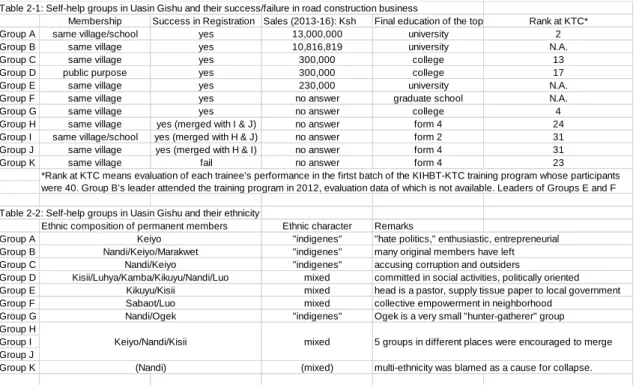
The 11 groups, whose leaders were interviewed by the author, are listed in Table 2. Table 2 shows the groups in order of sales from 2013 to 2016. The table includes important aspects of the questionnaire: 1. Condition for membership, 2. Success in registration 3. Sales (2013–16), 4. Education level of leaders, 5. Rank of performance in the KIHBT-KTC training program, 6. Ethnic composition of permanent members, 5. With regard to character of ethnic composition, “indigenes” means permanent members consist of only Kalenjin people, while “mixed” means both Kalenjin and “immigrants” are included.
Table 2-1: Self-help groups in Uasin Gishu and their success/failure in road construction business
Membership Success in Registration Sales (2013-16): Ksh Final education of the top Rank at KTC*
Group A same village/school yes 13,000,000 university 2
Group B same village yes 10,816,819 university N.A.
Group C same village yes 300,000 college 13
Group D public purpose yes 300,000 college 17
Group E same village yes 230,000 university N.A.
Group F same village yes no answer graduate school N.A.
Group G same village yes no answer college 4
Group H same village yes (merged with I & J) no answer form 4 24
Group I same village/school yes (merged with H & J) no answer form 2 31
Group J same village yes (merged with H & I) no answer form 4 31
Group K same village fail no answer form 4 23
Table 2-2: Self-help groups in Uasin Gishu and their ethnicity
Ethnic composition of permanent members Ethnic character Remarks
Group A "indigenes" Group B "indigenes" Group C "indigenes" Group D mixed Group E mixed Group F mixed
Group G "indigenes" Ogek is a very small "hunter-gatherer" group
Group H Group I Group J
Group K (mixed)
Source: created by the author based on interviews conducted in September-October 2016 and KIHBT-KTC 2015. (Nandi)
head is a pastor, supply tissue paper to local government collective empowerment in neighborhood
5 groups in different places were encouraged to merge multi-ethnicity was blamed as a cause for collapse. mixed
Kikuyu/Kisii Sabaot/Luo Nandi/Ogek Keiyo/Nandi/Kisii
*Rank at KTC means evaluation of each trainee's performance in the firtst batch of the KIHBT-KTC training program whose participants were 40. Group B's leader attended the training program in 2012, evaluation data of which is not available. Leaders of Groups E and F
"hate politics," enthusiastic, entrepreneurial many original members have left accusing corruption and outsiders
committed in social activities, politically oriented Keiyo
Nandi/Keiyo/Marakwet Nandi/Keiyo
16 3.2 Results of Research
3.2.1 Condition for membership
Every group except Group D answered that living in same village was the most important condition for membership. In addition to be a ‘youth’ group, members had to be under 35 at the time of organization. No interviewees said that ethnicity or clan was a condition for membership.
The leader of Group D stressed openness of membership and said they aimed at fighting youth delinquency and achieving social justice. Yet, according to the author’s research assistant who was a resident of Uasin Gishu, Group D was based in a particular area in suburbs of Uasin Gishu. The Group D leader also told us that he aspired to run for a seat on the County Assembly and seemingly he and his colleagues placed high priority on socio-political purposes. On the contrary, the top leader of Group A revealed that he hated and tried to distant himself from politics.
Group E’s leader was a clergyman and the group was very much faith-based trying to contribute to peace building among different groups in its neighborhood.
Group A and Group I, answered that being alumni of the same school located in their localities was another condition. The author interviewed two leaders of Group A and it seemed that they were very close to each other, friends that went to the same secondary school.
As a matter of course, among the 13 interviews, 12 answered that interest and/or commitment to road construction activity was an important condition of membership. Also, 8 chose importance of diligence and honesty. It is interesting that only the top leader of Group A stressed the importance of trust among members.
Few indicated the importance of certain levels of education or skills as conditions for membership.
3.2.2 Registration as a formal corporation
Of the 11 groups in question, three groups (Groups H, I, & J) formed one entity and became registered as a formal construction firm. Altogether, 10 groups were formally registered (three together as one), while one group (Group K) failed. Consequently, the number of registered firms contacted was eight.
The majority of interviewees answered that KTC training helped them clear the complex registration procedures. Most found merits in registration despite the cumbersome procedures and burdens of taxation. Opportunities to contract with the government seemed to be very attractive. One of the leaders of Group A (not the top leader) revealed an affirmative view for paying tax as a contribution to development of the society as a whole, referring to the teaching by an executive of CORE. On the other hand, the leader of Group C was concerned about corruption involved with tenders and road construction project contracts with the government.
3.2.3 Performance of business
Five of the eight registered firms provided sales amounts from 2013 to 2016. Groups F, H, I, and J answered that their firms had not been very successful in the road construction business. Also, though Group E had a modest amount of sales, it was not through road construction but through another kind of business (sale of paper to the Uasin Gishu county government). Between Groups A and B on the one hand, and Group C and D on the other, there were large differences in the amounts of sales. While the former were constantly successful in winning contracts with local governments, the latter two only won one contract each. Also, it should be noted that the leader of Group G did not provide a sales amount, although he said they had been successful in obtaining some small road construction contracts.
The variances among the groups require further exploration and explanation, which will be developed in the next section.
17 3.2.4 Education and training
Table 2 shows education level of the top leader in each group. Out of the eleven, one has made it to graduate school, three have gone to university, and three have studied at college. The other four have secondary school education. The leaders of the five firms making sales all have higher educations and the two highest-performing firms’ leaders have bachelor degrees.10
Every interviewee responded that they acquired road construction/rehabilitation technologies including Do-nou, ways of designing and implementing road works, organization and management of workers and groups, accounting skills, and knowledge of business negotiation through activities and training programs offered by CORE and KIHBT-KTC. There were apparently no differences among interviewees with regard to satisfaction with the training. The majority indicated the importance of Core in their ability to motivate and initiate road construction activities and businesses.
We gained some knowledge of how the participants performed in the above-mentioned KIHBT-KTC program assisted by CORE in 2015. According to KIHBT-KTC [2015] the leader of Group A was very successful in training11 as well as his counterpart
in Group G. The top leader of Group A was very knowledgeable in road construction technologies as well as the national government’s policy framework to promote business by young people and stated that his firm employed an engineer with expertise in construction technologies. In the interview, the author strongly felt his enthusiasm for this business as compared to other interviewees.
3.2.5 Ethnic Composition of groups/firms
The two highest-performing firms (Group A and Group B) consisted of only Kalenjin (‘indigenes’) people. The same held true for Group G which also performed quite well. Group A is notably comprised of only the sub-ethnic group Keiyo. The leader of Group B advised the author that “other” people left the group during its development and the expansion of its business.
The leader of Group K remarked that multi-ethnic composition made internal decision-making and collaboration difficult and drove the group into collapse. He feels that this is the reason why his group could not develop into a formal registered corporation.
We found that “mixed” firms did not perform as well as Groups A and B. Rather, Groups D and E, both intentionally stayed “mixed,” and prioritized political or social aims and thus did not focus only on profit-making activities. It might be well to contrast this with the stated aim of the Group B leader, that the group was organized to obtain contracts with the government from the beginning.
3.2.6 Employment and Internal Management
In regard to the construction business in general, it is important to note that it creates far more part-time employment than permanent employment. Groups A, B, C, D, and E all answered that they hired many additional people only on ad hoc basis for construction work.
Since few groups felt that skill or education was a necessary condition, there appears to be little room for meritocracy to function in terms of recruitment or grouping. This is presumably related to both the genesis of self-help groups and the nature of the road construction business in question. Youth self-help groups in Uasin Gishu were based largely on residential areas and were supposed to be as inclusive as possible. Also, the labor-based technologies of road construction such as Do-nou do not require much expertise or knowledge except for those in managerial and planning positions.
None of the groups/firms prepared wage scales proportionate to ability or performance of employees. Groups C, D, and E disallowed punishment. Group E leader
18
stressed religious reasons for not punishing faults or frauds, and instead preferred to convince the person committing an illicit act to reflect by himself or herself. Yet other Groups (A, B, F, I & J) affirmed the importance of punishment especially against embezzlement (B and J), fraud (I), and drunkenness (F). The leader of Group A informed that his firm applied a system of payment reductions in cases where a sub-contractor or part-time employee could not meet a work deadline.
4. Discussion: Can Development of Small Road Construction Firms be a Solution for the Nexus of Problems
In response to the research questions presented in sub-section 1.5, we would like to develop our discussion of how to understand causality and the implications of what we have observed. Research questions on development of road construction enterprises (1.1 and 1.2), and questions on inter-ethnic relations and enterprise development (2.1, 2.2 and 2.3) are to be discussed separately in this section.
4.1 NGO and governments’ success in interventions for the promotion of corporatization and thus formalization and development of former youth self-help groups engaged in road construction.
Out of the 11 youth self-help groups interviewed, 10 have successfully registered as formal road construction corporations. On the surface this would appear to be a complete success. However, we have to take into account the fact that CORE contacted 36 youth self-groups in Uasin Gishu to transfer Do-nou technology and we could not interview the other 25 groups. As mentioned above, the KTC training programs required a certain level of mathematic skill and CORE and KTC selected groups with relatively highly educated members (basically those with secondary education or higher). Consequently, our interviewees were not representative of the youth self-help groups as a whole that were more or less exposed to Do-nou technology in Uasin Gishu. Having recognized these limitations, we will now interpret the results of the research.
The above limitations notwithstanding, we can surely state that the NGO and government interventions have been successful in generating local groups and corporations which create employment to engage in road construction by applying labor-based technologies, though on a still somewhat ad-hoc basis.
CORE, the Kenyan subsidiary of an international NGO played a positive role in the promotion of road construction businesses. More than half of the interviewees stated that CORE, by introducing Do-nou technology, a typical labor-based road construction technology, motivated their interest in road construction activities and businesses. If it had been a technology with high capital intensiveness, it would not have maintained their interest since it would probably be too difficult to learn and involve high risk investments (see McCormick 1992 and 1993).
The success of four groups in obtaining road construction contracts with the government, especially with Groups A and B consistently winning them, means that local corporations emerged which could engage in road construction in Uasin Gishu and other counties, partly due to the interventions.
With regard to corporatization, while we appreciate the fact that 10 out of 11 groups (or eight among nine clusters) completed the complicated procedures for corporatization, we should take into account the fact that construction businesses have no obligation to pay taxes on sales if they don't win contracts12. Compared with manufacturing activities
which by nature necessitate firms to make products and sales regularly and to pay sales taxes applicable, construction enterprise leaders might have found it less costly to formalize less fearing the burdens of taxation.
19
Needless to say, mere corporatization and formalization would not have been the ultimate aim of the interventions by the NGO and the government. Successful and sustainable expansion of their businesses hopefully creating more employment, taking advantage of formalization and corporatization, should be the goal. As we have seen in Table 2, business performance, in terms of sales, varies strikingly. Among interventions by the NGO and the government, we might presume here that training matters. When we see the relation between the educational backgrounds of the top leaders, and their training performances at KIHBT-KTC, and the extent of their success in business, we can interpret the effects of training in two dimensions. Firstly, as Table 2 demonstrates, the leaders of higher performing firms recorded better results in the KIHBT-KTC training program, though regrettably we could not know how trainees from Groups B, E and F performed. This might mean, that if the contents of the program were well understood by the trainees, it was meaningful for their success in the road construction business. Secondly, it seems that performance in the program was very much influenced by educational background. Education levels higher than secondary appeared to be a condition for better training performance.
This implies that training interventions by the NGO and the government could have limited effect on enabling micro and small enterprises led by people with lower education levels. Unfortunately this corresponds to a large majority in the informal sector and rural areas. What we observed in the road construction business in Uasin Gishu is encouraging from the viewpoint of changes in the missing middle syndrome, in the sense that informal local enterprises, such as Groups A and B, developed into successful formal corporations in a short time. However, we should be very cautious not to state that we could find a large scale breakthrough in the syndrome when we take account the required educational backgrounds needed for the success, as mentioned above.
4.2 Relations between development and meritocratic organization of enterprises, inter-ethnic reconciliation, and inter-ethnic composition
While development and organization of multi-ethnic youth self-help groups were promoted after the PEV, road construction corporations succeeding them have apparently followed different paths. Members of the two most successful corporations (Groups A & B) comprise only ‘indigenes’ and those of the highest-performing Group A belong to only one sub-ethnic-group (Keiyo). If Group G (whose sales amounts we do not know) is also successful in business performance, we could say that groups/firms consisting of only ‘indigenes’ are more successful than ‘mixed’ groups.
We should be cautious to simply conclude that there is a negative correlation between multiplicity of ethnicity (or mixture of ‘indigenes’ and ‘immigrants’) and business performance, since ‘mixed’ groups were not totally excluded from public contracts as the cases of Groups D and E show.
Groups D and E, however, did not aim at the sole purpose of high business performance or profit making. A more important purpose was rather socio-political, including inter-ethnic collaboration itself. If their earnings from business helped them promote inter-ethnic reconciliation activities they were happy and so the cases of D and E also have positive implications for our Research Question 2.1.
Nevertheless, we cannot say that better business performances of the eight firms (11 groups) has promoted inter-ethnic reconciliation and collaboration. In this context, business activities of these newly corporatized firms has probably changed them from being multi-faceted development activities by informal youth self-help groups which were induced to be multi-ethnic.
At issue here is how to understand the large variance of business performance between the firms in question with regard to their ethnic composition. There are at least